Blog Archive

Showing posts with label IPCC. Show all posts

Saturday, October 6, 2018

Graham Readfearn: Earth's climate monsters could be unleashed as temperatures rise

As a UN panel prepares a report on 1.5 C global warming, researchers warn of the risks of ignoring ‘feedback’ effects

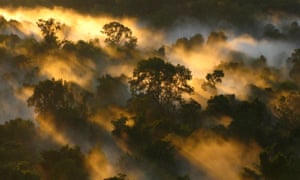
Amazon forest

 Fundamental questions are being raised about the ability of governments to stop the Earth from spiraling into a ‘hothouse’. Photograph: Peter van der Sleen/University o/PA

by Graham Readfearn, The Guardian, October 6, 2018

This week, hundreds of scientists and government officials from more than 190 countries have been buzzing around a convention centre in the South Korean city of Incheon.

They are trying to agree on the first official release of a report – the bit called the Summary for Policymakers – that pulls together all of what’s known about how the world might be affected once global warming gets to 1.5 C.
What will happen to coral reefs? How will extreme weather events and droughts change? What about heatwaves? And then, what are the different “pathways” that economies could choose to keep temperatures to 1.5 C?
On Monday morning, the summary document is expected to be released, and there will be a cascade of headlines around the world.
The report, being pulled together by the United Nations Intergovernmental Panel on Climate Change, was one tiny part of the Paris climate change agreement.
As things stand, if you add up all the things that the 190-plus countries have committed to do as part of that Paris deal, global temperatures will probably go well above 3 C.
We’re already at 1 C of warming, so the extra half a degree isn’t far away – many scientists will say it’s already locked in, while others say there are plausible ways to stabilize temperatures at that level.
But in August, one of the world’s leading scientific journals – the Proceedings of the National Academy of Sciences – published a “perspective” article that has become known as the “hothouse earth” paper.
There was no new science in the paper and while it was speculative, it did raise fundamental questions about the ability of governments around the world to stop the Earth from spiraling into a “hothouse.”
One of the report’s authors, Professor Will Steffen, of Australian National University and the Stockholm Resilience Centre, talked me through it.
The problem lies with “feedbacks” – in the “supplementary information” attached to the paper, Steffen and colleagues actually listed 10 of them. With each, they include estimates of how much extra CO2 and temperature they could add once you hit about 2 C of global warming.
For example, the ability of the land and ocean to keep soaking up CO2 could weaken, giving you an extra 0.25 C of warming. Dieback of trees in the Amazon and subarctic could give us another 0.1 C.
Permafrost, which is already starting to defy its name by not being all that permanent, could release ever more methane and carbon that might add a bit more warming again (0.09 C is the estimate there).
The point is that once you add them all up, you get close to 0.5 C of warming by the end of the century. Given we’re already at 1 C of global warming, that makes the job of keeping warming “well below 2 C” or even holding it at 1.5 C much, much harder than it already is.
And there’s the rub.
While governments have the means to affect how much CO2 gets released through policies that radically cut the use of fossil fuels, it would be much harder to get a grip on thawing permafrost, mass forest collapses, or the loss of polar sea ice.
By failing to get a grip on a thing that’s feasibly under your control, we end up risking the release a whole gang of other monsters that we can’t.
This gets us to another big issue, says Steffen, because climate models don’t include some of these feedbacks. In essence, the warmer things get, the less reliable the models become. He tells me:
“I think the dominant linear, deterministic framework for assessing climate change is flawed, especially at higher levels of temperature rise.
So, yes, model projections using models that don’t include these processes indeed become less useful at higher temperature levels. Or, as my co-author John Schellnhuber says, we are making a big mistake when we think we can “park” the Earth System at any given temperature rise – say 2 C – and expect it to stay there.”
For those who understand the idea of a carbon budget – where scientists have calculated him much CO2 you could emit before hitting certain temperature rises – it looks even meaner than before if Steffen and his colleagues are right.
But as they also point out, several of these feedbacks might have “tipping points” that then set off a cascade of other issues. Steffen says:
“Even at the current level of warming of about 1 C above pre-industrial, we may have already crossed a tipping point for one of the feedback processes (Arctic summer sea ice), and we see instabilities in others – permafrost melting, Amazon forest dieback, boreal forest dieback and weakening of land and ocean physiological carbon sinks.
And we emphasize that these processes are not linear and often have built-in feedback processes that generate tipping point behavior. For example, for melting permafrost, the chemical process that decomposes the peat generates heat itself, which leads to further melting and so on.”
For the record, Steffen thinks the assumptions in climate models that cuts in fossil fuel emissions will deliver relative cuts in temperatures “is OK for perhaps lower temperature rises of 1.5 or 2 C,” but beyond that, he’s sceptical.

The paper has received a bit of pushback from scientists, largely, it appears, because of the sensational headlines it attracted.

For example, Professor Richard Betts, of the UK’s MetOffice, has a measured perspective that’s well worth a look.

Dr Glen Peters, an Australian scientist and climate modeller based at the Centre for International Climate Research in Norway, also thought some of the media coverage went too far with the doomsday vibe.

But he told me that, while it was true that many of the feedbacks in the paper were not well covered by climate models, this was partly because they were not that well understood. I’ll leave you with his thoughts:
“The hothouse earth paper conjectures that many of these feedbacks may interact like a domino effect, lead the Earth system to spiral out of control to reach a new steady state very different from today, and these processes may even start if we are successful at meeting the goals of the Paris Agreement.
“There is also an important timescale question, are we talking decades or millennia, and that is very important for how society may respond. While all the claims made in the hothouse earth paper are justified, we simply don’t have the data to verify if those claims are true. While the paper put in plenty of language to indicate its exploratory nature … many headlines and statements went too far, indicating we had already gone too far and there was no turning back.”
https://www.theguardian.com/environment/planet-oz/2018/oct/06/earths-climate-monsters-could-be-unleashed-as-temperatures-rise

Friday, February 12, 2010

Seth Borenstein: Scientists seek better way to do climate report

Scientists seek better way to do climate report

by SETH BORENSTEIN, AP Science Writer, February 10, 2010
  Scientists seek better way to do climate report (AP)

In this February 19, 2001, file photo, Briton Robert Watson, right, then-chairman of the Intergovernmental Panel on Climate Change (IPCC) accompanied by James J. McCarthy, USA, IPCC's co-chairman, gestures during a news conference in Geneva, Switzerland. Some climate scientists are calling for drastic changes in how future United Nations climate reports are done. (AP Photo/Donald Stampfli)


(AP) -- A steady drip of unsettling errors is exposing what scientists are calling "the weaker link" in the Nobel Peace Prize-winning series of international reports on global warming.

The flaws -- and the erosion they've caused in public confidence -- have some scientists calling for drastic changes in how future United Nations climate reports are done. A push for reform being published in Thursday's issue of a prestigious scientific journal comes on top of a growing clamor for the resignation of the chairman of the Intergovernmental Panel on Climate Change.

The work of the climate change panel, or IPCC, is often portrayed as one massive tome. But it really is four separate reports on different aspects of , written months apart by distinct groups of scientists.
No errors have surfaced in the first and most well-known of the reports, which said the physics of a warming atmosphere and rising seas is man-made and incontrovertible. So far, four mistakes have been discovered in the second report, which attempts to translate what global warming might mean to daily lives around the world.

"A lot of stuff in there was just not very good," said Kevin Trenberth, head of climate analysis at the National Center for Atmospheric Research and a lead author of the first report. "A chronic problem is that on the whole area of impacts, getting into the realm of social science, it is a softer science. The facts are not as good."

It's been a dismal winter for climate scientists after the high point of winning the 2007 Nobel, along with former Vice President Al Gore, for championing efforts to curb global warming and documenting its effects.

-- In November, stolen private e-mails from a British university climate center embarrassed a number of scientists for their efforts to stonewall climate skeptics. The researchers were found to have violated Britain's Freedom of Information laws.

-- In December, the much anticipated of world leaders in Copenhagen failed to produce a meaningful mandatory agreement to curb greenhouse gases.

-- Climate legislation in the United States, considered key to any significant progress in slowing global warming, is stalled.


-- Some Republican U.S. senators, climate skeptics and British newspapers have called for Rajendra Pachauri, chairman of the IPCC, to resign. They contend he has financial conflicts of interest involving his role with the climate panel and a green-energy foundation he set up. He has vigorously denied any conflicts.

-- And in recent weeks, a batch of mistakes have been uncovered in the second of the four climate research reports produced in 2007.

That second report -- which examines current effects of global warming and forecasts future ones on people, plants, animals and society -- at times relied on government reports or even advocacy group reports instead of peer-reviewed research. Scientists say that's because there is less hard data on global warming's effects.

Nine different experts told The Associated Press that the second report -- because of the nature of what it examines -- doesn't rely on standards as high or literature as deep as the more quoted first report. And they say communication problems between lead authors of different reports make it is harder to spot errors.

The end result is that the document on the effects of climate change promotes the worst of nightmares and engages in purposeful hyping, said longtime skeptic John Christy of the University of Alabama, Huntsville.

David King, Britain's former chief scientific adviser who once lectured at the University of East Anglia, home to the climate center where scientist e-mails were hacked said that scandal laid bare the weaknesses in the IPCC. In a telephone interview, he said those who challenged the IPCC's assessment "are seen to be rocking the boat, and this in my view is extremely unfortunate."

Scientists -- including top U.S. government officials -- argue that the bulk of the reports are sound.

"The vast majority of conclusions in the IPCC are credible, have been through a very rigorous process and are absolutely state of the science, state of the art about what we know of the climate system," said National Oceanic and Atmospheric Administration chief Jane Lubchenco, who runs the agency that oversees much of the U.S. government's climate research.

The problems found in the IPCC 2007 reports so far are mostly embarrassing:

-- In the Asian chapter, five errors in a single entry on glaciers in Himalayas say those glaciers would disappear by 2035 -- hundreds of years earlier than other information suggests -- with no research backing it up. It used an advocacy group as a source. It also erroneously said the Himalayan glaciers were melting faster than other glaciers.

-- A sentence in the chapter on Europe says 55% of the Netherlands is below sea level, when it's really about half that amount.

-- A section in the Africa chapter that talks about northern African agriculture says climate change and normal variability could reduce crop yields. But it gets oversimplified in later summaries so that lower projected crop yields are blamed solely on climate change.

-- There's been a longstanding dispute about weather extremes and economics. The second report says that there are more weather disasters than before because of climate change and that it is costing more. The debate continues over whether it is fair to say increased disaster costs are due to global warming or other societal factors such as increased development in hurricane prone areas.

Scientists say the nature of the science and the demands of governments for a localized tally of effects and projections of future ones make the second report a bit more prone to mistakes than the first report. Regional research is more often done by governments or environmental groups; using that work is allowed by IPCC rules even if it is seen as less rigorous than traditional peer-reviewed research, said Martin Parry, chairman in charge of the report on effects.

The second report includes chapters on each region, which governments want to be mostly written by local experts, some of whom may not have the science credentials of other report authors. That's where at least three of the errors were found.

In Thursday's issue of the journal Nature, four IPCC authors call for reform, including Christy, who suggests the outright dumping of the panel itself in favor of an effort modeled after Wikipedia, the online encyclopedia.

A fifth author, writing in Nature, argues the IPCC rules are fine but need to be better enforced.

In response, Chris Field of Stanford University, the new head of the second report team, said that he welcomes the scrutiny and vows stricter enforcement of rules to check sources to eliminate errors in future reports; those are to be produced by the IPCC starting in 2013.

Many IPCC scientists say it's impressive that so far only four errors have been found in 986 pages of the second report, with the overwhelming majority of the findings correct and well-supported.

However, former IPCC Chairman Bob Watson said, "We cannot take that attitude. Any mistakes do allow skeptics to have a field day and to use it to undermine public confidence, private sector confidence, government confidence in the IPCC."

Link:  http://www.physorg.com/news185040703.html