Blog Archive

Showing posts with label Methane hydrates. Show all posts

Friday, June 2, 2017

"Massive blow-out craters formed by hydrate-controlled methane expulsion from the Arctic seafloor," K. Andreassen et al., Science, doi: 10.1126/science.aal4500

Science, 356(6341) (02 June 2017) 948-953; doi: 10.1126/science.aal4500

Massive blow-out craters formed by hydrate-controlled methane expulsion from the Arctic seafloor 

K. Andreassen,* A. Hubbard, M. Winsborrow, H. Patton, S. Vadakkepuliyambatta, A. Plaza-Faverola, E. Gudlaugsson, P. Serov, A. Deryabin, R. Mattingsdal, J. Mienert, and S. Bünz

Abstract

Widespread methane release from thawing Arctic gas hydrates is a major concern, yet the processes, sources, and fluxes involved remain unconstrained. We present geophysical data documenting a cluster of kilometer-wide craters and mounds from the Barents Sea floor associated with large-scale methane expulsion. Combined with ice sheet/gas hydrate modeling, our results indicate that during glaciation, natural gas migrated from underlying hydrocarbon reservoirs and was sequestered extensively as subglacial gas hydrates. Upon ice sheet retreat, methane from this hydrate reservoir concentrated in massive mounds before being abruptly released to form craters. We propose that these processes were likely widespread across past glaciated petroleum provinces and that they also provide an analog for the potential future destabilization of subglacial gas hydrate reservoirs beneath contemporary ice sheets.

http://science.sciencemag.org/content/356/6341/948

Wednesday, April 26, 2017

Ancient methane 'burp' points to climate change 110 million years ago

Frozen methane hydrates suddenly thawed 110 million years ago during a warming phase

by Jimmy Thomson, CBC News,April 24, 2017
Over 130 mounds like this one were discovered dotting the landscape of Ellef Ringnes Island, 500 kilometres north of Resolute, Nunavut. They point to an ancient release of methane.
Over 130 mounds like this one were discovered dotting the landscape of Ellef Ringnes Island, 500 kilometres north of Resolute, Nunavut. They point to an ancient release of methane. (submitted by Steve Grasby)
New research suggests a large amount of methane was released in the Arctic Ocean during a period of warming 110 million years ago and the methane "burp" points to the possibility of a similar release in today's warming conditions. 
The discovery happened in the remote High Arctic, on Ellef Ringnes Island, about 500 kilometres north of Resolute, Nunavut. During the Cretaceous period, 55 million years before the dinosaurs disappeared, the island was deep underwater.
Spaghetti rock
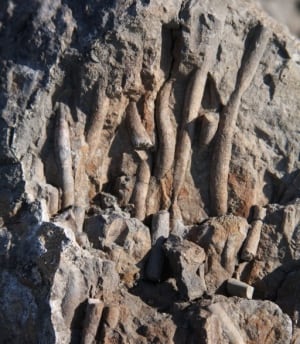
Fossils like these Cretaceous tubeworms show part of the deep-ocean community that fed off the methane leaking from the mud. (submitted by Steve Grasby )
Suddenly, from under the mud, bubbles of methane began to emerge as frozen deposits began to thaw.
The bubbles left traces in the form of over 130 mounds that persist on the island today, complete with fossils of life that formed around the methane seeps.
"There must have been some brief, rapid release into the ocean," explained Steve Grasby, one of the researchers who visited the island between 2009 and 2011. 
"Because we don't see them in the older rocks and we don't see them in the younger rocks. So something must have happened in the Earth's history at that time to release a bunch of methane into the sea," he said.  

Evidence of ancient climate change 

The thawing of the so-called methane hydrates coincides with a period of warming following a volcanic eruption, which released a cloud of carbon dioxide into the atmosphere. 
"That was when Earth transitioned from a cold climate to a warm climate," Grasby said.
"So we see this sudden and short term release of methane is coincident with this period of global climate warming." 
Today there are still deposits of methane hydrates buried under the sea. There have been concerns that their thawing could cause runaway climate change, since methane is a powerful, though short-lived, greenhouse gas that could further warm the climate, melting ever more hydrates. 
recent review by the United States Geological Survey says "most" of the methane never reaches the atmosphere. 
Grasby says his research points to a period in the Earth's geologic history when warming was releasing the gas from its frozen state, but, like today, it's hard to say what happens next.

Tuesday, September 6, 2016

Peter Wadhams: ‘Next year or the year after, the Arctic will be free of ice’

Scientist Peter Wadhams believes the summer ice cover at the north pole is about to disappear, triggering even more rapid global warming

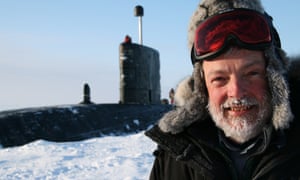
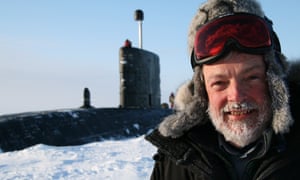
Peter Wadhams in the Arctic in 2007
Peter Wadhams in the Arctic in 2007: ‘We may able to raise the Thames barrier in Britain but in Bangladesh, people will be drowned.’

by Robin McKie, The Guardian, August 21, 2016

Peter Wadhams has spent his career in the Arctic, making more than 50 trips there, some in submarines under the polar ice. He is credited with being one of the first scientists to show that the thick icecap that once covered the Arctic ocean was beginning to thin and shrink. He was director of the Scott Polar Institute in Cambridge from 1987 to 1992 and professor of ocean physics at Cambridge from 2001 to 2015. His book, A Farewell to Ice, tells the story of his unravelling of this alarming trend and describes what the consequences for our planet will be if Arctic ice continues to disappear at its current rate.
You have said on several occasions that summer Arctic sea ice would disappear by the middle of this decade. It hasn’t. Are you being alarmist?
No. There is a clear trend down to zero for summer cover. However, each year chance events can give a boost to ice cover or take some away. The overall trend is a very strong downward one, however. Most people expect this year will see a record low in the Arctic’s summer sea-ice cover. Next year or the year after that, I think it will be free of ice in summer and by that I mean the central Arctic will be ice-free. You will be able to cross over the North Pole by ship. There will still be about a million square kilometres of ice in the Arctic in summer, but it will be packed into various nooks and crannies along the Northwest Passage and along bits of the Canadian coastline. Ice-free means the central basin of the Arctic will be ice-free, and I think that that is going to happen in summer 2017 or 2018.
Why should we be concerned about an Arctic that is free of ice in summer?
People tend to think of an ice-free Arctic in summer in terms of it merely being a symbol of global change. Things happen, they say. In fact, the impact will be profound and will effect the whole planet and its population. One key effect will be albedo feedback. Sea ice reflects about 50% of the solar radiation it receives back into space. By contrast, water reflects less than 10%. So if you replace ice with water, which is darker, much more solar heat will be absorbed by the ocean, and the planet will heat up even more rapidly than it is doing at present.
Sea ice also acts as an air-conditioning system. Winds coming over the sea to land masses such as Siberia and Greenland will no longer be cooled as they pass over ice, and these places will be heated even further. These effects could add 50% to the impact of global warming that is produced by rising carbon emissions.
What will be the effects of this accelerating increase in temperatures?
The air over Greenland will get warmer, and more and more of its ice will melt. It is already losing about 300 cubic kilometres of ice a year. Antarctica is adding to the melt as well. Sea-level rises will accelerate as a result. The most recent prediction of the Intergovernmental Panel on Climate Change (IPCC) is that seas will rise by 60 to 90 centimetres this century. I think a rise of one to two metres is far more likely. Indeed, it is probably the best we can hope for.
That may not sound a lot, but it is really very serious. It will increase enormously the frequency of storm surges all over the world. We may be able to raise the Thames barrier in Britain, but in Bangladesh, it just means more and more people will be drowned.
Global warming is generally associated with increased fossil-fuel burning and consequent rises in levels of atmospheric carbon dioxide. But is that the only climate problem we face?
No, it is not. We also have the issue of methane. Russian scientists who have investigated waters off their coast have detected more and more plumes of methane bubbling up from the seabed. The reason this is happening is closely connected with the warming of the planet and the shrinking of the Arctic icecaps.
Until around 2005, even in summer, you still had sea ice near the coast. Then it started to disappear, so that for three or four months a year warm water reached the shallow waters around the shores where there had been permafrost ground since the last ice age. It has started to melt with dangerous consequences. Underneath the permafrost there are sediments full of methane hydrates. When the permafrost goes, you release the pressure on top of these hydrates and the methane comes out of solution.
Can we monitor this methane just as we can monitor carbon dioxide?
Yes, we can measure methane over large areas using satellites. These have shown that methane levels that had been fairly flat for most of the last century have started to rise and are accelerating, often with little outliers on the graph. There is a scientist called Jason Box who works in Denmark for the Greenland Survey, and he calls these outliers dragon’s breath. They are not some sort of measurement caused by dodgy instruments. They are real pulses of methane coming from offshore flumes.
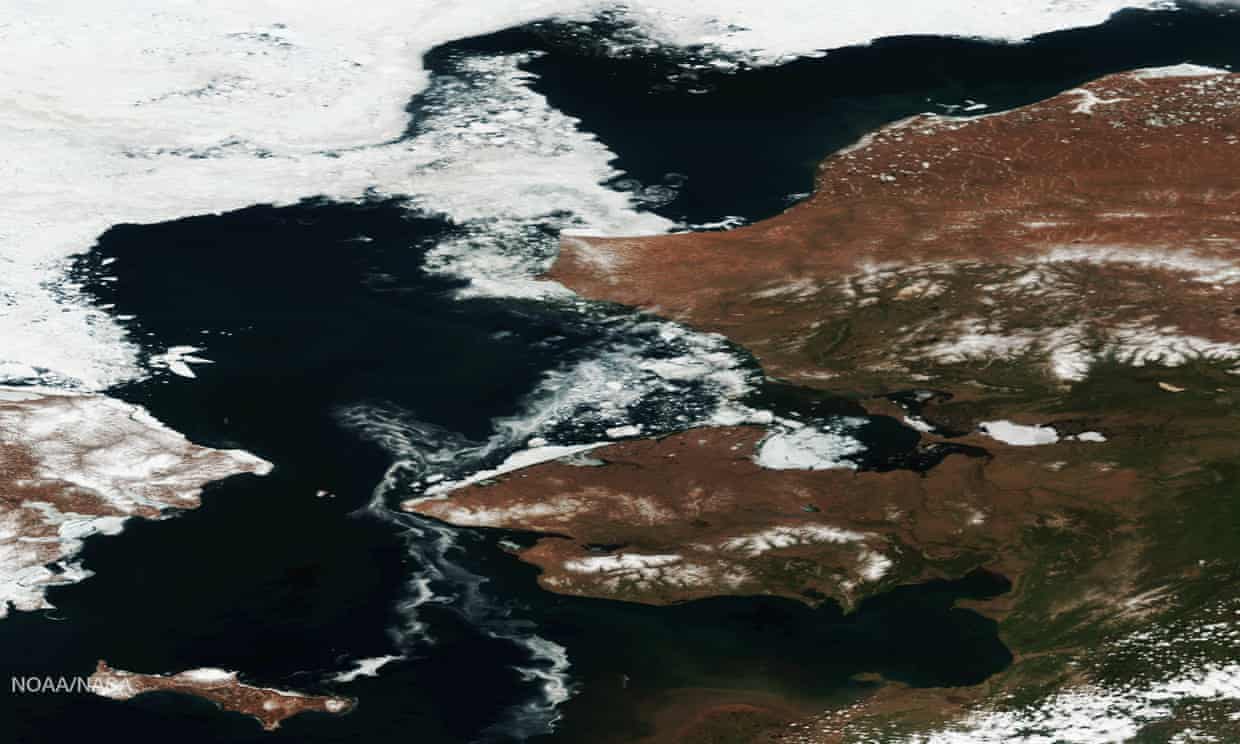
An image from the NOAA/Nasa Suomi NPP satellite taken on May 30, 2016, highlights the Arctic ice retreat off the north-west coast of Alaska
An image from the NOAA/Nasa Suomi NPP satellite taken on May 30, 2016, highlights the Arctic ice retreat off the north-west coast of Alaska. The average Arctic sea ice extent for May 2016 set a new record low since satellite observations began. Photograph: Suomi NPP/NASA/NOAA

How intense is methane as a heater of the atmosphere compared with carbon dioxide?
It is 23 times more powerful. However, methane dissipates much more quickly than carbon dioxide. It gets oxidised so that it only lingers in the atmosphere for about 7 or 8 years. By contrast, carbon dioxide hangs around in the climate system for about 100 years before it ends up in the sea and is absorbed by creatures that die and litter the seabed. At least that is what scientists thought. Today, there are quite a number of researchers who think carbon dioxide could last 1,000 years in the atmosphere.


So in the long run carbon dioxide is still going to be worse than methane in terms of heating the planet because a single methane pulse will have a disastrous effect, but if there is nothing to follow it on then it will go away. But with carbon dioxide there is a ratchet effect. All the carbon dioxide we release by burning fossil fuels just builds up in the atmosphere. We are having to live with last century’s carbon dioxide. What that says is simple: there is no such thing as a safe emission rate of carbon dioxide. That is why I am despondent about us ever being able to cut carbon emissions.
If we cannot halt the emissions of carbon dioxide, what can we do?
In the end, the only hope we have is to find a way to remove carbon dioxide from the atmosphere once it has got there. Even the IPCC has admitted that we will have to find a way to extract carbon dioxide from the air. The trouble is that they just don’t know how we can do that. The most favoured scheme is known as BECCS: bio-energy with carbon capture and storage. Essentially, you plant trees and bushes over vast swaths of ground. These grow, absorbing carbon dioxide in the process. Then you burn the wood to run power plants while trapping, liquefying and storing the carbon dioxide that is released.
It sounds straightforward. Will it work?
I am a bit suspicious of this technology. BECCS will need so much land to be effective. Calculations suggest it would need 40% to 50% of the arable land of the planet to make it work on the scale we will need and that would not leave enough land to grow crops to feed the world or to provide homes for a viable population of wild animals and plants. Other techniques, such as crushing and spreading olivine rocks, which absorb carbon dioxide, on beaches, will simply not scale up. They won’t work, so we will have to find some other way to remove carbon dioxide from the atmosphere directly.
As far as I can see, it will have to take the form of some sort of device into which you pump air at one end and you get air without carbon dioxide coming out the other end. It can be done, I am sure, but at the moment we do not have such a device. However, without something like that, I cannot see how we are going to deal with the carbon dioxide that is getting into the atmosphere. We are going to have to rely on a technology that has not yet been developed. That is a measure of the troubles that lie ahead for us. I think humanity can do it, but I would feel much better if I saw governments investing in such technology.
Farewell to Ice is published by Allen Lane (£20) on 1 September. Click here to order a copy for £16.40
https://www.theguardian.com/environment/2016/aug/21/arctic-will-be-ice-free-in-summer-next-year

Thursday, August 25, 2016

John Vidal: Time to listen to the ice scientists about the Arctic death spiral


The Arctic’s ice is disappearing. We must reduce emissions, fast, or the human catastrophe predicted by ocean scientist Peter Wadhams will become reality

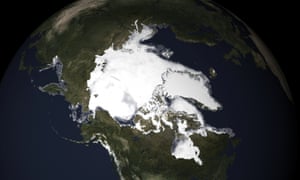
Arctic Sea Ice Melt


 Arctic sea ice melt in May. ‘The Arctic sea ice is declining by 13% a decade.’ Photograph: NOAA

by John Vidal, The Guardian, August 18, 2016
Ice scientists are mostly cheerful and pragmatic. Like many other researchers coolly observing the rapid warming of the world, they share a gallows humour and are cautious about entering the political fray.
Not Peter Wadhams. The former director of the Scott Polar Research Institute and professor of ocean physics at Cambridge has spent his scientific life researching the ice world, or the cryosphere, and in just 30 years has seen unimaginable change.
When in 1970 he joined the first of what would be more than 50 polar expeditions, the Arctic sea ice covered around 8m sq km at its September minimum. Today, it hovers at around 3.4m, and is declining by 13% a decade. In 30 years Wadhams has seen the Arctic ice thin by 40%, the world change colour at its top and bottom and the ice disappear in front of his eyes.
In a new book, published just as July 2016 is confirmed by NASA as the hottest month ever recorded, this most experienced and rational scientist states what so many other researchers privately fear but cannot publicly say – that the Arctic is approaching a death spiral which may see the entire remaining summer ice cover collapse in the near future.
Peter Wadhams
Pinterest


 ‘Because Peter Wadhams says what other scientists will not, he has been slandered, attacked and vilified by denialists and politicians who have advised caution or non-action.’ Photograph: PR
The warming now being widely experienced worldwide is concentrated in the polar regions and Wadhams says we will shortly have ice-free Arctic Septembers, expanding to four or five months with no ice at all. The inevitable result, he predicts, will be the release of huge plumes of the powerful greenhouse gas methane, accelerating warming even further.
He and other polar experts have moved from being field researchers to being climate change pioneers in the vanguard of the most rapid and drastic change that has taken place on the planet in many thousands of years. This is not just an interesting change happening in a remote part of the world, he says, but a catastrophe for mankind.
“We are taking away the beautiful world of Arctic Ocean sea ice which once protected us from the impacts of climate extremes. We have created an ocean where there was once an ice sheet. It is man’s first major achievement in re-shaping the face of the planet,” he writes.
And, boy, are we seeing extremes. So far this year, the planet’s average temperature has been 1.3C warmer than the late 19th century, and 2016 is virtually certain be the hottest year ever recorded.
Britain and northern Europe may have had average temperatures, but500 million people in the Middle East and north Africa, along with most of south-east Asia, have experienced droughts and searingly hot days and nights, which are only partly to do with the natural El Niño phenomenon. Meanwhile, China, India and the US have seen some of their longest heatwaves and worst floods in decades, and nearly 100 million people will need food aid in the coming months because of disrupted rainfall patterns.
Mitribah in Kuwait has reported a world record 54C, India and Iran have both recorded their highest ever temperatures, and deadly heatwaves have struck China, the US, Indonesia and New Zealand. We are perilously close to the 1.5C limit of warming that all countries signed up to in Paris last year and on track for a 3C-4C increase which would make much of the world uninhabitable.
Because Wadhams says what other scientists will not, he has been widely slandered, attacked and vilified by denialists and politicians who have advised caution or non-action. But now he returns their fire, exhorting people to counter what he calls “the sewage flow of lies and deceit” emitted by the deniers. Above all, he says, people who study climate change should speak up and be prepared to risk the blighting of their careers and absence of honours.
But he joins other climate researchers to cross lines that the public may still find unacceptable. He wants global action to find new ways to remove carbon from the atmosphere, and is not afraid of nuclear power – both of which answers can be swallowed – but he also argues for a colossal, global research programme in geo- engineering.
This is the deliberate attempt to reduce warming by the planetary-scale manipulation of weather patterns, oceans, currents, soils and atmosphere to decrease the amount of greenhouses gases.
Spraying sun-reflecting chemicals into the atmosphere, mimicking volcanoes, blocking sunlight and fertilising the oceans with iron filings attracts people who think that technology has all the answers, but it should strike fear into most of the world, which has not been responsible for warming and which has no reason to trust politicians’ or scientists’ further meddling with planetary forces.
How to proceed safely in a warming world without disastrous unintended consequences? The need for truly urgent action is undeniable, but by the time answers have been found to the massive questions of science, engineering and governance that Wadhams agrees need to be solved before geo-engineering on a planetary scale can go ahead, it will be far too late.
Climate change has been caused by ignorance and stupidity and cannot be solved by endorsing more of the same with geo-engineering. The only answer is reducing greenhouse emissions. Fast.

Saturday, November 14, 2015

"COP-21 is ignoring huge danger": Press Release by the Arctic Methane Emergency Group

PRESS RELEASE by the Arctic Methane Emergency Group, AMEG
November 2015

Transforming to a safer world

COP-21 is ignoring huge danger

COP-21 will not save humanity from catastrophic climate change and metres of sea level rise, if they continue to rely on IPCC assessments.

The world expects IPCC to ensure the safety of future generations, by producing realistic assessments of the dangers from climate change and by giving good advice to governments on how to deal with these dangers and prevent catastrophe.  But IPCC has absolutely failed in their obligation, under UNFCCC Article 2, to give adequate warning of the planetary emergency resulting from past and continued anthropogenic interference on two counts: excess CO2 in the atmosphere; and an Arctic soon to become seasonally free of sea ice.

Removing excess CO2

IPCC have consistently understated the dangers from global warming and ocean acidification arising from excess CO2 in the atmosphere.  A safe, sustainable target level for CO2 concentration has not been established, as required by UNFCCC Article 2; and other constraints, such as a limit on ocean acidification, rate of sea level rise and Arctic warming, have not been established either.

It is cogently argued by leading climate expert, Professor James Hansen, that the limit for CO2 should be set at 350 ppm or below.  It will require a massive effort in carbon dioxide removal to achieve this level within a few decades.  A similar limit on CO2 is required to avoid excessive ocean acidification, which, in combination with global warming, is already causing coral reefs to die.  By ignoring the dangers of ocean acidification, the whole marine food chain has been put at risk. 

IPCC has set a carbon budget of around 1000 gigatons of carbon for total allowed CO2 emissions, of which they say about half has been spent, leaving a remaining budget of less than 500 gigatons to achieve the 2 degrees target.  But other greenhouse gases together add 75% to the climate forcing from CO2.  This means that the CO2eq level is around 490 ppm.  If allowance is also made for climate forcing from black carbon and albedo loss, then it appears that the budget has already been used up.  The IPCC has failed to do the necessary calculations to establish the real position on carbon budget and what has to be achieved to have a good chance of preventing dangerous interference with the climate system, as UNFCCC require IPCC to establish.

Emissions reduction by itself will not remove CO2 from the atmosphere. While focussing on emissions reduction IPCC have been ignoring the urgency and immensity of the task to remove excess CO2 from the atmosphere, which will require a revolution in agriculture, forestry and marine management to put carbon in the ground and improve food production at the same time.  Any delay in getting started on these revolutions will increase the risk of disaster in decades to come.

It is proposed that the funding of the CO2 removal initiative should come from a carbon levy on fossil fuel producers.  This would provide justice, in that the people who benefit from taking carbon out of the ground would be paying for the carbon to be returned to the ground.  The levy would be ramped up until the CO2 level starts to fall towards the target 350 ppm.

Preventing the Arctic Ocean becoming seasonally free of sea ice

But, more serious still than the problem of excess CO2, IPCC has failed to acknowledge the dangers arising from rapid Arctic warming and the rapid decline of Arctic sea ice.  The Arctic Ocean could become seasonally free of sea ice within a few years.  This rapid decline is the real “elephant in the room”.  The sea ice has provided a reflective surface to keep the Arctic cool, maintain permafrost and stabilise our planet’s temperature, sea level and climate.  Now the sea ice is declining to a much lower level, and IPCC is ignoring the implications.

Because of this glaring omission from IPCC reports, it may soon be too late to prevent the Arctic getting locked into a state of low sea ice and rapid warming, from which there will be no escape.  Continued rapid warming will inevitably lead to several absolute catastrophes for the world:

  • accelerated meltdown of the Greenland Ice Sheet to give metres of sea level rise within decades;
  • accelerated meltdown of permafrost, releasing vast quantities of the potent greenhouse gas, methane, which both accelerates the Arctic warming in a positive feedback loop and counters attempts to limit global warming to a safe level;
  • destabilisation of the planet’s climate system, giving ever worse weather extremes compounded by global warming and El Niño events.
Conclusion

In brief, humanity faces a planetary emergency from precipitous decline of Arctic sea ice as well as from an excess of CO2 in the atmosphere.  COP-21 must now prepare to take the necessary interventions. 

Our condemnation of IPCC assessment reports is not idle speculation or doom-mongering but based on the best available scientific evidence.  There now has to be a strenuous, focussed and determined effort to find solutions to these problems and make the necessary interventions.  Of particular urgency, the Arctic has to be cooled such as to prevent further decline of sea ice.   This is a significant engineering challenge.  Any delay risks the passing of a point of no return, whereby the challenge becomes impossible.

By facing up to the truth of the situation, means can surely be found to avoid catastrophe, using mankind’s collective intelligence, technology and vast resources. 

All nations must now work together to stave off the huge threats facing our civilisation. 

Submitted on behalf of the Arctic Methane Emergency Group, 5 November 2015
By John Nissen, chair AMEG (www.ameg.me)

Email: johnnissen2003@gmail.com

More at AMEG's website at:  http://ameg.me/

Monday, July 20, 2015

Robert Schribbler: Concern Over Catastrophic Methane Release — Overburden, Plumes, Eruptions, and Large Ocean Craters

by Robert Schribbler, 

The amount of methane in the Arctic hydrates alone is estimated as 400 times more than the global atmospheric CH4 burden. The question is timescale of the methane liberation: gradual, abrupt, or something in between. Satellite monitoring of methane over the Arctic Ocean is necessary. — Dr. Leonid Yurganov
*  *  *  *
Depending on who you listen to, it’s the end of the world, or it isn’t. A loud and lively debate that springs up in the media every time a new sign of potential methane instability or apparent increasing emission from methane stores is reported by Arctic observational science.
On one side of this debate are those declaring the apocalypse is nigh due to, what they think, is an inevitable catastrophic methane release driven by an unprecedentedly rapid human warming of the Arctic. A release large enough to wipe out global human civilization. These doomsayers are fueled by a number of scientists (usually Arctic observational specialists) who continue to express concern — due to an increasing number of troubling, if not yet catastrophic, rumblings coming from the Arctic carbon store. The Arctic is warming faster than it ever has, they accurately note. And this very rapid rate of warming is putting unprecedented and dangerous stresses on carbon stores, including methane, that have lain dormant for many millions of years. The risk of catastrophic release, therefore, is high enough to sound the alarm.
On the other side are a number of mainstream news outlets backed up by a group of established scientists. This group claims that there’s generally no reason to worry about a methane apocalypse. The methane releases so far are relatively small (on the global scale) and there are all sorts of reasons why future releases will be moderate, slow in coming, and non-catastrophic. The methane store most pointed toward by methane catastrophists — a frozen water methane known as hydrate — tends to self-regulate release, in most cases, acting as a kind of pressure valve that would tend to moderate emission rates and prevent instances of catastrophic eruption (please see The Long Thaw).
A third group appears to have somewhat sidestepped an otherwise polarized discourse. Outlets like ThinkProgress and others have continued to quietly report observations without drawing conclusions, one way or the other, on the issue of near-term methane apocalypse. They point, instead, to what are, admittedly, some rather odd and scary methane rumblings going on near the pole. Among this ‘middle ground’ group are a survey of about 100 researchers who’ve identified a likely carbon release (including both methane and CO2) from the Arctic equaling between 10 and 35 percent of the human emission by the end of this century (please see High Risk of Permafrost Thaw). It is a ‘middle ground’ that is troubling enough. For 10-35% of the human carbon emission coming from the Arctic is a massive release in the range of 1 to 3.5 gigatons of carbon (with a fraction as volatile methane). If such an emission does materialize, it will equal (on the low end) or exceed the annual rate of environmental carbon release last seen during the PETM — a hothouse extinction 55 million years ago that turned the oceans into killers and forced life on land to shrink in size and burrow to avoid the awful heat and stifling atmosphere of that age.
Regardless of where you stand in this discourse, the Arctic itself continues to provide cause for both debate and appropriate concern.
Methane Overburden
Barrow Methane
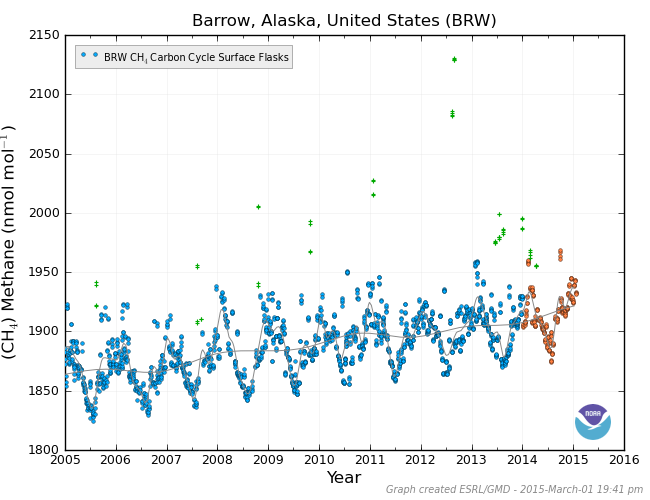
Barrow surface methane observations by NOAA ESRL show methane readings that range about 60 ppb above the global average. Note the 50 ppb increase over the past decade coincident with numerous ‘outlier’ spikes [green cross hatches] from local sources. Image source: NOAA ESRL.
Perhaps the most obvious sign that there’s something not quite right going on in the Arctic is a large overburden of both methane and CO2 in the region. Looking at NOAA’s ESRL site, we find that methane levels at Barrow, Alaska (one of just a handful of Arctic sensor stations in the ESRL network), are in the range of 1,910 parts per billion. By comparison, NOAA’s Mauna Loa Station, on the edge of the tropics and well away from the polar overburden, records about 1,850 parts per billion (ppb).
At current rates of atmospheric methane increase, it will take about 9 years for Mauna Loa to catch up to where Barrow is now. But by that time Barrow may be pushing 1,970 ppb or more. In addition, all Arctic stations record numerous anomalous spikes in methane from local sources. The ESRL site lists these spikes as outliers. But, for all the ESRL reporting stations, the Arctic stations are the ones that host by far the most numerous such outliers. The local methane sources, therefore, appear to be quite active in the Arctic. An observation that polar scientist, Dr Jason Box, admits keeps him awake at night.
AIRS_Methane
Global distribution of methane averaged over 2011 by NASA/AIRS. Note the very high concentrations in the Arctic region. For this map, the highest concentrations occur in the Yedoma region of Russia, a region of multiplying methane emitting tundra melt and thermokarst lakes [see below]. Image source: NASA/AIRS.
Perhaps the most reliable way to sample the Arctic methane overburden is to get a full view of it through satellite sensors. The above NASA image taken in 2011 shows a massive methane overburden in the upper latitudes that slowly diffuses southward. Note the highest concentrations in this image are near the permafrost zones in Yedoma in northeastern Russia.
NOAA also provides its METOP array which frequently finds methane concentrations at above 2,400 parts per billion at the 10,000 to 20,000 foot level in broad blankets over the Arctic region — especially in the months of September through November and then again in January. Again, these measures are the highest in any region of the globe, and they occur directly over the Arctic.
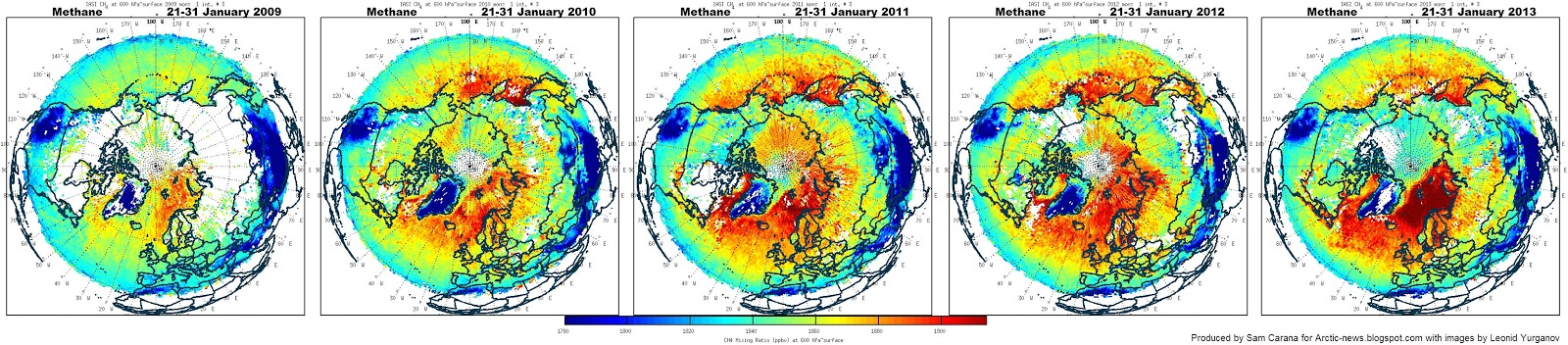
Dr. Leonid Yurgonov uses the AIRS/AQUA satellite sensor to provide a record of Arctic methane overburden. One that is clearly visible here:
methane-jan21-31
In the above image we see methane measurements at the 18,000 foot altitude above the Arctic and upper latitudes. The progression is from January of 2009 (furthest left) to January of 2013 (furthest right). Orange coloration represents methane readings in the range of 1,850 to 1,950 parts per billion. Deep red coloration is in the range of 2,000 parts per billion. Note the shift from blues and yellows (1,700-1,800 ppb) to oranges and reds (1,850-2,000 ppb) during the 5 years from 2009 to 2013.
So not only does the AIRS sensor show overburden, but it also finds methane build-up over the period measured.
These combined measures alone provide more than enough evidence of a methane overburden in the far northern region, together with a rate of buildup that maintains the overburden and leads the global methane measure. Cause for enough concern among Arctic researchers that they have tended to make statements like this:
The amount of methane in the Arctic hydrates alone is estimated as 400 times more than the global atmospheric CH4 burden! The question is timescale of the methane liberation: gradual, abrupt, or something in between. Satellite monitoring of methane over the Arctic Ocean is necessary! — Dr. Leonid Yurganov, AGU, 2012
Steady Increase So Far
But even if we do have both a buildup of methane in the polar region together with what looks like an ominous overburden, we should be quick to point out that the rate of increase, especially on the global scale, has been mostly steady so far.
Under any catastrophic methane release scenario, we would expect Arctic methane to rapidly jump higher, dragging the global measure along with it. In general, we’d expect almost all sensors to pick up the signal of an exponentially ramping curve. And we don’t see that as yet.
To this point, Dr. Yurganov’s statement from the 2012 AGU presentation is informative:
Current methane growth in the Arctic, including 2012, is gradual… If a sudden venting (bubbling) of methane would happen due to intense hydrates destruction, IASI would be able to detect it NRT.
Though there has been a bit of an uptick in global and Arctic methane increase rates during recent years, they have maintained about a 4-7 ppb annual increase since ending a decade-long pause from 1995 to 2005.
It is worth noting, however, that the global methane measure increasing at an exponential rate would be a trailing measure indicator — occurring only in the wake of any catastrophic or large-scale release. So, as a predictor, the global methane measure isn’t very useful.
Thermokarst Lakes 
Which brings us to the key question — what are the leading indicators of major methane releases or of catastrophic releases of the kind some have feared?
Since we have never directly observed one, and since large-scale or catastrophic releases are merely theoretical at this time, we can only point toward evidence of past large scale releases, and an ongoing, but apparently growing, smaller scale release happening now.
The first such related observation may well have come in the form of an increasing methane emission from thermokarst lakes. Thermokarst lakes form when sections of permafrost thaw and collapse, creating a depression. In wet regions, water soon pools within these hollows. Organic material at the bottom of the pool is provided by thawing permafrost. In the anaerobic lake bottom environment, methane is generated as the organic material is broken down.
Over recent years, this increasingly widespread thermokarst thaw and formation has resulted in a number of Arctic ‘fire lakes’ popping up — lakes whose methane emissions are so great that bubble concentrations are high enough to burn. During winter, these bubbles are trapped beneath ice and when released, create an explosive mixture.
Thermokarst Lake
Methane production in a thermokarst lake. Image source: The Royal Society.
From the 1970s through the mid 2000s, it is estimated that some regions of the Arctic experienced as much as a 58% increase in methane release due to thermokarst lake formation alone. An important measure since a number of studies found that thermokarst lake formation was one of the primary drivers of methane release from the Arctic at the end of the last ice age.
But as a catastrophic release driver, thermokarst lake formation is relatively mild, even if it is capable of pushing Arctic methane release levels higher. As such, the next indicator — a discovery of large methane releases from the ocean floor in the Arctic — was somewhat more concerning.
Oceanic Plumes
For as of 2011 an expedition to the East Siberian Arctic Shelf (ESAS) found massive plumes of methane, as large as one kilometer across, emitting from the shallow sea bed region off northeastern Siberia. The researchers, Shakhova and Semiletov, seemed very concerned that this might be a sign of a potential, impending, large-scale release on the order of 1 to possibly 50 gigatons. The methane stores for the ESAS alone were massive — in the range of hundreds of gigatons. So even a fractionally small release from this source could be devastating. For reference, a 1-gigaton release would more than double the annual methane release from all global human and natural sources. A 5-gigaton release, on its own, would be enough to more than double atmospheric methane concentrations. And since methane traps heat more than 20 times as efficiently as CO2 over a century time-scale, such a release would result in far more rapid warming than previously predicted by scientific bodies such as the IPCC -- a very rapid rate of warming that would be extraordinarily difficult for human civilizations to adapt to.
Of course this announcement set off amazing controversy. We couldn’t be certain what the source of this methane was, some said. Was it submerged permafrost methane? Was it hydrate? Was it free gas methane? And how could we be certain that this release hasn’t been ongoing for some time?
If such a methane release was building up to a catastrophic event, what mechanism would be the cause? In other words, how might gigatons of methane suddenly blow up from the sea bed?
arctic-methane-concentrations-sep-nov-2009-2012
Lower troposphere methane concentrations over the Kara, Laptev, and East Siberian Seas during September-November of 2009-2012 show overburden in active oceanic release zones. Image source: Dr. Leonid Yurganov.
This point is worth a bit of further exploration. The issue is that the most unstable form of methane when warmed is the methane hydrate store mentioned above. Methane hydrate is a frozen combination of gas methane and water. It crystallizes into a kind of fire ice under high pressure and in low temperature environments. It typically forms about 200-600 feet below the sea bed as methane bubbling up from warmer regions below contacts seawater, high pressure and cold. If the layer is warmed under human heat forcing, the hydrate thaws, releasing its gas. The gas now becomes stored in pockets under high pressure. The gas below pushes against the sea bed above and some of it bubbles out (and these releases are found in the large plumes along the ESAS and elsewhere). But most of it, so far, has remained entombed.
What, then, could cause the large stores of entombed gas releasing from destabilizing hydrate, to break through hundreds of feet of seabed — hitting first ocean water and then atmosphere?
Over the past four years conjecture over this issue has raged on. Swelling at points when Shakhova and Semiletov would make a new announcement and then ebbing as a wave of reassurances would rush in from scientific critics and mainstream media.
By summer of 2014, a discovery of new, large-scale plumes in the Laptev Sea by the SWERUS C3 expedition set off another wave of media speculation and controversy. But as the dust settled, it became clear that the Laptev sea floor had been added to the list of methane hot spots in the Arctic, following in the footsteps of the ESAS region as an area to watch for potential increasing rates of release.
Tundra Blowholes
In nature, gasses under high and increasing pressure often find pathways for escape. Typically, the escape is gradual — we see this in volcanic regions in the release of magma gasses through cracks in the earth and through vent pathways. And sometimes the escape is far more violent — with hot volcanic gasses blowing away even hills or mountainsides in spontaneous eruption, or bubbling out, en masse, through volcanic lakes to spill toxic plumes over a countryside.
The gas source in question for Arctic methane release — hydrate — is very large. Even at the low end, it is estimated that hundreds of gigatons of the stuff lie buried beneath frozen tundra ground or in ocean stores beneath the seabed. A gigaton is one billion tons. A billion tons of frozen hydrate would cover roughly one cubic kilometer. One cubic kilometer of a flammable gas under high pressure.
And in the Arctic, hundreds of billions of tons lie under rapidly warming permafrost both on land and in the submerged seabed.
Permafrost and Gas Hydrate Methane
Graphic of permafrost and gas hydrate methane by Carolyn Ruppel. Note that 75% of the ESAS sea floor is in the range of 50 meters in depth or shallower and that buried hydrate deposits can be found in the range of 200-300 feet. Image source: Methane Hydrates and Contemporary Climate Change.
As of 2011, some scientists were warning that we were seeing a slow release from some of this submerged hydrate store in the ESAS. By 2014, the potential slow release had expanded into the Laptev Sea.
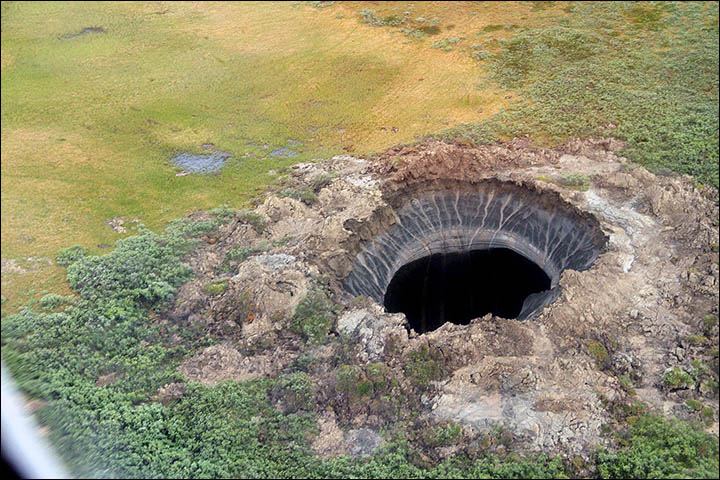
But that year, 2014, also saw something else. A potential catastrophic release of methane. For in the frozen region of Yamal, Russia, the earth near a remote Siberian village began to destabilize. Soon after, according to eyewitness accounts, the area began to smoke. Then, with a bright flash, the ground erupted.
When the smoke cleared, a massive crater was found where only flat, frozen tundra had been before. A giant plug of frozen earth had been ejected violently. And all that remained was an ominous gray-black crater.
Yamal crater
Yamal Crater as seen from the air. Image source: The Siberian Times.
Researchers investigating the crater found 10% atmospheric methane concentrations at its bottom.
Overall, it was estimated that about 11 tons of TNT equivalent explosive force was enough to remove this 100+ foot wide and 220 foot deep plug from the Earth. Exploding and burning methane in the range of about 10 tons would have been enough to generate the crater. Gas under high pressure in the hundred+ ton range may have been able to explosively excavate this hole.
As a result, the amount of methane in question for this single event was relatively small, especially when one considers the hundreds of billions of tons in the still frozen store.
It appeared that the rapidly warming Yamal territory and a broad region of nearby northwestern Siberia may be seeing tundra warming extending deep enough to begin to destabilize pockets of relic hydrate. The hydrate in some of these pockets is beginning to thaw and catastrophically erupt to the surface.
By early 2015, a total of seven primary craters and scores of secondary craters of this kind had been discovered throughout this section of Siberia. Local Russian authorities were very concerned — moving seismographs into the area to monitor ground stability in a region that includes one of their largest natural gas developments.
A large upheaval of this kind in the wrong place would easily rupture a pipeline or destroy sections of a gas production operation. But the deeper irony was that continued gas production in this region was contributing to a problem that may well be making the ground far, far less stable and setting up the risk for even larger-scale eruptions.
For the Yamal crater wasn’t important due to the relative size of its methane release — the release was very small in the global context. A mere drop in an ocean of greenhouse gasses being emitted now by humans. It was important due to two other, and perhaps more stark, reasons.
The first was the very violent nature of its release — an eruption similar to that of a volcano — representing a severe geophysical upheaval that was all too likely triggered by a rapid human warming of the tundra. This kind of release, as the Russians in the region were quick to realize, represented a danger to both inhabitants and to infrastructure.
But the second reason is, perhaps, more important. It is the fact that the Yamal crater may well be evidence of the kind of mechanism for catastrophic methane release some of the more conservative scientists have been demanding. It’s possible, then, that the Yamal crater is in microcosm, what a truly catastrophic methane release might look like on a much larger scale. And the critical question to ask here is — could there be a connection between the methane blowholes we are now observing in the Arctic and a number of mysterious and gigantic craters discovered on the sea bed around the world?
Giant Craters on the Seabed
In 2013, marine geophysicist Dr. Bryan Davy from GNS Science found what may be the world’s largest gas eruption craters on the seafloor, about 310 miles east of Christchurch, New Zealand.
The craters, which the researchers called ‘pockmarks,’ formed in an active gas zone along the ocean bottom. They measured from 250 meters to 7 miles in diameter and about 300 feet deep, with the largest crater able to encompass all of lower Manhattan.
Giant Craters in the Seafloor off Christchurch New Zealand
Giant craters off Christchurch, New Zealand, are thought to have formed due to large gas eruptions during previous episodes of sea bed warming. Could human warming be setting off something similar for the Arctic? Image source: Mysterious Giant Crater Like Structure Found Near New Zealand.
The craters are thought to have formed during ice ages when sea levels lowered off New Zealand causing the sea bed to warm and gas hydrate to thaw. Eventually, the gas is thought to have erupted into the surrounding water with a portion bubbling up into the atmosphere.
GEOMAR seismic records indicated active gas pockets beneath the crater zones. Dr. Joerg Bialas, a GEOMAR scientist, noted:
Gas release from the larger pockmarks may have been sudden and possibly even violent, with a massive volume being expelled into the ocean and atmosphere within hours or days.
The 300 foot depth of the craters touched the hydrate stability zone, even as their large size indicated that massive pockets of the gas lifted away large sections of sea bed suddenly and violently. It’s the kind of rapid destabilized gas release that may well represent a worst-case Arctic warming scenario.
Cause for Appropriate Concern
So the question must be asked — is the Yamal crater physical validation of a catastrophic methane hydrate release mechanism that has circulated, as theory, through the geophysical sciences for decades? One that involves large eruptions that displace massive sections of earth and seabed during a violent release process. Are the Siberian methane blowholes smaller examples of what can happen on a much greater scale? And does the methane overburden in the Arctic, the documented increasing thermokarst lake release, the sea bed methane release in the Laptev and ESAS, and the new formation of methane blow holes in Yamal, in the context of a rapidly warming Arctic tundra and sea bed (seeing unprecedented rates of warming), represent a growing risk for this kind of release?
Under even a ‘moderate’ 1 to 3.5 gigaton Arctic carbon release rate by end century given by the survey of 100 Arctic scientists, there will likely be more than enough potential freed methane to include large-scale catastrophic releases similar to the kind seen off New Zealand and elsewhere (250-meter to 7-mile-wide cratering events).
In this context, the issue is not one of ‘apocalypse now’ or ‘apocalypse not.’ That framing is all wrong. This issue is one of how much or how little geophysical upheaval and related methane release we will see — and how soon. One of how rapidly humans can stop making the situation even worse, by drawing down their own catastrophic emission rates as rapidly as possible.
There is, therefore, more than enough cause for appropriate concern and continued monitoring of what appears to be an ongoing destabilization of Arctic carbon stores — large enough to represent a variety of hazards both terrestrial and atmospheric.
Links:
Scientific hat tips to Dr. Leonid Yurganov, Dr. Gavin Schmidt, Dr. David Archer, Dr. Igor Semiletov, Dr. Natalia Shakhova, Dr. Carolyn Ruppel, Dr. Jason Box, Dr. Peter Wadhams, Dr. Bryan Davy, Dr. Joerg Bialas, SWERUS C3, GEOMAR, and The Russian Center of Arctic Exploration.