Blog Archive

Showing posts with label solar power. Show all posts

Tuesday, July 29, 2014

Peter Sinclair: For Utilities, Reality Is A Jolt!

by Peter Sinclair, Climate Denial Crock of the Week, July 28, 2014


Rebecca Smith of the Wall Street Journal has consistently been delivering the unwelcome news for electric utilities about changing times, and this morning she’s done it again.  I won’t often recommend a Murdoch paper as a resource, but do read the whole thing at the link if you can. It’s darkly comedic, for example:
Sherry Pfister, a retiree who once worked at the Palo Verde nuclear power plant 45 miles west of Phoenix, says she didn’t hesitate to lease solar panels for her home in Waddell, Ariz., and says the panels have cut her utility bill by a third.
“Why isn’t everybody doing it?” she wonders.
Turns out that growth in the economy no longer requires growth in the electricity sector.  One  CEO marvels, “It’s a new world for us.”

As the video above shows, that new world of decoupled growth and electricity began in the 1970s. 

But Utility Executives have never been hired to be forward thinking.
Perhaps that will change sometime soon..

http://climatecrocks.com/2014/07/29/for-utilities-reality-is-a-jolt/

Friday, May 9, 2014

Warren Buffett to Close One of Nation’s Dirtiest Coal Plants in Favor of Solar Energy

by Brandon Baker, EcoWatch, May 8, 2014
One of the dirtiest coal-fired power plants in the U.S. will soon shut down, thanks to a well-known billionaire and previously passed legislation.
As part of its acquisition of Nevada’s largest utility, NV Energy, Warren Buffett’s Berkshire Hathaway also inherited Reid Gardner, a 557-megawatt (MW), coal-fired energy plant near Las Vegas. The massive structure, which has a history of recognition among the country’s dirtiest carbon polluters, won’t be a lasting legacy of NV’s profile.
NV plans on shutting down three of Reid Gardner’s units that generate about 300 MW by the end of this year, according to the Las Vegas Review-Journal. The remaining 257 MW would be closed by the end of 2017. In all, the company wants to end all of its coal operations by 2019.
Coal-fired plants will soon be a thing of the past for NV Energy. Photo credit: OccupyLV.org
As The Atlantic points out, the utility’s decision is tied to state legislation passed last year requiring the company to eliminate 800 MW of coal energy in favor of renewables. That passage was influenced by years of fighting for cleaner air by the Moapa Band of Paiutes, a Native American community that lives near Reid Gardner.
The state utilities commission has 180 days to approve the plan, which would also include a new solar project totaling 200 MW of clean energy on the Moapa Band of Paiutes reservation. The land is about 70,000 acres and has enough to space to also support the 1.5 gigawatts of renewable energy the Moapa Band of Paiute wants to construct through a joint venture announced last year with Terrible Herbst Inc. and Stronghold Engineering Inc.
“This is going to provide a strong economic base for the tribe,” Sandy King, director of renewable-energy project development at Stronghold, told Renewable Energy World.
Last fall, the U.S. Environmental Protection Agency announced a limit of 1,100 pounds of carbon dioxide per megawatt-hour for new coal plants. 

Thursday, April 24, 2014

Koch brothers, big utilities attack solar, green energy policies

by Evan Halper, The Los Angeles Times, April 20, 2014
— The political attack ad that ran recently in Arizona had some familiar hallmarks of the genre, including a greedy villain who hogged sweets for himself and made children cry.
But the bad guy, in this case, wasn't a fat-cat lobbyist or someone's political opponent.
He was a solar-energy consumer.
Solar, once almost universally regarded as a virtuous, if perhaps over-hyped, energy alternative, has now grown big enough to have enemies.
The Koch brothers, anti-tax activist Grover Norquist and some of the nation's largest power companies have backed efforts in recent months to roll back state policies that favor green energy. The conservative luminaries have pushed campaigns in Kansas, North Carolina and Arizona, with the battle rapidly spreading to other states.
Alarmed environmentalists and their allies in the solar industry have fought back, battling the other side to a draw so far. Both sides say the fight is growing more intense as new states, including Ohio, South Carolina and Washington, enter the fray.
At the nub of the dispute are two policies found in dozens of states. One requires utilities to get a certain share of power from renewable sources. The other, known as net metering, guarantees homeowners or businesses with solar panels on their roofs the right to sell any excess electricity back into the power grid at attractive rates.
Net metering forms the linchpin of the solar-energy business model. Without it, firms say, solar power would be prohibitively expensive.
The power industry argues that net metering provides an unfair advantage to solar consumers, who don't pay to maintain the power grid although they draw money from it and rely on it for backup on cloudy days. The more people produce their own electricity through solar, the fewer are left being billed for the transmission lines, substations and computer systems that make up the grid, industry officials say.
"If you are using the grid and benefiting from the grid, you should pay for it," said David Owens, executive vice president of the Edison Electric Institute, the advocacy arm for the industry. "If you don't, other customers have to absorb those costs."
The institute has warned power companies that profits could erode catastrophically if current policies and market trends continue. If electricity companies delay in taking political action, the group warned in a report, "it may be too late to repair the utility business model."
The American Legislative Exchange Council, or ALEC, a membership group for conservative state lawmakers, recently drafted model legislation that targeted net metering. The group also helped launch efforts by conservative lawmakers in more than half a dozen states to repeal green energy mandates.
"State governments are starting to wake up," Christine Harbin Hanson, a spokeswoman for Americans for Prosperity, the advocacy group backed by billionaire industrialists Charles and David Koch, said in an email. The organization has led the effort to overturn the mandate in Kansas, which requires that 20% of the state's electricity come from renewable sources.
"These green energy mandates are bad policy," said Hanson, adding that the group was hopeful Kansas would be the first of many dominoes to fall.
The group's campaign in that state compared the green energy mandate to Obamacare, featuring ominous images of Kathleen Sebelius, the outgoing secretary of Health and Human Services, who was Kansas' governor when the state adopted the requirement.
The Kansas Senate voted late last month to repeal the mandate, but solar industry allies in the state House blocked the move.
Environmentalists were unnerved. "The want to roll it back here so they can start picking off other states," said Dorothy Barnett, director of the Climate and Energy Project, a Kansas advocacy group.
The arguments over who benefits from net metering, meanwhile, are hotly disputed. Some studies, including one published recently by regulators in Vermont, conclude that solar customers bring enough benefits to a regional power supply to fully defray the cost of the incentive.
Utilities deny that and are spending large sums to greatly scale back the policy.
In Arizona, a major utility and a tangle of secret donors and operatives with ties to ALEC and the Kochs invested millions to persuade state regulators to impose a monthly fee of $50 to $100 on net-metering customers.
Two pro-business groups, at least one of which had previously reported receiving millions of dollars from the Koch brothers, formed the campaign's public face. Their activities were coordinated by GOP consultant Sean Noble and former Arizona House Speaker Kirk Adams, two early architects of the Koch network of nonprofits.
In October, California ethics officials levied a $1-million fine after accusing groups the two men ran during the 2012 election of violating state campaign finance laws in an effort to hide the identities of donors.
The Arizona Public Service Co., the state's utility, also had Noble on its payroll. As a key vote at the Arizona Corporation Commission approached late last year, one of the commissioners expressed frustration that anonymous donors had bankrolled the heated campaign. He demanded APS reveal its involvement. The utility reported it had spent $3.7 million.
"Politically-oriented nonprofits are a fact of life today and provide a vehicle for individuals and organizations with a common point of view to express themselves," company officials said in a statement in response to questions about their campaign.
The solar companies, seeking to sway the corporation commission, an elected panel made up entirely of Republicans, formed an organization aimed at building support among conservatives. The group, Tell Utilities Solar Won't Be Killed, is led by former California congressman Barry Goldwater Jr., a Republican Party stalwart.
"These solar companies are becoming popular, and utilities don't like competition," Goldwater said. "I believe people ought to have a choice."
The commission ultimately voted to impose a monthly fee on solar consumers — of $5.
The solar firms declared victory. But utility industry officials and activists at ALEC and Americans for Prosperity say the battles are just getting underway. They note the Kansas legislation will soon be up for reconsideration, and fights elsewhere have barely begun.
In North Carolina, executives at Duke Energy, the country's largest electric utility, have made clear the state's net metering law is in their sights. The company's lobbying effort is just beginning. But already, Goldwater's group has begun working in the state, launching a social media and video campaign accusing Duke of deceit.
"The intention of these proposals is to eliminate the rooftop solar industry," said Bryan Miller, president of the Alliance for Solar Choice, an industry group.
"They have picked some of the most conservative states in the country," he added. "But rooftop solar customers are voters, and policymakers ultimately have to listen to the public."

Saturday, April 19, 2014

Solar's insane price drop may cause energy price deflation, stranded assets

Solar’s dramatic cost fall may herald energy price deflation

by Giles Parkinson, RenewEconomy, April 11, 2014

We’ve seen and published many dramatic graphs about the fall in solar, such as this one tracing the fall over the past 30 years and this from Citigroup, but the following graph from investment bank Sanford Bernstein is quite stunning – not just for its simplicity but because it draws attention to the potential impact of solar to the $5 trillion global energy market.
As you can see, the cost of solar PV has come from – quite literally – off the charts less than a decade ago to a point where Bernstein says solar PV is now cheaper than oil and Asian LNG (liquefied natural gas). It does its calculations on an MMBTU basis. MMBTU is the standard unit of measure for liquid fuels, often referred to as one million British thermal units.
bernstein solar
“For these (developing Asian economies) solar is just cheap, clean, convenient, reliable energy. And since it is a technology, it will get even cheaper over time,” Bernstein writes in a newly released report.
“Fossil fuel extraction costs will keep rising. There is a massive global market for cheap energy and that market is oblivious to policy changes” in China, Japan, the EU or the US, it writes.
This has potentially massive impacts for the oil, gas and LNG markets, and therefor the massive investments in the LNG plants in Queensland, Australia, where tens of billions of dollars have been invested by Australian and international energy majors on the assumption that the demand, and the price, of LNG will rise ever upwards.
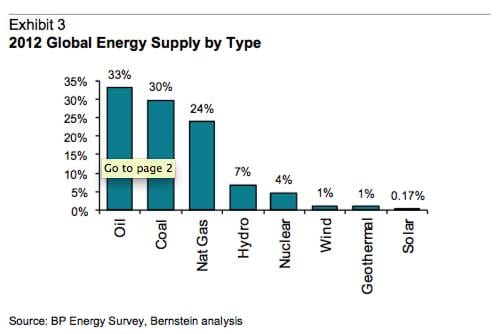
bernstein energy supplyAs Bernstein notes in its report, the share of solar PV in the global energy market is currently so small (see graph to the right) that “the idea that oil and gas is the “loser” in this formulation is laughable … in 2014.”
But that’s not the case a decade hence. Solar is already eating away at the margins of oil and gas demand.  Bernstein says the adoption of solar in off-grid areas in developing markets means less kerosene and diesel demand. The adoption of solar in the Middle East means less oil demand. The adoption of solar in China and developed Asia means less LNG demand. And distributed solar in the US, Europe and Australia means less natural gas demand.
And then Bernstein drops this bombshell – while solar has a fractional share of the market now,  within one decade, solar PV (plus battery storage) may have such a share of the market that it becomes a trigger for energy price deflation, with huge consequences for the massive fossil fuel industry that relies on continued growth.
“The behavior from here seems clear: the solar industry will expand. Retaliatory steps from distribution utilities will increase the market for cost-effective battery storage. This becomes – initially – a secondary market for battery technologies being developed for the auto sector. A failed battery technology in the auto sector (too hot, too heavy, too rigid a form factor) might well be perfect for the home energy storage market…. with an addressable end market of 2 billion backyards.
“And for some years, that will be the extent of the effect. We have previously calculated how large the solar sector would need to be in order to become a material share of incremental energy supply each year and therefore begin to displace high-cost oil and gas supply and start to depress prices.
“We estimate that the solar industry would need to be an order of magnitude larger than it is today to have this kind of impact. At the point where solar is displacing a material share of incremental oil and gas supply, global energy deflation would become inevitable: technology (with a falling cost structure) would be driving prices in the energy space. But even on an aggressive view, this could take the better part of a decade.”
But, the Bernstein analysts say, the risks are that they are being too conservative. The big oil and gas producers, and the investors that control the flow of capital, may not wait until energy prices do actually deflate, they will likely change their behaviour well before than in anticipation that it will happen.
“If the downward sloping forward curve is ever accepted as permanent, rational behavior from energy producers will guarantee it is so. Sitting on oil and gas reserves for the benefit of generations yet to come ceases to be a rational strategy if that reserve represents a depreciating rather than an appreciating asset.”
This, Bernstein says, is the hidden flaw with the idea that solar is “too small to matter.”  Ultimately, it says, what may kill the  energy market for equity investors is not the fact that renewable technology and battery storage will turn into behemoths, but the realisation of that future as inevitable.

Friday, January 24, 2014

Australian heat wave caused heart attacks to triple

The blackouts during Australia's heatwave didn't happen by accident


Australia broke yet another heatwave record this week while thousands of people suffered from electricity blackouts

by Alexander White, The Guardian, January 17, 2014


People cool off at Brighton Beach as temperatures reach over 40 degrees Celsius in Melbourne, Australia.
Parts of Melbourne were left without power as temperatures reach over 40 degrees Celsius in Melbourne, Australia. Photograph: Craig Sillitoe/Getty Images
Australia is experiencing the most extreme heatwave since, well, the last one in 2013 and 2009.
While the sunburned country is used to hot weather, our infrastructure was not built to cope with several days of above 40 °C temperatures. Now Victoria has now seen 4 consecutive days above 41 °C, breaking records that have existed since 1855.


In 2009, the heatwave preceded Black Saturday, one of the most devastating bush fires in recent times. The human cost of the 2009 heatwave was more than 374 deaths, in addition to the 173 people who died in the fires.
While there were heatwaves across most of Australia for the past fortnight, the heatwave this week finally hit the south-eastern seaboard, and Melbourne where I live.
In nearby South Australia, the state capital Adelaide became the hottest city on earth, with temperatures in Roseworthy exceeding 46 °C. (That's over 114.8 °F if you don't follow Celsius.)
Bushfires are raging across south-east Australia, with over 100 blazes burning in South Australia, Victoria and New South Wales. There are more than 60 burning in Victoria.
Under these conditions, we saw train and tram tracks buckle. Melbourne ground to a halt, when the public transport providers, Metro and Yarra Trams advised commuters to leave work early to avoid massive delays and service cancellations.
It became so hot that the Australian Open tennis competition had play stopped after players collapsed and hallucinated cartoon characters.
Climate change is causing heatwaves in Australia to become more frequent, last longer and to be hotter, according to a Climate Council report:
"As greenhouse gases continue to accumulate in the atmosphere from the burning of fossil fuels, more heat is trapped in the lower atmosphere," the report states. "This increases the likelihood that hot weather will occur and that heatwaves will become longer and more intense.


These heatwaves aren't just inconvenient for tennis fans or commuters. They're deadly.
Emergency services, including paramedics and firefighters have been mobilised in large numbers to respond to the increase in heat-related injuries. Heart attacks surged 300% during the heatwave and authorities expect an increase of 50% in mortalities caused by the extreme heat, mainly the elderly, infirm and children.
Also widely reported in Melbourne are localised, staged blackouts.
On Wednesday, the Victorian premier Denis Napthine, who has introduced an effective ban on the construction of wind turbines, talked about the need to "reduce the supply to some households".
He's talking about cutting the electricity to homes, during the hottest part of the day.
"The Government is insisting that priority is given to electricity supplies for hospitals, nursing homes emergency services, public transport and major infrastructure," he said in a radio interview, and he also noted that essential services "will be exempt" from power cuts.
The black outs were exacerbated by repair delays at one of Victoria's major power stations and problems with the Basslink power cable from Tasmania.
It is important for people to understand several important facts.
Firstly, peak demand in 2014 was less than during the 2009 record heat wave. According to Roger Dargavel, senior energy analyst from Melbourne University's energy institute:
peak demand on Tuesday (with a maximum temperature in Melbourne of 42.8 degrees) and Wednesday (41.7 degrees) was only a touch over 10 GW, well under the 2009 record.

Energy demand in Victoria has declined over the past five years by around 3% per year, despite quickly growing population. This is largely due to increases in energy efficiency, decline in energy intensive manufacturing and the massive uptake of household photovoltaic solar systems (around 3 GW nationally is installed).
In fact, according to the Clean Energy Council, without rooftop solar "acting to reduce the demand from large-scale power stations, it is very likely that Victoria would have set a new record for power use". So we can thank renewables that there weren't blackouts due to lack of supply. (Despite this, Tony Abbott has cut funding for the Clean Energy Finance Corporation, and premier Napthine has halted wind turbine approvals.)
Secondly, energy supply is not a natural phenomenon. It is not like water that flows downhill. The electricity supply is something that is determined by people. At some point, a person decides to turn off the electricity for a certain area. (This obviously excepts blackouts due to disasters.) In the case of the blackouts being referred to by premier Napthine, the decision makers are the energy distribution companies.
Thirdly, the energy market in Australia and Victoria is national, and largely privatised. In Victoria, the energy assets were sold off in the 1990s (along with a host of other essential services) by the conservative premier Jeff Kennett. The argument used to justify the privatisation was that it would result in lower prices.
Energy prices, as well as supply, are determined by "market forces". That is, the privately owned power companies sell electricity to the highest bidder. What's more, privatisation introduced the profit-motive, so that electricity companies have an incentive to increase their prices. In the three years before 2013, electricity prices rose by 66% or $680 per year, only around $54 of which can be attributed to the carbon price during 2013 (the first full year of its operation).
Additionally, Australia has a national energy market. This means that the grid connects between states, so when there is an excess of supply in one state, it can be sent to another state; and when there is an increase in demand in a state, supply can be sent from a neighbouring state.
Today, Fairfax reported that several large commercial users of electricity voluntarily reduced their energy consumption. This was due to price surges on the wholesale market. The wholesale market is regulated by the Australian Energy Market Operator, which operates the national electricity trading market. It is a corporation jointly owned by Australians state and federal governments, and industry.
The blackout during the heatwave in Melbourne was caused because someone in a private company decided to cut the power to everyday peoples' homes.
The decision-makers in these companies are profit driven. They are selling energy in a market. And these companies sell to the highest bidders. The fact that several bulk buyers reduced their energy consumption demonstrates this.
According to the ABC, prices increased in Victoria energy retailers are paying around $750 per megawatt hour and as high as $1,800/MWh, up from $48 on Monday and an average of around $60. Prices once reached $12,900/MWh, so, as Roger Dargaville noted "the system is under stress but a long way from cracking."
The State Government can effectively exempt essential services like the water pumps, hospitals, and public transport by guaranteeing that they will pay the price, however high.
Householders however, cannot. So power companies prioritise industrial energy users over people. This means cutting power to homes and sending it to industry.
The point of this post is blog that while the extremes of heat that we are experiencing may be a natural phenomenon, the consequences are caused by humans.
When people have their power supplies cut and their health is impacted, when infrastructure cannot cope and people are left stranded, and when companies and governments continue to pump billions of tonnes of greenhouse gasses into the atmosphere, it is because of someone's decision.
And if you don't care about the people, at least think of the cute koalas.

Tuesday, January 21, 2014

Google and Facebook promote ALEC policies that contravene their own clean energy policies -- talking out of both sides of their mouths

Google And Facebook Keep Supporting Laws That Gut Their Own Renewable Energy Investments

And they refuse to explain why. It's time for the tech giants to do a little reconciling for their massive support of renewable energy policy and their support of a legislative group that's now trying to punish people for generating their own solar energy.

by Sydney Brownstone, Co.Exist, December 5, 2013

How’s this for a cognitive dissonance doozy? Despite having invested more than $1 billion in renewable energy, Google also belongs to the American Legislative Exchange Council (ALEC), a powerful corporate lobbying group that, among other things, seeks to defeat supportive renewable energy policies on the state level. Facebook, which recently installed an extensive solar power system by Cogenra on its Menlo Park campus, also belongs.
On December 6, ALEC will meet at its annual summit in Washington, D.C., to discuss rolling back greenhouse gas regulations, and perhaps charging a fee to homeowners who install solar panels on their houses.


ALEC's mission is to help mostly conservative state legislators collaborate on writing bills which they can bring back to their home states and pass, resulting in uniform conservative laws enacted at the state-level around the country (perhaps most notoriously, it's been responsible for "stand your ground" laws around the country). It's also poured money into vehemently opposing state renewable portfolio energy standards, regulations that require increased energy sourcing from renewables. This is interesting, as Google proudly states that it derives 34% of its total energy from renewables, and Facebook has pledged to power 25% of its data centers from renewables by 2015.
Earlier this year, we reported that both Google and Facebook (along with Yelp) had joined ALEC’s ranks, which Google later confirmed via its public transparency page, and Facebook through its climate czar Bill Weihl (more on that later).
Though Google and Facebook have previously denied requests for comment on their ties to ALEC, the Daily Beast reported that both were members of ALEC's communications technology task force. It's likely that Google and Facebook not only pay normal corporate membership fees, but also task force membership fees, probably in thousands of dollars. What the companies get in return is relatively cheap and unique access to thousands of legislators across the country, and direct input into ALEC's highly influential model bill-making process on technology issues. This makes sense: Companies often play both sides of the ideological spectrum; they'll take any corporate advantage where ever they can buy it. What doesn't make as much sense -- because they refuse to explain it in any sort of depth --is why Google and Facebook find that access more valuable than the millions they have poured into clean energy.
We managed to get a Facebook spokesperson to speak in broad, fuzzy brushstrokes about the company's relationship to ALEC, telling Co.Exist in a statement: "Facebook belongs to various organizations representing views across the political spectrum. The private sector members of ALEC's technology committee have worked on model legislation on issues that directly affect our company including data security, privacy, and a free and open Internet. We want to be part of any conversation that contributes to shaping these issues and giving our users a better experience."
While ALEC has always pushed an anti-climate regulation agenda, the interest in punishing the owners of solar panels is a new development, as the Guardian revealed earlier this week. John Eick, ALEC’s analyst for its energy, environment and agriculture program, told the newspaper that the group would be exploring initiatives that charge homeowners a fee for distributing solar power back in the grid. "As it stands now, those direct generation customers are essentially freeriders on the system. They are not paying for the infrastructure they are using. In effect, all the other non direct generation customers are being penalized,” Eick said.
"They should be paying to distribute the surplus electricity,” Eick added.
The effort flies directly in the face of Google's residential solar initiatives. In 2011, Google entered a $280 million deal with SolarCity, a solar power system company, to create a fund for residential solar projects. The partnership would extend lease and purchase agreements to customers who couldn’t afford all the costs upfront. “Google is setting an example that other leading American companies can follow,” said Lyndon Rive, CEO of SolarCity, announced proudly in the Solar City press release at the time.
“Now, through this partnership with SolarCity, we’re excited to be making our first investment in distributed residential solar, making it easier and more affordable for consumers across the country, including our own employees, to use renewable energy at their own homes,” said Rick Needham, director of Google’s green business operations at Google, in the same release.
Neither Needham nor SolarCity responded to a request for comment over ALEC’s solar fee proposal.
The proposal also appears to contradict Facebook's green efforts. Last month, Brad Johnson, campaign manager for Forecast the Facts, a climate activist group, asked Bill Weihl, Facebook’s manager of energy efficiency and sustainability, why the company joined ALEC. Weihl explained that Facebook also works with the likes of Greenpeace and the World Wildlife Fund, but didn’t explain the ALEC incentive. “It’s certainly not because we’re trying to oppose renewable energy legislation,” Weihl told Johnson. Weihl did not respond for comment to this piece.
“It’s definitely a reputational risk for these forward-thinking online companies like Google and Facebook and Yelp to keep their membership in ALEC,” Gabriel Elsner, executive director of thinktank-watchdog Energy and Policy Institute, said. “ALEC is an anti-clean energy bill mill that is creating model legislation to help its fossil fuel and utility members at the expense of ratepayers and the public.”
In November, Arizona’s utility regulatory agency voted to charge solar homeowners 70 cents per kilowatt of solar energy installed on their roof a month. A spokesman from Arizona Public Service, Arizona’s largest utility, told the Arizona Capitol Times that the utility pays $10,000 in membership and specialized taskforce membership fees to ALEC. Now, the group is working on a resolution that would weaken rules allowing solar users to feed energy back into the grid and offset regular energy costs.
“The new model bills would eliminate incentives for home owners to go solar and invest in solar in their own homes, and would water down the renewable portfolio standards by opening up those policies to out of state energy sources,” Elsner said.
Elsner added that these new initiatives would likely all be on the table at ALEC’s energy task force meeting with corporations and state legislators this week. If those model bills pass the committee, they go to ALEC’s board of directors, and subsequently to legislators across the country.
Google chose not to respond to requests for comment on this piece. But regardless of whether the tech giant joined ALEC primarily to rally on other issues -- like, say, anti-SLAPP legislation that would protect online commenting -- it's certainly supporting a platform that contradicts its own investments.
The cynical notion that joining ALEC is par for the business course is also a flimsy suggestion. Coca Cola, Pepsi, McDonalds, Kraft, Amazon, and the Bill and Melinda Gates Foundation have all dropped relationships with ALEC in the face of its controversies (especially following the death of Trayvon Martin) over the last two years. But if Google and Facebook continue to stay on with ALEC, they owe us better logic as to why.

Friday, December 20, 2013

Wind Power Rivals Coal With $1 Billion Order From Buffett

by Ehren Goossens, Bloomberg News, December 17, 2013


The silhouettes of Vestas Wind Systems turbines are seen in this photograph taken with a tilt-shift lens at a wind farm in Lowville, New York. The market value of Vestas, Europe'€™s biggest turbine supplier, increased 86% in the second half through yesterday and it'€™s expected to report net income in the current quarter for the first time since since mid-2011. Photographer: Ron Antonelli/Bloomberg
The decision by Warren Buffett’s utility company to order about $1 billion of wind turbines for projects in Iowa shows how a drop in equipment costs is making renewable energy more competitive with power from fossil fuels.
Turbine prices have fallen 26% worldwide since the first half of 2009, bringing wind power within 5.5% of the cost of electricity from coal, according to data compiled by Bloomberg. MidAmerican Energy Holdings Co., a unit of Buffett’s Berkshire Hathaway Inc. (BRK/A), yesterday announced an order for 1,050 megawatts of Siemens AG (SIE) wind turbines in the industry’s largest order to date for land-based gear.
Wind is the cheapest source of power in Iowa, and the deal indicates that turbines are becoming profitable without subsidies, according to Tom Kiernan, chief executive officer of the American Wind Energy Association trade group. That’s a boost for suppliers including Siemens, General Electric Co. (GE) and Vestas Wind Systems A/S (VWS), and a threat to coal miners such as Peabody Energy Corp.
“If Congress were to remove all the subsidies from every energy source, the wind industry can compete on its own,” Kiernan said at a press conference at a Siemens factory in Fort Madison, Iowa, yesterday, when the order was announced.
Photographer: Daniel Acker/Bloomberg
Completed wind turbine blades made for General Electric Co.'s renewable energy business... Read More
Other wind-turbine companies are recovering from slumps. The market value of Vestas, Europe’s biggest turbine supplier, increased 86% in the second half through yesterday and it’s expected to report net income in the current quarter for the first time since since mid-2011.
Siemens slipped 0.6% to 95.47 euros at 3:37 p.m. in Frankfurt.

Energy ‘Hedge’

Growing demand for wind power will offset waning use of fossil fuels, said MidAmerican Energy CEO Bill Fehrman. This order for 448 turbines follows a December 2010 agreement to use 258 Siemens turbines for other projects in Iowa.
Wind farms provide “a hedge for our customers going forward in an era of reduced coal generation,” he said at the event. The projects will qualify for the federal production tax credit for wind power, which is set to expire at the end of the year.
One of the five Iowa wind farms, the 44-megawatt Vienna II project, is already in operation. The company expects another 506 megawatts of turbines to begin producing power next year and the rest will go online in 2015, Fehrman said.
The company is investing a total of $1.9 billion in the 5 projects. Broadwind Energy Inc. (BWEN)will supply the towers.
MidAmerican expects to close some coal-powered plants in 2015 as the price of wind power continues to slide, said Adam Wright, vice president of wind generation and development for MidAmerican’s Iowa utility.

Retiring Coal

“Those coal retirements do require us to have some excess capacity or an increase in capacity,” he said yesterday in an interview. “If you strip away everything from all generation resources, I think wind is more competitive.”
Wind turbines typically cost about $1 million for each megawatt of capacity, making the deal worth more than $1 billion for Siemens, Markus Tacke, chief executive officer of the company’s wind power division, said without providing an exact price.
Power from wind is now cheaper than power from newly built natural gas plants, said Amy Grace, a wind analyst for Bloomberg New Energy Finance.
“Most people expect gas to become more expensive,”she said in an interview. “I think in most windy areas in the U.S it will be competitive by 2020.”

Wind Forecast

The industry is expected to install about 32 gigawatts of new wind capacity worldwide this year, down 28 percent from last year, according to New Energy Finance, in part because of low demand in the U.S. in the first half after the production tax credit lapsed. It was renewed at the start of 2013. Demand next year will rebound to about 43.7 gigawatts.
Power from coal costs about $78.30 a megawatt-hour to produce and gas costs $69.71, compared with $82.61 for onshore wind farms, according to data compiled by Bloomberg.
The cost of wind power has declined about 90% in the past two decades, and 30% in the past 3 years, Kiernan said.
The cost and reliability of coal will ensure that it remains part of the energy mix, Vic Svec, head of investor relations for St. Louis-based Peabody Energy, the biggest U.S. coal producer, said in an e-mailed statement.
Siemens will supply hubs and nacelles, the car-sized units that house the gears, electronics and gearboxes for turbines, from its plant in Hutchinson, Kansas, and rotors and blades from the Fort Madison facility.
Siemens has also agreed to supply turbines for Cape Wind, the proposed offshore wind farm off the coast of Massachusetts that faced opposition from local residents including the Kennedy family. The company said the project will qualify for a key federal credit, the investment tax credit, which is also set to expire December 31, 2013.

Thursday, September 26, 2013

Bloomberg News: Annual Solar Installs to Beat Wind for First Time

by Marc Roca, Bloomberg News, September 26, 2013

Solar power capacity installed around the world this year will beat wind for the first time driven by stronger policy support in key markets, according to Bloomberg New Energy Finance. 

Photovoltaic plants will add about 36.7 gigawatts globally in 2013 and wind farms 35.5 gigawatts, or almost 25 percent less than last year, the research company said today in a statement. Solar capacity will rise about 20 percent from 2012. 

“The dramatic cost reductions in photovoltaics, combined with new incentive regimes in Japan and China, are making possible further, strong growth in volumes,” said Jenny Chase, BNEF’s head of solar analysis. 

Lower panel costs and government support are accelerating deployment of solar energy even as growth slows in the mature European markets. Wind installations, more than double solar before 2011, are also being slowed by Europe, as well as a lack of clarity on policy in the U.S. and China. 

Wind power installations will drop by almost a quarter this year to their lowest level since 2008 because of the policies in these two countries, according to Justin Wu, BNEF’s head of wind analysis. China and the U.S. combined represented about 60 percent of the global wind market last year. 

Until 2030, both maturing technologies will contribute almost equally to the world’s new electricity capacity, the company forecast. It sees wind accounting for 17 percent of global power capacity in 2030 from 5 percent now and solar expanding to 16 percent from 2 percent.

Cumulative wind capacity was almost three times solar at the end of 2012, with 278,000 megawatts of turbines operating compared with about 104,000 megawatts of panels, BNEF data show. 

http://www.bloomberg.com/news/2013-09-26/annual-solar-installs-to-beat-wind-for-first-time.html
 
To contact the reporter on this story: Marc Roca in London at mroca6@bloomberg.net

To contact the editor responsible for this story: Reed Landberg at landberg@bloomberg.net