Blog Archive

Showing posts with label Stephan Lewandowsky. Show all posts

Saturday, June 3, 2017

Stephan Lewandowsky warns that academics can ‘lose control’ of their data and see it used as ‘political propaganda’

Calls for open data adjudicator to combat ‘disinformation’

by John Elmes, Times Higher Education, June 2, 2017
Independent national bodies should be set up to adjudicate on how much of the data underpinning research needs to be released to satisfy scholarly needs while preventing its being used as “disinformation,” a leading academic has said.

Stephan Lewandowsky, professor of cognitive psychology at the University of Bristol, told the World Conference on Research Integrity that “open data is highly political” and that there is a danger that some people will use scholarly information as “noise, nonsense, commercial interests or political propaganda,” to further their own interests.
“There is a difference between evidence-based science on the one hand, and political noise on the other,” he told delegates at Vrije Universiteit-Amsterdam. It was unfortunate, he went on, that openness and transparency facilitate science but, at the same time, they “disproportionately also aid in the dissemination of noise and politically motivated disinformation.”

Open science means that academics no longer have jurisdiction over their data, Professor Lewandowsky said, and people could now “cherry-pick” the bits that they wanted for their own ends.
He cited as examples the tobacco industry, which, he said, had reproduced research data after removing evidence of the negative association between smoking and health, and climate science, where universities have been “peppered” with data requests for emails between researchers and other information.
“If you make your data openly available as a researcher, you will lose control [of it],” Professor Lewandowsky said. “There are some concerns being articulated about the implications – especially in biomedical data – about letting go of them entirely and making them publicly available.”
Speaking to Times Higher Education (THE) after his presentation, Professor Lewandowsky said that “open data is terrific, but we have to be open-eyed.”
He said that one solution was to ensure that the availability of data was “enshrined or agreed upon” during the peer review process.
“In some circumstances, it doesn’t matter whether you’ve made data available, because whoever says that you haven’t will continue saying that and will always ask for more; and sometimes you can’t deliver more because it would be unethical to do that. Having that established during peer review is a good idea,” Professor Lewandowsky said.
Professor Lewandowsky added that having an independent national body that could resolve disputes around the availability of data was “crucial.”
“I think that’s something that would be doable, especially in the UK, because it’s a very well-organised and relatively small community – unlike the US, which is immense,” he said. “The research councils would be, in theory, capable of administering such a thing.”
In his keynote, Professor Lewandowsky advocated “symmetry” between the expectations of those who want information and the academics who produce it.
“I think we’re entitled to expect the same rigour, accountability and preregistration on the part of people who want our data for their own purposes as we expect of ourselves,” he told the audience. “At the moment, we don’t do that. But there’s no reason why we shouldn’t. If somebody wants my data, sure they can have my data; but why shouldn’t they preregister their analysis plan for my data in the same way I preregistered mine?”
Professor Lewandowsky told THE that applying the “same principles and scrutiny to people who want your data as you do to the people who generated them” is the “obvious solution” and would minimize loss of control of data.
“Why shouldn’t they say what they’re going to do with the data?” he asked. “In fact, you could even argue that if it’s politically sensitive, their proposed analysis…needs ethics approval.”

Sunday, November 29, 2015

John Abraham: Study drives a sixth nail into the global warming ‘pause’ myth

Numerous climate records and denial myths have fallen in 2015

Road markings appear distorted during a heatwave, in New Delhi, India, 27 May 2015.

Road markings appear distorted during a heatwave, in New Delhi, India, 27 May 2015. Photograph: Harish Tyagi/EPA

by John Abraham, "Climate Consensus - The 97%," The Guardian, November 24, 2015

Despite the organization and funding behind groups which try to cast doubt about the causes and implications of climate change, the facts have spoken. The world continues to warm and their favorite myths have died.
We know that human-emitted heat-trapping gases warm the planet. In fact, this has been known for well over a century. With modern instruments (like ocean thermometers and satellites among others), we are now measuring the change. With advanced climate models, we can predict the changes. The measurements and the predictions are in excellent agreement, despite what cable news and second-rate skeptical scientists say.
And this year, the data are in. Using measurements to date, and long-term weather forecasting to predict the last 40 days of the year (while it may seem a bit early) we now know. As my colleague Dana Nuccitelli recently noted, 2015 is the hottest year on record. When the final numbers come out in January, the NOAA 2015 global averaged surface temperature anomaly over both land and ocean will be 1.6 °F above the long-term average. For the NASA GISTEMP dataset, it will be 1.5 °F above the long-term average. This comes on the heels of last year’s record and recent record ocean heat content. So, the bad news is we continue to break records.
The good news is that the favorite myths from climate-change skeptics [deniers] have taken a beating this year. Perhaps the best-known myth is the so-called “pause” or “hiatus” in global warming. This year, six individual studies have looked into this and found it incorrect. I have co-authored one of the studies, and I’ve written about some of the others here and here.
Well just today, another paper was published by Stephan Lewandowsky, James Risbey, and Naomi Oreskes that comes to the same conclusion. The paper is titled, “On the definition and identifiability of the alleged 'hiatus' in global warming.” The authors assess the magnitude and significance of all possible warming trends during the past 30 years. They found that looking back in time, the current definition of a “pause” in warming, as it is used in the literature, would have been used for more than one-third of the time, even though temperatures during the past 30 years increased by 1.1 °F (0.6 °C). 
The authors included 40 peer-reviewed studies that reported on the so-called hiatus or pause, and found no consistent definition among those studies. Then, the authors used these same 40 papers and asked whether the so-called “hiatus” was unusual in the time records. They found it wasn’t. 
The study also found that when the sample size is small (such as a short time period with very few years), a so-called “hiatus” will always appear. For instance, anyone claiming a “hiatus” shorter than 12 years will almost always find one.
I asked author Naomi Oreskes for a summary and she told me,
For a long time, climate change contrarians and deniers have insisted that global warming has paused, stopped, or taken a hiatus. This might have been dismissed as the usual denier cherry-picking—since much of it was based on cherry picking the starting year of 1998—an unusually hot year.
So we took up the question, first of all, whether the warming had stopped and second, if it had not, why were scientists calling it a pause. Ironically the paper that answered the second question got published first: we showed how contrarian discourse had steeped into the climate science community, so scientists were calling this decrease in the rate of warming a pause, when it clearly was no such thing. If warming continued, as indeed it did, then by definition that is not a pause, nor a hiatus. Our new paper, shows statistically that not only has there not been a pause or hiatus, but that the observed rate of warming is well within the range of previous fluctuations—including some positive fluctuations (i.e. increases in the rate of warming) that did not generate any scientific attention.
So the bottom line is: there is no pause, and there has never been one. The rate of global warming does fluctuate—but this has been known for a long time. Whether or not any particular fluctuation has an identifiable cause—like the effects of ocean heat uptake or an El Ninois an interesting question, but a fluctuation is not a pause, and it is important to be clear that the recent fluctuation is not statistically anomalous compared with other fluctuations we have seen, relative to the longer-term warming trend.
Now, with six nails in this coffin of this myth, are any more needed?
http://www.theguardian.com/environment/climate-consensus-97-per-cent/2015/nov/24/study-drives-a-sixth-nail-in-the-global-warming-pause-myth

Thursday, November 26, 2015

RealClimate: Hiatus or Bye-atus?

by Stephan Lewandowsky, James Risbey and Naomi Oreskes (guest post), Real Climate, November 26, 2015

The idea that global warming has “stopped” has long been a contrarian talking point. This framing has found entry into the scientific literature and there are now numerous articles that address a presumed recent “pause” or “hiatus” in global warming. Moreover, the “hiatus” also featured as an accepted fact in the latest IPCC report (AR5). 

Notwithstanding its widespread use in public and apparent acceptance in the scientific community, there are reasons to be skeptical of the existence of a “hiatus” or “pause” in global warming [Ed: see also this previous post]. We have examined this issue in a series of three recent papers, which have converged on the conclusion that there is not now, and there never has been, a hiatus or pause in global warming.

We are not alone in coming to this conclusion; evidence for this has also been reported by Cahill and colleagues in a recent statistical change point analysis, which failed to identify a slowing in warming at any point in time during the last four decades.

But because this conclusion is potentially controversial, it requires a careful analysis of the conceptual landscape of research on temperature variation over the recent period.
To date, research on the “pause” has addressed at least 4 distinct questions:
  1. Is there a “pause” or “hiatus” in warming?
  2. Has warming slowed compared to the long-term warming trend?
  3. Has warming lagged behind model-derived expectations?
  4. What physical mechanisms underlie the “hiatus”?
Those questions are not only conceptually distinct, they also involve different aspects of the data and entail different statistical hypotheses. Nonetheless, those questions have frequently been conflated in the literature, and by using a single blanket term such as “pause” or “hiatus” for distinctly different phenomena and research questions, unnecessary confusion has resulted.

To reduce this confusion, our recent work has been exclusively concerned with the first question: Is there, or has there recently been, a “pause” or “hiatus” in warming? It is this question—and only this question—that we answer with “no,” based on multiple lines of evidence:

In an article published in BAMS this year (Lewandowsky et al., 2015), we reported on the results of a blind expert test by professional economists. Blind tests are the methodological gold standard in many fields of enquiry, from pharmaceutical research to cognitive science. The economists in our sample were shown the global temperature data (NASA’s GISTEMP) but it was labeled as “world agricultural output” as shown in the figure below.

The experts had to evaluate a statement accompanying the graph which read: “A prominent Australian critic of conventional economics, Mr. X., publicly stated in 2006, that ‘There IS a problem with the growth in world agricultural output—it stopped in 1998.’ A few months ago, Mr. X. reiterated that ‘…. there’s no trend, 2010 is not significantly more productive in any way than 1998.’ ” This statement was an exact translation, into economic terms, of a series of public statements by an Australian contrarian (Bob Carter) claiming that global warming had stopped.

The experts in our sample clearly disagreed with the notion of a pause or hiatus: 

Experts rejected the idea that the data confirmed the statement and they instead found the data to contradict the accompanying statement. The experts also found the statement to be misleading and ill-informed. And nearly two thirds of our experts endorsed the possibility that the claim of a pause or hiatus might be fraudulent in light of the data.

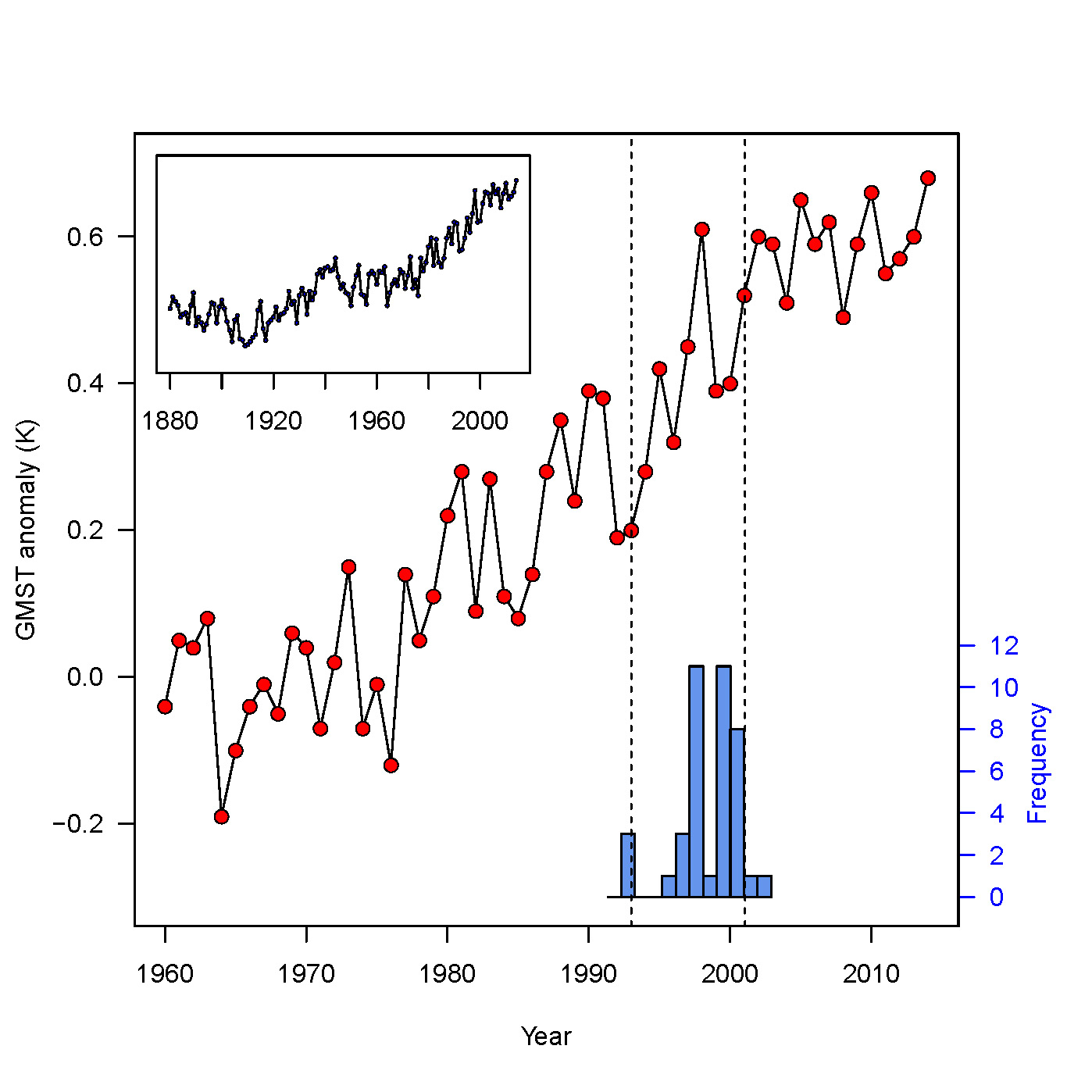
In a second article, just published in Scientific Reports (Lewandowsky et al., 2015b), we followed up on this experimental test with a formal statistical analysis that buttressed the conclusions of the blind expert test. We began by considering a corpus of 40 peer-reviewed articles that have addressed the pause and inferred from those publications what those authors considered to be the onset year of the pause. Did the pause commence in 1998? 2001? Or some other year? We found that there was considerable variation, shown by the blue histogram in the figure below, which shows the distribution of presumed onset times together with global temperatures during the modern record of global warming.
The histogram shows that the presumed onset of the pause spanned an entire decade (19932003). The mean presumed duration of the pause across the 40 articles was 13.5 years. We next took the onset and duration of the pause reported by each article and compared the associated decadal temperature trends against the distribution of all possible trends of equal duration during the last few decades. If there were a pause, we would expect the distribution of trends in the literature to differ considerably from the distribution of all trends of equivalent duration.

Because there is some disagreement about the onset of modern global warming, we used three reference dates for our comparison involving all possible trends: the year 1951, used by the IPCC in AR5, and 1964 and 1976, which are 2 standard deviations below and above and below the mean estimate of the year of onset of modern global warming derived by the Cahill et al. change-point analysis.

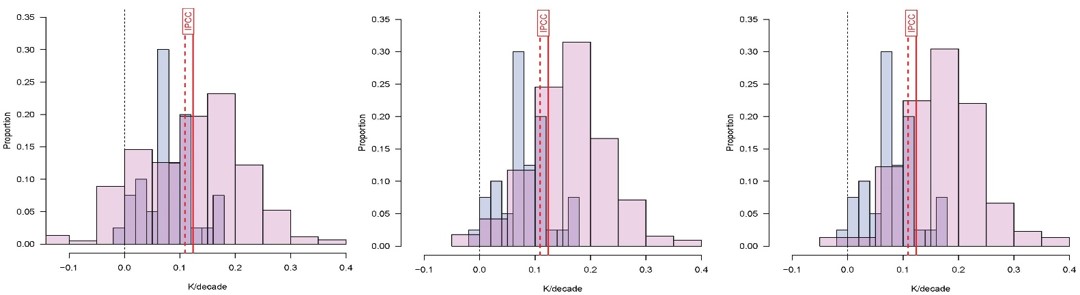
The results are shown in the 3 histograms below, with onset times 1951, 1964, and 1976, from left to right. The vertical red lines in each panel represent the long-term trend (1951–2012) used by the IPCC in the AR5. The solid line is for the GISS dataset analyzed here, and the dashed line is the long-term trend for the same period (0.12 K/decade) in the UK Met Office’s HadCRUT4 data set.


This analysis shows that the distribution of warming trends labeled as the pause by the literature is indistinguishable from the overall distribution of trends that have been observed from the middle of the 20th century onward. When 1964 or 1976 are instead used as onset of warming, then the distribution of trends labeled as a pause does sit at the lower end of the overall distribution, but it is still by no means consistently extreme or unusual.

Additionally, virtually all articles on the pause referred to a time period during which the decadal warming trend exceeded zero (the black vertical line). This is incompatible with standard dictionary definitions of a pause or hiatus, which cite a process that has been suspended or stopped. Periods in which warming continued (>0 K/decade), by definition, cannot be a pause or a hiatus.

For the notion of a hiatus in warming to be scientifically well-founded, there must either be a demonstrable and statistically-relevant absence of any trend in global temperatures or, minimally, the observed trend must differ in a statistically identifiable way from the historical record. With conventional frequentist statistics, the absence of a trend is difficult to establish, and results can be affected by vantage point. That is, different results may arise depending on when one chooses to look backward in time, not because anything notable has happened but because natural variability can override a long-term trend if only brief periods of time are considered and if the end points of the trend are varied.

We therefore compared the alleged pause against all possible historical trends once more, but this time across all possible historical vantage points during the last three decades. From each vantage point, we look backward in time a varying number of years and determine the magnitude and significance of the trend. The results are shown below using GISTEMP:

The top panel (A) shows the warming trends that were observable at any vantage point between 1984 and 2014 (horizontal axis). For each vantage point, between 3 and 25 years were included in the trend calculation (vertical axis). So, for example, looking backward from 2014, no matter how many years were included in the trend, all trends were positive. When 15 years are included, then the trend becomes statistically significant (hence the dot in the cell at latitude 15 for the last column). By contrast, in 2000, the most recent 3 or 4 years exhibited cooling, but by the time 15 years were included the trend was again significant. The bottom panel of the figure (B) presents the same data using a ternary classification of p-values for the linear trend into non-informative (p > 0.10; beige), partially informative but not conventionally significant (0.10 > p > 0.05; gray), and significant (p < 0.05; terracotta). This panel also includes three diagonal lines that identify the earliest calendar year included in the analysis. Any observation to the below and to the right of the line labeled “1975” only includes observations later than that, and so on for the other two lines. The observations above and to the left of the 1965 line go back to 1960 (top-left corner; looking back 25 years from 1984 inclusive).

The figure shows that at every year during the past 30 years of modern global warming, the immediately preceding warming trend was always significant when 17 years (or more) were included in the calculation. In a number of cases—including in 2014—fewer years were required to reach significance, but never more than 17. This result should not be surprising: Significance requires statistical power to be detected, and the more observations are considered the greater the power of the analysis. The fact that a trend fails to reach significance with, say, only 5 or 10 years of data is therefore non-informative: no matter how robust the warming trend, once natural variability is superimposed on the trend, it will escape statistical detection with a small sample. To conclude from that that global warming has “stopped” is unwarranted. Nevertheless, a number of papers in the peer-reviewed literature have done just that. That is, they concluded that there was a pause in warming using a time period that was too short to achieve conventional statistical significance.

To illustrate, we used the definitions of the pause found in our corpus of articles (mean duration 13.5 years), and asked how often the null hypothesis of no warming would fail to be rejected during the last 30 years. It turns out that during those 3 decades, the 14-year trend escaped significance 10 times and the 13-year trend 13 times, suggesting either that global surface warming “paused” between 30% and 43% of a time period during which the Earth warmed 0.6 K overall, or that global surface warming never paused and what we have been observing are routine fluctuations superimposed on a warming trend.

Taken together, the statistical and behavioral evidence demonstrate that the notion of a pause or hiatus—as commonly understood—is incorrect. The evidence from the blind expert test suggests that it is also misleading.

The question of a recent pause in warming is distinct from the matter of fluctuations in warming rates over any particular time period of interest. It is uncontroversial that the climate system is highly variable and, as our analysis shows, there have been many fluctuations, both positive and negative, as compared to the longer term warming trend. It is a valuable research endeavor to examine why these fluctuations occur, and to what extent models and observations may on occasion diverge. Such research has the potential to improve our overall understanding of the climate system.

This brings us to our final issue: If there is no pause and there was no pause, why did the recent period attract so much research attention? We can suggest a number of reasons. One is a matter of semantics. Many articles on the pause addressed not the absence of warming but were concerned with a presumed discrepancy between models and observations. We do not believe that those articles should have been framed in the language of a “pause,” but that does not mean their method or findings are compromised.

A second reason is that owing to the incessant challenge of climate science by highly-vocal contrarians and well-organized Merchants of Doubt, scientists may have become not only reticent in reporting the full spectrum of risk they are concerned about for the future (see for example Brysse et al., 2013), but have also subtly changed the way in which they approach their science. We explored the possible underlying mechanisms for this in an article earlier this year (Lewandowsky et al., 2015c). In a nutshell, we argue that scientists have unwittingly been influenced by a linguistic frame that demonstrably originated outside the scientific community, and that by accepting the word “pause,” scientists have subtly framed their research in ways that our statistical and behavioral analysis has revealed to be inappropriate.

When scientists use the terms “pause” or “hiatus” they may indeed know—and their colleagues may understand—that they do not mean to imply that global warming has stopped. The problem is that words such as “pause” or “hiatus” have vernacular meanings, and when scientists use a term from the public vernacular to describe a feature of science, confusion results when the vernacular term is an inappropriate description of that feature. Scientists might tacitly understand that global warming continues notwithstanding the “pause,” or they may intend “pause” to refer to differences between observed temperatures and model-derived expectations, but the public is not privy to that tacit understanding.

References

  1. N. Cahill, S. Rahmstorf, and A.C. Parnell, "Change points of global temperature," Environ. Res. Lett., 10 (2015) 084002. http://dx.doi.org/10.1088/1748-9326/10/8/084002
  2. S. Lewandowsky, J.S. Risbey, and N. Oreskes, "The “Pause” in Global Warming: Turning a Routine Fluctuation into a Problem for Science," Bull. Amer. Meteor. Soc., (2015) 150914120309001. http://dx.doi.org/10.1175/BAMS-D-14-00106.1
  3. S. Lewandowsky, J.S. Risbey, and N. Oreskes, "On the definition and identifiability of the alleged “hiatus” in global warming," Sci. Rep., 5 (2015) 16784. http://dx.doi.org/10.1038/srep16784
  4. K. Brysse, N. Oreskes, J. O’Reilly, and M. Oppenheimer, "Climate change prediction: Erring on the side of least drama?", Global Environmental Change, 23 (2013) 327-337. http://dx.doi.org/10.1016/j.gloenvcha.2012.10.008
  5. S. Lewandowsky, N. Oreskes, J.S. Risbey, B.R. Newell, and M. Smithson, "Seepage: Climate change denial and its effect on the scientific community," Global Environmental Change, 33 (2015) 1-13. http://dx.doi.org/10.1016/j.gloenvcha.2015.02.013

Wednesday, April 9, 2014

3rd editor resigns from Frontiers journals over retraction of Recursive Fury by Lewandowsky et al.

by Graham Readfearn, DeSmogBlog, April 9, 2014

Three university professors are resigning as editors at a scientific publisher in protest at its decision to retract research linking climate change scepticism to conspiratorial thinking.
Professors Ugo Bardi, of the University of Florence, Italy and Björn Brembs, of the University of Regensburg, Germany, launched scathing attacks on the Switzerland-based publisher Frontiers. Professor Colin Davis, of the University of Bristol, has also resigned in protest.
The academics said the journal should have stood by the authors of the research, with one saying the publishers had caved in to pressure from “delusionals.”
Frontiers staff and the three research authors, led by cognitive psychology professor Stephan Lewandowsky of the University of Bristol, had signed agreements preventing them from discussing the nature of the complaints, but DeSmogBlog revealed sceptics had claimed the research was defamatory.
Brembs described Frontiers' retraction decision as “an outrageous act of a scientific journal caving in to pressure from delusionals” who, he said, were “demanding the science about their publicly displayed delusions be hidden from the world.”
Brembs, an associate editor at Frontiers, wrote on his blog: “Essentially, this puts large sections of science at risk. Clearly, every geocentrist, flat earther, anti-vaxxer, creationist, homeopath, astrologer, diviner, and any other unpersuadable can now feel encouraged to challenge scientific papers in a court.”
Bardi, a chief specialty editor at Frontiers, said he had resigned because the journal “has shown no respect for authors nor for their own appointed referees and editors.”
He said the retraction was another example of the intimidation of scientists working on the climate change issue.
Davis confirmed to DeSmogBlog he had resigned from his associate editor role at Frontiers in Cognitive Science (a specialty journal under the Frontiers in Psychology umbrella). He said: “My resignation was in response to Frontiers' handling of the retraction of the paper by Lewandowsky et al. The retraction itself was very disappointing.”
The research paper, Recursive fury: Conspiracist ideation in the blogosphere in response to research on conspiracist ideation, was carried out while Lewandowsky was at the University of Western Australia. 
Despite the apparent concerns from Frontiers, the Perth-based university has agreed to host the paper on its own web server
The research analysed public comments, mostly by climate science sceptics, made on blogs and then categorized the comments as showing various attributes such as “nefarious intent” and “unreflexive counterfactual thinking.”
The categorized comments were in response to the publication of a previous paper that found a link between climate science denial and the acceptance of conspiracy theories, such as NASA faking the Apollo moon landings.
In a retraction statement, Frontiers said a “detailed investigation” had not identified “any issues with the academic and ethical aspects of the study.”
In the wake of media coverage, Frontiers published a second statement claiming it had not been threatened and that they had not “caved in to threats.” 
Professor Davis told DeSmogBlog he found the second statement “hard to fathom, to put it mildly.”
Frontiers editorial director Costanza Zucca has told Retraction Watch there was “no contradiction between the two statements.”
Frontiers said it “must uphold the rights and privacy of the subjects” named in research, even though the “subjects” were public statements.
DeSmogBlog also revealed that Canadian climate sceptic blogger and mining industry veteran Stephen McIntyre had used quotes illegally hacked from a private internet forum to try and back his complaints.  There is no indication McIntyre was involved in the hack.
The private forum was hosted by the website Skeptical Science, founded by University of Queensland academic John Cook, a co-author of the Recursive study. None of the hacked comments cited by McIntyre were made by any of the authors of the Recursive paper.
Lewandowsky said: “Are public statements by people who knowingly made them in public, subject to scholarly analysis? Or is it only stolen correspondence by third parties made in the expectation of privacy that can be used to allege malice on the part of someone who never said anything malicious himself?”
DeSmogBlog has twice approached Frontiers for comment but has not yet had any response.

Recursive Fury: Resigning from Frontiers, by Bjorn Brembs

by Bjorn Brembs, bjoern.brembs.blog, April 9, 2014

Last month, I was alerted to an outrageous act of a scientific journal caving into pressure from delusionals demanding the science about their publicly displayed delusions be hidden from the world: the NPG-owned publisher Frontiers retracted a scientific article, with which they could not find anything wrong: The article:
attracted a number of complaints which were investigated by the publisher. This investigation did not identify any issues with the academic and ethical aspects of the study. It did, however, determine that the legal context is insufficiently clear and therefore Frontiers wishes to retract the published article.
Essentially, this puts large sections of science at risk. Clearly, every geocentrist, flat earther, anti-vaxxer, creationist, homeopath, astrologer, diviner, and any other unpersuadable can now feel encouraged to challenge scientific papers in a court. No, actually, they don’t even have to do that, they only have to threaten court action and publishers will cave in and retract your paper.
As if we needed any more evidence that publishers are bad for science.
Now even the supposedly “good guys” show that they are not really on the side of science. Instead of at least waiting for a law suit to be filed and perhaps at least attempting to stand their ground (as Simon Singh did), they just took the article down in what can only be called anticipatory obedience. This is no way to serve science.
A week or two ago, I talked with a Frontiers representative on the phone, and she explained a few things to me which prompted me to read the paper in question, so I could make up my own mind. After reading the paper, any of the attempted explanations on the phone rang hollow: I’m certainly not a lawyer, but if taking publicly posted comments and citing them in a scientific paper, discussing them under a given hypothesis which has a scientific track record and plenty of precedence constitutes a cause for libel or defamation lawsuits, it is certainly the law and not the paper which is at fault. It is quite clear, why the content of the paper may feel painful to those cited in it, but as long as “conspirational ideation” is not an official mental disorder, I cannot see any defamation. If you don’t want to be labeled a conspiracy theorist, don’t behave like one publicly on the internet. Therefore, after reading the paper, in my opinion, Frontiers ought to have supported their authors just as their home institution (UWA) is supporting them as their employees.
As the Frontiers representative did not disclose any details and what she was able to disclose was both very general, hence not very convincing, and I promised not to disclose even that, one can only speculate what the motivations and considerations might have been at Frontiers as to why they decided to throw their authors under the bus.
Clearly, if legal problems are cited, it’s always money that’s at stake, I’d be surprised if this were controversial. I have heard through the grapevine that Frontiers apparently may have felt some pressure recently, to make more money, to publish more papers. I was told that they have sent out literally millions of spam emails to addresses harvested from, e.g. , PubMed, soliciting manuscript submissions. Obviously, a costly libel or defamation suit in the UK would not have been a positive on the balance sheets.
Alas, as much fun as all of this speculation may be, it is not really relevant to my conclusion: Frontiers retracted a perfectly fine (according to their own investigation) psychology paper due to financial risks for themselves. It can only be seen as at best a rather lame excuse or at worst rather patronizing, if Frontiers were to claim to be protecting their authors from lawsuits by removing the ‘offending’ article. This is absolutely no way to “empower researchers in their daily work." In the coming days I will send resignation letters to the Frontiers journals to which I have donated my free time for a range of editorial duties. Obviously, I will complete the tasks I have already started, but I will not accept any new tasks at Frontiers – at least not until they show more support of their authors.

Björn Brembs Resigns Editorship At Frontiers Journal Over Recursive Fury Fiasco

by Greg Laden, ScienceBlogs, April 9, 2014


Yesterday, Ugo Bardi resigned his editorship at Frontiers Journal over the Recursive Fury Fiasco. Today, a second editor has done so as well.
You should go read the original post, but here’s a key part of it:
Frontiers retracted a perfectly fine (according to their own investigation) psychology paper due to financial risks for themselves. It can only be seen as at best a rather lame excuse or at worst rather patronizing, if Frontiers were to claim to be protecting their authors from lawsuits by removing the ‘offending’ article. This is absolutely no way to “empower researchers in their daily work“. In the coming days I will send resignation letters to the Frontiers journals to which I have donated my free time for a range of editorial duties.
And now, on a completely unrelated note, for your amusement:

Chief specialty editor resigns from Frontiers in wake of controversial retraction of Recursive Fury paper about climate science denial psychology

by Igor Oransky, Retraction Watch, April 8, 2014

frontiersAn editor at a Frontiers journal has resigned to protest the publisher’s decision to retract the controversial “Recursive Fury” paper that linked climate skepticism to conspiratorial ideation.
Ugo Bardi was chief specialty editor of Frontiers in Energy Research: Energy Systems and Policy. He writes on his blog:

"…my opinion is that, with their latest statement and their decision to retract the paper, Frontiers has shown no respect for authors nor for their own appointed referees and editors. But the main problem is that we have here another example of the climate of intimidation that is developing around the climate issue."
Later, he notes his decision:

"The climate of intimidation which is developing nowadays risks to do great damage to climate science and to science in general. I believe that the situation risks to deteriorate further if we all don’t take a strong stance on this issue. Hence, I am taking the strongest action I can take, that is I am resigning from “Chief Specialty Editor” of Frontiers in protest against the behavior of the journal in the “Recursive Fury” case. I sent to the editors a letter today, stating my intention to resign.

"I am not happy about having had to take this decision, because I had been working hard and seriously at the Frontiers’ specialty journal titled 'Energy Systems and Policy.' But I think it was the right thing to do. I also note that this blunder by “Frontiers” is also a blow to the concept of 'open access' publishing, which was one of the main characteristic of their series of journals. But I still think that open access publishing it is the way of the future. This is just a temporary setback for a good idea which is moving onward."
This is not the first resignation of an editor linked to the publication of a controversial study about climate change. In 2003, half the editorial board of Climate Research, including the editor in chief, left their posts after the journal published a paper concluding that “the 20th century is probably not the warmest or a uniquely extreme climatic period of the last millennium.” In 2011, the editor of Remote Sensing did the same after his journal ran a paper he found deeply questionable. And the resignation of Chris Brierley from the editorial board of Climate last year was for similar reasons.
Meanwhile, Frontiers editorial director Costanza Zucca responded to a request for comment we placed last week about the apparent contradiction between the retraction notice and a later statement by the journal. The former said that the journal “did not identify any issues with the academic and ethical aspects of the study,” while the latter said the paper “did not sufficiently protect the rights of the studied subjects.” Zucca said:

"There is no contradiction between the two statements. The reference to ethical considerations in the original retraction statement is a reference to the ethical clearance for conducting the study given by UWA.

"The issue was not with the study as such, but with how the paper was written. The paper made it possible to explicitly identify subjects." [Note that the resubmitted paper did not, but the journal decided not to publish it anyway.]
Zucca added:

"Frontiers stands by its decision to retract the article, which it considers to have been the right and responsible course of action."
We’ve asked Zucca if the journal has any comment on Bardi’s resignation, and will update with anything we learn.
Update, 10 a.m. Eastern, 4/9/14: Zucca writes:

"We regret Ugo Bardi’s resignation."

http://retractionwatch.com/2014/04/09/chief-specialty-editor-resigns-from-frontiers-in-wake-of-controversial-retraction/

Sunday, April 6, 2014

A Conspiracy And Dunces? Journal Frontiers Tosses Authors Under Bus

by Greg Laden, "Greg Laden's Blog," Science blogs, April 7, 2014

Recently, the OpenAccess journal Frontiers retracted a paper written by Stephan Lewandowsky, John Cook, Klaus Oberauer, and Michael Marriot Hubble called “Recursive fury: Conspiracist ideation in the blogosphere in response to research on conspiracist ideation.” The paper discussed conspiracist ideation as implicated in the rejection of scientific work …
A recent study involving visitors to climate blogs found that conspiracist ideation was associated with the rejection of climate science and the rejection of other scientic propositions such as the link between lung cancer and smoking, and between HIV and AIDS (Lewandowsky, Oberauer, & Gignac, in press; LOG12 from here on). This article analyzes the response of the climate blogosphere to the publication of LOG12. We identify and trace the hypotheses that emerged in response to LOG12 and that questioned the validity of the paper’s conclusions. Using established criteria to identify conspiracist ideation, we show that many of the hypotheses exhibited conspiratorial content and counterfactual thinking. For example, whereas hypotheses were initially narrowly focused on LOG12, some ultimately grew in scope to include actors beyond the authors of LOG12, such as
university executives, a media organization, and the Australian government. The overall pattern of the blogosphere’s response to LOG12 illustrates the possible role of conspiracist ideation in the rejection of science, although alternative scholarly interpretations may be advanced in the future.
Professor of Psychology Stephan Lewandowsky.
Since the retraction it has become clear to me that the journal Frontiers has acted inappropriately. One could argue that the journal has been unethical or possibly libelous and left itself open to very legitimate civil action, but I’m not a lawyer. More importantly for the academic community, Frontiers has demonstrated itself to be dangerous. Academics who publish with this journal in any area where there exists, or could emerge, a community of science denialists or other anti-academic activists risk having their hard work ruined (by retraction) and, astonishingly, risk being accused by the journal itself of unethical behavior that they did not commit. For these reasons, I urge members of the academic community to pressure Frontiers to change their policies and issue appropriate apologies or other remediation. Academics considering submitting material toFrontiers should consider not doing so.
Here are the details.
As stated, “Recursive Fury” paper was retracted by the journal in association with this statement:
In the light of a small number of complaints received following publication of the original research article cited above, Frontiers carried out a detailed investigation of the academic, ethical and legal aspects of the work. This investigation did not identify any issues with the academic and ethical aspects of the study. It did, however, determine that the legal context is insufficiently clear and therefore Frontiers wishes to retract the published article. The authors understand this decision, while they stand by their article and regret the limitations on academic freedom which can be caused by legal factors.
According to the authors, this statement was the outcome of negotiations between them and Frontiers and was part of a legal agreement. The authors tell us that they did not agree with the decision, and were disappointed with it. The Australian Psychological Society and other organizations, such as the Union of Concerned Scientists shared their disappointment with Frontiers’ decision with the authors. Other than that, the authors have had very little to say publicly until now (See: Revisiting a Retraction by Stephan Lewandowsky). In fact, Lewandowsky has continued to serve as a volunteer co-editor for an upcoming issue of the journal, and continues peer reviewing work for them. Furthermore, Lewandowsky and as far as I can tell the other authors have not supported any particular action regarding this screw-up by Frontiers, opting, rather, to let things play out for a period of time.
Then, Frontiers got weird.
The journal released a second, longer, and very different statement about the retraction. When I read the statement I felt it accused the authors of at least two counts of unethical conduct, and the statement indicated that this is why the paper was retracted. So, at this point, Frontiers clearly had lied once or twice (depending on which, if any, of the contradictory statements is true). Also, the assertions made in the second retraction were clearly wrong. As far as I can tell the authors used correct and proper methods for obtaining their data, reporting the data, and reporting the results. Yet, the journal makes an almost explicit statement that the authors acted unethically.
Since the second retraction incorrectly, in my view, accused four well-established academics of unethical behavior, the journal had become dangerous. The second retraction statement notes,
Frontiers came to the conclusion that it could not continue to carry the paper, which does not sufficiently protect the rights of the studied subjects. Specifically, the article categorizes the behaviour of identifiable individuals within the context of psychopathological characteristics.
The source data for this paper was information fully available in public view on the Internet. The data was collected using widely available search engines such as Google. From the methods section:
An on-going web search in real time was conducted by two of the authors (J.C. and M.M.) during the period August-October 2012. This daily search used Google Alerts to detect newly published material matching the search term “Stephan Lewandowsky.” If new blog posts were discovered that featured links to other relevant blog posts not yet recorded, these were also included in the analysis. To ensure that the collection of hypotheses pertaining to LOG12 was exhaustive, Google was searched for links to the originating blog posts (i.e., rst instances of a recursive theory), thereby detecting any further references to the original hypothesis any derivatives
The search for data was later narrowed to focus on a subset of highly active internet sites, but still, all public (even if removed, as per the usual methods of finding blog posts and comments using “wayback machine” like technologies).
I’m not sure if an analogy is really needed here, but this is a bit like a peer-reviewed paper that studies statements made by Winston Churchill in public contexts during World War II. Except the conspiracy-ideationalizing, anti-science, internet trolls aren’t Winston Churchill.
The bottom line regarding Frontiers: If you publish there, and some people don’t like the work you did, they may manipulate Frontiers into throwing you under the bus. If you are an editor there or on the board, you may find yourself unwittingly part of an academic scandal that leaves you liable in part, or simply associated with, extremely questionable behavior. Rather than enhancing careers at the same time it enhances knowledge, this particular journal has become radioactive. My suggestion: Run away.
In order to fully document and underscore the problem, Stephan Lewandowsky has posted a full description of what transpired between the authors and the journal. It is posted HERE.
A few bullet points taken from the text and modified slightly (to be bullet points):
  • In the second statement, the journal seemed to state that the paper was retracted because it “did not sufficiently protect the rights of the studied subjects.”
  • In the contractually-agreed retraction statement, signed by legal representatives of both parties, that Frontiers “…did not identify any issues with the academic and ethical aspects of the study.”
  • In the second statement the journal said that it had received no (presumably legal) threats.
  • There exist public statements of individuals who explicitly stated that they had threatened the journal or had launched defamation complaints (see Lewandowsky’s post for links). Also, this claim contradicts the contractually-agreed retraction statement, which ascribed the retraction to an “insufficiently clear” legal context.
  • This legal context involved English libel laws in force prior to 2014. Those laws were sufficiently notorious for their chilling effect on inconvenient speech for President Obama to sign a law that makes U.K. libel judgments unenforceable in the U.S.
  • Frontiers revealed the existence of a new paper that we submitted in January 2014 and that according to their latest statement “did not deal adequately with the issues raised by Frontiers.”
In his post, Lewandowsky provides a detailed summary of events behind the scenes. Read his post to get these details. The crux of it is this: Frontiers had told the authors that there were no ethical issues with the paper, but a few changes might be made to reduce legal risks. Further back and forth happened, and during this time the legal liability context changed because of changes in English libel law. A second “replacement” article was produced, apparently going beyond and above what was necessary, but for some reason Frontiers chose not to use it. (They give a reason, but the reason seems weak given what we know about the article and about what Frontiers was asking for.)
Lewandowsky sums up as follows:
Throughout the entire period, from March 2013 until February 2014, the only concern voiced by Frontiers related to the presumed defamation risk under English libel laws. While the University of Western Australia offered to host the retracted paper at uwa.edu.au/recursivefury because it did not share those legal concerns, Frontiers rejected an anonymized replacement paper on the basis that non-identifiable parties might feel defamed.
No other cause was ever offered or discussed by Frontiers to justify the retraction of Recursive Fury. We are not aware of a single mention of the claim that our study “did not sufficiently protect the rights of the studied subjects” by Frontiers throughout the past year, although we are aware of their repeated explicit statements, in private and public, that the study was ethically sound.
This brings into focus several possibilities for the reconciliation of Frontier’s contradictory statements concerning the retraction:
First, one could generously propose that the phrase “did not sufficiently protect the rights of the studied subjects” is simply a synonym for “defamation risk” and that the updated statement therefore supports the contractually-agreed statement. This is possible but it puts a considerable strain on the meaning of “synonym.”
Second, one could take the most recent statement by Frontiers at face value. This has two uncomfortable implications: It would imply that the true reason for the retraction was withheld from the authors for a year. It would also imply that the journal entered into a contractual agreement about the retraction statement that misrepresented its actual position.
Third, perhaps the journal only thought of this new angle now and in its haste did not consider that it violates their contractually-agreed position.
Or there are other possibilities that we have not been able to identify.
I just noticed that Frontiers has struck up some sort of arrangement to work with the internationally known and usually (but not always) venerated Nature Publishing Group. I wonder if this means that Nature Publishing Group has lowered its ethical standards, or if Frontiers will be made to make amends to these authors and the rest of the academic community.
http://scienceblogs.com/gregladen/2014/04/06/a-conspiracy-and-dunces-journal-frontiers-tosses-authors-under-bus/