by Tim Radford, Climate News Network, March 29, 2015
LONDON – Scientists in the US report that the volume of Antarctic shelf ice is diminishing, and that there has been an 18% shrinkage in the mass of some ice floating on coastal waters over the last 18 years.
And because much of the loss has been off West Antarctica, where shelf ice helps to keep the ice sheet stable, it could mean that global sea levels will rise even faster as a result of increased glacial flow into the ocean.
The findings once again raise concern about the link between man-made emissions of greenhouse gases and the dangerous new world of global warming, climate change and sea level rise.
Fernando Paolo, a researcher at the Scripps Institution of Oceanography at the University of California, San Diego, and colleagues report in the journal Science that they used continuous radar altimetry measurements − taken from three European Space Agency satellites between 1994 and 2012 − to compose a high-resolution record of shelf ice thickness.
Declined swiftly
They found that the total volume of shelf ice – the thickness multiplied by the shelf area – around Antarctica stayed more or less the same from 1994 to 2003, but then declined very swiftly.
The ice shelves of West Antarctica lost ice during the entire period, and although East Antarctica had been gaining shelf ice, these gains ceased after 2003. Some shelves had lost 18% of their volume.
“Eighteen per cent over the course of 18 years really is a substantial change,” Paolo says. “Overall, we show not only that the total ice shelf volume is decreasing, but we see an acceleration in the last decade.”
Shelf ice is frozen sea, so when it melts, it makes no difference to sea levels. But there could be an indirect effect.
“The ice shelves buttress the flow from grounded ice into the ocean, and that flow impacts sea levels rise, so that’s a key concern from our new study,” says co-author Helen Fricker, a glaciologist at the Scripps Institution.
In climate science, one such study is never enough: such conclusions need support from other studies. But the ice volume measurements are likely to add to growing concern about West Antarctica.
One earlier study looked at the potential loss of ice from West Antarctica by examining the “grounding lines” of the terrestrial glaciers, and found evidence of continuous and accelerating retreat. In effect, the West Antarctic ice sheet could be approaching a point of no return, scientists reported.
And a second group used other satellite measurements to calculate that ice was being lost from the southern continent at an increasing rate – around 150 cubic kilometres a year from West Antarctica.
So the Scripps study indirectly backs up earlier findings. It calculates that most mass has been lost from ice shelves in the Amundsen and Bellingshausen seas, off the coast of West Antarctica. These account for less than 20% of the total West Antarctic ice-shelf area, but contribute more than 85% of the total ice-shelf volume loss from West Antarctica.
Slow process
Were the West Antarctic ice sheet to melt completely – a long, slow process at almost any temperatures – sea levels would rise by more than three metres worldwide.
At current rates, a couple of the ice shelves off the western coast of the continent could disappear completely within 100 years, the Scripps team says.
Although the Arctic is one of the fastest-warming places on the planet, and although this warming has been directly linked to man-made climate change, the pattern of temperature shifts in the southern hemisphere has been more ambiguous.
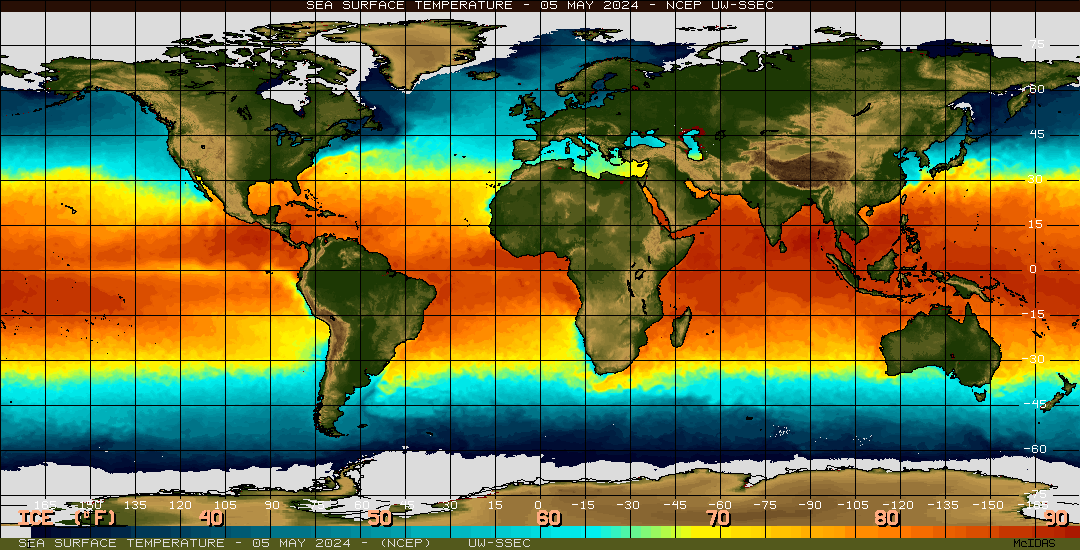
The Scripps team have now begun to think about possible reasons for the loss of shelf ice in the far south, and one factor might be the cycle of El Niño events – natural and periodic bubbles of Pacific ocean warmth that have waxed and waned at intervals and changed the prevailing weather patterns worldwide through history.
“We’re looking into connections between El Niño events in the tropical Pacific and changes in the Antarctic ice sheet,” Paolo says. “It’s very far apart, but we know these teleconnections exist. That may ultimately allow us to improve our models for predicting future ice loss.”
Showing posts with label teleconnections. Show all posts
Showing posts with label teleconnections. Show all posts
Saturday, April 18, 2015


Wednesday, April 16, 2014
Unexpected Teleconnections in Noctilucent Clouds
NASA, April 16, 2014: Earth's poles are separated by four oceans, six continents and more than 12,000 nautical miles.
Turns out, that's not so far apart.
New data from NASA's AIM spacecraft have revealed "teleconnections" in Earth's atmosphere that stretch all the way from the North Pole to the South Pole and back again, linking weather and climate more closely than simple geography would suggest.

For example, says Cora Randall, AIM science team member and Chair of the Dept. of Atmospheric and Oceanic Sciences at the University of Colorado, "we have found that the winter air temperature in Indianapolis, Indiana, is well correlated with the frequency of noctilucent clouds over Antarctica."
Noctilucent clouds, or "NLCs," are Earth's highest clouds. They form at the edge of space 83 km above our planet's polar regions in a layer of the atmosphere called the mesosphere. Seeded by "meteor smoke," NLCs are made of tiny ice crystals that glow electric blue when sunlight lances through their cloud-tops.
AIM was launched in 2007 to investigate these "night-shining" clouds, to discover how they form and to learn about their inner chemistry. As is often the case, however, when exploring the unknown, researchers found something they weren't even looking for: teleconnections.
"It has been a surprise," says Hampton University professor of atmospheric and planetary science James Russell, Principal Investigator of the AIM mission. "Years ago when we were planning the AIM mission, our attention was focused on a narrow layer of the atmosphere where NLCs form. Now we are finding out this layer manifests evidence of long-distance connections in the atmosphere far from the NLCs themselves."
One of these teleconnections links the Arctic stratosphere with the Antarctic mesosphere.
"Stratospheric winds over the Arctic control circulation in the mesosphere," explains Randall. "When northern stratospheric winds slow down, a ripple effect around the globe causes the southern mesosphere to become warmer and drier, leading to fewer NLCs. When northern winds pick up again, the southern mesosphere becomes colder and wetter, and the NLCs return."

This January, a time of year when southern NLCs are usually abundant, the AIM spacecraft observed a sudden and unexpected decline in the clouds. Interestingly, about two weeks earlier, winds in the Arctic stratosphere were strongly perturbed, leading to a distorted polar vortex.
"We believe that this triggered a ripple effect that led to a decline in noctilucent clouds half-way around the world," says Laura Holt of the University of Colorado's Laboratory for Atmospheric and Space Physics. "This is the same polar vortex that made headlines this winter when parts of the USA experienced crippling cold and ice."
Holt took a careful look at meteorological data and found that, indeed, there was a statistical link between winter weather in the USA and the decline in noctilucent clouds over Antarctica.
"We picked Indianapolis as an example, because I have family living there," says Randall, "but the same was true of many northern cities: cold air temperatures on the ground were correlated with NLC frequencies high above Antarctica two weeks later," she says.
The two week delay is, apparently, how much time it takes for the teleconnection signal to propagate through three layers of atmosphere (the troposphere, stratosphere and mesosphere), and from pole to pole.
It is a complicated topic, but this much is clear: "NLCs are a valuable resource for studying long-distance connections in the atmosphere," says Russell, "and we are just getting started."
Author: Dr. Tony Phillips | Production editor: Dr. Tony Phillips | Credit: Science@NASA
More information:
Electric-Blue Clouds Appear over Antarctica -- Science@NASA
Meteor Smoke Makes Strange Clouds -- Science@NASA
Strange Clouds at the Edge of Space -- Science@NASA
Subscribe to:
Posts (Atom)

 Posts
Posts