by Peter Hannam, Environmental Editor, The Sydney Morning Herald, May 14, 2016
For John Church, a leading authority on sea-level rise caused by global warming, there was much that was fitting – and yet callous – about being sacked at sea.
The veteran scientist was well into one of dozens of research voyages he had taken since joining CSIRO as a post doctoral student in 1979.
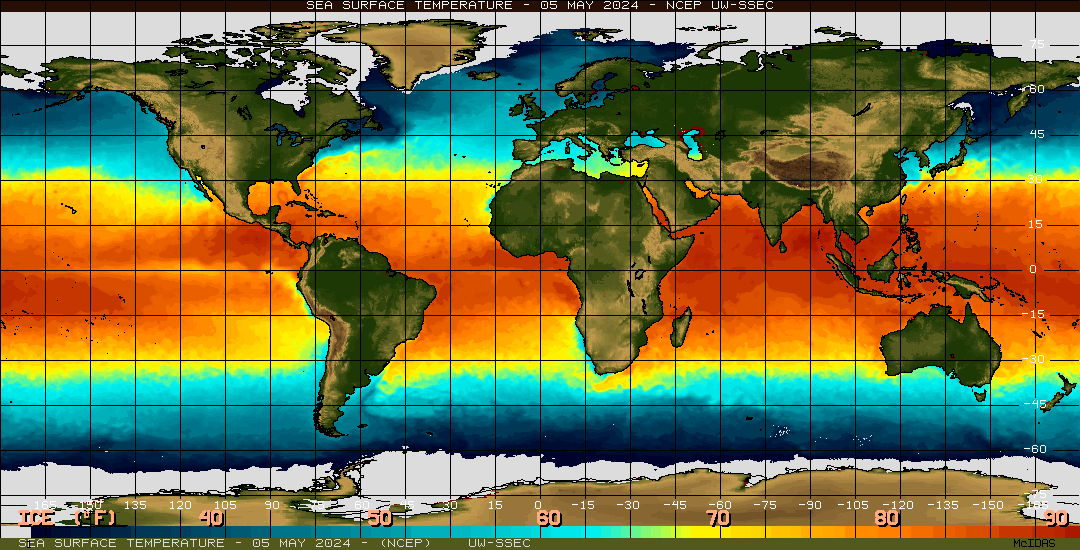
His vessel, the RV Investigator, was midway between Antarctica and New Zealand and steaming north on the 170 degree longitude when he received Thursday's call to tell him he was "potentially redundant." (See map below.)

John Church speaks to the media about proposed cuts to the CSIRO. Photo: Penny Stephens

Sitting with a supporter in the ship's conference room, Dr Church was told his services were no longer needed.
"I was OK during the call but it is certainly not a nice feeling to have what you have worked for – for so many years – thrown on the scrapheap," the 64-year-old told Fairfax Media after finishing a 12-hour stint on watch.

CSIRO's RV Investigator on one of its research voyages. Photo: Pete Harmsen
Accelerating sea-level rises
Dr Church's achievements include developing sophisticated models linking sparse tidal gauge information around the world with satellite data to reveal how much sea levels are rising.
The current mission is retracing previous journeys along the 170 W longitude line to measure precisely how key parameters such as temperature, salinity and acidity are changing.

As Dr Church notes, including in a Nature paper published last month, sea-level increases are accelerating as a warming planet melts glaciers and swells oceans.
From increases of a few tenths of a millimetre annually in the 1,000 years before about 1850, the rate jumped 1.7 mm on average in the 20th century. Since 1993, the rise has quickened to about 3 mm a year, he says. [It's now 3.4 mm/yr.]
Despite this trend, CSIRO will slash about half the climate staff – about 70 scientists – in its Oceans & Atmosphere division. New hires will be made in climate adaptation and mitigation, the agency promises but numbers cited so far are much smaller.
As with other CSIRO staff, Dr Church will get a chance to save his job. The sole scientist on board to be told of a pending redundancy, he was granted until June 16 – or three weeks after the voyage ends in Wellington, New Zealand – to argue his case.
Letter of support
Scientists from leading research agencies, such as NASA of the US and France's CNES, have called for Dr Church's group to be retained.
In a letter sent to Prime Minister Malcolm Turnbull and Science Minister Christopher Pyne obtained by Fairfax Media, the scientists said the team was key for global efforts to collect and analyse climate change processes.
"Breaking up the long-term research program of this world-famous CSIRO Oceans and Atmosphere unit is a catastrophic short-sighted management decision," the letter said.
"In addition to the detrimental effect on research and accuracy of predictions for the Australian region, this decision will also impact on the international collaboration programmes, built up progressively over the last 20 years."
Fairfax Media sought comment from Minister Pyne, and the PM's office.
Kim, Carr, Labor's shadow science minister, said "the actions of the CSIRO will only see Australia's best and brightest leave our shores for other countries who are in demand for their talent and expertise."
"Malcolm Turnbull says he wants to create an ideas boom, but all he is creating is the largest brain drain in Australia's history."
Greens Senator Peter Whish-Wilson said CSIRO executives had shown "monumental disrespect" to Dr Church by effectively issuing him his redundancy notice while at sea.
"John Church won the CSIRO Medal for Research Achievement in 2006 and is the world leader in sea-level rise research," Senator Whish-Wilson said.
"If CSIRO aren't holding onto John, then they aren't serious about continuing to engage in sea-level rise and I urge the board of CSIRO to stop this process immediately."
A CSIRO spokesman said it would not comment on discussions with staff: "All of the talks and negotiations at present have the same goal of ensuring the excellent science and the long-term future of CSIRO is maintained."
'Inconceivable to the world'
Rosemary Morrow, one of the letter's authors, said CSIRO's undermining of its oceans expertise "is just inconceivable to the rest of the world. Especially for a country at the crossroads of so many evolving climate modes – of droughts and driving rains."
Dr Morrow added a personal touch, saying Dr Church had been the ideal mentor when she studied in Hobart.
"John was a great PhD supervisor – interested, curious, with a wide oceanographic knowledge and a patient teacher," she said. "I was very lucky to have him…it was a very motivating start to my professional life."
Andy Pitman, head of the ARC Centre of Excellence for Climate System Science based at the University of NSW, said Dr Church was "the world's premier scientist" in sea-level research.
"Sacking John risks 30 years of accumulated science knowledge and the capability of transferring that knowledge to the next generation of scientists," Professor Pitman said.
"Sacking John risks 30 years of accumulated science knowledge and the capability of transferring that knowledge to the next generation of scientists," Professor Pitman said.
"If you have a batsman averaging over 100 in cricket, it's a cause for national celebration. In science, the accumulation of runs over time provides insight and understanding that is irreplaceable," said Professor Pitman. "CSIRO has just sacked its Bradman of sea-level science."
Outspoken
Dr Church, who has been among the most outspoken scientists criticising the current round of CSIRO job cuts, was told one reason for his firing was the need to consolidate sea-level change into regional impacts.
"This is essentially a repetition of [chief executive] Larry Marshall's incomplete, naive and misleading statements, except for a focus on my area of science," he said.
"Any reading of the literature or of the most recent [Intergovernmental Panel on Climate Change] reports would clearly indicate that the overriding uncertainty in sea level remains the amount and distribution of sea level rise," he said.
Also mentioned was the cutback of external funds, including the Abbott government's ending of the Australian Climate Change Science Program that had been funded from 1990 until June this year.
Various clashes in recent years with management "probably did not earn me any favours, but I do not know if I was targeted because I was prepared to think for myself and to speak out," Dr Church said. "Personally, that is what I think the taxpayer expects from their scientists."
Dr Church says he will take a short break after a stressful few months finishing research and confronting "the CSIRO disaster."
But he's unlikely to be marooned for long, with fellowships and other roles in the offing.
"Sea-level rise is a long-term issue," he says, noting that without emissions reductions, the world is committed to seas rising several metres over coming centuries.
"These will become critical issues without major and urgent greenhouse gas mitigation for the many millions of people living near the coast," he says.
http://www.smh.com.au/environment/climate-change/global-sealevel-expert-john-church-made-to-walk-the-plank-by-csiro-20160513-gov0k9.html



 Posts
Posts