Blog Archive

Showing posts with label Ocean chemistry. Show all posts

Monday, May 8, 2017

Joe Romm: Carbon pollution is suffocating ocean life and speeding up the next mass extinction

Oxygen levels ‘falling 2 to 3 times faster than predicted’ in our warming oceans, study finds


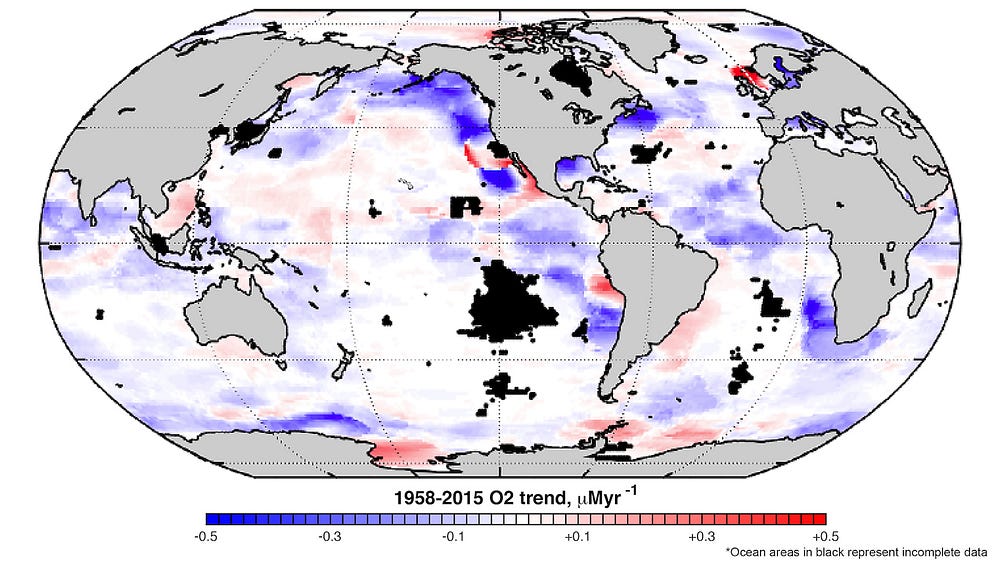
Much of the ocean is seeing sharp drops in oxygen levels (purple). CREDIT: Georgia Tech.

by Joe Romm, Climate Progress, May 8, 2017
Depletion of dissolved oxygen in our oceans, which can cause dead zones, is occurring much faster than expected, a new study finds.
And by combining oxygen loss with ever-worsening ocean warming and acidification, humans are re-creating the conditions that led to the worst-ever extinction, which killed over 90% of marine life 252 million years ago.
Researchers at Georgia Institute of Technology reviewed ocean data going back to 1958 and “found that oxygen levels started dropping in the 1980s as ocean temperatures began to climb.”
Scientists have long predicted that as carbon pollution warms the globe, the amount of oxygen in our oceans would drop, since warmer water can’t hold as much dissolved gas as colder water. And, Georgia Tech researchers point out, falling oxygen levels have recently led to more frequent low-oxygen events that “killed or displaced populations of fish, crabs and many other organisms.”
But what is especially worrisome about this new research is how quickly it is happening. “The trend of oxygen falling is about two to three times faster than what we predicted from the decrease of solubility associated with the ocean warming,” said lead researcher Prof. Taka Ito. “This is most likely due to the changes in ocean circulation and mixing associated with the heating of the near-surface waters and melting of polar ice.”
Global warming drives ocean stratification — the separation of the ocean into relatively distinct layers. This in turn speeds up oxygen loss, as explained in this 2015 video.


2011 study, “Rapid expansion of oceanic anoxia immediately before the end-Permian mass extinction,” found that rapid and widespread anoxia (absence of oxygen) preceded “the largest mass extinction in Earth history, with the demise of an estimated 90 percent of all marine species.”
As National Geographic reported in 2015, we’re already starting to see the impacts of anoxia. “The waters of the Pacific Northwest, starting in 2002, intermittently have gotten so low in oxygen that at times they’ve smothered sea cucumbers, sea stars, anemones, and Dungeness crabs,” the magazine reported.
Finally, a 2015 study found there is no techno-fix to prevent a catastrophic collapse of ocean life for centuries if not millennia if we continue current CO2 emissions trends through 2050.
If we don’t start slashing carbon pollution, then, as co-author John Schellnhuber put it, “we will not be able to preserve ocean life as we know it.”
Thanks to Samantha Page.

Thursday, April 13, 2017

WaPo: By 2030, half the world’s oceans could be reeling from climate change, scientists say

 
More than half the world’s oceans could suffer multiple symptoms of climate change over the next 15 years, including rising temperatures, acidification, lower oxygen levels and decreasing food supplies, new research suggests. By mid-century, without significant efforts to reduce warming, more than 80% could be ailing — and the fragile Arctic, already among the most rapidly warming parts of the planet, may be one of the regions most severely hit.
The study, published Tuesday in the journal Nature Communications uses computer models to examine how oceans would fare over the next century under a business-as-usual trajectory and a more moderate scenario in which the mitigation efforts promised under the Paris Agreement come into effect. In both scenarios, large swaths of the ocean will be altered by climate change.
Nearly all of the open sea is acidifying because of greenhouse gas emissions. But the researchers found that cutting greenhouse gas emissions could significantly delay future changes, giving marine organisms more time to migrate or adapt.
“Things that live in the ocean are used to regular variability in their environments,” said lead study author Stephanie Henson, a scientist at the National Oceanography Center at the University of Southampton in Britain. “It gets warm in the summer and it gets cold in the winter, and species survive that kind of range in temperature or other conditions perfectly well.”
But she noted a warming climate could eventually cause changes in the ocean that have never happened before — hotter temperatures, lower pH or less oxygen than have ever naturally occurred. When this happens, some organisms may no longer be able to tolerate the changed conditions and will be forced to migrate, evolve as a species or face possible extinction.
There’s a large degree of uncertainty in the scientific community about how organisms will react. But there’s evidence to suggest major challenges ahead. Mass coral bleaching events in the past few years have been largely attributed to unusually warm water temperatures. Large-scale coral death on the Great Barrier Reef last year is thought to be strongly linked to climate change.

“So we wanted to know when will climate change actually push the system outside the range of natural variability that organisms are used to,” Henson said.
The researchers focused on four specific climate-influenced “drivers,” of marine ecosystems: temperature, pH, oxygen levels and “primary production,” or how much food is available to a community.
Some parts of the ocean are already experiencing certain climate-driven changes beyond the limits of their natural conditions. The researchers note in the paper that 99% of the open ocean is experiencing a climate-driven change in pH, or ocean acidification. The subtropics and the Arctic are also experiencing sea surface temperatures beyond their natural ranges. And these changes will only continue to spread.
Under a business-as-usual climate scenario, the researchers found an alarming portion of the ocean will be affected by changes in multiple drivers at once. By 2030, they projected, 55% of the world’s oceans will experience changes in more than one of these factors — temperature and pH, most commonly — beyond the range of natural variability. By 2050, this number rises to 86%.
The researchers focused on areas where multiple changes are occurring at once. “We think that multiple different factors occurring at the same time probably have different responses in the marine environment than just one factor at a time,” Henson said. “So, for example, the combination of warming and ocean acidification may be even more detrimental than just one of those factors alone.”
The projections suggest climate mitigation can stall these effects — at least for a little while. Under the moderate climate scenario, the researchers found, 34% of the ocean will be affected by changes in multiple drivers, and 69% by 2050. In general, they concluded that climate mitigation can delay the onset of climate-influenced changes by about 20 years.
“Mitigation doesn’t stop the emergence of multiple different stressors in the ocean, but it does slow things down quite significantly,” Henson noted.
This delay could buy time for organisms to move or adapt to their surroundings, the researchers said. Fast-moving fish may be able to migrate to more hospitable waters, while organisms with speedy generation times, such as plankton, may be able to quickly evolve to their changing environments.
On the other hand, organisms in places with very stable environments and low natural variability in their conditions — the subtropics, for instance — may be especially vulnerable to future, climate-driven changes. Certain parts of the world are also likely to see more rapid changes than others. Their projections suggest that the Arctic will be a particular “hotspot” for changes in temperature, pH and oxygen content.
Scientists are still struggling to figure out which organisms are mostly likely to adapt or move — and which are most likely to die. But they do know there are bound to be winners and losers and that some changes to marine communities are likely to be long-lasting, if not permanent — long after greenhouse gas emissions have been curbed.

Monday, May 6, 2013

BBC: Arctic Ocean 'acidifying rapidly'


Saunders Island and Wolstenholme Fjord with Kap Atholl in the background is shown in this picture taken during an Operation IceBridge survey flight in April 2013

Related Stories

The Arctic seas are being made rapidly more acidic by carbon-dioxide emissions, according to a new report.
They say even if CO2 emissions stopped now, it would take tens of thousands of years for Arctic Ocean chemistry to revert to pre-industrial levels.
Many creatures, including commercially valuable fish, could be affected.
They forecast major changes in the marine ecosystem, but say there is huge uncertainty over what those changes will be.
It is well known that CO2 warms the planet, but less well-known that it also makes the alkaline seas more acidic when it is absorbed from the air.

The Arctic

arctic volcano
  • The Arctic region contains a vast ice-covered ocean roughly centred on the Earth's geographic North Pole
  • The Sun doesn't rise at all on the shortest day of the year within the Arctic Circle
  • Humans have inhabited the Arctic region for thousands of years, and the current population is four million
  • Geologists estimate the Arctic may hold up to 25% of the world's remaining oil and natural gas
Absorption is particularly fast in cold water so the Arctic is especially susceptible, and the recent decreases in summer sea ice have exposed more sea surface to atmospheric CO2.
The Arctic's vulnerability is exacerbated by increasing flows of freshwater from rivers and melting land ice, as freshwater is less effective at chemically neutralising the acidifying effects of CO2.
The researchers say the Nordic Seas are acidifying over a wide range of depths - most quickly in surface waters and more slowly in deep waters.
The report’s chairman, Richard Bellerby from the Norwegian Institute for Water Research, told BBC News that they had mapped a mosaic of different levels of pH across the region, with the scale of change largely determined by the local intake of freshwater.
“Large rivers flow into the Arctic, which has an enormous catchment for its size,” he said.
“There’s slow mixing so in effect we get a sort of freshwater lens on the top of the sea in some places, and freshwater lowers the concentration of ions that buffers pH change. The sea ice has been a lid on the Arctic, so the loss of ice is allowing fast uptake of CO2.”
This is being made worse, he said, by organic carbon running off the land – a secondary effect of regional warming.
“Continued rapid change is a certainty,” he said.
“We have already passed critical thresholds. Even if we stop emissions now, acidification will last tens of thousands of years. It is a very big experiment.”
The research team monitored decreases in seawater pH of about 0.02 per decade since the late 1960s in the Iceland and Barents seas.
Chemical effects related to acidification have also been encountered in surface waters of the Bering Strait and the Canada Basin of the central Arctic Ocean.
Scientists estimate that the average acidity of surface ocean waters worldwide is now about 30% higher than before the Industrial Revolution.
The researchers say there is likely to be major change to the Arctic marine ecosystem as a result. Some key prey species like sea butterflies may be harmed. Other species may thrive. Adult fish look likely to be fairly resilient but the development of fish eggs might be harmed. It is too soon to tell.

Tuesday, January 29, 2013

"Limiting global warming to 2 °C is unlikely to save most coral reefs," by K. Frieler et al., Nature Climate Change, 3 (2013); doi: doi:10.1038/nclimate1674

Nature Climate Change, 3 (2013) 165-170; doi: doi:10.1038/nclimate1674

Limiting global warming to 2°C is unlikely to save most coral reefs

Abstract

Mass coral bleaching events have become a widespread phenomenon causing serious concerns with regard to the survival of corals. Triggered by high ocean temperatures, bleaching events are projected to increase in frequency and intensity. Here, we provide a comprehensive global study of coral bleaching in terms of global mean temperature change, based on an extended set of emissions scenarios and models. We show that preserving >10% of coral reefs worldwide would require limiting warming to below 1.5°C (atmosphere–ocean general circulation models (AOGCMs) range: 1.3–1.8°C) relative to pre-industrial levels. Even under optimistic assumptions regarding corals’ thermal adaptation, one-third (9–60%, 68% uncertainty range) of the world’s coral reefs are projected to be subject to long-term degradation under the most optimistic new IPCC emissions scenario, RCP3-PD. Under RCP4.5 this fraction increases to two-thirds (30–88%, 68% uncertainty range). Possible effects of ocean acidification reducing thermal tolerance are assessed within a sensitivity experiment.

At a glance

Link: http://www.nature.com/nclimate/journal/v3/n2/full/nclimate1674.html

Sunday, December 9, 2012

Eight examples of where the IPCC has missed the mark on its predictions and projections


by Glenn Scherer, The Daily Climate, December 6, 2012

Scientists will tell you: There are no perfect computer models. All are incomplete representations of nature, with uncertainty built into them. But one thing is certain: Several fundamental projections found in Intergovernmental Panel on Climate Change reports have consistently underestimated real-world observations, potentially leaving world governments at doubt as to how to guide climate policy.

emissionsEmissions 

At the heart of all IPCC projections are "emission scenarios:" low-, mid-, and high-range estimates for future carbon emissions. From these "what if" estimates flow projections for temperature, sea-rise, and more. 
Projection: In 2001, the IPCC offered a range of fossil fuel and industrial emissions trends, from a best-case scenario of 7.7 billion tons of carbon released each year by 2010 to a worst-case scenario of 9.7 billion tons.
Reality: In 2010, global emissions from fossil fuels alone totaled 9.1 billion tons of carbon, according to federal government's Earth Systems Research Laboratory.
Why the miss? While technically within the range, scientists never expected emissions to rise so high so quickly, said IPCC scientist Christopher Fields. The IPCC, for instance, failed to anticipate China's economic growth, or resistance by the United States and other nations to curbing greenhouse gases.
"We really haven't explored a world in which the emissions growth rate is as rapid as we have actually seen happen," Fields said.

Temperature

IPCC models use the emission scenarios discussed above to estimate average global temperature increases by the year 2100.
warming-300
Projection: The IPCC 2007 assessment projected a worst-case temperature rise of 4.311.5 °F, with a high probability of 7.2 °F.
Reality: We are currently on track for a rise of between 6.3 and 13.3 °F, with a high probability of an increase of 9.4 °F by 2100, according to the Massachusetts Institute of Technology. Other modelers are getting similar results, including a study published earlier this month by the Global Carbon Project consortium confirming the likelihood of a 9 ºF rise.
Why the miss? IPCC emission scenarios underestimated global CO2 emission rates, which means temperature rates were underestimated too. And it could get worse: IPCC projections haven’t included likely feedbacks such as large-scale melting of Arctic permafrost and subsequent release of large quantities of CO2 and methane, a greenhouse gas 20 times more potent, albeit shorter lived, in the atmosphere than carbon dioxide.

Arctic Meltdown

Five years ago, the summer retreat of Arctic ice wildly outdistanced all 18 IPCC computer models, amazing IPCC scientists. It did so again in 2012.
ice-600Projection: The IPCC has always confidently projected that the Arctic ice pack was safe at least until 2050 or well beyond 2100.
Reality: Summer ice is thinning faster than every climate projection, and today scientists predict an ice-free Arctic in years, not decades. Last summer, Arctic sea ice extent plummeted to 1.32 million square miles, the lowest level ever recorded – 50% below the long-term 19792000 average. 
Why the miss? For scientists, it is increasingly clear that the models are under-predicting the rate of sea ice retreat because they are missing key real-world interactions.
"Sea ice modelers have speculated that the 2007 minimum was an aberration… a matter of random variability, noise in the system, that sea ice would recover.… That no longer looks tenable," says IPCC scientist Michael Mann. "It is a stunning reminder that uncertainty doesn't always act in our favor."

Ice Sheets

Greenland and Antarctica are melting, even though IPCC said in 1995 that they wouldn’t be. 
Projection: In 1995, IPCC projected "little change in the extent of the Greenland and Antarctic ice sheets… over the next 50100 years." In 2007 IPCC embraced a drastic revision: "New data… show[s] that losses from the ice sheets of Greenland and Antarctica have very likely contributed to sea level rise over 1993 to 2003." 
Today, ice loss in Greenland and Antarctica is trending at least 100 years ahead of projections compared to IPCC's first three reports.
Reality: Today, ice loss in Greenland and Antarctica is trending at least 100 years ahead of projections compared to IPCC's first three reports.
Why the miss? "After 2001, we began to realize there were complex dynamics at work – ice cracks, lubrication and sliding of ice sheets," that were melting ice sheets quicker, said IPCC scientist Kevin Trenberth. New feedbacks unknown to past IPCC authors have also been found. A 2012 study, for example, showed that the reflectivity of Greenland's ice sheet is decreasing, causing ice to absorb more heat, likely escalating melting. 

Sea-Level Rise 

The fate of the world's coastlines has become a classic example of how the IPCC, when confronted with conflicting science, tends to go silent.
Projection: In the 2001 report, the IPCC projected a sea rise of 2 mm per year. The worst-case scenario in the 2007 report, which looked mostly at thermal expansion of the oceans as temperatures warmed, called for up to 1.9 feet of sea-level-rise by century's end.
Today: Observed sea-level-rise has averaged 3.3 mm per year since 1990. By 2009, various studies that included ice-melt offered drastically higher projections of between 2.4 and 6.2 feet sea level rise by 2100.
Why the miss? IPCC scientists couldn't agree on a value for the contribution melting Greenland and Antarctic ice sheets would add to sea-level rise. So they simply left out the data to reach consensus. Science historian Naomi Oreskes calls this – one of IPCC's biggest underestimates – "consensus by omission." 

Ocean Acidification

To its credit, the IPCC admits to vast climate change unknowns. Ocean acidification is one such impact.
Projection: Unmentioned as a threat in the 1990, 1995 and 2001 IPCC reports. First recognized in 2007, when IPCC projected acidification of between 0.14 and 0.35 pH units by 2100. “While the effects of observed ocean acidification on the marine biosphere are as yet undocumented,” said the report, “the progressive acidification of oceans is expected to have negative impacts on marine shell-forming organisms (e.g., corals) and their dependent species.”
Reality: The world’s oceans absorb about a quarter of the carbon dioxide humans release annually into the atmosphere. Since the start of the Industrial Revolution, the pH of surface ocean waters has fallen by 0.1 pH units. Since the pH scale is logarithmic, this change represents a stunning 30 percent increase in acidity.
Why the miss? Scientists didn’t have the data. They began studying acidification by the late 1990s, but there weren’t many papers on the topic until mid-2000, missing the submission deadline for IPCC’s 2001 report. Especially alarming are new findings that ocean temperatures and currents are causing parts of the seas to become acidic far faster than expected, threatening oysters and other shellfish. 
National Oceanic and Atmospheric Administration chief Jane Lubchenco has called acidification the "equally evil twin" to global warming.

Thawing Tundra

Some carbon-cycle feedbacks that could vastly amplify climate change – especially a massive release of carbon and methane from thawing permafrost – are extremely hard to model. 
Projection: In 2007, IPCC reported with “high confidence” that “methane emissions from tundra… and permafrost have accelerated in the past two decades, and are likely to accelerate further.” However, the IPCC offered no projections regarding permafrost melt.
Reality: Scientists estimate that the world’s permafrost holds 1.5 trillion tons of frozen carbon. That worries scientists: The Arctic is warming faster than anywhere else on earth, and researchers are seeing soil temperatures climb rapidly, too. Some permafrost degradation is already occurring. 
Large-scale tundra wildfires in 2012 added to the concern.
Why the miss? This is controversial science, with some researchers saying the Arctic tundra is stable, others saying it will defrost only over long periods of time, and still more convinced we are on the verge of a tipping point, where the tundra thaws rapidly and catastrophically. A major 2005 study, for instance, warned that the entire top 11 feet of global permafrost could disappear by century's end, with potentially cataclysmic climate impacts. 
The U.N. Environmental Programme revealed this week that IPCC’s fifth assessment, due for release starting in September 2013, will again "not include the potential effects of the permafrost carbon feedback on global climate."

Tipping points

The IPCC has been silent on tipping points – non-linear "light switch" moments when the climate system abruptly shifts from one paradigm to another. 
The trouble with tipping points is they’re hard to spot until you’ve passed one.
Projection: IPCC has made no projections regarding tipping-point thresholds. 
Reality: The scientific jury is still out as to whether we have reached any climate thresholds – a point of no return for, say, an ice-free Arctic, a Greenland meltdown, the slowing of the North Atlantic Ocean circulation, or permanent changes in large-scale weather patterns like the jet stream, El Niño or monsoons. The trouble with tipping points is they’re hard to spot until you’ve passed one.
Why the miss? Blame the computers: These non-linear events are notoriously hard to model. But with scientists recognizing the sizeable threat tipping points represent, they will be including some projections in the 201314 assessment.

Friday, August 31, 2012

The Reality of Climate Change by xraymike79

Just a little doomer gloom to brighten your day:


The Reality of Climate Change


by  , Collapse of Industrial Civilization blog, August 31, 2012
The following is recent information from the National Oceanic and Atmospheric Administration (click on graphs to enlarge):
Year-to-Date Temperature Evolution

“This time series shows the 2012 year-to-date temperature through July, which was the warmest first seven months of any year on record for the lower 48. The year-to-date evolution of the contiguous U.S. temperatures for each year back to 1895 are also shown, with the five warmest and five coolest years highlighted. The January-July 2012 contiguous U.S. average temperature was 56.4 °F, 4.3 °F above average. The data for 2012 are preliminary.”

“This time series also shows the 2012 year-to-date temperature through July. Outcome scenarios based on persistence of temperature from August through December, the remaining five months of 2012, are shown. The January-July 2012 contiguous U.S. average temperature was 56.4 °F, 4.3 °F above average. The data for 2012 are preliminary.”And the following is a map of extreme global weather for July 2012 (click to enlarge):At this point, even if you don’t believe humans have anything to do with these extreme weather events which have grown progressively worse, the fact is that the climate is no longer falling within historic parameters from the records that have been kept over the last 116 years. An epic climate event is underway and there are 7 billion people in its path. Our leaders and the ‘captains’ of industry act as if they are powerless to do anything about it, much less alter our dependence on fossil fuels. In fact, we’re scrambling to the thawing Arctic to exploit more carbon-rich resources to cook. Nearly all scientists acknowledge that the release of CO2 from humankind’s burning of fossil fuels since the industrial revolution is the primary factor in today’s abnormal weather events. And recently, even former Koch-funded climate scientist deniers are changing their tune on the reality of anthropogenic climate change. It’s worth repeating the mind-blowing computation that we, the industrialized world, burn more than 100,000 tons of fossil fuel every hour. Certainly this has caused the acidification of the world’s oceans. A startling report from late last year stated:
The acidification of the world’s oceans from an excess of CO2 has already begun, as evidenced recently by the widespread mortality of oyster larvae in the Pacific Northwest. Scientists say this is just a harbinger of things to come if greenhouse gas emissions continue to soar.
And you can’t find fish from our waterways that is not contaminated with mercury:
Aug. 19 (Bloomberg) – Mercury contaminated every fish studied in 291 U.S. streams and rivers tested by scientists, and one in four had levels unsafe for people who eat average amounts of fish, a government report said today.
And in July a confrontational piece in the New York Times, written by marine ecologist Roger Bradbury, states rather bluntly:
IT’S past time to tell the truth about the state of the world’s coral reefs, the nurseries of tropical coastal fish stocks. They have become zombie ecosystems, neither dead nor truly alive in any functional sense, and on a trajectory to collapse within a human generation.
And:
Overfishing, ocean acidification and pollution have two features in common. First, they are accelerating. They are growing broadly in line with global economic growth, so they can double in size every couple of decades. Second, they have extreme inertia — there is no real prospect of changing their trajectories in less than 20 to 50 years. In short, these forces are unstoppable and irreversible.
And:
Coral reefs will be the first, but certainly not the last, major ecosystem to succumb to the Anthropocene — the new geological epoch now emerging.
As blogger it’ll-all-end-in-tears puts it, “The naming of the epoc feels like an appropriately hubristic climax to our age. The consequences of our prolonged war on the ecosystems that support (not serve…) us might well be coming around to extract their own price.”
Funny thing about the environment that we abuse and take for granted on a daily basis…Everything seems OK, until it suddenly isn’t.
I don’t know about you, but I like things to be somewhat predictable and dependable. It appears, however, that we have transgressed Mother Nature one too many times. Consider that at a one degree celsius increase, marked changes to the climate include the USA midwest becoming a desert with the remaining topsoil blowing away. The thinning polar ice caps and melting permafrost will release methane which is twenty times more potent than CO2:
Two new research papers published today improve our understanding of the planet’s methane emissions, and might raise worries about the role of the gas in warming the planet. The first suggests that there may be extensive methane deposits under the Antarctic ice sheets. Meanwhile, the second concludes that emissions of the gas from Arctic permafrost have been underestimated.
Island nations will flood. Forest fires will be more frequent. The frequency and intensity of storms will increase. Between a 1 and 2 degree increase, the albedo effect is diminished at the poles where sunlight reflects back into the atmosphere. Stressed trees from drought will also add more CO2 than O2. The world’s rivers will shrink. Countries will become destabilised and unleash waves of ecological and political refugees in search of H2O, food, and fuel. Between a 2 and 3 degrees increase, life becomes unbearable as soils emit more CO2, forests such as the Amazon burn away and release vast amounts of stored carbon, and the basic essentials of life (water, food, and fuel) become scarce. Nations wither and disappear.
And yet there will still be people who think it’s all a conspiracy.

Cartoon illustration by Horsey.