Blog Archive

Showing posts with label Dana Nuccitelli. Show all posts

Sunday, November 29, 2015

John Abraham: Study drives a sixth nail into the global warming ‘pause’ myth

Numerous climate records and denial myths have fallen in 2015

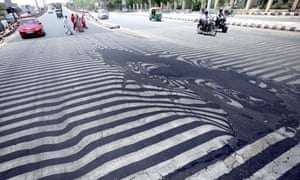
Road markings appear distorted during a heatwave, in New Delhi, India, 27 May 2015.

Road markings appear distorted during a heatwave, in New Delhi, India, 27 May 2015. Photograph: Harish Tyagi/EPA

by John Abraham, "Climate Consensus - The 97%," The Guardian, November 24, 2015

Despite the organization and funding behind groups which try to cast doubt about the causes and implications of climate change, the facts have spoken. The world continues to warm and their favorite myths have died.
We know that human-emitted heat-trapping gases warm the planet. In fact, this has been known for well over a century. With modern instruments (like ocean thermometers and satellites among others), we are now measuring the change. With advanced climate models, we can predict the changes. The measurements and the predictions are in excellent agreement, despite what cable news and second-rate skeptical scientists say.
And this year, the data are in. Using measurements to date, and long-term weather forecasting to predict the last 40 days of the year (while it may seem a bit early) we now know. As my colleague Dana Nuccitelli recently noted, 2015 is the hottest year on record. When the final numbers come out in January, the NOAA 2015 global averaged surface temperature anomaly over both land and ocean will be 1.6 °F above the long-term average. For the NASA GISTEMP dataset, it will be 1.5 °F above the long-term average. This comes on the heels of last year’s record and recent record ocean heat content. So, the bad news is we continue to break records.
The good news is that the favorite myths from climate-change skeptics [deniers] have taken a beating this year. Perhaps the best-known myth is the so-called “pause” or “hiatus” in global warming. This year, six individual studies have looked into this and found it incorrect. I have co-authored one of the studies, and I’ve written about some of the others here and here.
Well just today, another paper was published by Stephan Lewandowsky, James Risbey, and Naomi Oreskes that comes to the same conclusion. The paper is titled, “On the definition and identifiability of the alleged 'hiatus' in global warming.” The authors assess the magnitude and significance of all possible warming trends during the past 30 years. They found that looking back in time, the current definition of a “pause” in warming, as it is used in the literature, would have been used for more than one-third of the time, even though temperatures during the past 30 years increased by 1.1 °F (0.6 °C). 
The authors included 40 peer-reviewed studies that reported on the so-called hiatus or pause, and found no consistent definition among those studies. Then, the authors used these same 40 papers and asked whether the so-called “hiatus” was unusual in the time records. They found it wasn’t. 
The study also found that when the sample size is small (such as a short time period with very few years), a so-called “hiatus” will always appear. For instance, anyone claiming a “hiatus” shorter than 12 years will almost always find one.
I asked author Naomi Oreskes for a summary and she told me,
For a long time, climate change contrarians and deniers have insisted that global warming has paused, stopped, or taken a hiatus. This might have been dismissed as the usual denier cherry-picking—since much of it was based on cherry picking the starting year of 1998—an unusually hot year.
So we took up the question, first of all, whether the warming had stopped and second, if it had not, why were scientists calling it a pause. Ironically the paper that answered the second question got published first: we showed how contrarian discourse had steeped into the climate science community, so scientists were calling this decrease in the rate of warming a pause, when it clearly was no such thing. If warming continued, as indeed it did, then by definition that is not a pause, nor a hiatus. Our new paper, shows statistically that not only has there not been a pause or hiatus, but that the observed rate of warming is well within the range of previous fluctuations—including some positive fluctuations (i.e. increases in the rate of warming) that did not generate any scientific attention.
So the bottom line is: there is no pause, and there has never been one. The rate of global warming does fluctuate—but this has been known for a long time. Whether or not any particular fluctuation has an identifiable cause—like the effects of ocean heat uptake or an El Ninois an interesting question, but a fluctuation is not a pause, and it is important to be clear that the recent fluctuation is not statistically anomalous compared with other fluctuations we have seen, relative to the longer-term warming trend.
Now, with six nails in this coffin of this myth, are any more needed?
http://www.theguardian.com/environment/climate-consensus-97-per-cent/2015/nov/24/study-drives-a-sixth-nail-in-the-global-warming-pause-myth

Wednesday, November 18, 2015

2015 shatters the temperature record as global warming speeds back up

Thanks to human-caused global warming and an assist from El Niño, 2015 will easily be the hottest year in millennia

A man sleeps under the shade of a tree during a May 2015 heat wave in New Delhi, India.

 A man sleeps under the shade of a tree during a May 2015 heat wave in New Delhi, India. Photograph: Anindito Mukherjee/Reuters
by Dana Nuccitelli, The Guardian, November 18, 2015

With just a month and a half left in 2015, it’s clear this year will be by far the hottest on record, easily beating the previous record set just last year. The temporary slowdown in the warming of global surface temperatures (also misnamed the “pause”) has ended, as each of the past four years has been hotter than the one before.
El Niño is one reason 2015 has been such an incredibly hot year. During El Niño events, hot water is transported from the deep ocean layers to the surface. Over the past 15 years, we’ve experienced more La Niñas than El Niños, which helped temporarily slow the warming of global surface temperatures.
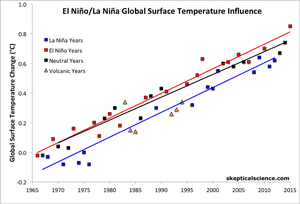
That changed in 2015, which has seen the third-largest surface temperature warming influence from an El Niño event on record (behind 1998 and 1987). The chart below breaks down global surface temperature data into years with El Niño, La Niña, neutral, and volcanic eruption temperature influences. Click here for additional details and a larger, animated version.
NOAA global surface temperature data (1966–2015) broken into El Niño, La Niña, and neutral years with linear trends for each category.
Pinterest
 NOAA global surface temperature data (1966–2015) broken into El Niño (red), La Niña (blue), neutral (black), and volcanic eruption (orange) years with linear trends for each category. Created by Dana Nuccitelli.
As the chart shows, 2015 will be more than 0.2 °C hotter than 1998, despite having a slightly weaker El Niño warming influence. That temperature difference is the result of human-caused global warming. If we look at the temperature trends just for El Niño years, for La Niña years, and for neutral years, each has a trend of 0.15–0.17 °C global surface warming per decade since the 1960s. The years during the mythical “pause” fall right along the long-term trend lines for each category (e.g., the blue points are consistently near the blue trend line).
This tells us that the long-term global warming trend persists, and it was only temporarily slowed because of the prevailing La Niña conditions from 1999 to 2012. In short, La Niña years in the 2000s have been hotter than previous La Niña years because of continued global warming, but they’re cooler at the surface than recent El Niño and neutral years.
We’ve now seen a new global surface temperature record in four of the past 11 years (2005, 2010, 2014, and 2015). This is consistent with a 2011 paper by climate scientists Stefan Rahmstorf and Dim Coumou, who found that as global warming continues, we should expect to set new records about once every four years.
Indeed, if we only use the data of the past 30 y, these show an almost linear trend of 0.017°C/y, yielding an expected 2.5 new record hot temperatures in the last decade [1 per 4 years].
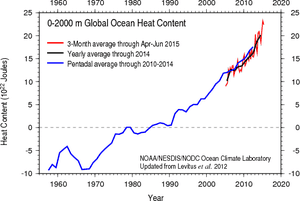
The oceans have continued to accumulate a tremendous amount of heat as well. According to NOAA, in 2015 the oceans have accumulated an amount of heat equivalent to about 400 million atomic bomb detonations (27 zettajoules, or 27 billion trillion Joules). That means the Earth accumulated about 14 atomic bomb detonations of energy per second, on average, throughout 2015. That’s a lot of heat, likewise reaching record levels.
Global ocean heat content estimates from NOAA, 0–2000 meters.
 Global ocean heat content estimates from NOAA, 0–2000 meters.
In short, while global surface warming temporarily slowed down due to a preponderance of La Niñas and a few other short-term factors, it’s now starting to speed up again. The warming of the oceans and heat build-up on Earth continue as well, not having slowed to begin with. One more climate myth bites the dust.

Friday, January 16, 2015

Global warming made 2014 a record hot year – in animated graphics

2014 was the hottest year on record, without assistance from El Niño

The sun rises in Pleasant Plains, Illinois.
The sun rises in Pleasant Plains, Illinois. Photograph: Seth Perlman/AP

by Dana Nuccitelli, "Climate Consensus - The 97%," The Guardian, January 16, 2015

NASA and NOAA have just reported that global surface temperatures in 2014 were the hottest on record. That also means 2014 was the likely hottest the Earth has been in millennia, and perhaps as much as 100,000 years.
But what’s really remarkable is that 2014 set this record without the aid of an El Niño event. El Niño events create conditions in which sea surface and hence global surface temperatures are anomalously hot. We call this part of the Earth’s “internal variability” because these events just temporarily shift heat around between the ocean surface and its depths. 
As this graphic shows (click here for an animated version), the last 5 record hot years of 2010, 2005, 1998, 1997, and 1995 were all assisted by El Niño events. 
NASA global surface temperature data (1966–2014) divided into La Niña years (blue), ENSO neutral years (black), and El Niño years (red), with linear trends displayed for each.  Years influenced by major volcanic eruptions (orange) are excluded from the trend analysis.
NASA global surface temperature data (1966–2014) divided into La Niña years (blue), ENSO neutral years (black), and El Niño years (red), with linear trends displayed for each. Years influenced by major volcanic eruptions (orange) are excluded from the trend analysis. Created by Dana Nuccitelli. Photograph: Dana Nuccitelli
In contrast, 2014 had a slight cooling influence from La Niña-like conditions at the beginning of the year, a slight warming influence from El Niño-like conditions toward the end, and no net temperature influence from the El Niño Southern Oscillation (ENSO) for the year as a whole. 2014 was by far the hottest ENSO-neutral year on record, and the first year since 1990 to set a record without influence from El Niño.
1998, which saw the strongest El Niño on record, now falls to 5th-hottest year on record. The intense El Niño event made global surface temperatures in 1998 about 0.2 °C hotter than they would have otherwise been. Due to human-caused global warming, ENSO-neutral years are now hotter than even the most intense El Niño years a decade or two ago. As NASA GISS director Gavin Schmidt said,
This is the latest in a series of warm years, in a series of warm decades. While the ranking of individual years can be affected by chaotic weather patterns, the long-term trends are attributable to drivers of climate change that right now are dominated by human emissions of greenhouse gases
As the above graphic shows, over the past 50 years, there has been the same 0.15–0.16 °C per decade warming trend for La Niña years, for ENSO neutral years, and for El Niño years. So for example, an ENSO-neutral year today is about 0.25 °C hotter than a similar year would have been in 1998. That’s why 2014 was hotter than 1998 despite the big difference in El Niño temperature influences between the two years.
This is all happening during a time when we’re constantly being bombarded with inaccurate claims of a global warming “pause.” These mistaken claims stem from the fact that the rate of global surface warming has slowed a bit over the past 15 years, in large part because we’ve seen more La Niña events and fewer El Niño events during that time, and also due to heightened volcanic activity.
In fact, at any point over the past 5 decades we can find a period during which global surface warming “paused.” Yet each such period was hotter than the last. That’s because each is just a temporary effect caused by a period with a predominance of La Niña events and other short-term cooling temperature influences. As this figure shows (click here for an animated version), underneath the short-term noise, human-caused global warming continues unabated.
NASA global surface temperature data for 1970–2014.  Trends in blue are shown for the periods Jan 1970–Oct 1977, Apr 1977–Dec 1986, Apr 1987–Oct 1996, Aug 1997–Dec 2002, Jan 2003–Jun 2012, and Jul 2012–Feb 2014.
NASA global surface temperature data for 1970–2014. Trends in blue are shown for the periods Jan 1970–Oct 1977, Apr 1977–Dec 1986, Apr 1987–Oct 1996, Aug 1997–Dec 2002, Jan 2003–Jun 2012, and Jul 2012–Feb 2014. Created by Dana Nuccitelli Photograph: Dana Nuccitelli
Following the global surface temperature records set in 2005 and 2010, a new record in 2014 is right on schedule. A 2011 paper by Stefan Rahmstorf and Dim Coumou found that as global warming continues, we should expect to set new records about once every 4 years.
Indeed, if we only use the data of the past 30 y, these show an almost linear trend of 0.017 °C/y, yielding an expected 2.5 new record hot temperatures in the last decade [1 per 4 years].
Given that we may see an El Niño event in early 2015, there’s also a chance that this record could be short lived, and 2015 might break it once again.
On top of the record global surface temperatures, we also saw a record amount of heat accumulating on Earth, mainly in the oceans. According to NOAA, in 2014 the oceans accumulated an amount of heat equivalent to about 200 million atomic bomb detonations (13 zettajoules, or 13 billion trillion Joules). That’s about 6 to 7 atomic bomb detonations per second, on average, throughout 2014. That’s a lot of heat, likewise reaching record levels.
Climate Nexus summarizes some other notable climate facts from 2014 in this video.
In short, global warming continues unabated, and claims of a “pause” are misguided. Because of human-caused global warming, average years today are hotter than El Niño years just a decade ago, and the Earth continues to accumulate immense amounts of heat. Despite short-term noise, that long-term trend will continue until we cut our carbon pollution and curb global warming.

Friday, April 11, 2014

Dana Nuccitelli: Climate imbalance – disparity in the quality of research by contrarian and mainstream climate scientists

Contrarian papers tend to be rebutted quickly in peer-reviewed literature, but receive disproportionate media attention

by Dana Nuccitelli, "Climate Consensus - The 97%," The Guardian, April 11, 2014


Unbalanced
Both the quality of mainstream and contrarian climate research and their media coverage have been unbalanced, but in different directions. Photograph: www.alamy.com
A new paper has been published in the journal Cosmopolis entitled "Review of the consensus and asymmetric quality of research on human-induced climate change." The paper was authored by John Abraham, myself, and our colleagues John CookJohn Fasullo, Peter Jacobs, and Scott Mandia. Each of the authors has experience in publishing peer-reviewed responses to flawed contrarian papers.
Despite the 97% expert consensus on human-caused global warmingsupported by peer-reviewed research, expert opinion, the IPCC reports, and National Academies of Science and other scientific organizations from around the world, a large segment of the population remains unconvinced on the issue. A new commentary by Edward Maibach, Teresa Myers and Anthony Leiserowitz in Earth's Future notes that most people don't know there is a scientific consensus about human-caused climate change, which undermines public engagement on the subject.
This 'consensus gap' is in large part due the media giving disproportionate coverage to climate contrarians. In our paper, we sought to evaluate whether that disproportionate media coverage was justified by examining how well contrarian hypotheses have withstood scientific scrutiny and the test of time. The short answer is, not well.
Low climate sensitivity papers by Lindzen and Spencer (open circles) and peer-reviewed rebuttals (closed circles).  Created by John Garrett (Wildomar, CA).Low climate sensitivity papers by Lindzen and Spencer (open circles) and peer-reviewed rebuttals (closed circles). Created by John Garrett of Wildomar, CA.
The first contrarian argument examined in our paper was the claim that the Earth is not warming. This argument was particularly popular in the late 1990s and early 2000s, when John Christy and Roy Spencer from the University of Alabama at Huntsville published an analysis of satellite data that seemed to indicate the lower atmosphere was cooling. This appeared to contradict surface temperature measurements from thousands of thermometers around the world, which when combined together, indicated substantial global warming. Contrarians were certain that the thermometers were wrong, the satellites were right, and we didn't have to worry about global warming.
However, it turns out that satellite measurements of atmospheric temperatures are very tricky. The satellites are positioned above the atmosphere that they're trying to measure, and have to peer through many different atmospheric layers. Their orbits also drift, and satellites have limited lifespans, forcing scientists to splice together measurements from different instruments.
Gradually, various problems with the satellite temperature measurements were identified, some by the Huntsville group, and several by other groups. Corrections were made to the record, and before long the satellite record showed the warming of the lower atmosphere happening at a similar rate to that estimated from the thermometers around the globe.
Evolution of lower tropospheric temperature trends from satellite observations.Evolution of lower tropospheric temperature trends from satellite observations.
Two decades later, additional possible biases are still being identified in the satellite temperature record. Nevertheless, contrarians continue that the lower atmosphere isn't warming as fast as it should be, or that the surface thermometer measurements are biased hot (recent research has shown they actually have a cool bias). However, Christy and Spencer's claim that the planet isn't warming did not withstand scientific scrutiny or the test of time.
The second contrarian argument we investigated involved the claim that the global climate is not very sensitive to the increased greenhouse effect because the planet has some sort of natural climate response that will offset global warming. One of the first such arguments in the peer-reviewed literature was the 'infrared iris' hypothesis from contrarian darling Richard Lindzen.
The premise of Lindzen's hypothesis was that as the climate warms, the area in the atmosphere covered by high cirrus clouds will contract to allow more heat to escape into outer space, similar to the iris in a human eye contracting to allow less light to pass through the pupil in a brightly lit environment. However, within a year of Lindzen's iris hypothesis paper being published, four scientific groups had published their own studies finding significant flaws in his methods and assumptions, shown in dark blue in the first graphic above.
Several more critiques were published in the ensuing years failing to find evidence supporting the iris concept (red in the first graphic), showing that while the scientific community took this new hypothesis seriously, it simply failed to withstand scientific scrutiny. Although this is the case for most of Lindzen's arguments, he continues to be among the most highly sought contrarians by journalists and policymakers who try to create the perception of significant disagreement amongst climate science experts.
Roy Spencer and his colleague Danny Braswell have similarly published papers arguing that the climate is not as sensitive to the increased greenhouse effect as most climate scientists believe and most of the available evidence indicates. A paper they published in 2008 used a very simple climate model to make this argument, but subsequent research showed that their model was actually too simple, and failed to accurately represent how the global climate operates (green in the first graphic).
Spencer and Lindzen published several other papers making similar arguments in subsequent years, but these again failed to withstand scientific scrutiny (orange, black, and light blue in the first graphic). Various other scientific groups pointed out several flaws in the methods and assumptions in each of their publications, and in fact one editor resigned because he felt his journal had failed its task of conducting rigorous peer-review in publishing a fundamentally flawed 2011 Spencer and Braswell paper (black in the first graphic).
To contrast, human-caused global warming is based on solid fundamental physics that we've understood for over a century. In contrast to the relatively few studies mentioned here, thousands of studies have scrutinized and reaffirmed the basic physics that underlies the theory. It has withstood the test of time.
While there are still some areas of climate science undergoing serious research, like how much we're influencing changes in various types of extreme weather, the central tenets of human-caused global warming are solidly established. While some challenges have been advanced in the scientific literature, these challenges have been found to be incorrect.
In addition to the failure of their alternative hypotheses to withstand scientific scrutiny, research has shown that contrarian scientists have less expertise and fewer publications than mainstream climate scientists, and that as climate expertise increases, so does acceptance of human-caused global warming.
This then raises the question as to why contrarians are given disproportionate attention by the media and policymakers. They represent a small minority of experts with fringe views that have failed to convince the rest scientific community, simply because their ideas haven't withstood scientific scrutiny. On the other side we have human-caused global warming, supported by 97% of peer-reviewed research, expert opinion, fundamental physics, and having withstood the test of time. The fact that these two groups are treated as being on equal scientific footing and the issue continues to be 'debated' in the media has resulted in a misinformed public, and that's a problem.
http://www.theguardian.com/environment/climate-consensus-97-per-cent/2014/apr/11/climate-change-research-quality-imbalance

Friday, March 28, 2014

Roger "The Dodger" Pielke stepped outside of his bubble and reality blew up in his face, and rightly so!

FiveThirtyEight Apologizes On Behalf Of Controversial Climate Science Writer

NATE SILVER
Nathaniel 'Nate' Silver, editor-in-chief of ESPN's FiveThirtyEight blog, speaks during a panel discussion at the South By Southwest (SXSW) Interactive Festival in Austin, Texas, U.S., on Saturday, March 8, 2014. The SXSW conferences and festivals converge original music, independent films, and emerging technologies while fostering creative and professional growth. (David Paul Morris/Bloomberg via Getty Images)

by Michael Calderone, Huffington Post, March 28, 2014

NEW YORK -- Two prominent climate scientists say Roger Pielke, Jr., a controversial writer at Nate Silver’s FiveThirtyEight site, sent emails threatening possible legal action in response to their criticism of his findings for the data-driven news site. 

Pielke says it's "ridiculous" to characterize the emails as threats against Michael Mann, director of the Earth System Science Center at Pennsylvania State University, and Dr. Kevin Trenberth, a distinguished senior climate scientist at the National Center for Atmospheric Research. 

FiveThirtyEight, however, apologized to both men.

"Roger is a freelance contributor and his private communications do not represent FiveThirtyEight," Silver said in a statement to HuffPost. "We had candid conversations with Michael Mann and Kevin Trenberth. We made clear that Roger's conversations with them did not reflect FiveThirtyEight's editorial values."

Revelations of the private correspondence are particularly poorly timed for FiveThirtyEight, which has been dogged online throughout most of its 11-day existence by the climate change dispute. The controversy was given increased exposure Thursday night on "The Daily Show."

It began with Pielke's March 19 article, “Disasters Cost More Than Ever -- But Not Because of Climate Change." Pielke’s claim that the cost from natural disasters has risen because of increased wealth, and not because climate change is making weather events more extreme, was quickly challenged by several scientists and experts, including Professor John P. Abraham on The Huffington Post.

Pielke, a political scientist at the University of Colorado, has been called a climate change skeptic, a label he doesn't apply to himself. And Pielke's no stranger to controversy within the scientific community. Typically, though, such disagreements over data and methodology are confined to academia and science press. 

But Pielke's piece was published on day three of the FiveThirtyEight relaunch, and media watchers had been anxiously waiting to see if Silver's revamped site, which had been in development for eight months, would live up to the hype.

Silver has emerged as one of the media’s foremost critics of “bullshit” punditry, and recently suggested that a deficiency in math skills marks “a weakness of conventional journalism.” It's because of such pronouncements that a debate over the data-driven analysis in a FiveThirtyEight article will inevitably shift attention to Silver.

In "The Daily Show" interview, Jon Stewart asked Silver about the issue. Silver acknowledged hearing “a lot of concern from our readers” about Pielke's article and said that about 80% of commenters "weighed in negatively." As a result, Silver told Stewart that the site is commissioning a rebuttal. 

But rebuttals to Pielke’s conclusions on FiveThirtyEight could be found online since shortly after the article's publication.
On March 19, Mann and Trenberth challenged Pielke’s claims in interviews with ThinkProgress


Mann told ThinkProgress that Pielke’s article was “deeply misleading, confirming some of my worst fears that Nate Silver’s new venture may become yet another outlet for misinformation when it comes to the issue of human-caused climate change.”

“This is the same old wrong Roger,” Trenberth told ThinkProgress. “He is demonstrably wrong and misleads.”

In an email to HuffPost, Mann said Pielke sent him "a threatening email in response to my fair criticism of his piece." Mann added that a representative from FiveThirtyEight contacted him and offered "an apology for what they characterized as unacceptable behavior by Pielke.”

Mann declined to make Pielke's email public, but told HuffPost that he viewed it as a "thinly veiled" threat of legal action.

In an email to HuffPost, Trenberth said Pielke contacted him and his bosses following the ThinkProgress report. Trenberth said he also received an apology from FiveThirtyEight.
Trenberth said he considered Pielke's email "a threat to me.”

“He was very accusatory and threatened me if I did not respond,” Trenberth told HuffPost.

Trenberth forwarded the text of the email to HuffPost. Pielke wrote that Trenberth had "made some pretty coarse and perhaps even libelous comments" in the ThinkProgress article. Pielke requested that Trenberth correct his public claims and noted that "an apology would be nice also."

"Once again, I am formally asking you for a public correction and apology," Pielke wrote to Trenberth and his bosses. "If that is not forthcoming I will be pursuing this further. More generally, in the future how about we agree to disagree over scientific topics like gentlemen?"

When asked about the claims that he sent threatening emails, Pielke told HuffPost: "In a nutshell this is ridiculous."

Pielke acknowledged contacting Mann and Trenberth and asked "them to be accurate in their representations of me and to conduct public discourse in a gentlemanly fashion."

"I do not threaten," Pielke told HuffPost, adding that he found "the idea offensive that they would characterize my correspondence in this way."

In a another email to HuffPost, Pielke said that his correspondence to the two colleagues was not on behalf of FiveThirtyEight, "but rather to two scientific peers I have known for decades." If FiveThirtyEight apologized on his behalf, Pielke said, "that is kind but unnecessary."

ThinkProgress editor Judd Legum told HuffPost that he contacted Silver and FiveThirtyEight managing editor Mike Wilson regarding Pielke’s emails, which he considered to be threats “to pursue legal action against” against the two climate scientists.

Beyond the two scientists' rebuttal, Pielke has also taken issue with a Tuesday Guardian post -- FiveThirtyEight undermines its brand by misrepresenting climate research" – by environmental scientist Dana Nuccitelli.

In an email to environment web editor Adam Vaughan, Pielke requested “that The Guardian correct multiple errors of fact in its piece on my work.” The Guardian looked into the matter, but did not make any changes to the piece.

John P. Abraham, a professor at the University of St. Thomas who blogs with Nuccitelli at The Guardian, wrote Wednesday on HuffPost that he contacted Silver last week and was invited to write a response to Pielke for FiveThirtyEight. Abraham said he submitted the piece and it went through the editing process before, "late in the game, they decided not to run my post." 

Abraham concluded in the HuffPost piece that Pielke's "inexact phrases, extensions of his own work beyond their application, and inclusion of non-weather-related disasters are some of the reasons his conclusions are not taken seriously by myself and other climate scientists."

On Friday, Silver addressed the climate change controversy in a lengthy "Note To Our Readers" on FiveThirtyEight and acknowledged receiving Abraham's piece. But that rebuttal, he said, "wasn’t quite what we were aiming for."

"Its criticism spanned several of the categories I outlined above, when we were looking for something more focused on the scientific claims made in Roger’s FiveThirtyEight article," Silver wrote.

In the Friday post, Silver -- whose previous incarnation of FiveThirtyEight ran for three years on the New York Times’ site and relaunched on March 17 -- wrote that the past two weeks have “been a heck of a learning experience."

Silver said FiveThirtyEight is looking for a rebuttal from someone who has not weighed in yet on the dispute and "has very strong credentials."

"We appreciate your patience in the meantime," Silver wrote. "Climate change is not going away as an issue, and we want to get this right. All journalism relies on trust -- between reporters and sources, between editors and writers, between a publication and its readers. Any time that trust is undermined, it’s a huge concern for us. We thank you for your continued feedback. We’re listening and learning."

http://www.huffingtonpost.com/2014/03/28/fivethirtyeight-climate-change-dispute_n_5049279.html