Blog Archive

Showing posts with label Naomi Oreskes. Show all posts

Friday, February 15, 2019

L. A. Times: As lawsuits over climate change heat up, oil industry steps up spurious attacks on its critics

As lawsuits over climate change heat up, oil industry steps up attacks on its critics

The Deepwater Horizon oil rig, aflame in the Gulf of Mexico in 2010. The rig's owner, BP, is one of more than 20 oil companies being sued over their alleged role in climate change. (Gerald Herbert / AP)


by Michael Hiltzik, The Los Angeles Times, February 12, 2019
The oil industry has been depicting itself lately as the target of a conspiracy by scientists, local government officials and climate change activists to make it look bad.
It would be odd to think that a conspiracy is necessary to punch holes in the fossil fuel companies’ public reputation, but here’s the argument presented by the Independent Petroleum Association of America (IPAA), one of the industry’s leading lobby organizations.

“In a highly-coordinated move,” the IPAA declares on its website, “nearly 30 scientists, government officials and third-party organizations recently joined the fledgling climate litigation campaign.” The IPAA labeled this a “free-for-all” and quoted an industry newsletter calling the campaign “a carefully orchestrated effort by local governments in California and elsewhere to use state law to collect damages from companies producing and marketing fossil fuels.”

If you think this sounds like a Goliath pretending to be a David, you are right. The litigation campaign IPAA refers to is a cluster of lawsuits pioneered in 2017 by the California counties of San Mateo, Imperial Beach, Marin, and Santa Cruz, and the cities of Richmond, Oakland, and San Francisco, among other jurisdictions, against more than 20 oil and gas companies.

The plaintiffs assert that the companies freely promoted the use of their products even though they were aware of the products’ effect on global warming — information the industry allegedly suppressed for years. The municipalities are asking that the companies be forced to help pay for the damage wreaked by climate change, including drought, wildfires, sea level rise, and extremes of heat and precipitation. Since the filing of the California cases, similar lawsuits have been filed by Rhode Island, Washington’s King County (that is, Seattle), Baltimore, and New York City.

The oil companies succeeded in transferring the state lawsuits to federal court, where they expect to face less liability under the law. The plaintiffs’ argument that the cases belong back in state court is being heard by the U.S. 9th Circuit Court of Appeals in San Francisco.

What has the industry vibrating at the moment is a sheaf of eight friend-of-the-court, or amicus, briefs all filed on January 29, 2019, with the appellate court supporting the transfer back to state court. Among other parties, the briefs were filed by the California Assn. of Counties, the Natural Resources Defense Council, a group of six prominent oil company critics, and the National League of Cities.

To the industry, this looks like a cabal. In a blog post, the IPAA found something sinister in “the fact that all eight of the briefs were filed within hours of one another on a random January afternoon (i.e. there wasn’t a court-designated deadline).” Not only was that “reason enough to suspect some level of coordination took place,” the blog post observes, but “signing onto the amicus briefs were many of the activists and politicians who have played key roles in the broader campaign to take down the oil and natural gas industry for years.”

A couple of points are pertinent here. First of all, there was indeed a court-designated deadline for filing the briefs — January 29, the day they were filed. The court’s procedural calendar specifies that amicus briefs must be filed no later than seven days after the main brief of the party they’re supporting. The California plaintiffs filed their brief on January 22, seven days earlier. So much for the “coordination.”

Second, why should it be so odd that the supporters of the cities and counties are drawn from the community of fossil fuel critics? Who else?

Let’s examine some of the industry’s other points. Among the chief targets of its pushback are Naomi Oreskes and Geoffrey Supran of the Department of the History of Science at Harvard University, who filed one of the amicus briefs, in conjunction with four other scholars with interest in climate change science.

Oreskes and Supran were the authors of a 2017 study detailing the industry’s determined, decades-long effort to suppress scientific evidence of global warming caused by the burning of fossil fuels, despite warnings by its own scientific researchers that the phenomenon was genuine, dangerous, and accelerating. 

We reported here on their study, which focused on Exxon Mobil. They compared hundreds of Exxon Mobil's internal reports and peer-reviewed research papers with its advertising — especially paid "advertorials" the company placed in the op-ed section of the New York Times from 1972 through 2001. The authors concluded that Exxon Mobil had systematically "misled non-scientific audiences about climate science."

The IPAA blog post claims that the Oreskes-Supran study has been debunked, but that’s not so. Their statistical method was questioned by another researcher, who was paid by Exxon Mobil. But the core of their findings wasn’t statistical but empirical. They compared internal company documents with the ad campaign and found them wildly divergent.

Oreskes, in an email, labeled the so-called debunking “the sort of expert-for-hire doubt-mongering” engaged in by the tobacco industry when it was fighting medical science over the dangers of smoking. That’s a topic she’s familiar with, having covered it in the 2010 book “Merchants of Doubt,” co-written with Erik M. Conway.

It’s hardly surprising that the oil industry would be uneasy about the “fledgling climate litigation campaign.” The plaintiffs aim to use state laws to fix blame on the fossil fuel companies in ways that can’t be accomplished under federal environmental laws such as the Clean Air Act.

Indeed, federal law vests the states with primary responsibility for addressing air pollution, according to Victor Sher, the San Francisco attorney representing the counties and cities. “Cases involving false and deceptive marketing, over-promotion of products, campaigns to deceive the public — those are traditional state police power matters that the Clean Air Act doesn’t address at all.”

Federal Judge Vince Chhabria of San Francisco largely agreed last March, when he ordered the lawsuits returned to state court. The oil companies appealed his order, which is why it’s now before the 9th Circuit bench.

The municipalities also are hoping to take advantage of California’s “public nuisance” doctrine, which holds that business can be held responsible for damage done by its products even if their usage was standard practice at the time.

The public nuisance argument was central to a lawsuit brought by California municipalities against lead paint manufacturers that concluded in 2017 with an order that the companies pay to clean up residual lead in dwellings that could pose a health hazard to children in those homes.

There’s no question that the cities and counties face a long and arduous road to saddling the oil industry with the responsibility for climate change and the expense of addressing its impacts. The lead paint lawsuit lasted 17 years before the verdict was made final.

But there’s also no question that the industry did its best to hide what it knew about the prospects of global warming and its products’ role in it. The latest misleading attack on its critics shows, if nothing else, that it still hasn’t learned to tell the truth, the whole truth and nothing but the truth.

Saturday, August 26, 2017

Exxon misled the public about climate change, Harvard study shows


FOR IMMEDIATE RELEASE
AUGUST 23, 2017
CONTACT:
Kyle Moler

Exxon misled the public about climate change, Harvard study shows

Cambridge, MA In the first comprehensive, academically peer-reviewed analysis of ExxonMobil’s 40-year history of climate-change communications, researchers at Harvard University have concluded that the company has misled the public about climate change.

A review of 187 public and internal Exxon documents found that, accounting for reasonable doubt, 83% of peer-reviewed papers authored by Exxon scientists and 80% of the company’s internal communications acknowledge that climate change is real and human-caused. In contrast, only 12% of Exxon’s advertorials directed at the public do so, with 81% instead expressing doubt.

“On the question of whether ExxonMobil misled non-scientific audiences about climate science, our analysis supports the conclusion that it did,” says the academic study published today by Drs. Geoffrey Supran and Naomi Oreskes in the journal Environmental Research Letters. [Link to paper: http://iopscience.iop.org/article/10.1088/1748-9326/aa815f or bit.ly/ExxonPaper. Paper published online at this address at 02:00 a.m. ET, August 23, 2017.]

These findings come as the Attorneys General of New York and Massachusetts and the Securities and Exchange Commission continue to investigate the oil and gas company for potentially misleading investors and the public about the risks of climate change. Exxon employees and shareholders have already filed lawsuits against the company on these grounds.

The year-long study is an expansive, quantitative, independent corroboration of the findings of investigative journalists, who ExxonMobil have accused of using “deliberately cherry-picked statements.” This latest work goes further, showing both that ExxonMobil knew about the basic realities of climate change decades ago and that the company simultaneously communicated positions that were at odds with this knowledge to the general public.

The authors explain that their research was prompted by ExxonMobil’s challenge to the public: “Read all of these documents and make up your own mind.”

“This paper takes up that challenge,” the Harvard authors write.

The researchers used an established social science method called content analysis to characterize 187 of ExxonMobil’s public and private publications about climate change, spanning 1977 to 2014. These included ExxonMobil’s peer-reviewed and non-peer-reviewed scientific work, internal company memos, and paid, editorial-style advertisements (“advertorials”) in The New York Times. Content analysis allowed Supran and Oreskes to evaluate the number of documents expressing different viewpoints on climate change and thereby to quantify the consistency of ExxonMobil’s climate communications.

The research looks at ExxonMobil’s positions on climate change as real, human-caused, serious, and solvable, and at the company’s acknowledgment of the risks of fossil-fuel assets becoming ‘stranded’ by climate policy. In each case, the article concludes, “available documents show a systematic discrepancy between what ExxonMobil’s scientists and executives discussed about climate change privately and in academic circles and what it presented to the general public.” The authors found the topic of stranded assets to be “discussed and sometimes quantified in 24 documents of various types, but absent from advertorials.”

In short, the paper finds, “ExxonMobil contributed quietly to the science and loudly to raising doubts about it.” The company’s academic publications had an average readership of tens to hundreds, whereas advertorial readerships were likely in the millions.

The Harvard paper is also explicit about its limitations. “We acknowledge that textual analysis is inherently subjective: words have meaning in context.” Yet, the authors argue, “While one might disagree about the interpretation of specific words, the overall trends between document categories are clear.”

To make these trends fully auditable, the peer-reviewed paper includes 121-pages of “Supplementary Information” [link to be added]. Here, the authors have tabulated all quotations, from all 187 analyzed documents, substantiating their conclusions.

The paper’s acknowledgments state that this research was supported by Harvard University Faculty Development Funds and by the Rockefeller Family Fund.

Other interesting findings of the analysis

  • Most of ExxonMobil’s climate science has been spearheaded by one person.
“In 1986, scientist Haroon Kheshgi joined ER&E [Exxon Research and Engineering], and was henceforth ExxonMobil’s principal (and only consistent) academic author, co-authoring 72% (52/72) of all analyzed peer-reviewed work (79% since his hiring). Indeed, the metadata title of the “Exxon Mobil Contributed Publications” file is Haroon’s CV.(See section 4.1.1 of paper for details.)

  • The Harvard study finds that “ExxonMobil’s advertorials included several instances of explicit factual misrepresentation.”
For example, “...an ExxonMobil advertorial in 2000 directly contradicted the IPCC and presented very misleading data, according to the scientist who produced the data.” (See section 3.1.5 of paper for details.)

  • Advertorials were part of an ExxonMobil climate-change communication plan
“Mobil/ExxonMobil bought AGW advertorials in the NYT specifically to allow the public to know where we stand.Readerships were likely in the millions. The company took out an advertorial every Thursday between 1972 and 2001. They paid a discounted price of roughly $31,000 (2016 USD) per advertorial and bought one-quarter of all advertorials on the Op-Ed page, towering over the other sponsors according to reviews of Mobil’s advertorials by Brown, Waltzer, and Waltzer.” (See section 4 of paper for details.)
  • ExxonMobil’s early estimates of the “carbon budget”  which implies risks of stranded fossil fuel assets, many have argued — “are within a factor of two of contemporary estimates.” (See section 3.4.2 of paper for details.)

Monday, February 22, 2016

108 scientists call on world’s largest Earth science organization (the American Geophysical Union) to reject ExxonMobil sponsorship


FOR IMMEDIATE RELEASE
February 22, 2016
Contact: Ben Scandella, 206-276-2699, bscand@gmail.com

108 scientists call on world’s largest Earth science organization
to reject ExxonMobil sponsorship

Cambridge, MA Today, more than 100* geoscientists sent a letter (also attached) to the President of the American Geophysical Union (AGU) - the world’s largest association of Earth scientists - calling for an end to ExxonMobil sponsorship of AGU in a stand against climate science disinformation.

Signatories include leading AGU-member scientists such as former Director of the NASA Goddard Institute for Space Studies and renowned climatologist Professor James E. Hansen, former President of the American Association for the Advancement of Science and Harvard Professor James J. McCarthy, Penn State’s Earth System Science Center director Michael E. Mann, and author of Merchants of Doubt and Harvard Professor Naomi Oreskes, as well as other concerned geoscientists including Professor Hans Schellnhuber, CBE, who currently serves as Chair of the German government’s Advisory Council on Global Change and as a climate advisor to the Pope.

“As Earth scientists, we are deeply troubled by the well-documented complicity of ExxonMobil in climate denial and misinformation…By allowing Exxon to appropriate AGU’s institutional social license to help legitimize the company’s climate misinformation, AGU is undermining its stated values as well as the work of many of its own members,” states the letter.

In fact, AGU’s own Organizational Support Policy states that “AGU will not accept funding from organizational partners that promote and/or disseminate misinformation of science, or that fund organizations that publicly promote misinformation of science.” Despite this claim, the nearly 24,000 attendees of the AGU 2015 Fall meeting were greeted by a prominent display of gratitude for Exxon’s sponsorship.

Asked why she signed the letter, Harvard Professor Naomi Oreskes - whose work has been instrumental in exposing the corporate-financed public relations efforts to sow confusion about scientific issues ranging from tobacco smoke to climate change - explained, “The scientific community has been clear and articulate in communicating the reality and threat of global warming. However, accepting sponsorship from ExxonMobil undermines that message. We cannot say that climate change is real and demonstrated, and at the same time turn a blind eye to the real and demonstrated nature of ExxonMobil’s anti-scientific activities.”

The letter comes amid the ExxonMobil climate denial scandal, with the company currently under investigation by the New York and California Attorneys General as to whether it lied to the public and its shareholders about climate change risks.

Leading climatologist Michael Mann, a signatory whose “hockey stick” global warming graph has made him a well-known target of attacks by climate deniers, remarked, “While I recognize that it is a contentious matter within the diverse AGU community, I just don't see how we can, in good conscience, continue to accept contributions from a company that has spent millions of dollars over several decades funding bad faith attacks on scientists within our community whose scientific findings happen to be inconvenient for fossil fuel interests.”

“As the largest and most respected society of Earth scientists in the world, the AGU should not be invested in nor take money from a corporation that places its profits above the health and well-being of our global society,” commented Cornell University Professor Charles Greene, another signatory of the letter.

The letter is the most recent example of a growing trend of scientists stepping out of their traditional roles to advocate for stronger climate action and to counter climate science disinformation in response to the urgency of climate change. For example, through the recently launched Climate Feedback project, scientists are evaluating the credibility of climate science presented in the popular press. Last Spring, dozens of the world’s top scientists released a letter urging science museums to cut ties to fossil fuel interests. They subsequently led a campaign to remove David Koch from the board of New York’s American Museum of Natural History. Mr. Koch resigned from his board position in December.

*Note: A few signatories prefer to not disclose their names in the online version of the letter.

###

RELEVANT LINKS:

  1. The letter follows an editorial by three AGU members, published in January, calling on AGU to reject Exxon’s sponsorship of its future scientific conferences: http://www.theguardian.com/environment/climate-consensus-97-per-cent/2016/jan/06/why-is-the-largest-earth-science-conference-still-sponsored-by-exxon

Saturday, January 30, 2016

Climate Science Legal Defense Fund Celebrates its Four-Year Anniversary

by Jeff Masters, WunderBlog, January 28, 2016

Whenever scientific research uncovers truths that threaten the profits of large and powerful corporations, those companies--and the politicians these corporations' money help elect -- inevitably fight back by attacking the scientists. As I discussed in detail in my 2009 blog post, "The Manufactured Doubt Industry and the Hacked Email Controversy," we've seen this behavior most clearly with the tobacco industry, but manufacturers of chlorofluorocarbons, asbestos, benzene, beryllium, chromium, MTBE, perchlorates, phthalates, and a slew of many other toxic chemicals have all waged elaborate campaigns to attack the scientific findings and the scientists that threatened their profits. These attacks often take the form of legal action, which government or university-funded scientists do not have the resources to combat. Such attacks against climate scientists have been particularly pernicious and numerous in recent years, and multiple climate scientists are currently involved in litigation in state and federal courts across the United States. 

The Climate Science Legal Defense Fund (CSLDF) was created to help these climate scientists fight back. CSLDF works to help raise funds for scientists’ legal defenses, serves as a resource in finding pro bono legal representation, and provides support during difficult litigation proceedings as well as when legal action is threatened. I'm proud to say that I'm a founding board member of the charity, and this week marks the four-year anniversary of their official debut. Over that time, they’ve helped nearly a hundred researchers across the country, from Arizona to Virginia. 

In celebration of their birthday, they’ve launched a new website at climatesciencedefensefund.org. The new site explains their history, details their initial work defending Dr. Michael Mann, and describes their current projects. I hope you will consider making a donation to this worthy cause in the future. 


Figure 1. Screen shot of the new website at climatesciencedefensefund.org.

To learn more about the well-funded attacks on climate science and climate scientists by the fossil fuel industry, my fellow CSLDF board member, Noami Oreskes, has co-authored the excellent book, Merchants of Doubt, which has also been made into a fascinating documentary (available on Netflix.)

http://www.wunderground.com/blog/JeffMasters/climate-science-legal-defense-fund-celebrates-its-fouryear-anniversar

Thursday, December 10, 2015

Peter Dykstra: Will we reach peak denial soon?

Senate Wide shot

Here are some crazy, detached folks that also happen to be enablers of crippling denial at the highest levels of the United States Congress


by Peter DykstraThe Daily Climate, December 9, 2015
In an email exchange a few months ago for another story, historian Naomi Oreskes counseled me that climate denial would only get more bold and unhinged as the impacts of climate change became more obvious.  
With their rhetoric around the Paris climate talks, anti-science firebrands are making their nemesis, Dr. Oreskes, seem prescient.
Attorney Arkady Bukh, guest blogging on Anthony Watts' go-to website for climate denial, drew a lengthy analogy between advocates of action on climate change and the “People’s Temple” religious cult.  
Leader Jim Jones, a former San Francisco street preacher, ordered over 900 of his followers to commit mass suicide in Guyana in 1978.  They complied. Now, 37 years after their tragic demise, they’re being compared to the science community, defense strategists, environmental activists, and a Pope.
Over at Breitbart, James Delingpole was slightly more restrained, dismissing climate scientists as “talentless low-lives who cannot be trusted.”  9-steyn
I reached out to the Climate Scientists’ Underground Lair, but their voicemail said they were all out selling drugs at middle schools.
A hardy perennial among denier memes is flourishing: President Obama, they say, is a hypocrite because he arrived at the Paris meet via a fuel-guzzling jet.  
I can remember encountering this one as far back as 1985, when a chemical industry exec told me that because I, too, had used an aeroplane, I had no moral authority to write about anyone else’s pollution.  But I’m no Obama, and he’s drawn heavy flack as Sean HannityGlenn Beck, the National Review, and others beat this dead horse.  
I’m willing to give Obama some slack for using Air Force One:  Perhaps the carbon-neutral Presidential trireme is back in dry dock.
Rush Limbaugh postulated that “deranged people …..and most of them are leftists” would take Obama’s embrace of climate action as a cue to start America’s next mass shooting.
Lord Monckton, the theatrical British peer, offered a different perspective: Instead of one-off acts of domestic terrorism, he said, Obama’s game was teaming up with “malevolent scientists,” using the climate summit to establish a world totalitarian government.
Another central theme from the denial-o-sphere is that distributing as much coal as possible throughout the developing world will be the key to beating “energy poverty.”  
Peabody Energy, who couldn’t lick Appalachian poverty even while mining a century’s worth of its coal, is big on this one.  And Peabody’s learning a thing or two about its own poverty:  Its stock traded at $112 a share in 2001, and right now, it’s hovering at $10.
Patrick Moore, an early Greenpeace leader who has spent the last quarter century in the employ of the chlorine industry, the timber industry, the nuclear industry, the aquaculture industry and others who need an environmental PR boost, officially weighed in as an ocean acidification denier
In a report that appears to contain no original research or indication of peer review, Moore defies a growing body of research as well as a basic understanding of chemistry by pronouncing that “alarmism” is responsible for findings—original research and peer-review included—that the pH balance of the oceans is beginning to change.
Hopefully you get the gist of this by now.
These people are crazy.  Detached from reality.  Off the deep end.  Not rowing with both oars in the water.  And while the U.S. media hasn’t entirely stopped giving them oxygen, they’re now largely quarantined onto Fox News. 

On Monday, a conference at an ironically-named Paris venue drew Moore, Monckton, and a host of denial cohorts, but according to Reuters, filled “just a handful of the 70 seats.
 Yes, there was plenty of room at the Hotel California.
These people are crazy. Detached from reality. Off the deep end. Not rowing with both oars in the water. 
So why am I spending time on them?
They’re also the enablers of crippling denial at the highest levels of the United States Congress, and at the core of the Republican race for the 2016 Presidential nomination.
On Tuesday, Ted Cruz held a hearing titled “Data or Dogma?”  The senator and presidential hopeful teed up four denier faves to testify: scientists John Christy, Judith Curry, William Happer, and, incredibly, Mark Steyn. 
Steyn is a conservative blogger who is facing a defamation lawsuit for likening Penn State climate scientist Michael Mann to Jerry Sandusky, the former Penn State football coach and convicted serial child rapist.  
Dr. Happer jumped the mother of all sharks last year, when in a TV interview he likened the “demonization” of CO2 to the treatment Jews received under Hitler.  Ted Cruz hearing
Their testimony, and that of Rear Admiral David Titley, the lone witness from outside the deny-o-sphere, is here.
Steyn’s is particularly striking: In a written statement prior to the testimony, he takes a swing at the National Science Foundation and manages to work in references to the “Communist regimes of Eastern Europe” and “the Baathist tyranny of Saddam Hussein.” He also repeated the charge that got him hauled into court.
Sen. Cruz kicked things off by ticking off a laundry list of oft-refuted claims: polar ice is not declining, there’s been no warming in 18 years, and, of course, that he’s all about science.  
He also introduced Steyn as a “human rights activist” for his role in toppling a Canadian anti-hate speech law.
Meanwhile, House Science Committee Chair Lamar Smith continues his much-criticized witch-hunt of government scientists, doubling down on threats to grill NOAA’s scientists and leadership.  
Eight science organizations have condemned Smith’s crusade.  Perhaps more significantly, Mike Mann pointed out in a New York Times op-ed that reasonable Republicans would also condemn such forays, but not anymore.
Senate Majority Leader Mitch McConnell worked overtime to undermine U.S. efforts to push for an accord.  And Cruz is hardly alone among the GOP presidential contenders.  
Only three long shots—Jeb Bush, John Kasich, and Chris Christie—have made occasional acknowledgements that maybe-just-maybe we’ve got a climate problem.  Last week, Christie flew with the pack, blurting out “Hell No!” when asked if the U.S. should lead on climate change.
Climate-denying demagogues are far from the only reason that denial is grossly over-represented in American politics.  An irrational campaign finance and primary system and under-performing political journalism are major players, too.  
But I neither expect nor want the Tom Steyers and Mike Bloombergs of the world to out-buy the tsunami of money coming from their ideological opposites.  Nor do I expect the Lamar Smiths or Jim Inhofes in Congress to feel unsafe in their denial—they routinely coast to re-election by margins of three to one or better.
But maybe we’re reaching peak denial.  Maybe the ideology, money, and irrational fear that a cabal of scientists and hippies are poised to take over the world are getting tired.   Maybe the crackpots will move on, as they’ve partially done with marriage equality. Humor me on this, please.

The Daily Climate is an independent, foundation-funded news service covering energy, the environment and climate change. Find us on Twitter @TheDailyClimate or email editor Brian Bienkowski at bbienkowski@ehn.org
Photos: www.commerce.senate.gov 

Sunday, November 29, 2015

John Abraham: Study drives a sixth nail into the global warming ‘pause’ myth

Numerous climate records and denial myths have fallen in 2015

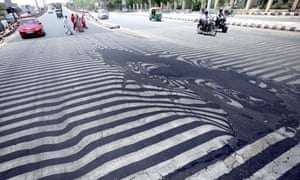
Road markings appear distorted during a heatwave, in New Delhi, India, 27 May 2015.

Road markings appear distorted during a heatwave, in New Delhi, India, 27 May 2015. Photograph: Harish Tyagi/EPA

by John Abraham, "Climate Consensus - The 97%," The Guardian, November 24, 2015

Despite the organization and funding behind groups which try to cast doubt about the causes and implications of climate change, the facts have spoken. The world continues to warm and their favorite myths have died.
We know that human-emitted heat-trapping gases warm the planet. In fact, this has been known for well over a century. With modern instruments (like ocean thermometers and satellites among others), we are now measuring the change. With advanced climate models, we can predict the changes. The measurements and the predictions are in excellent agreement, despite what cable news and second-rate skeptical scientists say.
And this year, the data are in. Using measurements to date, and long-term weather forecasting to predict the last 40 days of the year (while it may seem a bit early) we now know. As my colleague Dana Nuccitelli recently noted, 2015 is the hottest year on record. When the final numbers come out in January, the NOAA 2015 global averaged surface temperature anomaly over both land and ocean will be 1.6 °F above the long-term average. For the NASA GISTEMP dataset, it will be 1.5 °F above the long-term average. This comes on the heels of last year’s record and recent record ocean heat content. So, the bad news is we continue to break records.
The good news is that the favorite myths from climate-change skeptics [deniers] have taken a beating this year. Perhaps the best-known myth is the so-called “pause” or “hiatus” in global warming. This year, six individual studies have looked into this and found it incorrect. I have co-authored one of the studies, and I’ve written about some of the others here and here.
Well just today, another paper was published by Stephan Lewandowsky, James Risbey, and Naomi Oreskes that comes to the same conclusion. The paper is titled, “On the definition and identifiability of the alleged 'hiatus' in global warming.” The authors assess the magnitude and significance of all possible warming trends during the past 30 years. They found that looking back in time, the current definition of a “pause” in warming, as it is used in the literature, would have been used for more than one-third of the time, even though temperatures during the past 30 years increased by 1.1 °F (0.6 °C). 
The authors included 40 peer-reviewed studies that reported on the so-called hiatus or pause, and found no consistent definition among those studies. Then, the authors used these same 40 papers and asked whether the so-called “hiatus” was unusual in the time records. They found it wasn’t. 
The study also found that when the sample size is small (such as a short time period with very few years), a so-called “hiatus” will always appear. For instance, anyone claiming a “hiatus” shorter than 12 years will almost always find one.
I asked author Naomi Oreskes for a summary and she told me,
For a long time, climate change contrarians and deniers have insisted that global warming has paused, stopped, or taken a hiatus. This might have been dismissed as the usual denier cherry-picking—since much of it was based on cherry picking the starting year of 1998—an unusually hot year.
So we took up the question, first of all, whether the warming had stopped and second, if it had not, why were scientists calling it a pause. Ironically the paper that answered the second question got published first: we showed how contrarian discourse had steeped into the climate science community, so scientists were calling this decrease in the rate of warming a pause, when it clearly was no such thing. If warming continued, as indeed it did, then by definition that is not a pause, nor a hiatus. Our new paper, shows statistically that not only has there not been a pause or hiatus, but that the observed rate of warming is well within the range of previous fluctuations—including some positive fluctuations (i.e. increases in the rate of warming) that did not generate any scientific attention.
So the bottom line is: there is no pause, and there has never been one. The rate of global warming does fluctuate—but this has been known for a long time. Whether or not any particular fluctuation has an identifiable cause—like the effects of ocean heat uptake or an El Ninois an interesting question, but a fluctuation is not a pause, and it is important to be clear that the recent fluctuation is not statistically anomalous compared with other fluctuations we have seen, relative to the longer-term warming trend.
Now, with six nails in this coffin of this myth, are any more needed?
http://www.theguardian.com/environment/climate-consensus-97-per-cent/2015/nov/24/study-drives-a-sixth-nail-in-the-global-warming-pause-myth