Blog Archive

Showing posts with label Velicogna. Show all posts

Wednesday, July 22, 2015

James Hansen: ‘Emergency Cooperation Among Nations’ Is Needed to Prevent Catastrophic Sea Level Rise

"Roughly 10 feet of sea level rise—well beyond previous estimates—would render coastal cities such as New York, London, and Shanghai uninhabitable." Photo credit: Woodbine
“Roughly 10 feet of sea level rise—well beyond previous estimates—would render coastal cities such as New York, London, and Shanghai uninhabitable.” Photo credit: Woodbine

by Jon Queally, Common Dreams, July 21, 2015
If a new scientific paper is proven accurate, the international target of limiting global temperatures to a 2 °C rise this century will not be nearly enough to prevent catastrophic melting of ice sheets that would raise sea levels much higher and much faster than previously thought possible.
According to the new study—which has not yet been peer-reviewed, but was written by former NASA scientist James Hansen and 16 other prominent climate researchers—current predictions about the catastrophic impacts of global warming, the melting of vast ice sheets and sea level rise do not take into account the feedback loop implications of what will occur if large sections of Greenland and the Antarctic are consumed by the world’s oceans.
A summarized draft of the full report was released to journalists on Monday, with the shocking warning that such glacial melting will “likely” occur this century and could cause as much as a 10 foot sea-level rise in as little as 50 years. Such a prediction is much more severe than current estimates contained in reports issued by the Intergovernmental Panel on Climate Change (IPCC) — the UN-sponsored body that represents the official global consensus of the scientific community.
“If the ocean continues to accumulate heat and increase melting of marine-terminating ice shelves of Antarctica and Greenland, a point will be reached at which it is impossible to avoid large scale ice sheet disintegration with sea level rise of at least several meters,” the paper states.
Separately, the researchers conclude that “continued high emissions will make multi-meter sea level rise practically unavoidable and likely to occur this century. Social disruption and economic consequences of such large sea level rise could be devastating. It is not difficult to imagine that conflicts arising from forced migrations and economic collapse might make the planet ungovernable, threatening the fabric of civilization.”
The Daily Beast‘s Mark Hertsgaard, who attended a press call with Dr. Hansen on Monday, reports that the work presented by the researchers is
"...warning that humanity could confront “sea level rise of several meters” before the end of the century unless greenhouse gas emissions are slashed much faster than currently contemplated.
This roughly 10 feet of sea level rise—well beyond previous estimates—would render coastal cities such as New York, London, and Shanghai uninhabitable. “Parts of [our coastal cities] would still be sticking above the water,” Hansen said, “but you couldn’t live there.”
This apocalyptic scenario illustrates why the goal of limiting temperature rise to 2 degrees Celsius is not the safe “guardrail” most politicians and media coverage imply it is, argue Hansen and 16 colleagues in a blockbuster study they are publishing this week in the peer-reviewed journal Atmospheric Physics and Chemistry. On the contrary, a 2C future would be “highly dangerous.”
If Hansen is right—and he has been right, sooner, about the big issues in climate science longer than anyone—the implications are vast and profound.
In the call with reporters, Hansen explained that time is of the essence, given the upcoming climate talks in Paris this year and the grave consequences the world faces if bold, collective action is not taken immediately. “We have a global crisis that calls for international cooperation to reduce emissions as rapidly as practical,” the paper states.
Hansen said he has long believed that many of the existing models were under-estimating the potential impacts of ice sheet melting, and told the Daily Beast: “Now we have evidence to make that statement based on much more than suspicion.”
Though he acknowledged the publication of the paper was unorthodox, Hansen told reporters that the research itself is “substantially more persuasive than anything previously published.”
For his part, Eric Holthaus, a meteorologist who writes about weather and climate for Slate, said the “bombshell” findings are both credible and terrifying. Holthaus writes:
To come to their findings, the authors used a mixture of paleoclimate records, computer models, and observations of current rates of sea level rise, but “the real world is moving somewhat faster than the model,” Hansen says.
[…] The implications are mindboggling: In the study’s likely scenario, New York City—and every other coastal city on the planet—may only have a few more decades of habitability left. That dire prediction, in Hansen’s view, requires “emergency cooperation among nations.”
In response to the paper, climate scientist Michael Oppenheimer of Princeton University affirmed: “If we cook the planet long enough at about two degrees warming, there is likely to be a staggering amount of sea level rise. Key questions are when would greenhouse-gas emissions lock in this sea level rise and how fast would it happen? The latter point is critical to understanding whether and how we would be able to deal with such a threat.”
The new research, Oppenheimer added, “takes a stab at answering the ‘how soon?’ question but we remain largely in the dark. Giving the state of uncertainty and the high risk, humanity better get its collective foot off the accelerator.”
And as the Daily Beast‘s Hertsgaard notes, Hansen’s track record on making climate predictions should command respect from people around the world. The larger question, however, is whether humanity has the capacity to act.
“The climate challenge has long amounted to a race between the imperatives of science and the contingencies of politics,” Hertsgaard concludes. “With Hansen’s paper, the science has gotten harsher, even as the Nature Climate Change study affirms that humanity can still choose life, if it will. The question now is how the politics will respond—now, at Paris in December, and beyond.”
http://ecowatch.com/2015/07/21/james-hansen-climate-report/

Wednesday, December 3, 2014

NASA: Antarctic Melt Loss Triples in a Decade

by Peter Sinclair, Climate Crocks, December 3, 2014
Evidence is piling up indicating the planet will be extremely fortunate to stay on the lower end of sea level rise estimates.

And remember, this study covers just one area of Antarctica, where we have good instrument coverage.

A comprehensive, 21-year analysis of the fastest-melting region of Antarctica has found that the melt rate of glaciers there has tripled during the last decade. 
The glaciers in the Amundsen Sea Embayment in West Antarctica are hemorrhaging ice faster than any other part of Antarctica and are the most significant Antarctic contributors to sea level rise. This study by scientists at the University of California, Irvine (UCI), and NASA is the first to evaluate and reconcile observations from four different measurement techniques to produce an authoritative estimate of the amount and the rate of loss over the last two decades.
This work extends the work of Eric Rignot, who stunned the ice sheet community last spring with his “holy shit moment” paper on unstoppable Antarctic melting – discussed here in a very important video, if you have not seen it.


“The mass loss of these glaciers is increasing at an amazing rate,” said scientist Isabella Velicogna, jointly of UCI and NASA’s Jet Propulsion Laboratory, Pasadena, California. Velicogna is a coauthor of a paper on the results, which has been accepted for publication in the journal Geophysical Research Letters. 
Lead author Tyler Sutterley, a doctoral candidate at UCI, and his team did the analysis to verify that the melting in this part of Antarctica is shifting into high gear. “Previous studies had suggested that this region is starting to change very dramatically since the 1990s, and we wanted to see how all the different techniques compared,” Sutterley said. “The remarkable agreement among the techniques gave us confidence that we are getting this right.” 
The researchers reconciled measurements of the mass balance of glaciers flowing into the Amundsen Sea Embayment. Mass balance is a measure of how much ice the glaciers gain and lose over time from accumulating or melting snow, discharges of ice as icebergs, and other causes. Measurements from all four techniques were available from 2003 to 2009. Combined, the four data sets span the years 1992 to 2013.
Worth watching this video from a year ago if you have not yet, backgrounder on the movement of large ice sheets.

The glaciers in the embayment lost mass throughout the entire period. The researchers calculated two separate quantities: the total amount of loss, and the changes in the rate of loss. 
The total amount of loss averaged 83 gigatons per year (91.5 billion U.S. tons). By comparison, Mt. Everest weighs about 161 gigatons, meaning the Antarctic glaciers lost an amount of water weight equivalent to Mt. Everest every two years over the last 21 years. 
The rate of loss accelerated an average of 6.1 gigatons (6.7 billion U.S. tons) per year since 1992.
During the period when the four observational techniques overlapped, the melt rate increased an average of 16.3 gigatons per year — almost three times the rate of increase for the full 21-year period. The total amount of loss was close to the average at 84 gigatons. 
The four sets of observations include NASA’s Gravity Recovery and Climate Experiment satellites, laser altimetry from NASA’s Operation IceBridge airborne campaign and the earlier ICESat satellite, radar altimetry from the European Space Agency’s Envisat satellite, and mass budget analyses using radars and the University of Utrecht’s Regional Atmospheric Climate Model. 
The scientists noted that glacier and ice sheet behavior worldwide is by far the greatest uncertainty in predicting future sea level. “We have an excellent observing network now. It’s critical that we maintain this network to continue monitoring the changes,” Velicogna said, “because the changes are proceeding very fast.”
This is just Antarctica. At the other pole, Greenland is also vulnerable, and estimates of how fast it can shed mass keep increasing. Below, see Dr. Jeff Masters' analysis of that loss, and Dr. James Hansen’s take on what an accelerating Greenland loss might mean to the world.
Dr. Jeff Masters at Weather Underground:
Human-caused global warming has set in motion an unstoppable slow-motion collapse of the glaciers in West Antarctica capable of raising global sea level by 4 feet (1.2 meters) in a few hundred years, said NASA in a May 2014 press release. What’s more, one of the glaciers involved, the Thwaites Glacier, acts as a linchpin on the rest of the ice sheet, which contains enough ice to cause a total of 10 to 13 feet (3 to 4 meters) of global sea level rise over a period of centuries. This unstoppable collapse makes saving Greenland “absolutely essential,” said glaciologist Richard Alley in a May 2014 interview in Mother Jones. 
Greenland’s ice sheet holds enough water to raise global sea levels by 7.36 meters (24.15 feet) were it all to melt, and civilization would be hard-pressed to deal with 10–13 feet of sea level rise from West Antarctica, let alone another 20+ feet from Greenland. “If we’ve committed to 3.3 meters (10.8') from West Antarctica, we haven’t committed to losing Greenland, we haven’t committed to losing most of East Antarctica,” said Alley. “Those are still out there for us. And if anything, this new news just makes our decisions more important, and more powerful.” 
Unfortunately, the Greenland Ice Sheet is much more vulnerable to melting than previously thought, found a May 2014 study by Morlighem et al., "Deeply incised submarine glacial valleys beneath the Greenland ice sheet." The researchers found that widespread ice-covered valleys extend much deeper below sea level and farther inland than previously thought, and would likely melt significantly from steadily warming waters lapping at Greenland’s shores.

Figure 2. Monthly changes in the total mass (in gigatons) of the Greenland ice sheet estimated from GRACE satellite measurements between March 2002–July 2013. The blue and orange asterisks denote April and July values, respectively. Note that the decline in ice mass lost from Greenland is not a straight line – it is exponential, meaning that, in general, more ice loss is lost each year than in the previous year. However, the mass loss during the 2013 summer melt season was probably smaller than during 2012, said the 2013 Arctic Report Card.

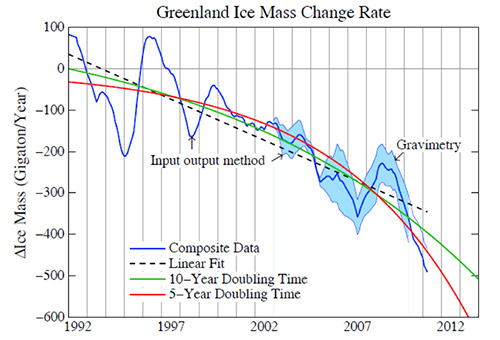
Fig. 1 shows that Greenland has been losing mass at a faster and faster rate over the past decade, with the recent rate corresponding to ~1 mm sea level per year (1 mm sea level = 360 Gt ice). The linear fit to the Shepherd et al. data in Fig. 1 yields a Greenland contribution to global sea level of about 30 cm by 2100.
Fig. 1. Annual mass change of Greenland ice sheet based on the input-output method, an analysis of gravity measurements, and a best-estimate composite (Shepherd et al., 2012).
Fig. 1. Annual mass change of Greenland ice sheet based on the inputoutput method, an analysis of gravity measurements, and a best-estimate composite (Shepherd et al., 2012).
The increasing Greenland mass loss in Fig. 1 can be fit just as well by exponentially increasing annual mass loss, a behavior that Hansen (2005, 2007) argues could occur because of multiple amplifying feedbacks as an ice sheet begins to disintegrate. A 10-year doubling time would lead to 1 meter sea level rise by 2067 and 5 meters by 2090. The dates are 2045 and 2057 for 5-year doubling time and 2055 and 2071 for a 7-year doubling time.
http://climatecrocks.com/2014/12/03/nasa-antarctic-melting-triples/ 

Friday, March 11, 2011

E. Rignot et al., Geophys. Res. Lett., 38 (2011), Acceleration of the contribution of the Greenland and Antarctic ice sheets to sea level rise


Geophysical Research Letters, 38 (2011) L05503; doi: 10.1029/2011GL046583
Acceleration of the contribution of the Greenland and Antarctic ice sheets to sea level rise
E. Rignot, I. Velicogna (Earth System Science, University of California, Irvine, CA, and Jet Propulsion Laboratory, California Institute of Technology, Pasadena, CA, U.S.A.), M. R. van den Broeke (Institute for Marine and Atmospheric Research, Utrecht University, Utrecht, The Netherlands), A. Monaghan (National Center for Atmospheric Research, Boulder, CO, U.S.A.) and J. Lenaerts (Institute for Marine and Atmospheric Research, Utrecht University, Utrecht, The Netherlands)

Abstract
Ice sheet mass balance estimates have improved substantially in recent years using a variety of techniques, over different time periods, and at various levels of spatial detail. Considerable disparity remains between these estimates due to the inherent uncertainties of each method, the lack of detailed comparison between independent estimates, and the effect of temporal modulations in ice sheet surface mass balance. Here, we present a consistent record of mass balance for the Greenland and Antarctic ice sheets over the past two decades, validated by the comparison of two independent techniques over the last 8 years: one differencing perimeter loss from net accumulation, and one using a dense time series of time-variable gravity. We find excellent agreement between the two techniques for absolute mass loss and acceleration of mass loss. In 2006, the Greenland and Antarctic ice sheets experienced a combined mass loss of 475 ± 158 Gt/yr, equivalent to 1.3 ± 0.4 mm/yr sea level rise. Notably, the acceleration in ice sheet loss over the last 18 years was 21.9 ± 1 Gt/yr2 for Greenland and 14.5 ± 2 Gt/yr2 for Antarctica, for a combined total of 36.3 ± 2 Gt/yr2. This acceleration is 3 times larger than for mountain glaciers and ice caps (12 ± 6 Gt/yr2). If this trend continues, ice sheets will be the dominant contributor to sea level rise in the 21st century.
Received 4 January 2011, accepted 2 February 2011, published 4 March 2011.
Citation: Rignot, E., I. Velicogna, M. R. van den Broeke, A. Monaghan, and J. Lenaerts. (2011). Acceleration of the contribution of the Greenland and Antarctic ice sheets to sea level riseGeophys. Res. Lett.38, L05503; doi: 10.1029/2011GL046583.
Link to abstract:  http://www.agu.org/pubs/crossref/2011/2011GL046583.shtml