Blog Archive

Showing posts with label Koch Industries. Show all posts

Sunday, June 4, 2017

Graham Readfearn: White House debate on Paris was never about climate change


The wrangling between Trump’s advisors was always about how best to burn more fossil fuels


Supposedly at war over climate change, key advisors Jared Kushner and Steve Bannon watch on as Trump signs orders to green-light the Keystone XL and Dakota Access pipelines (Photo: Office of the President of the United States)

by Graham Readfearn, Climate Change News, June 2, 2017


As United States President Donald Trump was deliberating his country’s future in the Paris climate deal, there were two internal camps marshalling their arguments.

But the wrangling in the White House was not a debate about climate change. It was over how best to burn more fossil fuels.

In one corner were the fossil fuel apologists, the climate science denialists and the network of conservative think tanks that have used conflicted cash to keep their arguments flowing.

For them, leaving the United Nations pact would help the US regain a competitive advantage and put their economic prosperity first. The costs of climate change impacts were never factored, because for them, they do not exist.

In the other corner, there were groups who, on the face of it, seemed unlikely bedfellows.

Trump’s daughter Ivanka and her husband Jared Kushner – both presidential advisors – recruited of the likes of Hollywood star-turned-climate campaigner Leonardo diCaprio and former Vice-President Al Gore to sit down with the president.

In the uncertain months leading up to this decision, much was made of her influence on her father. But, on this issue at least, that appears to have been overblown.


Rex Tillerson told his senate confirmation hearing that the US should stay in the agreement to protect its own interests (Photo: greatagain.com)


Ivanka was joined by Trump’s secretary of state Rex Tillerson, who oversaw a long-running programme designed to confound climate action as the CEO of Exxon. He was also pushing for the Trump administration to keep a seat at the UN table.

At least two coal companies, Peabody Energy and Cloud Peak, had tried to convince Trump to remain in the Paris deal. Oil and gas giants Exxon and Conoco also voiced support for the Paris deal.

This internal fight represented two different approaches from a fossil fuel industry trying to sustain itself. One approach is to bulldoze and cherry-pick your way through the science of climate change and attack the UN process — all to undermine your opponents’ core arguments.

Another approach is to accept the science but work the system to convince governments that “clean coal” and efficiency gains are the way forward.

The latter was exactly the rationale reportedly deployed by coal firms like Peabody Energy and Cloud Peak.

According to White House officials quoted by Reuters, these firms wanted Trump to stay in the Paris deal because this gave them a better chance of getting support for “low-emission” coal plants.  They might also get some financial help to support the development of carbon capture and storage (CCS) technology.

When the World Coal Association talks about its role at United Nations climate talks, it too is hopeful that being inside the United Nations tent will give them a chance to justify the future of its industry through less-dirty coal generators and CCS.

During his senate confirmation, Tillerson was asked if the US should maintain leadership on climate issues. He demurred, saying that the US should “maintain its seat at the table”. Earlier he had said he held this view so that the US could understand “what the impacts may be on the American people and American competitiveness.”

It was hardly an endorsement of the aims of the process. Its certainly didn’t convince Trump, of course, as we now know who won.


Celebrating today will be Trump’s chief strategist Steve Bannon, the former boss of the hyper-partisan news outlet Breitbart, and Scott Pruitt, the head of Trump’s Environmental Protection Agency (Bannon once called global warming a manufactured crisis, while Pruitt is unconvinced that extra carbon dioxide in the atmosphere is causing climate change).

Trump had declared a year ago that, if elected, he would leave the Paris agreement and stop all payments to “UN global warming programs.” On that, he has simply fulfilled a campaign promise.

The “remain” camp was clearly facing an uphill battle.

There’s an awful lot of dust that needs to settle before the implications of Trump’s decision become clear.  Will his decision galvanize others, such as Europe and China, to take a great leadership role?

Will it encourage some eastern European countries already unhappy at the greenhouse gas cuts pledged in Paris, to slow the process further?

For the meantime, we can begin to assess why the climate denial machine that won the day over those trying to subvert the climate process from within.

Social science academics that have studied the “climate change counter movement” say the organisations that proliferate this world view have captured key institutions that grant them outsize power.

Professor Riley Dunlap, a pioneer in the field of environmental sociology, concedes that Trump’s decision is  “a major victory for the denial machine.”

In particular Dunlap, of Oklahoma State University, points to “core elements like the Heritage Foundation” – a think tank that Trump has tapped for several positions in his administration.

“Withdrawal is the logical outcome of their success in getting Trump to appoint hardcore deniers like Scott Pruitt to key cabinet and administrative positions,” says Dunlap.

“This administration is institutionalising climate change denial2 more fully and brazenly than did the George W. Bush administration, which was effective in stalling both national and international policy-making.”

“While efforts to reduce carbon emissions can still be taken at state and local levels, the federal government’s role is critical, especially in international efforts to deal with climate change.”

The only way to change that is through the ballot box, he says.

“We are not going to reduce the influence of the denial interests in the federal government until we see major changes in its composition – a new administration and Republicans losing their grip on Congress.”

Professor Robert Brulle, of Drexel University, has studied the network of think tanks that have been pushing back against climate action – often with debunked arguments about the influence of fossil fuel brining on the climate.

“It is very clear to me that the organisations long-associated with providing climate misinformation played a major role in the announcement by president Trump,” Brulle told Climate Home.

“What is needed is the public exposure of the tactics and strategies of these organisations engaged in misinformation efforts, and how they work with their sponsors to create and promulgate their misinformation campaigns.”

Professor Aaron McCright, of Michigan State University, also researches the political and social dimensions of climate policy.

He says there is a slowly strengthening bloc within the Republican Party that rejects the kind of climate science denial that has become a key element of their party’s identity.

“These science-accepting Republicans must continue to grow in number; they must find public platforms to consistently communicate their messages; and they must do the hard work of convincing their GOP brothers and sisters to accept the science and go about looking for conservative solutions to climate change,” he says.

“This will not be easy.  But, I think this is the only real way to crowd out motivated climate change denial from their party.  The change must come from within.”

http://www.climatechangenews.com/2017/06/02/white-house-debate-paris-never-climate-change/

Thursday, December 8, 2016

Jane Mayer, The New Yorker: Scott Pruitt, Trump’s Industry Pick for the E.P.A.

by Jane Mayer, The New Yorker, December 7, 2016


Garvin Isaacs, the president of the Oklahoma Bar Association, isn’t one for understatement, but he topped himself in his reaction to the news that Donald Trump is expected to nominate Scott Pruitt, the Oklahoma attorney general, to run the Environmental Protection Agency.

“It’s the worst thing in the history of our environment!” Isaacs exclaimed when I spoke to him on Wednesday. “We are in danger. The whole country is in danger. Our kids are in danger. People have got to do something about the Citizens United decision that is turning our country into an oligarchy, run by oil-and-gas interests,” he said.

Isaacs is a colorful and respected local litigator who has long been a thorn in the side of Oklahoma’s powerful. He claims the fossil-fuel industry “owns the whole darn state.” But his worries at the state level are now national. By choosing Pruitt, Isaacs said, Trump has outsourced his environmental policy to the Republican Party’s most powerful private donors—the oil-and-gas magnates who have funded Pruitt’s campaigns in Oklahoma.

Until now, Pruitt’s greatest claim to national fame was his star role in a Pulitzer Prize-winning investigation by the Times, in 2014. The investigation revealed that a letter Pruitt sent to the E.P.A in 2011, complaining about federal regulators’ estimation of the air pollution caused by drilling in Oklahoma, was actually written by lawyers for Devon Energy, one of the state’s biggest oil-and-gas companies. (“Outstanding!” the company’s director of government relations wrote in a note to Pruitt’s office.) The Times found that Pruitt had sent similar letters, drafted by energy-industry lobbyists, to the Department of the Interior, the Office of Management and Budget, and President Obama. Pruitt has also taken a lead role in coördinating a twenty-eight-state legal challenge to the Obama Administration’s regulations on fossil-fuel pollution, which are at the center of its larger effort to stem climate change.

In taking these anti-regulatory positions, Pruitt has clearly aligned himself with his right-wing campaign donors, including Charles and David Koch. KochPAC, the political-action committee of the brothers’ Kansas-based oil-and-chemical conglomerate, Koch Industries, contributed to Pruitt’s campaigns in 2010, 2013, and 2014. Pruitt has also been backed by several other billionaire oil-and-gas executives, who joined political forces with the Kochs during the Obama years, becoming “investors,” as they called themselves, in the Kochs’ anti-regulatory, pro-business political movement. Harold Hamm, the billionaire founder and chief executive of Continental Resources, and Larry Nichols, the chairman emeritus of Devon Energy, have both supported Pruitt. Hamm, in fact, was the co-chairman of Pruitt’s 2013 reëlection campaign. This year, Hamm became an early and ardent Trump supporter and adviser on energy matters. In September, Politico reported that Nichols had become a close adviser to Trump on energy, too. It’s not clear that Pruitt will continue to take dictation from his fossil-fuel backers, but they almost certainly will have a lot more to thank him for if he enters the Trump Administration.

During the Presidential campaign, Trump signalled his support for the fossil-fuel industry and his lack of concern about climate change, which he called “a hoax.” He also echoed the industry’s calls to dismantle the E.P.A. In that sense, Trump’s nomination of Pruitt would not be unexpected. But it is deeply inconsistent with his populist rhetoric during the campaign. Trump mocked billionaire Republican political donors, including the Koch brothers. Steve Bannon, his campaign manager and now his chief strategist, derided the “donor class,” which he said had sold out ordinary voters, while Trump promised to take on corrupt special interests in Washington, and, as he put it, “drain the swamp.” With the choice of Pruitt, though, Trump appears to have once again chosen the plutocrats over the populists.

Saturday, May 7, 2016

As Climate Deception Investigations Gain Momentum, ExxonMobil Plays the Victim

2016-05-05-1462477765-8464431-ClimateFraudInvestigation.jpg
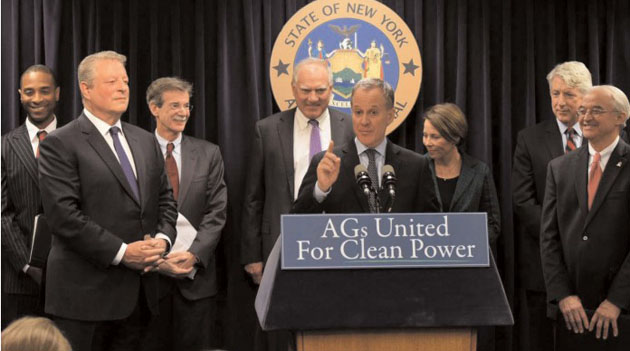
Al Gore joined New York Attorney General Eric Schneiderman (center) at a news conference announcing more AGs will investigate ExxonMobil for fraud.

by Elliot Negin, Senior Writer - Union of Concerned Scientists, Huffington Post, May 6, 2016

With several state attorneys general now investigating whether ExxonMobil misled its shareholders and the public about climate change risks, it was more than a little ironic when the company recently cried foul.
“Collaboration, collusion, conspiracy,” charged ExxonMobil Media Relations Manager Alan Jeffers, “pick a word.”
Pick a word? How about nonsense? If anyone could be accused of collusion and conspiracy, it’s ExxonMobil. But more on that later.
What prompted Jeffers’ ludicrous allegation was a meeting that took place on March 29, 2016. My colleague Peter Frumhoff (lead climate scientist at the Union of Concerned Scientists) and environmental attorney Matt Pawa briefed a handful of state attorneys general, including New York’s Eric Schneiderman, who launched an investigation of ExxonMobil last November. Later that day, Schneiderman and 16 other attorneys general joined former Vice President Al Gore at a press conference to declare their support for more aggressive government action on climate change. During the event, AGs from the U.S. Virgin Islands and Massachusetts announced that they, too, would initiate investigations of ExxonMobil.
On April 15, 2016, Reuters broke the story that Frumhoff and Pawa had met behind closed doors with the state prosecutors before the press conference. The news organization had obtained emails disclosing the meeting through an open records request filed by a group called the Energy & Environment Legal Institute (E&E Legal).
“The previously unknown level of coordination with outside advisers offered a glimpse behind the scenes in an increasingly pitched battle between Exxon and environmental groups,” Reuters reported. “Exxon has said it has been unfairly singled out and that climate activists are conspiring to rally public opinion against it.”
Unfortunately, not only did the Reuters story fail to adequately identify E&E Legal, it also mischaracterized what amounted to a routine meeting in an ongoing legal investigation.
Confidentiality is Standard Operating Procedure
Reuters described E&E Legal, a small, three-person nonprofit, as a “free-market think tank with ties to the Competitive Enterprise Institute [CEI], whose website says it opposes U.S. Environmental Protection Agency regulation of greenhouse gas emissions.” What it didn’t mention is that E&E Legal — which could hardly be called a think tank — is at least partly funded by the coal industry and has repeatedly harassed prominent climate scientists, including Katharine Hayhoe and Michael Mann, by filing intrusive open records requests that have tied them up for weeks and wasted hundreds of thousands of public university dollars.
What’s more, the story didn’t explain that the group’s connection with CEI is through CEI staff attorney Chris Horner, who handles E&E Legal’s open records filings. CEI has been peddling lies about climate science on behalf of fossil fuel interests for decades, and Horner is associated with other climate science denier groups as well as the coal industry, a relationship that was recently revealed by coal company bankruptcy filings.
More important, Reuters failed to clarify that the attorneys general were merely doing their jobs. By their very nature, legal investigations can entail gathering information privately from a wide variety of sources.
This is a key point. State attorneys general have the authority to meet with anyone they choose — be it a scientist, an environmental lawyer or a corporate official — in the course of an investigation on a confidential basis. In other words, there was no hint of collusion or conspiracy. Meeting privately with experts is part of the legal discovery process. Moreover, in New York — under the state’s Martin Act — the attorney general can initiate a completely confidential investigation of potentially fraudulent practices.
But that didn’t stop FoxNews.com, the Daily Caller, theWashington Examiner and the Washington Times — the climate science denial echo chamber — from providing ExxonMobil and E&E Legal a platform to make bogus charges about “collusion” and “conspiracy” in subsequent stories.
ExxonMobil’s Disinformation Network
Schneiderman’s investigation — and one launched in January by California’s attorney general — followed the release of documents by the Union of Concerned Scientists (UCS) and reporters at InsideClimate News and Columbia Journalism School revealing that Exxon scientists conducted cutting-edge climate research decades ago and warned top management of the potentially catastrophic risks posed by global warming. Schneiderman’s staff is now reviewing the company’s statements to investors regarding those risks to see if they contradicted what it was hearing from its own scientists.
The New York AGs office also is taking a close look at ExxonMobil’s support for a network of think tanks and advocacy groups that has been spreading disinformation about climate science for nearly 20 years. Here is where questions about “collusion” and “conspiracy” come into play.
That network was exposed back in 2007 when UCS documentedthat ExxonMobil had spent at least $16 million between 1998 and 2005 on more than 40 climate science denier groups. The group that got the most money? CEI, which received more than $2 million. Despite the fact that it had no scientists on its staff, CEI established itself as the go-to group to provide “the other side” of a manufactured scientific debate. It is perhaps best remembered for reassuring Americans that global warming is nothing to worry about in a TV commercial extolling the virtues of carbon dioxide. The spot’s unforgettable tag line: “They call it pollution. We call it life.”
ExxonMobil publicly ended its direct support for CEI in 2005, but the company continues to spend millions of dollars annually on denier groups and congressional climate science denier political campaigns. CEI, meanwhile, may have lost ExxonMobil as a benefactor, but according to the most recent available tax records, it is still receiving money from billionaire industrialist Charles Koch, co-owner of the coal, oil and gas conglomerate Koch Industries.
In any case, it is difficult to determine just where CEI gets itsfunding these days. Much of it comes from a secretive, pass-through foundation called Donors Trust and its affiliate Donors Capital Fund. Since 2002, the intertwined funds have laundered more than $457 million from anonymous corporations, foundations and individuals and distributed that money to hundreds of anti-regulation groups, including the American Enterprise Institute, the Heartland Institute and, of course, CEI.
The First Amendment Doesn’t Protect Fraud
As one of ExxonMobil’s top climate science denier grantees, CEI now finds itself in the hot seat. U.S. Virgin Islands Attorney General Claude Walker not only launched an investigation of ExxonMobil for defrauding investors and the general public, he also subpoenaed communications between ExxonMobil and many of its denier network groups. He specifically asked CEI for all its climate change and energy policy materials, as well as its donor lists, over a 10-year period beginning in 1997.

CEI has filed to quash the subpoena and pushed back in an April 23 op-ed in the Washington Post. CEI President Kent Lassman and his general counsel, Sam Kazman, insisted that their organization and ExxonMobil are being unfairly harassed for exercising their First Amendment rights. A week later, the Wall Street Journal editorial board chimed in, calling Walker’s subpoena of CEI documents “a form of harassment” and “a dangerous turn for free speech.”
Of course, the real issue is not CEI’s or ExxonMobil’s First Amendment rights. CEI, which has been exercising its right to mislead the public about climate change for quite some time, is being investigated to determine the extent to which it functioned as ExxonMobil’s paid surrogate. ExxonMobil, meanwhile, is being investigated to ascertain if it is guilty of fraud. And, as Attorney General Schneiderman has noted, “The First Amendment, ladies and gentlemen, doesn’t give you the right to commit fraud.”
Elliott Negin is a senior writer with the Union of Concerned Scientists.

Saturday, December 12, 2015

Brendan DeMelle: Historic Paris Climate Agreement Should Spook Fossil Fuel Markets and Escalate Clean Tech Investment

by Brendan DeMelle, DeSmog blog, December 12, 2015
World leaders reached an historic agreement in Paris moments ago, capping off the COP21 climate talks with a unanimous deal among 195 countries to curb global warming pollution and hasten the clean energy transition. The gavel just fell on the Paris Agreement, and it's time to celebrate.
Is it enough to please everyone? No. Will people continue to suffer from climate-charged extreme weather events? Yes. But today is a welcome change from previous summit failures.
It’s a big deal whenever 195 countries agree on anything, and that’s exactly what’s happened here today. 195 nations, from the richest to the poorest, agreed to pave the road to the end of fossil fuels.
This agreement sends a strong signal to politicians and the markets that it’s time to immediately escalate the transition to renewable energy and end the reign of fossil fuels which have polluted not only the planet but also democracies the world over.
Let there be no doubt that unacceptable compromises were made here in Paris, and much work remains to strengthen this agreement on the critical issues of human rights, finance for countries that must adapt to the inevitable and ongoing impacts, and other critical issues.
Sea levels will continue to rise and the world must assist those climate refugees who have been and will be displaced by climate chaos. The poorest, most vulnerable nations must be adequately financed to protect their people.
As a result of this agreement, we can move from a sense of total failure towards guarded optimism that we’re on the right path.
This reminds me of the feeling I had on the night of Barack Obama’s victory in 2008. My wife and I hosted a party for friends to watch the results, and as we cheered Obama’s victory, I turned to my brother and said that it was fine to celebrate tonight, but tomorrow we had to wake up and start holding him accountable for all the promises he’d made during the campaign.
This Paris deal is no different.
Today, there will be celebration. But tomorrow, the hard work must begin to hold leaders accountable for the promises made here and to continue to strengthen this agreement because much was lost to compromise.
There are many more miles to travel to break free from fossil fuels entirely, and to ensure justice is done to hold those accountable for the damage they knowingly caused. Those such as ExxonMobil and the Koch brothers — who actively sowed doubt to confuse the public and bought off politicians to delay action — must be held to account.
That important work is already underway, and will need broad public pressure.
The historic agreement today in Paris sends the right signal to the world.

Keep your eyes peeled on the New York Stock Exchange (NYSE) on Monday morning to see what happens to the big oil, gas and coal stocks. Peabody Energy closed on Friday at a very weak $8.82 (NYSEBTU), continuing a rapid decline over the past year. Here's the Peabody stock chart over the last year:


Blog Image credit: Shutterstock
http://www.desmogblog.com/2015/12/12/historic-climate-agreement-should-spook-fossil-fuel-markets-and-escalate-clean-tech-investment

Friday, July 10, 2015

Joe Romm: Oil Company Exxon Knew About The Scientific Reality Of Climate Change In 1981


by Joe Romm, Think Progress, July 10, 2015

“Pope Francis blasts global warming deniers,” the Washington Post wrote last month. The Pope’s climate encyclical focused on the immorality of climate inaction — which makes the immorality of knowingly spreading disinformation for the purpose of delaying action all the more base.
Now the Union of Concerned Scientists has disclosed an email revealing that Exxon understood the scientific reality of climate change as far back as 1981. “Other companies, such as Mobil, only became aware of the issue in 1988, when it first became a political issue,” Exxon’s former in-house climate expert, chemical engineer Leonard S. Bernstein wrote last year. The 30-year veteran of Mobil and Exxon explained:
Exxon first got interested in climate change in 1981 because it was seeking to develop the Natuna gas field off Indonesia. This is an immense reserve of natural gas, but it is 70% CO2. That CO2 would have to be separated to make the natural gas usable.
And yet despite a growing understanding of the scientific reality of climate change in the 1980s and 1990s, Exxon became one of the biggest funders of scientists and think tanks and others who do little but deny and cast doubt on the scientific understanding of human-caused global warming.
As recently as February 2015, a New York Times exposé revealed that a researcher at the Harvard-Smithsonian Center for Astrophysics who routinely casts doubt on widely accepted climate science had “accepted more than $1.2 million in money from the fossil-fuel industry over the last decade while failing to disclose that conflict of interest in most of his scientific papers.” This included funding from ExxonMobil and “at least $230,000 from the Charles G. Koch Charitable Foundation.”
In the book and film “Merchants of Doubt: How a Handful of Scientists Obscured the Truth on Issues from Tobacco Smoke to Global Warming,” historians and journalists show that this misinformation and disinformation campaign goes all the way back to the tobacco industry’s campaign to cast doubt on claims that cigarette smoking is bad for your health — and that in some cases it involves the same exact people.
The Times documented back in 2009 that the Global Climate Coalition (GCC), an anti-action lobbying group backed by fossil fuel industries, ignored its own climate scientists during the 1990s while spreading disinformation about global warming. An internal report stating that the human causes of global warming “cannot be denied” was ignored by GCC leaders. The GCC led an “aggressive lobbying and public relations campaign against the idea that emissions of heat-trapping gases could lead to global warming.” Yet the final draft of a 1995 “Primer on Climate Change Science” written by the GGC’s own scientific experts revealed that those experts “were advising that the science backing the role of greenhouse gases in global warming could not be refuted.”
Those experts explained: “The scientific basis for the Greenhouse Effect and the potential impact of human emissions of greenhouse gases such as CO2 on climate is well established and cannot be denied.” And after a long analysis of “Are There Alternate Explanations for the Climate Change Which Has Occurred Over the Last 120 Years?” they conclude: “The contrarian theories raise interesting questions about our total understanding of climate processes, but they do not offer convincing arguments against the conventional model of greenhouse gas emission-induced climate change.”
The Times reported that the GCC “was financed by fees from large corporations and trade groups representing the oil, coal and auto industries, among others” with a budget totaling nearly $1.7 million in 1997 alone. Ultimately, The Times notes, “The coalition, according to other documents, later requested that the section of the primer endorsing the basics of global warming science be cut.”
The tobacco industry knew of the dangers of smoking and the addictive nature of nicotine for decades, but its CEOs and representatives publicly denied those facts. In the same way, many of those denying the reality of human-caused climate change have long known the actual science.
Over the years, fossil fuel company executives have funneled tens of millions of dollars into this disinformation campaign. The top funder was ExxonMobil for a long time. But the company was overtaken years ago by Koch Industries, run by billionaires Charles and David Koch, who spent more than $48.5 million from 1997 to 2010 to fund disinformation. From 2005 to 2008, the Kochs outspent Exxon-Mobil well over 2-to-1 in funding the climate denial machine.
In February, the New York Times revealed that over the previous ten years, Wei-Hock “Willie” Soon had accepted more than a million dollars from fossil fuel interests, including Exxon-Mobil and the Charles G. Koch Charitable Foundation, “while failing to disclose that conflict of interest in most of his scientific papers.” During this period, Soon advanced a repeatedly debunked theory arguing that humans are not the primary cause of global warming. The Times explained:
Though he has little formal training in climatology, Dr. Soon has for years published papers trying to show that variations in the sun’s energy can explain most recent global warming. His thesis is that human activity has played a relatively small role in causing climate change.
The New York Times then explains that “many experts in the field say that Dr. Soon uses out-of-date data, publishes spurious correlations between solar output and climate indicators, and does not take account of the evidence implicating emissions from human behavior in climate change.” Gavin A. Schmidt, the head of NASA’s Goddard Institute for Space Studies explained that solar variability probably is responsible for at most 10% of recent global warming, whereas human-caused greenhouse gases are responsible for the overwhelming majority of it. He added, “the science that Willie Soon does is almost pointless.”
In October 2014, the Smithsonian itself put out a climate statement, which makes clear that such a view is simply anti-scientific. The Smithsonian explains, “Scientific evidence has demonstrated that the global climate is warming as a result of increasing levels of atmospheric greenhouse gases generated by human activities.” Amazingly, the newly uncovered documents show that “Dr. Soon, in correspondence with his corporate funders, described many of his scientific papers as ‘deliverables’ that he completed in exchange for their money.” The Smithsonian repeatedly signed off on contracts with Southern Company Services — a coal company and long-time funder of science denial — requiring the Smithsonian to provide the coal utility “advanced written copy of proposed publications … for comment and input.”
Yet the fossil fuel industry has known for two decades that the solar variability explanation for recent climate change is untrue. As far back as 1995, the scientific and technical advisers to the Global Climate Coalition wrote in their draft primer:
[The] hypothesis about the role of solar variability and [Pat] Michaels’ questions about the temperature record are not convincing arguments against any conclusion that we are currently experiencing warming as the result of greenhouse gas emissions. However, neither solar variability nor anomalies in the temperature record offer a mechanism for off-setting the much larger rise in temperature which might occur if the atmospheric concentration of greenhouse gases were to double or quadruple.
So the fossil fuel industry has known for a long, long time that human-caused climate change was a very real threat based on well-documented science. It has callously disregarded that reality to spread falsehoods and thwart action.
The Pope ends his encyclical calling on God to “Enlighten those who possess power and money that they may avoid the sin of indifference, that they may love the common good, advance the weak, and care for this world in which we live. The poor and the earth are crying out.”
If indifference to the dangers of climate inaction by the rich and powerful is a sin, what would the Pope say about a company that’s fostering lies in order to spread indifference among the public, the media, and policy-makers?

http://thinkprogress.org/climate/2015/07/10/3678684/original-sin-denial-exxon-climate-change-1981/

Wednesday, July 8, 2015

Exxon knew global warming was real 30 years ago! UCS: "The Climate Deception Dossiers"

Internal fossil fuel industry memos reveal decades of disinformation—a deliberate campaign to deceive the public that continues even today.

from the Union of Concerned Scientists, July 7, 2015

For nearly three decades, many of the world's largest fossil fuel companies have knowingly worked to deceive the public about the realities and risks of climate change.

Their deceptive tactics are now highlighted in this set of seven "deception dossiers"—collections of internal company and trade association documents that have either been leaked to the public, come to light through lawsuits, or been disclosed through Freedom of Information (FOIA) requests.

Each collection provides an illuminating inside look at this coordinated campaign of deception, an effort underwritten by ExxonMobil, Chevron, ConocoPhillips, BP, Shell, Peabody Energy, and other members of the fossil fuel industry.

The climate deception dossiers

Containing 85 internal memos totaling more than 330 pages, the seven dossiers reveal a range of deceptive tactics deployed by the fossil fuel industry. These include forged letters to Congress, secret funding of a supposedly independent scientist, the creation of fake grassroots organizations, multiple efforts to deliberately manufacture uncertainty about climate science, and more.

The documents clearly show that:
  • Fossil fuel companies have intentionally spread climate disinformation for decades. 
  • Fossil fuel company leaders knew that their products were harmful to people and the planet but still chose to actively deceive the public and deny this harm.
  • The campaign of deception continues today.
Download the full report for in-depth information on each of the seven dossiers. The complete collection of documents is available in the sources and resources section below. 


What fossil fuel companies knew and when they knew it


The fundamentals of global warming have been well established for generations. Fossil fuel companies have almost certainly been aware of the underlying climate science for decades.
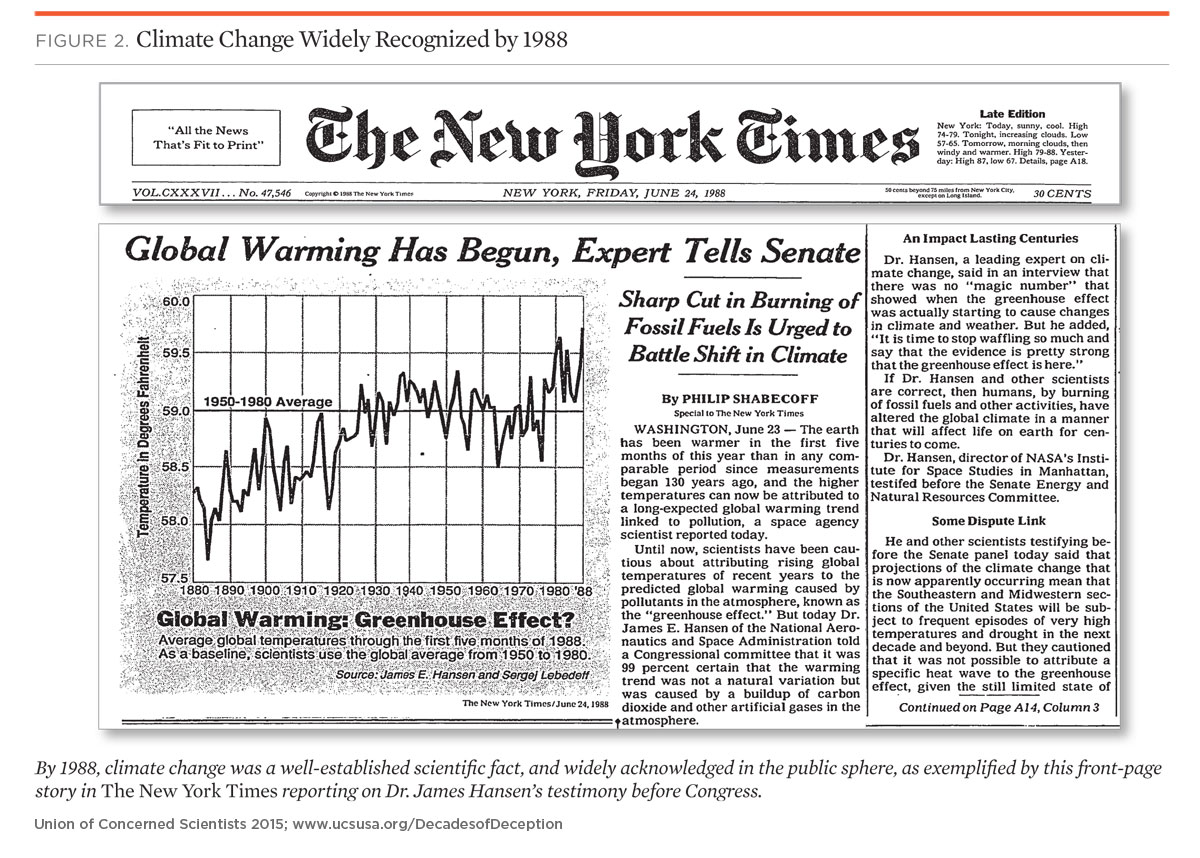
By 1988, climate change was a well-established scientific fact and widely acknowledged in the public sphere, as exemplified by this front page story in the New York Times. Enlarge image.

As early as 1977, representatives from major fossil fuel companies attended dozens of congressional hearings in which the contribution of carbon emissions to the greenhouse effect was discussed.

In 1988, the issue moved beyond the scientific community and onto the national stage. James Hansen, a leading NASA climate scientist, testified before Congress that scientific data had confirmed that industrial activities were causing climate change. It was also in 1988 that the United Nations formed the Intergovernmental Panel on Climate Change and the U.S. Congress introduced the National Energy Policy Act in an effort to reduce emissions of heat-trapping gases.

It is difficult to imagine that executives, lobbyists, and scientists at major fossil companies were by this time unaware of the robust scientific evidence of the risks associated with the continued burning of their products.
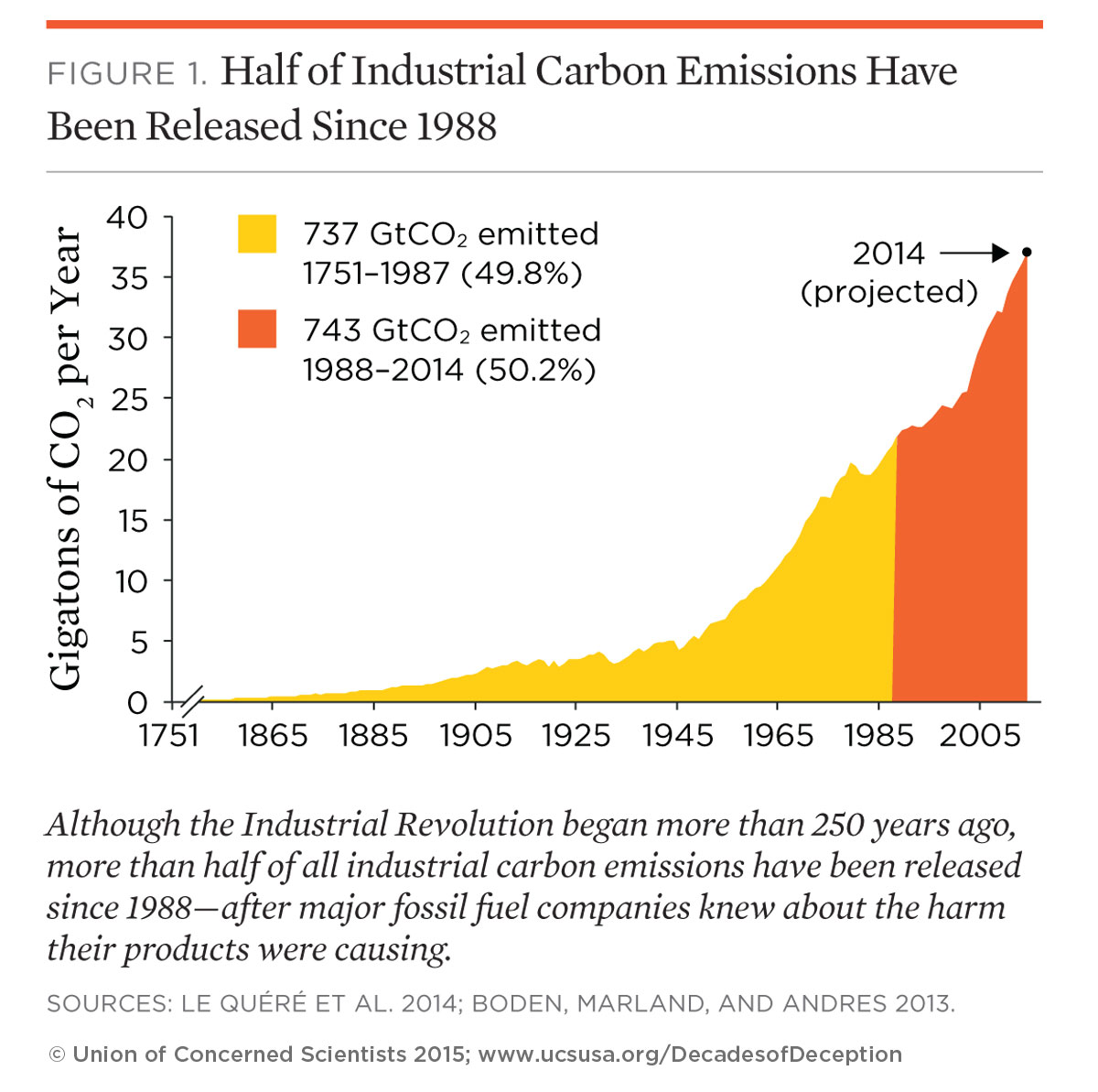
More than half of all industrial carbon emissions have been released since 1988—after major fossil fuel companies knew about the harm their products were causing. Enlarge image.

Indeed, one of the key documents highlighted in the deception dossiers is a 1995 internal memo written by a team headed by a Mobil Corporation scientist and distributed to many major fossil fuel companies. The internal report warned unequivocally that burning the companies' products was causing climate change and that the relevant science "is well established and cannot be denied."

How did fossil fuel companies respond? They embarked on a series of campaigns to deliberately deceive the public about the reality of climate change and block any actions that might curb carbon emissions.

The result? More than half of all industrial carbon emissions have been released since 1988 and there is still no comprehensive U.S. federal policy to address the problem.


Holding fossil fuel companies accountable


As the picture of fossil fuel companies' efforts to deceive the public comes into clear view, the time is ripe to hold these companies accountable for their actions and responsible for the harm they have caused.

So how should the American public expect fossil fuel companies to behave? At a minimum, society should expect them to:
  • Stop disseminating misinformation about climate change. It is unacceptable for fossil fuel companies to deny established climate science. It is also unacceptable for companies to publicly accept the science while funding climate contrarian scientists or front groups that distort or deny the science.
  • Support fair and cost-effective policies to reduce global warming emissions. It is time for the industry to identify and publicly support policies that will lead to the reduction of emissions at a scale needed to reduce the worst effects of global warming.
  • Reduce emissions from current operations and update their business models to prepare for future global limits on emissions. Companies should take immediate action to cut emissions from their current operations, update their business models to reflect the risks of unabated burning of fossil fuels, and map out the pathway they plan to take in the next 20 years to ensure we achieve a low-carbon energy future.
  • Pay for their share of the costs of climate damages and preparedness. Communities around the world are already facing and paying for damages from rising seas, extreme heat, more frequent droughts, and other climate-related impacts. Today and in the future, fossil fuel companies should pay a fair share of the costs.
  • Fully disclose the financial and physical risks of climate change to their business operations. As is required by law, fossil fuel companies are required to discuss risks—including climate change—that might materially affect their business in their annual SEC filings. Today, compliance with this requirement is not consistent.

Sources and resources


Source documents (PDFs) 
High-Resolution Graphics (JPGs) 
Rights and permission: You are free to use and post these graphics without alterations online, in written materials, and in presentations. Any online use must include proper citation and a link to this web page.