When we see records being broken and unprecedented events such as this, the onus is on those who deny any connection to climate change to prove their case. Global warming has fundamentally altered the background conditions that give rise to all weather. In the strictest sense, all weather is now connected to climate change. Kevin Trenberth
HIT THE PAGE DOWN KEY TO SEE THE POSTS
Now at 8,800+ articles. HIT THE PAGE DOWN KEY TO SEE THE POSTS
Science, 363(6423) (11 Jan 2019) 128-129; doi: 10.1126/science.aav7619 How fast are the oceans warming? Lijing Cheng, John Abraham, Zeke Hausfather, and Kevin Trenberth Abstract
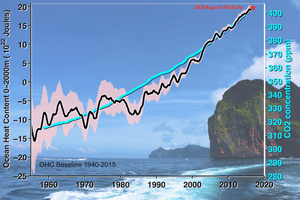
Climate change from human activities mainly results from the energy imbalance in Earth's climate system caused by rising concentrations of heat-trapping gases. About 93% of the energy imbalance accumulates in the ocean as increased ocean heat content (OHC). The ocean record of this imbalance is much less affected by internal variability and is thus better suited for detecting and attributing human influences (1) than more commonly used surface temperature records. Recent observation-based estimates show rapid warming of Earth's oceans over the past few decades (see the figure) (1, 2). This warming has contributed to increases in rainfall intensity, rising sea levels, the destruction of coral reefs, declining ocean oxygen levels, and declines in ice sheets; glaciers; and ice caps in the polar regions (3, 4). Recent estimates of observed warming resemble those seen in models, indicating that models reliably project changes in OHC.
Rising ocean temperatures can bleach corals, like these off of Papua New GuineaCreditCredi(Jurgen Freund/NPL/Minden Pictures). by Kendra Pierre-Louis, The New York Times, January 10, 2019 Scientists say the world’s oceans are warming far more quickly than previously thought, a finding with dire implications for climate change because almost all the excess heat absorbed by the planet ends up stored in their waters.
A new analysis, published Thursday in the journal Science, found that the oceans are heating up 40% faster on average than a United Nations panel estimated 5 years ago. The researchers also concluded that ocean temperatures have broken records for several straight years.
“2018 is going to be the warmest year on record for the Earth’s oceans,” said Zeke Hausfather, an energy systems analyst at the independent climate research group Berkeley Earth and an author of the study. “As 2017 was the warmest year, and 2016 was the warmest year.”
As the planet has warmed, the oceans have provided a critical buffer. They have slowed the effects of climate change by absorbing 93% of the heat trapped by the greenhouse gases humans pump into the atmosphere.
“If the ocean wasn’t absorbing as much heat, the surface of the land would heat up much faster than it is right now,” said Malin L. Pinsky, an associate professor in the department of ecology, evolution and natural resources at Rutgers University. “In fact, the ocean is saving us from massive warming right now.”
But the surging water temperatures are already killing off marine ecosystems, raising sea levels and making hurricanes more destructive.
As the oceans continue to heat up, those effects will become more catastrophic, scientists say. Rainier, more powerful storms like Hurricane Harvey in 2017 and Hurricane Florence in 2018 will become more common, and coastlines around the world will flood more frequently. Coral reefs, whose fish populations are sources of food for hundreds of millions of people, will come under increasing stress; a fifth of all corals have already died in the past three years.
People in the tropics, who rely heavily on fish for protein, could be hard hit, said Kathryn Matthews, deputy chief scientist for the conservation group Oceana. “The actual ability of the warm oceans to produce food is much lower, so that means they’re going to be more quickly approaching food insecurity,” she said.
Because they play such a critical role in global warming, oceans are one of the most important areas of research for climate scientists. Average ocean temperatures are also a consistent way to track the effects of greenhouse gas emissions because they are not influenced much by short-term weather patterns, Mr. Hausfather said.
“Oceans are really the best thermometer we have for changes in the Earth,” he said.
But, historically, understanding ocean temperatures has been difficult. An authoritative United Nations report, issued in 2014 by the Intergovernmental Panel on Climate Change, presented five different estimates of ocean heat, but they all showed less warming than the levels projected by computer climate models — suggesting that either the ocean heat measurements or the climate models were inaccurate.
Since the early 2000s, scientists have measured ocean heat using a network of drifting floats called "Argo," named after Jason’s ship in Greek mythology. The floats measure the temperature and saltiness of the upper 6,500 feet of the ocean and upload the data via satellites.
But before Argo, researchers relied ontemperature sensorsthat ships lowered into the ocean with copper wire. The wire transferred data from the sensor to the ship for recording until the wire broke and the sensor drifted away.
That methodwas subject touncertainties, particularly around the accuracy of the depth at which the measurement was taken. Those uncertainties hamper today’s scientists as they stitch together 20th-century temperature data into a global historical record.
In the new analysis, Mr. Hausfather and his colleagues assessed three recent studies that better accounted for the older instrument biases. The results converged at an estimate of ocean warming that was higher than that of the2014 United Nations reportand more in line with the climate models.
The waters closest to the surface have heated up the most, and that warming has accelerated over the past two decades, according to data from the lead author of the new study, Lijing Cheng of the Institute of Atmospheric Physics in Beijing.As the oceans heat up, sea levels rise because warmer water takes up more space than colder water. In fact, most of the sea level rise observed to date is becauseof thiswarming effect, not melting ice caps.
Absent global action to reduce carbon emissions, the authors said, the warming alone would cause sea levels to rise by about a foot by 2100, and the ice caps would contribute more. That could exacerbate damages from severe coastal flooding and storm surge.
The effects of the warming on marine life could also have broad repercussions, Dr. Pinsky said.“As the ocean heats up, it’s driving fish into new places, and we’re already seeing that that’s driving conflict between countries,” he said. “It’s spilling over far beyond just fish, it’s turned into trade wars. It’s turned into diplomatic disputes. It’s led to a breakdown in international relations in some cases.”
A fourth study reviewed by the researchers strengthened their conclusions. That studyused a novel method to estimate ocean temperatures indirectly, and it also found that the world’s oceans were heating faster thanthe authors of the 2014 study did.
The study initially contained an error that caused its authors to revise their estimates downward.But as it turned out, the downward revision brought the study’s estimates much closer to the new consensus.
“The correction made it agree a lot better with the other new observational records,” Mr. Hausfather said. “Previously it showed significantly more warming than anyone, and that was potentially worrisome because it meant our observational estimates might be problematic. Now their best estimate is pretty much dead-on with the other three recent studies.”
The scientists who published the four studies were not trying to make their results align, Mr. Hausfather said. “The groups who were working on ocean heat observations, they’re not climate modelers,” he said. “They’re not particularly concerned with whether or not their observations agree or disagree with climatemodels.”
A dead coral reef in waters off Indonesia.CreditEthan Daniels/Stocktrek Images, via Science Source
Image
A dead coral reef in waters off Indonesia (Credit Ethan Daniels/Stocktrek Images, via Science Source). Laure Zanna, an associate professor of climate physics at the University of Oxford who was not involved in the study, said the new research was “a very nice summary of what we know of the ocean and how far the new estimates have come together.”
Dr. Zanna published a study this week that used existing data to estimate ocean temperatures dating back to 1871. The goal was to figure out places where sea level rise might happen even faster than expected because of the way ocean currents redistribute heat, allowing regions that are especially at risk to better plan for those changes.
“We are warming the planet, but the ocean is not warming evenly, so different places warm more than others,” Dr. Zanna said. “And so the first consequence will be that sea level will be different in different places depending on the warming.”
Though the new findings provide a grim forecast for the future of the oceans, Mr. Hausfather said that efforts to mitigate global warming, including the 2015 Paris climate agreement, would help. “I think there’s some reason for confidence that we’ll avoid the worst-case outcomes,” he said, “even if we’re not on track for the outcomes we want.”
Our new paper illustrates the rapid, consistent warming of Earth’s oceans
Bondi Beach in Sydney, Australia. Photograph: Mick Tsikas/AAP
by John Abraham, "Climate Consensus – The 97%," The Guardian, September 20, 2017
We’ve known for decades that the Earth is warming, but a key question is, how fast? Another key question is whether the warming is primarily caused by human activities. If we can more precisely measure the rate of warming and the natural component, it would be useful for decision makers, legislators, and others to help us adapt and cope. Indeed, added ocean heat content underlies the potential for dangerous intense hurricanes.
An answer to the “how fast?” question was partly answered in an Opinion piece just published on Eos.org, the daily online Earth and space science news site, by scientists from China, Europe, and the United States. I was fortunate enough to be part of the research team.
Study authors Dr. John Fasullo, Dr. Kevin Trenberth, and Dr. Lijing Cheng (co-authors Timothy Boyer, John Abraham, and Karina von Shuckmann not shown).
To measure how fast the globe is warming, we focused on the extra heat that is being trapped in the climate. The key to measuring the extra heat is by comparing the incoming and outgoing energy – just like you watch your bank account, keeping track of income and expenses to tell whether your bank balance will increase or not.
Okay so how do we measure these incoming and outgoing flows? In our view, the best way is in the oceans. We know that the oceans absorb almost all of the excess heat – so, perhaps we can detect energy increases in ocean waters.
Measuring the oceans is challenging. They are vast and they are deep – measurements can be noisy. Detecting a long-term trend (a signal) within the noise can be a challenge. But this challenge is exactly what we focused on. We wanted to know how large the signal-to-noise ratio is for ocean heat measurements, because this would tell us how many years of data are needed to detect warming. Can we detect global warming with one year of measurements? With a decade? Or do we need multiple decades of measurements to be sure the climate is changing?
Our work shows that scientists need less than 4 years of ocean heat measurements to detect a warming signal. This is much shorter than the nearly three decades of measurements that would be required to detect global warming if we were to use temperatures of air near the Earth’s surface. It is also slightly better than the nearly 5 years of sea level rise data that are needed for detecting a long-term trend. This means that the warming is not natural but rather stems from the human-induced climate change, primarily from increases in heat-trapping gases in the atmosphere.
This finding should help change the way we talk about global warming. Normally, scientists and the public wait for the official annual “global temperatures” to be released (every January or February) by major research groups like NASA, NOAA, and the Hadley Centre in the UK. Avid consumers of global warming news often use these air temperatures to “prove” or “disprove” global warming. If it was hot last year, “It's global warming!” If last year was cool, “Global warming is over!”
But the year-to-year fluctuations of air temperatures are predominantly associated with El Niño and weather variability and mislead those who use any one year as climate-change proof. We saw the impact of fluctuations over the past two decades, when a slowing of the rise of global surface temperatures led to false claims that global warming had “stopped” or that there was a “hiatus.” No such cessation occurred for ocean heat content.
Hence, global ocean heat content data isn’t so noisy. It represents the total thermal energy in the ocean waters and is now known with a high degree of certainty (see the figure below), in part because scientists have improved ocean temperature sensing methods and increased the number of sensors throughout the ocean waters.
Increases in ocean heat content since 1950s. Illustration: Cheng, L., K. E. Trenberth, J. Fasullo, J. Abraham, T. P. Boyer, K. von Schuckmann, and J. Zhu (2017), Taking the pulse of the planet, Eos, Vol. 98.
According to our analysis, the top 10 warmest years of ocean heat content are all in the most recent decade (following 2006), with the last two years being the hottest. The heat storage in the ocean corresponds to 3 × 10²³ Joules (a 3 with twenty-three zeroes after it) since 1960. Prior to the 1980s, values are not as well known, and the global record is unreliable prior to about 1960.
In the most recent 25 years, the Earth has gained approximately 0.7 Watts for every square meter of surface area. That may not sound like much, but think about how many square meters are required to cover the surface of the Earth. To put these numbers in perspective, the heat increase in the oceans since 1992 is about 2,000 times the total net generation of electricity in the USA in the past decade.
We believe, and argue, that ocean heat content is the key to quantifying how fast the climate is changing, and it has important implications for regional patterns of climate. According to Trenberth:
A key reason for the exceptionally active Atlantic hurricane season this year is because of the regional build-up of ocean heat, along with its global warming component, that fuels hurricanes.
“Ocean Heat Content” should become a standard metric not only for measuring climate change but for testing our computer models that are used to predict the future climate.
Readers, please note the Trenberth quote just under the name of this blog. He's been a leader on climate science and overwhelmingly deserves this award.
A profile of award-winning climate scientist Kevin Trenberth
Kevin Trenberth - recent award winner - is one of the world’s foremost climate scientists
Dr. Kevin Trenberth at the March for Science on 22 April 2017 in Denver, Colorado.
by John Abraham, "Climate Consensus - the 97%," The Guardian, July 27, 2017
The American Geophysical Union - the pre-eminent organization of Earth scientists - presents annual awards to celebrate the achievements of scientists. The awards, which are often named after famous historical scientists, reflect the contributions to science in the area of the award namesake. With the 2017 award winners just announced, it’s appropriate to showcase one of the winners here.
The 2017 winner of the Roger Revelle medal is Dr. Kevin E. Trenberth. One of the most well-known scientists in the world, he is certainly the person most knowledgeable about climate change that I know.
Kevin Trenberth Photograph: Robert Tjalondo
The Roger Revelle award is given to an honoree who has made outstanding contributions to the understanding of the atmosphere and its interactions with other parts of the climate system. Named after Roger Revelle, who was critical in bringing the idea of human-caused climate change to the scientific community, it is amongst the highest honors. Revelle wrote regarding increasing carbon dioxide in the atmosphere in 1957:
human beings are now carrying out a large scale geophysical experiment
Kevin Trenberth Photograph: Robert Tjalondo
Certainly the other scientists nominated were of incredible quality. Why was Kevin granted the award? I cannot answer this for certain because I was not on the committee, but it’s possible that he won strictly because of his scientific contributions.
Dr. Trenberth is a leading voice in the concept of Earth Energy Imbalance (which is really the rate of global warming). He also pioneered research related to the interactions of the atmosphere with the oceans, particularly the El Niño/La Niña cycle. He has worked on advancements to climate models and to experimental observations of climate. Another major area of contribution is the changes in precipitation with climate change, and especially the frequency and intensity of extremes. He has also changed the approaches to attribution of human-caused climate change.
But perhaps Dr. Trenberth won the award because of the sheer volume and impact of his scholarship. He is closing in on 70,000 citations to his work. This puts him near the top of the list worldwide for impact.
Or maybe he won because of his tireless efforts in service to the scientific community, with leadership roles in the IPCC, the World Climate Research Programme, NOAA, and other groups. Or lastly, it could be because he is tireless as both a researcher and a communicator. Dr. Trenberth can be heard or read almost weekly in major newspapers, magazine articles, radio and television shows. When reporters need complex climate science explained, he is a go-to person, and has been for years.
His personal life is interesting, too. Born in New Zealand, he studied mathematics before embarking on meteorology. His time in New Zealand provided him with a different geographic perspective than his American and European colleagues. New Zealand is more impacted by certain climate oscillations, like fluctuations in the temperature of the Pacific Ocean surface waters. Certainly these experiences affected his climate views.
Growing up, family, school, and sports – he was a top rugby player - were important. He was somehow able to balance these three pillars of life without sacrifice to his academics. Born into a family of very modest means, Kevin had to make his own fortunes. His early academic performance resulted in financial scholarships for school.
After some time spent in the New Zealand army, he was ready to embark upon his scientific career. After winning a New Zealand government fellowship to do his doctorate at MIT, he met his future wife Gail who was as ever energetic, smart, and involved in life as was Kevin. They had a daughter in New Zealand, and, after moving to the U.S. as a professor at the University of Illinois, began fostering, which led to the adoption of their second child.
Somehow Kevin and his wife kept both career and family center in their lives and Kevin’s reputation as a top-rated scientist increased. He moved to the National Center for Atmospheric Research in 1984. His scientific work and his public communication efforts meant that he became a frequent target of groups that try to deny human-caused climate change or diminish its importance. The problem with Kevin is, he knows so much you can just assume he is smarter than you.
Well-known contrarians such as Richard Lindzen, Roy Spencer, and John Christy have had their works rebutted by Trenberth for technical errors. Trenberth has also crossed paths with vocal down-players of climate change like Roger Pielke Jr., who reportedly threatened Trenberth by email. Pielke Jr. was working for Nate Silver’s 538 website; his actions lead to Nate Silver stating “We had candid conversations with Michael Mann and Kevin Trenberth (about the emails). We made clear that Roger’s conversations with them did not reflect FiveThirtyEight’s editorial values.” More details of the altercation are available here.
Why would I write about this aspect of Trenberth’s career? Because it shows that he has suffered slings and arrows for his tireless work. He has spent his career being honest about the limits of our knowledge of the Earth’s climate but also being clear about our certainty of human-caused climate change. His reward for this tireless service to society has been attacks on his research and his person. However, he has been impeccable in character and scholarship. The ill-advised who tangle with Trenberth have discovered they are on the short end of the intellectual battle.
It is my view that the AGU, by granting awards such as these to scientists, effectively encourage others to reach the highest standards in their profession.
Interested readers can go here to read about the other AGU award winners for the 2017 year.








 Posts
Posts