Blog Archive

Showing posts with label Peter Wadhams. Show all posts

Tuesday, September 6, 2016

Peter Wadhams: ‘Next year or the year after, the Arctic will be free of ice’

Scientist Peter Wadhams believes the summer ice cover at the north pole is about to disappear, triggering even more rapid global warming

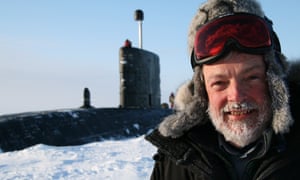
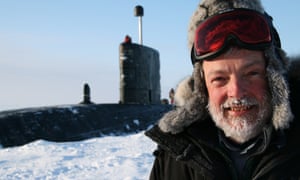
Peter Wadhams in the Arctic in 2007
Peter Wadhams in the Arctic in 2007: ‘We may able to raise the Thames barrier in Britain but in Bangladesh, people will be drowned.’

by Robin McKie, The Guardian, August 21, 2016

Peter Wadhams has spent his career in the Arctic, making more than 50 trips there, some in submarines under the polar ice. He is credited with being one of the first scientists to show that the thick icecap that once covered the Arctic ocean was beginning to thin and shrink. He was director of the Scott Polar Institute in Cambridge from 1987 to 1992 and professor of ocean physics at Cambridge from 2001 to 2015. His book, A Farewell to Ice, tells the story of his unravelling of this alarming trend and describes what the consequences for our planet will be if Arctic ice continues to disappear at its current rate.
You have said on several occasions that summer Arctic sea ice would disappear by the middle of this decade. It hasn’t. Are you being alarmist?
No. There is a clear trend down to zero for summer cover. However, each year chance events can give a boost to ice cover or take some away. The overall trend is a very strong downward one, however. Most people expect this year will see a record low in the Arctic’s summer sea-ice cover. Next year or the year after that, I think it will be free of ice in summer and by that I mean the central Arctic will be ice-free. You will be able to cross over the North Pole by ship. There will still be about a million square kilometres of ice in the Arctic in summer, but it will be packed into various nooks and crannies along the Northwest Passage and along bits of the Canadian coastline. Ice-free means the central basin of the Arctic will be ice-free, and I think that that is going to happen in summer 2017 or 2018.
Why should we be concerned about an Arctic that is free of ice in summer?
People tend to think of an ice-free Arctic in summer in terms of it merely being a symbol of global change. Things happen, they say. In fact, the impact will be profound and will effect the whole planet and its population. One key effect will be albedo feedback. Sea ice reflects about 50% of the solar radiation it receives back into space. By contrast, water reflects less than 10%. So if you replace ice with water, which is darker, much more solar heat will be absorbed by the ocean, and the planet will heat up even more rapidly than it is doing at present.
Sea ice also acts as an air-conditioning system. Winds coming over the sea to land masses such as Siberia and Greenland will no longer be cooled as they pass over ice, and these places will be heated even further. These effects could add 50% to the impact of global warming that is produced by rising carbon emissions.
What will be the effects of this accelerating increase in temperatures?
The air over Greenland will get warmer, and more and more of its ice will melt. It is already losing about 300 cubic kilometres of ice a year. Antarctica is adding to the melt as well. Sea-level rises will accelerate as a result. The most recent prediction of the Intergovernmental Panel on Climate Change (IPCC) is that seas will rise by 60 to 90 centimetres this century. I think a rise of one to two metres is far more likely. Indeed, it is probably the best we can hope for.
That may not sound a lot, but it is really very serious. It will increase enormously the frequency of storm surges all over the world. We may be able to raise the Thames barrier in Britain, but in Bangladesh, it just means more and more people will be drowned.
Global warming is generally associated with increased fossil-fuel burning and consequent rises in levels of atmospheric carbon dioxide. But is that the only climate problem we face?
No, it is not. We also have the issue of methane. Russian scientists who have investigated waters off their coast have detected more and more plumes of methane bubbling up from the seabed. The reason this is happening is closely connected with the warming of the planet and the shrinking of the Arctic icecaps.
Until around 2005, even in summer, you still had sea ice near the coast. Then it started to disappear, so that for three or four months a year warm water reached the shallow waters around the shores where there had been permafrost ground since the last ice age. It has started to melt with dangerous consequences. Underneath the permafrost there are sediments full of methane hydrates. When the permafrost goes, you release the pressure on top of these hydrates and the methane comes out of solution.
Can we monitor this methane just as we can monitor carbon dioxide?
Yes, we can measure methane over large areas using satellites. These have shown that methane levels that had been fairly flat for most of the last century have started to rise and are accelerating, often with little outliers on the graph. There is a scientist called Jason Box who works in Denmark for the Greenland Survey, and he calls these outliers dragon’s breath. They are not some sort of measurement caused by dodgy instruments. They are real pulses of methane coming from offshore flumes.
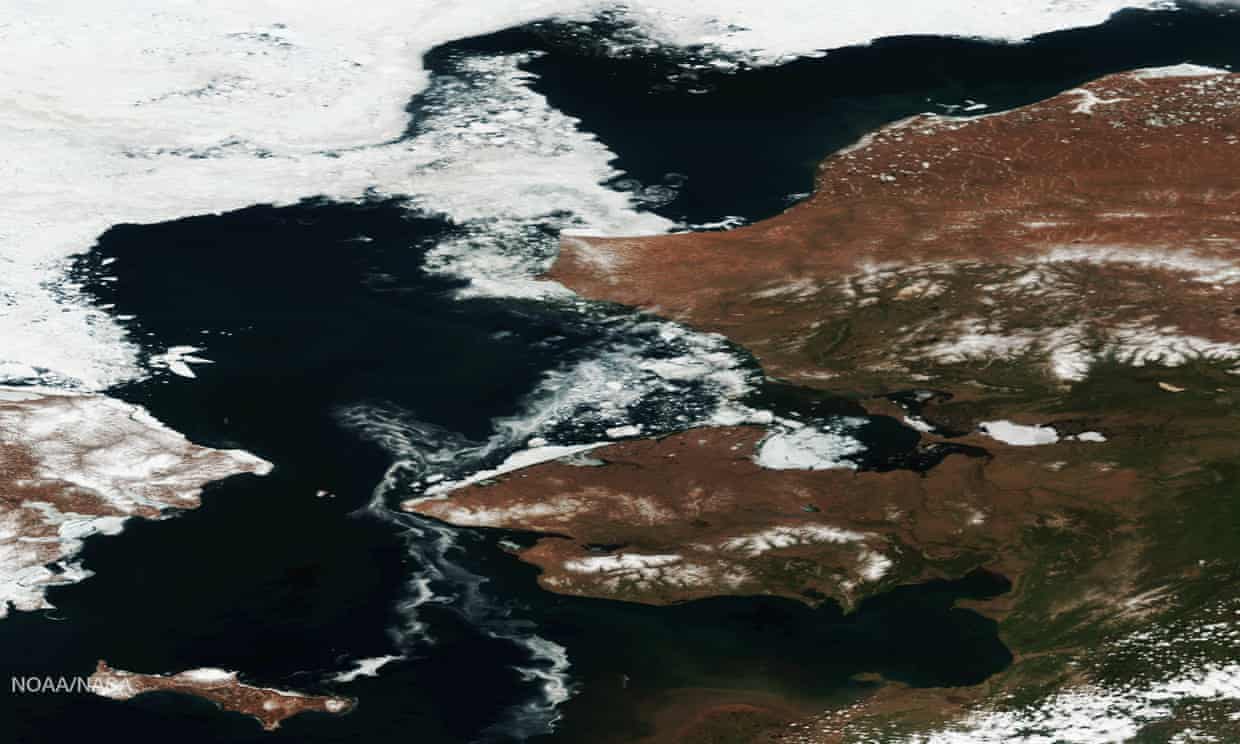
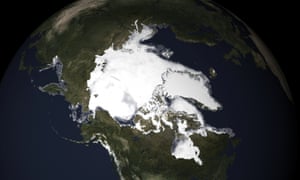
An image from the NOAA/Nasa Suomi NPP satellite taken on May 30, 2016, highlights the Arctic ice retreat off the north-west coast of Alaska
An image from the NOAA/Nasa Suomi NPP satellite taken on May 30, 2016, highlights the Arctic ice retreat off the north-west coast of Alaska. The average Arctic sea ice extent for May 2016 set a new record low since satellite observations began. Photograph: Suomi NPP/NASA/NOAA

How intense is methane as a heater of the atmosphere compared with carbon dioxide?
It is 23 times more powerful. However, methane dissipates much more quickly than carbon dioxide. It gets oxidised so that it only lingers in the atmosphere for about 7 or 8 years. By contrast, carbon dioxide hangs around in the climate system for about 100 years before it ends up in the sea and is absorbed by creatures that die and litter the seabed. At least that is what scientists thought. Today, there are quite a number of researchers who think carbon dioxide could last 1,000 years in the atmosphere.


So in the long run carbon dioxide is still going to be worse than methane in terms of heating the planet because a single methane pulse will have a disastrous effect, but if there is nothing to follow it on then it will go away. But with carbon dioxide there is a ratchet effect. All the carbon dioxide we release by burning fossil fuels just builds up in the atmosphere. We are having to live with last century’s carbon dioxide. What that says is simple: there is no such thing as a safe emission rate of carbon dioxide. That is why I am despondent about us ever being able to cut carbon emissions.
If we cannot halt the emissions of carbon dioxide, what can we do?
In the end, the only hope we have is to find a way to remove carbon dioxide from the atmosphere once it has got there. Even the IPCC has admitted that we will have to find a way to extract carbon dioxide from the air. The trouble is that they just don’t know how we can do that. The most favoured scheme is known as BECCS: bio-energy with carbon capture and storage. Essentially, you plant trees and bushes over vast swaths of ground. These grow, absorbing carbon dioxide in the process. Then you burn the wood to run power plants while trapping, liquefying and storing the carbon dioxide that is released.
It sounds straightforward. Will it work?
I am a bit suspicious of this technology. BECCS will need so much land to be effective. Calculations suggest it would need 40% to 50% of the arable land of the planet to make it work on the scale we will need and that would not leave enough land to grow crops to feed the world or to provide homes for a viable population of wild animals and plants. Other techniques, such as crushing and spreading olivine rocks, which absorb carbon dioxide, on beaches, will simply not scale up. They won’t work, so we will have to find some other way to remove carbon dioxide from the atmosphere directly.
As far as I can see, it will have to take the form of some sort of device into which you pump air at one end and you get air without carbon dioxide coming out the other end. It can be done, I am sure, but at the moment we do not have such a device. However, without something like that, I cannot see how we are going to deal with the carbon dioxide that is getting into the atmosphere. We are going to have to rely on a technology that has not yet been developed. That is a measure of the troubles that lie ahead for us. I think humanity can do it, but I would feel much better if I saw governments investing in such technology.
Farewell to Ice is published by Allen Lane (£20) on 1 September. Click here to order a copy for £16.40
https://www.theguardian.com/environment/2016/aug/21/arctic-will-be-ice-free-in-summer-next-year

"A Farewell to Ice" by Arctic sea ice expert Peter Wadhams: review – climate change writ large

The warning this book gives us about the consequences of the loss of the planet’s ice is emphatic, urgent and convincing

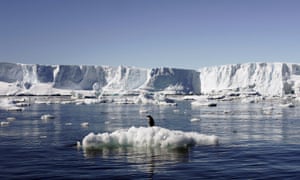
an adelie penguin in east antarctica
An Adélie penguin, east Antarctica. The loss of our sea ice will have dire consequences across the planet, not just at the poles, says Peter Wadhams. Photograph: Staff/Reuters.

by Horatio Clare, The Guardian, August 21, 2016

Becoming a world authority on sea ice has taken Peter Wadhams to the polar zones more than 50 times, travelling on foot and by plane, ship, snowmobile and several nuclear-powered submarines of the Royal Navy.
Nonscientists who read his astonishing and hair-raising A Farewell to Ice will agree that the interludes of autobiography it contains are engrossing, entertaining and, when one submarine suffers an onboard explosion and fire while under the ice, harrowing.
Any reader should find the science of sea-ice creation and the implications for us all of its loss – explored and explained here with clarity and style – beautiful, compelling and terrifying.
Wadhams thanks Ernest Hemingway for his title. Climate change, a cause and an effect of ice loss, brings conflict that would have interested the great author. Persecuted by trolls and climate-change deniers, Wadhams made news last year when three of his peers met premature deaths. One fell down stairs. One died in wilderness, possibly struck by lightning. A third, out cycling, was crushed by a lorry. Claiming that he had been targeted by a lorry while cycling, Wadhams speculated that oil companies or governments had it in for him and his ilk because of the conclusions to which their work has led them. But his book is more extraordinary than any conspiracy.
A Farewell to Ice proceeds methodically. Ice cores, tubes of compacted polar snow, record the last million years of atmospheric change, during which the Earth has oscillated between ice ages and warm periods. Now the pattern is breaking.
“Our planet has changed colour. Today, from space, the top of the world in the northern summer looks blue instead of white. We have created an ocean where there was once an ice sheet. It is Man’s first major achievement in reshaping the face of his planet,” Wadhams writes.
Polar ice is thinning and retreating with unprecedented speed. All our ingenuity cannot, at present, change that. Because ice only grows in winter but can melt year-round, its growth rate is limited, while melt rate is unlimited.
Ice is extraordinary stuff. A “puckered honeycomb” of oxygen and hydrogen atoms, it is highly mutable in different states because the length of the hydrogen bonds in its molecules varies. Ice [can] exist near absolute zero, the lowest temperature theoretically possible. Recent research suggests it may have entirely covered the Earth three times, making “snowball Earths.” Ice coats space dust, giving stars their twinkle. Life may have originated in that shining dust, according to the astronomer Fred Hoyle. Polar ice functions as Earth’s air- and water-conditioning system, and our thermostat.
Wadhams outlines how CO2 emissions are smashing the system, spinning the thermostat to hot. Without the albedo effect of ice – by which it reflects solar radiation up to 10 times more effectively than open water – we have entered a negative feedback loop.
Wadhams puts this plainly. “There is no period in Earth’s history where the rate of rise of atmospheric CO2 is as great as it is today.” The asteroid that finished the dinosaurs blasted 4.5 gigatonnes of carbon into the atmosphere, “yet the CO2 rate rise [in the aftermath] was still an order of magnitude lower than the current rate.”
The ice he worries about most covers Arctic seabeds – [made of] permafrost from the last ice age. Losing this will release huge methane plumes. Methane is 23 times more effective in raising global temperature than is CO2. Wadhams and colleagues have modelled the consequences using different dates for methane release.
A business-as-usual approach by humanity makes 2035 a plausible moment for the permafrost to melt and methane to escape. The worst floods, fires, droughts, and storms we have seen will be as nothing to what Africa, Asia, and the Americas experience in this scenario. Millions die. Low-lying areas are inundated. Survivors live in a patchy post-apocalypse. Europe’s current refugee crisis would be dwarfed.
We still have time, A Farewell to Ice concludes, for drastic action, despite long procrastination. The fall of Margaret Thatcher was bad for the ice: she was a fan of Wadhams’s work, quoting him extensively in her efforts to set up a body to understand and mitigate the loss of sea ice. Subsequent prime ministers did little or worse than nothing, suppressing facts that lobbyists in business and industry (some of them former Thatcherite ministers like Lord Lawson and Peter Lilley) did not like.
Last year’s Paris agreement, when global leaders resolved to prevent a temperature rise of 2C (with an aspiration of 1.5C), gives Wadhams hope. He believes there is now a common will across the world to confront and avert the nightmare. Solutions include wind, wave, solar, tidal, and nuclear energy (not the perilous water-cooled reactor type David Cameron wanted for Hinkley Point, which have a terrible record, but the “pebble bed” type, apparently) and, above all, direct air capture (DAC) [of CO2], which has yet to be invented.
You pump air through a system that removes the CO2 and “either liquefies it or turns it chemically into something useful,” Wadhams says. Salvation requires “a [DAC] research program on the scale of the Manhattan Project” and voluntary change by all: home insulation, no more SUVs or budget flights. We act, decisively and immediately, or our grandchildren pay full price, with our children impotent to help them, if you believe this book. I am afraid I do.
A Farewell to Ice is published by Allen Lane (£20). Click here to buy it for £16.40
https://www.theguardian.com/books/2016/aug/21/farewell-to-ice-peter-wadhams-review-climate-change

Thursday, August 25, 2016

John Vidal: Time to listen to the ice scientists about the Arctic death spiral


The Arctic’s ice is disappearing. We must reduce emissions, fast, or the human catastrophe predicted by ocean scientist Peter Wadhams will become reality

Arctic Sea Ice Melt


 Arctic sea ice melt in May. ‘The Arctic sea ice is declining by 13% a decade.’ Photograph: NOAA

by John Vidal, The Guardian, August 18, 2016
Ice scientists are mostly cheerful and pragmatic. Like many other researchers coolly observing the rapid warming of the world, they share a gallows humour and are cautious about entering the political fray.
Not Peter Wadhams. The former director of the Scott Polar Research Institute and professor of ocean physics at Cambridge has spent his scientific life researching the ice world, or the cryosphere, and in just 30 years has seen unimaginable change.
When in 1970 he joined the first of what would be more than 50 polar expeditions, the Arctic sea ice covered around 8m sq km at its September minimum. Today, it hovers at around 3.4m, and is declining by 13% a decade. In 30 years Wadhams has seen the Arctic ice thin by 40%, the world change colour at its top and bottom and the ice disappear in front of his eyes.
In a new book, published just as July 2016 is confirmed by NASA as the hottest month ever recorded, this most experienced and rational scientist states what so many other researchers privately fear but cannot publicly say – that the Arctic is approaching a death spiral which may see the entire remaining summer ice cover collapse in the near future.
Peter Wadhams
Pinterest


 ‘Because Peter Wadhams says what other scientists will not, he has been slandered, attacked and vilified by denialists and politicians who have advised caution or non-action.’ Photograph: PR
The warming now being widely experienced worldwide is concentrated in the polar regions and Wadhams says we will shortly have ice-free Arctic Septembers, expanding to four or five months with no ice at all. The inevitable result, he predicts, will be the release of huge plumes of the powerful greenhouse gas methane, accelerating warming even further.
He and other polar experts have moved from being field researchers to being climate change pioneers in the vanguard of the most rapid and drastic change that has taken place on the planet in many thousands of years. This is not just an interesting change happening in a remote part of the world, he says, but a catastrophe for mankind.
“We are taking away the beautiful world of Arctic Ocean sea ice which once protected us from the impacts of climate extremes. We have created an ocean where there was once an ice sheet. It is man’s first major achievement in re-shaping the face of the planet,” he writes.
And, boy, are we seeing extremes. So far this year, the planet’s average temperature has been 1.3C warmer than the late 19th century, and 2016 is virtually certain be the hottest year ever recorded.
Britain and northern Europe may have had average temperatures, but500 million people in the Middle East and north Africa, along with most of south-east Asia, have experienced droughts and searingly hot days and nights, which are only partly to do with the natural El Niño phenomenon. Meanwhile, China, India and the US have seen some of their longest heatwaves and worst floods in decades, and nearly 100 million people will need food aid in the coming months because of disrupted rainfall patterns.
Mitribah in Kuwait has reported a world record 54C, India and Iran have both recorded their highest ever temperatures, and deadly heatwaves have struck China, the US, Indonesia and New Zealand. We are perilously close to the 1.5C limit of warming that all countries signed up to in Paris last year and on track for a 3C-4C increase which would make much of the world uninhabitable.
Because Wadhams says what other scientists will not, he has been widely slandered, attacked and vilified by denialists and politicians who have advised caution or non-action. But now he returns their fire, exhorting people to counter what he calls “the sewage flow of lies and deceit” emitted by the deniers. Above all, he says, people who study climate change should speak up and be prepared to risk the blighting of their careers and absence of honours.
But he joins other climate researchers to cross lines that the public may still find unacceptable. He wants global action to find new ways to remove carbon from the atmosphere, and is not afraid of nuclear power – both of which answers can be swallowed – but he also argues for a colossal, global research programme in geo- engineering.
This is the deliberate attempt to reduce warming by the planetary-scale manipulation of weather patterns, oceans, currents, soils and atmosphere to decrease the amount of greenhouses gases.
Spraying sun-reflecting chemicals into the atmosphere, mimicking volcanoes, blocking sunlight and fertilising the oceans with iron filings attracts people who think that technology has all the answers, but it should strike fear into most of the world, which has not been responsible for warming and which has no reason to trust politicians’ or scientists’ further meddling with planetary forces.
How to proceed safely in a warming world without disastrous unintended consequences? The need for truly urgent action is undeniable, but by the time answers have been found to the massive questions of science, engineering and governance that Wadhams agrees need to be solved before geo-engineering on a planetary scale can go ahead, it will be far too late.
Climate change has been caused by ignorance and stupidity and cannot be solved by endorsing more of the same with geo-engineering. The only answer is reducing greenhouse emissions. Fast.

Monday, July 27, 2015

Arctic sea ice expert Peter Wadhams complains to UK press watchdog over Times story

Cambridge professor Peter Wadhams says he was misquoted in a story about the deaths of three leading British scientists in 2013

Peter Wadhams, professor of ocean physics at Cambridge University, during an expedition to the North Pole.

Peter Wadhams, professor of ocean physics at Cambridge University, during an expedition to the North Pole.
by The Guardian, July 27, 2015

One of the world’s leading Arctic sea ice experts has responded strongly to a Times newspaper story claiming that he thought assassins may have murdered three leading British scientists in 2013.
Professor Peter Wadhams, Cambridge professor of ocean physics, has complained to the Independent Press Standards Organisation (IPSO) that his scientific reputation had been damaged by Times environment editor Ben Webster and that he had been inaccurately quoted.
The Times said it had a recording of Wadhams’ comments and stood by the story.
The Times report centred on the deaths within a few months in 2013 of three leading sea ice scientists, two of them from University College London, and a narrow escape for Wadhams after a driver of an unmarked lorry reportedly tried to push his car off the M25.
According to Wadmams: “Webster ... asked for further details. I asked that this be completely off the record because of (a) the sensibilities of relatives of the deceased (b) my own scientific reputation (I did not want to be made out to be a crazy person), (c) the fact that these deaths were investigated and were very clearly simply an extraordinary coincidence.
“He [Webster] raised the question of whether they were murdered. I agreed that for a short time I thought that they were, since I had had the experience of being run off the road at the same time by a lorry, but that it was very clear afterwards that the three deaths were individually explainable accidents.”
He further claimed that a promise of confidentiality was breached. “I did not make any of the statements enclosed in quotation marks by the reporter. Webster promised that this was in confidence and that if he wanted to use it he would contact me first.”
A spokesperson for The Times said: “We have a recording of Professor Wadhams making these statements. Another newspaper [the Telegraph] subsequently reported that he had made similar comments to their journalist. We stand by the story.”
Profesor Wadhams, who is head of the Polar ocean physics group in the Department of Applied Mathematics and Theoretical Physics, is a controversial figure in international science, going further than more cautious colleagues in predicting the final collapse of Arctic sea ice in summer months within a few years.
In an email to the Guardian in 2012, Wadhams said: “I have been predicting [the collapse of sea ice in summer months] for many years. The main cause is simply global warming: as the climate has warmed there has been less ice growth during the winter and more ice melt during the summer.
“Climate change is no longer something we can aim to do something about in a few decades’ time, and that we must not only urgently reduce CO2 emissions but must urgently examine other ways of slowing global warming, such as the various geoengineering ideas that have been put forward.”
http://www.theguardian.com/environment/2015/jul/27/arctic-sea-ice-expert-complains-to-press-watchdog-over-times-story

Saturday, July 4, 2015

MUST SEE NEW VIDEO of Prof. Peter Wadhams on the Arctic sea ice and the subsea methane problem

by Robert Hunziker, Counter Punch, July 3, 2015

[Watch the Arctic sea ice via this link:  https://earthdata.nasa.gov/labs/worldview/?p=arctic&l=MODIS_Aqua_CorrectedReflectance_TrueColor,MODIS_Aqua_CorrectedReflectance_Bands721(hidden),MODIS_Terra_CorrectedReflectance_TrueColor(hidden),MODIS_Terra_CorrectedReflectance_Bands367(hidden),MODIS_Terra_CorrectedReflectance_Bands721(hidden),Graticule,Coastlines&t=2015-07-03&v=-1558366.776201329,-1132033.255730632,1415329.223798671,498174.744269368]

SKIP TO MINUTE 7 FOR THE BIT ABOUT METHANE COMING OUT OF THE SHALLOW SHELVES OFF SIBERIA 


Published on June 20, 2015
Exclusive interview with Professor Peter Wadhams, leading Arctic scientist, Cambridge University - Filmed by Judy Sole, the University of Earth - www.theuniversityofearth.net

The Intergovernmental Panel on Climate Change (IPCC) as well as world governments ignores the risks of an ice-free Arctic (Peter Wadhams). Rather, an ice-free Arctic is widely applauded by much of the world as a positive way forward for re-opening of northern shipping routes, new trips for cruise lines, and access to a huge cache of fossil fuels.
According to Professor Peter Wadhams of Cambridge University, an ice-free Arctic with its concomitant methane outbreak potential is scarcely mentioned by the IPCC in its assessment. Evidently, the IPCC does not want to discuss the possibility of major catastrophes.
In truth, an ice-free Arctic tempestuously opens up eons of methane entrapped ever since the last Ice Age. The ramifications are profound.
When the Vatican recently held meetings with leading scientists about climate change in preparation for the Pope’s encyclical of June 2015, one of the invited guest speakers was Professor Peter Wadhams. Assuming that the Pontifical Academy of Sciences listened carefully to his words, they may still be suffering from bouts of sleeplessness.
Status of Arctic Sea Ice and Why it Matters
Peter Wadhams, Professor of Ocean Physics and Head of the Polar Ocean Physics Group, Department of Applied Mathematics and Theoretical Physics, University of Cambridge, recently committed to a very candid interview: “Our Time is Running Out – The Arctic Sea Ice is Going,” May 15th, 2015 (all subsequent quotes are from that interview).
“I’ve been measuring the ice thickness go down by 50% over the last 30 years. In the summer for instance, you used to see very heavy pack ice so that a ship would have great difficulty getting through it. Today, it’s more like a blue planet. It’s almost an ice-free Arctic. That’s a big change.”
Accordingly, with the passage of time, the risk of a massive methane outbreak increases along with the ongoing disintegration of sea ice.
“We’re really concerned about the Arctic offshore… the continental shelves of Siberia are very shallow waters. And up until recently there was always sea ice over those shelves, even in the summer… now, it retreats in the summer and it already disappears for 2-3 months off of those shelves. That allows the water to warm up. And, when the water warms up, it causes underwater permafrost to melt, which hadn’t melted since the last Ice Age, and that’s allowing methane to be released.”
According to Professor Wadhams, the East Siberian Sea is a lurking monster. He believes the effect of a methane outbreak could be as catastrophic as an asteroid collision into Earth. The amount of warming would be immediate and large. The probability it will happen: “I would say it is about 50% because we’re seeing the permafrost melting and we’re seeing the methane already being released.”
In fact, field scientists are already seeing sizeable increases of big plumes of methane in the summer whilst discovering new areas of methane release. Until only recently, the East Siberian Sea was monitored every year by one Russian ship. Whereas nowadays, and over the past couple of years, Swedish ships are going elsewhere in the Arctic, and “they’re seeing just as much methane coming out as in East Siberia.”
“So, it’s not a low probability, high catastrophic risk. It’s a high catastrophic, high probability risk.”
He believes complete disappearance of the ice in mid summer could occur within the next couple of years. Presently, the volume of ice in the summer is only a quarter of the 1980s. If that trend continues, summer ice will go to zero very soon.
Impact of Ice-Free Arctic
Changes in the Arctic are driving changes elsewhere on the planet. “For instance, the disappearance of ice in the Arctic is leading to warmer air masses moving over Greenland in the summer. That’s causing the Greenland ice sheet to melt faster. And, that’s causing global sea level rise to elevate.”
Result, instead of a one-meter sea level rise this century, as predicted by the IPCC, Greenland’s melt could cause a rise of a couple of meters, or more. In fact, some glaciologists are talking about 4 or 5 meters [13-16 ft.].
The final cataclysmic impact of too much sea level rise would be some areas of the world, like Miami, would have to be completely abandoned, vacated, evacuated similar to Chernobyl, and very much like Chernobyl, because of cuckoo energy policies.
Not only that, global warming accelerates as a result of Arctic sea ice loss, which reduces global albedo whereby radiation is reflected straight back into outer space, but with loss of the white icy reflective background the sun’s radiation absorbs into a dark background, all of which results in the rate of worldwide warming much faster than anticipated by mainstream science, the IPCC.
“So, this attempt to pretend that we can keep global warming below two degrees C, which was already a pretense, is even more ridiculous. It’s certainly going to get to 4 °C or 5 °C degrees by the end of this century, which will have quite catastrophic impacts on agricultural production.”
What to do?
As for stopping offshore methane release by “bringing back Arctic sea ice, some people are proponents of doing that. The problem is you really cannot bring back the ice without cooling the planet. Global temperatures govern sea ice; it cannot be isolated or targeted. Finding a way to bring back Arctic sea ice won’t work unless you can cool the entire planet.”
The only realistic possibility, ironically, is modification of the fracking method used in oil and gas drilling by utilizing offshore platforms along the Arctic coastline, a network of horizontal drills into the creation of cavities to suck up the methane to prevent it from emitting into the atmosphere (Wadhams). But, no research has been done on this. It has only been suggested.
Regardless of how, what, or when, resolution of the problem is an enormous, overwhelming task: “There is a conspiracy of complacency around the world in which they still imagine that if we do a few minor things, minor adjustments and reduce our carbon dioxide emissions, then all will be well. But, it won’t because we’ve already got too much carbon dioxide in the atmosphere. We’re already going to have more than 2 °C degrees of warming even if we don’t emit anymore because of the already existing carbon dioxide in the atmosphere. So, we’ve got to not only stop emitting it or reducing it, reducing emissions, but find ways to take it out of the atmosphere, and that’s a technology that hasn’t been developed.”
Climate change has a progressive effect, slowly working throughout the world. But, all of the slowness is building up to a big change. Moreover, by the time anomalous weather patterns disrupt agriculture, causing worldwide starvation, it’ll be too late to do anything. Unfortunately, global inertia is the problem. “The forces of inertia are so enormous… the use of fossil fuel is so built into our society. Everything in life results from burning fossil fuels.”
Timing of the Worse Case
The only way to save civilization as it currently exist is to bring CO2 levels down, and that can only be accomplished by some drastic method of actually removing CO2 from the atmosphere. “We can’t do it by messing around with reducing our emissions, we can’t even do it by stopping our emissions because we’ve gone too far. We’ve got to actually take it out.”
Professor Wadhams claims climate change research must, front and center, become the major thrust of a worldwide scientific effort, and it must be done urgently, similar to the Manhattan Project (ironically). Society will be forced to use some technology, which is not yet proven, to remove CO2 to prevent a catastrophe. Accordingly, there is no time to tinker around.
He believes in a worse case scenario, “by ten years time, we’ll really be in the soup.”
Current Arctic Weather Conditions
According to Arctic News, as of July 2nd: “While the media gives wide coverage to the heat waves that have been hitting populous countries such as India, Pakistan, the U.S., Spain and France recently, less attention is given to heat waves hitting the Arctic.”
Furthermore: “The heat waves that hit Alaska and Russia recently are now followed up by a heat wave in East Siberia… a location well within the Arctic Circle… temperatures as high as 37.1 °C (98.78 °F) were recorded on July 2, 2015.”
And, even more, “With temperatures as high as the 37.1 °C (98.78 °F) recorded on July 2, 2015, huge melting can be expected where there still is sea ice in the waters off the coast of Siberia, while the waters where the sea ice is already gone will warm up rapidly. Note that the waters off the coast of Siberia are less than 50 meters (164 ft.) deep, so warming can quickly extend all the way down to the seabed, that can contain enormous amounts of methane in the form of free gas and hydrates.”
Also, on July 1, 2015, a temperature of 36 °C (96.8 °F) was recorded near the Kolyma River that flows into the East Siberian Sea.
The Arctic is hotter than Miami!
Somehow or other, 98 °F in the Arctic makes the world seem upside down/sideways. Is it?
Robert Hunziker lives in Los Angeles and can be reached at roberthunziker@icloud.com

Sunday, June 7, 2015

Earth has warmed as usual, with no slowdown

US scientists re-examine the collection of data which seemed to show global warming slowing since 1998 and say temperatures have continued to rise steadily

by Tim Radford, Climate News Network, June 7, 2015

LONDON − Forget about the so-called “hiatus” in global warming. The planet’s average temperatures are notching up as swiftly now as they did 20 or 30 years ago.

A team of US researchers has looked again not just at the data for the last 60 years but at how it has been collected, and done the sums again. They conclude, in the journal Science,  that the “estimate for the rate of warming during the first 15 years of the 21st century is at least as great as the last half of the 20th century. These results do not support the notion of a ‘slowdown’ in the increase of global surface temperature rise.”

But first, the story-so-far. Climate sceptics have repeatedly claimed that global warming has slowed or stopped. This was not the case: 13 of the hottest years ever recorded have all occurred in the last 14 years, and 2014 was the hottest of them all.

But when climate scientists looked at a graph of the rise of temperatures in the last 60 years, they saw – or thought they saw – a distinct drop in the rate of increase in global average temperatures in the last 15 years.

This apparent dip became the subject of a whole series of studies. Researchers had never expected the rise to follow a straight line – all sorts of natural climate cycles would naturally affect annual records – but the rate of increase was slower, and more sustained in its slowness, than anyone could explain, especially as there had been no drop in the greenhouse gas emissions that drive global warming.

Data anomalies

Some proposed that the expected extra heat in the atmosphere had been drawn down into the great oceans and others that an unnoticed increase in volcanic activity had helped screen the sunlight and cool the atmosphere unexpectedly. Yet another group looked not at average temperature patterns but the change in the frequency of heat waves and saw a different kind of rise.

Yet another group wondered if the problem might be only apparent: more complete data from many more parts of the world might combine to tell a different story. Thomas Karl and colleagues at the National Oceanographic and Atmospheric Administration in the US made this their starting point.

They looked again at how the data had been collected, and the gaps that might have appeared. Sea surface temperatures, for instance, were at different periods collected by bucket from a ship’s deck, by readings aboard surface drifting and moored buoys or by engine-intake thermometers in ships’ engine rooms, and there could be subtle differences not accounted for.

There were very few readings from the Arctic, yet the Arctic is by far the fastest-warming region of the planet, and the pattern of land-based temperature readings, too, repaid re-examination.

By the time the NOAA team had finished, the recalibrated figures told a different story. Between 1998 and 2012, the world warmed at the rate of 0.086 °C per decade, more than twice the rate of 0.039 °C per decade measured by the Intergovernmental Panel on Climate Change.

The new figure is much closer to the rate estimated for the decades 1950 to 1999, at 0.113 °C per decade. And the new analysis lifts the rate of warming from 2000 to 2014 to 0.116 °C per decade, which if anything is an acceleration, not a slowdown.

British climate scientists have welcomed the finding: it is however the finding of just one group and, like all such research, will be accepted more readily if it can be separately replicated.

“This study makes the important point that we need to look really carefully at data quality and issues of instrument change,” said Piers Forster, professor of climate change at the University of Leeds, UK.

”Yet there are several legitimate judgment calls made when combining datasets to make a global mean-time series. I still don’t think this study will be the last word on this complex subject.”

But Peter Wadhams, a professor of ocean physics at the University of Cambridge, UK, called the study careful and persuasive, and said: “I think it shows clearly that the so-called ‘hiatus’ does not exist and that global warming has continued over the past few years at the same rate as in earlier years.”