Blog Archive

Showing posts with label trees. Show all posts

Tuesday, October 6, 2015

Threat to Brazil’s indigenous reserves raises climate and health concerns as studies show that reduced deforestation leads to lower CO2 emissions and better air quality

by Jan Rocha, Climate News Network, October 1, 2015

SÃO PAULO − Environmental organisations warn that a bill now going through the Brazilian Congress to transfer responsibility for demarcating indigenous reserves from federal government experts to politicians could lead to an increase of 110 million tonnes of CO2 emissions by 2030.

The Amazon Environmental Research Institute (IPAM) calculates that the accumulated carbon stock inside indigenous reserves in the Amazon basin amounts to 47 billion tonnes − or more than a year’s worth of global emissions.

Studies have shown that rainforest located in indigenous reserves is almost always preserved, even when much of the land around it has been cleared for farming.

But the controversial bill that might soon be voted into law could radically change that situation by giving Congress responsibility for demarcating indigenous reserves − which critics liken to asking the fox to look after the chicken house.

The 2014 elections in Brazil produced a very reactionary chamber of deputies, many of them belonging to the “bullet, bull and bible” lobbies defending law and order, agribusiness and conservative moral issues, with very little sympathy for, or understanding of, Brazil’s hundreds of indigenous groups.

Formally recognised

At present, indigenous lands are formally recognised only after detailed anthropological, archaeological and historical studies conducted by the National Indian Foundation (FUNAI), the government agency for policies relating to indigenous peoples, which then physically demarcates their territory.

It is a slow and painstaking process that allows for the compensation of farmers who have settled in good faith − sometimes with land titles dating back to Brazil’s imperial government in the 19th century.

The 698 indigenous reserves occupy 13% of Brazil’s total land area, almost all (98%) of it in the Amazon basin. Two-thirds have been officially recognised, while another 228 await demarcation, but the bill could include a clause making even recognised reserves open to revision.

If the demarcation process were transferred to congress, environmental groups such as the Socioenvironmental Institute (ISA), a well-respected Brazilian NGO, fear that forested indigenous areas will be opened up “to high impact activities like mining, dams, oil and gas pipelines, waterways, railways, roads, and non-indigenous settlements and farming activities.”

“It is worth emphasising the strategic importance of indigenous lands for environmental conservation,” ISA says.

The accumulated deforestation in indigenous territories in Amazonia is just 1.9% of the original forested area within them, compared to overall deforestation of 22.8% of the total original forested area, according to figures produced for 2013 by the Program to Calculate Deforestation in the Amazon (PRODES), the monitoring project of Brazil’s National Institute for Space Research.

“Even outside Amazonia, where indigenous reserves are much smaller in area, they have played an important role in safeguarding biodiversity,” ISA adds.

If the new bill is approved by Congress, IPAM reckons that the probable changes could lead to an extra 110 million tonnes of carbon emissions by 2030.

The Brazilian government is committed [watch what they do, not what they say!] to zero illegal deforestation in the Amazon by 2030, but embattled president Dilma Rousseff is currently too busy fighting the threat of impeachment to take on another fight with some of the Congress members she needs to keep on her side.

Criminal loggers

The government has mounted a number of successful law enforcement operations to crack down on criminal loggers, and deforestation rates have been falling. But if indigenous areas stop being protected, and fall into the hands of farmers, loggers and mining companies, the Forest Code allows for 20% of the acquired area to be cleared.

According to a recent study published in Nature Geoscience, falling deforestation rates are not only good for reducing CO2 emissions, but have also contributed to saving lives by improving air quality.

The study found that the 40% reduction in Brazil’s deforestation rates since 2004 is preventing 1,060 premature adult mortalities annually across South America, because of the consequent reduction in fire emissions and, therefore, of particulate matter (PM).

The study says: “Inhalation of PM from fires has adverse impacts on human health, including increased hospital admissions and premature mortality.”

It estimates that deforestation fires alone cause an average of 2,906 premature deaths annually across South America from cardiopulmonary disease and lung cancer. 

*Jan Rocha, a freelance journalist living in Brazil, is a former correspondent there for the BBC World Service and The Guardian.

Amazon carbon sink is in decline as trees die off faster

What’s pulling the plug on the world’s carbon sink? Geoff GalliceCC BY
by Oliver Phillips and Roel Brienen, The Conversation, March 18, 2015
Tropical forests are being exposed to unprecedented environmental change, with huge knock-on effects. In the past decade, the carbon absorbed annually by the Amazon rain forest has declined by almost a third.
At 6m km2, the Amazon forest covers an area 25 times that of the UK, and spans large parts of nine countries. The region contains a fifth of all species on earth, including more than 15,000 types of tree. Its 300 billion trees store 20% of all the carbon in the Earth’s biomass, and each year they actively cycle 18 billion tonnes of carbon, twice as much as is emitted by all the fossil fuels burnt in the world.
The Amazon Basin is also a hydrological powerhouse. Water vapour from the forest nurtures agriculture to the south, including the biofuel crops which power many of Brazil’s cars and the soybeans which feed increasing numbers of people (and cows) across the planet.
What happens to the Amazon thus matters to the world. As we describe in research published in Nature, the biomass dynamics of apparently intact forests of the Amazon have been changing for decades now with important consequences.

Is climate changing the Amazon?

There are two competing narratives of how tropical forests should be responding to global changes. On one hand, there is the theoretical prospect (and some experimental evidence) that more carbon dioxide will be “good” for plants. Carbon dioxide is the key chemical ingredient in photosynthesis, so more of it should lead to faster growth and thus more opportunities for trees and whole forests to store carbon. In fact almost all global models of vegetation predict faster growth and, for a time at least, greater carbon storage.
The Amazon is a big part of Earth’s carbon cycle. Peter Reid / Scottish Centre for Carbon StorageCC BY
Arrayed against this has been an opposing expectation, based on the physical climate impacts of the very same increase in atmospheric CO2. As the tropics warm further, respiration by plants and soil microbes should increase faster than photosynthesis, meaning more carbon is pumped into the air than is captured in the “sink.” More extreme seasons will also mean more droughts, slowing growth and sometimes even killing trees.

Which process will win?

The work we have led takes a simple approach. With many colleagues, we track the behaviour of individual trees through time across permanent plots distributed right across South America’s rain forests. Together with hundreds of partners in the RAINFOR network, this close-up look at the Amazon ecosystem has been underway since the 1980s, allowing an unprecedented assessment of how tropical forests have changed over the past three decades.
Researchers looked at trees right across the Amazon. RAINFORCC BY-NC-SA
Our analysis – based on work across 321 plots, 30 years, eight nations, and involving almost 500 people – first of all, confirms earlier results. The Amazon forest has acted as a vast sponge for atmospheric carbon. That is, trees have been growing faster than they have been dying.
The difference – the “sink” – has helped to put a modest brake on the rate of climate change by taking up an additional two billion tonnes of carbon dioxide each year. This extra carbon has been going into ostensibly mature forests, ecosystems which according to classical ecology should be at a dynamic equilibrium and thus close to carbon-neutral.

Hard-living trees

However, we also found a long and sustained increase in the rate of trees dying in Amazon forests that are undisturbed by direct human impacts. Tree mortality rates have surged by more than a third since the mid-1980s, while growth rates have stalled over the past decade. This had a significant impact on the Amazon’s capacity to take-up carbon.
My, haven’t you grown? Roel BrienenCC BY-NC-SA
Recent droughts and unusually high temperatures in the Amazon are almost certainly behind some of this “mortality catch-up.” One major drought in 2005 killed millions of trees. However the data shows tree mortality increases began well before then. Some other, non-climatic mechanism may be killing off Amazonian trees.
The simplest answer is that faster growth, which is consistent with a COstimulation, is now causing trees to also die faster. As the extra carbon feeds through the system, trees not only grow quicker but they also mature earlier. In short, they are living faster, and therefore dying younger.
Thus, 30 years of painstakingly monitoring the Amazon has revealed a complex and changing picture. Predictions of a continuing increase of carbon storage in tropical forests may be overly optimistic – these models simply don’t capture the important feed-through effect of faster growth on mortality.
At least the mushrooms are happy. Roel BrienenCC BY-NC-SA
As the Amazon forest growth cycle has been accelerating, carbon is moving through it more rapidly. One consequence of the increase in death should be an increase in the amount of necromass – dead wood – on the forest floor. While we haven’t measured these changes directly, our model suggests the amount of dead wood in the Amazon has increased by 30% (more than 3 billion tonnes of carbon) since the 1980s. Most of this decaying matter is destined to return to the atmosphere sooner rather than later.
More than a quarter of current emissions are being taken up by the land sink, mostly by forests. But a key element appears to be saturating. This reminds us that the subsidy from nature is likely to be strictly time-limited, and deeper cuts in emissions will be required to stabilise our climate.
Trees coming into leaf later and bumblebees with shorter tongues are just two of the impacts on nature that researchers are linking to global warming

by Tim Radford, Climate News Network, October 4, 2015

LONDON − Spring is arriving ever earlier as greenhouse gas levels rise and global temperatures warm, and the Northern Hemisphere growing season is now two weeks longer  than it was in 1900.

But, paradoxically, new research shows that forest giants that once responded to the early spring are beginning to slow down – because they miss the chill.

Yongshuo Fu, an Earth system scientist at Peking University, Beijing, and colleagues report in the journal Nature that they have measured a slowdown in the response of oaks and other forest citizens to the change in temperatures and carbon dioxide levels.

Where these species, on average, unfolded their first leaves four days earlier, with every 1 ˚C rise in temperature, they now do so only 2.3 days earlier for every additional 1 ˚C.

Ever-earlier spring

The reason is that, to take full advantage of the ever-earlier spring, these deciduous species first need to feel a period of chill. And as temperatures on average rise, the extent of true winter chill diminishes.

The researchers concede that there may be other or additional reasons why alder (Alnus glutinosa), silver birch (Betula pendula), horse chestnut (Aesculus hippocastanum), beech (Fagus sylvatica), lime (Tilia cordata), oak (Quercus robur) and ash (Fraxinus excelsior) seem to be slowing in their leafy response.

But since many deciduous trees depend on a frosty spell to release them from their periods of dormancy, it seems a likely factor.

To identify the slowdown, the researchers used data from the Pan-European Phenology Project, which for 33 years has monitored the unfolding of the first leaves of all seven species at 1,245 sites across central Europe.

The scientists used direct observation, and confirmed their hypothesis with computer models to show once again that as humans change the climate, by increasing carbon dioxide levels in the atmosphere as a consequence of the combustion of fossil fuels, they are also changing the ecosystems that support all life on Earth.

And in the same week, US scientists report that as global warming begins to change the mix of mountain wildflowers each spring, pollinating insects, too, are beginning to respond.

Nicole Miller-Struttmann, a biologist at the State University of New York, and colleagues report in the journal Science that, in the last 40 years, the tongues of two species of alpine bumblebee have grown shorter.

Bumblebees need long tongues to reach deep into the flower tubes of the plants they favour. But warmer summers have meant that the flowers they favour most in the Rocky Mountains have become less frequent, and pollinators that once specialised have now become generalist foragers, grabbing honey where they can.

In the course of doing so, two that are commonly found at high altitudes, species Bombus balteatus and B. sylvicola, have evolved shorter tongues.

Gaining altitude

The mix of flowers at lower altitudes has become impoverished, and although mountain flowers have been gaining altitude over the decades, the gain in higher growth has not been enough to offset the loss for the bees.

The research confirms a wider picture of change as a consequence of global warming. In the Americas, plants are colonising higher slopes, and in Europe the bumblebee has also been feeling the heat, and losing part of its range.

In general, high altitude sites seem to be warming faster than the lowlands.

Research of this kind provides a local snapshot of global change, and what it means for individual species in nature’s mix.

“We see broader bumblebee foraging niches, immigration by short-tongued bumblebees, and shorter tongue length within resident bee populations as floral resources have dwindled,” the scientists conclude.

“In remote mountain habitats − largely isolated from habitat destruction, toxins, and pathogens − evolution is helping wild bees keep pace with climate change.” 

Thursday, February 20, 2014

Climate, Trees, and Legacy: 01 - Introduction; by scientist Connie Barlow


Published on January 4, 2014

Connie Barlow introduces in January 2014 a learning and action series for helping trees adapt to climate change — species by species, decade by decade. Citizen naturalists are invited to research a favorite native tree species and begin to work with others to keep up with the northward movement of forest zones by planting and monitoring small numbers of wild seeds of common species onto private forested lands well north of where those seeds were collected.

This "assisted migration" in a time of unprecedented climate shift will be increasingly necessary in the decades ahead. Foresters can create the maps to show us where species will need to move to. But we citizen naturalists will play a complementary role in ensuring that the full diversity of genotypes keeps pace with a warming and drying continent.

Importantly, human action will mimic what birds, rodents, and other native seed dispersers have been able to accomplish on their own in previous periods of Earth history, when warming occurred at a slower, more natural pace.

Note: Three tree paintings by Illinois artist Mary Southard are included, as are several still shots from the 20th-century classic animated short film, "The Man Who Planted Trees."

The series host, Connie Barlow, is the founder of the citizen activist group Torreya Guardians. She is the author of "The Ghosts of Evolution."

Learn more about assisted migration: (2-min video): http://youtu.be/uz_pN3lvh7I and annotated list of articles: http://www.torreyaguardians.org/assis...

Learn more about the work of Torreya Guardians: (75-min video): http://youtu.be/N_9SCSB5wfM and website: http://www.torreyaguardians.org

Learn more about "The Ghosts of Evolution" (5-min music video): http://youtu.be/A-kYjjphxJY

Click blue timecodes to advance to TOPICS in this video:

00:01 Climate adaptation as well as mitigation

02:30 50th anniversary of The Wilderness Act in 2014

03:23 Reservation, Restoration, Resilience, and Reconciliation Ecology

Link:  http://www.youtube.com/watch?v=JqksZfXwO44

Wednesday, October 30, 2013

Falling Colors: The Long Agony of Trees

by Tom Lewis, The Daily Impact, October 30, 2013

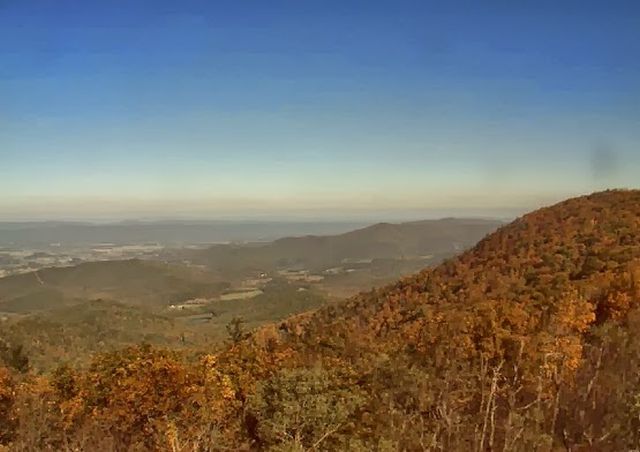
Spectacular? Not Really. The fall foliage season is increasingly pastel, washed out, as on Virginia’s Blue Ridge Mountains pictured here. The culprit is that visible, constant pall of pollution. (National Park Service Photo)
A long-time friend of, and commenter on, The Daily Impact, Gail Zawacki, has for years maintained a lonely vigil on behalf of trees. On her blog. Wit’s End, she chronicles the massive, mortal harm being done to trees all over the world by air pollution. They are, in fact, slowly dying, a fact that should be most strikingly obvious to everyone in the fall, when by the tens of thousands we drive our emissions-rich cars long distances to see the fall colors. Which, increasingly, aren’t there any more. In part because of the emissions from our cars. Yet no one (except Gail) seems able to see the sick trees for the pale forest.
Here’s a sampling of explanations offered by writers, broadcasters and bloggers throughout the Northeastern United States this year for the pathetic showing of the fall leaves:
  • “The deep reds didn’t appear this year, I think it was the lack of a killer frost.” — Vermont
  • “I was surprised how the the colors of the foliage on the Blue Ridge and in many areas of the [Shenandoah] Valley are fairly dull in color. Maybe it was the abnormally dry period before the deluge.” — Virginia
  • “A hard frost early in the season tends to turn the leaves brown,” says an AccuWeather meteorologist. “On the other hand, [you don’t want it to be] too warm; you want a bit of frost that tends to bring out the brighter colors.”
  • “The other factor besides dry was the cicadas which chomped branches and nutrients back in June.” — Virginia
  • “It does seem that maybe our extended dry stretch was a bit too much then mix that with the rainy stretch and you’ve got some issues.” — Virginia
  • “The best fall color for an area occurs during the shortening days of autumn when days are bright, sunny and cool, when nights are cool but not below freezing, and when there has been ideal rainfall.” — Maryland
So, to sum up then, the problem of the washed-out colors is caused by frost, or lack of frost; rain, or lack of rain, or too much rain, or too little rain for too long followed by too much; or cicadas.
The problem and its cause matter. Set aside for the moment the enormous wound to the living web of life that sustains us all that this represents. It should matter even to industrialists; the U.S. Forest Service estimates that fiery foliage generates $8 billion in tourism revenue annually for New England alone. Foliage season is so important to Vermont that the state employs a leaf forecaster. States throughout the eastern United States avidly harvest tourist dollars every fall foliage season. So they should want to know why the colors are washing out.
Gail Zawacki is trying to tell them:
“The trees are dying from air pollution. It’s a global issue. Trees absorb ozone through their leaves when they photosynthesize and it damages the stomates, because ozone is a highly reactive gas and especially toxic to vegetation. You can’t see ozone, but the background level is inexorably increasing in the lower atmosphere, as more and more precursors are emitted and travel around the world. When plants are injured from repeated, cumulative exposure they lose natural immunity to insects, disease and fungus. It’s a huge problem well known to scientists and agronomists, but they don’t like to publicize it because the only way to deal with it is to drastically curtail fuel emissions and agricultural chemicals.”
Industry is like Aesop’s scorpion, who stings to death the frog carrying him across a stream, thus ensuring his own death, because, he explains with his last breath, “It’s my nature.”

Monday, October 21, 2013

Dry season lengthening increases risk of Amazon rainforest dieback

Amazon 'is at higher risk of tree loss'by Alex Kirby, Climate News Network, October 21, 2013

Part of the Amazon rainforest may be more vulnerable to the effects of climate change than first thought, US researchers say.

LONDON, 21 October - Researchers say the southern part of the Amazon rainforest is at a far higher risk of dieback than the models used in the most recent report by the Intergovernmental Panel on Climate Change (IPCC).

The research team, led by Professor Rong Fu of the University of Texas, say that this is because the forest is drying out much quicker than projected.

If the damage is severe enough, they say the loss of rainforest could cause the release of large volumes of carbon dioxide into the atmosphere, and could also disrupt plant and animal communities in one of the world's most biodiversity-rich regions, as outlined in the Proceedings of the National Academy of Sciences.

The team used ground-based rainfall measurements from the past three decades. Findings showed that since 1979, the dry season in southern Amazonia lasted about a week longer in each decade.

At the same time, the annual fire seasons have become longer. The researchers say the most likely explanation for the increasingly longer dry seasons is global warming.

“The dry season over the southern Amazon is already marginal for maintaining rainforest,” says Professor Fu. “At some point, if it becomes too long, the rainforest will reach a tipping point."

She says the length of the dry season is the most important climate factor controlling the southern Amazon rainforest. If it is too long, the forest will not survive.

A study published earlier this year suggested that rainforests worldwide might be able to withstand the impacts of climate change more successfully than thought.

The new results also contrast sharply with forecasts made by the models used by the IPCC: even under future scenarios in which greenhouse gases rise dramatically, those models project the southern Amazon dry season will be at most 10 days longer by the end of the century, and that the risk of climate change-induced rainforest dieback should therefore be relatively low.


Rainfall limited

Professor Fu and her colleagues say the water stored in the forest soil at the end of each wet season is all that the trees have to last them through the dry months. The longer that lasts - regardless of how wet the wet season was - the more stressed the trees become and the more susceptible they are to forest fires.

They say the most likely explanation for the lengthening dry season in recent decades is human-caused greenhouse warming, which inhibits rainfall in two ways: It makes it harder for warm, dry air near the surface to rise and freely mix with cool, moist air above; and it blocks incursions by cold weather fronts from outside the tropics which could trigger rainfall.

The team says the IPCC's climate models represent these processes poorly, which might explain why they project only a slightly longer Amazonian dry season.

The Amazon rainforest normally acts as a carbon sink, removing atmospheric CO2 and storing it. But during a severe drought in 2005 it went into reverse, releasing one petagram of carbon (one billion tonnes - about one-tenth of annual human emissions) to the atmosphere.

Fu and her colleagues estimate that if dry seasons continue to lengthen at just half the rate seen in recent decades, the 2005 Amazon drought could become the norm rather than the exception by the end of this century.

Some scientists think the combination of longer dry seasons, higher surface temperatures and more fragmented forests caused by deforestation could eventually convert much of southern Amazonia from rainforest to savanna.

Earlier studies have shown that human-caused deforestation in the Amazon can alter rainfall patterns. But the researchers did not see a strong sign of that in the pattern of increasing dry season length. That was most pronounced in the south-western Amazon, while the most intense deforestation occurred in the south-east.

Because the north western Amazon has much higher rainfall and a shorter dry season than the south, the researchers think it is much less vulnerable to climate change.

Friday, September 6, 2013

U.S. Becomes Largest Wood Pellet Exporter,Enviva, Clearcutting Forests and Destroying Wetlands


When you think about burning wood to heat your home, you might imagine a cozy fireplace, not a giant power plant. Unfortunately, utility companies in Europe are making massive investments to convert their power plants to burn wood—known as “biomass”—as a replacement for coal and other fossil fuels.

This is despite the fact that recent research shows that burning whole trees in power plants actually increases carbon emissions relative to fossil fuels for many decades—anywhere from 35 to 100 years or more. It also emits higher levels of multiple air pollutants.

biomassART

The result of this new demand has been the explosive growth of wood pellet exports from North America, most of which originate in our Southern forests here in the U.S., putting into peril some of the most valuable ecosystems in the world.

At the leading edge of this new industry is Enviva, the South’s largest exporter of wood pellets. Enviva harvests trees from Southern forests, chips them in pellet mills and loads the pellets onto ships bound for Europe, where they are burned in utility-scale power plants to keep the lights on in Europe. Not exactly a cozy picture.

New maps and a report published last week by Natural Resources Defense Council (NRDC) and Dogwood Alliance show what’s at stake for the forests surrounding Enviva’s Ahoskie facility—and the multitude of species that depend on them for their habitat. Using Geographical Information Systems (GIS) data layers to show the landscapes and species within the 75-mile radius from which the Ahoskie mill buys trees for wood pellet manufacturing, the results reveal how Enviva has some of the most biologically diverse and environmentally sensitive natural forests in the world in its crosshairs.

Enviva’s Ahoskie mill alone produces roughly 400,000 tons of wood pellets per year for export to Europe as fuel for electricity. To feed the facility, Enviva sources wood from the Southeastern Mixed Forests and the Middle Atlantic Coastal Forests ecoregions, both of which have been designated by the World Wildlife Fund as critical/endangered because of their high biodiversity and the combination of threats they face, including habitat fragmentation and land conversion. Yet less than one percent of the forests in the Ahoskie facility’s sourcing region are protected from logging activities that would degrade native ecosystems.

Natural forests within the Ahoskie mill’s sourcing area have already been reduced to just a small percentage of their original size, with large swaths converted to pine plantations. As the first map shows and the report details, the few remaining natural forests in this landscape are highly fragmented: 

Map 1.png

The second map identifies locations of wetland hardwood forests surrounding the Ahoskie mill. The Wall Street Journal documented how Enviva sources wood for its flagship pellet-manufacturing mill in Ahoskie, NC, from clear-cut wetland forests in the Mid-Atlantic Coastal ecoregion, some with trees more than 100 years old. 

Map 2.png

Clear-cutting wetland hardwood forests has serious ecological impacts. Forested wetlands play a vital role as anchors for remaining biodiversity across this broad landscape, offering habitat for waterfowl, songbirds, black bear and a variety of reptiles and amphibians. At the same time, these forests also provide invaluable ecosystem services for communities, including improved water quality, flood storage and the buffering of water flow during drought.

When these landscapes vanish, so do all the benefits they provide—such as critical habitat for wildlife—and water quality and flood protection for nearby communities.

Sadly, much of the forested wetlands in the broad ecoregion from which Enviva is sourcing have already been lost to logging. By using wetland species to make wood pellets, Enviva puts additional pressure on these forests, encouraging clear-cut logging of these sensitive forests.

The third and fourth maps in the series differentiate between the increased presence of pine forests, mostly pine plantations and the few remaining natural forest types in the region:

map 3.png
map 4.png

Ahoskie is just one of dozens of wood pellet mills currently operating in the South, a region that has become the largest exporter of wood pellets in the world. Industry growth has been explosive. In 2012, 1.3 million tons of wood pellets were exported from the South for biomass. Market analysts expect that number to more than quadruple to almost 6 million tons by 2015.

The massive additional demand for logs being driven by the biomass energy industry now risks destroying ecosystems that can never be replaced. Increased use of wood from natural forests by Enviva and other biomass companies will lead to additional fragmentation of what is clearly an already highly fragmented landscape, decreasing landscape integrity, water quality and flood storage, wildlife corridors and habitats, and recreational resources. Greater use of plantation pine will incentivize future conversion of the few remaining natural and semi-natural forests to intensive plantations, which bear little resemblance to natural forests in terms of the biological diversity and wildlife habitat they support.

Enviva and other companies using biomass or producing wood pellets for utilities must establish adequate policies to protect our climate and forests before expanding their activities.

Quickly shifting our power sector away from coal and other fossil fuels is obviously critical. And while there is a limited role for wood residuals—for example, tops and limbs from logging operations, provided strict sustainability standards are adopted, or sustainably grown agricultural materials that would otherwise end up in a landfill or burned—the right way to do this is through investments in energy efficiency and modern, twenty-first century energy technologies like wind, solar and geothermal.

Cutting down our precious forests to fuel a return to prehistoric energy sources like burning wood is not the solution.

http://ecowatch.com/2013/wood-pellet-exporter-clearcutting-forests-destroying-wetlands/

Tuesday, February 5, 2013

Texas drought killed 301 million trees

by Kathy Huber, The Houston Chronicle, September 25, 2012


The numbers are ugly. A whopping 301 million trees have died across state forest lands as a result of the 2011 drought, the Texas A&M Forest Service reported Tuesday.
The latest count was determined after a three-month, on-the-ground study of hundreds of forested plots, as well as satellite imagery from before and after the drought. It includes trees killed directly by the drought and those so weakened that they succumbed to insects and disease.
The Brazos Valley region took the heaviest hit, losing nearly 10% of its trees on forested land. North Texas and western northeast Texas lost 8.3% and 8.2%, respectively.
Harris County is included in the 6.5% loss in the western section of southeast Texas. That's nearly 19 million fewer trees than the near 290 million live tree count before the drought. Far east stretches of southeast Texas got better news: a 1.3% loss, down 7.5 million trees from pre-drought 597.1 million live trees.
The 301 million count falls about midway of the forest service's previous estimates of 100-500 million drought-related tree deaths.
Although still a huge toll, the good news is the forest is resilient [wrong], says Burl Carraway, department head for the Texas A&M Forest Service Sustainable Forestry department. Young, new trees eventually grow in the place of fallen dead trees. [Wrong.]
"Tree death is a natural forest process," he said in a news release. "We just had more last year than previous years." [Wrong.]
Most of the dead trees will stand until they fall, says Forest Service analyst Chris Edgar. This benefits wildlife and helps prevent soil erosion.
The dead trees, however, could become hazards in fire conditions.
The 301 million does not include trees that shade our home gardens, city parks and streets. Another 5.6 million urban trees have died from the drought, according to an earlier study done by the service's Urban Forest program.
Houstonians have been shaken by the drought-related gaps in our urban forest.
Forester Mickey Merritt roughly estimates the drought has taken 50% of the trees in the city's Memorial Park.
Nature will also gradually help re-green urban canopies. More help will come from those that residents are eager to replant.  [Wrong.]