Saturday, May 8, 2021


Monday, April 27, 2020
Amy Westerfelt: The Reason COVID-19 and Climate Seem So Similar: Disinformation
The disinformation industry has deployed these strategies across multiple issues.
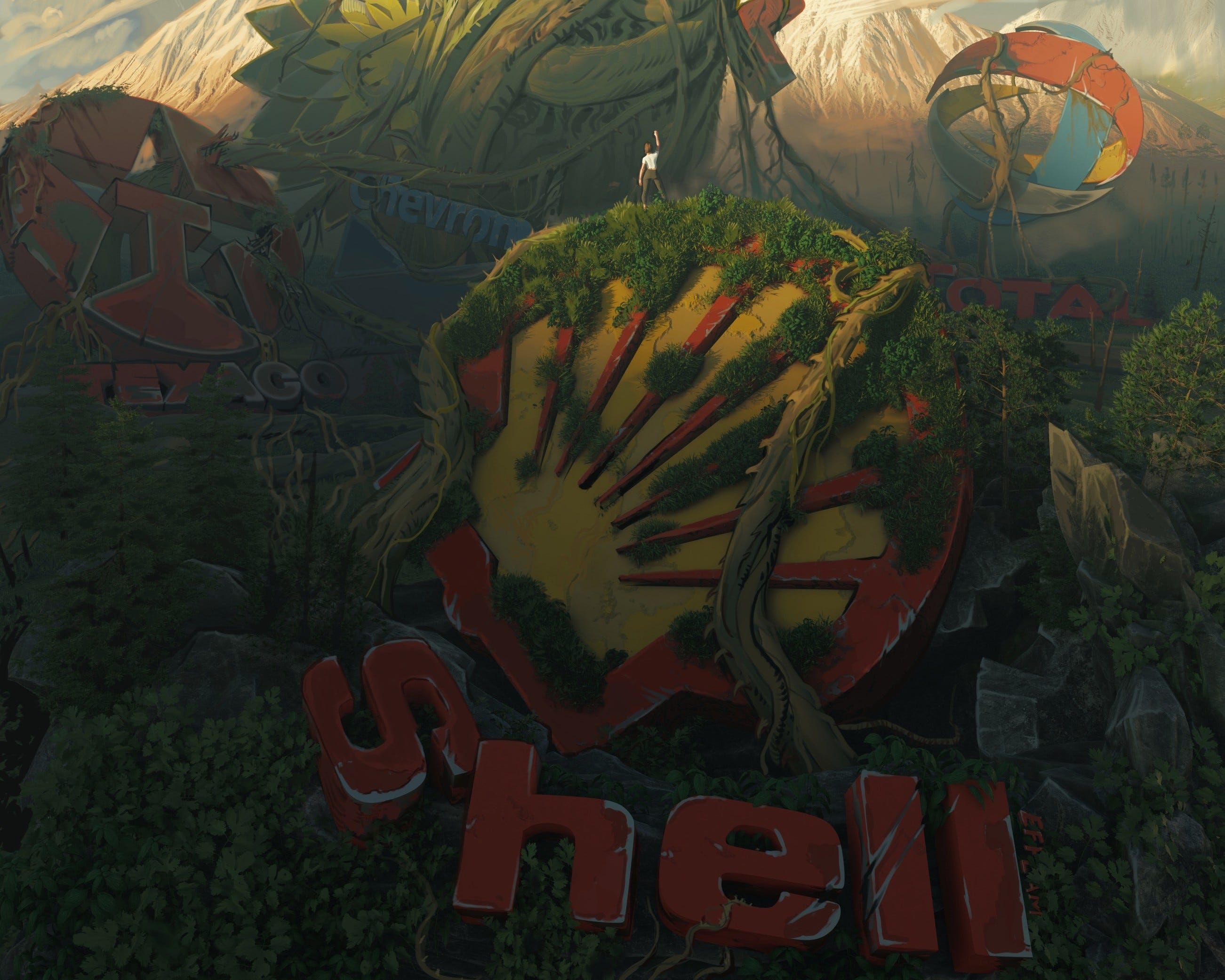
Illustration by Efflam Mercier.
by Amy Westerfelt, Drilled News, April 20, 2020
For a long time, the story went that the tobacco industry cooked up disinformation and then spread it to the fossil fuel guys, the chemical industry, pharma, you name it. But one thing that became incredibly clear when we began digging into PR firms and specific publicists was that this version of history is not quite right; if disinformation strategies were cooked up by any particular industry it was the public relations industry, which put these strategies to work on behalf of fossil fuels, tobacco, chemical manufacturers and more, often all at the same time. The very first publicist, Ivy Ledbetter Lee, worked on behalf of both Standard Oil and, shortly after, American Tobacco, for example. Daniel Edelman developed astroturf campaigns for both RJ Reynolds tobacco company and the American Petroleum Institute, as did John Hill, who went so far as to have tobacco folks join the API. He also worked with Monsanto, juggling all three clients at the same time. E. Bruce Harrison worked for the chemical guys first, then managed front groups for tobacco and fossil fuels at the same time. You get the drift.
These industries all surely learned from each other at various points in time, but that was mostly because they were working with the same publicists. The history is less that tobacco or oil embraced disinformation first and then passed it on and more that a handful of PR firms and consultants created the disinformation industry, and then put it to work on behalf of whatever industry needed it at any given time.
Today, those same strategies are at work on behalf of those who worry that the response to COVID-19 will undermine capitalism, which is why climate folks keep noting how familiar the whole anti-science component of the rightwing response to the pandemic feels. It’s familiar because the exact same strategies are being deployed, in some cases by the same people. Here are a few key examples:
- Disinformation Strategy #1: He who controls the language controls the narrative. Ivy Lee’s big thing, way back 100+ years ago when he was working with the Rockefellers... oh, and advising Hitler and Goebbels too… was to take control of language. If the government wanted to impose safety regulations on your industry, you described them as “extra” or “additional” or “surplus.” In climate, we’ve seen language shift from “the greenhouse effect” to global warming to climate change. When media finally seized the power to make its own language choices, opting for “climate crisis” or “climate emergency," it was deemed radical, even by other journalists. In the COVID-19 context, we’ve seen this too. It’s gone from a “flu” to “a really bad flu” to “a pandemic” in a relatively condensed amount of time. But you’ll see those trading in disinformation continue to refer to it as “just a bad flu” or point out how many people the flu kills every year.
- Disinformation Strategy #2: Leverage science illiteracy to create doubt: This has been a hugely effective tactic for multiple industries because the vast majority of public don’t spend a lot of time reading scientific studies, nor do they understand that scientific research has its own language. That makes it very easy to point to something like the uncertainty inherent in any scientific research and say “see, they don’t really know.” The best recent example of this is the re-emergence of Michael Fumento, as Drilled News contributor Paul Thacker pointed out recently. Fumento questioned health models for the tobacco guys, climate models for the oil guys, and has now returned to question public health models used to predict the spread and likely death toll of COVID-19. Fumento was also famously fired when Businessweek outed him for accepting $60,000 from Monsanto one year to write GMO-friendly pieces in his column, which was syndicated to dozens of papers across the country. Of course models, like science in general, have a bit of uncertainty baked in; they represent both the most extreme outcomes and the most likely scenarios, they encapsulate multiple variables. And if you know enough about them, it’s quite easy to cherry pick data and flaws and argue, as Fumento does, that modeling in general is bunk that ought to be thrown out.
- Disinformation strategy #3: Astroturfing This weekend, social media was awash in the news that those anti-lockdown rallies in Minnesota, Michigan, Wisconsin and Colorado were all fomented by rightwing donors. Someone on Reddit figured out all the “re-open the economy” websites were made by one guy in Florida. This is astroturfing 101, and it’s a strategy that’s been a key tool in the disinformation toolbox for at least 100 years. When coalminers and steelworkers were striking regularly back in the late 1800s and early 1900s, publicists like Ivy Lee, Edward Bernays and John Hill helped create fake protest groups that supposedly represented all the coal miners who just wanted these strikes to be over so they could get back to work. In more recent years, fossil fuel companies have backed fake advocacy groups like the California Drivers Alliance or the Washington Consumers for Sound Fuel Policy to fight against everything from emissions regulations to a carbon tax. Astroturfing is fake activism meant to give the illusion of grassroots opposition to policy. My favorite example is the Save the Plastic Bag Coalition, a petrochemical and plastic manufacturers-backed group that protests bag bans and bag taxes. It’s somewhat rare, however, to get a sitting U.S. President supporting and promoting your astroturf campaign, as Trump has done with the fake “re-open the economy” movement.
Season 3 of Drilled gets into these strategies and more in great detail, and you’re bound to see in this history the roots of today’s pandemic disinformation machine.
This week is Earth Week and a lot of media outlets are focused on solutions to climate change, a conversation that COVID-19 has certainly changed. Which got me thinking: often people act like climate accountability is not a solution, like all we do is point out problems or play the blame game. Sorry for harshing your mellow about carbon capture occasionally, but for the team at Drilled News, accountability is an absolutely necessary part of addressing climate change. How can you move forward functionally if you don’t know where things went wrong in the past? How can any technological solution possibly work if it’s plugged into the same old system (carbon capture is an excellent example of this, come to think of it)?
Our hope, of course, is that when people learn to recognize these strategies and know what’s behind them, they might become less effective. Disempowering the disinformation industry is a necessary part of any climate solution.
Friday, April 24, 2020
Bill McKibben's response to Michael Moore's Planet of the Humans
A Youtube video emerged on Earth Day eve making charges about me and about 350.org — namely that I was a supporter of biomass energy, and that 350 and I were beholden to corporate funding, and have misled our supporters on the costs and trade-offs related to decarbonizing our economy. These things aren’t true. Apparently there are lots of other falsehoods and misrepresentations in the film as well, but I’ll let others speak to those.
Like the film-maker, I previously personally supported burning bio-mass as an alternative to fossil fuels—in my case, when the rural college where I teach replaced its oil furnaces with a wood-chip burner more than a decade ago, I saluted it. But as more scientists studied the consequences of large-scale biomass burning, the math began to show that it would put large amounts of carbon into the atmosphere at precisely the wrong moment: if we break the back of the climate system now, it won’t matter if forests suck it up fifty years hence. And as soon as that became clear I began writing and campaigning on those issues. Here’s a piece of mine from 2016 that couldn’t be much clearer, and another from 2019 in the New Yorker about the fights in the Southeast, and another from 2020 as campaigners fought to affect policy in the Northeast. The other side has definitely noticed—here’s an article from the biomass industry attacking me, 350.org, and others. I’m reasonably sure that most of the valiant people here and in the UK that have been fighting this fight will vouch that I’ve been a help, not a hindrance.
As for taking corporate money, I’ve actually never taken a penny in pay from 350.org, or from any other environmental group. Instead, I’ve donated hundreds of thousands of dollars over the years in honoraria and prizes. And 350.org hasn’t taken corporate money, (though it did accept the donation of hundreds of irregular parkas from The North Face in 2009 to warm the hundreds of young people it brought from around the world to the Copenhagen climate conference) 350.org has no financial interest in the campaigns it runs to clean our financial system of dirty fossil fuels, and does not act as financial adviser; it’s untrue to suggest it ever promoted one fund over another or profited from doing so.
I am used to ceaseless harassment and attack from the fossil fuel industry, and I’ve done my best to ignore a lifetime of death threats from right-wing extremists. It does hurt more to be attacked by others who think of themselves as environmentalists. I have spent much of the last ten years doing my best to enlarge the environmental movement in every way I can think of, and to support others in their work; I think that a broad big movement is our best hope. And I have found great joy and satisfaction in that work. I don’t understand the reasoning behind these particular attacks; when I first heard rumors of them last summer I wrote the producer and director to set the record straight, and never heard back from them. That seems like bad journalism, and bad faith.
Obviously there are worse things going on in the world right now, from the pandemic we are all dealing with, to the efforts of the oil industry to use its cover to build new pipelines; they overshadow these attacks, which in any event aren’t on me alone but on lots of others who work, day by day, for change—we’re well aware our victories won’t come all at once, but also that we need to keep pushing. So while you shouldn’t waste any sympathy on me, I am very grateful for the solidarity people have been showing. That feels good.
Bill McKibben
Sunday, March 8, 2020
WaPo: The Congo rain forest is losing ability to absorb carbon dioxide. That’s bad for climate change

Increasing heat and drought is believed to be stifling the growth of the trees in the African rainforest, a phenomenon previously noted in the Amazon. The new data provides the first large-scale evidence that tropical rainforests around the world that have been untouched by logging or other human activity are losing their potency to fight climate change.
The study predicts that by 2030, the African jungle will absorb 14% less carbon dioxide than it did 10 to 15 years ago. By 2035, Amazonian trees won’t absorb any carbon dioxide at all, the researchers said.
By the middle of the century, the remaining uncut tropical forests in Africa, the Amazon and Asia will release more carbon dioxide than they take up — the carbon “sink” will have turned into a carbon source.
Tropical forests will “add to the problem of climate change, rather than mitigating against,” said Simon Lewis, an ecologist at the University of Leeds in England and one of the paper’s co-authors.
The results imply that unless nations accelerate efforts to counter climate change, temperatures will rise even faster than anticipated. The Earth “is more sensitive to carbon dioxide emissions than we thought,” said Lewis, who published a less comprehensive study of the African carbon sink in 2009.
The findings contradict models used by the Intergovernmental Panel on Climate Change and governments around the world, which predicted that the Congo Basin rainforest would continue to absorb carbon for many decades to come.
Richard Betts, head of climate impacts research at Britain’s Hadley Centre, who was not involved in the new study, called the results “a really important finding.”
Scientists have warned for decades that increased temperatures and reduced rainfall could hamper the tropical carbon sink, or the absorption of carbon dioxide by tropical forests.
The researchers estimate that in the 1990s, 17 percent of the carbon dioxide pumped out of smokestacks and tailpipes was taken up by uncut tropical jungles rather than accumulating in the atmosphere, slowing climate change. That figure has dropped to only 6 percent, they say.
The Congo Basin research took more than a decade of work, requiring travel in dugout canoes, on motorcycles and by foot to some of the world’s most inaccessible jungles, and the measurement of tens of thousands of trees by hand. “This has been a huge endeavor,” said Wannes Hubau, a forest ecologist at the Africa Museum in Brussels and a co-author of the paper.
Tough research environment
The new study’s origins date to 2005 when, with a research fellowship from Britain’s venerable Royal Society, Lewis began assembling a network of forest plots in Africa that had not been degraded by logging to track the amount of carbon the trees there absorb each year.
A group of several hundred Amazon plots had been set up by a colleague five years earlier. But no one had done a similar survey of trees in the Congo Basin. And Africa is different.
“It’s a difficult research environment,” Lewis said. The road network in central Africa is spare and poorly maintained, and perennial political upheaval often halts work. Moreover, there’s little funding to support such research, and few African researchers with whom to collaborate.

Computing the carbon content of a forest requires boots on the ground, measuring the girth of every tree in a patch about twice the size of a football field as frequently as every few years, Lewis said.
Scientists have come up with standard equations for converting the diameter of a tree trunk into the amount of carbon contained in the wood. The quantity of carbon absorbed, or lost, by a plot is simply the mathematical difference between how much the trees contain in successive censuses.
Lewis set up several dozen sites himself in Cameroon and Congo. But he wanted a record of carbon uptake in the years even before he began. So he sought out plots that had been set up earlier, often for different purposes by other researchers, and often later abandoned.
One study site was started in 1979 in Liberia by a group of German foresters. The researchers fled the country in the late 1980s during Liberia’s civil war, and the records there were destroyed. But Lewis ferreted out a database of measurements that had been saved on a computer in the Netherlands. After hostilities ended, he drove to Liberia’s only remaining rainforest in 2007 with a sketch of the research locations and found a local resident who had helped conduct the original census. “He led us straight to tree number one of the census,” Lewis said. “Now they’re a core part of our network.”
Expanding the network
In 2013, Lewis hired Hubau to expand the network and look into questionable data on existing sites. It wasn’t easy. They wanted patches scattered all across central Africa, as far as possible from human influence.
Hubau reached one site in Congo by motorcycle to find trunks as expansive and true as Greek columns, rising 10 stories above him. He had brought along a sheaf of papers that contained the vitals of each tree with a trunk thicker than his wrist. It amounted to 376 trees, when last counted in 2014.
Hubau noted which trees had died since then and which trees had grown big enough to be added to the roster. He wrapped a tape measure around the trunk of each tree. For trees too broad for Hubau’s lanky arms to hug, a helper would pass the dangling end of the tape measure around.
But the site had serious complications. The 2014 crew had nailed numbered tags identifying each tree too tightly to the trunks. Subsequent growth had swallowed up some of them. Termites had attacked red blazes that a 2012 team had painted to mark the height from the ground at which they had applied their tapes. Tree girth must be checked at the same place each time. Even a slight change in the measurement point introduces errors that throw off the carbon tally.
After two days of sweaty labor and detective work, Hubau had identified and measured every tree in that plot.
Predicting the sink's future
The new Nature paper combines the work of researchers and field assistants who studied 135,625 trees at 244 African plots in 11 countries with data that, in some cases, goes back to the 1960s. It concludes that, on average, African trees absorbed the same amount of carbon dioxide for two decades through 2014. But a subset of trees began to lose their capacity to absorb carbon as early as 2010.
A typical acre of African jungle accumulates an extra 1,200 pounds of wood every year, equivalent to about half a cord of firewood. Like their Amazonian counterparts, the African forests appear to benefit from carbon dioxide fertilization — they grow more quickly as the amount of carbon dioxide in the atmosphere steadily increases.
But higher temperatures and increased drought, both detrimental to tree growth, are eroding the benefits of carbon fertilization, according to the new study.
Lewis, Hubau and a long list of colleagues used the African records, combined with a comparable set already available from the Amazon, to tease out the factors that influence the health of the tropical carbon sink and to predict its future.
Researchers have already documented a reduction in carbon uptake in the Amazon rainforest. In a 2015 paper also published in Nature, scientists found that intact Amazon jungle absorbed 30 percent less carbon in the 2000s than in the 1990s. The new study finds that Africa is lagging only 10 or 20 years behind the Amazon. Hubau says central African forests are cooler than those in the Amazon, a factor that has delayed the impact of rising temperatures.
“This carbon sink is turning off far earlier than even the most pessimistic of these climate models,” Lewis said.
Now, “we’ll have to cut emissions faster than expected,” said Betts, of the Hadley Centre.
Grossman’s reporting in Congo was supported by the Pulitzer Center on Crisis Reporting.
Mark Carney of the Bank of England unveils climate stress test

Every financial institution needs a climate plan, says Mark Carney. Image: By Markus Spiske on Unsplash
Tackling climate change isn’t just about replacing fossil fuels with renewables, or planting more trees. It’s about confronting climate stress across society.
LONDON – The warming world means climate stress now permeates every part of society. And so an entire financial system which has underpinned the growth of a global economy largely dependent on fossil fuels must be reoriented to deal with what is fast becoming a full-blown crisis.
A campaign to halt or withdraw multi-million dollar investments from industries associated with fossil fuel use is gaining momentum. And the central banks – the institutions responsible for regulating countries’ financial systems – are now taking action.
Leading the charge is the venerable Bank of England (BOE), one of the oldest such institutions in the world. In December it became the first central bank to announce what it terms a banking stress test on climate change.
Under the BOE’s stress test framework, banks and insurance companies will be required to go through their books to evaluate their exposure to the impacts of climate change.
If, for instance, a British bank has loaned money to a company building a coal-fired power plant, the BOE will require the bank concerned to hold a substantial amount of additional capital to cover the risks of the project being abandoned because of new regulations or other climate change-related factors.
“A question for every company, every financial institution, every asset manager, pension fund or insurer is what’s your plan on climate change”
In the same way, if an insurance group has granted cover to houses on a flood plain, or to coastal properties which could be subject to rises in sea level – or if a bank has granted mortgages on such properties – the BOE will require additional capital to be held to cover the financial risks involved.
Other financial institutions are examining ways in which their activities can be protected from the more serious impacts of a warming world. Several insurance groups have announced plans to withdraw cover from fossil fuel projects.
Central banks are following the BOE’s lead: a body with the somewhat cumbersome title of the Network of Central Banks and Supervisors for Greening the Financial System (NGFS) now has more than 40 members – all involved in monitoring the risks climate change poses to the finance sector.
The BOE’s action has two aims. One is to ensure the financial system can withstand the considerable financial costs posed by climate change. The other is to encourage financial institutions to invest their funds in more sustainable, environmentally friendly projects.
Mark Carney, the outgoing BOE governor who is soon to take up a post as UN special envoy for climate action and finance, describes the BOE stress test as the first comprehensive assessment of whether the financial system is on track to help deliver a transition to a sustainable future.
Worthless assets possible
“A question for every company, every financial institution, every asset manager, pension fund or insurer is what’s your plan (on climate change),” Carney told the BBC.
He says that unless the finance sector and large companies wake up to the scale of the climate crisis, many of the assets they now hold in fossil fuels and other enterprises will become worthless.
Some financial institutions are taking action, says the BOE governor, divesting from investments in fossil fuels and becoming involved in more sustainable projects, but progress is still far too slow. Time is of the essence.
“The climate emergency continues to build. The next year will be critical,” says Carney.
Tropical forests may be heating Earth by 2035
by Tim Radford, Climate News Network, March 6, 2020

Bayaka people in the Central African Republic rainforest. Image: By JMGRACIA100, via Wikimedia Commons
Climate change so far has meant more vigorous forest growth as greenhouse gases rise. The tropical forests may soon change that.
LONDON, 6 March, 2020 – Within about fifteen years, the great tropical forests of Amazonia and Africa could stop absorbing atmospheric carbon, and slowly start to release more carbon than growing trees can fix.
A team of scientists from 100 research institutions has looked at the evidence from pristine tracts of tropical forest to find that – overall – the foliage soaked up the most carbon, most efficiently, more than two decades ago.
Since then, the measured efficiency of the forests as a “sink” in which carbon is sequestered from the atmosphere has been dwindling. By the last decade, the ability of a tropical forest to absorb carbon had dropped by a third.
All plant growth is a balancing act based on sunshine and atmospheric carbon and rainfall. Plants absorb carbon dioxide as they grow, and surrender it as they die.
In a dense, undisturbed wilderness, fallen leaves and even fallen trees are slightly less likely to decompose completely: the atmospheric carbon in leaf and wood form has a better chance of being preserved in flooded forests as peat, or being buried before it can completely decompose.
The forest becomes a bank vault, repository or sink of the extra carbon that humans are now spilling into the atmosphere from car exhausts, factory chimneys and power station furnaces.
Theory and practice
And in theory, as more and more carbon dioxide gets into the atmosphere, plants respond to the more generous fertilization by growing more vigorously, and absorbing more carbon.
But as more carbon gets into the atmosphere, the temperature rises and weather patterns begin to become more extreme. Summers get hotter, rainfall more capricious. Then trees become vulnerable to drought, forest fire and invasive diseases, and die more often, and decompose more completely.
Wannes Hubau, once of the University of Leeds in the UK and now at the Royal Museum for Central Africa in Belgium, and more than 100 colleagues from around the world, report in the journal Nature that they assembled 30 years of measurement from more than 300,000 trees in 244 undisturbed plots of forest in 11 countries in Africa, and from 321 plots of forest in Amazonia, and did the sums.
In the 1990s, intact tropical forests removed around 46 billion tonnes of carbon dioxide from the atmosphere. By the 2010s, the uptake had fallen to around 25 billion tonnes. This means that 21 billion tons of greenhouse gas that might otherwise have been turned into timber and root had been added to the atmosphere.
This is pretty much what the UK, France, Germany and Canada together spilled into the atmosphere from fossil fuel combustion over a 10-year period.
“We’ve found one of the most worrying impacts of climate change has already begun. This is decades ahead of even the most pessimistic climate models”
“Extra carbon boosts tree growth, but every year this effect is being increasingly countered by the negative impacts of higher temperatures and droughts which slow growth and can kill trees,” said Dr Hubau.
“Our modeling shows a long-term decline in the African sink and that the Amazon sink will continue to rapidly weaken, which we predict will become a carbon source in the mid-2030s.”
Tropical forests are an integral factor in the planetary carbon budget – a crude accounting system that climate scientists rely upon to model the choice of futures that face humankind as the world heats up.
Around half of Earth’s carbon is stored in terrestrial vegetation and the tropical forests account for about a third of the planet’s primary productivity. So how forests respond to a warmer world is vital.
Because the Amazon region is being hit by higher temperatures, and more frequent and prolonged droughts than forests in tropical Africa, Amazonia is weakening at a faster rate.
But decline has also begun in Africa. In the 1990s, the undisturbed tropical forests alone inhaled 17% of human-made carbon dioxide emissions. In the decade just ended, this proportion fell to 6%.
Catastrophic prospect
In roughly the same period, the area of intact forest fell by 19%, and global carbon dioxide emissions rose by 46%. Even so, the tropical forests store 250 billion tonnes of carbon in their trees alone: 90 years of fossil fuel emissions at the present rate. So their sustained loss would be catastrophic.
“Intact tropical forests remain a vital carbon sink but this research reveals that unless policies are put in place to stabilize the Earth’s climate, it is only a matter of time until they are no longer able to sequester carbon,” said Simon Lewis, a geographer at the University of Leeds, and one of the authors.
“One big concern for the future of humanity is when carbon-cycle feedbacks really kick in, with nature switching from slowing climate change to accelerating it.
“After years of work deep in the Congo and Amazon rain forests, we’ve found one of the most worrying impacts of climate change has already begun.
“This is decades ahead of even the most pessimistic climate models. There is no time to lose in tackling climate change.”
Friday, February 7, 2020
Roger Harrabin, BBC: Bank of England chief Mark Carney issues climate change warning
Bank of England chief Mark Carney issues climate change warning
by Roger Harrabin, BBC Environment Analyst, BBC, December 30, 2019
Readers, please see link at the bottom to go to the video interview.
The world will face irreversible heating unless firms shift their priorities soon, the outgoing head of the Bank of England has told the BBC.
Mark Carney said the financial sector had begun to curb investment in fossil fuels – but far too slowly.
He said leading pension fund analysis "is that if you add up the policies of all of companies out there, they are consistent with warming of 3.7-3.8C".
Mr Carney made the comments in a pre-recorded BBC Radio 4 Today interview.
The interview, by presenter Mishal Husain, is one of several items on the programme which are focusing on climate change, on the day the show is guest edited by environmental campaigner Greta Thunberg.
Mr Carney added that the rise of almost 4C was "far above the 1.5 degrees that the people say they want and governments are demanding.”
Scientists say the risks associated with an increase of 4C include a nine metre rise in sea levels - affecting up to 760 million people – searing heatwaves and droughts, and serious food supply problems.
Wednesday, January 22, 2020
Evidence that an ice-free Arctic Ocean allowed ancient CO2 and methane emissions

Speleothems like these form fastest when the permafrost has thawed. Image: By James St John, via Wikimedia Commons
by Tim Radford, Climate News Network, January 10, 2020
LONDON – Deep in a cave in Siberia, Israeli, Russian and British scientists have identified evidence of periodic losses of carbon from the permafrost. And the unexpected link is not simply with peak periods of bygone global warming, but with an ice-free Arctic Ocean. The escape into the atmosphere of prodigious volumes of methane and carbon dioxide from the thawing soils is in step not with average planetary temperature rise, but with long periods when the Arctic Ocean is free of ice every summer.
Fact one: about one quarter of land in the northern hemisphere is now, and has been for much of the last half million years, permanently frozen, and with it about twice as much atmospheric carbon – in the form of peat and preserved vegetation – as there exists freely in the planetary atmosphere.
Fact two: in the most recent decades, sea ice has been both thinning and dwindling rapidly, and the polar ocean could by 2050 become almost entirely ice-free in the summer months. “This discovery about the behaviour of the permafrost suggests that the expected loss of Arctic sea ice will accelerate melting of the permafrost presently found across much of Siberia” And this twist in the tale of a rapidly-warming Arctic is preserved in stalagmite formations in a cave deep beneath the rim of the Arctic Circle in Siberia.
The chronology of stalagmite and stalactite development can be established precisely by the pattern of uranium and lead isotope deposits in formations, built up imperceptibly by the steady drip of water from, and through, the soils far above. That is, the speleothems – a geologist’s catch-all word for both stalactite and stalagmite – form fastest when the permafrost has thawed. And unexpectedly, the periods of thaw did not match the peaks of interglacial warming during the last 1.35 million years. They did however coincide with periods when the Arctic was ice-free in the summer.
“This discovery about the behaviour of the permafrost suggests that the expected loss of Arctic sea ice in the future will accelerate melting of the permafrost presently found across much of Siberia,” said Gideon Henderson of the University of Oxford, and one of the authors of a new study in the journal Nature.
The argument goes like this: if there is no sea ice then more heat and moisture is delivered from the ocean to the atmosphere, with warmer air flowing over Siberia, and therefore more autumn snowfall. A blanket of snow insulates the soil beneath from the extreme winter cold, so ground temperatures go up, to unsettle the permafrost and start a thaw that leads to accelerated plant decay and ever-increasing escape of carbon dioxide and methane that would otherwise have been frozen into the permafrost. So the stalagmites endure as evidence of these warmer soils and survive as a direct link to periods of ice-free ocean.
“If these processes continue during modern climate change, future loss of summer Arctic sea ice will accelerate the thawing of Siberian permafrost,” the scientists say.
https://climatenewsnetwork.net/ice-free-arctic-ocean-allowed-ancient-carbon-leaks/
Sunday, January 19, 2020
Nick Breeze: Coping with climate distress - interview with psychotherapist Ro Randall
Coping with climate distress - interview with psychotherapist Ro Randall
Nick Breeze
for more information visit https://envisionation.co.uk
or https://www.
[or https://climatepsychology.us/]
Ro Randall is psychotherapist specialising in climate-related distresswith many years researching the impact of the climate crisis on individuals and climate groups.
https://www.youtube.com/watch?
Nick Breeze
for more information visit https://envisionation.co.uk
or https://www.
[or https://climatepsychology.us/]
Ro Randall is psychotherapist specialising in climate-related distresswith many years researching the impact of the climate crisis on individuals and climate groups.
https://www.youtube.com/watch?
Tuesday, September 3, 2019
Dorian Hammering Grand Bahama Island: Prolonged Storm Surge Threat Ahead for Southeast U.S.
September 2, 2019, 1:34 PM EDT

| Above: @astro_christina captured this image of #HurricaneDorian on September 2, 2019 from the space station. |
After thrashing Great Abaco Island on Saturday, Dorian has parked over Grand Bahama Island, which has been getting the most fierce and prolonged battering from an extreme Atlantic hurricane in history. According to the NOAA historical hurricane database, the only comparable Category 5 beating is the one administered to Honduras by Hurricane Mitch of 1998, which spent 12 hours within 50 miles of the island of Guanaja as a Category 5 storm. However, Mitch's eye did not stay parked over land like Dorian's has.
At 3 pm EDT, Dorian was centered about 25 miles east-northeast of Freeport, moving west-northwest at just 1 mph. The hurricane’s eyewall has been slamming the island since 9 pm EDT Sunday, and storm surge has been extreme and prolonged over many areas. Sustained winds were 150 mph, not far below Category 5 strength. However, Hurricane Hunters confirmed a break in the eyewall on Monday afternoon, and the central pressure had risen to 941 millibars, so we can expect Dorian's strength to be further downgraded on Monday evening.
“These hazards will continue over Grand Bahama Island during most of the day, causing extreme destruction on the island,” said the National Hurricane Center in a noon update. There have been multiple reports of storm-surge flooding forcing residents to take shelter in attics.
“The Bahamas is presently at war and being attacked by Hurricane Dorian,” Prime Minister Dr. Hubert Minnis told the Nassau Guardian. “And yet, it has no weapon at its disposal to defend itself during such an assault by this enemy.”
This is a topographic map of Grand Bahama island.
Green: 0-15 ft
Yellow: 15-30 ft
Red: 30+ ft
Dorian's storm surge is estimated at 18-23 ft, which would submerge everything in green and significant parts of the yellow. Hopefully most people managed to move to safe locations.


629 people are talking about this
Storm surge: the biggest U.S. threat from Dorian
After days of uncertainty on crucial aspects of Dorian’s track, computer models came into sharper agreement on Sunday night. The 0Z ensemble model runs from the European and GFS models closely agreed that Dorian will arc northeastward just off the coast from east central Florida on Tuesday to south of North Carolina by Friday. A small minority (about 10%) of ensemble tracks produce brief, grazing landfalls.
The latest 12Z Monday runs of the four track models that performed best in the two-day time range in 2018—the European, UKMET, HWRF, and GFS—have all fallen in line with a track about 50 - 80 miles from the coast of Florida and Georgia, then growing very close to the coast or making landfall in the Carolinas. Hurricane watches are not issued until 48 hours before a landfall threat, so we can expect such watches to be extended up the Southeast coast over the next day or two as the threat unfolds. Remember that the average error in a 24-hour NHC forecast is about 40 miles, and a 48-hour forecast is typically in error by about 65 miles.
The long awaited stall of #Hurricane #Dorain occurred last night, unfortunately over #GrandBahama island
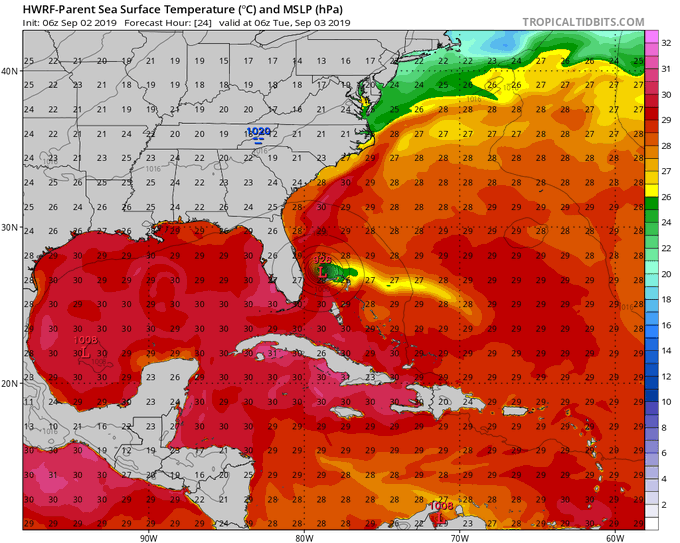
As it remains stalled, it is upwelling cooler water underneath. We see this effect via warming cloud tops near the center. More weakening expected in the short term.


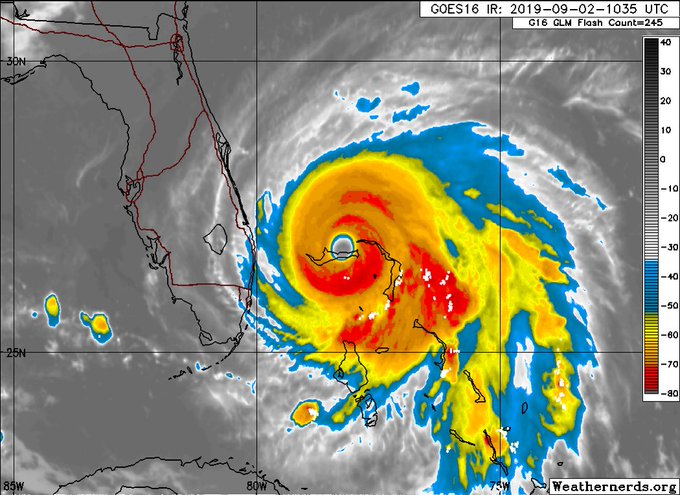
Here is the 24h HWRF forecast for #Dorian parent domain just looking at the SST field underneath. You can follow the cold wake of the storm track, but notice the <26c br="" dorian.="" ssts="" under="">
This would likely induce continued weakening until Dorian moves away from its own cold wake.
32 people are talking about this
Comparing Dorian and Matthew
The consensus track for Dorian bears a close resemblance to that of 2016’s Hurricane Matthew, which caused more than $10 billion in U.S. damage as it curled very near the coast from Florida to North Carolina on a coast-hugging track. The lastest NHC forecast has Dorian following Matthew's track within about 20 miles, all the way from central Florida to South Carolina. What are the similarities and differences?
—Size: Dorian is about the same size as Matthew. During its track up the Southeast U.S. coast, Matthew had hurricane-force winds that extended out about 45 mlies to the northwest of the center, and tropical storm-force winds that extended out about 120 miles. For Wednesday, NHC is predicting that Dorian's hurricane-force and tropical storm-force winds will extend out 40 and 120 miles to the northwest, respectively.
—Speed: Dorian will be a slower mover than Matthew, especially near Florida. Matthew took a day and a half to get from just east of Florida's Space Coast to just south of Wilmington, North Carolina. Dorian is predicted to take about two days to cover the same territory. As a result, water will pile up along the Southeast coast ahead of Dorian for a longer period than with Matthew, and peak flooding may extend over multiple tidal cycles.
—Strength: Dorian will probably be about as strong as Matthew, perhaps a little stronger. Dorian will likely weaken to Category 3 strength as it moves near northern Florida, and it will likely be a Category 1 or 2 off North Carolina. This is quite similar to the weakening that Matthew experienced, although Matthew was already a minimal Category 1 by the time it reached northern South Carolina.
—Track: It’s uncertain at this point exactly where Dorian may track closer to or farther from the coast than Matthew. Matthew made landfall just north of Charleston, South Carolina as a Category 1 hurricane. Dorian is more likely to make landfall in North Carolina, according to the latest NHC forecast.
All told, Dorian will have the potential to produce some of the largest storm surges on record along the Southeast coast, and will likely be a multi-billion dollar storm due to storm surge damages alone. Whether or not local all-time records occur, as they did during Matthew in 2016 at several locations, will hinge on Dorian’s exact track, timing, and strength.
Dorian is not moving into a strong preexisting frontal zone, so rainfall well inland will not be excessive, at least initially. The most concerning area for potential inland flooding is North Carolina, as by the time Dorian reaches this location (around Friday) it may be producing an expansive shield of rains to its north and northeast. Widespread rains of 5-10” and localized amounts well over 10” may be possible across eastern North Carolina, which was devastated by massive inland flooding during Matthew as well as during Florence (2018) and Floyd (1999).
Dorian is not moving into a strong preexisting frontal zone, so rainfall well inland will not be excessive, at least initially. The most concerning area for potential inland flooding is North Carolina, as by the time Dorian reaches this location (around Friday) it may be producing an expansive shield of rains to its north and northeast. Widespread rains of 5-10” and localized amounts well over 10” may be possible across eastern North Carolina, which was devastated by massive inland flooding during Matthew as well as during Florence (2018) and Floyd (1999).
President Trump says he didn’t know Category 5 hurricanes existed
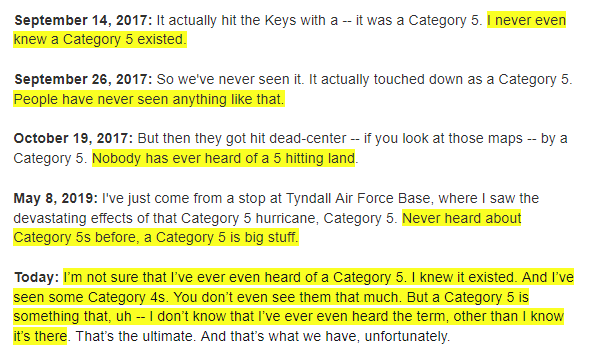
On Sunday, President Trump expressed his surprise over Hurricane Dorian’s Category 5 strength, saying:
“I’m not sure I’ve ever even heard of a Category 5. I knew it existed. And I’ve seen some Category 4s. You don’t even see them that much. But a Category 5 is something that, uh, I don’t know that I’ve never even heard the term, other than I know it’s there. That’s the ultimate. And that’s what we have, unfortunately.”
But the President knew full well that Category 5 hurricanes exist, based on his past comments. As reported today by the Capital Weather Gang’s Andrew Freedman, Trump has expressed shock at the existence of Category 5 storms at least two other times: during Hurricane Irma in 2017 (“never even knew a Category 5 existed”) and Hurricane Michael in 2018 (never heard about Category 5s before.”) Oddly, though, Trump has repeatedly called Hurricane Maria, which devastated Puerto Rico in 2017, a Category 5—even though it was a Category 4 at landfall. Troublingly, since the president is in charge of ordering disaster relief in the wake of a hurricane, his Category 5 misconceptions could lead to a slowing or mis-allocation of resources.
President Donald Trump on the existence of Category 5 hurricanes, 2017-2019.

22.7K people are talking about this
Trump’s Category 5 blindness is also financially dangerous for a businessman who owns a multi-million-dollar property on a barrier island in a hurricane storm surge zone--the Mar-a-Largo resort in Palm Beach, Florida. NOAA’s National Storm Surge Hazard Maps database predicts that Mar-a-Largo would see inundations of up to 3 – 6’ on the back-bay side during a Category 5 hurricane. The resort was evacuated and boarded up for Dorian, after a 1 pm Sunday evacuation order was given for the barrier island.
Also concerning is the President’s failure to understand the size of Dorian. On Sunday, he tweeted: "In addition to Florida – South Carolina, North Carolina, Georgia, and Alabama, will most likely be hit (much) harder than anticipated. Looking like one of the largest hurricanes ever.”
In these comments, President Trump confused the strength of the storm for its size. The intensity of a hurricane’s peak winds is not correlated with the areal size, and Dorian is an average-sized hurricane whose winds will come nowhere close to affecting Alabama. Officials there had to scramble to put out statements refuting the President’s misinformation. Unfortunately, he repeated the claim later at a FEMA press conference. He told journalists: "And Alabama could even be in for at least some very strong winds and something more than that, it could be. This just came up, unfortunately. It's the size of the storm that we're talking about. So, for Alabama, just please be careful also.”
Finally, we should be concerned about the President’s reported willingness to use nuclear weapons on hurricanes. According to an August 25, 2019 report from Axios, citing inside sources, during one hurricane briefing at the White House, Trump said (paraphrasing the president's remarks): "I got it. I got it. Why don't we nuke them? They start forming off the coast of Africa, as they're moving across the Atlantic, we drop a bomb inside the eye of the hurricane and it disrupts it. Why can't we do that? Trump has denied making the statement.
If one were to detonate a nuclear device in the eyewall of a hurricane, the radioactive fallout would very efficiently be carried high into the atmosphere due to the tremendous upper-level outflow that ventilates a hurricane. In a matter of days, radioactive fallout would be carried around the globe by the sub-tropical jet stream, contaminating rainfall over a huge area. The blast would also have little or no impact on the hurricane, since the amount of energy released by a nuclear device is puny compared to what a hurricane generates. It is also illegal under the terms of the Peaceful Nuclear Explosions Treaty between the U.S. and the former Soviet Union to explode a nuclear weapon in the atmosphere.
Dr. Jeff Masters co-wrote this post, including the section on President Trump.
Subscribe to:
Posts (Atom)

 Posts
Posts