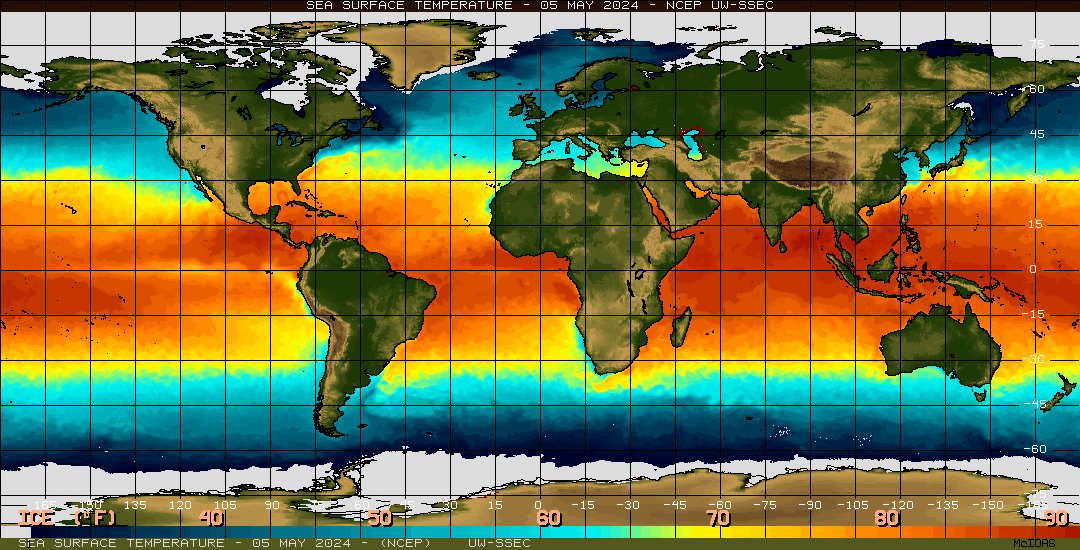
When we see records being broken and unprecedented events such as this, the onus is on those who deny any connection to climate change to prove their case. Global warming has fundamentally altered the background conditions that give rise to all weather. In the strictest sense, all weather is now connected to climate change. Kevin Trenberth
HIT THE PAGE DOWN KEY TO SEE THE POSTS
Now at 8,800+ articles. HIT THE PAGE DOWN KEY TO SEE THE POSTS
Science, 363(6423) (11 Jan 2019) 128-129; doi: 10.1126/science.aav7619 How fast are the oceans warming? Lijing Cheng, John Abraham, Zeke Hausfather, and Kevin Trenberth Abstract
Climate change from human activities mainly results from the energy imbalance in Earth's climate system caused by rising concentrations of heat-trapping gases. About 93% of the energy imbalance accumulates in the ocean as increased ocean heat content (OHC). The ocean record of this imbalance is much less affected by internal variability and is thus better suited for detecting and attributing human influences (1) than more commonly used surface temperature records. Recent observation-based estimates show rapid warming of Earth's oceans over the past few decades (see the figure) (1, 2). This warming has contributed to increases in rainfall intensity, rising sea levels, the destruction of coral reefs, declining ocean oxygen levels, and declines in ice sheets; glaciers; and ice caps in the polar regions (3, 4). Recent estimates of observed warming resemble those seen in models, indicating that models reliably project changes in OHC.
Rising ocean temperatures can bleach corals, like these off of Papua New GuineaCreditCredi(Jurgen Freund/NPL/Minden Pictures). by Kendra Pierre-Louis, The New York Times, January 10, 2019 Scientists say the world’s oceans are warming far more quickly than previously thought, a finding with dire implications for climate change because almost all the excess heat absorbed by the planet ends up stored in their waters.
A new analysis, published Thursday in the journal Science, found that the oceans are heating up 40% faster on average than a United Nations panel estimated 5 years ago. The researchers also concluded that ocean temperatures have broken records for several straight years.
“2018 is going to be the warmest year on record for the Earth’s oceans,” said Zeke Hausfather, an energy systems analyst at the independent climate research group Berkeley Earth and an author of the study. “As 2017 was the warmest year, and 2016 was the warmest year.”
As the planet has warmed, the oceans have provided a critical buffer. They have slowed the effects of climate change by absorbing 93% of the heat trapped by the greenhouse gases humans pump into the atmosphere.
“If the ocean wasn’t absorbing as much heat, the surface of the land would heat up much faster than it is right now,” said Malin L. Pinsky, an associate professor in the department of ecology, evolution and natural resources at Rutgers University. “In fact, the ocean is saving us from massive warming right now.”
But the surging water temperatures are already killing off marine ecosystems, raising sea levels and making hurricanes more destructive.
As the oceans continue to heat up, those effects will become more catastrophic, scientists say. Rainier, more powerful storms like Hurricane Harvey in 2017 and Hurricane Florence in 2018 will become more common, and coastlines around the world will flood more frequently. Coral reefs, whose fish populations are sources of food for hundreds of millions of people, will come under increasing stress; a fifth of all corals have already died in the past three years.
People in the tropics, who rely heavily on fish for protein, could be hard hit, said Kathryn Matthews, deputy chief scientist for the conservation group Oceana. “The actual ability of the warm oceans to produce food is much lower, so that means they’re going to be more quickly approaching food insecurity,” she said.
Because they play such a critical role in global warming, oceans are one of the most important areas of research for climate scientists. Average ocean temperatures are also a consistent way to track the effects of greenhouse gas emissions because they are not influenced much by short-term weather patterns, Mr. Hausfather said.
“Oceans are really the best thermometer we have for changes in the Earth,” he said.
But, historically, understanding ocean temperatures has been difficult. An authoritative United Nations report, issued in 2014 by the Intergovernmental Panel on Climate Change, presented five different estimates of ocean heat, but they all showed less warming than the levels projected by computer climate models — suggesting that either the ocean heat measurements or the climate models were inaccurate.
Since the early 2000s, scientists have measured ocean heat using a network of drifting floats called "Argo," named after Jason’s ship in Greek mythology. The floats measure the temperature and saltiness of the upper 6,500 feet of the ocean and upload the data via satellites.
But before Argo, researchers relied ontemperature sensorsthat ships lowered into the ocean with copper wire. The wire transferred data from the sensor to the ship for recording until the wire broke and the sensor drifted away.
That methodwas subject touncertainties, particularly around the accuracy of the depth at which the measurement was taken. Those uncertainties hamper today’s scientists as they stitch together 20th-century temperature data into a global historical record.
In the new analysis, Mr. Hausfather and his colleagues assessed three recent studies that better accounted for the older instrument biases. The results converged at an estimate of ocean warming that was higher than that of the2014 United Nations reportand more in line with the climate models.
The waters closest to the surface have heated up the most, and that warming has accelerated over the past two decades, according to data from the lead author of the new study, Lijing Cheng of the Institute of Atmospheric Physics in Beijing.As the oceans heat up, sea levels rise because warmer water takes up more space than colder water. In fact, most of the sea level rise observed to date is becauseof thiswarming effect, not melting ice caps.
Absent global action to reduce carbon emissions, the authors said, the warming alone would cause sea levels to rise by about a foot by 2100, and the ice caps would contribute more. That could exacerbate damages from severe coastal flooding and storm surge.
The effects of the warming on marine life could also have broad repercussions, Dr. Pinsky said.“As the ocean heats up, it’s driving fish into new places, and we’re already seeing that that’s driving conflict between countries,” he said. “It’s spilling over far beyond just fish, it’s turned into trade wars. It’s turned into diplomatic disputes. It’s led to a breakdown in international relations in some cases.”
A fourth study reviewed by the researchers strengthened their conclusions. That studyused a novel method to estimate ocean temperatures indirectly, and it also found that the world’s oceans were heating faster thanthe authors of the 2014 study did.
The study initially contained an error that caused its authors to revise their estimates downward.But as it turned out, the downward revision brought the study’s estimates much closer to the new consensus.
“The correction made it agree a lot better with the other new observational records,” Mr. Hausfather said. “Previously it showed significantly more warming than anyone, and that was potentially worrisome because it meant our observational estimates might be problematic. Now their best estimate is pretty much dead-on with the other three recent studies.”
The scientists who published the four studies were not trying to make their results align, Mr. Hausfather said. “The groups who were working on ocean heat observations, they’re not climate modelers,” he said. “They’re not particularly concerned with whether or not their observations agree or disagree with climatemodels.”
A dead coral reef in waters off Indonesia.CreditEthan Daniels/Stocktrek Images, via Science Source
Image
A dead coral reef in waters off Indonesia (Credit Ethan Daniels/Stocktrek Images, via Science Source). Laure Zanna, an associate professor of climate physics at the University of Oxford who was not involved in the study, said the new research was “a very nice summary of what we know of the ocean and how far the new estimates have come together.”
Dr. Zanna published a study this week that used existing data to estimate ocean temperatures dating back to 1871. The goal was to figure out places where sea level rise might happen even faster than expected because of the way ocean currents redistribute heat, allowing regions that are especially at risk to better plan for those changes.
“We are warming the planet, but the ocean is not warming evenly, so different places warm more than others,” Dr. Zanna said. “And so the first consequence will be that sea level will be different in different places depending on the warming.”
Though the new findings provide a grim forecast for the future of the oceans, Mr. Hausfather said that efforts to mitigate global warming, including the 2015 Paris climate agreement, would help. “I think there’s some reason for confidence that we’ll avoid the worst-case outcomes,” he said, “even if we’re not on track for the outcomes we want.”
Michael Mann, climate scientist at Pennsylvania State University, along with colleagues, has published a new study that connects these disruptive weather extremes with a fundamental change in how the jet stream is behaving during the summer. Linked to the warming climate, the study suggests this change in the atmosphere’s steering current is making these extremes occur more frequently, with greater intensity, and for longer periods of time.
The study projects this erratic jet-stream behavior will increase in the future, leading to more severe heat waves, droughts, fires and floods.
The jet stream is changing not only because the planet is warming up but also because the Arctic is warming faster than the mid-latitudes, the study says. The jet stream is driven by temperature contrasts, and these contrasts are shrinking. The result is a slower jet stream with more wavy peaks and troughs that Mann and his study co-authors ascribe to a process known as “quasi-resonant amplification.”
The altered jet-stream behavior is important because when it takes deep excursions to the south in the summer, it sets up a collision between cool air from the north and the summer’s torrid heat, often spurring excessive rain. But when the jet stream retreats to the north, bulging heat domes form underneath it, leading to record heat and dry spells.
If the excursions in the jet stream endure long enough, it can then set the stage for floods where the jet dips, and wildfires and drought where it ascends.
“What made these events [in the summer of 2018] so devastating was not just the extreme nature of the meteorological episodes but their persistence,” Mann said in a blog post discussing the implications of the new study.
The study, published Wednesday in Science Advances, finds that these quasi-resonant amplification events — in which the jet stream exhibits this extreme behavior during the summer — are predicted to increase by 50 percent this century if emissions of carbon dioxide and other greenhouse gases continue unchecked.
Whereas previous work conducted by Mann and others had identified a signal for an increase in these events, this study for the first time examined how they may change in the future using climate model simulations.
“Looking at a large number of different computer models, we found interesting differences,” said Stefan Rahmstorf from the Potsdam Institute for Climate Impact Research and a co-author of the study, in a news release. “Distinct climate models provide quite diverging forecasts for future climate resonance events. However, on average they show a clear increase in such events.”
In an email, Mann said climate models aren’t fully capturing the phenomenon, and, for this reason, we should expect weather extremes “beyond what is typically projected” into the future.
Mann added the existing analyses that attempt to uncover the role of climate change in recent extreme events “are under-attributing the role that climate change is having … because they are not capturing the key mechanism responsible.”
Mann said in his blog commentary that he was particularly struck by the jet-stream behavior in the summer. “In summer 2018, I would argue, that signal was no longer subtle,” he said. “It played out in real time on our television screens and newspaper headlines in the form of an unprecedented hemisphere-wide pattern of extreme floods, droughts, heat waves and wildfires.”
Although model projections suggest these extreme jet-stream patterns will increase as the climate warms, the study concluded that their increase can be slowed if greenhouse gas emissions are reduced along with particulate pollution in developing countries. “[T]he future is still very much in our hands when it comes to dangerous and damaging summer weather extremes,” Mann said. “It’s simply a matter of our willpower to transition quickly from fossil fuels to renewable energy.”
Dr. Jennifer Francis, a climate researcher at Rutgers University who has published work exhibiting changing jet-stream behavior because of climate change, found the results of this new study compelling. “This work takes a big step toward understanding the spate of deadly extreme weather events during recent summers — heat waves, floods and droughts,” she said in an email.
A group of British scientists and their supporters is willing to risk a prison term to press governments to tackle climate change and environmental crisis.
by Alex Kirby, Climate News Network, October 31, 2018
LONDON − A growing number of British academics, writers and activists say they are ready to go to prison in support of their demands for action on the environment.
Scientists are not normally renowned for their political activism, and the UK is hardly a hotbed of determined and risky protest against its rulers. But, if this group of nearly 100 British scientists and their backers is right, all that may be on the brink of changing.
Today sees the launch of ExtinctionRebellion, which describes itself as an international movement using mass civil disobedience to force governments to enter World War Two−level mobilization mode, in response to climate breakdown and ecological crisis.
The group is launching a Declaration of Rebellion against the UK government “for criminal inaction in the face of climate change catastrophe and ecological collapse” at the Houses of Parliament in central London.
“We need ExtinctionRebellion as part of the mosaic of responses to the extremely precarious situation we now find ourselves in”
From today it promises “repeated acts of disruptive, non-violent civil disobedience” if the government does not respond seriously to its demands, and says “there will be mass arrests.”
“Now is the time because we are out of time. There is nothing left to lose.”
The group’s demands include the declaration by the UK government of a state of emergency, action to create a zero carbon economy by 2025, and the establishment of a national assembly of “ordinary people” to decide what the zero carbon future will look like.
“Children alive today in the UK will face unimaginable horrors as a result of floods, wildfires, extreme weather, crop failures and the inevitable breakdown of society when the pressures are so great. We are unprepared for the danger our future holds.”
Its members say they are willing to make personal sacrifices, to be arrested and to go to prison. They hope to inspire similar actions around the world and believe this global effort must begin in the UK, today, where the industrial revolution began.
Another supporter is Andrew Simms of the New Weather Institute. He told the Climate News Network: “This is almost a cry of desperation. People are bewildered. But almost every profound change in British society, from the abolition of slavery to the improvement of shipping safety, has involved people risking arrest.
“The signs I am getting from the UK government now are that it is a reckless administration putting its own people and others at risk by putting climate change virtually nowhere.
“The Declaration alone won’t bring about change: we’ll need people working practically to make change happen on the ground. But we need ExtinctionRebellion as part of the mosaic of responses to the extremely precarious situation we now find ourselves in.”
Simms, convinced that an entirely new potential for rapid societal change now exists, says: “We know what’s needed, and the resources to do it are there. ExtinctionRebellion is one example of how new ideas can spread quickly and rapid shift − and radical action − can come closer.”
The ocean is the main source of thermal inertia in the climate system1. During recent decades, ocean heat uptake has been quantified by using hydrographic temperature measurements and data from the Argo float program, which expanded its coverage after 20072,3. However, these estimates all use the same imperfect ocean dataset and share additional uncertainties resulting from sparse coverage, especially before 20074,5. Here we provide an independent estimate by using measurements of atmospheric oxygen (O2) and carbon dioxide (CO2)—levels of which increase as the ocean warms and releases gases—as a whole-ocean thermometer. We show that the ocean gained 1.33 ± 0.20 × 10²² joules of heat per year between 1991 and 2016, equivalent to a planetary energy imbalance of 0.83 ± 0.11 watts per square metre of Earth’s surface. We also find that the ocean-warming effect that led to the outgassing of O2 and CO2 can be isolated from the direct effects of anthropogenic emissions and CO2 sinks. Our result—which relies on high-precision O2 measurements dating back to 19916—suggests that ocean warming is at the high end of previous estimates, with implications for policy-relevant measurements of the Earth response to climate change, such as climate sensitivity to greenhouse gases7 and the thermal component of sea-level rise8.
IPCC. Climate Change 2013: The Physical Science Basis (eds Stocker, T. F. et al.) (Cambridge Univ. Press, Cambridge, 2013).
2.
Abraham, J. P. et al. A review of global ocean temperature observations: implications for ocean heat content estimates and climate change. Rev. Geophys. 51, 450–483 (2013).
Boyer, T. et al. Sensitivity of global upper-ocean heat content estimates to mapping methods, XBT bias corrections, and baseline climatologies. J. Clim. 29, 4817–4842 (2016).
Church, J. A. et al. in Climate Change 2013: The Physical Science Basis (eds Stocker, T. F. et al.) 1137–1216 (IPCC, Cambridge Univ. Press, Cambridge, 2013).
9.
Ishii, M. et al. Accuracy of global upper ocean heat content estimation expected from present observational data sets. Sci. Online Lett. Atmos. 13, 163–167 (2017).
Desbruyères, D. G., Purkey, S. G., McDonagh, E. L., Johnson, G. C. & King, B. A. Deep and abyssal ocean warming from 35 years of repeat hydrography. Geophys. Res. Lett. 43, 10356–10365 (2016).
Loeb, N. G. et al. Observed changes in top-of-the-atmosphere radiation and upper-ocean heating consistent within uncertainty. Nat. Geosci. 5, 110–113 (2012).
Ritz, S. P., Stocker, T. F. & Severinghaus, J. P. Noble gases as proxies of mean ocean temperature: sensitivity studies using a climate model of reduced complexity. Quat. Sci. Rev. 30, 3728–3741 (2011).
Resplandy, L. et al. Constraints on oceanic meridional heat transport from combined measurements of oxygen and carbon. Clim. Dyn. 47, 3335–3357 (2016); erratum 49, 4317 (2017).
Stephens, B. B. et al. Testing global ocean carbon cycle models using measurements of atmospheric O2 and CO2 concentration. Glob. Biogeochem. Cycles12, 213–230 (1998).
DeVries, T. The oceanic anthropogenic CO2 sink: storage, air-sea fluxes, and transports over the industrial era. Glob. Biogeochem. Cycles28, 631–647 (2014).
Wang, R. et al. Influence of anthropogenic aerosol deposition on the relationship between oceanic productivity and warming. Geophys. Res. Lett. 42, 10745–10754 (2015).
Rietbroek, R., Brunnabend, S.-E., Kusche, J., Schröter, J. & Dahle, C. Revisiting the contemporary sea-level budget on global and regional scales. Proc. Natl Acad. Sci. USA113, 1504–1509 (2016).
IPCC. Climate Change 2007: Synthesis Report (eds Core Writing Team, Pachauri, R. K. & Reisinger, A.) (IPCC, Geneva, 2008).
25.
Keeling, R. F. & Severinghaus, J. P. in The Carbon Cycle (eds Wigley, T. M. L. & Schimel, D.) 134–140 (Cambridge Univ. Press, New York, 2000).
26.
Resplandy, L., Séférian, R. & Bopp, L. Natural variability of CO2 and O2 fluxes: what can we learn from centuries-long climate models simulations? J. Geophys. Res. Oceans120, 384–404 (2015).
Keeling, R. F. & Garcia, H. E. The change in oceanic O2 inventory associated with recent global warming. Proc. Natl Acad. Sci. USA99, 7848–7853 (2002).
Bopp, L., Le Quéré, C., Heimann, M., Manning, A. C. & Monfray, P. Climate-induced oceanic oxygen fluxes: implications for the contemporary carbon budget. Glob. Biogeochem. Cycles16, 1022 (2002).
Keeling, C. D., Piper, S. C., Whorf, T. P. & Keeling, R. F. Evolution of natural and anthropogenic fluxes of atmospheric CO2 from 1957 to 2003. Tellus B Chem. Phys. Meterol. 63, 1–22 (2011).
Olsen, A. et al. The Global Ocean Data Analysis Project version 2 (GLODAPv2)—an internally consistent data product for the world ocean. Earth Syst. Sci. Data8, 297–323 (2016).
Severinghaus, J. P. Studies of the Terrestrial O2and Carbon Cycles in Sand Dune Gases and in Biosphere. PhD Thesis, Columbia Univ. (1995).
34.
Hamme, R. C. & Keeling, R. F. Ocean ventilation as a driver of interannual variability in atmospheric potential oxygen. Tellus B Chem. Phys. Meterol. 60, 706–717 (2008).
Andres, R. J., Boden, T. A. & Higdon, D. A new evaluation of the uncertainty associated with CDIAC estimates of fossil fuel carbon dioxide emission. Tellus B Chem. Phys. Meterol. 66, 23616 (2014).
Keeling, R. F., Manning, A. C., Paplawsky, W. J. & Cox, A. C. On the long-term stability of reference gases for atmospheric O2/N2 and CO2 measurements. Tellus B Chem. Phys. Meterol. 59, 3–14 (2007).
Ballantyne, A. P. et al. Audit of the global carbon budget: estimate errors and their impact on uptake uncertainty. Biogeosciences12, 2565–2584 (2015).
Bronselaer, B., Winton, M., Russell, J., Sabine, C. L. & Khatiwala, S. Agreement of CMIP5 simulated and observed ocean anthropogenic CO2 uptake. Geophys. Res. Lett. 44, 12298–12305 (2017).
Oeschger, H., Siegenthaler, U., Schotterer, U. & Gugelmann, A. A box diffusion model to study the carbon dioxide exchange in nature. Tellus27, 168–192 (1975).
Wang, D., Gouhier, T. C., Menge, B. A. & Ganguly, A. R. Intensification and spatial homogenization of coastal upwelling under climate change. Nature518, 390–394 (2015).
Ito, T., Nenes, A., Johnson, M. S., Meskhidze, N. & Deutsch, C. Acceleration of oxygen decline in the tropical Pacific over the past decades by aerosol pollutants. Nat. Geosci. 9, 443–447 (2016).
Jickells, T. D. et al. A reevaluation of the magnitude and impacts of anthropogenic atmospheric nitrogen inputs on the ocean. Glob. Biogeochem. Cycles31, 289–305 (2017).
Somes, C. J., Landolfi, A., Koeve, W. & Oschlies, A. Limited impact of atmospheric nitrogen deposition on marine productivity due to biogeochemical feedbacks in a global ocean model. Geophys. Res. Lett. 43, 4500–4509 (2016).
Aumont, O., Ethé, C., Tagliabue, A., Bopp, L. & Gehlen, M. PISCES-v2: an ocean biogeochemical model for carbon and ecosystem studies. Geosci. Model Dev. 8, 2465–2513 (2015).
Talley, L. D. et al. Changes in ocean heat, carbon content, and ventilation: a review of the first decade of GO-SHIP global repeat hydrography. Annu. Rev. Marine Sci. 8, 185–215 (2016).
Gruber, N., Sarmiento, J. L. & Stocker, T. F. An improved method for detecting anthropogenic CO2in the oceans. Glob. Biogeochem. Cycles10, 809–837 (1996).
Dunne, J. P. et al. GFDL’s ESM2 global coupled climate–carbon Earth system models. Part I: physical formulation and baseline simulation characteristics. J. Clim. 25, 6646–6665 (2012).
Dunne, J. P. et al. GFDL’s ESM2 global coupled climate–carbon Earth system models. Part II: carbon system formulation and baseline simulation characteristics. J. Clim. 26, 2247–2267 (2013).
Séférian, R., Iudicone, D., Bopp, L., Roy, T. & Madec, G. Water mass analysis of effect of climate change on air–sea CO2 fluxes: the Southern Ocean. J. Clim. 25, 3894–3908 (2012).
Kay, J. E. et al. The Community Earth System Model (CESM) large ensemble project: a community resource for studying climate change in the presence of internal climate variability. Bull. Am. Meteorol. Soc. 96, 1333–1349 (2015).
Keller, D. P., Oschlies, A. & Eby, M. A new marine ecosystem model for the University of Victoria Earth System Climate Model. Geosci. Model Dev. 5, 1195–1220 (2012).
Keller, D. P., Kriest, I., Koeve, W. & Oschlies, A. Southern Ocean biological impacts on global ocean oxygen. Geophys. Res. Lett. 43, 6469–6477 (2016).
Moore, J. K., Lindsay, K., Doney, S. C., Long, M. C. & Misumi, K. Marine ecosystem dynamics and biogeochemical cycling in the Community Earth System Model [CESM1(BGC)]: comparison of the 1990s with the 2090s under the RCP4.5 and RCP8.5 scenarios. J. Clim. 26, 9291–9312 (2013).
Rödenbeck, C., Le Quéré, C., Heimann, M. & Keeling, R. F. Interannual variability in oceanic biogeochemical processes inferred by inversion of atmospheric O2/N2 and CO2 data. Tellus B Chem. Phys. Meterol. 60, 685–705 (2008).
Hamme, R. C. Mechanisms controlling the global oceanic distribution of the inert gases argon, nitrogen and neon. Geophys. Res. Lett. 29, 35-1–35-4 (2002).
Trenberth, K. E., Fasullo, J. T., von Schuckmann, K. & Cheng, L. Insights into Earth’s energy imbalance from multiple sources. J. Clim. 29, 7495–7505 (2016).
Morice, C. P., Kennedy, J. J., Rayner, N. A. & Jones, P. D. Quantifying uncertainties in global and regional temperature change using an ensemble of observational estimates: the HadCRUT4 data set. J. Geophys. Res. Atmos. 117, D08101 (2012).


 Posts
Posts