Climate change brings more Sahel storms
Climate change is upsetting rainfall patterns and the frequency of flooding in West Africa as it makes the region's Sahel storms three times likelier.
by Tim Radford, Climate News Network, May 7, 2017
LONDON – Climate change has already made a difference to life in the West African Sahel, the arid belt of land stretching from the Atlantic to the Red Sea which separates the Sahara desert from the African savanna. It has made catastrophic storms three times more frequent.
And, according to a new study in the journal Nature, Sahel storms are among the most powerful on the planet. In 2009, one vast downpour deposited 263 mm of rain over Ouagadougou, the capital of Burkina Faso, claiming 8 lives, flooding half the city and forcing 150,000 people out of their homes.
Researchers believe the pattern of thunderstorms known as mesoscale convective systems will increase in frequency as global temperatures rise, as a consequence of increasing levels of carbon dioxide in the atmosphere, in turn driven by worldwide use of fossil fuels as sources of energy.
Mesoscale convective systems are big, bad, and very cold columns of thunderous cloud: up to 16 km high, covering an area of 25,000 square kilometres, and with temperatures at the highest altitude as low as minus 40 °C.
Between 1986 and 2005, Burkina Faso registered floods at a rate of little more than one a year. In the 11 years between 2006 and 2016, it was hit by 55 flood events.
Repeated warnings
Climate scientists have been warning for three decades that global warming will be accompanied by an increase in “extreme” events: in particular drought, flood, heat wave, and tropical cyclone.
Global warming has already been observed in the Sahel, and the consequences have not necessarily been bad: overall, precipitation has increased, and farmers have benefited, although in a dryland region south of the Sahara where people have endured a 2,000-year history of periodic drought, famine remains a constant hazard.
And now, so do massive downpours of rain: the Sahel storms. British and French scientists examined 35 years of satellite data and the rain gauges in the region to identify a rise in extreme daily rainfall totals. They found 85% of extreme rainfall cases coincided with satellite records of a passing mesoscale convection system.
They also examined the pattern of temperatures over the region and found that although the annual average temperatures have risen, the so-called “wet season” temperatures have remained steady. That is, locally warmer conditions alone have not brought more rainfall.
“Global warming is expected to produce more intense storms, but we were shocked to see the speed of changes taking place in this region of Africa”
Instead, they blame man-made global warming which has changed wind and rain conditions, and this will go on strengthening during this century, “suggesting the Sahel will experience particularly marked increases in extreme rain,” they conclude.
“Global warming is expected to produce more intense storms, but we were shocked to see the speed of changes taking place in this region of Africa,” said Christopher Taylor, a meteorologist at the UK’s Centre for Ecology and Hydrology, who led the study.
His co-author Douglas Parker, professor of meteorology at the University of Leeds in the UK, said: “African storms are highly organised meteorological engines, whose currents extract water from the air to produce torrential rain.
“We have seen these engines becoming more efficient over recent decades, with resulting increases in the frequency of hazardous events.”
http://climatenewsnetwork.net/climate-change-brings-more-sahel-storms


New research suggests a large amount of methane was released in the Arctic Ocean during a period of warming 110 million years ago and the methane "burp" points to the possibility of a similar release in today's warming conditions.
The discovery happened in the remote High Arctic, on Ellef Ringnes Island, about 500 kilometres north of Resolute, Nunavut. During the Cretaceous period, 55 million years before the dinosaurs disappeared, the island was deep underwater.
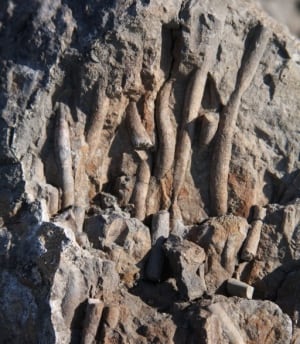
Fossils like these Cretaceous tubeworms show part of the deep-ocean community that fed off the methane leaking from the mud. (submitted by Steve Grasby )
Suddenly, from under the mud, bubbles of methane began to emerge as frozen deposits began to thaw.
The bubbles left traces in the form of over 130 mounds that persist on the island today, complete with fossils of life that formed around the methane seeps.
"There must have been some brief, rapid release into the ocean," explained Steve Grasby, one of the researchers who visited the island between 2009 and 2011.
"Because we don't see them in the older rocks and we don't see them in the younger rocks. So something must have happened in the Earth's history at that time to release a bunch of methane into the sea," he said.
Evidence of ancient climate change
The thawing of the so-called methane hydrates coincides with a period of warming following a volcanic eruption, which released a cloud of carbon dioxide into the atmosphere.
"That was when Earth transitioned from a cold climate to a warm climate," Grasby said.
"So we see this sudden and short term release of methane is coincident with this period of global climate warming."
- 'It scares me': Permafrost thaw in Canadian Arctic sign of a global trend
- Arctic lakes melting earlier and earlier each year, recent 14-year study shows
Today there are still deposits of methane hydrates buried under the sea. There have been concerns that their thawing could cause runaway climate change, since methane is a powerful, though short-lived, greenhouse gas that could further warm the climate, melting ever more hydrates.
A recent review by the United States Geological Survey says "most" of the methane never reaches the atmosphere.
Grasby says his research points to a period in the Earth's geologic history when warming was releasing the gas from its frozen state, but, like today, it's hard to say what happens next.







 Posts
Posts