Blog Archive

Sunday, June 28, 2015

Most Extreme Weather Has Climate Change Link, Study Says

Global warming has created a 'new normal,' scientists say, and the old hesitance to attribute extreme weather to climate change is outdated.

In the wake of major hurricanes, floods and heat waves, scientists are quick to say that no single weather event can be attributed to climate change until careful analysis draws that conclusion. Now, a new study argues that thinking is backwards, that all extreme weather has a link to climate change.

The default position has been holding science back in connecting weather and climate, concludes the authors of a peer-reviewed paper published Monday in Nature Climate Change.

This "could be a game changer in how these studies are done in [the] future," lead author Kevin Trenberth said in an email.

Trenberth is a senior scientist at the National Center for Atmospheric Research (NCAR), and one of three researchers behind the study.

The paper presents a new research technique that grew out of an idea Trenberth first proposed at a conference in 2010. It also provides scientists examples of how to apply the method, and challenges the conclusions of a 2014 paper that found no climate influence in the massive floods that swept Boulder, Colo., in 2013.

Trenberth said his approach is new, and conventional research methods still dominate the field.

Traditionally, researchers begin with a default assumption that the extreme weather event they're examining is not influenced by human-caused climate change. They then run computer models or other tests to see if global warming has increased the intensity or likelihood of that event.

But Trenberth's team says this method can lead to "false negatives" that underestimates the role of climate change. It's particularly problematic when scientists are studying extreme weather driven by atmospheric circulation—factors such as weather patterns and storm patterns—when it's difficult to separate the influence of climate change from natural variability.

Trenberth's paper instead suggests focusing on thermodynamic changes caused by global warming, such as increased sea-surface temperatures, humidity and sea level rise. Unlike atmospheric circulation patterns, scientists have a much better understanding of how climate change affects thermodynamic shifts, said study co-author John Fasullo, a NCAR project scientist.

According to the study, these warming-fueled changes play an important role in increasing the intensity of storms and the impact of storm surges, creating "a new normal" in the underlying conditions that influence all weather events.

"Because global warming is real and present, it is not a question as to whether it is playing a role, but what that role is," the authors wrote.

"We're not even interested in the question of the cause," Fasullo explained. "We're trying to understand the influence climate change will have on extreme weather events."

In fact, Fasullo says, even the term "new normal" can be misleading, because it implies that the climate is no longer changing, when in reality the climate won't stabilize until greenhouse gas concentrations in the atmosphere level off.

Trenberth said he expects pushback from scientists who favor the older methods, but he believes "a sea change is in order with the conservative scientists and we need to stop proving over and over again that climate change is having effects...I hope that it leads to more fruitful studies and better communications with the public."

Higher Seas, Higher Temps

The Earth had droughts and hurricanes long before humans, but we're "changing the way these events unfold," Fasullo said. "So from our point of view, this default assumption of no climate change [influence] is a poor place to start the quantitative analysis. You wouldn't want to assume nothing is changing."

Kerry Emanuel, a professor of atmospheric science at the Massachusetts Institute of Technology who wasn't involved in study, agreed that a lot of evidence now points to conditions changing because of global warming. But, he said, many scientists would prefer to stick with the default assumption that extreme weather events are not influenced by climate change until proven otherwise.

"The real crux of the matter is not fooling yourself" into a false sense of confidence, he said. "Scientists are very guarded about that possibility."

The study gives several examples of how to use the new method. Supertyphoon Haiyan, which hit the Philippines in November 2013, was driven in large part by the natural variability of sea surface temperatures in the Pacific Ocean. But the storm surge was made worse by an increase in local sea levels, which were nearly 12 inches higher than they were in 1993.

Another example is the "snowmageddon" storm that hit Washington, D.C., in February 2010. The intensity of the blizzard—which dropped up to three feet of snow in the mid-Atlantic region—was influenced by high sea-surface temperatures in the tropical Atlantic (2.7 degrees Fahrenheit above normal), which brought large amounts of moisture into the storm.

In a third example, Trenberth's paper disputed the conclusions of a 2014 study published in the Bulletin of the American Meterological Society, which found that the 2013 Boulder floods were caused by an extremely rare concurrence of weather patterns that brought a huge amount of moisture over the region—and climate change played no discernible factor in that setup. But Trenberth's team said the excessive moisture was enabled by unusually high sea-surface temperatures off the coast of Mexico.

'Preparing for the Last Disaster'

Emanuel said Trenberth's new approach isn't wrong, but it's open to misinterpretation because it doesn't consider all aspects of climate change's possible impacts.

For instance, the research method might show that a storm identical to Haiyan would have had a smaller impact if it had hit the Philippines 100 years ago. That information is useful, but it has to be interpreted correctly in a limited context, Emanuel said. "It is a very narrowly posed and narrowly answered question."

Further analysis would be required to answer other related questions, such as, what is the probability that Haiyan would have formed at all under the lower sea-surface temperatures of the past? And is it more or less likely to have followed Haiyan's exact same storm track? Those answers would provide a more complete picture of global warming's impacts, he said.

The study also has implications for disaster planning. If climate change exerts an even bigger influence on extreme weather than previously thought, then it emphasizes how the U.S. is "woefully underprepared in regards to climate adaptation planning," said Melanie Gall, a University of South Carolina professor who studies disaster risk and emergency management.

"All of our current planning is so retrospective," Gall said. "We always prepare for the last disaster" instead of looking at future risks and how conditions will change with global warming, she said.

Many of the states that are most vulnerable to extreme weather—including Texas, Louisiana, Mississippi and Florida—are politically conservative, and don't consider climate change on a state level, she said. "I think what this study shows," she added, "is we need to plan for it, and it needs to be recognized, and not wait until we have the perfect evidence."

http://insideclimatenews.org/news/23062015/most-extreme-weather-has-climate-change-link-study-says-global-warming-trenberth-ncar-sea-levels

Unprecedented ocean temperature rises off the Atlantic and Pacific coasts of the US may be linked to sea level rise or the recent pattern of “weird” weather

by Tim Radford, Climate News NetworkJune 28, 2015

LONDON − Oceanographers are puzzled by an accelerated burst of warming sea that threatens the fisheries of the American Atlantic coast. [The sea-surface temperature anomaly even persisted at 12 
°C for several months, although it is now about 6 °C.]

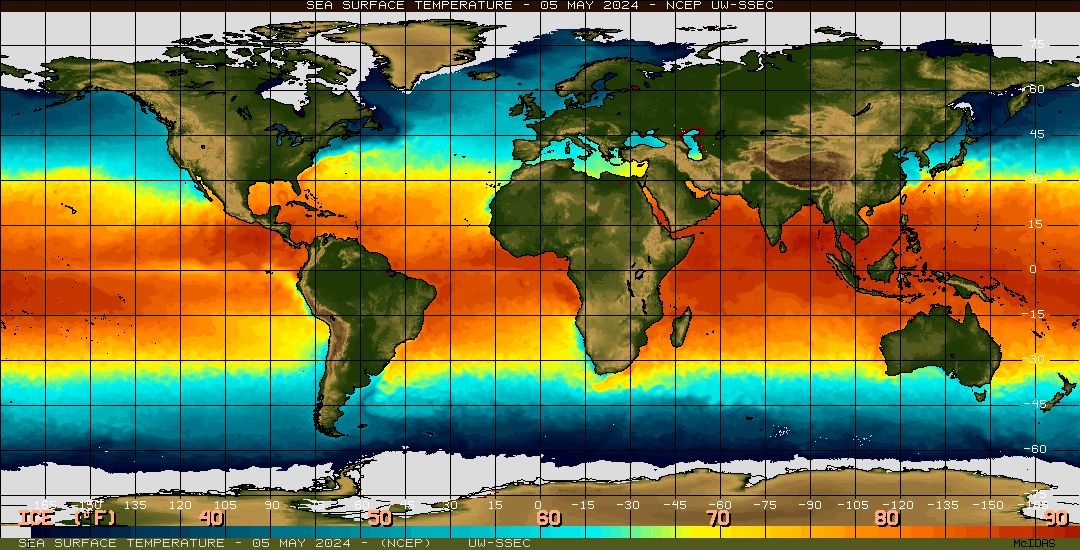
Meanwhile, off the US West coast, scientists report that they have been baffled by a mysterious “blob” of water up to 4 °C warmer than the surrounding Pacific, linked to weird weather across the entire country.

Jacob Forsyth and research colleagues from the Woods Hole Oceanographic Institution (WHOI) in Massachusetts report in the Journal of Geophysical Research: Oceans that the ocean off the US northeast continental shelf has been warming at unprecedented levels for 13 years.

Their findings came after analysis of data from sensors − called bathythermographs − dropped 14 times a year from the container ship Oleander, which for 37 years has travelled between New Jersey and Bermuda. Each detector takes the temperature of the water column as it sinks up to 700 metres.

Startling discovery

What they were startled to discover was an unexplained, and unprecedented, rise in the water temperatures that may be linked with an equally mysterious sea level anomaly: sea levels are going up, but they are going up faster off the northeast coast of the US than almost anywhere else.

“The warming rate since 2002 is 15 times faster than from the previous 100 years,” says Glen Gawarkiewicz, a WHOI senior scientist and one of the authors of the report.

“There’s just been this incredible acceleration to the warming, and we don’t know if it’s decadal variability or if this trend will continue.”

To make sure of their perspective, the authors compared their analysis with surface data from the Nantucket lightship and other such installations along the coast, from 1880 to 2004. The new study shows that the warming is not just confined to surface waters.

Although there must be some link with the steady rise in atmospheric temperatures because of global warming as a result of human-made carbon dioxide emissions, the oceanographers suspect there may also be another explanation, so far undiscovered.

Off the Pacific coast, meteorologists have been scratching their heads over the appearance in 2014 of a “remarkably” warm patch −  1,500 kilometres across in every direction and 100 metres deep − that could be linked to “weird” weather across the continental US that has seen heat and drought in the west and blizzards and chills in the East.

High pressure ridge

Nicholas Bond,  a research meteorologist at the University of Washington in Seattle, and colleagues report in Geophysical Research Letters that what they have called “the blob” was linked to a persistent high pressure ridge, linked in turn to a calmer ocean during the last two Northern Hemisphere winters.

The blob plays a sure role in the West Coast weather. Air sweeping across it picks up heat, and this results in warmer temperatures and lower snowpack in coastal mountains − which certainly stoke up the conditions for drought.

A second study in Geophysical Research Letters links the warm Pacific puzzle to the big freeze in the eastern states in 2013 and 2014.

Once again, there doesn’t seem to be a direct connection with climate change, but it raises the spectre of changes to come.

“This is a taste of what the ocean will be like in future decades,” Dr Bond says. “It wasn’t caused by global warming, but it’s producing conditions that we think are going to be more common with global warming.” 

Friday, June 26, 2015

WaPo: It’s time for conservatives to end the denial on climate change


A boy catches fish in a dried-up pond near the banks of the Ganges river Allahabad, India, June 4, 2015. (Jitendra Prakash/Reuters)

by Michael Gerson, The Washington Post, June 26, 2015

Reducing Pope Francis’s encyclical “Laudato Si” to a white paper on global warming is, in George Weigel’s fitting analogy, “akin to reading ‘Moby Dick’ as if it were a treatise on the 19th-century New England whaling industry.” The whole spirit and story of the thing are missed.
The pope’s sprawling, ambitious statement — setting out a theory of nature and of the human person — will be profitably scrutinized for decades. Environmentalists who like some of Francis’s conclusions will find, if they sit quietly with the text rather than rummage through it for the politically relevant bits, that the pope is making a frontal assault on a technological and utilitarian worldview that treats creation as “raw material to be hammered into useful shape,” reduces humans to mere consumers and treats inconvenient people as so much refuse.
In the pope’s vision, both nature and human nature are gifts to be appreciated and accepted, not despoiled or redefined. And the ultimate demonstration of God’s attitude toward nature is the incarnation, in which the creator — so the remarkable story goes — somehow became a crawling, puking, sleeping, living, dying creature, occupying a biological niche, in a thin layer of air, on a floating, fragile ball.
Francis is offended — infuriated, really — by how humans have treated their home and one another. And he has particularly harsh words for habits of consumption and exploitation in rich countries. The pope is frankly distrustful of global capitalism and the “logic of markets.” It is fair to say that he has a broader understanding of the (very real) flaws of the developed world than he has of the economic conditions that might allow large numbers of poor people to join the developed world. But an uncomfortable relationship with modernity — including classical liberal economics — is hardly new in Catholic social thought.
The pope’s environmental concerns are broad (clean drinking water and biodiversity rank high). But there is no getting around the fact that Francis regards potentially catastrophic, human-caused global warming as a fact. “A very solid scientific consensus indicates that we are presently witnessing a disturbing warming of the climatic system. . . . [a] number of scientific studies indicate that most global warming in recent decades is due to the great concentration of greenhouse gases . . . released mainly as a result of human activity.”
In American politics, the pope’s encyclical has not made legislative action on climate change inevitable, but it has made the issue unavoidable. The politician’s shrug — “I’m no scientist” — is no longer acceptable. If climate change is a global threat, then addressing it, as the pope argues, is both a moral and public requirement.
But the dysfunctional American debate on climate change illustrates a broader challenge. Ten or 15 years ago, this issue was less divisive. But it got pulled into the polarization vortex. And now the two sides do not merely hold different policy views; they have different versions of reality. The camps not only advocate different solutions; they also inhabit different factual universes.
Many conservative Republicans now deny the existence or danger of human-caused warming and routinely question the motives of scientists who speak up on the issue. For a conservative to stray from skepticism is regarded as ideological betrayal.
In a recent National Affairs essay, Jim Manzi and Peter Wehner provide an explanation: “The Republican position — either avowed ignorance or conspiracy theorizing — is ultimately unsustainable, but some still cling to it because they believe that accepting the premise that some climate change is occurring as a result of human action means accepting the conclusions of the most rabid left-wing climate activists. They fear, at least implicitly, that the politics of climate change is just a twisted road with a known destination . . .ceding yet another key economic sector to government control.”
This is the temptation of the ideologically intense on the left and right: Truth exists to serve the narrative rather than the narrative arising from truth. It is a malady easy to see in others and harder to diagnose in ourselves. But it is dangerous to democracy. Without a common factual basis, it is impossible to make incremental progress on public matters. All that remains are shouting matches and power plays.
The pope’s views on climate change are shared by every national academy of science in the world, including our own. But, as Manzi and Wehner demonstrate in their essay, there are distinctly conservative responses to global warming, particularly in promoting energy innovation.
Conservatives can choose their policy reaction but not their own reality.

Extreme Heat Wave Intensifies In The Northwest; May Break June, All-Time Records This Weekend Into Early July

by Jon Erdman, Wunderground, June 26, 2015
 
A torrid heat wave is now shifting into high gear and may shatter June or even all-time records in parts of the Great Basin and Northwest. Furthermore, it is likely to last well into early July.

Heat Alerts
The National Weather Service has issued an excessive heat warning for parts of northwest Oregon and western Washington, including Portland, Salem, Eugene, Vancouver, Seattle, Las Vegas and Death Valley. Heat advisories have also been posted for other parts of the Northwest and Great Basin.
Daily record highs were tied Thursday in Ely, Nevada (95); South Lake Tahoe, California (90); Olympia, Washington (90); and Bellingham, Washington (83).

Current Temperatures
June has already been a hot month in parts of the West.
Earlier in the month, Yakima, Washington, tied its all-time June high of 105 degrees. This occurred 15 days earlier on the calendar than the previous June 105-degree high. Medford, Oregon, is pacing for their hottest June on record, dating to 1911. Portland, Oregon, has already tallied 5 days of 90-degree-plus heat this month through Thursday, just one day shy of the June record set in 2003.
(MORE: Earth's Record Year? | How Hot is Too Hot?)
The culprit in this hot setup is part of an overall pattern shift taking place across the United States.

West Heat Wave Setup
A dome of high pressure aloft that has been searing the Desert Southwest over the past week is surging northwestward, and will become established over the Great Basin by this weekend.
In addition to suppressing thunderstorm development over most of the Great Basin, this will allow the sizzling late-June sun to send temperatures soaring not simply in the typically hot Desert Southwest, but also locations well to the north including the Pacific Northwest, interior Northwest and northern Rockies. 
Highs in the triple digits are expected in many lower-elevation locations west of the Continental Divide and inland from the Pacific Coast.
This includes much of Nevada, California's Central Valley, the Salt Lake Valley, Idaho's Snake River Plain, much of Oregon's lower elevations east of the immediate coast, and areas to the east of the Cascades in Washington State. Valley locations in western Montana such as Kalispell and Missoula will also top the century mark this weekend into early next week.
In particular, parts of the Columbia Basin and lower Snake River Valley may surge above 110 degrees. This includes cities such as Yakima, Kennewick and Walla Walla in Washington as well as Lewiston, Idaho.
(FORECASTS: Seattle | Portland | Boise | Salt Lake City)
The extreme heat is even expected to surge north into Canada. Even Revelstoke, British Columbia – 130 miles north of the U.S. border and better known for skiing – could touch 100 degrees (38 degrees Celsius) this weekend. Environment Canada says parts of southern British Columbia could reach 40 degrees Celsius - 104 degrees Fahrenheit - this weekend, which may not only top daily records, but also set June records, as well.

Forecast Highs
Compared to what the more arid Great Basin is used to, evening and overnight temperatures will be slow to drop, bottoming out in the 70s in the hottest locations. 
This heat appears to be locked in place well into next week, as the upper-level dome of high pressure remains camped out near the Great Basin.
(MAPS: 10-Day Temperature Forecasts)
The hot, dry weather will also produce high fire danger, as drought conditions have worsened over the Northwest and northern Rockies in the spring. Disturbances riding around the west side of the upper-level ridge and just enough mid-level moisture may trigger isolated, mainly dry afternoon thunderstorms, which may ignite new wildfires. 
(MORE: Western Wildfires Latest News)
In mid-May, Washington Gov. Jay Inslee issued a statewide drought emergency, and spring runoff from winter's paltry snowpack was expected to be the least in 64 years. 
Seattle has seen only 7 days with measurable rain since May 1, one-third the average number of such days, according to NWS-Seattle. Portland, Oregon, set a new record June dry streak of 22 straight days through Thursday, according to NWS-Portland. 

Monthly, All-Time Records Threatened?

This heat wave may not only top daily record highs, but may also threaten record highs for the entire month of June, or, in a few locations, all-time record highs.
Here are some locations that may flirt with – we're defining that as within 3 degrees – either their June or all-time record highs. Click on the city link for the latest 10-day forecast.
  • Yakima, Washington: All-time record is 111 degrees on July 26, 1928
  • Spokane, Washington: All-time record is 108 degrees on July 26, 1928 and Aug. 4, 1961
  • Boise, Idaho: All-time record is 111 degrees on July 19, 1960 and July 12, 1898
  • Salt Lake City: June record is 105 degrees on June 28-29, 2013
  • Kennewick, Washington: June record high is 110 degrees on June 7, 1912
  • Portland, Oregon: June record high is 102 degrees on June 26, 2006
  • Pendleton, Oregon: June record high is 108 degrees on June 30, 1924, and June 17, 1961
  • Reno, Nevada: June record is 104 degrees on June 16, 1940
  • Kalispell, Montana: All-time record high is 105 degrees on Aug. 4, 1961. 
  • Missoula, Montana: June record high is 100 degrees on Jun. 29, 1937 and Jun. 13, 1918. 
One of the biggest factors in heat wave deaths is not only the magnitude, but also the longevity of the heat. 
  • Seattle may see highs reach at least the low 90s for several days, starting this weekend. On average, they typically see the 90-degree mark only three days a year.
  • Spokane, Washington may see a couple of days with century-mark highs. Only one such day a year is the average, there. Even when not in the 100s it will be at least in the middle or upper 90s.
  • Portland, Oregon last saw triple-digit heat in August 2012. They may see at least one, if not more in this heat wave. The city may also make a run at its longest streak of 90-degree days; that was a 10-day streak in 2009.
  • Pendleton, Oregon may threaten its all-time record of eight consecutive 100-degree days set in five previous years, most recently in 1967.
  • Medford, Oregon may tie its record number of June triple-digit days (6 days in 1987, 1970 and 1926) and will likely tie its June record for 90-degree-plus days (21 in 1918).
  • Salt Lake City may see triple-digit highs several days in a row from the weekend into next week. Six days a year reach 100-degrees or hotter in the Salt Lake Valley, on average.
  • Kalispell, Montana may see two or three days in a row of triple-digit heat beginning this weekend. In records dating to 1899, they've only seen 12 such days, only two of which have occurred this century. They have never recorded a triple-digit high in June.
This is a dangerous heat wave. Take safety precautions against the heat.
Those playing or working outdoors, as well as those without access to air conditioning, will face an elevated risk of heat-related illness.
Remember to never leave kids or pets unattended in cars and drink more water than usual. Wear light-colored clothing and keep your head and body cooler with a hat. Take frequent rest breaks in shaded or air-conditioned environments.
Senior meteorologist Nick Wiltgen contributed to this report.

Monday, June 22, 2015

Cardinal Donald Wuerl speaks so beautifully, Chris Wallace of Fox News has nowhere to go

from Peter Sinclair's "This Is Not Cool," June 22, 2015


Cardinal Donald Wuerl came on Fox News Sunday show, yesterday, and showed how its done.
At 4:10, deftly and with a kindly clerical smile, he bodyslams Rush Limbaugh.

During the rest of the interview he handles Chris Wallace’s predictable talking points as smoothly as a ninja sushi chef.

More Please.

UPDATE:
On the first Sunday after Pope Francis issued a landmark document on the environment, Roman Catholics attending Mass in Kenya, France, MexicoPeru and the United States said they were thankful that he was using his pulpit to address climate change, pollution and global inequality. 
But few priests or bishops — other than in parts of Latin America — used their own pulpits on Sunday to pass on the pope’s message, according to parish visits, interviews with Catholic leaders and reports from Catholics after Mass. Despite the urgent call to action in Francis’ document and the international attention it received, it will take some time to know whether Catholic clergy are familiar or comfortable enough with its themes to preach them to the faithful. 
It traditionally takes months for papal teaching documents, known as encyclicals, to be read, understood and disseminated. And this one, “Laudato Si’,” or “Praise Be to You: On Care for Our Common Home,” is long, nearly 200 pages, and intricately weaves spiritual and moral teachings with economic, scientific and political analysis. It includes a forceful denunciation of a global economic system that the pope says plunders the resources of the poor for the benefit of the rich, leaving the poor to disproportionately suffer the consequences, including the effects of climate change.
http://climatecrocks.com/2015/06/21/cardinal-baffles-fox-host-with-calm-defense-of-pope/

New study links global warming to Hurricane Sandy and other extreme weather events

by John Abraham, "Climate Consensus - The 97%," The Guardian, June 22, 2015

Escalators to the South Ferry Whitehall St. subway station in the financial district of Manhattan are shown flooded in the aftermath of Hurricane Sandy.  A new study finds that without human-caused global warming, the New York subways might not have been flooded.
Escalators to the South Ferry Whitehall St. subway station in the financial district of Manhattan are shown flooded in the aftermath of Hurricane Sandy. A new study finds that without human-caused global warming, the New York subways might not have been flooded. Photograph: HANDOUT/Reuters
One of the hottest areas of climate research these days is on the potential connections between human emissions, global warming, and extreme weather. Will global warming make extreme weather more common or less common? More severe or less severe? 
New research, just published today in Nature Climate Change helps to answer that question by approaching the problem in a novel way. In short yes, human emissions of greenhouse gases have made certain particular weather events more severe. Let’s investigate how they arrived at this conclusion.
Lead author Kevin Trenberth and his team recognized that there are two potential ways a warming climate may lead to weather changes. The first way is through something called thermodynamics. We experience thermodynamics in our own lives. Warm air can be more humid than cold air; we feel that difference throughout the year. Also, warm air evaporates water more quickly. That’s why hair blow dryers and restroom hand dryers usually use heated air. It’s why puddles evaporate more quickly on hot days. 
In short, the atmosphere can become either warmer and wetter or warmer and dryer, depending on where you are. The general rule of thumb is that areas which are currently dry will become drier; areas that are currently wet will become wetter; and rains will occur in heavier downbursts.
Dr. Kevin Trenberth.
 Dr. Kevin Trenberth. Photograph: National Center for Atmospheric Research
The scientists list the following questions as a guide to their study. 
1. Given a particular weather pattern, how were the temperatures, precipitation, and associated impacts influenced by climate change?
2. Given a drought, how was the drying enhanced by climate change and how did that influence the moisture deficits and dryness of the soils, leading to a more intense and long-lasting drought?
3. Given a flood, where did the moisture come from? Was it increased by warmer ocean waters?
4. Given a heat wave, how was that influenced by drought, changes in precipitation, and extra heat from global warming?
5. Given extreme snow, where did the moisture come from? Was it related to oceans that are warmer?
6. Given an extreme storm, how was it influenced by sea temperatures, ocean heat content, unusual moisture transports?
7. Was a storm surge worse because of higher sea levels?
In other words, the authors take for granted that an event has occurred and they ask, how did climate change affect its impact?
The authors use a few well-known cases studies. “Snowmaggedon,” which occurred in Washington, DC, in 2010; Superstorm Sandy; Supertyphoon Haiyan; and the flooding in Boulder, Colorado. They found that for Snowmaggedon and Sandy, unusually warm waters made those events worse. In addition, for Sandy, the human-caused sea level rise added to the storm surge. They report,
It is possible that subways and tunnels may not have been flooded without the warming-induced increases in sea level and storm intensity and size. Putting the potential price tag of human climate change on this storm in the tens of billions of dollars.
For Supertyphoon Haiyan which ravaged the Philippines in November 2013, the increased sea temperatures and ocean heating along its path increased its strength and this made the impacts worse. For the Colorado floods, the authors found that ocean temperatures off the coast of Mexico were very high. This was where much of the water entered the atmosphere before subsequently falling in Colorado. According to the authors,
the extremely high sea surface temperatures and record water vapor amounts that accompanied the event … probably would not have occurred without climate change
Later, the authors make reference to the 2010 Russian heat wave and the current drought in California. This new study reconciles past conflicting studies where very little evidence of a climate link was found of general circulation changes, but evidence is clear of in the thermodynamics.
Without getting too deep in the weeds, the authors also explain why other teams have failed to make a connection between extreme weather and a warming planet. In some cases, they have asked the wrong questions. In other cases, they have used tools that were too crude. For instance, calculations performed in 2014 by another team relied upon climate models that did not have sufficient resolution. 
In summary, human warming affects weather in two ways. It changes the odds that any given extreme event will occur. But more importantly it makes the events more severe. I’ll leave you with the final paragraph from the paper which summarizes this as well as I could.
The climate is changing: we have a new normal. The environment in which all weather events occur is not what it used to be. All storms, without exception, are different. Even if most of them look just like the ones we used to have, they are not the same.
http://www.theguardian.com/environment/climate-consensus-97-per-cent/2015/jun/22/new-study-links-global-warming-to-hurricane-sandy-and-other-extreme-weather-events 

Kevin Trenberth: Human influence on extreme climate events is greater than conventional analyses suggest

News Release Summary for Trenberth et al. Nature Climate Change paper.

Human-caused climate change is making many weather and climate extremes more frequent and/or intense.

The conventional approach to extreme event attribution tends to underestimate the human influence. A new paper “Attribution of climate extreme events” by Kevin Trenberth and colleagues in Nature Climate Change suggests that addressing this problem lies, in part, in separating atmospheric dynamics from thermodynamics.

Atmospheric dynamics deals with the phenomena and their development and movement; they are short-lived and inherently unpredictable. Indeed, extreme weather events are by their nature always unique. On the other hand, thermodynamics involves changes in temperature and temperature extremes, and the associated changes in atmospheric moisture vapor that lead to more intense rains and flood risks, as well as droughts in which the extra heat from increased greenhouse gases accumulates. For these larger thermodynamic influences, more reliable and useful statements can be made about the role of human-caused climate change in extreme events.

Thus, a more robust and societally relevant approach to extreme event attribution is to look at how the impacts of particular events were affected by observed changes in the environment where they develop: the air and sea surface temperature, sea level, and atmospheric moisture content.

The paper notes that sea-surface temperatures have increased by about 0.6 °C or 1 °F globally since the 1950s due to human-caused warming. Atmospheric moisture associated with this increase has risen by about 5%. Global sea level has risen by about 19 cm or 7.5 inches, with regional variations. These factors play a key role in feeding moisture into storms, intensifying them, causing heavy rains, and amplifying storm surges. Among the several examples discussed in the paper are these two:

In October 2012’s Superstorm Sandy, for example, high sea-surface temperatures were responsible for greatly increasing the storm’s strength (as measured by storm depth and wind speed) and for increasing precipitation by 35%. Even if just a third or a half of the increased sea-surface temperature is attributable to human-caused warming, then the storm surge and associated damage was considerably influenced by climate change. Indeed, the subways and tunnels might not have flooded without the warming-induced increases in sea level and storm intensity and size, putting the price tag of human-caused warming on this storm in the tens of billion of dollars.

In the Boulder floods of September 2013, extremely high sea-surface temperatures off the west coast of Mexico, and the associated record atmospheric water vapor amounts that flowed into Colorado as a result, were instrumental in the event, and it probably would not have occurred without human-caused warming. Such an increase in atmospheric water vapor becomes concentrated when focused by topography, as it did in Boulder, and further amplified on the ground as water drains into channels and rivers. This suggests an important role for human-caused warming in those Boulder floods.

In summary, the paper emphasizes that the climate is changing. We have a new normal. The environment in which all weather events occur is not what it used to be: all storms, without exception, are different. Even if they look like ones we used to have, they are not the same. The most useful way to evaluate the effects of human-caused warming on extreme events is to focus on the influences of the changed large-scale thermodynamic environment on the extremes of temperatures and moisture associated with the event.