Blog Archive

Friday, September 27, 2013

Lee Camp and Chris Hedges on NSA spying, inverted totalitarianism, and how to fight back

NBC: Michael Mann discusses the new IPCC report and professional climate change deniers

http://www.nbcnews.com/id/49263362#53124281

David Suzuki: Attacks on climate change science hinder solutions

Photo: Attacks on climate change science hinder solutions
Resolving the problem of climate change will cost, but it will be much more expensive to follow the defeatist advice of industry shills, whose greed and lack of care for humanity will condemn our children and grandchildren to an uncertain future.
By David Suzuki with contributions from contributions from David Suzuki Foundation Communications Manager Ian Hanington.

Alberta oil
                                                  sands
Starting in late September, the Intergovernmental Panel on Climate Change will release its Fifth Assessment Report in three chapters and a summary. Not to be outdone, contrarians [i.e., paid fossil-fuel deniers]have unleashed a barrage of attacks designed to discredit the science before it's released. Expect more to come.

Many news outlets are complicit in efforts to undermine the scientific evidence. Contrarian [i.e., paid fossil-fuel deniers] opinion articles have run in publications in Canada and around the world, from the Financial Post and Washington Post to The Australian and the U.K.'s Mail on Sunday.

In The Guardian, scientists Dana Nuccitelli and John Abraham point out that attacks cover five stages of climate denial: deny the problem exists, deny we're the cause, deny it's a problem, deny we can solve it and claim it's too late to do anything.

One attack that's grabbing media attention is the so-called Nongovernmental International Panel on Climate Change's report "Climate Change Reconsidered II: Physical Science." It's written by Fred Singer, a well-known tobacco industry apologist and climate change denier, with Bob Carter and Craig Idso, also known for their dismissals of legitimate climate change science, and published by the Heartland Institute, a U.S. non-profit known for defending tobacco and fossil fuel industry interests. Heartland made headlines last year for comparing people who accept the overwhelming scientific evidence for human-caused climate change with terrorists and criminals such as Unabomber Theodore Kaczynski!

Read Singer's report if you want. But it's full of long-discredited claims, including that carbon dioxide emissions are good because they stimulate life. It's not the goal of deniers and contrarians to contribute to our understanding of climate change; they want to promote fossil fuel companies and other industrial interests, a point explicitly stated in the Heartland-NIPCC news release.

It claims the Singer report, which isn't peer-reviewed, provides governments with "the scientific evidence they need to justify ending the expansion of ineffective alternative energy sources and other expensive and futile strategies to control climate. Then they can focus on supporting our most powerful energy sources - coal, oil, natural gas, nuclear, and hydro-power - in order to end the scourge of energy poverty that afflicts over one billion people across the world."

In other words, don't worry about climate change, let alone health-damaging pollution or the fact that fossil fuels will become increasingly difficult to extract and eventually run out altogether. And even though mountains of solid evidence from around the world show climate change is and will continue to be most devastating for the world's poorest people, the report feigns concern for those suffering from "energy poverty."

Overall, the attacks on legitimate climate science are coming from people whose arguments have been debunked many times and who often have ties to the fossil fuel industry. Some, including Roy Spencer and Ross McKitrick, have signed the Cornwall Declaration, which states: "We believe Earth and its ecosystems - created by God's intelligent design and infinite power and sustained by His faithful providence - are robust, resilient, self-regulating, and self-correcting, admirably suited for human flourishing, and displaying His glory. Earth's climate system is no exception."

The declaration also states that "There is no convincing scientific evidence that human contribution to greenhouse gases is causing dangerous global warming" and that renewable energy should not be used to replace fossil fuels. Their world view can't accept the reality of climate change or its solutions no matter how much evidence is provided - something that offends many people of faith who believe we have a responsibility to care for the Earth.

The IPCC report, on the other hand, is a review of all the available science on climate change, conducted by hundreds of experts from around the world. It confirms climate change is happening, burning fossil fuels is a major cause and it will get worse if we fail to act. It also examines what appears to be a slight slowing of global warming - but certainly not a halt, as deniers claim - and offers scientific explanations for it. Upcoming chapters will also propose solutions.

Resolving the problem of climate change will cost, but it will be much more expensive to follow the defeatist advice of industry shills, whose greed and lack of care for humanity will condemn our children and grandchildren to an uncertain future.


Real Climate: the new IPCC report

RealClimate, September 27, 2013

The time has come: the new IPCC report is here! After several years of work by over 800 scientists from around the world, and after days of extensive discussion at the IPCC plenary meeting in Stockholm, the Summary for Policymakers was formally adopted at 5 o’clock this morning. Congratulations to all the colleagues who were there and worked night shifts. The full text of the report will be available online beginning of next week. RealClimate summarizes the key findings and shows the most interesting graphs.

Global warming
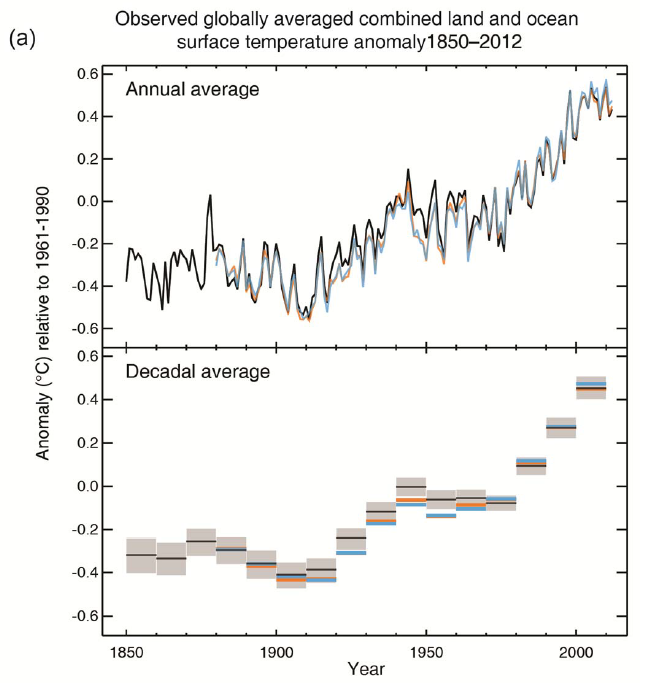
It is now considered even more certain (> 95%) that human influence has been the dominant cause of the observed warming since the mid-20th century. Natural internal variability and natural external forcings (eg the sun) have contributed virtually nothing to the warming since 1950 – the share of these factors was narrowed down by IPCC to ± 0.1 degrees. The measured temperature evolution is shown in the following graph.

Figure 1. The measured global temperature curve from several data sets. Top: annual values. ​​Bottom: averaged values ​​over a decade.

Those who have these data before their eyes can recognise immediately how misguided the big media attention for the “wiggles” of the curves towards the end has been. Short-term variations like this have always existed, and they always will. These are mostly random, they are (at least so far) not predictable, and the IPCC has never claimed to be able to make predictions for short periods of 10-15 years, precisely because these are dominated by such natural variations.

The last 30 years were probably the warmest since at least 1,400 years. This is a result from improved proxy data. In the 3rd IPCC report this could only be said about the last thousand years, in the 4th about the last 1,300 years.

The future warming by 2100 – with comparable emission scenarios – is about the same as in the previous report. For the highest scenario, the best-estimate warming by 2100 is still 4 °C (see the following chart).

Figure 2. The future temperature development in the highest emissions scenario (red) and in a scenario with successful climate mitigation (blue) – the “4-degree world” and the “2-degree world.”

What is new is that IPCC has also studied climate mitigation scenarios. The blue RCP2.6 is such a scenario with strong emissions reduction. With this scenario global warming can be stopped below 2 °C.

A large part of the warming will be irreversible: from the point where emissions have dropped to zero, global temperature will remain almost constant for centuries at the elevated level reached by that time. (This is why the climate problem in my opinion is a classic case for the precautionary principle.)

Sea-level rise
Sea levels are rising faster now than in the previous two millennia, and the rise will continue to accelerate – regardless of the emissions scenario, even with strong climate mitigation. (This is due to the inertia in the system.) The new IPCC scenarios to 2100 are shown the following graph.

Figure 3. Rise of the global sea level until the year 2100, depending on the emissions scenario.
This is perhaps the biggest change over the 4th IPCC report: a much more rapid sea-level rise is now projected (28–97 cm by 2100). This is more than 50% higher than the old projections (1859 cm) when comparing the same emission scenarios and time periods.

With unabated emissions (and not only for the highest scenario), the IPCC estimates that by the year 2300 global sea levels will rise by 13 meters.

Already, there are likely more frequent storm surges as a result of sea level rise, and for the future this becomes very likely.

Land and sea ice
Over the last two decades, the Greenland and Antarctic ice sheets have been losing mass, glaciers have continued to shrink almost worldwide, and Arctic sea ice and Northern Hemisphere spring snow cover have continued to decrease in extent.

The Greenland ice sheet is less stable than expected in the last report. In the Eemian (the last interglacial period 120,000 years ago, when the global temperature was higher by 1–2 °C) global sea level was 5–10 meters higher than today (in the 4th IPCC report this was thought to be just 46 meters). Due to better data very ​​high confidence is assigned to this. Since a total loss of the Greenland ice sheet corresponds to a 7-meter rise in sea level, this may indicate ice loss from Antarctica in the Eemian.

In the new IPCC report the critical temperature limit at which a total loss of the Greenland ice sheet will occur is estimated as 1–4 °C of warming above preindustrial temperature. In the previous report that was still 1.94.6 °C – and that was one of the reasons why international climate policy has agreed to limit global warming to below 2 degrees.

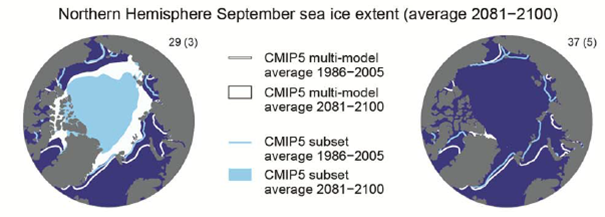
With unabated emissions (RCP8.5) the Arctic Ocean will likely become virtually ice-free in summer before the middle of the century (see figure). In the last report, this was not expected until near the end of the century.


Figure 4. The ice cover on the Arctic Ocean in the 2-degree world (left) and the 4-degree world (right).

Rainfall
The IPCC expects that dry areas become drier due to global warming, and moist areas even wetter. Extreme rainfall has likely already been increasing in North America and Europe (elsewhere the data are not so good). Future extreme precipitation events are very likely to become more intense and more frequent over most land areas of the humid tropics and mid-latitudes.

Oceans
At high emissions (red scenario above), the IPCC expects a weakening of the Atlantic Ocean circulation (commonly known as the Gulf Stream system) by 12% to 54% by the end of the century.
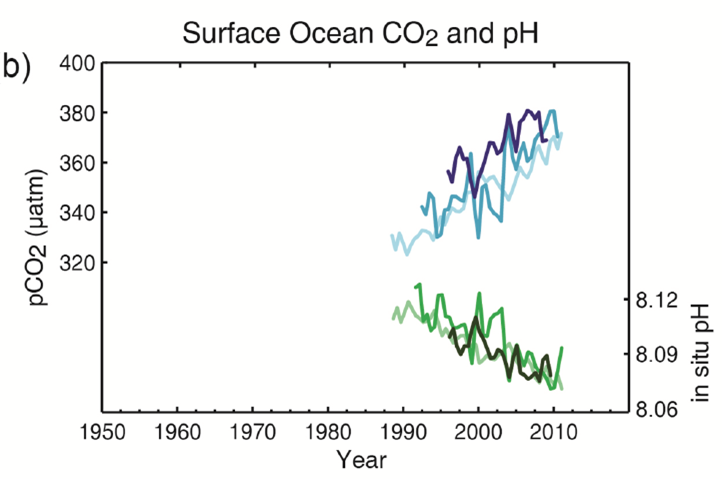
Last but not least, our CO2 emissions not only cause climate change, but also an increase in the CO2 concentration in sea water, and the oceans acidify due to the carbonic acid that forms. This is shown by the measured data in the graph below.

Figure 5. Measured CO2 concentration and pH in seawater. Low pH means higher acidity.

Conclusion
The new IPCC report gives no reason for complacency – even if politically motivated “climate skeptics” have tried to give this impression ahead of its release with frantic PR activities. Many wrong things have been written which now collapse in the light of the actual report.

The opposite is true. Many developments are now considered to be more urgent than in the fourth IPCC report, released in 2007. That the IPCC often needs to correct itself “upward” is an illustration of the fact that it tends to produce very cautious and conservative statements, due to its consensus structure – the IPCC statements form a kind of lowest common denominator on which many researchers can agree. The New York Times has given some examples for the IPCC “bending over backward to be scientifically conservative.” Despite or perhaps even because of this conservatism, IPCC reports are extremely valuable – as long as one is aware of it.

Further Commentary:

2 °C or not 2 °C: Insights from the latest IPCC Climate Report

2 °C or Not 2 °C: Insights from the Latest IPCC Climate Report
In his “To Be or Not to Be” soliloquy, Shakespeare’s Hamlet eloquently presents each of us with an opportunity to wrestle with the timeless question of how to respond to the slings and arrows of life’s outrageous fortunes.
With today’s release of the Summary for Policymakers of Working Group I:  The Physical Science Basis, the Intergovernmental Panel on Climate Change’s (IPCC) Fifth Assessment Report (AR5) presents us with a very different opportunity to wrestle with our collective response to the slings and arrows of unabated carbon emissions on our warming planet. To be sure, the formal language of the IPCC is far less eloquent than Shakespeare’s, but the authoritative and cautiously-written climate science synthesis provokes us to confront profoundly important questions – questions that are hugely time-sensitive, not timeless.
Much media attention in the lead-up to the release has focused on questions over the pace of warming during the past decade. But the most fundamental questions that the IPCC can inform and motivate us to address are not about current changes, driven largely by past emissions – they are about how the emissions choices we make today and in the near future will affect the scale of warming and climate disruption that our generation imposes on generations to come.
Subscribe to the series RSS feed.
Most often, the question gets framed as “will we stay below 2 °C?”, that is, will we reduce emissions swiftly enough to keep global average surface temperatures from rising to 2 degrees Celsius (3.6 degrees Fahrenheit) above pre-industrial levels? Signing the Copenhagen Accord in 2009, world leaders agreed to keep temperature increases resulting from heat-trapping emissions to less than 2 °C, a target aimed at limiting dangerously disruptive climate impacts. A policy target informed by science, “2 °C” is the formally codified benchmark, the line in the sand by which nations have agreed to measure our collective success in providing  generations to come with a secure climate future.
The IPCC’s Summary for Policy Makers (SPM) tells us that global average surface temperatures have risen about 0.85 °C since 1900. It concludes that “cumulative emissions of CO2 largely determine global mean surface warming by the late 21st century and beyond” – in other words, the principal driver of long-term warming is total emissions of CO2. And it finds that having a greater than 66% probability of keeping warming caused by CO2 emissions alone to below 2 °C requires limiting total further emissions to between 370540 Gigatons of carbon (GtC).
At current rates of CO2 emissions (about 9.5 GtC per year), we will hurtle past the 2 °C carbon budget in less than 50 years. And this conservatively assumes that emissions rates don’t continue on their current upward trajectory of ~3% per year.
Future temperature change is projected comparing results of multiple global climate models using four “Representative Concentration Pathways (RCPs)” – standardized scenarios of possible future concentrations of heat-trapping gases, aerosols, and other human drivers of climate change.
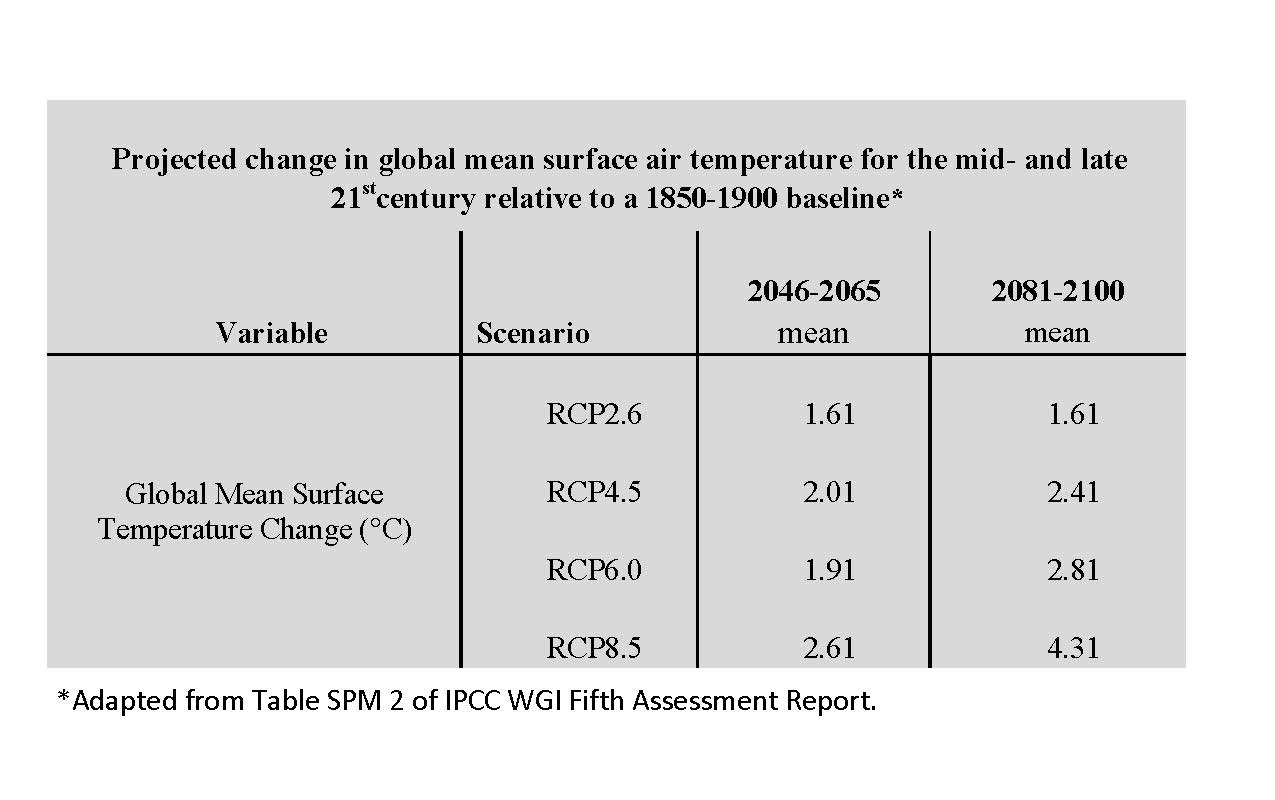
The SPM draws modest direct attention to some of the IPCC’s findings most relevant to the 2 °C policy target. Table SPM2, for example, projects temperature changes to the end of this century (20812100) relative to a 19862005 baseline, rather than to the pre-industrial baseline upon which the 2 °C target rests. But one can draw upon the information within the table’s footnote, which quantifies mean projected warming between 18501900 and 19862005 as 0.61 °C to assess warming relative to pre-industrial levels more directly. More in-depth information will be forthcoming in Chapter 12 of the full report, due out next week.
IPCC latest report projected changes
Global carbon dioxide emissions are currently tracking above the highest concentration pathway (RCP8.5), a pathway that the IPCC projects will bring global average surface temperatures well above 2 °C by mid-century and above 4 °C by 2100. Only projections following the lowest concentration pathway (RCP2.6) result in a mean increase in global average temperatures below 2 °C.
There are uncertainties around these temperature projections, of course. The SPM concludes that “global surface temperature change for the end of the 21st century is likely to exceed 2 °C for RCP6.0 and RCP8.5 and more likely than not to exceed 2 °C for RCP 4.5.” And, importantly “warming will continue beyond 2100 under all RCP scenarios except RCP 2.6.”
Can we transition swiftly to a pathway akin to RCP 2.6?  Doing so would require global carbon dioxide emissions reductions of 50% below 1990 levels by 2050 and may well require sustained globally net negative COemissions, i.e., net removal of CO2 from the atmosphere in the second half of this century. Some have proposed that this might be achieved by both dramatically reducing carbon emissions, and coupling large-scale expansion of bioenergy with carbon capture and storage (CCS).
Beneath its cautious prose, the IPCC report firmly highlights the urgency of our challenge. The science itself does not prescribe specific actions. And the IPCC steers clear of assessing the relative likelihood that political will and policy choices will lead us to follow more closely along one concentration pathway or another. And yet – the IPCC report’s findings make clear that with each passing year of continued high emissions, the prospect of keeping temperatures from rising less than 2 °C through emissions reductions alone will become ever more vanishingly small. They challenge us to both redouble efforts to aggressively reduce emissions and to begin the hard work of preparing now to manage the risks of a world that may warm well in excess of 2 °C within this century.
Look for more insights from the IPCC Working Group II report (Impacts, Adaptation and Vulnerability) due out next March and the Working Group III report (Mitigation) slated for release in April.
About the author: Peter Frumhoff is a global change ecologist and serves as chief scientist for the UCS climate campaign. Dr. Frumhoff is an internationally-recognized expert on climate change impacts, climate science and policy, tropical forest conservation and management, and biological diversity. He holds a Ph.D. in Ecology. Subscribe to Peter's posts
Support from UCS members make work like this possible. Will you join us? Help UCS advance independent science for a healthy environment and a safer world.

Gwynne Dyer: No time to be trigger happy on climate

Wind turbines used to generate electricity are seen at a wind farm in Guazhou, 950km (590 miles) northwest of Lanzhou, Gansu Province September 15, 2013. (REUTERS/Carlos Barria)

by Gwynne Dyer, special to QMI Agency, Fort Murray Today, September 25, 2013

American campaign strategist James Carville coined the phrase “It’s the economy, stupid” to focus the attention of campaign workers on the one key issue that could get Bill Clinton elected president in the 1992 U.S. election.
Alas, the authors of the Fifth Assessment of the Intergovernmental Panel on Climate Change (IPCC), out Friday, have no such sage to guide them. They’ll have to make do with me.
The 800-odd authors of the report are all scientists. They are selected by their fellow scientists in the various disciplines relevant to climate change, and they are doing this work at the behest of the world’s governments, not as an outside pressure group. It is, after all, the Intergovernmental Panel on Climate Change.
But scientists are very cautious people. They won’t go one millimetre beyond what the evidence makes indisputable, knowing that they will be attacked by rival scientists if they do. They are much more comfortable talking about probabilities rather than certainties. They are, in other words, a nightmare for journalists who have to transmit their findings to the world.
Of the nearly 100 scientists I have interviewed on climate change during the past five years, not one doubted that global warming is a big and frightening problem. Indeed, there was often an undercurrent of panic in their remarks. But when it comes to writing official reports, they retreat into science-speak.
So the Second Assessment of the IPCC, published in 1995, said that it was more than 50% likely that human emissions of greenhouse gases were contributing to global warming. The Third Assessment, in 2001, raised the likelihood to 66%. The Fourth, in 2007, upped the ante to 90%, and the Fifth, this week, says 95%.
But how do you make a headline out of that? How much warming? How fast? And with what effects on human beings? The latest report runs to thousands of pages, and the answers are buried among the statistics.
What would Jim Carville do? He’d say: It’s the feedbacks, stupid.
Without the feedbacks, we could go on burning fossil fuels and cutting down the forests, and the average global temperature would creep up gradually, but so slowly that most inhabited parts of the planet would stay liveable for a long time.
But if we trigger the feedbacks, the whole thing goes runaway.
The feedbacks are natural sources of warming that we activate by raising the average global temperature just one or two Celsius degrees. There are three main ones.
As the highly reflective ice and snow that covers most of the polar regions melts, the rate at which the sun’s heat is absorbed goes up steeply over a large part of the planet. We are creating a new warming engine that we can’t turn off.
The polar warming melts the frozen ground and coastal seabed (permafrost) in the Arctic, which then release massive quantities of methane that causes further warming.
And the oceans, as they warm, release some of the vast quantities of carbon dioxide they absorbed in the past, simply because warmer water can contain less dissolved gas.
Those are the killer feedbacks. At least five times in the past 500 million years, the planet has lurched suddenly into a climate five to six Celsius degrees higher than now, and in every case these feedbacks are the prime suspects.
We don’t need to build the gun that kills us. We just have to pull the trigger. And we are playing with the trigger now.
— Gwynne Dyer is an independent journalist whose articles are published in 45 countries.

Widespread Use of Neonicotinoids Poses Risks to More Than Bees

Xerces Society, EcoWatch, September 26, 2013
Screen Shot 2013-09-26 at 11.38.48 AMreport released this week by the Xerces Society for Invertebrate Conservation moves the spotlight from the risks neonicotinoids pose to bees to the impacts of neonicotinoids to invertebrates such as earthworms or lady beetles.
Beyond the Birds and the Bees provides a comprehensive review of published articles and pulls together the growing body of research that demonstrates risks from neonicotinoids to these beneficial insects. These risks occur particularly in agricultural systems, but are also found in urban and suburban ornamental landscapes.
Findings from the Review:
  • Although neonicotinoids have been promoted as safer for beneficial insects than older insecticides, the balance of evidence suggests that neonicotinoids are generally harmful to a variety of beneficial insects.
  • Widespread preemptive application of neonicotinoids (or any pesticide) represents a fundamental shift away from Integrated Pest Management, since chemicals are frequently applied before pest damage has occurred, and often in the absence of any current pest abundance data.
  • Use of neonicotinoid seed treatments on annual field crops has increased dramatically in the last decade yet these treatments may not consistently result in yield benefits and can be less cost effective than other control measures.
  • Though neonicotinoid seed treatments may be unnecessary or more expensive than other treatments in some circumstances, it is very challenging for farmers to obtain non-organic field crop seed that is not treated with neonicotinoids.
  • Neonicotinoid resistance has been documented in a number of pests, including green peach aphid, whitefly, and Colorado potato beetle. The environmental persistence of neonicotinoids such as imidacloprid and clothianidin, coupled with their widespread use, can facilitate pest resistance.
  • Although there has been less research on the impact of neonicotinoids to soil organisms, most studies to date have found that neonicotinoids may have negative effects on earthworms and other soil invertebrates.
Although less charismatic than bees, beneficial insects such as beetles and wasps play critical roles in healthy, functioning ecosystems. For example, predatory and parasitic insects and other arthropods provide natural pest suppression to farms—an ecosystem service conservatively valued at more than $4.5 billion annually—as well as to natural areas and developed landscapes.
Screen Shot 2013-09-26 at 11.39.53 AM
Imidacloprid (in neoniconoids class) use on farms. Darker color indicates greater quantity used per square mile.
Neonicotinoids are now the most widely used group of insecticides in the world, and their use in the U.S. has been steadily increasing since their initial registration in the mid-1990s. Neonicotinoids have been promoted as low-risk chemicals: low impact on human health, low toxicity to nontarget organisms, lower application rates and compatibility with Integrated Pest Management. Unfortunately, the many studies completed since these compounds began being used have not born out the validity of these assumptions.
Based on the Findings, Xerces Society’s Recommendations:
  • The U.S. Environmental Protection Agency (EPA) should re-assess the ecological safety of currently approved neonicotinoids and immediately suspend registration of imidacloprid, clothianidin, thiamethoxam and dinotefuran for all applications where there is a risk to nontarget organisms.
  • The U.S. EPA should significantly speed up the registration review process for neonicotinoids. The risk from exposure to neonicotinoid insecticides needs to be scientifically evaluated against the risk posed to beneficial species by alternative control measures.
  • The U.S. EPA should expand the number of nontarget terrestrial insect species used in the risk assessment process.
  • The U.S. EPA should adopt risk assessment protocols for exposure to nontarget insects that account for cumulative and synergistic effects, effects of long-term exposure to low concentrations, and exposure to pesticides through pollen and nectar.
  • The USDA Risk Management Agency’s Federal Crop Insurance Corporation should approve reductions in crop insurance premiums for producers who avoid prophylactic use of neonicotinoids where the pest pressure does not warrant use.
  • The prophylactic use of neonicotinoids on crops should be halted. Neonicotinoids should only be used as part of an Integrated Pest Management plan.
  • The use of neonicotinoids for cosmetic reasons (such as against aphids in parks and gardens) rather than economic reasons should be banned on city- and county-owned lands.
Visit EcoWatch’s BIODIVERSITY page for more related news on this topic.

Justin Gillis, NYT: U.N. Climate Panel Endorses Ceiling on Global Emissions


STOCKHOLM — The world’s top climate scientists on Friday formally embraced an upper limit on greenhouse gases for the first time, establishing a target level at which humanity must stop spewing them into the atmosphere or face irreversible and potentially catastrophic climatic changes. They warned that the target is likely to be exceeded in a matter of decades unless steps are taken soon to reduce emissions.
Related

Temperature Rising

Articles in this series focus on the central arguments in the climate debate and examine the evidence for global warming and its consequences.


Readers’ Comments

Share your thoughts.
Unveiling the latest United Nations assessment of climate science, the experts cited a litany of changes that are already under way, warned that they are likely to accelerate and expressed virtual certainty that human activity is the main cause.
“Climate change is the greatest challenge of our time,” said Thomas F. Stocker, co-chairman of the Intergovernmental Panel on Climate Change, the United Nations-sponsored group of scientists that produced the report. “In short, it threatens our planet, our only home.”
The panel, in issuing its most definitive assessment yet of the risks of human-caused warming, hoped to give impetus to international negotiations toward a new climate treaty, which have languished in recent years in a swamp of technical and political disputes. The group made clear that time is not on the planet’s side if emissions continue unchecked.
“Human influence has been detected in warming of the atmosphere and the ocean, in changes in the global water cycle, in reductions in snow and ice, in global mean sea level rise, and in changes in some climate extremes,” the report said. “It is extremely likely that human influence has been the dominant cause of the observed warming since the mid-20th century.” [In fact, research suggests that all of the warming since 1950 is due to human-caused greenhouse gas emissions.]
Despite the urgency of the panel’s findings, the course of future international negotiations remains unclear and heated opposition both to established climate science and to strong actions to reduce emissions is certain to continue.
Going well beyond its four previous analyses of the emissions problem, the panel endorsed a “carbon budget” for humanity — a limit on the amount of the primary greenhouse gas, carbon dioxide, that can be produced by industrial activities and the clearing of forests.
To stand the best chance of keeping the planetary warming below an internationally agreed target of 3.6 degrees Fahrenheit (2 degrees Celsius) above the level of preindustrial times, the panel found, no more than one trillion metric tons of carbon can be burned and the resulting gas released into the atmosphere.
Just over half that amount has already been emitted since the beginning of the Industrial Revolution, and at the rate energy consumption is growing, the trillionth ton will be released somewhere around 2040, according to calculations by Myles R. Allen, a scientist at the University of Oxford and one of the authors of the new report. More than three trillion tons of carbon are still left in the ground as fossil fuels.
To keep using fossil fuels beyond the trillionth ton of emissions, companies would have to develop potentially expensive technology to capture and store carbon dioxide from emissions sources like power plants. Such efforts have been lagging badly; only last week, Norway scaled back one of the most ambitious such projects because of soaring costs.
But a considerable body of research suggests that in principle it could be done, and in the United States, the Obama administration is moving toward rules that would essentially require utilities to develop the technology if they want to keep burning coal to produce electricity. In response, the president’s Republican opponents have accused him of waging a “war on coal.”
The report is a 30-page synopsis of a larger, 900-page report that is to be released next week on the physical science of climate change. That will be followed by additional reports in 2014 on the likely impacts and on possible steps to limit the damage.
The group has now issued five major reports since 1990, each of them finding greater certainty that the world is warming and greater likelihood that human activity is the chief cause. The new report finds a 95-100% probability that most of the warming of recent decades is human-caused, up from the 90-100% probability cited in the last report, in 2007.
But the new document also acknowledges that climate science still contains huge uncertainties [no, not on the basic problem, where certainty is 100%], including the likely magnitude of the warming for a given level of emissions, the rate at which the ocean will rise, and the likelihood that plants and animals will be driven to extinction. The scientists emphasized, however, that those uncertainties cut in both directions and the only way to limit the risk is to limit emissions.
The group won the Nobel Peace Prize in 2007, along with Al Gore, the former vice president, for highlighting the climate problem. But it came under attack in recent years by climate-skeptic organizations [i.e., right-wing faux think tanks who are financed by the fossil fuel industry], who assailed the new report as alarmist even before it was published.
The Heartland Institute [it is just unbelievable that Gillis was compelled to mention this criminal organization, an essential component of the Climate Denial Machine], a Chicago organization that once compared climate scientists to the Unabomber, issued a document last week saying that any additional global warming would likely be limited to a few tenths of a degree and this “would not represent a climate crisis.”  [This document was written by people paid by the fossil fuel industry and did not undergo any sort of peer-review process -- in short, it is junk science. One must wonder if Gillis was forced to mention this notorious group.]
The new IPCC report did not take direct aim at such climate doubters [i.e., paid deniers], but it did curtly dismiss some of their favorite theories, like the notion that cosmic rays are warming the planet.
On an issue much cited by the climate doubters [i.e., paid deniers], a slowdown in global warming that has occurred over the past 15 years, the report acknowledged that it was not fully understood, but said such pauses had occurred in the past and the natural variability of climate was a likely explanation.
“People think that global warming means every year is going to be warmer than the year before,” said Gerald A. Meehl, an American scientist who helped write the report. “It doesn’t work that way. It’s more like a stair-step kind of thing.”
Climate scientists not involved in writing the new report said that the authors had made a series of cautious choices in their assessment of the scientific evidence.
Regarding sea level rise, for instance, they gave the first firm estimates ever contained in an intergovernmental panel report, declaring that if emissions continue at a rapid pace, the rise by the end of the 21st century could be as much as three feet. They threw out a string of published papers suggesting a worst-case rise closer to five feet. [James Hansen's estimate is far higher, perhaps 2 meters or 6.5 feet.]
Similarly, the authors went out of their way to include a recent batch of papers suggesting the earth might be somewhat less sensitive to carbon dioxide emissions than previously thought, even though serious questions have been raised about the validity of those estimates.
The new report lowered the bottom end of the range of potential warming that could be expected to occur over the long term if the carbon dioxide level in the atmosphere were to double, reversing a decision the panel made in the last report and restoring a scientific consensus that had prevailed from 1979 to 2007. Six years ago, that range was reported as 3.6 to 8.1 degrees Fahrenheit; the new range is 2.7 to 8.1 degrees.
In Washington, the White House praised the new report. President Obama’s science adviser, John P. Holdren, cited increased scientific confidence “that the kinds of harm already being experienced from climate change will continue to worsen unless and until comprehensive and vigorous action to reduce emissions is undertaken worldwide.”
Ban Ki-moon, the United Nations secretary general, spoke to delegates at the meeting Friday by video link, declaring his intention to call a meeting of heads of state in 2014, in a risky attempt to push such a treaty forward. The last such high-level meeting, in Copenhagen in 2009, ended in disarray.
“The heat is on,” Mr. Ban declared. “Now we must act.”

How hot will it get in my lifetime? Interactive chart

Go to The Guardian website and put in your year of birth:

http://www.theguardian.com/environment/interactive/2013/sep/27/climate-change-how-hot-lifetime-interactive


The IPCC's Fifth Assessment Report

FOR IMMEDIATE RELEASE

By the editors

Summary for Policymakers of the Working Group I contribution to the Fifth Assessment Report

A note from the Climate News Network editors: we have prepared this very abbreviated version of the first instalment of the IPCC's Fifth Assessment Report (AR5) to serve as an objective guide to some of the headline issues it covers. It is in no sense an evaluation of what the Summary says: the wording is that of the IPCC authors themselves, except for a few cases where we have added headings. The AR5 uses a different basis as input to models from that used in its 2007 predecessor, AR4: instead of emissions scenarios, it speaks of RCPs, representative concentration pathways. So it is not possible everywhere to make a direct comparison between AR4 and AR5, though the text does so in some cases, and at the end we provide a very short list of the two reports' conclusions on several key issues. The language of science can be complex. What follows is the IPCC scientists' language. In the following days and weeks we will be reporting in more detail on some of their findings.

In this Summary for Policymakers, the following summary terms are used to describe the available evidence: limited, medium, or robust; and for the degree of agreement: low, medium, or high. A level of confidence is expressed using five qualifiers: very low, low, medium, high, and very high, and typeset in italics, e.g., medium confidence. For a given evidence and agreement statement, different confidence levels can be assigned, but increasing levels of evidence and degrees of agreement are correlated with increasing confidence. In this Summary the following terms have been used to indicate the assessed likelihood of an outcome or a result: virtually certain 99–100% probability, very likely 90–100%, likely 66–100%, about as likely as not 33–66%, unlikely 0–33%, very unlikely 0–10%, exceptionally unlikely 0–1%. Additional terms (extremely likely: 95–100%, more likely than not >50–100%, and extremely unlikely 0–5%) may also be used when appropriate.
Observed Changes in the Climate System


Atmosphere

Warming of the climate system is unequivocal, and since the 1950s, many of the observed changes are unprecedented over decades to millennia. The atmosphere and ocean have warmed, the amounts of snow and ice have diminished, sea level has risen, and the concentrations of greenhouse gases have increased

Each of the last three decades has been successively warmer at the Earth’s surface than any preceding decade since 1850.

For the longest period when calculation of regional trends is sufficiently complete (1901–2012), almost the entire globe has experienced surface warming.

In addition to robust multi-decadal warming, global mean surface temperature exhibits substantial decadal and interannual variability. Due to natural variability, trends based on short records are very sensitive to the beginning and end dates and do not in general reflect long-term climate trends.

As one example, the rate of warming over the past 15 years, which begins with a strong El Niño, is smaller than the rate calculated since 1951.

Changes in many extreme weather and climate events have been observed since about 1950. It is very likely that the number of cold days and nights has decreased and the number of warm days and nights has increased on the global scale

Ocean

Ocean warming dominates the increase in energy stored in the climate system, accounting for more than 90% of the energy accumulated between 1971 and 2010 (high confidence ). It is virtually certain that the upper ocean (0−700 m) warmed from 1971 to 2010, and it likely warmed between the 1870s and 1971.

On a global scale, the ocean warming is largest near the surface, and the upper 75 m warmed by 0.11 [0.09 to 0.13] °C per decade over the period 1971–2010. Since AR4, instrumental biases in upper-ocean temperature records have been identified and reduced, enhancing confidence in the assessment of change.

It is likely that the ocean warmed between 700 and 2000 m from 1957 to 2009. Sufficient observations are available for the period 1992 to 2005 for a global assessment of temperature change below 2000 m. There were likely no significant observed temperature trends between 2000 and 3000 m for this period. It is likely that the ocean warmed from 3000 m to the bottom for this period, with the largest warming observed in the Southern Ocean.

More than 60% of the net energy increase in the climate system is stored in the upper ocean (0–700 m) during the relatively well-sampled 40-year period from 1971 to 2010, and about 30% is stored in the ocean below 700 m. The increase in upper ocean heat content during this time period estimated from a linear trend is likely.

Cryosphere

Over the last two decades, the Greenland and Antarctic ice sheets have been losing mass, glaciers have continued to shrink almost worldwide, and Arctic sea ice and Northern Hemisphere spring snow cover have continued to decrease in extent (high confidence).

The average rate of ice loss from the Greenland ice sheet has very likely substantially increased ... over the period 1992–2001. The average rate of ice loss from the Antarctic ice sheet has likely increased ... over the period 1992–2001. There is very high confidence that these losses are mainly from the northern Antarctic Peninsula and the Amundsen Sea sector of West Antarctica.

There is high confidence that permafrost temperatures have increased in most regions since the early 1980s. Observed warming was up to 3°C in parts of Northern Alaska (early 1980s to mid-2000s) and up to 2°C in parts of the Russian European North (1971–2010). In the latter region, a considerable reduction in permafrost thickness and areal extent has been observed over the period 1975–2005 (medium confidence).

Multiple lines of evidence support very substantial Arctic warming since the mid-20th century.

Sea Level

The rate of sea level rise since the mid-19th century has been larger than the mean rate during the previous two millennia (high confidence). Over the period 1901–2010, global mean sea level rose by 0.19 [0.17 to 0.21] m.

Since the early 1970s, glacier mass loss and ocean thermal expansion from warming together explain about 75% of the observed global mean sea level rise (high confidence). Over the period 1993–2010, global mean sea level rise is, with high confidence, consistent with the sum of the observed contributions from ocean thermal expansion due to warming, from changes in glaciers, Greenland ice sheet, Antarctic ice sheet, and land water storage.

Carbon and Other Biogeochemical Cycles

The atmospheric concentrations of carbon dioxide (CO2), methane, and nitrous oxide have increased to levels unprecedented in at least the last 800,000 years. CO2 concentrations have increased by 40% since pre-industrial times, primarily from fossil fuel emissions and secondarily from net land use change emissions. The ocean has absorbed about 30% of the emitted anthropogenic carbon dioxide, causing ocean acidification

From 1750 to 2011, CO2 emissions from fossil fuel combustion and cement production have released 365 [335 to 395] GtC [gigatonnes - one gigatonne equals 1,000,000,000 metric tonnes] to the atmosphere, while deforestation and other land use change are estimated to have released 180 [100 to 260] GtC.

Of these cumulative anthropogenic CO2 emissions, 240 [230 to 250] GtC have accumulated in the atmosphere, 155 [125 to 185] GtC have been taken up by the ocean and 150 [60 to 240] GtC have accumulated in natural terrestrial ecosystems.

Drivers of Climate Change

The total natural RF [radiative forcing - the difference between the energy received by the Earth and that which it radiates back into space] from solar irradiance changes and stratospheric volcanic aerosols made only a small contribution to the net radiative forcing throughout the last century, except for brief periods after large volcanic eruptions.

Understanding the Climate System and its Recent Changes

Compared to AR4, more detailed and longer observations and improved climate models now enable the attribution of a human contribution to detected changes in more climate system components.

Human influence on the climate system is clear. This is evident from the increasing greenhouse gas concentrations in the atmosphere, positive radiative forcing, observed warming, and understanding of the climate system.

Evaluation of Climate Models

Climate models have improved since the AR4. Models reproduce observed continental-scale surface temperature patterns and trends over many decades, including the more rapid warming since the mid-20th century and the cooling immediately following large volcanic eruptions (very high confidence).

The long-term climate model simulations show a trend in global-mean surface temperature
from 1951 to 2012 that agrees with the observed trend (very high confidence). There are, however, differences between simulated and observed trends over periods as short as 10 to 15 years (e.g., 1998 to 2012).

The observed reduction in surface warming trend over the period 1998–2012 as compared to the period 1951–2012, is due in roughly equal measure to a reduced trend in radiative forcing and a cooling contribution from internal variability, which includes a possible redistribution of heat within the ocean (medium confidence). The reduced trend in radiative forcing is primarily due to volcanic eruptions and the timing of the downward phase of the 11-year solar cycle.

Climate models now include more cloud and aerosol processes, and their interactions, than at the time of the AR4, but there remains low confidence in the representation and quantification of these processes in models.

The equilibrium climate sensitivity quantifies the response of the climate system to constant radiative forcing on multi-century time scales. It is defined as the change in global mean surface temperature at equilibrium that is caused by a doubling of the atmospheric CO2 concentration.

Equilibrium climate sensitivity is likely in the range 1.5°C to 4.5°C (high confidence), extremely unlikely less than 1°C (high confidence), and very unlikely greater than 6°C (medium confidence). The lower temperature limit of the assessed likely range is thus less than the 2°C in the AR4, but the upper limit is the same. This assessment reflects improved understanding, the extended temperature record in the atmosphere and ocean, and
new estimates of radiative forcing.

Detection and Attribution of Climate Change

Human influence has been detected in warming of the atmosphere and the ocean, in changes in the global water cycle, in reductions in snow and ice, in global mean sea level rise, and in changes in some climate extremes. This evidence for human influence has grown since AR4. It is extremely likely that human influence has been the dominant cause of the observed warming since the mid-20th century.

It is extremely likely that more than half of the observed increase in global average surface temperature from 1951 to 2010 was caused by the anthropogenic increase in greenhouse gas concentrations and other anthropogenic forcings together. The best estimate of the human-induced contribution to warming is similar to the observed warming over this period.

Future Global and Regional Climate Change

Continued emissions of greenhouse gases will cause further warming and changes in all components of the climate system. Limiting climate change will require substantial and sustained reductions of greenhouse gas emissions.

The global ocean will continue to warm during the 21st century. Heat will penetrate from the surface to the deep ocean and affect ocean circulation.

It is very likely that the Arctic sea ice cover will continue to shrink and thin and that Northern Hemisphere spring snow cover will decrease during the 21st century as global mean surface temperature rises. Global glacier volume will further decrease.

Global mean sea level will continue to rise during the 21st century. Under all RCP scenarios the rate of sea level rise will very likely exceed that observed during 1971–2010 due to increased ocean warming and increased loss of mass from glaciers and ice sheets.

Sea level rise will not be uniform. By the end of the 21st century, it is very likely that sea level will rise in more than about 95% of the ocean area. About 70% of the coastlines worldwide are projected to experience sea level change within 20% of the global mean sea level change.

Climate change will affect carbon cycle processes in a way that will exacerbate the increase of CO2 in the atmosphere (high confidence). Further uptake of carbon by the ocean will increase ocean acidification.

Cumulative emissions of CO2 largely determine global mean surface warming by the late 21st century and beyond. Most aspects of climate change will persist for many centuries even if emissions of CO2 are stopped. This represents a substantial multi-century climate change commitment created by past, present and future emissions of CO2.

A large fraction of anthropogenic climate change resulting from CO2 emissions is irreversible on a multi-century to millennial time scale, except in the case of a large net removal of CO2 from the atmosphere over a sustained period.

Surface temperatures will remain approximately constant at elevated levels for many centuries after a complete cessation of net anthropogenic CO2 emissions. Due to the long time scales of heat transfer from the ocean surface to depth, ocean warming will continue for centuries. Depending on the scenario, about 15 to 40% of emitted CO2 will remain in the atmosphere longer than 1,000 years.

Sustained mass loss by ice sheets would cause larger sea level rise, and some part of the mass loss might be irreversible. There is high confidence that sustained warming greater than some threshold would lead to the near-complete loss of the Greenland ice sheet over a millennium or more, causing a global mean sea level rise of up to 7 m.

Current estimates indicate that the threshold is greater than about 1°C (low confidence) but less than about 4°C (medium confidence) global mean warming with respect to pre-industrial. Abrupt and irreversible ice loss from a potential instability of marine-based sectors of the Antarctic Ice Sheet in response to climate forcing is possible, but current evidence and understanding is insufficient to make a quantitative assessment.

Methods that aim to deliberately alter the climate system to counter climate change, termed geoengineering, have been proposed. Limited evidence precludes a comprehensive quantitative assessment of both Solar Radiation Management (SRM) and Carbon Dioxide Removal (CDR) and their impact on the climate system.

CDR methods have biogeochemical and technological limitations to their potential on a global scale. There is insufficient knowledge to quantify how much CO2 emissions could be partially offset by CDR on a century timescale.

Modelling indicates that SRM methods, if realizable, have the potential to substantially offset a global temperature rise, but they would also modify the global water cycle, and would not reduce ocean acidification.

If SRM were terminated for any reason, there is high confidence that global surface temperatures would rise very rapidly to values consistent with the greenhouse gas forcing. CDR and SRM methods carry side effects and long-term consequences on a global scale.
Then and Now

For comparison, here are the IPCC's projections in four key areas: from the 2013 AR5, in bold - from the 2007 AR4, in regular type

Probable temperature rise by 2100: 1.5-4°C under most scenarios - from 1.8-4°C
Sea level rise: very likely faster than between 1971 and 2010 - by 28-43 cm
Arctic summer sea ice disappears: very likely it will continue to shrink and thin - in second half of century
Increase in heat waves: very likely to occur more frequently and last longer - increase very likely