Blog Archive

Monday, June 25, 2012

Jason Box: Greenland ice sheet reflectivity at record low, particularly at high elevations


Greenland ice sheet reflectivity at record low, particularly at high elevations

NASA MODIS MOD10A1 data from 1-22 June 2012 versus the previous 12 June periods spanning 2000-2011.


by Jason Box, meltfactor.org, June 25, 2012


An updated compilation of NASA MODIS observations of Greenland ice surface reflectivity through 22 June, 2012 indicates that now, well into into the 2012 melt season, the ice sheet remains in a darkened state (see Greenland Ice Sheet Getting Darker).

Ice sheet reflectivity this year has been the lowest since accurate records began in March 2000.
In this condition, the ice sheet will continue to absorb more solar energy in a self-reinforcing feedback loop that amplifies the effect of warming. It’s not a runaway loop, just an amplifier. A record setting melt season is likely if this pattern keeps up this year.

Perhaps most remarkable about the 2012 pattern is how much darker the snow and ice is becoming, not only at the lowest elevations around the ice sheet periphery where melting is always most intense, but in the higher elevation net snow accumulation area. June monthly average reflectivity is below the 2000-2011 average across the southern-central area where surface elevations are above 2,000 m (6,561 feet). A purple area about 1/4 the distance north of the ice sheet's southern tip at an elevation of 2,400 m (7,874 ft.) has reflectivity  7% below the already declining 2000-2011 June (12 year) average.

Consistent with the low albedo anomaly at high elevations is the shift of the summer radiation balance from negative (cooling) to positive (heating) (Box et al., 2012). In the 12 years between 2000 and 2011, the high elevation ice sheet net radiation (sum of upward and downward solar and infrared radiation) approached positive values. What I expect we will see if these low albedo conditions persist is 100% surface melting over the ice sheet. This would be a first in observations. It may not happen this year, but the trajectory the ice sheet is on, along with amplified Arctic warming, will have the ice sheet responding by melting more and more.

An updated visualization of the ‘noodle plot’ above will be maintained here.


The cause of the low reflectivity involves a combination of multiple factors:
  1. Abnormally intense melt at low elevations erases bright white snow, exposing a darker impurity rich bare ice surface. When the melt back of winter snow happens earlier, the anomaly grows.
  2. In areas where snow remains, temperature-driven snow metamorphism reduces reflectivity by rounding the sharp ice crystal edges that scatter visible light (Wiscombe & Warren, 1980;  Warren, 1982; Dozier et al., 2009). This NOAA climate watch article includes a very useful photo. Fresh snow reflects ~84% of solar energy (Konzelmann & Ohmura, 1995). This fraction, called the albedo, decreases with increasing snow effective grain size.
  3. Increased snow liquid water content in areas of enhanced melting increases absorption of visible light; and
  4. Potentially less summer snowfall as in year 2011. Summertime snow events take the edge off the amplifying feedback by brightening the surface. With climate warming, the ratio of snowfall to rainfall decreases. It actually does rain on the lower elevations of the ice sheet. I measured 5 cm rainfall in a single 24-h period in June 1998 at Swiss Camp, located at 1,150 m elevation along the central western slope of the ice sheet.
  5. Atmospheric circulation that colleague Dr. Xavier Fetteweis at University of Liège, Belgium, has been examining for Greenland and who plans to post an analysis here.
  6. The possibility of increased snow impurities like carbonaceous soot from wildfires or diesel exhaust can lower ice sheet reflectivity.
I don’t know the relative contribution of impurities versus the reflectivity reduction resulting from the first three melt factors. Yet, the pattern of concentrated low reflectivity around the ice sheet periphery  indicates the earlier loss of winter snow in the ablation area of the ice sheet where bare ice is exposed each year sometime during the melt season. That exposure is just happening earlier in the year. The pattern over the far northwestern ice sheet, over the Humboldt glacier, is a strong suggestion of increased melting.


Enhanced ice sheet melting is likely promoted by changes in the surrounding marine environment:
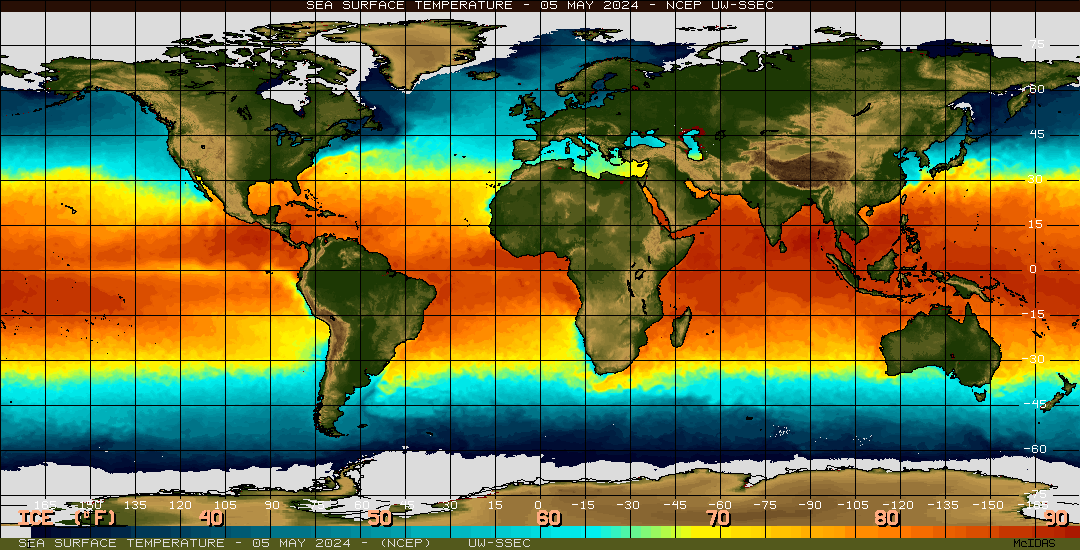
  1. Abnormally high sea surface temperatures (see the DMI’s nice web product and select anomaly from the drop down menu).
  2. A record setting low Arctic sea ice area (see NDISC’s operational sea ice extent visualization products).
There is certainly more to the story, such as the role of atmospheric circulation in pumping warm air up from the south, as in the case of the former record setting year 2011 low albedo anomaly. That circulation anomaly is described in a paper I’m completing the rebuttal for. This is after an intensive external and anonymous review process for the paper:
  • Box, J. E., Fettweis, X., Stroeve, J. C., Tedesco, M., Hall, D. K., and Steffen, K. (2012). Greenland ice sheet albedo feedback: thermodynamics and atmospheric drivers, The Cryosphere Discuss., 6, 593-634, doi:10.5194/tcd-6-593-2012
I paste below the abstract of that study that contains yet more relevant information:
  • Greenland ice sheet mass loss has accelerated in the past decade responding to combined glacier discharge and surface melt water runoff increases. During summer, absorbed solar energy, modulated at the surface primarily by albedo, is the dominant factor governing surface melt variability in the ablation area. Using satellite-derived surface albedo with calibrated regional climate modeled surface air temperature and surface downward solar irradiance, we determine the spatial dependence and quantitative impact of the ice sheet albedo feedback over twelve summer periods beginning in 2000. We find that while albedo feedback defined by the change in net solar shortwave flux and temperature over time is positive over 97% of the ice sheet, when defined using paired annual anomalies, a second order negative feedback is evident over 63% of the accumulation area. This negative feedback damps the accumulation area response to warming due to a positive correlation between snowfall and surface air temperature anomalies. Positive anomaly–gauged feedback concentrated in the ablation area accounts for more than half of the overall increase in melting when satellite derived melt duration is used to define the timing when net shortwave flux is sunk into melting. Abnormally strong anticyclonic circulation, associated with a persistent summer North Atlantic Oscillation extreme since 2007 enabled three amplifying mechanisms to maximize the albedo feedback: (1) increased warm (south) air advection along the western ice sheet increased surface sensible heating that in turn enhanced snow grain metamorphic rates, further reducing albedo; (2) increased surface downward shortwave flux, leading to more surface heating and further albedo reduction; and (3) reduced snowfall rates sustained low albedo, maximizing surface solar heating, progressively lowering albedo over multiple years. The summer net infrared and solar radiation for the high elevation accumulation area approached positive values during this period. Thus, it is reasonable to expect 100% melt area over the ice sheet within another similar decade of warming.
According to a cross validation with independent GC-Net AWS data, degrading MODIS instrument sensitivity identified by Wang et al. (2012) is not here detected in the MOD10A1 product.


http://www.meltfactor.org/blog/?p=476

Rinehart sends ultimatum to Fairfax board, demands board control, right to hire and fire. Threat to democracy in Australia


Rinehart sends ultimatum to Fairfax board

The Age, June 26, 2012


Gina Rinehart: the untold story, now told

Author Adele Ferguson reveals the obstacles she battled and overcame to write her unofficial biography of the world's richest woman.


MINING magnate Gina Rinehart, disappointed that she has not been welcomed by Fairfax as a ''white knight'', has threatened to sell her stake in the publishing business if the board does not bow to her demands.

Mrs Rinehart told the ABC's Four Corners that she would consider selling off her stake in the company ''unless director positions are offered without unsuitable conditions''.


The comments, made via her company Hancock Prospecting, were sent to the ABC a week ago, when Mrs Rinehart was moving to increase her stake in Fairfax, which owns The Age, and was seeking to gain board representation.


<p></p>
Mrs Rinehart is now the company's largest single shareholder, with 18.6%, and is reportedly seeking three seats on the eight-member board, including the role as deputy chairman.

The board has been resisting her push and insisting that she support the company's charter of editorial independence, which prevents board members from interfering with the content of the journalism. Mrs Rinehart is believed to be resisting those attempts.

The statement said Mrs Rinehart had hoped to be viewed by the board as a ''a successful business person and a necessary 'white knight.' '' It said that, if her conditions were not met, she might sell her stake and ''consider repurchasing at some other time.''

It also put Mrs Rinehart's views on a range of subjects, including climate change. ''She remains concerned by the lack of understanding in the media on this issue,'' it said.

''To lessen the fear the media have caused over these issues, Mrs Rinehart suggests that the media should also permit to be published that climate change has been occurring naturally since the earth began, not just the views of the climate extremists. It is a fact that there have been ice ages, then periods of global warming to end the ice ages, and these have occurred naturally, including due to the earth's orbit, and not due to mankind at all.''

The statement spoke glowingly of climate sceptics Ian Plimer, a geologist, and Andrew Bolt, a columnist in Rupert Murdoch's News Ltd.

''Mrs Rinehart admires people like Ian Plimer who have independently chosen on their own accord to stand up against this tidal wave, which has caused fear, and despite substantial attacks by some of the media and extremists.''

Asked if she had used her position on the board of the Ten Network to help hire Bolt, Hancock Prospecting replied: ''It is noted that his program is very popular in country areas, yet unfortunately many country areas are unable to receive Channel 10. As stated previously by Mrs Rinehart, Mrs Rinehart hopes that should Mr Bolt's time permit, that he would consider a longer program on Channel 10.''

The statement did not answer questions about whether Mrs Rinehart had funded community organisations lobbying to stop the carbon tax. But it did criticise the media for failing to accurately report the tax's potential impacts.

As the battle for control of Fairfax intensified, 63 prominent Victorians signed a letter to The Age describing the charter as crucial to a healthy democracy. These included former premiers John Cain, Joan Kirner and Steve Bracks, and former prime minister Malcolm Fraser.

Sunday, June 24, 2012

George Monbiot: How “Sustainability” Became “Sustained Growth”


The Rio Declaration rips up the basic principles of environmental action.


by George Monbiot, published on the Guardian’s website, 22nd June 2012

In 1992, world leaders signed up to something called “sustainability.” Few of them were clear about what it meant; I suspect that many of them had no idea. Perhaps as a result, it did not take long for this concept to mutate into something subtly different: “sustainable development.” Then it made a short jump to another term: “sustainable growth.” And now, in the 2012 Earth Summit text that world leaders are about to adopt, it has subtly mutated once more: into “sustained growth.”

This term crops up 16 times in the document, where it is used interchangeably with sustainability and sustainable development. But if sustainability means anything, it is surely the opposite of sustained growth. Sustained growth on a finite planet is the essence of unsustainability.

As Robert Skidelsky, who comes at this issue from a different angle, observes in the Guardian today:

“Aristotle knew of insatiability only as a personal vice; he had no inkling of the collective, politically orchestrated insatiability that we call economic growth. The civilization of 'always more' would have struck him as moral and political madness. And, beyond a certain point, it is also economic madness. This is not just or mainly because we will soon enough run up against the natural limits to growth. It is because we cannot go on for much longer economising on labour faster than we can find new uses for it.”

Several of the more outrageous deletions proposed by the United States – such as any mention of rights or equity or of common but differentiated responsibilities – have been rebuffed. In other respects the Obama government’s purge has succeeded, striking out such concepts as “unsustainable consumption and production patterns” and the proposed decoupling of economic growth from the use of natural resources.

At least the states due to sign this document haven’t ripped up the declarations from the last Earth Summit, 20 years ago. But in terms of progress since then, that’s as far as it goes. Reaffirming the Rio 1992 commitments is perhaps the most radical principle in the entire declaration.

As a result, the draft document, which seems set to become the final document, takes us precisely nowhere. 190 governments have spent 20 years bracing themselves to “acknowledge,” “recognise” and express “deep concern” about the world’s environmental crises, but not to do anything about them.

This paragraph from the declaration sums up the problem for me:

“We recognize that the planet Earth and its ecosystems are our home and that Mother Earth is a common expression in a number of countries and regions and we note that some countries recognize the rights of nature in the context of the promotion of sustainable development. We are convinced that in order to achieve a just balance among the economic, social and environment needs of present and future generations, it is necessary to promote harmony with nature.”

It sounds lovely, doesn’t it? It could be illustrated with rainbows and psychedelic unicorns and stuck on the door of your toilet. But without any proposed means of implementation, it might just as well be deployed for a different function in the same room.

The declaration is remarkable for its absence of figures, dates and targets. It is as stuffed with meaningless platitudes as an advertisement for payday loans, but without the necessary menace. There is nothing to work with here, no programme, no sense of urgency or call for concrete action beyond the inadequate measures already agreed in previous flaccid declarations. Its tone and contents would be better suited to a retirement homily than a response to a complex of escalating global crises.

The draft and probably final declaration is 283 paragraphs of fluff. It suggests that the 190 governments due to approve it have, in effect, given up on multilateralism, given up on the world and given up on us. So what do we do now? That is the topic I intend to address in my column next week.

monbiot.com

Saturday, June 23, 2012

Bob Cringley: The next Japanese nuclear accident (it’s inevitable) will be even worse


The next Japanese nuclear accident (it’s inevitable) will be even worse

by Robert X. Cringely, "I, Cringley" blog, May 24, 2012 

This is my sixth column about the Fukushima Daiichi nuclear accident that started last year in Japan following the tsunami. But unlike those previous columns (1,2,3,4,5), this one looks forward to the next Japanese nuclear accident, which will probably take place at the same location. That accident, involving nuclear fuel rods, is virtually inevitable, most likely preventable, and the fact that it won’t be prevented comes down solely to Japanese government and Tokyo Electric Power Company (TEPCO) incompetence and stupidity. Japanese citizens will probably die unnecessarily because the way things are done at the top in Japan is completely screwed up.
Understand that I have some cred in this space having worked three decades ago as an investigator for the Presidential Commission on the Accident at Three Mile Island and later wrote a book about that accident. I also ran for 20 years a technology consulting business in Japan.
Here’s the problem. In the damaged Unit 4 at Fukushima Daiichi there are right now 1,535 fuel rods that have yet to be removed from the doomed reactor. The best caseestimate of how long it will take to remove those rods is three years. Next to the Unit 4 reactor and in other places on the same site there are more than 9,000 spent fuel rods stored mainly in pools of water but in some spots exposed to the air and cooled by water jets.  The total volume of unstable nuclear fuel on the site exceeds 11,000 rods. Again, thebest estimate of how long it will take to remove all this fuel and spent fuel is 10 years but it may well take longer.
Fukushima has always been a seismically active area. Called the Japan Trench Subduction Zone, it has experienced nine seismic events of magnitude 7 or greater since 1973. There was a 5.8 earthquake in 1993; a 7.1 in 2003; a 7.2 earthquake in 2005; and a 6.2 earthquake offshore of the Fukushima facility just last year, all of which caused shutdowns or damage to nuclear plants. Even small earthquakes can damage nuclear plants: a 6.8 quake on Japan’s west coast in 2007 cost TEPCO $5.62 billion.
But last year’s 9.0 earthquake and tsunami made things far worse, further destabilizing the local geology. According to recently revised estimates by the Japanese government, the probability of an earthquake of 7.0 magnitude or greater in the region during the next three years is now 90 percent. The Unit 4 reactor building that was substantially damaged by the tsunami and subsequent explosions will not survive a 7.0+ earthquake.
An earthquake of 7.0 or greater is likely to disrupt cooling water flow and further damage fuel storage pools possibly making them leak. If this happens the fuel rods will be exposed, will get hotter and eventually melt, puddling in the reactor basement and beneath the former storage ponds. This is a nuclear meltdown, which will lead to catastrophic (though non-nuclear) explosions and the release of radioactive gases, especially Cesium 137.
The amount of Cesium 137 in the fuel rods at Fukushima Daiichi is the equivalent of 85 Chernobyls.
To review, there is a 90 percent chance of a large earthquake in the minimum three years required to remove just the most unstable part of the fuel load at Fukushima Daiichi. The probability of a large earthquake in the 10+ years required to completely defuel the plant is virtually 100 percent. If a big earthquake happens before that fuel is gone there will be global environmental catastrophe with many deaths.
Let me explain how something like this can happen. For 20 years I ran with a partner a consulting business in Japan serving some of that country’s largest companies.  Here is how our business worked:
1) A large Japanese company would announce a bold technical goal to be reached in a time frame measured in years, say 5-10. This could be building a supercomputer, going to the Moon, whatever.
2) Time passes and in quarterly meetings team leaders are asked how the project is going. They lie, saying all is well, while the truth is that little progress has been made.  Though money is spent, sometimes no work is done at all.
3) The project deadline eventually approaches and a junior team member is selected to take the heat, admitting in a meeting that there has been very little progress, taking responsibility and offering to resign. The goal will not be reached, the company will be embarrassed.
4) In a final attempt to avoid corporate embarrassment, the company reaches out to me: surely Bob knows some Silicon Valley garage startup that can build our supercomputer or take us to the Moon. Money is no object.
5) Sure enough, there often is such a startup and the day is saved.
It’s my belief that this is exactly what’s going on right now at Fukushima Daiichi. The very logic of time and probability that scares the bejesus out of me is being completely ignored, replaced with magical thinking. Organizations are committing to fix the current disaster and avoid the next disaster when in fact they are probably incapable of doing either. Lies are being told because Japanese government and industry are more afraid of their vulnerability being exposed than they are concerned about citizens dying. Afraid of being embarrassed, they press forward doing the best that they can, praying that an earthquake doesn’t happen.
This is no way to approach a nuclear catastrophe. What’s even worse is this approach isn’t unique to Japan but is common in the global nuclear industry.
Time is critical. What’s clearly required in Fukushima is new project leadership and new technical skills. Some think the Japanese military should take over the job, but I believe that would be just another mistake. The same foot dragging takes place in the Japanese military that happens in Japanese industry.
Fukushima Daiichi requires a Manhattan Project approach.  The sole role of the Japanese government should be to pay for the job. A single project leader or czar should be selectednot from the nuclear industry and that leader should probably not be Japanese. Contracts should be let to organizations from any country on equal merit so only the best people who can move the quickest with safety get the work. Then cut the crap and get it done in a third or half the time.
But that’s not how it will happen. In Japan it almost never is.

TEPCO to speed up removal of spent fuel rods at Fukushima reactor No. 4 by 12 months


Japan to speed up Fukushima nuclear plant cleanup

by Kiyoshi Takenaka and Yoko Kubota, Japan Today, June 22, 2012
TOKYO —
Workers at the crippled Fukushima Daiichi nuclear plant will begin removing fuel rods from a damaged reactors a year ahead of schedule, a government minister said Thursday, a move to address concerns about the risk of a new quake that could cause a further accident and scatter more radioactive debris.
“We would like to start taking out undamaged fuel this year. Preparation is now under way,” Japan’s nuclear crisis minister, Goshi Hosono, told Reuters in an interview.
“Doing it quickly is important. But we also have to make sure those workers out there, who are struggling under harsh conditions, will not be endangered by trying to move things fast.”
Tokyo Electric Power Co (TEPCO), operator of the plant, had said in April it aimed to begin removing the fuel rods from the No. 4 reactor at the end of next year.
That would have left large quantities of radioactive fuel rods outside the protection of strong containment vessels for two and a half years after the accident.
Experts say the fuel rods, now covered only by water and a white plastic tarp, could present a risk of a knock-on accident if the reactor building collapsed or the water supply used to keep the rods cool were disrupted by another earthquake.
Some 1,535 fuel assemblies—enough uranium fuel rods to power three reactors—are being stored in a pool atop the mangled No. 4 reactor building. The reactor, which was shut down for maintenance at the time of the March 2011 earthquake and tsunami, was badly damaged by a series of powerful explosions that followed the disaster as power was cut off to the plant.
Hosono said last month during a visit to the Fukushima plant that he expected workers to begin removing fuel from the No. 4 reactor’s storage pool next year.
Work began in April to raise what amounts to a giant tent over the building to keep radioactive dust from scattering during the transport of the fuel rods.
TEPCO says its analysis shows the No.4 reactor building would hold up in a strong earthquake. But Japanese safety regulators ordered TEPCO to recheck its findings last month after measurements showed one of the walls of the reactor building was buckling out by about 3 centimeters.
The removed uranium fuel rods will be placed in another storage pool at the Fukushima plant, officials have said.
Hosono also said Tokyo was considering setting up a training facility for nuclear workers, including engineers, to secure specialists for the long process of decommissioning the Fukushima plant and cleaning up radioactive debris.
“It will be 10 years, 20 years, probably even more before decommissioning is complete,” Hosono said. “The task will not be sustainable unless we train the next generation of talent, and the generation after that.”
He added: “The government is looking into establishing a place for bringing up such talent. When it comes to a location, Fukushima would make an excellent training ground.”
The disaster in Fukushima heightened public concerns about nuclear safety, leaving Japan with no online reactors since May after all 50 went off line for maintenance checks.
To avoid a summertime power shortage, Hosono, the prime minister and two other ministers, earlier in June approved the restart of two reactors in western Japan. They are expected to be back online in July.
Hosono said that no other reactors will be restarted until a new regulatory agency is set up by September.
Parliament approved a law on Wednesday for a more independent regulatory body. The regulatory agency has up to now been placed under the ministry that also promoted the use of nuclear power, one key factor experts blame for the failure to avert the Fukushima crisis.

Friday, June 22, 2012

NSIDC Arctic Sea Ice Report, June 19, 2012: Arctic Sea Ice Tracking at Record Low Levels


Sea ice tracking at record low levels

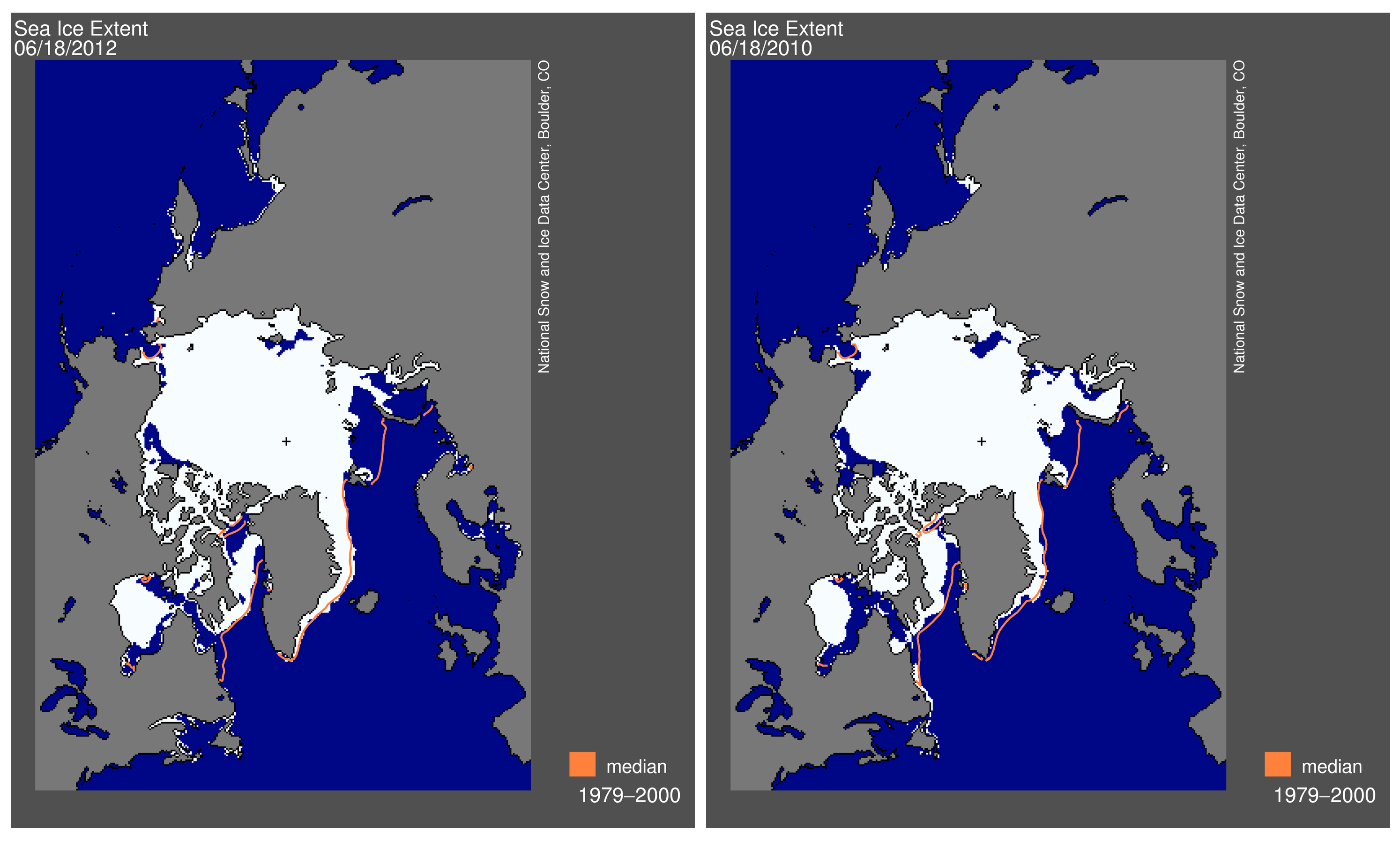
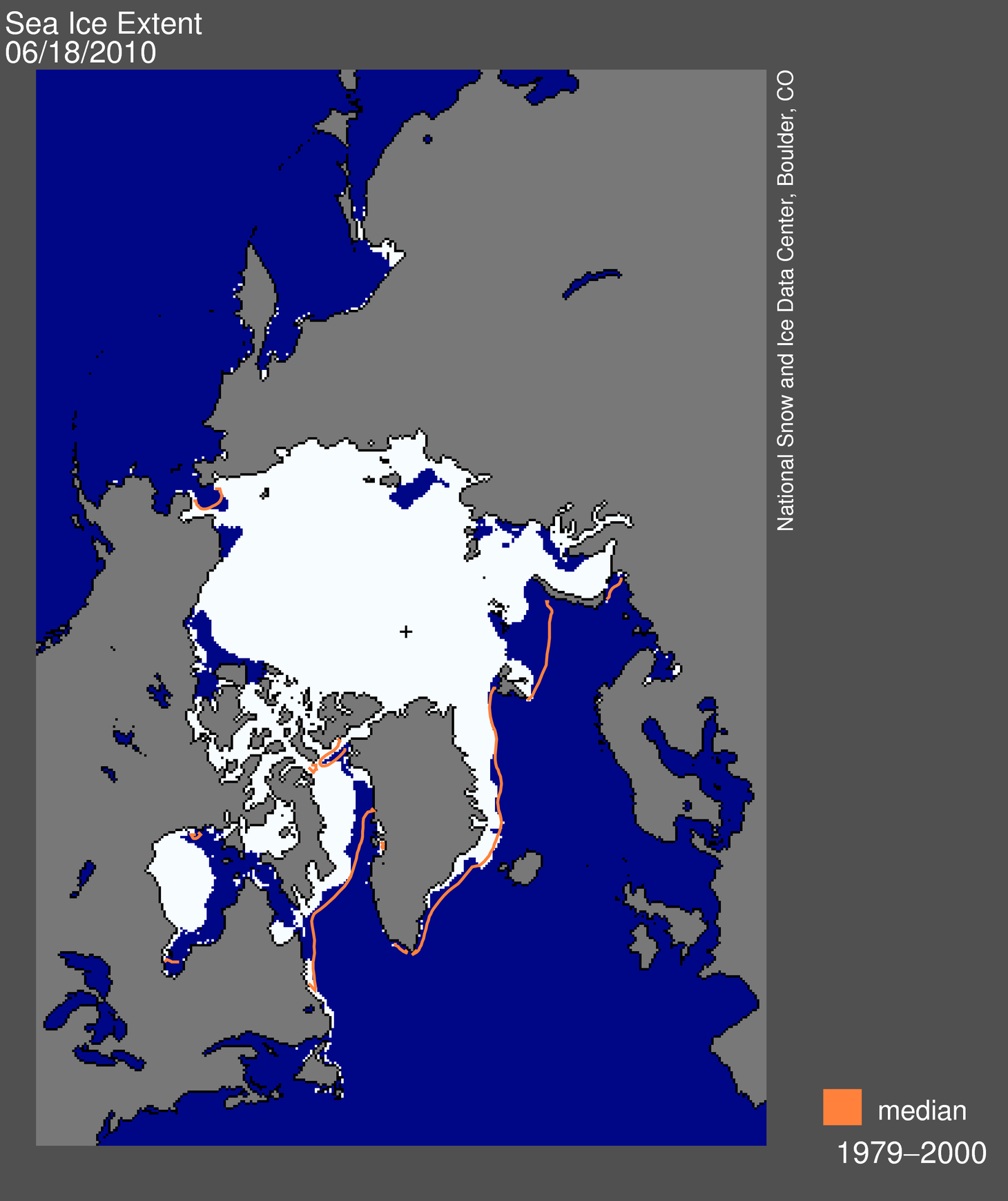
After a period of rapid ice loss through the first half of June, sea ice extent is now slightly below 2010 levels, the previous record low at this time of year. Sea level pressure patterns have been favorable for the retreat of sea ice for much of the past month.

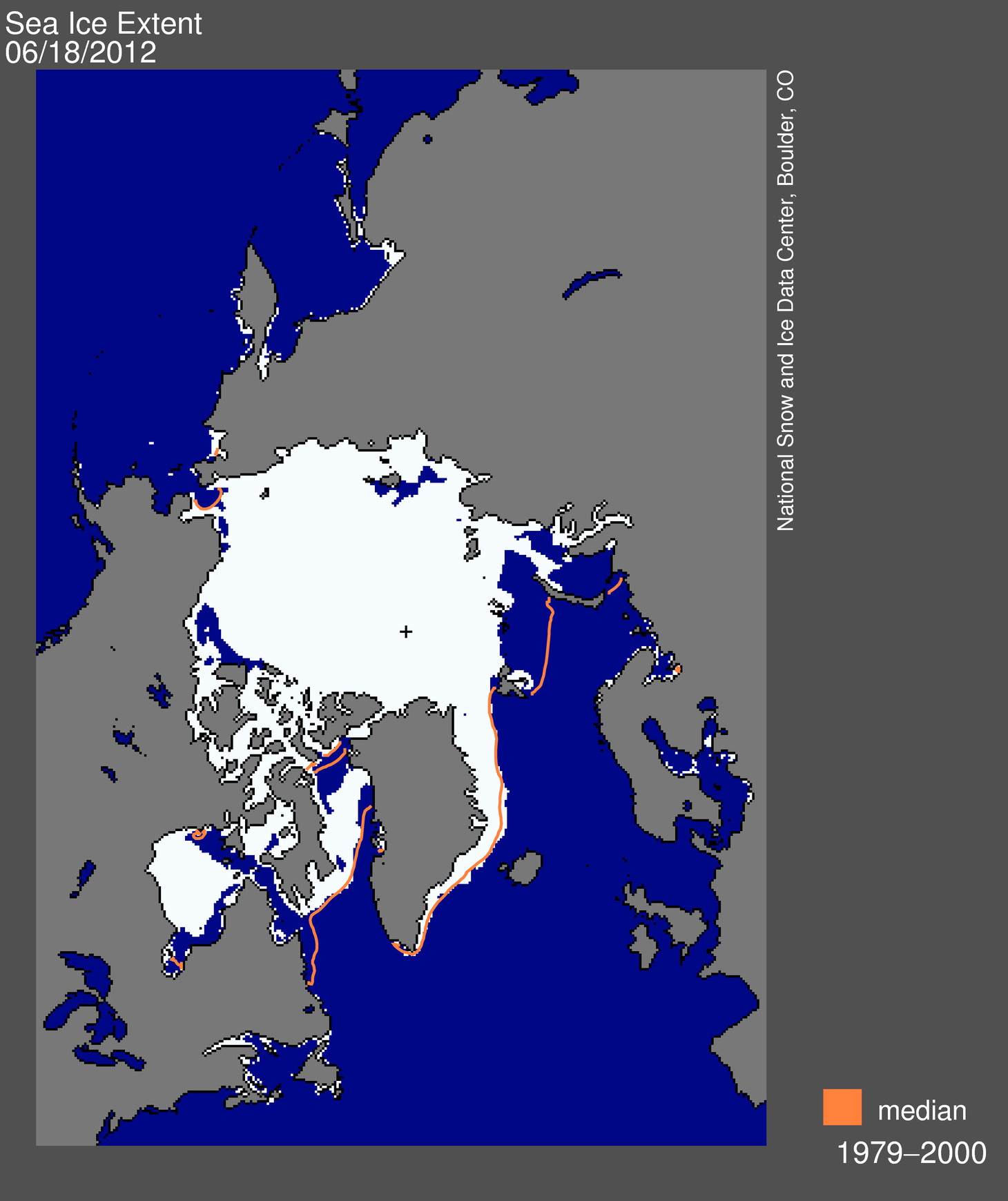
Figure 1. Arctic sea ice extent for 18 June 2012 (left) was 10.62 million square kilometers (4.10 million square miles), 31,000 square kilometers (12,000 square miles) below the same day in 2010 (right). The orange line shows the 1979 to 2000 median extent for that month. The black cross indicates the geographic North Pole. Sea Ice Index data. About the data. Credit: National Snow and Ice Data Center
High-resolution images: Figure 1aFigure 1b
Overview of conditions
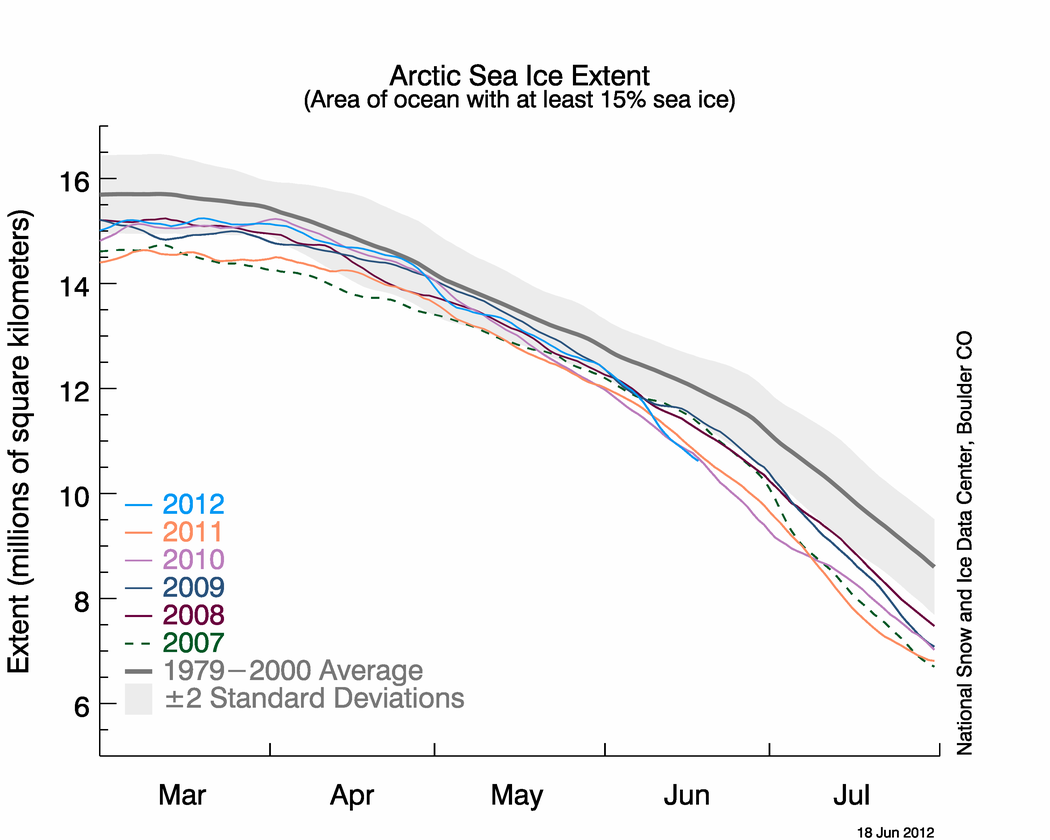
On June 18, the five-day average sea ice extent was 10.62 million square kilometers (4.10 million square miles). This was 31,000 square kilometers (12,000 square miles) below the same day in 2010, the record low for the day and 824,000 square kilometers (318,000 square miles) below the same day in 2007, the year of record low September extent.

Figure 2. The graph above shows Arctic sea ice extent as of June 18, 2012, along with daily ice extent data for the previous four years. 2012 is shown in blue, 2011 in orange, 2010 in pink, 2009 in navy, 2008 in purple, and 2007 in green. The gray area around the average line shows the two standard deviation range of the data. Sea Ice Index data. Credit: National Snow and Ice Data Center. High-resolution image
Conditions in context
The main contributors [huh? no, the main effects of warmer sea and air temperatures and the formation of late and thin first-year ice] to the unusually rapid ice loss to this point in June are the disappearance of most of the winter sea ice in the Bering Sea, rapid ice loss in the Barents and Kara Seas, and early development of open water areas in the Beaufort and Laptev Seas north of Alaska and Siberia. Recent ice loss rates have been 100,000 to 150,000 square kilometers (38,600 to 57,900 square miles) per day, which is more than double the climatological rate.

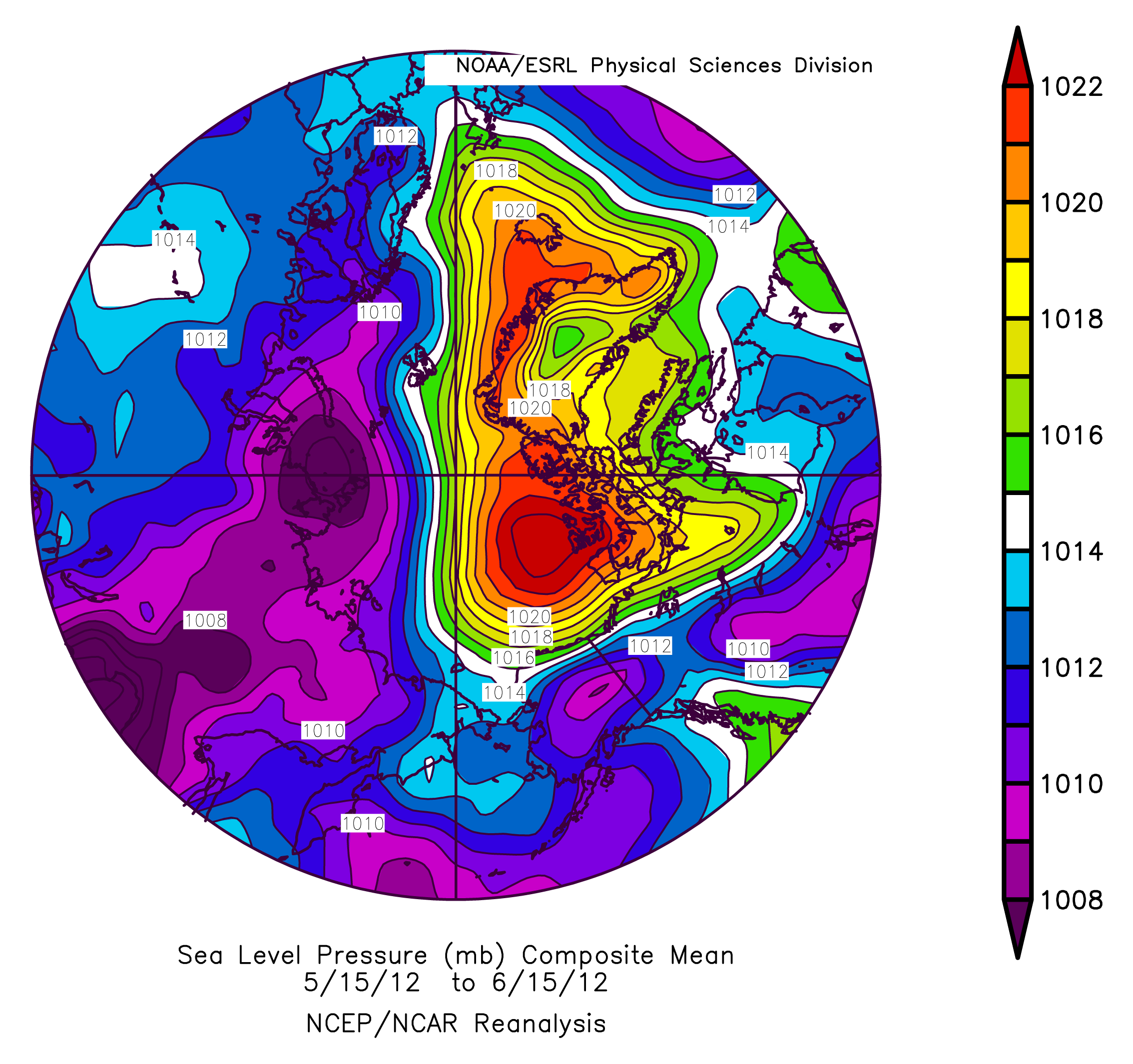
Figure 3: This map of mean sea level pressure from 15 May 2012 to 15 June 2012 shows a pattern of high pressure over the Beaufort Sea and a pattern of low pressure over the Laptev Sea, conditions favorable to summer ice loss. Credit: NSIDC courtesy NOAA/ESRL PSD. High-resolution image
Sea level pressure favors the advection of ice
A pattern of high pressure over the Beaufort Sea and low pressure over the Laptev Sea has been present for the past few weeks. This pattern is favorable for summer ice loss, by advecting warm winds from the south (in eastern Asia) to melt the ice and transport it away from the coastlines in Siberia and Alaska. The high pressure over the Beaufort leads to generally clear skies, and temperatures are now above freezing over much of the Arctic pack. Snow cover in the far north is nearly gone, earlier than normal, allowing the coastal land to warm faster.
Early melt onset, and clear skies near the solstice are favorable conditions for more rapid melting, and warming of the ocean in open-water areas. The persistence of this type of pressure pattern throughout summer 2007 was a major factor toward causing the record low September extent that year. Conversely, in 2010, the patterns were not as favorable for loss of ice and the seasonal decline slowed later in the summer, and the extent did not approach the record low levels of 2007.
While these patterns and conditions have looked similar to 2007, over the last couple days the high pressure pattern over the Beaufort Sea has broken down. And while the extent is at a record low for the date, it is still early in the melt season. Changing weather patterns throughout the summer will affect the exact trajectory of the sea ice extent through the rest of the melt season.

Thursday, June 21, 2012

Arctic Climate Far More Vulnerable Than Thought, May Be Linked to Antarctic Ice-Sheet Behavior

Arctic Climate More Vulnerable Than Thought, May Be Linked to Antarctic Ice-Sheet Behavior 


ScienceDaily, June 21, 2012 — First analyses of the longest sediment core ever collected on land in the Arctic, published this week in Science, provide dramatic, "astonishing" documentation that intense warm intervals, warmer than scientists thought possible, occurred there over the past 2.8 million years.
These are co-lead scientists Julie Brigham-Grette and Pavel Minyuk with core. The two scientists celebrated when drilling reached the bottom of lake sediments at a depth of 318 m below the lake bottom. At that point, drilling began reaching into the 3.6-million-year-old impact rock. (Credit: Courtesy of Tim Martin)


Further, these extreme inter-glacial warm periods correspond closely with times when parts of Antarctica were ice-free and also warm, suggesting strong inter-hemispheric climate connectivity, say the project's three co-chief scientists. The Polar Regions are much more vulnerable to change than once believed, they add. The team was led by Martin Melles of Germany's University of Cologne, Julie Brigham-Grette of the University of Massachusetts Amherst and Pavel Minyuk of Russia's Northeast Interdisciplinary Scientific Research Institute in Magadan.


Brigham-Grette, the lead U.S. scientist says, "What we see is astonishing. We had no idea that we'd find this. It's astonishing to see so many intervals when the Arctic was really warm, enough so forests were growing where today we see tundra and permafrost. And the intensity of warming is completely unexpected. The other astounding thing is that we were able to determine that during many times when the West Antarctic ice sheet disappeared, we see a corresponding warm period following very quickly in the Arctic. Arctic warm periods cluster with periods when the Western Antarctic ice sheet is gone."
Data reported by Melles, Brigham-Grette, Minyuk and colleagues come from analyzing sediment cores collected in 2009 from under ice-covered Lake El'gygytgyn in the northeast Russian Arctic. "Lake E" was formed 3.6 million years ago when a huge meteorite hit Earth and blasted out an 11-mile (18 km) wide crater. It has been collecting layers of sediment ever since. Luckily, it is located in one of the few areas in the Arctic not eroded by continental glaciers, leaving the thick sediment record remarkably undisturbed and continuous. Cores from Lake E reach back in geologic time nearly 30 times farther than Greenland ice cores covering the past 110,000 years.
In their first paper reporting results, Brigham-Grette and colleagues discuss four warm phases in detail; two of the oldest warm interglacials from about 1.1 million years ago and 400,000 years ago, and two of the youngest from 125,000 and about 12,000 years ago.
Working with 2.5-inch (6.6 cm) diameter mud cores, they analyzed such variables as pollen assemblages and number of diatoms, which allow estimates of changing vegetation type, coverage, summer average temperatures and rainfall, for example. Other analyses yield quantitative physical properties including elemental carbon, nitrogen and sulfur, whether organic material is present and in what concentrations.
The pollen-based climate reconstructions suggest that summer temperatures and annual precipitation during the exceptional interglacials were about 4 to 5 degrees C warmer and about 12 inches (300 mm) wetter than in other interglacials, they say. Modeling and sensitivity tests for these warm periods also suggest it's virtually impossible for Greenland's ice sheet to have existed in its present form at those times.
Simulations using a state-of-the-art climate model show that the high temperature and precipitation during the "super interglacials" cannot be explained by Earth's orbital parameters or variations in atmospheric greenhouse gases alone, which geologists typically see driving the glacial/interglacial pattern during ice ages. This suggests additional climate feedbacks are at work. The Lake E researchers suspect the trigger for intense interglacials might be in Antarctica. Earlier work by the international ANDRILL program discovered recurring intervals when the West Antarctic Ice Sheet melted. The Lake E study shows that some of these events match remarkably well with the super interglacials in the Arctic.
Brigham-Grette and colleagues discuss two scenarios for future testing that could explain inter-hemispheric climate coupling. First, reduced glacial ice cover and loss of ice shelves in Antarctica could have limited formation of cold water masses that flow into the north Pacific and well up to the surface, resulting in warmer surface waters, higher temperatures and increased precipitation on nearby land. Alternatively, disintegration of the West Antarctic Ice Sheet likely led to a significant global sea level rise and allowed more warm surface water into the Arctic Ocean through the Bering Strait.
Not only do results shed light on natural variability of the Arctic climate, but this view of the past may be a key to understanding climate in future centuries, the researchers say."We have a lot more to learn," says Brigham-Grette. "But our results mesh with what glaciologists are seeing today. Seven of the 12 major ice shelves around the Antarctic are melting or are gone. We suspect the tipping point for the gradual de-glaciation of Greenland and the Arctic may be lower than glaciologists once thought."
The international Lake El'gygytgyn Drilling Project was funded by the International Continental Drilling Program (ICDP), the U.S. National Science Foundation's Division of Earth Sciences and Office of Polar Programs, the German Federal Ministry for Education and Research, Alfred Wegener Institute, GeoForschungsZentrum-Potsdam, the Russian Academy of Sciences Far East Branch, the Russian Foundation for Basic Research and the Austrian Ministry for Science and Research.

Jeff Masters: Record flooding in Duluth, Minnesota, at the St. Louis River, June 21, 2012

Record flooding in Duluth, Minnesota


by Dr. Jeff Masters, WunderBlog, June 21, 2012


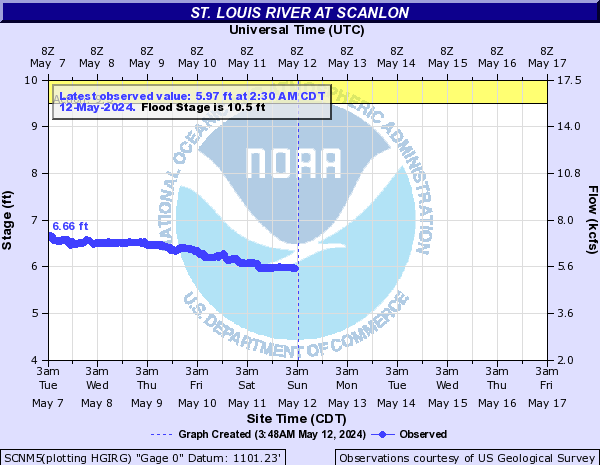
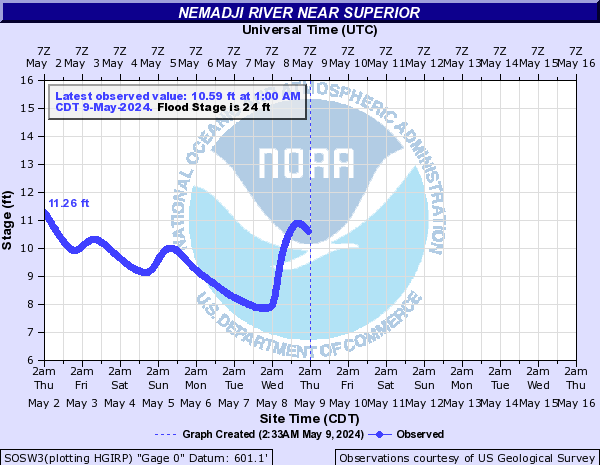
Figure 3. The St. Louis river upstream from Duluth, Minnesota, reached its highest flood height on record this morning, 6.1 feet above flood stage. The river rose over 10 feet in 24 hours. Image credit: NOAA.

Flood waters have crested in Duluth, Minnesota, this Thursday morning (June 21, 2012), and are slowly falling, in the wake of the city's all-time record 24-hour rainstorm. A series of "training" thunderstorms that followed the same path passed over a wide swath of northern Minnesota between noon Tuesday and noon Wednesday, dropping 7.20" of rain on the city. According to wunderground's weather historian Christopher C. Burt, this far surpasses the previous 24-hour record rainfall for Duluth, the 5.79" that fell on August 22-23, 1978. Two rivers in the Duluth area, the Nemadji and St. Louis, hit their highest flood heights on record Thursday morning, causing destructive flooding. Sadly, major flooding occurred at the Duluth zoo, washing a seal into a neighboring street, and killing at least eleven zoo animals.


http://www.wunderground.com/blog/JeffMasters/comment.html?entrynum=2127

A MUST READ: The Battle Over Climate Science


Climate scientists routinely face death threats, hate mail, nuisance lawsuits and political attacks. How much worse can it get?


Heating Up Daniel Schumpert and Jason Briney
There’s no police tape across Michael Mann’s office doorway this morning. “Always a good start,” he says, juggling a cup of coffee as he slides his key into the lock.
Mann, a paleoclimatologist, wears a sport coat over a turtleneck. As he takes a seat at his desk, a narrow sunbeam angles through the window, spotlighting a jumble of books, journals and correspondence. Behind him, a framed picture of his six-year-old daughter rests near a certificate for the Nobel Peace Prize he shared in 2007. Propped into a corner is a hockey stick, a post-lecture gift from Middlebury College, which Mann jokingly says he keeps “for self-defense.”
Mann directs Penn State University’s Earth System Science Center. Several months ago, he arrived at his office with an armload of mail. Sitting at his desk, he tore open a hand-addressed envelope and began to pull out a letter. He watched as a small mass of white powder cascaded out of the folds and onto his fingers. Mann jerked backward, letting the letter drop and holding his breath as a tiny plume of particles wafted up, sparkling in the sunlight. He rose quickly and left the office, pulling the door shut behind him. “I went down to the restroom and washed my hands,” he says. “Then I called the police.”
For someone describing an anthrax scare, Mann is surprisingly nonchalant. “I guess,” he says, “it’s so much a part of my life that I don’t even realize how weird it is.”
“Weird” is perhaps the mildest way to describe the growing number of threats and acts of intimidation that climate scientists face. A climate modeler at Lawrence Livermore National Laboratory answered a late-night knock to find a dead rat on his doorstep and a yellow Hummer speeding away. An MIT hurricane researcher found his inbox flooded daily for two weeks last January with hate mail and threats directed at him and his wife. And in Australia last year, officials relocated several climatologists to a secure facility after climate-change skeptics unleashed a barrage of vandalism, noose brandishing and threats of sexual attacks on the scientists’ children.
Those crude acts of harassment often come alongside more-sophisticated legal and political attacks. Organizations routinely file nuisance lawsuits and onerous Freedom of Information Act (FOIA) requests to disrupt the work of climate scientists. In 2005, before dragging Mann and other climate researchers into congressional hearings, Texas congressman Joe Barton ordered the scientists to submit voluminous details of working procedures, computer programs and past funding—essentially demanding that they reproduce and defend their entire life’s work. In a move that hearkened back to darker times, Oklahoma senator James Inhofe, the ranking member of the Senate’s Environment and Public Works Committee, released a report in 2010 that named 17 prominent climate scientists, including Mann, who, he argued, may have engaged in “potentially criminal behavior.” Inhofe outlined three laws and four regulations that he said the scientists may have violated, including the Federal False Statements Act—which, the report noted, could be punishable with imprisonment of up to five years.
It’s late February when I visit Mann in his office, almost two years after Inhofe issued his “list of 17.” Though it’s still winter in central Pennsylvania, the temperature outside hangs in the upper 60s, crocus stems poke up from flower beds, and shopkeepers have thrown open their doors along College Avenue. Mann is home for three days between conferences in Milwaukee and Hawaii and West Coast stops on a promotional tour for his new book, The Hockey Stick and the Climate Wars.
In the late 1990s, Mann developed a graph that demonstrated a recent and dramatic uptick in global mean surface temperatures. The hockey-stick-shaped curve has become emblematic to both sides of the climate debate. To the vast majority of climate scientists, it represents evidence, corroborated by decades of peer-reviewed research, of global warming. To climate-change skeptics, the hockey stick is the most grievous of many illusions fabricated by thousands of conspiring scientists to support an iniquitous political agenda.
The Intergovernmental Panel on Climate Change (IPCC) included Mann’s graph in its Third Assessment Report in 2001. Al Gore and Davis Guggenheim then included it in their 2006 climate-change documentary An Inconvenient Truth. The film galvanized both the pro- and contra-climate-science camps, propelling the issue of human-caused global warming into the culture wars—and Mann along with it. “Since then, my life has been crazy,” he says. “People have stolen my e-mails and bought billboards and newspaper ads to denounce me; they’ve staged bogus grassroots protests; they’ve threatened my family. I’ve been through eight investigations by everyone from the National Science Foundation to the British House of Commons. Every time, they find no evidence of fraud or misuse of information. Every time, they conclude that my methods are sound, my data replicable. And every time I’m exonerated, another investigation pops up.”
Mann has been called a “compulsive liar, a con man and an extraordinary psychological case.” Some critics accuse him of masterminding a cabal of scientists that aims to establish a new world order. Still others compare him to Hitler, Stalin and Satan.
At the time of our meeting, Mann was juggling several FOIA requests and two lawsuits—one of which would be resolved the following week, when the Virginia Supreme Court rejected the state attorney general’s demand that the University of Virginia (Mann’s former employer) turn over the researcher’s e-mails and other documents. The university spent nearly $600,000 to argue that releasing personal correspondence would chill academic research. “Yes, there’s been a toll on me and my family,” Mann says. “But it’s bigger than that. Look what it’s doing to science, when others see this and see what happens if they speak up about their research. These efforts to discredit science are well-organized. It’s not just a bunch of crazy people.”
Force of Nature: Michael Mann, a paleoclimatologist, has been the subject of lawsuits, congressional investigations and an anthrax scare.  Tom Clynes
“There’s really only about 25 of us doing this,” Steve Milloy says, shortly after sitting down at Morton’s, a Washington, D.C., steakhouse favored by lawyers and lobbyists. “A core group of skeptics. It’s a ragtag bunch, very Continental Army.” Milloy, a Fox News commentator and former tobacco-industry advocate, runs a website called JunkScience.com that is an outlet for attacks on those he calls “global-warming alarmists.” Many of those who question mainstream climate science resent being called deniers; they say it unfairly equates them with Holocaust deniers. They prefer doubters, skeptics or realists. “Me, I just stick with denier,” Milloy says. “I’m happy to be a denier.”
Milloy is dressed in a striped pink button-down shirt and khaki pants, classic Potomac prep. He moved into climate denial in the 1990s as funding from the tobacco lobby began to dry up. At the time, conservative and libertarian think tanks were just starting to take aim at climate science. Milloy, who has received funding from entities controlled by oil billionaires Charles and David Koch, helps them get their message to the masses.
Milloy and other aggressive deniers practice a form of asymmetric warfare that is decentralized and largely immune to reasoned response. They launch what Aaron Huertas, a press secretary at the Union of Concerned Scientists, calls “information missiles,” anti-climate-change memes that get passed around on listservs, amplified in the blogosphere, and picked up by radio talk-show hosts or politicians. “Even if they don’t have much money, they are operating in a structure that allows them to punch above their weight,” Huertas says.
Scientists who speak up quickly become targets. Both Milloy and his counterpart Marc Morano, who runs the site ClimateDepot.com and once declared that climate scientists “deserve to be publicly flogged,” occasionally publish the e-mail addresses of climate researchers, a stunt that can result in scientists receiving a flood of vitriolic messages. A few weeks before our meeting, Milloy had offered a $500 bounty for a video of anyone who would heckle Mann with “an alarmism-debunking” question during the California leg of his book tour. The hecklers never materialized but, as with the white powder in Mann’s letter (which the FBI determined to be cornstarch), the threat made an impact.
Mann calls Milloy “a valueless, all-purpose denier for notorious industries who need a hired gun.” But Milloy, like others in the movement, says that he’s fighting an existential war with forces that would, without his intervention, steal the American way of life. “This whole green thing, the whole environmental scare industry, is really just an ingenious plan to exert government control over everything we do,” Milloy says. “I have yet to see an environmental scare that is remotely true when it comes to human health. Secondhand smoke, air quality, ozone depletion, pesticides, superfund sites—you name it.”
* * *

The evidence to support the theory of anthropogenic, or human-caused, climate change has been mounting since the mid-1950s, when atmospheric models predicted that growing levels of CO2 in the atmosphere would add to the natural “greenhouse effect” and lead to warming. The data was crude at first, and opinions vacillated (skeptics like to recall a 1974 Time cover story that predicted an impending ice age). But by the mid-1990s, thousands of lines of independent inquiry supported the conclusion summarized in the 1995 IPCC report: “The balance of evidence suggests a discernible human influence on global climate.”
Since then, the case for anthropogenic climate change has only strengthened; 98% of actively publishing climate scientists now say that it is undeniable. But several finer points remain unsettled. For instance, researchers still don’t completely understand the role of aerosols in the atmosphere, the variable effects of clouds at different heights, and the influence of feedback mechanisms such as the changing reflectivity of the Earth’s surface and the release of gases from permafrost or deep seabeds. Climate-change skeptics have been keen to capitalize on those gaps in knowledge. “They play up smaller debates,” says Francesca Grifo at the Union of Concerned Scientists, “and divert the dialogue by attacking particular aspects. They represent climate science as a house of cards, where you pull out one and it all falls apart.”
In 1998, following the negotiation of the Kyoto Protocol on global warming, the American Petroleum Institute convened a task force to spend more than $5.9 million to discredit climate science and quash growing public support of curbing emissions. The group borrowed many of the methods and people, including Milloy, that had been used to mislead Congress and the public about the connection between smoking and cancer and heart disease. In a leaked memo titled the “Global Climate Science Communications Plan,” the task force laid out a strategy to “build a case against precipitous action on climate change based on the scientific uncertainty.” The memo details a plan to recruit, train and pay willing scientists to sow doubt about climate science among the media and the public. “Victory will be achieved,” the memo states, when “recognition of uncertainties becomes part of the ‘conventional wisdom’ ” and when “those promoting the Kyoto treaty on the basis of the extant science appear to be out of touch with reality.”
In March 2001, George W. Bush’s administration declared that climate science was “too uncertain” to justify action (such as ratifying the Kyoto treaty) that might put the brakes on economic growth. That refrain would be echoed again and again, weakening or derailing successive international agreements and domestic policy. How had a small band of non-scientists managed to so quickly and thoroughly pursuade the nation’s leaders to reject an ever more coherent and definitive body of scientific evidence?
Stop Global Warming: A protester at a pro-climate-science rally in 2007.  Reuters/Hyungwon Kang
“Multiple feet of sea level rising in the next few decades, that’s just fantasy,” says Myron Ebell, the director of energy and global-warming policy at the Competitive Enterprise Institute, a free-market think tank. Ebell is in a taxi heading down K Street, Washington’s lobbyist row, talking to a reporter from the Naples Daily News in Florida. The journalist called to get his perspective on a new scientific study that warns of more frequent flooding along U.S. coastlines as higher temperatures accelerate rising sea levels. “The evidence is inconclusive,” Ebell says. “The [Antarctic] ice sheet is not shrinking but may in fact be expanding. The reality from the experts is . . . ”
Ebell does not claim to be a scientist. His background is in economics, and like Milloy, he was a member of the American Petroleum Institute task force in 1998. Yet his lack of scientific credentials has not deterred a stream of journalists from requesting his opinion of the newly released study. “Happens every time I get quoted in the New York Times,” he says. Ebell provides two things most scientists can’t: a skeptical view of climate science and clear, compelling sound bites ready for the evening news or the morning paper. For a deadline-pressured journalist covering “both sides” of a complex issue, Ebell might seem an ideal source. Yet by including unscientific opinions alongside scientific ones, that same journalist creates an illusion of equivalence that can tilt public opinion.
“It’s that false balance thing,” Mann says. “You’re a reporter and you understand there’s an overwhelming consensus that evidence supports a particular hypothesis—let’s say, the Earth is an oblate spheroid. But you’ve got to get a comment from a holdout at the Flat Earth Society. People see the story and think there’s a serious scientific debate about the shape of the Earth.”
On the taxi’s radio, a weatherman forecasts that tomorrow will be Washington’s hottest March 15 in recorded history. Ebell glances out the window at the cherry trees, in full bloom two weeks earlier than usual, as he thumbs down to his next call. “This one’s a producer at PBS NewsHour,” he says. “They’re interviewing one of those sea-level guys and they want to know how they should approach asking him a negative question.”
Ebell connects with the producer: “What they’re saying is, we’ve got to throw huge, scarce resources into what is essentially a nonproblem, that would be the point I’d make to him. The modelers will never admit that their models have no forecasting ability. They’re just saying that this could happen.” Then he winds up for his kicker. “Well, I’m sorry, a lot of things could happen. The Earth could be hit by an asteroid tomorrow.”
* * *

For the many scientists who consider themselves both political conservatives and supporters of the consensus position on anthropogenic climate change, ideology and party affiliation provide little shelter from attacks and harassment. Katharine Hayhoe is an atmospheric scientist at Texas Tech University, a political conservative and an evangelical Christian. In 2007, Terry Maple, the co-author of Newt Gingrich’s forthcoming book on environmental entrepreneurship, asked her to write a chapter reviewing the scientific facts surrounding climate change. For most of his political career, Gingrich championed the virtues of science, but last year, while campaigning in the Republican presidential primaries, he dropped Hayhoe’s chapter after Rush Limbaugh discovered her contribution and ridiculed her as a “climate babe.”
“Nice to hear that Gingrich is tossing my climate chapter in the trash,” Hayhoe tweeted on hearing the news. “100+ unpaid hours I could’ve spent playing w[ith] my baby . . .” The day after Hayhoe’s tweet, the American Tradition Institute (ATI), a conservative think tank, announced that it had filed a FOIA request with Texas Tech University “relating to collaboration on a book, using public time and resources.” The ATI’s paperwork referred to Hayhoe as a “climate activist.”
“I can delete the death threats and the e-mail I got calling me a ‘Nazi bitch whore climatebecile,’ ” Hayhoe says, “but responding to nuisance lawsuits and investigations takes up enormous amounts of time that could be better spent teaching, mentoring, researching, doing my job.”
“When I get an e-mail that mentions my child and a guillotine, I want to pull a blanket over my head.”David Schnare heads the Environmental Law Center at the ATI, which since its inception in 2009 has sued the employers and former employers of a number of climate scientists, including Mann and James Hansen, the outspoken head of the NASA Goddard Institute for Space Studies. The ATI wants the researchers’ correspondence and research records. “We are not a venal organization,” Schnare says. “Our law center seeks to defend good science and proper governmental behavior and to expose the converse. Citizens have the right to know how government money is spent. Scientists who feel they shouldn’t have to respond to these requests shouldn’t be working in a government institution, because this is the price of entering.”
Richard Muller: Muller, a physicist, was one of the few prominent scientists skeptical of global warming. He reversed his position last year.  Dan Tuffs
In 2006, Jeffrey Gleason and Charles Monnett, two government scientists working out of Alaska, published a report that described dead polar bears floating in the Arctic Ocean. The apparently drowned animals raised concerns about the effect of melting ice in the Arctic. As with Mann’s hockey-stick graph, the story of drowned polar bears made its way into An Inconvenient Truthand became a point of contention for climate skeptics. In 2010 both scientists came under investigation by the U.S. Office of the Inspector General for what it termed “integrity issues.”
Jeff Ruch, the executive director of Public Employees for Environmental Responsibility, is providing Gleason and Monnett with legal representation. “After more than two years of investigations, there have been no charges, no timelines, no requests for response,” Ruch says. “It’s Kafkaesque. We don’t know what started this and what’s keeping it going. But we do know that for both men, their lives have been hell.” Monnett, Ruch says, has vowed not to publish another scientific paper, and Gleason has left his job in Alaska. Neither scientist responded to our requests for comment.
The story of Monnett and Gleason is exceptional. Few scientists have actually left their field as a result of harassment, says Gavin Schmidt, a climate modeler at NASA Goddard who is currently defending a case brought by the ATI. “But,” he says, “it does dissuade people from speaking out about their work. They see the harassment and intimidation and say, ‘It’s more stress than I need.’ ”
“When I get an e-mail that mentions my child and a guillotine,” Hayhoe says, “I sometimes want to pull a blanket over my head. The intent of all this is to discourage scientists. As a woman and a mother, I have to say that sometimes it does achieve its goal. There are many times when I wonder if it’s worth it.”
With scientists reluctant to speak out (and drowned out when they do), skeptics have had more room to attack climate-research programs. Last year, Republicans in the House of Representatives made a unanimous decision to overturn the Environmental Protection Agency’s finding that greenhouse-gas pollution threatens public health. Texas representative Ralph Hall, the chairman of the House Committee on Science, Space, and Technology, along with 10 of his Republican colleagues, also called for budget cuts and program terminations that directly targeted climate-science research, efforts to curb emissions, and preparations for climate-change impact at the National Science Foundation, the EPA and the Department of Energy.
Although many of the cuts were undone in the Senate, funding for climate-related programs at the National Oceanic and Atmospheric Administration did not fare as well. After launching an investigation into NOAA’s attempts to reorganize its climate services into a single unit, Hall successfully pushed through legislation to cut the agency’s climate-research funding by 20 percent, forcing it to cancel research grants.
“Now government agencies and researchers are doing anything to keep the word ‘climate’ out of their budgets and proposals,” says Rick Piltz, a former senior associate in the U.S. Climate Change Science Program Office (in 2009, it was renamed the U.S. Global Change Research Program). “And this at a time when all agencies need to be thinking about how the nation will be affected by climate change and factor it into their planning.”
Worldwide, proposals for carbon taxes, cap-and-trade programs and meaningful CO2 reductions have foundered on a lack of political consensus. In December, Canada became the first country to withdraw from the Kyoto Protocol, citing the cost of compliance. The U.N.’s 2009 climate conference in Copenhagen yielded little actionable policy, and this June’s Earth Summit +20 in Brazil has been newsworthy mostly for the low expectations surrounding it.
In the U.S., local climate skeptics have been advancing their agendas. In Virginia, Tea Party–inspired residents recently derailed municipal preparations for sea-level rise around Hampton Roads, the body of water that borders Norfolk-Virginia Beach. They disrupted planning meetings and disputed as a plot NOAA’s findings that the area faces the second-highest risk from sea-level rise of any region of its size in the U.S. In April, Tennessee lawmakers passed a measure that allows teachers to question accepted theories on evolution and climate change in the classroom. Science advocates were also stunned by a recently disclosed initiative to design a school curriculum that questions climate science. Science educators say they’re increasingly worried that climate could become the same kind of flash point as evolution. The question science advocates ask now is, how do they turn the conversation back to the science?
Face of Denial: The Heartland Institute launched an anti-climate-science ad campaign in Chicago in May. The ad was pulled within a day, but other versions would have shown Charles Manson and Osama bin Laden.  Heartland Institute
Scientists are starting to fight back. Schmidt co-founded RealClimate.org, a forum for climate scientists to quickly respond to developing stories and “provide the context sometimes missing in mainstream commentary.” Several other scientists launched the Climate Science Legal Defense Fund last year to help scientists and institutions respond to nuisance lawsuits. “We have a responsibility to the scientific community to not allow those looking to discredit us to be successful,” Mann says. “What they’re going to see is that they’ve awakened a sleeping bear. We will counterpunch.”
But playing the activist can be a slippery slope. In February, climate analyst and MacArthur “genius” grant recipient Peter Gleick admitted using a false identity to obtain and distribute files that provided a detailed picture of the finances and plans of the Heartland Institute, an anti-regulatory think tank that calls climate research “junk science.” The incident was a bizarre mirror of the 2009 “Climate Gate” scandal, in which hackers gained access to the e-mails of prominent climate scientists and distributed excerpts out of context. Although eight independent investigations later found that the scientists did nothing unethical, Climate Gate has become a rallying point for climate-change skeptics. Gleick was almost certainly aiming to incite a similar reaction among climate-science advocates. Instead many in the scientific community quickly condemned his tactics. Schmidt deemed them “completely irresponsible” and predicted that “public discussion on this issue will be much the poorer for this.”
Seated at a conference table in Heartland’s new downtown Chicago headquarters, Joe Bast, the organization’s president, is a bit more forceful. “Peter Gleick was so desperate and delusional that he was willing to break the law repeatedly and lie and deceive people. Once again, the most alarmist voices in the debate have been found to be behaving very badly.” Bast is compact and intense, with a well-trimmed beard and a raspy voice “from years of smoking,” he tells me. He says the documents, one of which appears to have been forged, don’t show a smoking gun. “Our enemies are calling it ‘Denial Gate,’ ” he says, leaning forward over the table. “We’re calling it ‘Fake Gate.’ Try to find anything in there that suggests we are anything other than sincere and above the table, and doing exactly what we say we’re doing.”
“We cannot allow those looking to discredit scientists to be successful. They’ve awakened a sleeping bear. We will counterpunch.”Probably the most surprising revelation is that Heartland’s climate work is funded primarily by one individual, referred to in the institute’s fundraising plan as the Anonymous Donor, who has contributed $12.7 million over the past five years. The organization’s climate programs include the school curriculum questioning widely accepted climate science and its annual International Conference on Climate Change, an event many scientists lampoon as “Denialpalooza.” Despite those programs, Bast says Heartland does not reject all of mainstream climate science. “Virtually everybody agrees,” he tells me, that “there has been warming in the second half of the 20th century [and] that there is probably a human role in that warming, that carbon dioxide is a greenhouse gas, and that the increase in atmospheric concentrations can be attributed to human activity.” The organization, he says, argues primarily for “cost-effective solutions” to climate change. As our meeting is wrapping up, Bast says genuinely, “Don’t call us deniers. Skeptics is fine. Moderates, realists. But not deniers.”
But a few weeks later, Heartland would launch a new advertising campaign. As drivers crawled along Chicago’s busy Eisenhower Expressway, they were confronted with a large billboard that compared believers in global warming with Ted Kaczynski, the Unabomber. The text on the billboard read, “I still believe in global warming. Do you?” The advertisement was meant to be the first in a series. Others would liken climate-science advocates to mass murderers, including Charles Manson and Osama bin Laden. Bast did not respond for comment following the launch of the campaign, but Heartland issued a press release: “The people who believe in man-made global warming are mostly on the radical fringe of society. This is why the most prominent advocates of global warming aren’t scientists. They are murderers, tyrants, and madmen.”
Collateral Damage: Katharine Hayhoe, an atmospheric scientist, wrote a chapter on climate change for Newt Gingrich’s forthcoming book, only to have it pulled after the politician hit the campaign trail.  AP Photo/Nellie Doneva
“There are powerful voices of unreason,” says Ben Santer, who led the 1995 IPCC team, “but every year, the science becomes stronger and the data are telling an ever more consistent story.” As with tobacco, the more consistent the scientific story, the more difficult it will become for skeptics to reject anthropogenic climate change. That point was driven home after the Charles Koch Foundation donated $150,000 toward a study by Richard Muller, a physicist at the University of California at Berkeley who was, at the time, a darling of the climate-skeptic community. Muller spent two years investigating claims by global-warming deniers that temperature rises verified by multiple studies were skewed because of flawed analysis, unreliable weather stations and the effect of urban heat islands. Muller and his research team (which included Saul Perlmutter, the joint winner of the 2011 Nobel Prize in Physics) compiled 1.6 billion readings at 39,000 sites and examined other historical data.
Muller’s conclusion was most likely not what the Koch brothers had in mind. Last October, his team announced that the global mean temperature on land had increased by 1.6 degrees since 1950, a result that matched the numbers accepted by the mainstream climate-science community. “The skeptics raised valid points, and everybody should have been a skeptic two years ago,” Muller told me. “Now we have confidence that the temperature rises previously reported had been done without bias. Global warming is real.”
Some conservative think tanks have since begun to soften their positions. Jeff Kueter, the current president of the George C. Marshall Institute, which has been advocating against mainstream climate science since the 1980s, told me in his office in Virginia last month that “climate change is not a hoax” and that “human activities undoubtedly have an impact on climate change.”
Those who fund the denial machine are likewise reconsidering their positions. Exxon has scaled back its annual anti-climate-science funding by 78 percent, or $2.7 million, since 2006. Other publicly traded oil companies have followed suit. In response to Heartland’s billboard campaign, some of its biggest donors, including State Farm Insurance, the beverage giant Diageo, and the insurance and financial-services company USAA, announced that they were pulling their funding. In a message on Heartland’s website, Bast wrote, “We do not apologize for running the ad, and we will continue to experiment with ways to communicate the ‘realist’ message on the climate.” The billboard, however, was gone a day after it was put up.
Public opinion in the U.S. about anthropogenic climate change is also changing. This spring, four major universities released polls showing that a clear majority of American citizens now say that the world is warming and that the country should take action. Jon Krosnick, a professor of communications at Stanford University, conducted one of the polls. He found that 83% of Americans say they believe that the Earth has been warming. One significant factor, he suggests, is that Americans can finally see and feel climate change happening.
“You no longer have to believe a scientist who is telling you that something is happening that you can’t see,” Krosnick says. “Now people are saying, ‘I can tell my plants are flowering much earlier, and I’m wearing shorts and T-shirts to the fall fair, when I used to wear jackets.’ ” Among those he polled, 71% support the U.S. taking action to reduce emissions regardless of whether other countries do so. “If the public does in fact support these views,” Krosnick asks, “why are politicians not taking action?”
Voice of Doubt: Myron Ebell educates the media about the “uncertainties” surrounding climate science. The brothers Charles and David Koch support a number of anti-climate-science programs.  Kevin Dietsch/UPI/Newscom
On a summery afternoon in mid-March, Senator Inhofe dashes onto the stage at the Heritage Foundation, a conservative think tank in Washington, D.C., to introduce his new book, The Greatest Hoax: How the Global Warming Conspiracy Threatens Your Future. “Why?” he asks the crowd. “Why, when the United Nations IPCC is totally refuted, when Al Gore is totally discredited, when man-made global warming is totally debunked, when passing a global-warming cap-and-trade bill is totally shot down, why is this book necessary?” He veers off-topic for several minutes to rail against “liberal Republicans” and “an unelected bureaucrat at the EPA.” Then, suddenly, he looks around and asks, “Am I going to be introduced?”
I scan the room. Myron Ebell of the Competitive Enterprise Institute and Marc Morano, the ClimateDepot.com blogger and former Inhofe aide who is widely considered to have ghostwritten most of his book, are there. So are about 150 others, a mostly older crowd that’s captivated by Inhofe’s folksy outrage and his PowerPoint presentation, which begins with his famous 2003 quote: “With all the hysteria, all the fear, all the phony science, could it be that man-made global warming is the greatest hoax ever perpetrated on the American people? It sure sounds like it is.”
It’s an entertaining ride. Inhofe doesn’t mention Robert F. Kennedy Jr.’s comment earlier that week referring to him as “Big Oil’s top call girl.” Instead he speaks of the current “war on fossil fuels” and about how the U.N.’s interest in climate is motivated by “power, autonomy and control.” He boasts of how, in 2005, he called science-fiction novelist Michael Crichton to the Senate floor to testify as an “expert witness” on climate change and about how in 2009 he flew to Copenhagen as “a one-man truth squad” to take the wind out of the U.N. Climate Change Conference. He shows a picture of the igloo his children built in front of their Washington, D.C., home in 2010 to mock Al Gore.
Throughout his presentation, Inhofe deftly manages to be simultaneously affable and outraged. “I love everybody,” he tells me after the crowd has departed, adding that he and Gore were “good friends” at one time. “I still am,” he says, “because I love everybody. That’s the difference between me and my adversaries.”
Koch Brothers: The brothers Charles and David Koch support a number of anti-climate-science programs.  AFP/Getty Images
Just as in the rest of the country, belief in human-caused climate change in Oklahoma has been rising with the thermometer—according to Krosnick, a large majority of Inhofe’s constituents now believe that anthropogenic global warming is real. I ask Inhofe if he’s noticed any climate changes in his home state, such as last summer’s unprecedented heat and severe drought, withering crops, wild fires and dramatically expanded tornado season. “There’s not been any warming,” he snaps. “And there’s actually been a little bit of cooling. It’s all documented. Look at the Dust Bowl. Back then it was a lot hotter. Matter of fact, now they say the hottest time was actually during that time—1934, I guess.”
Actually, last summer’s average temperature of 86.9 ˚F was the highest ever recorded in Oklahoma. And last spring’s drought, when hundreds of farmers abandoned livestock they could no longer manage to feed or water, was the worst since 1921.
Many of the scientists I’ve spoken with say that no single act of harassment or intimidation has stung more than Inhofe’s “list of 17,” the call for the congressional investigation of prominent climate scientists. Mann, I tell Inhofe, said it “smacked of modern-day McCarthyism.”
“I’m not the guy that called for investigations, I don’t think,” Inhofe says. He quickly glances at his communications director, Matt Dempsey. “Did I ever call for investigations?” I study Inhofe’s face for a clue as to whether he’s joking—he brags about the episode in his book. It’s clear that he is not. Dempsey nods at his boss. “Okay,” Inhofe says. “Maybe right after Climate Gate, I said they need to be investigated.”
The room is nearly empty when I ask Inhofe, finally, if he could imagine the possibility, however remote, that science could provide any amount or type of evidence that could convince him that human-caused climate change could be real. The senator darts an impatient look at his watch, and his handlers rise. It’s clear that the interview is coming to an end. “When people like you ask that question,” Inhofe says, “I can tell you believe it.”