Blog Archive

Tuesday, August 30, 2011

Polarstern: Arctic sea ice at the North Pole half as thick as it was in 2001


North Pole sea ice half as thick as 2001


Sea ice floating near the top of the world appears to be half as thick as it was 10 years ago, according to reports from a premier German research icebreaker on a 9-week mission to survey the Arctic Ocean from one side to the other.
The 387-foot Polarstern plowed through floes at the geographic North Pole at exactly 11:42 p.m. ADT on August 21, 2011, and is now steaming south toward Canada, according to this story posted by the Alfred Wegener Institute for Polar and Marine Research.
Over the past few weeks, initial measurements of sea ice have averaged about 0.9 meters or about three feet — 1.1 meters thinner than comparable measurements taken in 2001, the last time the Polarstern visited the North Pole and a season when observed floe depth matched the long-term average.
But in what could be a disconcerting harbinger for the 2010 melt season — about to reach its low point during the next 3-4 weeks — the ice thickness measured by Polarstern scientists this summer is almost exactly the same as measurements taken in the central Arctic in 2007.
That’s the year the polar ice cap shrank to its all-time summer minimum — a dismal record that the current overall ice cap has been flirting with off-and-on for weeks.
The Arctic “is now experiencing a similarly small ice cover as the year that went down in the annals as the one with the lowest extent of sea ice since the beginning of satellite measurements in 1979,” according to chief scientist Ursula Schauer, an oceanographer from the Institute, in this story filed from the North Pole.
Sunday’s North Pole visit marked the vessel’s third visit to the home planet’s most northern point. In 1991, the Polarstern and the Swedish research icebreaker Oden became the first two conventionally driven ships to sail there. The Polarstern returned almost exactly 10 years later to the day with the U.S. Coast Guard icebreaker Healy.
But the vessel’s most startling navigational feat might have occurred in 2008, when it performed the first circumnavigation of the Arctic Ocean by traversing both the Canadian Northwest Passage and the Russian Northern Sea Route during a single 10,800-nautical-mile voyage.
One of the world’s most sophisticated and versatile research vessels, the Polarstern has conducted more than 50 separate missions since commissioned in 1982 and spends about 310 days a year at sea. Its double-hull construction allows it to bash through ice up to five feet thick while cruising at 5 knots, and can handle temperatures that descend to about -60 °F, making it capable of overwintering in the polar night. Its name means “Pole Star.”
This time, the ship is driving straight across from Franz Josef Land to the western Canadian Basin. This tracking map shows the vessel’s completed route and its current location in real time. With 55 scientists from 6 countries aboard, the goal of the latest “TransArc” mission is to document changes in water, air and ice, plus take samples from the sea floor for clues to ancient life and climate.
Trip progress was initially brisk due to the lack of thick floes, according to the story. Still, the ice did thicken somewhat as they drew further north.
“Since 9 August, the Polarstern has been sailing through dense pack ice on the route along 60° East in temperatures of around 0 °C. At first it was predominantly one-year-old sea ice, now older and consequently thicker ice floes appear.”
Visiting the North Pole itself, that mythic polar locale that dazzles the imagination and makes for whiz-bang headlines, isn’t really the point of the trip, Schauer explained.
“From a scientific point of view the North Pole is not more interesting than other places in the Arctic,” she said in statement made when the ship passed the pole. “The expected changes are rather minor here. However, the northern part of the Canadian sector of the Arctic still numbers among the least researched regions on the globe because of the dense pack ice.”
The scientists have so far struggled to find floes thick enough to conduct experiments and take measurements, according to last week’s trip report.
“It has not been easy to find a suitable ice flow to work at,” Schauer wrote. “The ice is covered by melt ponds — they look beautifully but make the flows very porous. Melt ponds are darker and thus absorb the sun’s heat stronger than the surrounding whitish ice, setting up a positive feedback loop that allows melting of even more ice.
“The ponds make the flows fragile, so when Polarstern tries to go alongside such a flow, it simply breaks in pieces. For a large ice station on Friday we had to spend 5 hours searching for a suitable flow.”
Even worse, the same warm weather that has contributed to one of the biggest meltbacks of Arctic ice on record has often enveloped the Polarstern in amorphous soup.
“Since the beginning of our research program, low-pressure systems have brought moist warm air to the central Arctic, and we have rarely seen the sun,” Schauer wrote in the report. “Fog and low clouds prevail, and the visibility is so poor that our helicopters cannot fly. This hampers an important part of our programme – the measurement of ice thickness.”
For those of us who Deutsch spreche, here is a daily blog posted by GEO Magazine in German about the latest science activity aboard the ship at the top of the world. If you can’t read it, cutting and pasting the text block into a Google translators will harvest you the gist of what’s happening. Not to mention, like any non-reader (i.e., a toddler) you can admire the pictures.
Contact Doug O'Harra at doug(at)alaskadispatch.com

Monday, August 29, 2011

Eli Rabett on the Monnett Affair: Clowns on Ice


Clowns on Ice

by Eli Rabett, Rabett Run, August 29, 2011
Unhappily for the Bureau of Ocean Energy Management and the Department of the Interior Inspector General, PEER has been putting all of the material from their jihad against Charles Monnett on line. Eli has been picking up a few crumbs.

All the bunnies know that Dr. Monnett has been directed to go back to work AND that there is now an investigation of BOEMRE AND that the Department of Justice has declined Eric May's polite suggestion of a criminal prosecution, but Eli can go a bit further by pointing first to the letter of suspension that put Monnett on administrative leave with pay which states in the first paragraph 
You will remain on administrative leave pending the final results of an Office of Inspector General (OIG) investigation into integrity issues
but now we have the BOEMRE spokeswoman, Melissa Schwartz saying 
The return of an employee to work does not suggest that future administrative actions cannot/will not be taken. Federal regulations create a presumption against lengthy administrative leaves. Lengthier administrative leaves are reserved for exceptional situations when all other options are considered insufficient to adequately protect the government's interests.
But wait, there is more. The latest letter from the IG's office is not from Eric May, but David Brown, the Special Agent in Charge, they are providing some adult supervision, and Brown is still headed down the yellow brick road.
Regarding the Mineral Management Service's sole source Contract # 1435-01-05-CT-39151, you admitted to assisting Dr. Andrew Derocher in preparing his proposal in response to the government's Request for Proposal (RFP). You further acknowledge that you then filled the position as Chair of the Technical Proposal Evaluation Committee (TPEC) for this particular contract. Accordingly, as the Chair of the TPEC, you were the government official responsible for reviewing Dr. Derocher's Proposal in order to ensure the Proposal met the minimum qualifications of the RFP. Essentially, you admitted that you reviewed a Proposal as the Chair of a TPEC, and thus the government official responsible for protecting the government's interest, that you helped draft. 
How does Eli know that the OIG is headed right into the swamp? There is a letter on the PEER site from another contracting officer's technical representative who is [snark] asking for additional training.
Although I have been on Agency Technical Proposal Evaluation Committees (TPECs) for 30 years and a Contracting Officer’s Representative/Contracting Officer’s Technical Representative/Project Officer (COR/COTR/PO) for over 20 years, the issues being raised by Office of Inspector General (OIG) in regard to Dr. Monnett demonstrate that my COR training is incomplete. I therefore request that BOEMRE provide me and other CORs additional training in appropriate COR/pre-COR appointment/ potential contractor/grantee interactions. I recommend that such training be the focus of COR certification renewal training that is required during the current 2-year recertification period. This may be particularly important training for the inexperienced, first-time CORs who have taken over most of Dr. Monnett’s contracts.
and he goes on to ask some embarrassing questions
Sole-Source Contracts State of Understanding:

o I am unclear what I can share in a proposed sole-source contract. Obviously we need to find out whether the proposed sole-source “contractor” is interested and available before it makes sense to try to establish the Solicitation. FAR 15.201 encourages contact and exchange with interested parties until the solicitation is issued; at which time, further exchange of information must start going through the CO. Once the decision to solesource has made past the FedBiz notification period without comment, the language in FAR 15.201 suggests sharing of draft RFPs, one-on-one meetings, etc. with the one potential Offeror (see FAR 15.201(c)) is appropriate and encouraged. The language in FAR15.201 suggests that discussion of a presolicitation draft proposal based on a draft RFP could be appropriate in a sole-source contract for agency “participants in the acquisition process.” However, if the COR participates in any of these presolicitation, encouraged contacts and exchanges and then as usual serves as the TPEC Chair for the subsequent proposal, has the COR, in OIG words “reviewed a Proposal as …the government official responsible for protecting the government’s interest, that you helped draft?” Detailed training should be provided on the application of FAR 15.201 in sole-source procurement.
with several further examples
o I am unclear what I can share in a proposed cooperative agreement. We can have
competitive contracting or a sole-source co-op. Obviously, for the latter, we need to find out whether the co-op “contractor” is interested and available before it makes sense to try to establish the co-op. In either case, the meaningful participation role of the PO in the co-op has to be established before the Proposal can be approved. The TPEC-chair PO then reviews the revised proposal and in OIG words “reviewed a Proposal as …the government official responsible for protecting the government’s interest, that you helped draft.” Training should clarify why this help in preparing Proposals and then reviewing them is okay for co-op proposals.
The bunnies should remember that the Derocher proposal started as a coop agreement.
o The CMI Program Announcement suggests that “Proposals for topics that may be highly relevant…should be discussed with the CMI Director and BOEMRE contracts in advance of proposal development.” The BOEMRE contact is the PO and in the language of the OIG the PO would have “assisted…in preparing…Proposal.” The PO manages the review of the initial submitted Proposal. Authors of proposals which make it through the subsequent Technical Steering Committee review are told to contact the PO to discuss changes the PO wants in the proposal, including providing a meaningful participation role of the PO in the project. The PO then reviews the revised proposal and has in OIG words “reviewed a Proposal as …the government official responsible for protecting the government’s interest, that you helped draft.” Training should clarify why this help in preparing proposals and then reviewing them is okay for CMI proposals.
The snark light is lit. Smoke em'. 

http://rabett.blogspot.com/2011/08/clowns-on-ice.html
See witty commentary here:  

New infographic explores how Keystone pipelines are ‘built to spill’


New infographic explores how Keystone pipelines are ‘built to spill’

by Heather Libby, tcktcktck.org, August 29, 2011

View the full-size infographic here: http://twitpic.com/6dc6mg/full
TransCanada says their Keystone pipelines are the safest on the continent.
But what about those 12 spills in the past year? Since its operation began in June of 2010, the Keystone 1 pipeline has suffered more spills than any other 1st year pipeline in U.S. history, a track record which does not bode well for the proposed Keystone XL which tracks across one of the largest aquifers in the world – the Ogallala – which supplies drinking water to millions of mid-Westerners and provides 30% of the nation’s groundwater used for irrigation.
The Keystone pipeline map shows the spills documented in TransCanada’s publicly released safety records alongside the proposed route for Keystone XL, indicating key risk areas near waterways and major metropolitan areas.
Together with  Emma Pullman from DeSmogBlog, I created an infographic showcasing the spills and potential risks. See it below, read more at the Huffington Post or download a high-resolution PDF here.
Keystone-XL-Pipeline-Infographic

Irene Adds to a Bad Year for Insurance Industry


Irene Adds to a Bad Year for Insurance Industry


The total damage inflicted by Hurricane Irene may reach $7 billion by the time the storm dissipates in the coming days, making one of the insurance industry’s worst years even tougher, according to an early estimate by the Kinetic Analysis Corporation in Silver Spring, Md.


Most of the loss will very likely come from property in New York and New Jersey, according to industry experts. Although Irene had diminished to a tropical storm by the time it reached New York early Sunday, those two states have the most valuable coastal property on the Atlantic Coast.


At $7 billion in possible losses, Irene would be among the 10 costliest catastrophes in American history, according to the Insurance Information Institute.
The most expensive disaster by far was Hurricane Katrina in 2005, which caused $45 billion worth of damage, not counting costs that were covered by the National Flood Insurance Program. The second, at about $23 billion, was the Sept. 11, 2001, terrorist attacks on the World Trade Center and Pentagon, which the institute counts as a single event.
All but one of the remaining top 10 were hurricanes, ranging in cost from $22 billion for Hurricane Andrew in 1992 to $6 billion for Hurricane Rita in 2005.
Insured losses in the Carolinas from Hurricane Irene were estimated Sunday at $200 million to $400 million by Eqecat, a company in Oakland, Calif., that models the effects of natural disasters. The company said that parts of North Carolina and Virginia had received 20 inches of rain, more than had been forecast, and that more than a million people were without power after Irene, which was ranked a Category 1 hurricane when it came ashore there.
In the Caribbean, Irene caused an estimated $500 million to $1.1 billion worth of damage, most of it in the Bahamas, where it was a Category 2 hurricane, but also in Puerto Rico, the Dominican Republic and other territories, according to AIR Worldwide, a Boston company that analyzes the cost of storm damage.
Even before the current Atlantic hurricane season started in June, American property insurers had run through a typical year’s worth of catastrophe payouts because of an unusual string of severe natural disasters. Their losses could grow even more, because forecasters have been predicting an above-average hurricane season this year.
The A. M. Best Company, which rates the financial strength of insurers, called the level of natural disasters this year “unprecedented” in a report on the American insurance industry issued last week. The company, based in New Jersey, said disaster-related losses this year had already exceeded the total for all of 2010. It estimated the losses at $27 billion through June 30, compared with $11.9 billion in the first six months of last year and $19.6 billion for all of 2010. The company based its findings on a survey of roughly 150 insurers, which it said accounted for 80 percent of the industry.
A. M. Best said the year’s series of major disasters would hurt insurers’ earnings, but was unlikely to threaten their capital. It noted, though, that the industry would “be tested through the remainder of 2011, as budgets for catastrophe-related losses already have been exhausted.”
Moody’s Investors Service said many property and casualty insurers were still profitable in the storm-ridden second quarter of this year, but their profits often shrank compared with the second quarter of 2010, and their reserves to pay claims had diminished and would have to be rebuilt at some point. A few, with large operations in the Midwest and Southeast, swung from profits to losses, Moody’s said, including Allstate, Hartford Financial Services, Travelers and Cincinnati Financial.
Moody’s research covered only the publicly traded insurers, not mutual companies like State Farm, which has the largest share of the personal insurance market in the United States. State Farm has disclosed payouts of more than $2.5 billion through May of this year.
Some of the losses for American companies grew out of catastrophes in other countries, including the powerful earthquake and tsunami that hit Japan in March and an earthquake in New Zealand in February that was followed by floods and destructive aftershocks.
In the United States, there were blizzards in the Midwest, fires in the Southwest, severetornadoes in the Southeast, a hailstorm in Oklahoma that did more than a billion dollars’ worth of damage and flooding along the Mississippi and other rivers. The worst losses arose from the tornadoes and hailstorms that hit in April and May, including the tornado that struck Joplin, Mo., on May 22 and the one in Tuscaloosa, Ala., on April 27.
Eqecat said tornadoes alone were costing insurers up to $18 billion so far this year, with up to $7 billion of that from just three days, April 25 through 28. Most of the claims involved damage to homes and cars, and companies that sell personal insurance are taking a bigger blow than those that sell coverage to businesses.
Eqecat said those three days were “likely the most expensive tornado outbreak ever in the United States.”
Property and casualty insurers are also having a difficult year because of low investment income, a result of the Federal Reserve’s efforts to use low interest rates to stimulate the economy. In addition, insurers have been struggling with what is known as a “soft” market, in which competition for new business is intense and companies have a hard time raising premiums enough to cover all the risks they bear. Some analysts have been wondering whether the year’s storms will be the catalyst that changes those market conditions.


“To the extent that carriers perceive greater catastrophe risk, we expect that they will manage their exposures down,” Moody’s said in a research report this month. In other words, they would charge more, underwrite more strictly or buy more reinsurance so that some of their losses would be reimbursed.
Although painful for insurers and property owners, hurricanes rarely cause more than a blip on the national economy.
The biggest categories of loss are property damage and the disruption to business. For companies that suffer both, “there obviously can be some layoffs associated with natural disasters if businesses are forced to shut down,” said James F. O’Sullivan, chief economist at MF Global.
For the broader economy, those losses tend to be offset by increases in spending from cleanup activity and rebuilding. With so many construction workers currently unemployed, rebuilding can provide short-term jobs.
Allen L. Sinai, chief global economist at the consulting firm Decision Economics, said that with the potential for some companies to be shut down for up to a week after a hurricane hits, he would most likely downgrade his third-quarter growth forecast for economic output, or gross domestic product, between a half and a full percentage point.
But, he said, “we’ll probably get most of it back” in the fourth quarter on the “rebound effect.” He said that insurance payments to cover repairs of storm damage would show up as extra economic activity after the storms.
Any slowdown in the growth rate, of course, could have a further dampening effect by depressing already sluggish consumer confidence, which is hitting lows not seen since the middle of the most recent recession.
In general, said Mark Skidmore, an economist at Michigan State University who has studied the long-term economic effects of natural disasters, wealthier countries tend to be able to recover quickly and relatively efficiently because insurance steps in. Haiti is still reeling from the 2010 earthquake, Mr. Skidmore said, in large part because the “economic base was so fragile to begin with.”
Joshua Shapiro, chief United States economist at MFR Inc., warned against those who argue that disasters can ultimately spur growth as cities and businesses rebuild. Some say that such activity actually leads to growth because governments, homeowners and businesses often install new technology or other improvements when they rebuild after a disaster.
“The ultimate impact is still negative because you’re starting from a lower level of activity or assets and you’re repairing them,” Mr. Shapiro said. “If you’re looking at growth for the month or two afterward, obviously things are growing faster because it’s engendering all this activity, but you’re just trying to get back to where you were.”
If it really were true that natural disasters led to growth, he said, “if you’re in the middle of recession you just wander around blowing up buildings and that would be your path to prosperity.”
“And clearly that’s not the case,” Mr. Shapiro said. “It’s not the case with a natural disaster, either.”
Charles C. Watson Jr., president of Kinetic Analysis, said Irene hit at a time when small businesses and homeowners “can’t handle another shock to the budget.”
“Their reserves are lower than normal, insurance won’t be covering as much, government budgets are stretched, and there is a question mark as to if banks will want to loan money to repair or cover operating losses in vulnerable areas,” Mr. Watson said. “For coastal businesses dependent on tourism, losing this weekend and potentially the big Labor Day weekend due to cleanup could be devastating, given the tight margins this year.”
Mr. Watson also said Irene was causing more than the usual level of uninsured losses, which meant governments, businesses and the public would bear a bigger burden than in other natural disasters.
Much of the damage was being caused by rain-induced and coastal flooding, something private insurers seldom cover, he said. Also, insurance companies with coastal exposures have been shifting away from fixed deductibles on homeowners’ insurance, and replacing them with deductibles for storm damage that move up and down with the value of a home. This change means many homeowners will have to cover more of their repair costs themselves before their insurance kicks in.

NASA climate scientist James Hansen was arrested today outside the White House after joining a protest against the proposed Keystone XL oil pipeline


NASA climate scientist James Hansen was arrested today outside the White House after joining a protest against the proposed Keystone XL oil pipeline


by energyNOW!, August 29, 2011
energyNOW! producer Natalia Melia witnessed Hansen’s arrest at the demonstration, which started August 20, 2011. The protestors want President Obama to block the pipeline project, which would bring crude from Canada’s oil-sands to refineries on the U.S. Gulf coast.
The U.S. State Department said last week the environmental risks from the Keystone XL project are low, but the Obama administration has yet to make a final decision on the pipeline.
Hansen has warned that the greenhouse gas emissions tied to oil-sands crude production will make global warming worse. "It’s our children and grandchildren that will pay the price if they OK this tar-sand pipeline," Hansen told energyNOW! earlier today.


James Hansen's grandchildren:

http://www.energynow.com/video/2011/08/29/nasa-scientist-james-hansen-arrested

Record crowd stands firm against a Tar Sands pipeline that’s ‘built to spill’


Record crowd stands firm against a Tar Sands pipeline that’s ‘built to spill’

by Heather Libby, tcktcktck.org, August 29, 2011

Protesters are arrested on Day 10 of the Keystone XL pipeline sit-in at the White House | Photo Credit: Josh Lopez
Today was the biggest day of peaceful civil disobedience yet at the White House as 140 Americans including the top climate scientist and a large group of religious leaders were arrested to push President Obama to deny the permit for a massive new oil pipeline.
NASA’s Dr. James Hansen, the lead climate scientist in the USA shared this statement following his arrest: “If Obama chooses the dirty needle it will confirm that the President was just green-washing all along, like the other well-oiled coal-fired politicians, with no real intention of solving the addiction.”
Earlier this summer, Dr. Hansen and twenty other leading scientists sent a letter to the White House urging the President to prevent the construction of the Keystone XL pipeline, writing: “If the pipeline is to be built, you as president have to declare that it is ‘in the national interest.’ As scientists, speaking for ourselves and not for any of our institutions, we can say categorically that it’s not only not in the national interest, it’s also not in the planet’s best interest.”
President Obama must decide whether or not to grant a “presidential permit” for a Canadian company, TransCanada, to begin construction of the Keystone XL, a 1,700 mile pipeline from the Canadian tar sands to refineries on the Gulf of Mexico.
“Climate change hurts the poor first,” said Rose Berger, a Roman Catholic and editor at Sojourners magazine who led a large delegation of religious leaders participating in the protest and was arrested this morning. “The tar sands development and the permitting the Keystone XL pipeline will worsen climate change and should be stopped.”
“We must turn up the heat in a sustained effort against the scourge of climate change, which harms not just our land and water but people here and now, our human future and all earthly creation,” said Rabbi Fred Scherlinder Dobb of Adat Shalom Reconstructionist congregation in Bethesda, MD.
The executive directors of Greenpeace and 350.org, as well as the President of CREDO Mobile, also took part in today’s sit-in. So far, the ongoing White House protest that began on Saturday, Aug 21st has led to the arrest of over 500 Americans.

Bill McKibben: “We still need you here in DC”

There’s still time to join the peaceful action in Washington, DC and send a message to President Obama on the Keystone XL pipeline. Here more from 350.org’s Bill McKibben in this impassioned video update:
The protest will continue until September 3rd with large crowds expected each day.

James Hansen: "Einstein said to think and not act is a crime. If we understand the situation, we must try to make it clear."


NASA's Hansen Explains Decision to Join Keystone Pipeline Protests

"Einstein said to think and not act is a crime," James Hansen tells SolveClimate News. "If we understand the situation, we must try to make it clear."

By Elizabeth McGowan, SolveClimate News
August 29, 2011
James Hansen, head of NASA's Goddard Institute for Space Studies, addresses a crowd of protesters at a White House climate change rally in October 2010. Credit: Chesapeake Climate
WASHINGTON—Unless Hurricane Irene interrupts his travel, renowned NASA climate scientist James Hansen will join demonstrators today at the White House to protest the controversial Keystone XL pipeline. U.S. Park Police officers have arrested hundreds of participants since the sit-in began August 20, 2011.

Thirty years ago, Hansen was among the first scientists to warn that burning fossil fuels was warming the Earth—and would lead to dire consequences. Frustrated that few were heeding alarms about the dangers of climate change, he turned to civil disobedience a couple of years ago. Twice he has been arrested for protesting mountaintop removal coal mining—in West Virginia in 2009 and at the White House in 2010.

Now 70, Hansen heads the NASA Goddard Institute for Space Studies in New York City. In June he joined an effort spearheaded by Bill McKibben, the Vermont author, professor and founder of the advocacy organization 350.org, to coordinate a two-week protest against Keystone XL. They want the Obama administration to reject a Canadian company's application to construct the $7 billion, 1,702-mile pipeline, which would carry heavy crude from the oil sands mines of Alberta to refineries along the Gulf Coast.

On Friday, State Department officials released their final environmental analysis of TransCanada's proposed pipeline, saying the project will have "limited adverse environmental impacts." The administration is expected to approve or reject Keystone XL by the end of the year.

In this interview with SolveClimate News, conducted via e-mail, Hansen talks about the link between oil sands and emissions of heat-trapping gases, and why he’s again risking arrest in the nation’s capital.

SolveClimate News: Can you explain why you have said it's "game over" on the climate front if the Keystone XL pipeline is built?

James Hansen: President George W. Bush said that the U.S. was addicted to oil. So what will the U.S. response to this situation be? Will it entail phasing out fossil fuels and moving to clean energy or borrowing the dirtiest needle from a fellow addict? That is the question facing President Obama.

If he chooses the dirty needle, it is game over because it will confirm that Obama was just greenwashing, like the other well-oiled coal-fired politicians with no real intention of solving the addiction. Canada is going to sell its dope, if it can find a buyer. So if the United States is buying the dirtiest stuff, it also surely will be going after oil in the deepest ocean, the Arctic, and shale deposits; and harvesting coal via mountaintop removal and long-wall mining. Obama will have decided he is a hopeless addict.

SolveClimate News: You have referred to Keystone XL as the "fuse to the biggest carbon bomb on the planet." What actual effect would it have on the amount of carbon dioxide in the air?

James Hansen: If released all at once, the known tar sands resource is equivalent to 150 parts per million. As is the case with other fossil fuel sources, the amount in the air declines to about 20% after 1,000 years. Of course, only a small fraction of the resource is economically recoverable at the moment. But if you decide you are going to continue your addiction and build a big pipeline to Texas, the economically extractable oil will steadily grow over time. Moreover, the known resources would grow because there is plenty more to be discovered.


Every seller will tell you his pile of pollution is small compared to the total pile on Earth, and that is correct.  What makes tar sands particularly odious is that the energy you get out in the end, per unit carbon dioxide, is poor. It's equivalent to burning coal in your automobile. We simply cannot be that stupid if we want to preserve a planet for our children and grandchildren.

Editor's Note: Before the Industrial Revolution, the amount of carbon dioxide in the air measured about 280 parts per million (ppm), according to researchers. Today, it  measures about 395 ppm. That means, for example, that every million pints of air contained 395 pints of carbon dioxide. To keep climate disruption to a minimum, many scientists say ppm shouldn't rise above 350.

SolveClimate News: You were one of the earliest scientific voices to warn about the harm of climate change. Did you ever imagine that a pipeline such as Keystone XL could become the centerpiece of climate activism?

James Hansen: No. In my first major paper on this topic, in Science in 1981, I listed the amount of carbon dioxide that would be introduced by each fossil fuel. I concluded that the world would recognize that it had to phase out coal without burning it all, and not develop unconventional fossil fuels such as tar sands. I was assuming that policymakers would be rational. I did not realize the power that fossil fuel special interests have over policymakers and the public.

SolveClimate News: Some people cite national security as a reason for approving Keystone XL. They say it's better to import diluted bitumen from a friendly U.S. neighbor than from overseas enemies. Can that dynamic be changed?

James Hansen: No, it is not logical. In a study funded by the Rockefeller Foundation, a group of retired four-star generals and admirals concluded that climate change, if not addressed, will be the greatest threat to national security. The definition of how not to address climate change is to develop unconventional fossil fuels such as tar sands. That would guarantee that there will be far greater national security problems.

It is a nonsense argument, because oil is an internationally traded quantity, with the source practically disappearing.  It does matter how much oil you import.  We need an energy policy that puts a price on carbon so we wind down our oil addiction.  That is the only way to obtain national security.

SolveClimate News: Can you give three reasons why the president should follow your advice and reject the request to build Keystone XL?

James Hansen: Our children and grandchildren; the other species on the planet; and creation.

Solve Climate News: Most people don't understand the link between a pipeline such as Keystone XL and climate change. How do you deal with that?

Jim Hansen: It is exceedingly difficult. Turn on your television and listen to the advertisements that the fossil fuel companies are broadcasting. How can we compete against such enormously powerful moneyed interests? Look how difficult it was to fight against the tobacco companies. They are puny compared with the fossil fuel special interests, which permeate governments around the world.  The dynamic can change and will change, but it requires a growing movement. I don't know exactly how we can do it, but we must.

Solve Climate News: What is motivating you to travel to the White House and risk arrest?

James Hansen: Einstein said to think and not act is a crime. If we understand the situation, we must try to make it clear. I decided six or seven years ago that I did not want my grandchildren to look back in the future and say "Opa understood what was happening, but he didn't make it clear."


See also:

Elizabeth Kolbert: HURRICANE IRENE AND GLOBAL WARMING: A GLIMPSE OF THE FUTURE?


HURRICANE IRENE AND GLOBAL WARMING: A GLIMPSE OF THE FUTURE?


by , The New Yorker, August 28, 2011
122369992_p465.jpeg
Nowadays, whenever there’s an Irene-like event—a huge storm, a terrible flood, a killer heat wave—the question is raised: was this caused by global warming? The very frequency with which this question is being asked these days should make people take notice, but the answer that comes back is usually squishy enough to allow them to forget about the issue until the next disaster occurs, at which point the process starts all over again. The problem here, as several commentators have pointed outthis weekend, is that the question being posed is not the question we should be asking.
The standard answer to the question “Was Irene (or the recent flooding along the Missouri River, or the current record-breaking Texas drought, or [choose your own favorite example]) caused by global warming?” is: No one event can be definitively attributed to climate change (though in some cases, you can get pretty close). Hurricanes fall into the category of “weather,” which is driven partly by large and predictable forces and partly by those that are stochastic, or random.
How about posing the question this way: Are more events like Irene what you would expect in a warming world? Here the answer is a straightforward “yes.” In fact, experts have been warning for years that New York will become increasingly vulnerable to storm surges and flooding as the planet heats up. In 2009, the New York City Panel on Climate Change, appointed by Mayor Bloomberg, concluded that, as a result of global warming, “more frequent and enhanced coastal flooding” was “very likely” and that “shortened 100-year flood recurrence period” was also “very likely.” Much of the problem simply has to do with sea levels—as these rise, any storm or storm surge becomes more dangerous. Marcus Bowman, an oceanography professor at Stony Brook University, has warned that the city could one day have “flood days,” the way it now has snow days.
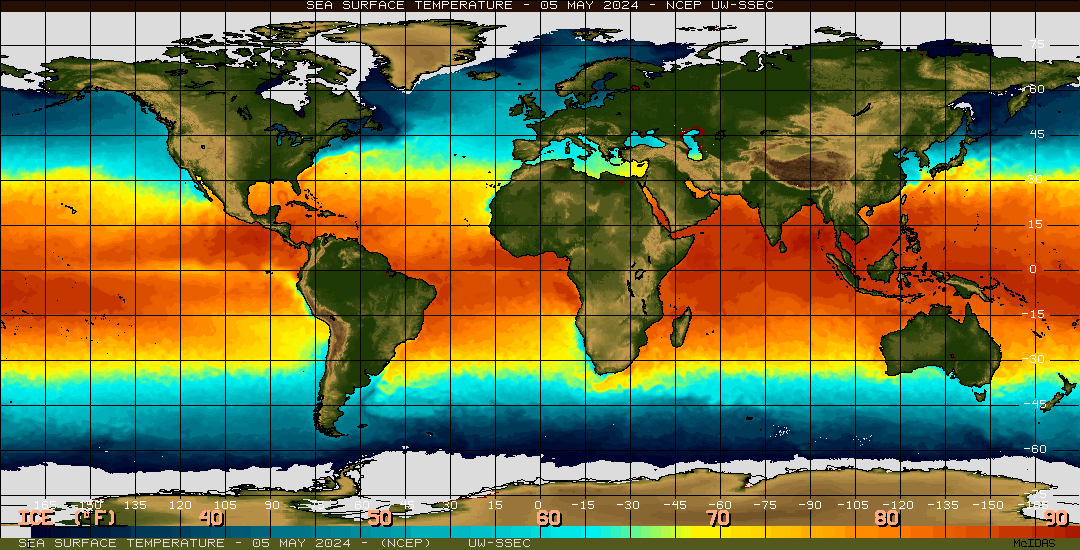
Meanwhile, rising temperatures make other risks worse as well. Warm air holds more moisture, so as temperatures rise there is more water available to the system. And warmer ocean temperatures mean there is more energy available to fuel severe storms like Irene. As Kevin Trenberth, a senior scientist at the National Center for Atmospheric Research, in Boulder, explained recently on the blog Climate Progress, “Owing to higher SSTs [sea surface temperatures] from human activities, the increased water vapor in the atmosphere leads to 5 to 10% more rainfall and increases the risk of flooding.” Also, “because water vapor and higher ocean temperatures help fuel the storm, it is likely to be more intense and bigger as well.”
When we add all of these risk factors together, we can say with a great deal of confidence that in the future, there will be more and more events like Irene. We can comfort ourselves by saying that this particular storm was not necessarily caused by global warming. Or we can acknowledge the truth, which is that we are making the world a more dangerous place and, what’s more, that we know it.
http://www.newyorker.com/online/blogs/newsdesk/2011/08/hurricane-irene-and-global-warming-a-glimpse-of-the-future.html
Above: Waves crash onto a road as Hurricane Irene arrives in Southampton, New York. Photography by Joe Raedle/Getty.