Blog Archive

Monday, December 27, 2010

Eric D. Prince et al., Fish. Ocean., 19 (2010), Ocean scale hypoxia-based habitat compression of Atlantic istiophorid billfishes

Fisheries Oceanography, 19(6) (2010) 448-462; doi: 10.1111/j.1365-2419.2010.00556.x


Ocean scale hypoxia-based habitat compression of Atlantic istiophorid billfishes


Eric D. Prince et al.

Abstract

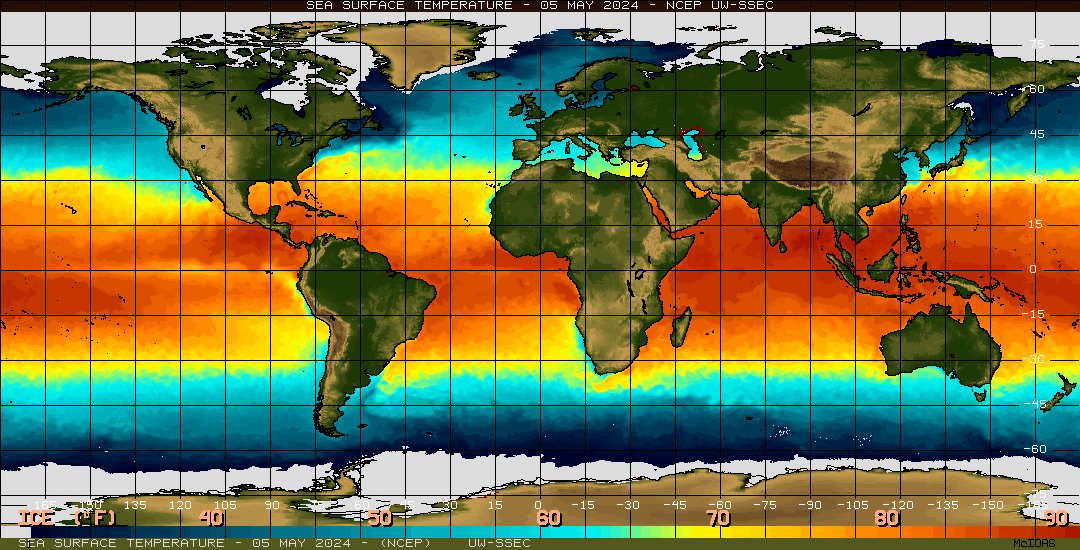
Oxygen minimum zones (OMZs) below near-surface optimums in the eastern tropical seas are among the largest contiguous areas of naturally occurring hypoxia in the world oceans, and are predicted to expand and shoal with global warming. In the eastern tropical Pacific (ETP), the surface mixed layer is defined by a shallow thermocline above a barrier of cold hypoxic water, where dissolved oxygen levels are ≤3.5 mL L−1. This thermocline (∼25–50 m) constitutes a lower hypoxic habitat boundary for high oxygen demand tropical pelagic billfish and tunas (i.e., habitat compression). To evaluate similar oceanographic conditions found in the eastern tropical Atlantic (ETA), we compared vertical habitat use of 32 sailfish (Istiophorus platypterus) and 47 blue marlin (Makaira nigricans) monitored with pop-up satellite archival tags in the ETA and western North Atlantic (WNA). Both species spent significantly greater proportions of their time in near-surface waters when inside the ETA than when in the WNA. We contend that the near-surface density of billfish and tunas increases as a consequence of the ETA OMZ, therefore increasing their vulnerability to overexploitation by surface gears. Because the ETA OMZ encompasses nearly all Atlantic equatorial waters, the potential impacts of overexploitation are a concern. Considering the obvious differences in catchability inside and outside the compression zones, it seems essential to standardize these catch rates separately to minimize inaccuracies in stock assessments for these species. This is especially true in light of global warming, which will likely exacerbate future compression impacts.


Link:  http://onlinelibrary.wiley.com/doi/10.1111/j.1365-2419.2010.00556.x/abstract

Sunday, December 26, 2010

Dennis Markatos-Soriano: 5 Energy Predictions for 2011: Solar Soars As Fossil Fuel Costs Grow

5 Energy Predictions for 2011: Solar Soars As Fossil Fuel Costs Grow

gas-pump1
by Dennis Markatos-Soriano, Sustainable Energy Transition, December 26, 2010 

The year ahead appears poised to be another wild ride for the energy sector. A recovering US economy combined with continued strength in China and India will send oil and coal prices toward highs not seen since 2008. Meanwhile, solar and wind power will become increasingly attractive investments and grow their share of the energy pie.

Oil: Gasoline Gets Expensive Again

The financial collapse of September 2008 took the wind out of oil’s bullish run from $10 per barrel in the late 1990s to over $140 in mid-2008. But as the US economy regains its footing (even the housing sector by late 2011), gasoline is shooting back up toward $4 per gallon. Prices recently climbed back above $3 per gallon – meaning that Americans are again sending over $1 billion per day for overseas imports to serve our oil addiction.  It’s time for our country to embrace the bicycle and more walking – but I’ll leave more on that for another post. I see gasoline increasing toward $3.25+ on $100 oil due to an inability of non-OPEC producers to increase supply that matches higher demand, particularly from China. And most OPEC nations seem reluctant to increase output levels while prices rise.

Coal: Historic Highs on Their Way

China and India are becoming huge net importers of coal and this development will tighten the global coal market significantly. South African, Indonesian, and Australian exports will be maxed out, sending importers on the lookout for coal from the US and elsewhere. Supply increases take time so the tight global market will likely push spot market coal prices above $150/ton, potentially challenging mid-2008 levels above $175/ton.

Natural Gas: Rising from the Bottom

Natural gas prices in the US have remained relatively low even during the recent 18-month run-up in oil prices, a departure from the usual price link between oil and natural gas. This divergence in price is due to recent growth in natural gas supply based on new drilling techniques that use potent chemical mixes to extract shale gas formerly too difficult to retrieve. Unless the extraction techniques are slowed on water pollution concerns, this drilling is poised to keep a lid on natural gas prices and thus help natural gas keep market share it took from coal in 2009. I see natural gas rising from the bottom ~$4 per MMBtu lately but staying mostly restrained below $7 (still significantly below the summer 2008 high ~$10).

Solar: The Boom Continues

2010 is turning into another record year for solar. Globally, solar installations grew more than 100% to ~16 GW. This occurred in a year many analysts were fretting for solar due to accelerated cuts in German subsidies. But Germany still grew tremendously thanks to lower solar costs and the country remains almost half of the global market. German officials are considering more accelerated subsidy cuts in 2011 to slow their overheated market greater than 7 GW this year, causing some analysts to worry again. But I see next year playing out in a similar way to 2010, with another record year ahead as the global solar market passes 20 GW.


I expect German subsidy reductions will help solar consumers everywhere enjoy 10-15% price reductions for solar PV panels, bringing them below $1.50 per Watt. The strong recent profits of many solar producers such as First Solar, Trina, Suntech, Yingli Green Energy, JA Solar, and Jinko show that most producers can handle a price drop of this magnitude. Such a low price for modules and panels would send solar electricity prices below 30 cents per kWh for residential, below 20 cents per kWh for commercial, and ~15 cents per kWh for industrial. This is a price that can now compete without subsidies in islands and remote applications that don’t yet have access to a grid (a market that includes over a billion people). And sufficient subsidies in growing solar markets such as the US, China, India and Italy are poised to take up the slack from German demand stagnation until larger grid parity is achieved in 2012-2015.

Wind

After record growth in 2009, 2010 has been a tough year for the wind industry. Low natural gas prices and the lack of new projects signed during the Great Recession has dramatically slowed wind power installation in the US and most of the world. Though China wind growth continues unabated due to its white-hot electricity demand growth and may have just passed the US as the global leader of wind power capacity. But the stagnant overall market this past year means that wind turbine prices are lower and getting more competitive with fossil fuel-fired electricity. Look for wind turbine prices below $1.45 per Watt and total cost including installation below $2 per Watt onshore. The offshore market has higher installation costs that are offset by more consistent winds and close proximity to demand centers (cities). Offshore wind can begin to take growing market share in 2011.

Efficient Renewables Closing the Gap with Fossil Fuels

As described above, I see solar and wind power prices further converging with fossil fuel prices in 2011. Therefore renewable subsidies can be lowered in cash-strapped countries without risking market collapse. Increasingly efficient lighting (such as CFLs and LEDs) and other appliances will open up solar and wind resources to the masses, especially when complemented by efficient active transport by bicycle along growing greenways and bike lanes. The key potential game changer for oil and other commodity prices would be a significant weakening or strengthening of the dollar, either stoking higher prices in the US or taming the increase, respectively.

The energy system is in for big change during 2011. Investment in efficiency and renewables will pay off for early adopters as cleantech moves from niche market to more mainstream source.

George Monbiot: Cold Burn. Yes, the extreme cold in the UK right now really could be a result of global warming


Cold Burn

Yes, the extreme cold in the UK right now really could be a result of global warming
By George Monbiot. Published in the Guardian 21st December 2010
There were two silent calls, followed by a message left on my answerphone. She had a soft, gentle voice and a mid-Wales accent. “You are a liar Mr Monbiot. You and James Hansen and all your lying colleagues. I’m going to make you pay back the money my son gave to your causes. It’s minus 18 degrees and my pipes have frozen. You liar. Is this your global warming?”. She’s not going to like the answer, and nor are you. It may be yes.
There is now strong evidence to suggest that the unusually cold winters of the past two years in the UK are the result of heating elsewhere. With the help of the severe weather analyst John Mason and the Climate Science Rapid Response Team(1), I’ve been through as much of the scientific literature as I can lay hands on. (Please also see John Mason’s article, which explains the issue in more detail(2)). Here’s what seems to be happening.
The global temperature maps published by NASA present a striking picture(3). Last month’s shows a deep blue splodge over Iceland, Spitsbergen, Scandanavia and the UK, and another over the western US and eastern Pacific. Temperatures in these regions were between 0.5 and 4 degrees colder than the November average from 1951 and 1980. But on either side of these cool blue pools are raging fires of orange, red and maroon: the temperatures in western Greenland, northern Canada and Siberia were between two and ten degrees higher than usual(4). NASA’s Arctic oscillations map for December 3-10 shows that parts of Baffin Island and central Greenland were 15 degrees warmer than the average for 2002 to 2009(5). There was a similar pattern last winter(6). These anomalies appear to be connected.
The weather we get in UK winters, for example, is strongly linked to the contrasting pressure between the Icelandic Low and the Azores High. When there’s a big pressure difference, the winds come in from the south-west, bringing mild, damp weather from the Atlantic. When there’s a smaller gradient, air is often able to flow down from the Arctic. High pressure in the icy north last winter, according to the US National Oceanic and Atmospheric Administration(NOAA), blocked the usual pattern and “allowed cold air from the Arctic to penetrate all the way into Europe, eastern China, and Washington DC”(7). Another US agency, NASA, reports that the same thing is happening this winter(8).
Sea ice in the Arctic has two main effects on the weather. Because it’s white, it bounces back heat from the sun, preventing it from entering the sea. It also creates a barrier between the water and the atmosphere, reducing the amount of heat that escapes from the sea into the air. In the autumns of 2009 and 2010, the coverage of Arctic sea ice was much lower than the long-term average: the second smallest, last month, of any recorded November(9). The open sea, being darker, absorbed more heat from the sun in the warmer, light months. As it remained clear for longer than usual, it also bled more heat into the Arctic atmosphere. This caused higher air pressures, reducing the gradient between the Iceland Low and the Azores High.
So why wasn’t this predicted by climate scientists? Actually it was, and we missed it. Obsessed by possible changes to ocean circulation (the Gulf Stream grinding to a halt), we overlooked the effects on atmospheric circulation. A link between summer sea ice in the Arctic and winter temperatures in the northern hemisphere was first proposed in 1914(10). Close mapping of the relationship dates back to 1990, and has been strengthened by detailed modelling since 2006(11,12,13,14,15,16).
Will this become the pattern? It’s not yet clear. Vladimir Petoukhov of the Potsdam Institute says that the effects of shrinking sea ice “could triple the probability of cold winter extremes in Europe and northern Asia.”(17) James Hansen of NASA counters that 7 of the past 10 European winters were warmer than average(18). There are plenty of other variables: we can’t predict the depth of British winters solely by the extent of sea ice.
I can already hear the howls of execration: now you’re claiming that this cooling is the result of warming! Well yes, it could be. A global warming trend doesn’t mean that every region becomes warmer, every month. That’s what averages are for: they put local events in context. The denial of manmade climate change has mutated first into a denial of science in general, now into a denial of basic arithmetic. If it’s snowing in Britain, a thousand websites and quite a few newspapers tell us, the planet can’t be warming.
According to NASA’s datasets, the world has just experienced the warmest January-November since the global record began, 131 years ago(19). 2010 looks likely to be either the hottest or the equal hottest year. This November was the warmest on record(20).
Sod all that, my correspondents insist: just look out of the window. No explanation of the numbers, no description of the North Atlantic Oscillation or the Arctic Dipole, no reminder of current temperatures in other parts of the world, can compete with the observation than there’s a foot of snow outside. We are simple, earthy creatures, governed by our senses. What we see and taste and feel overrides analysis. The cold has reason in a deathly grip.
www.monbiot.com
References:
7. J. Overland, M. Wang, and J. Walsh, 14th October 2010. Arctic Report Card.http://www.arctic.noaa.gov/reportcard/atmosphere.html
9. National Snow and Ice Data Center (NSIDC) reported on 6 December 2010. ***
10. HH Hildebrandsson, 1914. Cited by Dagmar Budikova, 2009. Role of Arctic sea ice in global atmospheric circulation: A review. Global and Planetary Change Vol 68, pp 149–163. doi:10.1016/j.gloplacha.2009.04.001
11. There’s a review of the science until early 2009 at:
Dagmar Budikova, 2009. Role of Arctic sea ice in global atmospheric circulation: A review. Global and Planetary Change Vol 68, pp 149–163. doi:10.1016/j.gloplacha.2009.04.001
12. More recent modelling work is summarised by James Overland and Muyin Wang, 2010. Large-scale atmospheric circulation changes are associated with the recent loss of Arctic sea ice. Tellus Vol 62A, pp1–9. doi: 10.1111/j.1600-0870.2009.00421.x
See also the following recent papers:
13. Jennifer A. Francis et al, 2009. Winter Northern Hemisphere weather patterns remember summer
Arctic sea-ice extent. Geophysical Research Letters, Vol. 36, L07503, doi:10.1029/2009GL037274.
14. Meiji Honda, Jun Inoue and Shozo Yamane, 2009. Influence of low Arctic sea-ice minima on anomalously cold Eurasian winters. Geophysical Research Letters, Vol. 36, L08707. doi:10.1029/2008GL037079.
15. Vladimir Petoukhov and Vladimir* Semenov, 2010. A link between reduced Barents-Kara sea ice and cold winter extremes over northern continents. Journal of Geophysical Research, Vol 115, D21111. doi:10.1029/2009JD013568.
16. Chunzai Wang, Hailong Liu, Sang-Ki Lee, 2010. The record-breaking cold temperatures during the winter of 2009/2010 in the Northern Hemisphere. Atmospheric Science Letters, Volume 11, Issue 3, pp 161–168. doi: 10.1002/asl.278
18. James Hansen, Reto Ruedy, Makiko Sato and Ken Lo, 13th December 2010. GISS Surface Temperature Analysis: 2010 - Global Temperature and Europe’s Frigid Air.http://data.giss.nasa.gov/gistemp/2010november/
19. James Hansen et al, as above.
20. James Hansen et al, as above.

Greg Craven telling truth to power at AGU on December 15, 2010

What's the Worst That Could Happen? A Veteran of the Climate Change Culture Wars Explains Why America Isn't Listening and What To Do About It.
by Greg Craven
Transcript of an over-the-top but still valuable presentation (edited for stumbles) to ~200 scientists
American Geophysical Union Fall Meeting
Dec. 15, 2010
This is not a talk. This is a primal scream. For help. For salvation. For the lives of my children. And I will not apologize. I will not yield. I will charge the stage and scream my message if I must. I am in the zone. I am over the edge. I am gone. I am enlightened. I am maniacal. I am insane. I am terrified at what I have just become. All of my life has been to serve this single moment. And you may need to forcibly remove me to the hospital, screaming like a madman. But you will not stop me. For I have revelation to bring.
I am a fanatic of science. I love you, and what you do. What I bring you is the loving but eviscerating criticism of the outsider looking in. So I'm going to give you the gift of brutal frankness. Because you have done an abhorrent job at communicating climate change to the public so far. Because what you've been giving them up to now, as a scientist, is information. And with the terrifying divergence between public opinion and scientific opinion in the last few years, with public opinion in the U.S. plummeting over the last several years, that strategy clearly is not working.
So it is time for a radical change in tactics. [Applause.]
Don't applaud just yet, I'm about to call you insane. [Mild laughter.]
The definition of insanity is doing the same thing over and over and expecting a different result. And I'm sorry you have to hear this, but it's best to come from a friend. You have become insane. You have brought them information when they needed emotion. What you must bring them now, as a citizen, as a father, as a mother, as an aunt, as a grandparent, who knows better than anyone else what the physical world will bring in the future, you must give them yourself.
This talk was supposed to be about becoming better communicators about climate change. My answer to the question "What can be done about it?"—about America not listening—was "You must become better communicators by understanding the psychology of the individual, the foibles of the brain, how they are exploited by the ruthless denial machine, and how we can work with that."
And in short order I'd vomited up 20,000 words, just to give the briefest of overviews. I am filled with it. But when the hard drive with the only copy of my speech text on it crashed at 1 a.m. this morning, I realized, thankfully, that that would have been the wrong speech to give. Tragically ineffective. Because I realized, as the result of two watershed conversations yesterday, one with a marketing expert on the plane, and one with an atmospheric chemist at dinner, that my message to you now is that you muststop communicating as scientists. You must begin communicating as citizens, as a father, as a mother, with whatever feelings are in your heart, with your fears, speak to them of your hopes, let them know about your befuddlement at the divergence. And tell them frankly, forthrightly, sincerely, about any terror that you are ignoring, with your head down, soldiering on, hoping that someone, somewhere, sometime will fix the problem.
Well I've got sober news for you. You, in this room, in this community of science—you are that someone. You are the ones we have been waiting for. You are the last battle reserves in civilization's last stand. And you damn well need to saddle up and come down off that hill as the cavalry, to turn the tide of battle when all hope seems lost. So sound your bugle call and come down into the bloody fray.
My journey in climate change has gone from dawning realization, to "holy shit!" to terror and fierce urgency to protect my children, and now sadly, inevitably, to despair. And to leaving the ship to itself, to build my lifeboat for my family, before what others have wrought take us below the icy water. You say you want to have an effect on the public? If you trod a journey at all similar to mine, think, visualize, take five minutes to meditate on the impact it would have if you took off your goddamned scientist hat for just a moment, and put on your citizen hat. And said frankly to the public through the largest mouthpiece you can: "As a scientist, here's my understanding. As a citizen, here's my hope, my vision. And as a mother, here's my contingency plan, here's my lifeboat."
If you obliterated your comfort zone and the hard line of purity of your scientific sensibilities--that you do cling to, with the faith of a god--and you actually went forth as an actual advocate, a sentiment normally anathema to the constitution of a scientist, imagine if you went out into the fray bearing your heart, with your emotion and the authority of your understanding as your weapon. For what you've been giving them as a scientist up to now is information, and with that increasing divergence between public and scientific opinion, we must change.
Shall we continue with that? You have been insane. . . . Please—come back to the world. Nothing we've done has worked. Giving information hasn't worked. Climate crusades haven't worked. Striving for social change hasn't worked. Pleading on behalf of future generations, and all the other species on the planet which are threatened by the next great extinction from us--on the magnitude of the Permian extinction, where over 90% of every organism on the world perished. Despite all our hopes, even finally getting an enlightened leader, who gets it, who gets the problem, and installs a perfect team of science advisors. Even that hasn't worked, and that seemed our last best hope. In fact we've gone backwards.
So . . . what hope do we have left? You. And the gravitas that your scientific authority brings you. It is an unbearable burden to you, I know. It is inconceivable to you. It is anathema.
But sometimes burdens that cannot be borne must be borne, because there is no remaining option. That moment is now.
I went through the harshest, most unimaginable hell doing my climate change crusade over the last three years. Three and a half years ago I posted a single innocuous video on YouTube—a ten minute whiteboard lecture drawing a decision grid for risk analysis, proposing how confused but sincere laypeople can possibly make sense out of the shouting match about climate change when they don't have the expertise, they don't have the time, they don't have the training, and they've got to get their kids to school. I gave the URL of that video to exactly 153 people: my students, on the last day of the school year. The following Monday it had 10,000 views. As of now, three and a half years later, it has over 8 million.
If you harness the power of the viral--if you design whatever best, most authentic message you can from your heart and your fears and your intellect, and you insert into that message "Please—pass this on. And when you do, tell them to pass it on, and preserve that message. . . ." Then you touch ten people, they each touch ten people, and as I'm sure you're aware, in just 5 steps that's over 100,000 people that have been touched. By you. That is power. Claim it.
The reason it was hell for three and half years is because I was also a teacher. And I was supposed to be a father, and a husband, although I abrogated all three of those responsibilities to work through the night, every night, for weeks and months at the end. Abusing my body with a case of red bull every 24 hours, and sleeping 2 hours, and then continuing. Because I had that fierce urgency that the time has passed. That with the inertia of policy, of social change, of energy infrastructure, of the collapse of carbon emissions, and of the inertia of the climate system, by the time you realize it is your last stand, by the time you can identify what is indeed your last chance—because we've been saying it for years, devaluing its effect—it is in the past. It can only be identified with certainty in hindsight.
And you've got to know: the public requires certainty before making a decision. They misunderstand the basic nature of science, and that science cannot provide certainty--it can only provide "good enough to go on." So tell them that. Unhitch them from the con man in their brains that keeps them holding on to something that they can never get from science, which is "The Answer."
So why did I go through that hell? Why did I knowingly and deliberately choose to inflict grievous harm to my wife, my children, and my health? Why did I do it? You might guess I did it for the security of my daughters. You might guess I did it for personal satisfaction. Or ego. You might guess I did it for moral absolution so that I could say I did all I could. But the brutal fact is: I did it because I couldn't not do it. Every minute of every day I realized that I was constitutionally incapable of not doing this, because it concerned my two beautiful daughters and their safety. Because the decision to have kids is the decision to have your heart walking around raw outside of you for the rest of your life. And I discovered that I have a Papa Bear button and I will go through anything, I will sacrifice anything, I will bear the impossible and destroy anything that gets between me and their safety. And at this point in the game, I will abandon ship and run for the lifeboat with my family to create what resilience I can for me and mine.
How tragic, how sad, how pathetic that I have come to that. But that pathos has power if it is shared in a way that no information, no data, no evidence can ever bring. You know it is the last stand when the hippie liberals start to collaborate with the survivalist nut jobs. And that's happening right now. I'm a member of those discussion forums. (Don't tell anyone please, especially my wife.) [Mild laughter.]
If you share even a pale shade of that sentiment, it is your supreme moral duty to come down into the fray and fight for your life, your kids' lives, and our life, because the civilization that has so generously granted you your position--make no mistake--your position of extreme privilege in the history of humankind, the privilege of pursuing your own selfish gratification in the pleasure of finding things out. . . . That civilization is teetering over the precipice, staring down into the abyss. You must be the hand that reaches out, grabs hold, and pulls us back from the brink of extinction. The hand of a hero. You.
You must stop selfishly pursuing your pleasure in finding things out. To be frank: fuck your research. We. Need. You. I know I am almost certain to outrage you with my impertinence and the audacity of my message. And my word choice, for substituting 'fuck for 'screw'. [Mild laughter.] And that's the lesson you must absorb into the fiber of your being, for the meaning of communication is not what you intend, or the information. The meaning of communication is the response it elicits in the listener. And that's where we have failed. So while you may be likely to forget the details of my rant, you will always feel the emotional aftertaste of it. And that is the purpose of communicating the science of climate change to the lay public. To give them an emotional aftertaste.
Every single time I've spoken, and caused a huge emotional impact--I've had people come up to me crying, saying that's the best speech they've ever heard in their lives, and I thought I had bombed the speech! I'd done it at the last minute, my script wasn't complete, I'd fumbled it, I'd gone over time, I'd talked too fast. I was horrified. And people came up saying, "Thank you. You changed my life!" What the hell? What was going on? So I asked, a bunch. And they all said it was because I had opened my heart to them. Because I was authentic. Because I came alive when I was talking about my daughters.
Note: none of those are intellectual things. None of those are even information. The are not abstract, they are concrete. They are not in the future, they are in the present. They are now. They're not a concern. They are a terror. They are a fierce and eviscerating urgency. What they are is impacting. What they are is the potential to spread like a virus and enlist an army to fight the war for civilization itself, and for you and your family along with it. You are not doing it for "the children." You are doing it for your children.
Because you can't not do it. Your role, your job--the one we have assigned you and gladly supported--has always been to stand on the hill overlooking the bloody battlefield and give reconnaissance and convey information about what's ahead. But there comes a time in the last stand for every single support troop, no matter how far removed, to pick up a weapon, come down into the fray, and fight to the death for what they stand for. To charge into the face of annihilation itself and fight with their teeth, tearing out the jugular of their enemy with their bloody mouth if they have no weapons left. That time is now.
If you do not believe that, if you do not feel that, I challenge you to be intellectually honest--that part of you that you hold up as better than any other profession, and I support you in that opinion--you are the only rational thinkers on the planet. Beware, psychological research shows that people don't generally make decisions rationally. If you don't agree with this--that this is the time to radically challenge your comfort zone, and your traditional mores of never letting feelings or opinions on policy pass your lips--I'm not going say "If not now, then when?" I'm going to say: detail an operational definition of a test to test whether a situation would merit that extreme action or not. Come up with the characteristics. And then I defy you to compare them to the situation now. If you do that, forget everything I've said. I absolve you. That's all I ask. But if your intellectually honest operational definition tells you that the time is now. . . .
You shall spill your blood. You shall soak the earth with your viscera. You shall scream the alarm until your throat runs raw. And then you shall pick up rocks and bang them together as the alarm until your hands become a bloody pulp. What shall be your future regrets if you choose? Will they be that you stood by, hopeful, desperate, unaffected, impotent while your children were slaughtered before you? Or will it be that you went too far, destroyed your career, your life, in your panic to save them?
This is your power. This is your purpose. This is your insignificant role in an infinite, uncaring universe. You will not be denied. You will charge the stage of the world and scream your message if you must. This is the most important thing here. This is the most important thing now. And I shall not yield. I shall not back down. I shall stand. And I will be heard. Because I have need to be all afire, for I have mountains of ice about me to melt.
Incidentally, nothing you can say critically after this can touch me. It's strange to feel what it's like to be inside the madman. I've always wondered. But it struck at 1 a.m. this morning. And I know what the face of god--which I don't believe in--but this morning, for the first time in my life, I feel that level of faith: that this is what must be done.
[Sigh of relief that this exceedingly uncomfortable speech is done.]
I am Greg Craven. I am my daughter's . . . [unable to speak] . . . I'm kind of exhausted. . . .
I am Greg Craven. Hear my name. I am my daughter's father. On behalf of my children, please--I beseech you--and I thank you for your time. Sorry.
[Applause. Polite? Mildly enthusiastic? Scornful? Happy this ridiculously inappropriate rant is done? (I'm told this was the first time the word "fuck" has ever been used onstage at an AGU meeting, with hundreds of thousands of scientific presentations given over the decades.  So . . . I've got that going for me.)]
[End of speech]

Global Glass Onion news from December 25, 2010

This guy is an awesome collector of news, so I lifted a lot:


Ingredient Costs Expected To Push Food Prices Up - As previously reported here, more large packaged-food makers have announced and/or implemented price hikes to their product lines. In the meantime, the US largest, Kraft Foods is in the process of rolling out price hikes on about 40 percent of it’s line-up.  Analysts are suggesting the rate of inflation on food could more than double in the next year. General Mills hasn’t raised food prices in 3 1/2 years.  The maker of Bisquick, Betty Crocker, Pillsbury and Gold Medal flour has stated it will raise prices on 25% of it’s cereal line on Monday. Last month, McDonald’s said it is planning on raising prices in order to offest rising costs. Kellogg is expected to raise cereal prices along with Unilever and Nestle who have signaled increases are likely in the near future. “The USDA doesn’t like to break bad news” says one agricultural economist that expects at a least a doubling in food inflation next year.Coffee, sugar, wheat and corn are at all highs not seen in 2 to 20 years on the commodity markets. 

Old, high grain prices near - Grains are all approaching their recent highs. Wheat, corn, and soybeans are within striking distance of the two-year highs made for all three crops.  Grains have some great examples in the commodities of just how volatile things can be, as sugar, cotton, and coffee all are giving the grains a sign of the type of strength that commodities can get when people are short supplies.   Coffee prices ran to new highs today, running above their recent highs and now at all-time highs for coffee prices, well above 2008 price levels. Cotton has rallied to new highs as well, impressive after a huge price dip of about 20% from the highs made in November.  Since then, cotton prices have rallied back to new highs, above the November highs, and the volatility seems to be accelerating (limit up Tuesday and limit down Wednesdday).  These are indeed interesting times, especially when one realizes that cotton competes with corn, soybeans, and wheat acreage in the cotton belt.  Surely there will be more cotton acres in 2011, and that will come at the expense of the other 3 major crops when they have no room to give up acreage.  That makes for some interesting times as we go into spring - with the battle for acreage heating up between the big 4 crops.

Sugar May Reach 40 Cents as Weather Hurts Global Crops, Thai Miller Says - Raw sugar in New York may climb to 40 cents a pound by January on concern dry weather in Brazil, the biggest exporter, and record rainfall in Australia may tighten supplies, said the Thai Sugar Millers Corp.  “Bad weather conditions are threatening crops around the globe,” said Vibul Panitvong, executive chairman of the company that represents the country’s 46 millers. Thailand is the world’s second-largest exporter. Raw sugar in New York yesterday gained to the highest level in 30 years on speculation that shipments from Brazil and India, the top producers, may be too low to meet demand. Rain in Queensland state this month after Australia’s wettest spring on record forced producers to leave some cane unharvested. “Frost in Florida and heavy snow in Europe will also worsen the supply situation,”

Mexico hedges against corn inflation - Mexico has taken the unusual step of insuring itself against the effect of rising corn prices on tortilla, a food staple for millions in the country, in the latest sign of growing concern about food inflation in emerging countries.  Rising food inflation has become a big headache in countries from Mexico to China and India as bad weather has ruined crops, forcing prices up.  Food accounts for up to half of all household spending in emerging countries, compared to just 10 to 15 per cent in Europe and the US.  The move by Mexico, disclosed by its economic minister, came as the quoted price of corn in Chicago hit a two-year high on the back of a smaller-than-expected harvest in the US, which accounts for more than half of the world's exports.  Bruno Ferrari told local media on Wednesday the government had bought futures contracts to fix the cost of corn. "The prices are guaranteed," he said. "The supply is also guaranteed ... until the third quarter of the next year." A government official confirmed his comments.

U.S. Ethanol Subsidies: A Bad Policy That Refuses to Die - U.S corn farmers and ethanol distillers are among those celebrating passage of last week's tax bill. A little-noticed provision of the law extends ethanol tax credits ($.45 per gallon, plus a bonus for small producers) and tariffs on ethanol imports ($.54 per gallon), previously set to expire at the end of 2010. Should the rest of us also celebrate? I think not. U.S. ethanol policy contradicts every principle of sound economics. It encourages use of fuels whose opportunity costs are high while discouraging use of those whose costs are low. It promotes trade flows that run opposite to comparative advantage. It creates new market failures instead of correcting those that already exist.

The Touch and Feel of Record Cotton Prices - Cotton prices hit another record earlier today. As noted by the San Francisco ChronicleCotton futures in New York jumped to a record, gaining by the daily limit for a third day, on signs that growers may struggle to meet mounting demand from China, the world’s biggest consumer. Cotton for March delivery gained 2.7 percent to $1.5412 a pound. Prices have more than doubled this year, heading for the biggest annual gain since 1973. What’s behind this move? Well, judging by everything I’ve read so far, it sounds like good old-fashioned demand (up) and supply (down). But just to be sure, I decided to check in with two famous economic commentators. I tracked down the talking “bunnies” over on YouTube (ht SK) and, sure enough, they agree that supply and demand fundamentals are what’s driving the cotton market.* Unfortunately, the critters have a much more serious tone than in theirfamous explanation of QE2 (except for some gratuitous language at the very end, which tries to pay homage to their earlier work). But they do speak with authority

A Physicist Solves the City - West illustrates the problem by translating human life into watts. “A human being at rest runs on 90 watts,” he says. “That’s how much power you need just to lie down. And if you’re a hunter-gatherer and you live in the Amazon, you’ll need about 250 watts. That’s how much energy it takes to run about and find food. So how much energy does our lifestyle [in America] require? Well, when you add up all our calories and then you add up the energy needed to run the computer and the air-conditioner, you get an incredibly large number, somewhere around 11,000 watts. Now you can ask yourself: What kind of animal requires 11,000 watts to live? And what you find is that we have created a lifestyle where we need more watts than a blue whale. We require more energy than the biggest animal that has ever existed. That is why our lifestyle is unsustainable. We can’t have seven billion blue whales on this planet. It’s not even clear that we can afford to have 300 million blue whales.” The historian Lewis Mumford described the rise of the megalopolis as “the last stage in the classical cycle of civilization,” which would end with “complete disruption and downfall.” In his more pessimistic moods, West seems to agree: he knows that nothing can trend upward forever.“The only thing that stops the superlinear equations is when we run out of something we need,” West says. “And so the growth slows down. If nothing else changes, the system will eventually start to collapse.

Dreaming of a trashy Christmas - In the period between Thanksgiving and New Year's, American households generate 25% more waste. That's about 1 million extra tons of trash each year, according to the Environmental Protection Agency. That includes everything from food to wrapping paper, holiday decorations, packaging, and old cellphones and laptops that are unceremoniously dumped as soon as the latest models emerge from under the Christmas tree. "The holiday season is especially important for us because all of the festivities, gift giving and traveling does create a lot more waste than at other times of the year," said Jennifer Berry, spokeswoman with Scottsdale, Arizona-based Earth911.

Success of Appliance Rebate Program Raises Questions about Environment, Economy - In Thursday’s press release (“Appliance Rebate Program Exceeds All Expectations, Benefits Thousands of Marylanders”), the Maryland Energy Administration (MEA) applauds the success of the Energy Efficient Appliance Rebate Program.  This program “encouraged residents to replace outdated, inefficient appliances in their homes with ENERGY STAR-rated equivalents,” according to the press release.  The MEA administered rebates for “more than 18,500 clothes washers, 4,500 refrigerators and 6,000 central air conditioners and air sources heat pumps,” according to Thursday’s press release.  Funded by the American Recovery and Reinvestment Act, the MEA estimates the program will save $19.6 million and 9,000 MWh.   The program, which ended on November 12, 2010, does more than demonstrate the commitment of Marylanders to saving energy.  It also raises a few important questions.   What role should the federal and state government play in promoting energy efficiency and responsible environmental stewardship?  Can programs to promote energy efficiency help enliven our economy? 

EPA Takes Control of Texas Carbon Permits as Perry Rejects U.S. Regulation - Bloomberg - The U.S. Environmental Protection Agency said it will take control of carbon-emission rules in Texas after GovernorRick Perry rejected new federal regulations intended to combat climate change.  The EPA will decide directly on greenhouse-gas permits for companies seeking to build or upgrade power plants and oil refineries in Texas, the agency said today in a statement. The EPA’s nationwide carbon rules, imposed under the Clean Air Act, take effect Jan. 2.  Texas is the only state that has refused to implement the new rules.

A Coming Assault on the E.P.A. - Republicans in the next Congress are obviously set on limiting the Environmental Protection Agency’s authority under the Clean Air Act to regulate a wide range of air pollutants — even if it means denying the agency money to run its programs and chaining its administrator, Lisa Jackson, to the witness stand. Fred Upton, who will become the next chairman of the House Energy and Commerce Committee, says he plans to call Ms. Jackson so often for questioning that he’ll guarantee her a permanent parking space on Capitol Hill. President Obama’s political advisers have shown little enthusiasm for environmental issues. On the other hand, his chief environmental adviser is Carol Browner, herself a former E.P.A. administrator whose aggressive clean-air initiatives in the Clinton years would never have prevailed without Oval Office support.  Which is just what Ms. Jackson will need in the months ahead. On her plate is: a proposed rule reducing pollutants like sulfur dioxide, the acid rain gas, from power plants east of the Mississippi River; a first-of-its-kind rule limiting toxic pollutants like mercury, which the agency has been ducking for years; and, most problematic, proposals imposing new “performance standards” on power plants to limit greenhouse gases.

Terminating Climate Change - In an interview with editors at the Los Angeles Times, the outgoing California governor said he was in "no rush" to find a new job when his term ends next month. But asked specifically whether he'd consider a post working for President Obama, he said yes and began to "riff on his credentials," according to the Times' David Lauter. Schwarzenegger, who counts legislation combating global warming as one of his signature achievements in office, suggested he might be interested in a post dealing with energy or the environment. "I'm a big believer in environmental issues," Schwarzenegger said, who added that he wanted a post where he could use his "celebrity power … knowledge and experience" to impact public policy. "I've traveled the world. … I'm very familiar with the world."

Cold Burn There is now strong evidence to suggest that the unusually cold winters of the past two years in the UK are the result of heating elsewhere. With the help of the severe weather analyst John Mason and the Climate Science Rapid Response Team(1), I’ve been through as much of the scientific literature as I can lay hands on. (Please also see John Mason’s article, which explains the issue in more detail(2)). Here’s what seems to be happening. The global temperature maps published by NASA present a striking picture(3). Last month’s shows a deep blue splodge over Iceland, Spitsbergen, Scandanavia and the UK, and another over the western US and eastern Pacific. Temperatures in these regions were between 0.5 and 4 degrees colder than the November average from 1951 and 1980. But on either side of these cool blue pools are raging fires of orange, red and maroon: the temperatures in western Greenland, northern Canada and Siberia were between two and ten degrees higher than usual(4). NASA’s Arctic oscillations map for December 3-10 shows that parts of Baffin Island and central Greenland were 15 degrees warmer than the average for 2002 to 2009(5). There was a similar pattern last winter(6). These anomalies appear to be connected.

2010 Extreme Weather: Deadliest Year In A Generation - This was the year the Earth struck back. Earthquakes, heat waves, floods, volcanoes, super typhoons, blizzards, landslides and droughts killed at least a quarter million people in 2010 - the deadliest year in more than a generation. More people were killed worldwide by natural disasters this year than have been killed in terrorism attacks in the past 40 years combined.  "It just seemed like it was back-to-back and it came in waves," said Craig Fugate, who heads the U.S. Federal Emergency Management Agency. It handled a record number of disasters in 2010.  "The term '100-year event' really lost its meaning this year."

The year of living dangerously. Masters: “The stunning extremes we witnessed gives me concern that our climate is showing the early signs of instability” - Munich Re: "The only plausible explanation for the rise in weather-related catastrophes is climate change" - A year of deadly record-smashing weather extremes from Nashville to Moscow, from the Amazon to Pakistan, ended with staggering deluges from California — “Rainfall records weren’t just broken, they were obliterated” — to Australia: More than a year’s rain fell in Carnarvon in just 24 hours this week.  A monsoonal low hovering over the Gascoyne dumped a 24-hour record 204.8mm, smashing the previous record of 119.4mm set on March 24, 1923. NASA reported that it was the hottest ‘meteorological year’ [December to November] on record and likely to be the hottest calendar year. Uber-meteorologist and former NOAA Hurricane hunter Dr. Jeff Masters of Weather Underground reported, “The year 2010 now has the most national extreme heat records for a single year–nineteen. These nations comprise 20% of the total land area of Earth. This is the largest area of Earth’s surface to experience all-time record high temperatures in any single year in the historical record.”

NOAAFuture of Arctic Sea Ice and Global Impacts -The diagram in Figure 2 (right) explains the Arctic climate feedback and its global implications.  As the earth warms, the warming is amplified in the Arctic. More sea ice melts in the summertime, and with more open water, heat from the sun is absorbed in the ocean. With the warmer Arctic, winter freezeup is delayed, resulting in thinner wintertime ice.  The heat absorbed into the ocean in summertime is released to the atmosphere in the fall, warming the atmosphere and changing the atmospheric pressure surfaces over the pole.  This dome of warm air and elevated atmospheric pressure surfaces over the pole changes the Arctic atmospheric wind patterns, allowing outbreaks of cold Arctic air to the south.

Growing Hypoxic Zones Reduce Habitat for Billfish and Tuna, which could increase vulnerability to fishing- Billfish and tuna, important commercial and recreational fish species, may be more vulnerable to fishing pressure because of shrinking habitat according to a new study published recently in the journal Fisheries Oceanography by scientists from NOAA, The Billfish Foundation, and University of Miami Rosenstiel School of Marine and Atmospheric Science. An expanding zone of low oxygen, known as a hypoxic zone, in the Atlantic Ocean is encroaching upon these species’ preferred oxygen-abundant habitat, forcing them into shallower waters where they are more likely to be caught. While these hypoxic zones occur naturally in many areas of the world’s tropical and equatorial oceans, scientists are concerned because these zones are expanding and occurring closer to the sea surface, and are expected to continue to grow as sea temperatures rise.

Ocean acidification may disrupt the marine nitrogen cycle - Ocean acidification, the result of roughly a third of global CO2 emissions dissolving into the seawater and lowering its pH, has complicated and poorly understood consequences for ocean ecosystems. Scientists already know that a drop in ocean pH affects the carbon cycle, reducing the carbonate ions that organisms like coralsmollusks and crustaceans use to build shells and external skeletons. Now, a new study shows that a CO2-induced increase in acidity also appears to disrupt the marine nitrogen cycle. The finding, to be published December 21 in the Proceedings of the National Academy of Sciences, could have ramifications for the entire ocean food web. The authors of the study examined a specific step in the marine nitrogen cycle, called nitrification, in whichmicroorganisms convert one form of nitrogen, ammonium, into nitrate, a form plants and other marine microorganisms require to survive.

EIA Projects Climate Catastrophe - The U.S. Energy Information Administration has projected that the United States will lead the world into catastrophic global warming over the next twenty five years. In its 2011 Annual Energy Outlook, the EIA predicts that energy-related CO2 emissions will “grow by 16 percent from 2009 to 2035,” reaching 6.3 billion metric tons of carbon dioxide equivalent (or 1.7 GtC): The fuel mix the EIA projects remains predominantly coal and oil, with a moderate rise in renewable energy, whose pollution benefits are offset by growth in energy demand: This pathway would almost certainly commit the world to catastrophic climate change, including rapid sea level rise, extreme famine, desertification, and ecological collapse on land and sea. Right now, the United States, with less than five percent of global population, produces 20 percent of global warming pollution. Center for American Progress senior fellow Joe Romm published in Nature in 2008 that humanity “must aim at achieving average annual carbon dioxide emissions of less than 5 GtC [5 billion metric tons of carbon, or 18 billion metric tons of carbon dioxide] this century or risk the catastrophe of reaching atmospheric concentrations of 1,000 p.p.m.”

More scrapped plans, retirements for U.S. plants in 2010 - Over the course of this year, more U.S. coal-fired power plants were tapped for retirement and more proposed plants were canceled than in 2009, according to an end-of-year report by the Sierra Club, which is fighting the continued use of coal. Data collected by the advocacy group show that 38 coal plant projects were dropped or delayed in 2010, up from 26 the year before and 27 in 2008. Meanwhile, power producers announced plans to retire 48 existing plants this year, four times as many as in 2009 and 12 times as many as in the year before that. The retirements announced this year would take 12,000 megawatts of coal-fired power off the grid — roughly 4 percent of the nation’s total coal-fired capacity and enough electricity to power about 6 million American homes.

African Huts Far From the Grid Glow With Renewable Power - Every week, Ms. Ruto walked two miles to hire a motorcycle taxi for the three-hour ride to Mogotio, the nearest town with electricity. There, she dropped off her cellphone at a store that recharges phones for 30 cents. Yet the service was in such demand that she had to leave it behind for three full days before returning.  That wearying routine ended in February when the family sold some animals to buy a small Chinese-made solar power system for about $80. Now balanced precariously atop their tin roof, a lone solar panel provides enough electricity to charge the phone and run four bright overhead lights with switches.

Spain’s Cuts to Solar Aid Draw Fire - A group of international investors has called on the Spanish government to reconsider plans to cut costly subsidies for solar power, saying they would cause a wave of defaults and more bad loans for Europe’s banks. Tom Murley, head of the renewable-energy team at U.K. private-equity firm HgCapital, said the changes represented a “breach of trust” that would increase regulatory uncertainty in the Spanish renewables industry.

The long and the short of energy efficiency - Originally on Market Forces: David Owen asks a provocative question in the current New Yorker: If our machines use less energy, will we just use them more? He more or less says yes. The real answer comes in two parts. For now—over days, weeks, months, and even years—energy efficiency will decrease energy use and emissions. Screw a compact fluorescent light (CFL) bulb into a socket that used to hold an incandescent and your energy use will go down. Chances are you won't leave the lights on four times as long just because light now costs a quarter. Over time—years, decades, centuries, and millennia—more energy efficient lights and appliances will indeed mean that more people use more of them. CFLs make light more affordable. That doesn't matter to the typical U.S. household, where few light sockets remain unused because of energy costs. But globally—and over time—it does make a difference.

‘Resisting The Green Dragon’: Religious Right Attacks Environmentalism As ‘Deadly’ And ‘Destructive’ In New DVD Series - Various conservative Christian leaders have united with the Cornwall Alliance for the release of a shocking new 12-part DVD series, "Resisting The Green Dragon," that attempts to debase and discredit the environmental movement by portraying it as "one of the greatest deceptions of our day" that is "seducing your children" and "striving to put America and the world under its destructive control." The hyperbolic accusations spewed throughout the video give it the appearance of a ridiculous parody, calling environmentalism "deadly," a "cult" and a "spiritual deception." Unfortunately, the comical PSA is anything but a joke.In the video, David Barton, founder of WallBuilders, attests that environmentalists' "false assertions are based more on their own morbid pessimistic fears, not on any good science," while the president of the Southern Baptist Convention's Ethics and Religious Liberty Commission, Dr. Richard Land, says, "Environmentalists have a long history of believing and promoting exaggerations and myths" -- statements both so steeped in irony that they are hardly worth parrying.

The U.S.S. Prius - And what could save America’s energy future — at a time when a fraudulent, anti-science campaign funded largely by Big Oil and Big Coal has blocked Congress from passing any clean energy/climate bill — is the fact that the Navy and Marine Corps just didn’t get the word.  God bless them: “The Few. The Proud. The Green.” Semper Fi.  Spearheaded by Ray Mabus, President Obama’s secretary of the Navy and the former U.S. ambassador to Saudi Arabia, the Navy and Marines are building a strategy for “out-greening” Al Qaeda, “out-greening” the Taliban and “out-greening” the world’s petro-dictators. Their efforts are based in part on a recent study from 2007 data that found that the U.S. military loses one person, killed or wounded, for every 24 fuel convoys it runs in Afghanistan.  Mabus’s argument is that if the U.S. Navy and Marines could replace those generators with renewable power and more energy efficient buildings, and run its ships on nuclear energy, biofuels and hybrid engines, and fly its jets with bio-fuels, then it could out-green the Taliban — the best way to avoid a roadside bomb is to not have vehicles on the roads — and out-green all the petro-dictators now telling the world what to do.

U.S. Demand For Gas At Start Of Long-Term Decline - The world's biggest gas-guzzling nation has limits after all. After seven decades of mostly uninterrupted growth, U.S. gasoline demand is at the start of a long-term decline. By 2030, Americans will burn at least 20 percent less gasoline than today, experts say, even as millions more cars clog the roads. The country's thirst for gasoline is shrinking as cars and trucks become more fuel-efficient, the government mandates the use of more ethanol and people drive less. "A combination of demographic change and policy change means the heady days of gasoline growing in the U.S. are over," said Daniel Yergin, chairman of IHS Cambridge Energy Research Associates

Can Natural Gas Replace Oil for Diesel? - In a series of posts (most recent here), I’ve noted that oil and natural gas prices have become unhinged from each other. Oil (denominated in $ per barrel) used to trade at 6 to 12 times the price of natural gas (denominated in $ per MMBtu). But lately that ratio has been north of 20, thanks to a surfeit of new gas in the United States (and elsewhere) and, recently, growing global demand for oil. The wide spread between oil and natural gas prices provides a tempting incentive for any innovators who can figure out how to use natural gas, rather than oil, to make transportation fuels. Over at the New York Times, Matthew Wald identifies one possibility, using natural gas to produce diesel:

Neb. lawmakers: Pipeline route is out of our hands - The State of Nebraska should explore enacting regulations to protect landowners and taxpayers from problems associated with pipelines, three state senators said Wednesday.  But the state is probably powerless to tell a Canadian company to reroute a proposed 36-inch crude-oil pipeline around the sensitive, groundwater-rich Sand Hills region, they said.  "I think the siting is a federal issue," said State Sen. Annette Dubas of Fullerton.

Will shale gas turn out to be an energy sink? - If you externalize the costs of a business activity, it means other people pay the costs--environmental, social and otherwise--and you get the profits. It goes on all the time in extractive industries such as oil and natural gas and mining. And, it is also a natural strategy for manufacturers who dump their pollution into the air and the water. It's even practiced in finance where the executives of Wall Street banks have managed to collect the bonuses made off a phony boom in the last decade and saddle taxpayers with the losses of the inevitable bust caused by bad and often fraudulent loans, misleading derivative contracts, and leveraged speculation in stocks and commodities. If the loopholes are there, you can be assured that people in business will take advantages of them. That's exactly what is happening in the business of shale gas drilling. Drillers are exempt from federal clean air and water regulations under a bill shepherded through Congress in 2005 by none other former Halliburton CEO Dick Cheney in his capacity as the then vice president of the United States. (Halliburton is one of the world's largest providers of drilling fluids for shale gas drilling and other oil and gas drilling operations.) That means the drillers can externalize the environmental costs of these hazardous fluids and other materials needed to fracture the shale and thereby free the natural gas. They can foist those costs on nearby residents in the form of ruined water supplies, toxic air pollution, poisoned land, and health problems for humans and animals.

Tech Talk: When oil isn’t crude and gas isn’t gas, the Eagle Ford Shale play - There are two figures that keep cropping up when folk write about the production of oil, one number is the daily flow rate for crude oil, and while the EIA report that the peak production year to date was in 2005, when the world produced 73.72 mbd, the IEA have reported that the peak occurred in 2006. Yet just last week the IEA raised their forecast for next year’s oil demand to 88.8 mbd and there is about 15 mbd difference between the two numbers. So you might ask what causes this, where do these additional liquids come from and what is their future, relative to that of crude alone.  Part of the answer comes from what are known as refinery gains, the fact that when you crack a high-carbon crude into lower carbon products in a refinery then there is a gain in volume. In Oil 101 Morgan gives this processing gain in volume to be around 2.2 mbd. In addition there is the rising level of bio-fuel production, about 900,000 bd of ethanol in the US alone, for example. But the largest volume comes from the liquids associated with the production of natural gas.  These are collectively described as Natural Gas Liquids (NGL) and condensate.

Central Arkansas growing weary of relentless tremors - Although drilling for natural gas has been ruled out as a cause for the quakes, experts want to continue looking at salt water disposal wells, said Scott Ausbrooks, geohazards supervisor for the Geological Survey. Disposal wells occur when drilling waster is injected back into the earth after drilling.  Earlier this month, the Arkansas Oil and Gas commission issued an emergency moratorium on permits for new disposal wells. The commission will ask for a six-month extension for the moratorium at a January regulatory meeting.  The state also will soon become one of a few to require companies to disclose the chemicals used in fracking fluid, the water-and-chemical solution used in high-pressure drilling operations, said Shane Khoury, deputy director and general counsel for the Arkansas Oil and Gas Commission.

Big Oil Money Working to Rewrite History of Gulf Oil Disaster - Big polluters have spent years funding think tanks to give a veneer of credibility to their push for profit. I mean, if the CEO of Exxon Mobil comes out and says Congress should roll back the Clean Air Act, it would just rally people behind pollution limits. So instead, Exxon Mobil has given more than $2 million to the Competitive Enterprise Institute to say it for them. Now the polluter-funded think tank-media complex has a new target – whitewashing the Gulf oil disaster. Robert Nelson has an opinion piece made up to look like a news article in the Weekly Standard claiming the Gulf oil disaster caused little damage and calling anyone who would claim otherwise “secular equivalents to the devil.” Why would a public policy professor at the University of Maryland write something not just so wrong, but with such an angry, combative tone? A look at Nelson’s extracurricular activities reveals a web of connections to big polluters like Koch Industries & Exxon Mobil:

Chevron to Spend $4 Billion on U.S. Gulf Discovery - Chevron Corp., the second-largest U.S. oil company, plans to spend $4 billion to get crude and natural gas from its Big Foot discovery in the U.S. Gulf of Mexico.The field, which contains the equivalent of 200 million barrels of crude, is scheduled to come online in 2014, the San Ramon, California-based company said in a statement today. It will be capable of producing 75,000 barrels of oil and 25 million cubic feet of gas a day, the company said. The discovery is about 225 miles (360 kilometers) south of New Orleans in waters 5,200 feet deep.

Saudi Aramco LPG exports to fall 24% in 2011 to 6.5 million mt - Saudi Aramco's LPG export for 2011 will slump 23.5% to anywhere between 6 million mt and 6.5 million mt as it diverts product to meet local demand, term customers and trade sources said Tuesday. The Middle Eastern oil giant is expected to close 2010 with total exports of anywhere between 8 million mt and 8.5 million mt, in line with the volumes it shipped out in 2009.  "The reduction in export volume is led by the need to meet domestic demand, particularly, from Saudi Kayan Petrochemical Company," Kayan's steam cracker complex located in Jubail Industrial City, centers around a naphtha- and LPG-fed steam cracker, which has a nameplate capacity of 1.33 million mt/year of ethylene. Saudi Aramco produces around 18 million mt/year of LPG of which, the lion's share -- that is not shipped out -- finds use in the domestic petrochemical industry.

Interactive: The Global Oil Diet - The United States is the third-largest producer of oil in the world, but it is by far the world's largest consumer of oil, using about twice as much oil as it produces. The highly-localized distribution of oil around the world and differences in regulatory approaches to drilling mean that among large economies there is enormous variation in the ratio of oil produced to oil consumed: Japan, Germany and South Korea must import practically all the oil that they use, while Canada and Russia are heavy users as well as net exporters of oil.

Russian Oil Production Stats  - We seem to be having Oil Production Update Week here at Early Warning, and today it's Russia (currently the largest oil producing nation in the world).  In the 2007, 2008 timeframe it appeared that the Russian resurgence was over with production peaking and starting to go down, as Russia struggled to maintain production from all the worked-over Soviet-era oilfields in West Siberia, with limited new projects to bring on line.  But then in 2009 there was another half mbd increase (apparently mainly from East Siberia).  Now in 2010, it appears this latest increase has been slowing down again, though I certainly wouldn't want to call peak on it.

Iranian Oil Production Stats  - The graph above shows Iranian oil production according to four data sources: the Oil and Gas Journal (but only updated through 2008), the International Energy Agency (IEA), the US Energy Information Agency (EIA), and the Joint Oil Data Initiative (JODI). There is considerable dissension over what Iranian production has been doing. The Iranians themselves reported to JODI that their production fell sharply about 0.5mbd when OPEC decided to cut back production to support prices in the great recession. However, the US EIA and the IEA in Paris report that any cutback was non-existent (EIA) or small and uneven (IEA), with production recently presumably being pretty much Iranian capacity. Since the current Iranian regime is clearly dishonest and corrupt about other matters (its nuclear facilities, its presidential elections), I'm inclined to believe the international agencies.  Therefore, I wouldn't expect large increases in Iranian production any time soon.

Cuts in Subsidies Quadruple Gas Prices in Iran - After midnight on Sunday, the price of subsidized gasoline jumped to 38 cents a liter from 10 cents a liter. Similar increases went into effect for compressed natural gas and diesel fuel, with subsidy reductions for other commodities expected to be phased in gradually. Security forces with riot shields took positions at gas stations in Tehran, bracing for a possible repeat of the unrest that followed the introduction of gasoline rationing in 2007, but there were no reports of violence.  Policy makers have described the program as a “rationalization” or “targetization” of Iran’s vast and inefficient subsidies system, but some analysts fear it could increase living costs for millions of middle- and low-income households.

Iran's experiment with Reaganomics --- Within hours of speaking with the BBC and Voice of America, both in Persian, Fariborz Raisdana, a leading Iranian economist, was arrested by the security forces of the Islamic Republic. On both these occasions, Raisdana was severely critical of Iranian President Mahmoud Ahmadinejad's program of substantially cutting governmental subsidies, in what amounts to "the biggest surgery" to the Iranian economy in 50 years. Initiated on Sunday, the government's actions introduced a four-fold rise in the price of gasoline and seriously cut government food subsidies, including, literally, people's daily bread. The current 20% inflation rate, some economies believe, will in fact increase after these new "austerity measures." Even economists sympathetic to Ahmadinejad's policies warn of higher inflation and characterize his claim of "zero inflation" as disingenuous.