Blog Archive

Saturday, October 30, 2010

Coward, national traitor, job-killer Charles Koch refuse to debate California Marine Corps veteran Joel PowerVote.CA Francis


by Joseph Romm, Climate Progress, October 30, 2010

This week Joel Francis, a senior at Cal State Los Angeles and a Marine Corps veteran, flew to the Wichita, Kansas, headquarters of Koch Industries.  His mission was to knock on Charles Koch’s door and demand he defend his involvement in Prop 23.  CAP’s Jorge Madrid has the story.
“If you are going to try to hurt the economy of a state you don’t even live in, then you ought to have the courage to explain yourself in person,” said Francis.
Koch is one of the primary financial backers of a California ballot initiative, Prop 23, which aims to effectively repeal the states landmark climate and clean energy law.

Francis, a former student body president and member of the university’s debate team made public his intentions to travel to Koch Industries last week, in a video statement in which he challenged Koch to a public debate – “anytime, anywhere.”
The video has since gone viral on the web, and Francis garnered over 1,200 supporters in just a few days.

Silence and Security Guards
Not surprisingly, Koch has remained silent about his support for Prop 23, issuing only a “no comment” statement through 4 security guards posted at the building’s entrance when Francis and his coalition arrived.  The security guards then ordered the group to leave the premises.
“Unfortunately, though he prepared for our visit today, he didn’t prepare a statement or anything else in return. I find that to be a slap on the face to millions of young Californians,” Joel said.
While it was expected that Koch would not answer debate challenge, Francis and the opponents of Prop 23 can still claim a strong victory for mobilizing the voice of California’s university students.

The group organizing with Francis, PowerVote.CA, is a project of the California Student Sustainability Coalition, a network of thousands of university students in chapters that reach many of the state’s college campuses.  The group has been operating since 2001.

An Uncertain Future for College Grads
Joel Francis, like many college seniors, is nervous about his future job prospects after graduation.  He believes Prop 23 passing will make his prospects even worse.
“The job market is tough, and all graduating seniors are having to open the scope of the jobs they look at. We have to look as far and wide as possible, not just at the traditional jobs in our field…A million dollar donation [by Koch] is threatening the job opportunities out there for graduates like me.”
He has reason for concern. Numerous studies have indicated that Prop 23 threatens half a million jobs in California. This loss does not include the 100,000 new clean energy jobs California can expect to create in the next 10 years, and billions of dollars in private investmentthe state could unlock if its environmental and clean energy policies are upheld (and Proposition 23 is voted down).

Francis thinks of himself as “just one college student,” but he knows he can make his voice, and the voice of his generation, be heard on this critical issue.  He will continue his fight until Election Day – you can support Joel’s efforts here.

Jellyfish 'may benefit from ecosystem instability': Regional seas of the northeast Atlantic have been warming for the past 15 years at a rate not experienced in recent centuries

Jellyfish 'may benefit from ecosystem instability'


Moon jellyfish (Image: Michelle Cronin/Coastal & Marine Resources Centre)  
The causes behind jellyfish blooms are difficult to disentangle, say the authors
 
A team of researchers have been trying to identify how jellyfish may benefit from marine ecosystems destabilised by climate change and overfishing.
There is concern that a rise in jellyfish numbers could prevent depleted commercially important fish stocks recovering to historical levels.

However, a study by European scientists says more data is needed to understand what is happening beneath the waves.

The findings are set to be published in the journal Global Change Biology.

Researchers from the UK and Ireland said samples collected from the Irish Sea since 1970 have recorded an increase in material from cnidarians (the division of the animal kingdom that includes jellyfish and coral), "with a period of frequent outbreaks between 1982 and 1991."

"There does appear to have been an increase in abundance since 1994 for the Irish Sea," said co-author Christopher Lynam, a researcher at the Centre for Environment Fisheries and Aquaculture Science (Cefas).

The team added that previous studies had recorded changes to marine ecosystems as a result of various factors, such as the removal of top predators, and changes to the distribution and characteristics of plankton.

'Jellyfish joyride'
These changes have led to a growing concern that the oceans may become increasingly dominated by jellyfish because "many gelatinous zooplankton species are able to increase in abundance rapidly and adapt to new conditions."

Jellyfish bloom (Image: PA) 
Vast blooms of certain jellyfish can cause havoc in affected areas

In recent years, there have been a number of examples of sudden blooms of jellyfish in European waters -- including the Irish, Mediterranean and Black seas -- which have killed fish and closed beaches.

In 2007, an invasion of mauve stingers (Pelagia noctiluca) wiped out Northern Ireland's only salmon farm, killing more than 100,000 fish.

However, Dr Lynam was keen to point out that the team's study was dominated by the common moon jellyfish (Aurelia aurita), which was not responsible for wiping out the salmon.

The main concern, the team wrote, was the establishment of a "never-ending jellyfish joyride" in which the creatures become so established that it makes it almost impossible for commercial fish stocks to return to historical levels.

But Dr Lynam told BBC News: "I don't think that the hypothesis that jellyfish will come into an area and dominate, not allowing anything to come back again, is really supported.

"Such a nightmare scenario does not seem to be the case, when you consider the data and studies that have been carried out."

Complicated picture
He explained that the team looked at whether factors such as changes to the climate and overfishing were responsible for the increase in jellyfish abundance.

"It is quite a complicated set of possible linkages that need to be drawn, which we really only have a vague insight at the moment.

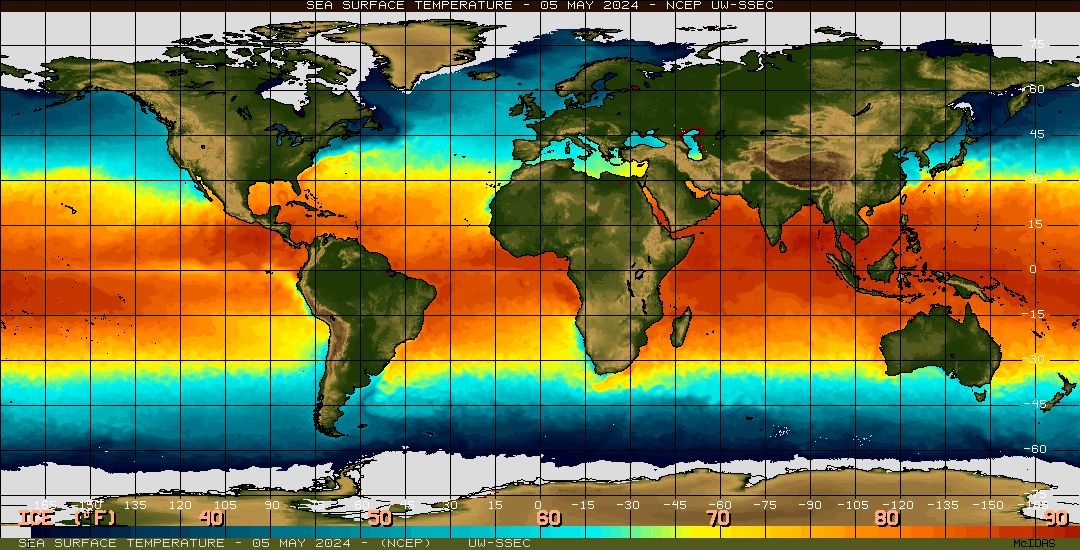
"For the recent period where we have good data, it appears as if sea surface temperature is the most important variable.

"This does not necessarily prove it of course, but it does appear to be benefiting jellyfish."

The team, using data provided by the UK Met Office, commented: "The regional seas of the northeast Atlantic have been warming for the past 15 years at a rate not experienced in recent centuries."

Overfishing has also been linked to the rise of jellyfish populations. Research suggests that commercial fishing during the 20th Century had resulted in a change in the Irish Sea's ecosystem.

The researchers wrote: "The overexploitation of herring during the late 1970s was followed by a period of ecosystem instability in the 1980s in which the frequency of occurrence of cnidarian material... rose to high levels, indicating outbreaks of jellyfish."

Dr Lynam added: "If you take out a lot of the plankton feeders, there could be more food for jellyfish so they might become more abundant. There may be feedback mechanisms that we are not aware of, so there does need to be further study."

But he cited examples in the North Sea and Black Sea where fish species had declined, leading to an increase in jellyfish abundance, but the introduction of measures such as limits on catches had resulted in a recovery of fish stocks.
The team urged for the monitoring of jellyfish to continue, and concluded: "The move to ecosystem-based fisheries management requires extensive ecological knowledge and an understanding of the risks posed by any indirect effects... of our utilisation of the sea's resources."

Link:  http://www.bbc.co.uk/news/science-environment-11644500

Friday, October 29, 2010

Richard Somerville editorial: How much should the public know about climate science?


by Joseph Romm, Climate Progress, October 29, 2010
Unfortunately, the world needs to take firm action about the threat of manmade climate change within the next decade…   Realistically, there may be no chance to educate the general public in depth about the science so quickly. Meanwhile, a well-funded and effective professional disinformation campaign has been successful in sowing confusion, and many people mistakenly think climate change science is unreliable or is controversial within the expert community. Thus, the more urgent task for us scientists may well be to give the public guidelines for recognizing and rejecting junk science and disinformation. If students today, who will be adults tomorrow, can understand and apply these guidelines, they may not need a detailed knowledge of climate change science. To that end, I offer the following six principles.
Climatologist Richard C. J. Somerville is Distinguished Professor Emeritus at Scripps Institution of Oceanography.  Although I did my thesis research at Scripps, we’ve never formally met.

Somerville helped organize the must-read 2007 Bali Climate Declaration, in which more than 200 of the world’s leading climate scientist explained why we must limit total warming to no more than 2 °C.

He sent me a new essay published online with open access in Climatic Change, “How much should the public know about climate science?“  He notes that recent research shows “global emissions of greenhouse gases must peak and decline within the next decade if global warming is to be limited to a level that avoids severe climate disruption” (see figure below).

Given the success of the most effective, immoral, and self-destructive disinformation campaign in US history, scientists need to focus their messaging on a handful of key points.  Somerville offers six:

  1. The essential findings of mainstream climate change science are firm. The world is warming. There are many kinds of evidence: air temperatures, ocean temperatures, melting ice, rising sea levels, and much more. Human activities are the main cause. The warming is not natural. It is not due to the sun, for example.  We know this because we can measure the effect of man-made carbon dioxide and it is much stronger than that of changes in the sun, which we also measure.
  2. The greenhouse effect is well understood. It is as real as gravity. The foundations of the science are more than 150 years old. Carbon dioxide in the atmosphere traps heat. We know carbon dioxide is increasing because we measure it. We know the increase is due to human activities like burning fossil fuels because we can analyze the chemical evidence for that.
  3. Our climate predictions are coming true. Many observed climate changes, like rising sea level, are occurring at the high end of the predicted range. Some observed changes, like melting sea ice, are happening faster than the anticipated worst case.Unless mankind takes strong steps to halt and reverse the rapid global increase of fossil fuel use and the other activities that cause climate change, and does so in a very few years, severe climate change is inevitable. Urgent action is needed if global warming is to be limited to moderate levels.
  4. The standard skeptical arguments have been refuted many times over. The refutations are on many web sites and in many books. For example, the mechanisms causing natural climate change like ice ages are irrelevant to the current warming. We know why ice ages come and go. That is due to changes in the Earth’s orbit around the sun, changes that take thousands of years. The warming that is occurring now, over just a few decades, cannot possibly be caused by such slow-acting processes. But it can be caused by man-made changes in the greenhouse effect.
  5. Science has its own high standards. It does not work by unqualified people making claims on television or the Internet. It works by expert scientists doing research and publishing it in carefully reviewed research journals. Other scientists examine the research and repeat it and extend it. Valid results are confirmed, and wrong ones are exposed and abandoned. Science is self-correcting. People who are not experts, who are not trained and experienced in this field, who do not do research and publish it following standard scientific practice, are not doing science. When they claim that they are the real experts, they are just plain wrong.
  6. The leading scientific organizations of the world, like national academies of science and professional scientific societies, have carefully examined the results of climate science and endorsed these results. It is silly to imagine that thousands of climate scientists worldwide are engaged in a massive conspiracy to fool everybody. It is also silly to think that a few minor errors in the extensive IPCC reports can invalidate the reports. The first thing that the world needs to do to confront the challenge of climate change wisely is to learn about what science has discovered and accept it. The IPCC Fourth Assessment Report at www.ipcc.ch is a good place to start.
The Fourth Assessment is a good place to start, but, as Somerville notes, the science in many aspects has become more dire (see “An illustrated guide to the latest climate science” and The Copenhagen Diagnosis).  For refuting the standard talking points of the anti-science disinformers, I’d recommend starting with Skeptical Science.
Somerville notes:
The CO2 growth rate has increased substantially over the period of record. It was 1.4 ppm per year on average from 1960 to 2005, but 1.9 ppm per year for the decade from 1995 to 2005, the highest recorded for any decade since measurements began…  The observed increasing acidification of the world oceans, which may have profound biological implications, is also a serious consequence of adding CO2 to the atmosphere.
He presents this figure:
2C
Emissions pathways to give a 67% chance of limiting global warming to 2 ◦C above preindustrial temperatures. From: The Copenhagen Diagnosis, Updating the World on the Latest Climate Science (www.copenhagendiagnosis.com). Originally from German Advisory Council on Climate Change, Solving the Climate Dilemma: The Budget Approach, WBGU, Berlin, 2009. Creative Commons license.
Obviously, the all-too-willing takeover in this country of the conservative movement by the Tea Party makes it exceedingly unlikely we are going to hit one of those pathways (see Why the victory of the Tea Party extremists (backed by Big Oil) over the slightly less extreme GOP establishment (also backed by Big Oil) is good for progressives, but bad for climate and clean energy).  That doesn’t change the urgency of the messaging, but it does require an augmented strategy, which I will discuss post-election.

Link:  http://climateprogress.org/2010/10/29/richard-somerville-climate-science/

Models predict extreme precipitation, extremely low-pressure system for Northwest U.S. for November 1-2, 2010

Major Rain and Flooding Event Approaching


by Chris Mass, Cliff Mass Weather Blog, Seattle, Washington, October 28, 2010
Well, I was having some fun in my last blog, but this one will be serious. The reason? A major rain and potential flooding event may be coming, one that could impact some people's lives. But some uncertainty remains, and I will try to be upfront with that as well.

During the next few days, a disturbance off of Asia (Typhoon Chaba) will move northward, turn into a midlatitude cyclone and amplify into an extraordinarily deep, low-pressure center (see graphic). We are talking about 939 mb! (Compare that to the 955 mb over the Midwest that everyone was excited about two days ago.) There are so many isobars near that low the graphic is turning black!
PLEASE CLICK ON FIGURES TO ENLARGE

The monster storm, huge in scale and possessing hurricane force winds, will produce giant waves -- greater than 50 ft. high.  I could fill an entire blog about this storm...but there is a more acute worry here at home.

As the low pushes into the Gulf of Alaska it will result in the establishment of a very strong, moist current heading right for our region. You know the names -- "atmospheric river" is the generic term and our version is often called a "pineapple express."  The next graphic presents the early stages of this feature (Monday AM)....the total amount of water vapor in a vertical column is being shown:


You can see the current of moist air heading right for us.

Here is the 24-h rainfall prediction ending at 5 AM Tuesday. Red indicates 5-10 inches of precipitation over the Olympics, north Cascades, and mountains of southern BC. Precip decreases rapidly to the south.


A looks at a closer view for the same period below. A profound rainshadow will also exist NE of the Olympics. I am sure the National Weather Service will be putting out some statements on potential flooding of rivers coming off the Olympics and N. Cascades. At this point, it does not look like a situation that would produce urban flooding over the Puget Sound population areas.

The plume of atmospheric river air over us on Monday and Tuesday will feel warm, moist....almost tropical after the cold weather. Freezing levels will rise to 8,000-10,0000 ft., and a lot of the new snow will melt (sorry snow lovers).

I should be clear that there is often a lot of uncertainty with these cases of tropical storms converting into midlatitude systems. But the computer models have really locked on to this solution, and we are close enough now in time that I am believing it. Let's face it, it is really extraordinary we can do this at all.
Link:  http://cliffmass.blogspot.com/2010/10/major-rain-and-flooding-event.html

NOAA: Record high (94 °F) in Houston, TX, October 28, 2010; hottest temperature this late in the year


Hat tip to Climate Progress commenter Adam R.
SXUS74 KHGX 280752 CCA
RERHOU

RECORD EVENT REPORT...CORRECTED
NATIONAL WEATHER SERVICE HOUSTON/GALVESTON TX
250 AM CDT THU OCT 28 2010

...HOTTEST TEMPERATURES FOR SO LATE IN THE SEASON AT HOUSTON
INTERCONTINENTAL AND HOUSTON/HOBBY...

A RECORD HIGH TEMPERATURE OF 94 DEGREES WAS SET AT HOUSTON
INTERCONTINENTAL ON WEDNESDAY. THIS BREAKS THE OLD RECORD OF 91
DEGREES SET IN 1995. THIS IS ALSO THE HOTTEST TEMPERATURE EVER
RECORDED THIS LATE IN THE FALL SEASON AT HOUSTON. PREVIOUSLY...THE
LATEST THAT A TEMPERATURE THIS WARM OCCURRED IN HOUSTON WAS ON
OCTOBER 19TH...IN 2004.

THE LOW TEMPERATURE AT HOUSTON INTERCONTINENTAL ON WEDNESDAY WAS
ONLY 76 DEGREES. THIS TIES THE RECORD HIGH MINIMUM TEMPERATURE FOR
THE DATE LAST SET IN 1939.

A RECORD HIGH TEMPERATURE OF 92 DEGREES WAS SET AT HOUSTON/HOBBY
AIRPORT ON WEDNESDAY. THIS BREAKS THE OLD RECORD OF 90 DEGREES SET
IN 1970. THIS IS ALSO THE HOTTEST TEMPERATURE EVER RECORDED THIS
LATE IN THE FALL SEASON AT HOBBY. PREVIOUSLY...THE LATEST THAT A
TEMPERATURE THIS WARM OCCURRED AT HOBBY WAS OCTOBER 25TH...IN 1942.

Rated FALSE by the Truth-O-Meter (and James Hansen debunks Loughlin): House candidate Loughlin claims 94% of climate-warming carbon emissions are natural

House candidate Loughlin claims 94 percent of climate-warming carbon emissions are natural (rated FALSE by the Truth-O-Meter)


by The Truth-O-Meter, PolitiFact Rhode Island, October 29, 2010
We all know about the theory of climate change, the idea that the earth is gradually warming because of pollution. [Readers, please note that climate change is not an idea or a theory or an issue -- it is a fact.] Whenever the weather turns particularly hot or cold, we joke about it, often in supportive or derisive terms depending on our opinion on the issue.

Unlike some other Republicans who dismiss global warming, John Loughlin, who is running for Congress in the 1st District, has acknowledged that the climate is changing. However, he said during a September press conference, "I think the data is unclear as to the extent of man-caused climate change. When you look at the total percentage of greenhouse gas emissions, a good number of them, in fact, the vast majority of them, are naturally occurring."

He made a similar statement Oct. 19 during a WPRI/Providence Journal debate when challenged on the topic by his Democratic rival, David Cicilline. "I'm not a scientist but I did work for NASA and when I was at NASA we had a scientist who I actually did some of the press release work for by the name of Dr. James Hansen at the Goddard Institute for Space Studies. Dr. Hansen released a peer-reviewed paper in the '70s that talked about global cooling. And then it's only later that he's kind of gotten a conversion to global warming."

He went on to tell Cicilline, "I'm saying really the earth is warming, but it's not conclusively caused by man. It's not conclusive. I mean 94 percent of the carbon emissions which you so want to get rid of are caused by nature."

When people talk about carbon emissions, they are mostly talking about carbon dioxide, the gas we exhale and the gas plants need to grow. Unfortunately, when levels in the air become too high, it traps heat coming from the sun as part of the so-called "greenhouse effect." (Other gases such as methane and ozone also play a role, as do tiny particles known as aerosols.) The warmer air melts polar caps, raises sea levels and shifts ecosystems toward the poles. Plants and animals that can't adapt risk extinction.

Loughlin's 94-percent figure sounds very authoritative and specific. So we emailed Loughlin's campaign on Oct. 21, and called his spokeswoman a day later, to ask for the source. They have not responded.

Meanwhile, we emailed a copy of Loughlin's debate comment to Hansen.

"I never had any global cooling paper or talk or comment," he wrote back to us. "The change of carbon dioxide, the increase year to year is entirely human-made. There is an up-and-down flux caused by vegetation growing (sucking carbon dioxide from the air) and decaying in the winter (releasing carbon dioxide), which is large -- this fluctuation is natural and does not alter the annual mean increase due to humans. He is speaking nonsense."

So Hansen is saying that 0 percent of the increase in climate-changing carbon dioxide emissions is coming from nature, not the 94 percent claimed by Loughlin.

We still wondered where Loughlin might have gotten his 94-percent figure. So we contacted William F. Ruddiman, author of a widely used climate textbook who is at the University of Virginia in Charlottesville.

He agreed with Hansen, saying that nature sends a lot of carbon in and out of the atmosphere every year and the sources can be pinpointed because fossil-fuel carbon has a slightly different composition than the carbon that is constantly recycled by nature.

Before the industrial revolution, the atmosphere had roughly 600 billion tons of carbon dioxide, according to Ruddiman. Above-ground vegetation contains about 610 billion tons of carbon and the surface oceans contain about 1,000 billion tons. (There's another 1,550 billion tons or so hidden in the soil and more in the deep ocean, but that doesn't circulate fast enough to play a big role in changes over decades or centuries.)

Each year, the atmosphere and ocean exchange about 75 billion tons; another 100 billion tons go back and forth between the air and the vegetation.

"In those exchanges, the carbon is just moving back and forth in nature and in equal numbers, so there is no net gain to the atmosphere," Ruddiman said.

Now add in the pollution generated by humans.

"I think what humans are doing now is something like 30 billion tons of carbon dioxide per year," said Ruddiman. That amount is small compared with the amount shuttled back and forth between the air, ocean and vegetation, and perhaps half of that gets pulled out of the air.

So we did some math. When there's 175 billion tons going into the air from natural sources along with 30 billion tons of pollution (for a total of 205 billion tons), that's 85 percent from natural sources.

The only problem: the 175 billion tons comes back out every year, so when critics say humans are having only a small impact on the process, they are misunderstanding -- or misstating -- the process, Ruddiman said.

"The amount of carbon dioxide humans are putting into the atmosphere is smaller but it's not balanced, and so it builds up over time and it causes a sizable net gain," Ruddiman explained.

"It may be 10 billion tons a year but much of it builds up year after year after year," he said, and persists in the atmosphere, trapping heat like a chemical blanket.

Scientists who have used a variety of techniques to track earth's changing climate over hundreds of thousands of years have found data that show carbon dioxide levels during that period never grew faster than 30 parts per million per 1,000 years. Yet the level has risen by that amount in just the last 17 years, according to the Intergovernmental Panel on Climate Change, the international organization widely regarded by the scientific community as a leading authority on the topic.

The result is the warmer temperatures and melting icecaps widely documented around the globe.

And what about volcanoes? People think of them as sending lots of carbon dioxide in the air. It turns out that eruptions are a drop in the bucket, generating 0.2 billion tons annually, according to the U.S. Geological Survey.

We also asked Ruddiman about the concept of global cooling, which critics also focus on. The fact is, in the 1970s, geologists were saying earth was coming out of a warm period and destined for another ice age. Core samples taken from the ocean floor combined with other data had allowed them to track the timing of past ice ages as changes in the earth's orbit exposed the planet to varying amounts of sunlight.

But even as scientists were tracking those cycles, which extend over thousands of years, other researchers in the '70s were warning that a carbon dioxide build-up was going to disrupt that cycle and overwhelm the natural cooling trend.

"I remember thinking that probably in one thousand to two thousand years, at most, we would see snow start accumulating in the high latitudes in the Northern Hemisphere," Ruddiman said. "That was reasonable from what we knew from ice age cycles. What very few of us were aware of was the buildup of carbon dioxide. Most of us are geologists, not geochemists," he said, explaining that by the 1980s the problem had become obvious.

"The same people who said, 'If nature remains in control we're going into a glaciation in the next 1,000 or 2,000 years' turned around and said, 'Yeah, but nature's not in control. Humans are intervening much faster than nature can do the job and so we're going into a warmer time,' " Ruddiman recalled.

"It's been made to sound like scientists are flip-flopping, but it's just the natural evolution of science," he said. "You broaden your point of view as you gain information that changes your conclusions. And that's what happened."

Ultimately, the Loughlin campaign did not provide any evidence that nature is responsible for the buildup of carbon dioxide in the atmosphere, which is the key problem stoking the fears of global warming. And the NASA scientist he mentioned told us Loughlin's comments were "nonsense."

There's plenty of room to debate aspects of climate change, such as the best way to prevent climate-related problems, how much money should be spent on prevention, and whether it's worth the investment if other countries aren't willing to seriously limit their carbon emissions.

But Loughlin's suggestion that nature is largely responsible for the looming problem is wrong. We rate his claim as False.

IPCC was not wrong about the Amazon's high sensitivity to drought

The Grumble in the Jungle

by Rob Painting, Skeptical Science, October 29, 2010
An article in a British newspaper claimed that the Intergovernmental Panel on Climate Change (IPCC) published wrong information about the Amazon Rainforest in their 2007 report. The issue centred on the statement that about 40% of the Amazon was susceptible to the effects of drought, or more specifically "slight reductions in rainfall".
The Amazon is the world's largest tropical rainforest, and due to its immense size, has a global effect on the Earth's climate. Despite being well adapted and resilient to wet and dry periods which occur throughout the year, the rainforest is vulnerable to extended periods of drought. Any major decline in the health of the Amazon rainforest is likely to impact the world climate.
The skeptic claims relate to section 13.4.1 of the IPCC Fourth Assessment Report (2007) which made the statement: 'Up to 40% of the Amazonian forests could react drastically to even a slight reduction in precipitation; this means that the tropical vegetation, hydrology and climate system in South America could change very rapidly to another steady state, not necessarily producing gradual changes between the current and the future situation' (Rowell and Moore, 2000)
The reference is to a non-peer reviewed report prepared by the World Wide Fund for Nature (WWF) which itself cites an original peer reviewed study (Nepstad 1999) as the basis for the claim. The citations in the WWF and IPCC reports are not complete, Nepstad 1994Nepstad 1999 and Nepstad 2004support the claim that up to half the Amazon rainforest were severely affected by drought. Further studies, carried out since the 2007 IPCC report, reinforce the Amazon's susceptibilty to long term reductions in rainfall .
The IPCC could have avoided confusion by simply citing the peer reviewed studies themselves, rather than the WWF report and perhaps "slight reduction" should have been better defined or qualified. Despite the error in citation, the statement made by the IPCC is factually correct. Maybe the last word should go to the lead author of the papers upon which the statements were based, Daniel Nepstad, who made a public press release to clear up the mainstream media confusion over the subject. Nepstad concludes:
"In sum, the IPCC statement on the Amazon was correct. The report that is cited in support of the IPCC statement (Rowell and Moore 2000) omitted some citations in support of the 40% value statement.
 This post is the Basic Version (written by Rob Painting) of the skeptic argument "IPCC were wrong about Amazon rainforests".

Thursday, October 28, 2010

Du Pont, Koch, Honeywell fight to keep carbon emissions data secret


Companies fight to keep global warming data secret

AP
This undated handout photo provided by DuPont shows their titanium dioxide factory plant in New Johnsonville, Tenn. Some of the country's largest polluters of heat-trapping gases, including businesses that publicly support curbs on global warming, don't want the public knowing exactly how much they pollute. For DuPont, a founder of the U.S. Climate Action Partnership (a group of businesses that support controls on global warming pollution), the proposal has caused heartburn, according to Michael Parr, senior manager of government affairs. (AP Photo/DuPont)

Some of the country's largest emitters of heat-trapping gases, including businesses that publicly support efforts to curb global warming, don't want the public knowing exactly how much they pollute.
Oil producers and refiners, along with manufacturers of steel, aluminum and even home appliances, are fighting a proposal by the Environmental Protection Agency that would make the amount of greenhouse gas emissions that companies release — and the underlying data businesses use to calculate the amounts — available online.
While gross estimates exist for such emissions from transportation and electricity production and manufacturing as a whole, the EPA is requiring companies for the first time to submit information for each individual facility.
The companies say that disclosing details beyond a facility's total emissions to the public would reveal company secrets by letting competitors know what happens inside their factories. More importantly, they argue, when it comes to understanding global warming, the public doesn't need to know anything more than what goes into the air.
"There is no need for the public to have information beyond what is entering the atmosphere," Steven H. Bernhardt, global director for regulatory affairs for Honeywell International Inc., said in comments filed with the agency earlier this year. The Morristown, N.J.-based company is a leading manufacturer of hydrofluorocarbons, a potent greenhouse gas used in a variety of consumer products. Honeywell wants the EPA to reconsider its proposal, which the company said would damage its business.
Other companies are pressing the agency to require a third party to verify the data, so they don't have to submit it at all, or to allow them to argue on a case-by-case basis to keep some of it confidential, a suggestion the EPA warned would delay public release.
The EPA says it's necessary to make the data public in order for the companies' calculations to be checked.
"It is important for outside groups and the public to have access to this information so they can essentially see and check EPA's and the company's math — giving the public greater confidence in the quality of data," the agency said in a statement.
As the EPA prepares to regulate greenhouse gases, the data companies are being required to submit will help determine what limits eventually are put in place and whether they are working.
The EPA required companies responsible for large amounts of heat-trapping pollution to begin this year collecting 1,500 pieces of information. The data, which is due to be reported by March, will be used in the first-ever inventory of greenhouse gases, a massive database that will reveal most sources of greenhouse gases in the United States.
Suppliers of fossil fuels, which when burned release greenhouse gases, plus manufacturers of engines and vehicles, and facilities that release 25,000 tons or more of any of six heat-trapping gases, all must comply with the regulation, the first by the government on pollution blamed for global warming.
Most companies don't have a problem telling the government or the public how much they pollute; they already do it for other types of pollution, such as toxic chemicals and sulfur dioxide, the gas that forms acid rain.
What they oppose — almost unanimously — is the public disclosure of the underlying data necessary to calculate the annual amount of greenhouse gases.
The EPA wouldn't need that information if companies actually measured greenhouse gas pollution at its source. But that equipment is expensive and for many companies would cost millions of dollars.
Even the Federal Trade Commission has weighed in, and asked the EPA to treat data used in emissions equations as confidential since it could lead to collusion among companies and raise prices for consumers.
Aluminum smelters want 11 of the 15 data fields the EPA intends to make public kept confidential, according to comments filed by the Aluminum Association.
Koch Nitrogen Co. LLC, a fertilizer producer, questions the EPA's desire to make unit-specific or facility-specific emissions available, calling it "misguided" since a change in pollution from a single factory is unlikely to influence policy on a global problem.
For DuPont, a founder of the U.S. Climate Action Partnership — a group of businesses that support controls on global warming pollution — the proposal has caused heartburn, according to Michael Parr, senior manager of government affairs. Many of the company's plants, including a titanium dioxide factory in New Johnsonville, Tenn., release greenhouse gases when generating power.
"We actually lobbied for this reporting bill because we think it is a very good idea," Parr said in an interview. "What we are trying to get across is that if you take that information about how the plant runs and you make that available to the public it does not make the public any better informed about what is coming out of my plant. It exposes the fruits of all my innovation."
If there is one polluting sector that is supportive of EPA's plans for full disclosure, it's electricity producers, which make public much of the data already.
Companies that sell information to investors and businesses want even more disclosure. They argue it is necessary to know how efficient a facility is, which is the amount of greenhouse gases released per unit of production. Bloomberg LP, which has provided greenhouse gas data to the financial community since 2005, is asking the EPA to make public production volume data even if it is not used to calculate emissions.
In the company's comments it says, "Greenhouse gas emissions are not meaningful in isolation."

Climate hawk Schwarzenegger says Prop 23 fight sets national example: “Stand up against the oil companies”


by Brad Johnson, Wonk Room, Think Progress, October 28, 2010


In an interview with ABC’s Diane Sawyer, Gov. Arnold Schwarzenegger (R-CA) said he believes politicians in Washington need to fight the “people that have polluted the world, who have enriched themselves in doing that,” and defend climate action, as California is now doing. Schwarzenegger has joined with California’s cleantech community, the climate movement, and economic justice groups to “wipe out Proposition 23″ — the oil-funded initiative to kill the state’s landmark global warming legislation, AB 32.

Brad Johnson has the story — and must-see video — of a man who epitomizes the term ‘climate hawk:

He believes that politicians who support our soldiers who are “risking their lives to defend this country” should “stand up against the oil companies.” Those who have instead conceded to the flood of dirty cash from polluters — at least $69.5 million in ads alone this year — are “disgusting” “wimps”:
What would help is if we are now successful in beating back the Texan oil companies, the same players that have been there for decades ruining everything. You know, trying to get rid of our light rail in 45 cities. And so now the important thing is we push back, wipe out Proposition 23. And in doing that, it will be one of the first times in a long time where oil companies — rich people that have polluted the world, who have enriched themselves in doing that — have been pushed back. And it will be that momentum. 
We need to go to Washington and say, “Look what happened. You, because oil companies have spent money against you, they have threatened you, you backed off the energy policy and the environmental policy in Washington.” What wimps. No guts. I mean, here, you idolize and always celebrate the great warriors, our soldiers, our men and women who go to Iraq and Afghanistan, and they’re risking their lives to defend this country, and you’re not even willing to stand up against the oil companies? I say, “That’s disgusting.” You promised the people you’d represent them. You didn’t promise the people you’d represent the oil companies and the special interests.
Watch it:
Schwarzenegger is right — America needs more climate hawks.

– Brad Johnson, in a WonkRoom cross-post.


Link:  http://climateprogress.org/2010/10/28/arnold-schwarzenegger-prop-23-climate-hawk-stand-up-against-the-big-oil-companies/

Joseph Romm: Global warming is driving increased frequency of extreme wet or dry summer weather in southeast, so droughts and deluges are likely to get worse


by Joseph Romm, Climate Progress, October 28, 2010
A new study by a Duke University-led team of climate scientists suggests thatglobal warming is the main cause of a significant intensification in the North Atlantic Subtropical High (NASH) that in recent decades has more than doubled the frequency of abnormally wet or dry summer weather in the southeastern United States.
Increasingly Variable Summer Rainfall in Southeast Linked to Climate ChangeThe NASH, commonly referred to as the Bermuda High, is an area of high pressure that forms each summer near Bermuda, where its powerful surface center helps steer Atlantic hurricanes and plays a major role in shaping weather in the eastern United States, Western Europe and northwestern Africa.
That’s from the Duke University news release for a new study in the Journal of Climate.
In a September 2009 post, “Hell and High Water hits Georgia,” I noted that, “as climate scientists have predicted for a long time, wild climate swings are becoming the norm, in this case with once-in-a-century drought followed by once-in-a-century flooding.”  And in fact, the flooding was more like a once in 500 year event.
Now a team of scientists has quantified the rise in extreme wet and dry summer weather — and finds global warming is likely the main cause.  The release continues:

By analyzing six decades of U.S. and European weather and climate data, the Duke-led team found that the center of the NASH intensified by 0.9 geopotential meters a decade on average from 1948 to 2007.  (Geopotential meters are used to measure how high above sea level a pressure system extends; the greater the height, the greater the intensity. 
The team’s analysis found that as the NASH intensified, its area enlarged, bringing the high’s weather-making western ridge closer to the continental United States by 1.22 longitudinal degrees a decade. 
“This is not a natural variation like El Nino,” says lead author Wenhong Li, assistant professor of earth and ocean sciences at Duke University’s Nicholas School of the Environment.   “We thoroughly investigated possible natural causes, including the Atlantic Multivariate Oscillation (AMO) and Pacific Decadal Oscillation (PDO), which may affect highs, but found no links. 
“Our analysis strongly suggests that the changes in the NASH are mainly due to anthropogenic warming,” she says. 
An early online edition of the study, published in the Journal of Climate, is available at the American Meteorological Society’s website at http://journals.ametsoc.org/ doi/ pdf/ 10.1175/ 2010JCLI3829.1.
The study has a firewall.  For the text alone, you can get around it here.
As the NASH intensified and migrated westward, Li’s team’s analysis found that its meridional variation, or north-south movement, also was enhanced from 1978 to 2007, a period when the frequency of extreme summer rainfall variability in the Southeast more than doubled over the previous 30 years.  
From 1978 to 2007, 11 summers – defined in this study as the months of June, July and August – had total seasonal precipitation anomalies greater than one standard deviation from the mean.  Six of the summers were abnormally wet, while five were abnormally dry. 
To forecast future trends in the NASH’s intensity, the team used climate models developed for use by the Intergovernmental Panel on Climate Change’s Fourth Assessment Report in 2007. The models – known as  Coupled Model Intercomparison Project Phase 3 (CMIP3) models – predict the NASH will continue to intensify and expand as concentrations of carbon dioxide and other greenhouse gases increase in Earth’s atmosphere in coming decades
This intensification will further increase the likelihood of extreme summer precipitation variability – periods of drought or deluge – in southeastern states in coming decades,” Li says. 
If the NASH ‘s western ridge’s meridional movement jogs a little to the north as it expands, the likelihood increases for more extreme dry weather in the Southeast that summer, she explains. If the NASH wobbles a little to the south, extreme wet weather becomes more likely… 
In addition to long-term rainfall data and the CMIP3 models, the team used atmospheric reanalysis data from the U.S. National Center for Environmental Prediction/National Center for Atmospheric Research and the European Centre for Medium-Range Weather Forecasts to conduct the study.
For a meteorologist’s take on the amazing 2009 Georgia flooding, also using the NCEP reanalysis data, see “Weather Channel expert on Georgia’s record-smashing global-warming-type deluge.”

The peer-reviewed analysis concludes that “the NASH system will likely intensify, expand and move further westward in the 21st century with the increase of CO2, indicating increased likelihoods of both extreme rainfall events and droughts over the SE US in the future.”

The scary part, as I’ve said many times, is that we’ve only warmed about a degree Fahrenheit in the past half-century.  We are on track to warm nearly 10 times that this century (see M.I.T. doubles its 2095 warming projection to 10 °F — with 866 ppm and Arctic warming of 20 °F ). 

And that’s just business as usual. 

The plausible worst-case scenario is beyond comprehension:
Drought and deluge — Hell and High Water — we ain’t seen nothing yet!

Link:  http://climateprogress.org/2010/10/28/global-warming-extreme-wet-dry-summer-weather-in-southeast-droughts-and-deluges/