Blog Archive

Thursday, September 30, 2010

Marc Bierkens: Groundwater depletion rate accelerating worldwide

Groundwater depletion rate accelerating worldwide

AGU, September 24, 2010
In recent decades, the rate at which humans worldwide are pumping dry the vast underground stores of water that billions depend on has more than doubled, say scientists who have conducted an unusual, global assessment of groundwater use.
These fast-shrinking subterranean reservoirs are essential to daily life and agriculture in many regions, while also sustaining streams, wetlands, and ecosystems and resisting land subsidence and salt water intrusion into fresh water supplies. Today, people are drawing so much water from below that they are adding enough of it to the oceans (mainly by evaporation, then precipitation) to account for about 25 percent of the annual sea level rise across the planet, the researchers find.
Soaring global groundwater depletion bodes a potential disaster for an increasingly globalized agricultural system, says Marc Bierkens of Utrecht University in Utrecht, the Netherlands, and leader of the new study.
"If you let the population grow by extending the irrigated areas using groundwater that is not being recharged, then you will run into a wall at a certain point in time, and you will have hunger and social unrest to go with it," Bierkens warns. "That is something that you can see coming for miles."
He and his colleagues will publish their new findings in an upcoming issue of Geophysical Research Letters, a journal of the American Geophysical Union.
In the new study, which compares estimates of groundwater added by rain and other sources to the amounts being removed for agriculture and other uses, the team taps a database of global groundwater information including maps of groundwater regions and water demand. The researchers also use models to estimate the rates at which groundwater is both added to aquifers and withdrawn. For instance, to determine groundwater recharging rates, they simulate a groundwater layer beneath two soil layers, exposed at the top to rainfall, evaporation, and other effects, and use 44 years worth of precipitation, temperature, and evaporation data (1958–2001) to drive the model.
Applying these techniques worldwide to regions ranging from arid areas to those with the wetness of grasslands, the team finds that the rate at which global groundwater stocks are shrinking has more than doubled between 1960 and 2000, increasing the amount lost from 126 to 283 cubic kilometers (30-68 cubic miles) of water per year. Because the total amount of groundwater in the world is unknown, it's hard to say how fast the global supply would vanish at this rate. But, if water was siphoned as rapidly from the Great Lakes, they would go bone-dry in around 80 years.
Groundwater represents about 30% of the available fresh water on the planet, with surface water accounting for only 1%. The rest of the potable, agriculture friendly supply is locked up in glaciers or the polar ice caps. This means that any reduction in the availability of groundwater supplies could have profound effects for a growing human population.
The new assessment shows the highest rates of depletion in some of the world's major agricultural centers, including northwest India, northeastern China, northeast Pakistan, California's central valley, and the midwestern United States.
"The rate of depletion increased almost linearly from the 1960s to the early 1990s," says Bierkens. "But then you see a sharp increase which is related to the increase of upcoming economies and population numbers; mainly in India and China."
As groundwater is increasingly withdrawn, the remaining water "will eventually be at a level so low that a regular farmer with his technology cannot reach it anymore," says Bierkens. He adds that some nations will be able to use expensive technologies to get fresh water for food production through alternative means like desalinization plants or artificial groundwater recharge, but many won't.
Most water extracted from underground stocks ends up in the ocean, the researchers note. The team estimates the contribution of groundwater depletion to sea level rise to be 0.8 mm per year, which is about a quarter of the current total rate of sea level rise of 3.1 mm per year. That's about as much sea-level rise as caused by the melting of glaciers and icecaps outside of Greenland and Antarctica, and it exceeds or falls into the high end of previous estimates of groundwater depletion's contribution to sea level rise, the researchers add.

Doug MacAyeal explains glaciological mosh pits to Graham Cogley (like the disintegration of the Larsen B Ice Shelf in 2002 and the Wilkins Ice Shelf in 2008)

Glaciological mosh pits

by Graham Cogley, environmentalresearchweb, September 27, 2010
Last month I found out what a mosh pit is. Doug MacAyeal told me. I gather that anybody more than about 15 years younger than me already knows this, but for the rest of us a mosh pit is the place in front of the stage at a rock concert, where extreme violence is likely to break out. (But apparently it is good-natured violence.)
Like me, Doug MacAyeal was attending a symposium of the International Glaciological Society to mark the 50th anniversary of the Byrd Polar Research Center in Columbus, Ohio. He is a glaciologist who is unusually gifted in the understanding of forces. In fact, one of the reasons he was at the symposium was to accept the Byrd Polar’s Goldthwait Polar Medal, an award made only intermittently to the most distinguished of glaciologists. Doug’s talk entitled “The glaciological mosh pit” made clear why he is a Goldthwait medallist.
The glaciological mosh pit, just before the violent release of gravitational potential energy that justifies the name, is a collection of icebergs, detached from each other but in close physical contact. They are the descendants of blocks of ice in an ice shelf that were formerly separated along crevasses, but the crevasses have now propagated through the whole thickness of the shelf. The bergs are typically much longer than they are wide, but the crucial point is that they are in a gravitationally unstable state, being several timestaller than they are wide.
Although their weight is supported by the water, they would topple over if they were not propping each other up. Do they topple as soon as the crevasses break through to the base of the shelf? If so, why do all the crevasses apparently make the breakthrough at the same time? If not, what keeps them from toppling, and what triggers the eventual catastrophe?
I have trouble sorting out the ways in which this adds up to an exciting mechanical and glaciological problem. First and foremost, perhaps, the mosh pit is already a horrible mess and is about to get very much messier, but there is the prospect of reducing the chaos to intellectual order.
Then there is the question of how it got that way in the first place. There is a link here to global warming. The crevasses probably would not penetrate to the base of the ice shelf if they were not strengthened by an influx of surface meltwater. The ice shelves have been around for a long time, and that they are disintegrating now suggests that surface meltwater is now more abundant than formerly.
A related question is why some floating slabs of ice disintegrate mosh-pit fashion but some others break up along just a few cracks, or even a single crack, to form ice islands.
And then there is the really big question: what happens to the released energy when the berg finally switches from being a vertically extended slab to being a more civilized, horizontally extended slab? It seems that, apart from a little bit of heat and a little bit of noise (waves in the air), nearly all of the gravitational energy becomes kinetic energy (waves in the water). This wave energy has to go somewhere in turn, and it can do an astonishing amount of damage when the waves break.
Doug MacAyeal and his students are grappling with this question along several lines of attack. Doug’s talk was mainly about the theory of the balance of forces on a collection of gravitationally unstable icebergs, and about how tricky it is to write this balance down algebraically. Justin Burton told us about the research group’s efforts to simulate the mosh pit with fake plastic icebergs in a large tank of water, showing fascinating movies of the collapse and “seaward” advance of the collection and the subsequent sloshing about of the water. Nicholas Guttenberg described early work on computational simulation of the mosh pit, with an equally fascinating movie showing “virtual collapse.”
So far we have a sample of only two observed glaciological mosh pits, the disintegration of most of Larsen B Ice Shelf in 2002 and of part of Wilkins Ice Shelf beginning in March 2008. But two examples are more than twice as interesting as one, as well as being infinitely more interesting than none at all. Two mosh pits suggest a pattern, and the possibility of more to come and perhaps to guard against.

Joeri Rogelj et al., ERL 5 (2010), Analysis of the Copenhagen Accord pledges and its global climatic impacts—a snapshot of dissonant ambitions

Environmental Research Letters5 (July-September 2010) 034013; doi: 10.1088/1748-9326/5/3/034013


Analysis of the Copenhagen Accord pledges and its global climatic impacts—a snapshot of dissonant ambitions

Joeri Rogelj1,2,*, Claudine Chen1, Julia Nabel1,3, Kirsten Macey4, William Hare1,4, Michiel Schaeffer4,5, Kathleen Markmann1, Niklas Höhne6, Katrine Krogh Andersen7 and Malte Meinshausen1

1 PRIMAP Group, Earth System Analysis, Potsdam Institute for Climate Impact Research (PIK), PO Box 60 12 03, 14412 Potsdam, Germany
2 Institute for Atmospheric and Climate Science, ETH Zurich, Universitätstrasse 16, 8092 Zürich, Switzerland
3 Land Use Dynamics, Swiss Federal Institute for Forest, Snow and Landscape Research, Zürcherstrasse 111, 8903 Birmensdorf, Switzerland
4 Climate Analytics GmbH, Telegrafenberg A26, 14473 Potsdam, Germany
5 Environmental Systems Analysis Group, Wageningen University & Research Centre (WUR), PO Box 47, 6700 AA Wageningen, The Netherlands
6 Ecofys GmbH, Am Wassermann 36, 50829 Cologne, Germany
7 Danish Climate Centre, Danish Meteorological Institute, Lyngbyvej 100, 2100 Copenhagen, Denmark

Abstract

This analysis of the Copenhagen Accord evaluates emission reduction pledges by individual countries against the Accord's climate-related objectives. Probabilistic estimates of the climatic consequences for a set of resulting multi-gas scenarios over the 21st century are calculated with a reduced complexity climate model, yielding global temperature increase and atmospheric CO2 and CO2-equivalent concentrations. Provisions for banked surplus emission allowances and credits from land use, land-use change and forestry are assessed and are shown to have the potential to lead to significant deterioration of the ambition levels implied by the pledges in 2020. This analysis demonstrates that the Copenhagen Accord and the pledges made under it represent a set of dissonant ambitions. The ambition level of the current pledges for 2020 and the lack of commonly agreed goals for 2050 place in peril the Accord's own ambition: to limit global warming to below 2 °C, and even more so for 1.5 °C, which is referenced in the Accord in association with potentially strengthening the long-term temperature goal in 2015. Due to the limited level of ambition by 2020, the ability to limit emissions afterwards to pathways consistent with either the 2 or 1.5 °C goal is likely to become less feasible.

*Correspondence e-mail: joeri.rogelj@env.ethz.ch


Link:  http://iopscience.iop.org/1748-9326/5/3/034013/fulltext

How will wind-generated marine aerosols amplify or reduce global warming? Marine clouds are sensitive to surface wind speed by Paul Glantz

Insight: marine clouds are sensitive to surface wind speed

Greenhouse gases affect Earth's climate but aerosol particles are also important for our planet's radiation budget. This is because these particles directly scatter solar radiation back into space or absorb it, and indirectly influence the properties of clouds by acting as cloud-condensation nuclei. When predicting how the climate will respond to an enhanced greenhouse effect, a big challenge is also to figure out how wind-generated marine aerosols will amplify or reduce global warming. The outcome is uncertain because of surface wind-speed predictions.
by Paul Glantz, environmentalresearchweb.org, September 27, 2010
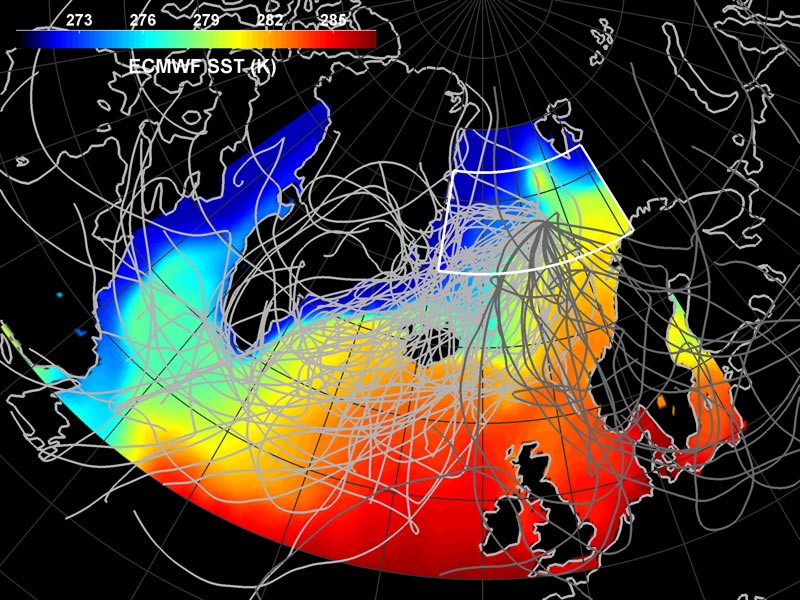
We can investigate marine clouds using satellite observations. Figure 1 shows the correlation between satellite cloud optical thickness (COT) and model surface wind speed (U10m), obtained in the sub-arctic marine atmosphere over the Norwegian Sea and Barents Sea (this area is shown in figure 2). The movement of marine air masses, before they arrive in the area being investigated, are represented by the light solid lines in figure 2. The relationship shown in figure 1 allows a very simple but powerful way to incorporate climate forcing in model predictions, and highlight how marine sea-spray influences COT and the way that it affects the global climate.
We will evaluate results from these optical property measurements on low-level clouds, as well as on estimated cloud-droplet numbers, based on model simulations. To this end, a process model will be developed that can accurately handle both predictions of vertical mixing of water vapour and clouds, together with the number of sea-salt particles – which are greatly affected by wind speeds – and descriptions of gas-phase chemistry and aerosol-cloud interactions.

About the author

Paul Glantz is an associate research scientist at the Department of Applied Environment Science at Stockholm University, Sweden. His work focuses on understanding aerosol cloud interactions in the lower background atmosphere and in anthropogenic-influenced air masses.

" Monckton Testimony at US Congress: Ignorance or Perjury?" by Scott Mandia

Monckton Testimony at US Congress: Ignorance or Perjury?

by Scott Mandia, September 21, 2010

Climate Scientists Respond
On May 6, 2010, Mr. Christopher Monckton testified by invitation to the Select Committee on Energy Independence and Global Warming of the U.S. House of Representatives.  Mr. Monckton, who is not a scientist, gave testimony that was in stark contrast to that of the scientists who were present at the hearing as well as the many official statements produced by the world’s premiere scientific organizations, about the growing dangers of climate change.  Here, a number of top climate scientists have thoroughly refuted all of Mr. Monckton’s major assertions, clearly demonstrating a number of obvious and elementary errors.  We encourage the U.S. Congress to give careful consideration to the implications this document has for the care that should be exercised in choosing expert witnesses to inform the legislative process.
The authors of the report state:
Mr. Monckton makes a number of scientific assertions about (1) the efficacy of warming from CO2, (2) the benefits of elevated CO2, (3) the relationship between CO2 and ocean acidification, (4) recent global temperature trends, (5) and the sensitivity of the climate to CO2. He has also claimed that (6) there is no need to take quick action to address the changing climate. In all cases, Mr. Monckton’s assertions are shown to be without merit – they are based on a thorough misunderstanding of the science of climate change.
We believe the responses contained here strongly refute the statements made by Mr. Monckton. It is our hope that this document will be of use to members of Congress and their staffs as further hearings and debates on climate change and energy policy take place. We would be pleased to respond to any inquiries and offer necessary clarifications.
Authors:
Dr. Ray Weymann, Director Emeritus and Staff Member Emeritus, Carnegie Observatories, Pasadena, California; Member, National Academy of Sciences.
Dr. Barry Bickmore, Associate Professor of Geological Sciences, Brigham Young University, Provo, Utah.
Dr. John Abraham, Associate Professor of Engineering, University of St. Thomas, St. Paul, Minnesota.
Dr. Michael Mann, Professor of Meteorology with a Joint Appointment with the Department of Geosciences and Director, Earth System Science Center, Penn State University, University Park, Pennsylvania.
Dr. Winslow Briggs, Director Emeritus and Staff Member Emeritus, Department of Plant Biology, Carnegie Institution for Science, Palo Alto, California; Member, National Academy of Sciences.
As mentioned in a previous blog post, Monckton has been wrong about climate science many times and has been repeatedly shown the errors of his ways.  In fact, Monckton has quite a long rap sheet.  What makes this latest report so damning for Monckton is that he gave his testimony under oath in front of a United States Congressional panel.
Monckton must now decide how to respond.  He essentially has two options:
  1. Admit that he is ignorant about the science and that he made an honest mistake.
  2. Claim that the world’s experts are lying.
If he chooses #1, he should immediately issue a public statement to that effect that includes an apology to the United States public, to their elected leaders, and to the scientists that he has essentially called liars.  Unfortunately, Monckton’s track record reveals that he will choose #2.
If so, it is time for our elected leaders to respond.  From lectlaw.com:
When a person, having taken an oath before a competent tribunal, officer, or person, in any case in which a law of the U.S. authorizes an oath to be administered, that he will testify, declare, depose, or certify truly, or that any written testimony, declaration, deposition, or certificate by him subscribed, is true, willfully and contrary to such oath states or subscribes any material matter which he does not believe to be true; or in any declaration, certificate, verification, or statement under penalty of perjury, willfully subscribes as true any material matter which he does not believe to be true; 18 USC
In order for a person to be found guilty of perjury the government must prove: the person testified under oath before [e.g., the grand jury]; at least one particular statement was false; and the person knew at the time the testimony was false.
The testimony of one witness is not enough to support a finding that the testimony was false. There must be additional evidence, either the testimony of another person or other evidence, which tends to support the testimony of falsity. The other evidence, standing alone, need not convince that the testimony was false, but all the evidence on the subject must do so.
To my U.S. readers:
If Monckton does not issue a public statement admitting he was wrong that includes an apology to the United States public, to their elected leaders, and to the scientists that he has essentially called liars, I urge you to write your elected leaders and demand that they take action.  Write to them and point to the .pdf file.  Ask them to investigate Monckton to see if they believe he committed perjury. 
You may locate your senators and representatives by visiting: USA.gov
Update 9/21/10: Monckton has responded.  As expected, he has chosen option #2.  In his published comments at The Guardian, Monckton states: “One of the lead authors is currently under criminal investigation for alleged fabrication of results: another has been caught out in repeated lies: a third admits to suffering a mental disability: and many of the scientists whom these lead authors invited to contribute are among the long-discredited clique of Climategate emailers.”
It is time for you to take action.  Please visit USA.gov and ask your elected representatives to investigate Monckton.  I also encourage you to send letters to the various media sources that I have listed in the previous blog post Turn the Tables on Monckton.  Please make your voices heard.

Wednesday, September 29, 2010

James Hansen: Human-made climate change pits the rich and powerful against the young and unborn, against the defenseless, and against nature. Our government allows and contributes to a great hoax, perpetrated on the public by moneyed interests, aimed at confusing the public about the reality of climate change. Join the Million Letter March!

From Dr. James E. Hansen
Equal Protection of the Laws
Here are my remarks given at Freedom Plaza before the Appalachia Rising march to the White House on 27 September.


Freedom Plaza: Equal Protection of the Laws

We hold this truth to be self evident – all people are created equal.


That truth is the basis for equal protection of the laws – a right guaranteed by our Constitution.


"All people" includes young people, mountain people, poor people.


Our government was instituted to protect the rights of all people.


We are gathered here today to draw attention to the failure of our government to protect the rights of the people, and failure to provide equal protection of the laws.


People have suffered a long train of abuses, invariably with the same objective – to enrich the few at the expense of the many.


First, the government is failing to protect the future of young people, knowingly allowing and even subsidizing actions that benefit the few at the expense of the public and at the expense of all life sharing this Earth.


Second, the legislative and executive branches of government knowingly propose actions that demonstrably and utterly fail to preserve our climate, and the environment for life.


Third, our government allows and contributes to a great hoax, perpetrated on the public by moneyed interests, aimed at confusing the public about the reality of climate change.


We are in danger of becoming the land for the rich and the home of the bribe.
More than 200 years after the founding of our nation, we face a great moral crisis. Human-made climate change pits the rich and powerful against the young and unborn, against the defenseless, and against nature. The moral issue is comparable to slavery and civil rights.


Solution for civil rights was provided by the combination of people in the streets and the courts, which provided equal protection of the laws and ordered desegregation.


Brave people have been standing up in West Virginia, in Kentucky, in Tennessee, in Utah, in Australia, in the United Kingdom, around the world.


But now is the time to go on the offensive. We should not be begging courts to forgive the brave people who protest. We must ask the courts to order the government to present plans to phase down fossil fuel emissions at a pace dictated by science, a pace stabilizing climate, preserving nature and a future for young people, providing young people equal protection of the laws.


We can bring that case. But we can win only if the public understands the situation, sees through the lies of the moneyed interests, sees what is needed to solve the problem.


As long as fossil fuels are the cheapest energy, we will not solve the addiction. There will be more mountaintop removal, longwall mining, tar sands, deep ocean drilling, shale gas, seeking the last drop in the most pristine places.


We must put a fee on carbon, collected from fossil fuel companies, with all proceeds distributed to the public. One hundred percent or fight!


Most people will get more in the monthly green check than they pay in increased energy prices. Our economy and innovations will be stimulated. We will move to clean energies.


A coalition is building for a carbon fee with 100% distributed to the public in a monthly check. In October this coalition will launch a campaign, Million Letter March, gathering letters showing that the people insist on an honest equitable solution. Please join the March.


Let us resolve to have a rebirth – a rebirth of our nation, a rebirth of equality of opportunity, true equality -- with a government of the people, by the people and for the people – all of the people.


Link:  http://www.columbia.edu/~jeh1/mailings/2010/20100929_FreedomPlaza.pdf

Fight Back Now!: Rep. Joe Barton, traitor to his country, purposely misled Congress, a crime, with the completely false Wegman Report, John Mashey's 250-page dissection proves

Wegman-gate: Readers, please alert Congress and the Media!


by Scott Mandia, September 28, 2010

There are some that that wish to delay action on climate change and some that refuse to accept the scientific consensus that humans are causing significant global warming with possible devastating impacts. These delayers and contrarians often hang their hats on the Wegman Report as proof that climate scientists are either corrupt or incompetent.  The Wegman report, commissioned by Rep. Joe Barton (R-TX) and Rep. Ed Whitfield (R-KY), is central to the infamous Hockey Stick Controversy and was promoted as “independent, impartial, expert” work by a team of “eminent statisticians.”  It was none of those.   
As detailed in John Mashey on Strange Scholarship in the Wegman Report, the Wegman report was a facade for a PR campaign well-honed by Washington, DC, “think tanks” and allies, underway for years.  
Most of my readers are likely aware of the Hockey Stick Controversy but I will briefly summarize here.  (Click the link for all the gory details.)  As described in Determining the Climate Record, historical temperatures (before the use of thermometers) can be determined using physical and biological fossil data called proxy data, such as ice cores, corals, trees, marine fossils, and boreholes.  Most temperature reconstructions end up appearing with a hockey stick shape: relatively flat temperatures between 1000 AD and 1900 (handle) followed by a very sharp rise since 1900 (blade).  

The hockey stick graph as shown in the 2001 IPCC report. This chart shows the data from Mann et al. 1999. The blue lines are temperatures estimated from proxy indicators, red lines are temperatures from thermometers, and the gray shaded region represents estimated error bars.
At the request of Congress in 2006, a panel of scientific experts was convened by the National Research Council to assess the validity of the hockey stick reconstructions of climate scientists Drs. Michael Mann, Raymond Bradley, and Malcolm Hughes.  The panel chaired by Dr. Gerald North found that although there were some statistical problems with the reconstructions, these issues were minor and did not change the results.  Modern global temperatures were significantly warmer than in the past 1000 years.  
Around the same time, Rep. Joe Barton (R-TX) and Rep. Ed Whitfield (R-KY) convened their own panel chaired by Edward Wegman.  The panel’s final report is known as the Wegman Report.  The Wegman Report came to quite a different conclusion.  The Wegman Report claimed that the hockey stick reconstruction could not be supported by the data and that there was a social network of scientists tied to Dr. Mann that may have made independent studies “not independent”.  
So why the disparity?  
Do you recall Joe Barton’s well-publicized apology to BP for what he called a “shake down” by the Obama Administration because the US government demanded that BP help those that were suffering?  Let me refresh your memory:  
  
According to Opensecrets.orgRep. Barton gets most of his campaign finance money from the fossil fuel industry.  

Rep. Barton Major Campaign Contributors
Explains a lot, does it not?  The Wegman Panel was commissioned by Barton.  Barton’s donors stand to lose market share to alternative energy sources if carbon fuels are regulated.  Of course, to stop the threat that is global warming, all nations must immediately reduce their carbon fuel use, especially the biggest polluter: the United States.   
Is this guilt by association or is there really guilt regarding the Wegman Report?   
John Mashey answers that question in his 250-page dissection of the Wegman Report.  Please view the six pageExecutive Summary and the full report.  Arthur Smith has an excellent summary of Mashey’s Report on his blog:  
Among Mashey’s findings:  
  • Of 91 pages, 35 are largely plagiarized text, often injected with errors, bias and changes of meaning. 3 pages are a mathematical appendix that seems to be the only contribution of the report’s 2nd author (David Scott). 7 pages are a padded bibliography (see below). That leaves barely half the report as actual original material from Wegman and Said.
  • A sketch of central England temperatures for the past 1000 years from the first (1990) IPCC report was highlighted in the Wegman report, but the report’s version was altered, at least by shifting the time axis and truncating the recent temperature rise (already truncated at 1975 in the original). An unaltered version of the same sketch can be found in the NAS report; until now nobody seems to have noticed that Wegman (or a source or associate) had distorted the graph.
  • Of 80 references in the bibliography, 40 are never cited in the report.
  • Many of the science papers in the remaining 40 are, while cited and sometimes summarized, otherwise ignored in the analysis
  • Wegman sent the report to a few statisticians; all known to him. Some were given only a few days to comment. Some gave strong advice that was simply ignored. This was claimed as peer review by Representative Whitfield
  • Some commenters were surprised to be listed as reviewers
  • Wegman and Said promised to publish their analysis in the peer-reviewed literature, but other than one paper in a journal where Said was associate editor (accepted 6 days after receipt), none have appeared
  • Incriminating documents associated with Said have disappeared from websites in recent weeks
One might ask why raise this ghost now?  Many reconstructions since 1999 show the hockey stick using various proxy data and various statistical techniques so we are quite confident that modern global climate is significantly warmer than in the past 2,000 years.  The IPCC (2007) concluded: “warming of the climate system is unequivocal, as is now evident from observations of increases in global average air and ocean temperatures, widespread melting of snow and ice, and rising global average sea level.  Most of the observed increase in globally averaged temperatures since the mid-20th century is very likely due to the observed increase in anthropogenic greenhouse gas concentrations.  Discernible human influences now extend to other aspects of climate, including ocean warming, continental-average temperatures, temperature extremes and wind patterns.”  Since 2007, there is not a single international scientific body that holds an opposing view.  
We need to highlight the Wegman Report and its many flaws because those that wish to delay action or to deny the science are waving the report like a flag of truth.  More disturbingly, as reported in PoliticoHouse Republicans will kill Nancy Pelosi’s special global warming committee if they win back the House in November.  Worse,  Rep. Jim Sensenbrenner (R-WI) wants to keep the Select Committee on Energy Independence and Global Warming alive so it can investigate climate science and police President Barack Obama’s green policies.  Essentially a witch hunt against science much like Virginia Attorney General Ken Cuccinelli’s Misguided Investigation of Michael Mann.  Not to be outdone, Rep. Darrell Issa (R-CA) wants to conduct inquiries into the Climategate emails.  Of course, several independent investigations found no wrong-doing and Climategate coverage was unfair and unbalanced.  Far more press coverage was given to the accusations than the exonerations.  
Here is where YOU can help:  
Write to your elected leaders and to news outlets and let them know that Barton’s Wegman Report is a sham and that the witch hunts must stop.  Science drives most policy issues and the United States and the world can ill afford the anti-science positions of these prominent politicians.  Tell your elected leaders and the press to investigate Wegman’s report with the same zeal as they did the stolen CRU emails.   
They investigated Climategate.  Now they need to investigate Wegman-gate.  
I created a page that lists contact information for US Congress and many US news outlets.  The page is titled: Media & Gov. Contacts and appears at the bottom of my Blogroll list.  Please use this link now and in the future to express your concerns.  Agreeing with each other on blogs isn’t going to stop the witch hunts.  You must get the general public and our elected officials to see that climate science and scientists are being attacked.
The public does not respect weakness.  Fight back!