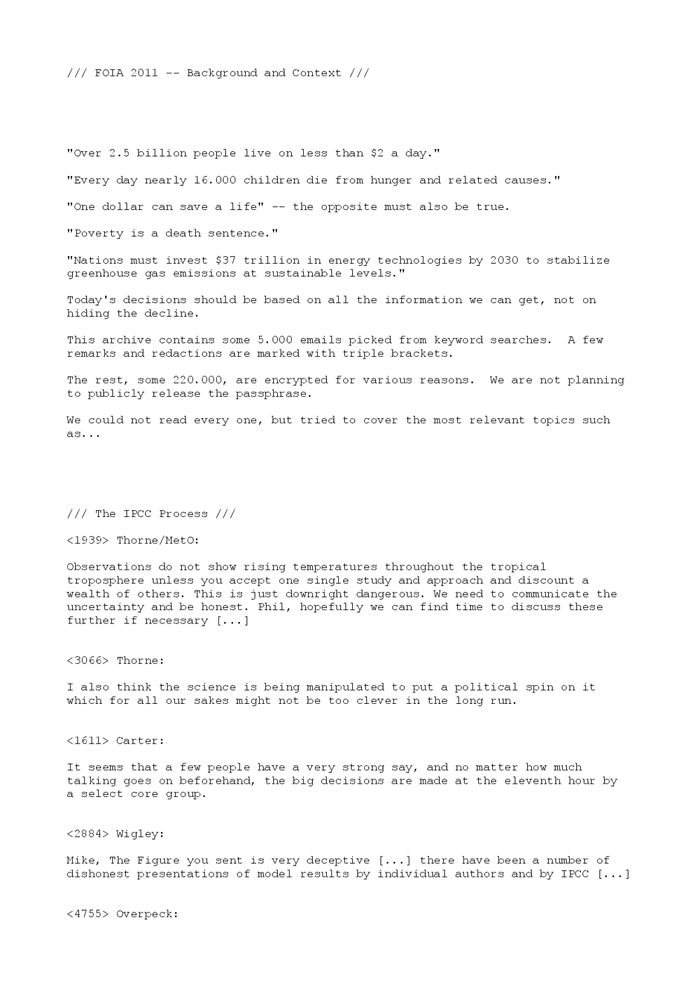
Son of climategate? SwiftHack 2.0? Dejavugate (as in “deja vu all over again”)? Whichever moniker one prefers for the latest release of stolen CRU emails, it is very clear that a new round of out-of-context quote mining and error-filled “analysis” is already unfolding. And the leader out of the gate, so to speak, appears to be Ross McKitrick, whose recent National Post piece on the IPCC and the latest batch of stolen emails is now being spread far and wide. In one particularly outrageous and error-filled passage, McKitrick accuses IPCC AR4 co-ordinating lead authors Phil Jones and Kevin Trenberth of selecting their team of contributing authors solely on the basis of whether they agree with the pair’s scientific views. He even goes so far as to accuse Jones of “dismissing” (i.e., rejecting as a contributing author) one qualified expert who, supposedly in Jones’s own words, “has done a lot, but I don’t trust him.”
But the record clearly shows that it was Trenberth who made that last comment, and that he was expressing misgivings about the quality of the researcher’s work, not whether he was on the “right side” of scientific issues. And the expert in question, climatologist Joel Norris, was in fact selected by Trenberth as a contributing author. Even worse, McKitrick has reversed the order of the Jones quotes, taken them out of context, and then juxtaposed them to make it appear as if they were part of the same exchange. Meanwhile, an examination of the two separate email discussions show chapter co-ordinators trying to fill out their team with authors who will be able to contribute effectively, in complete contradiction to McKitrick’s central thesis.
Complaisant National Post editors have a long history of handing economist and climate science gadfly Ross McKitrick a platform for his nonsense, especially whenever he has a new think tank report to peddle. This time around, the occasion for the piece Fix it or Fold It was the latest screed from the Global Warming Policy Foundation, a McKitrick “report” entitled What Is Wrong with the IPCC? Certainly there is much to criticize here, starting with the supreme irony of the GWPF attacking the IPCC for supposed bias and lack of transparency. After all, the GWPF has been caught “hiding the incline” in their misbegotten analysis of the Berleley Earth global land-surface temperature series, and it’s hard to imagine a less transparent organization, judging by the official report of their first few months of operation. But for today, we’ll leave all that aside and take a look at McKitrick’s hasty attempt to buttress his weak case against IPCC scientists by quoting from the latest dump of stolen emails. In this excerpt he rails against the criteria supposedly used by Phil Jones for choosing contributing authors (CAs) for the AR4 WG1 chapter 3, Observations: Surface and Atmospheric Climate Change. In a surprise, and fast-breaking development, Monday morning saw the release of more than 5,000 fresh emails of climate scientists connected with the U.K. Climate Research Unit. … But the ones that pertain to the IPCC process fully support the contentions in my report.
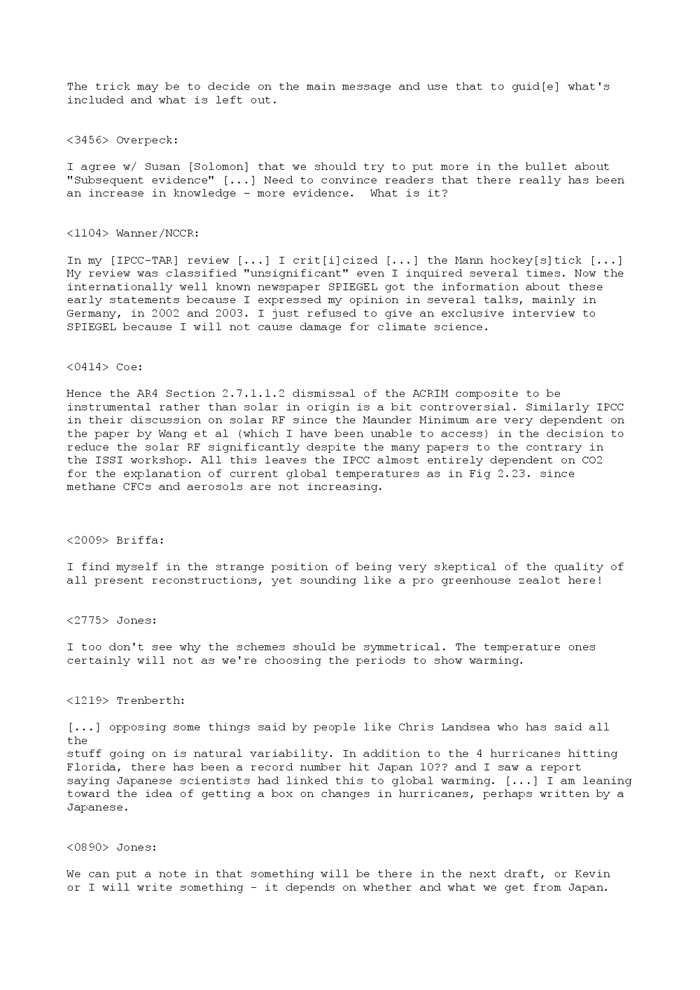
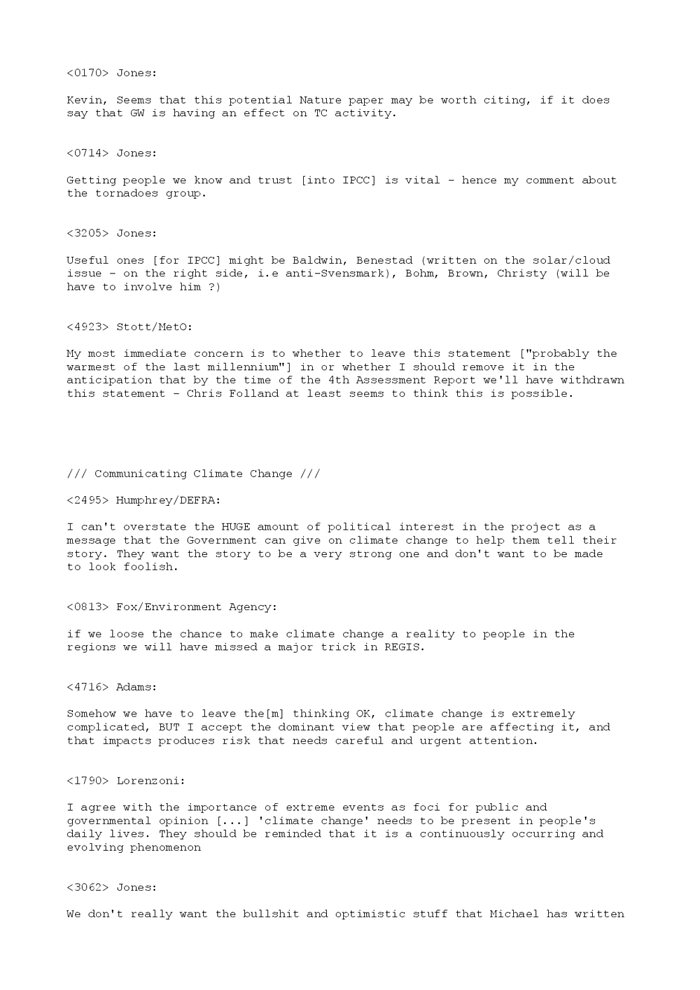
For instance, I discuss the problem that IPCC chapter authors are able to recruit contributing authors (CAs) in an opaque process that does not ensure a diversity of views. The resulting uniformity is obvious simply from looking at the list of authors, but we can now see the confirmatory evidence in the email traffic. In a pair of emails (nos. 0714 and 3205), IPCC lead author Phil Jones goes through lists of possible CAs with his IPCC coauthor Kevin Trenberth, declaring “Getting people we know and trust is vital.” He then categorizes his recommendations based, not on whether the person is the most qualified but on whether the person is “on the right side” (namely agrees with him), or whether he “trusts” him or not. At one point he dismisses a particular expert who “has done a lot but I don’t trust him.” This kind of cronyism is shown by the emails to be rampant in the IPCC.
This exposition is highly problematic. For starters, only the first two quotes are from Jones. And, unlike the impression given by McKitrick they are separated by more than three months, with the “right side” quote actually preceding the “know and trust” quote! McKitrick has reversed the order of the quotes and juxtaposed them as if they were part of the same exchange.
So let’s take a look at key excerpts from the emails and place these quotes a little more in context, and just as importantly, in proper sequence.
At the time of the first email exchange (no. 3205, dated June 9-10), the main focus had been on trying to reach the lead authors to start preparing for the first writing team meeting that fall in Trieste, three of whom neither Jones nor Trenberth had been able to reach. But Jones also ran through the list of CAs prepared by the IPCC.
The additional list sent from WG1 contains a FEW useful names. There are some who are CLAs/LAs on other chapters (Forster, Hegerl, Hewitson, Karoly, Lean, Nicholls, Peterson and Villalba). Of those only Neville Nicholls, Bruce Hewitson and Tom Peterson would likely have been useful.
So what did Jones mean by “useful”? Here are his comments, running through the a list of IPCC suggestions alphabetically:
Useful ones might be Baldwin, Benestad (written on the solar/cloud issue – on the right side, i.e anti-Svensmark), Bohm, Brown, Christy (will be have to involve him ?), Dai (good), Fraedrich (circulation), Frei (good, for extremes), Fyfe (circulation), Gallo, Groisman, Hanssen-Bauer (OK), Hurrell (good), King (good for Antarctic), Kodera, Kunkel (has written stuff, but never met him), McBride (OK, but will he do anything in our timeframe), Nobre (simialr to McBride), Power (good), Rayner (good but will mostly be in the oceans chapter), Salinger (knows the ropes), Seidel (good), Stephenson (just about OK), Vose (probably) and Zhang. There are a few others (e.g. Ramaswamy, but they seem more appropriate elsewhere in AR4).
So in only one case (Benestad) is being “on the right side” of a scientific issue even mentioned. And there can be no doubt about Benestad’s expertise in this area. Overall, the clear criterion involves matching CAs with a particular area needed according to the chapter 3 outline (“good, for extremes” or “good for Antarctic”). Concerns include problems with availability (such as conflicts with other chapters), regional representation, or ability to deliver within the prescribed time frame.
The only two “skeptics” mentioned in the email are John Christy and Patrick Michaels. Christy was in fact included; the ensuing period must have been uncomfortable for him, as it included a major correction to his UAH troposhere temperature record, and the ascendant credibility of the competing tropospheric analysis from RSS.
In any event, McKitrick’s assertion that agreement with Jones on scientific issues was the main criterion for his CA recommendations is completely unsupported by the actual record. And the real reason there are few “skeptics” in the WG1 is simply that their contributions to climate science have been few and uncompelling. They represent a very small part of the peer-reviewed scientific literature, despite their promotion by fossil-fuel funded think tanks and PR firms, aided by a complaisant right wing press outlets.
The second email exchange (no. 0714) features a longish email from Trenberth, where he embedded reply comments in an earlier email from Jones. These are from September 15, 2004, at the beginning of the chapter 3 planning process and a full three months after the first exchange. The whole sequence is kicked off by Trenberth’s email the previous day, where he sent Jones an annotated version of the chapter 3 outline, and asked Jones for additional suggestions. (I’ve formatted and ordered the emails in a more readable PDF to make the back and forth easier to follow.) In reply, Jones ran through various sections in the chapter outline with additional suggestions on who might be able to help out with each. Here he discusses section 3.4 and raises clouds observations as an area still needing attention.
I’ve emailed Adrian Simmons on another issue and asked him how much he would like to get involved. Need to add Peter Thorne to 3.4.1.6 [troposperic temperatures] . Co-ordination with the various US efforts essential. Tom Wigley tells me he’s heavily involved in one of these.
Clouds in 3.4.3 are a problem.
Trenberth replied:
I have done a very preliminary review of literature on clouds. I can send to you if you like? Liepert might be better there. Rossow also? But I don’t trust him. Norris has done a lot but I don’t trust him either.
So it is Trenberth, not Jones, who initially discussed “trust,” but as we’ll see in a moment, he meant something very different from the meaning implied by McKitrick.
Jones also mentioned some possibilities for section 3.9, which are crucial to interpreting his later comments.
For 3.9.3.4 there is Nikolai Dotzek who said he could do something on tornadoes and severe local weather events. No idea how good he is. Their web site ([1]http://www.tordach.org) has some links to work in Germanic countries. Tordach has a US page as well. Ever heard of this? Another person here is Rudolf Brazdil (Czech Rep.)
I’ll add them for discussion.
Later the same day, Jones replied to Trenberth:
Getting people we know and trust is vital – hence my comment about the tornadoes group.
I still favour Steve Warren on clouds, but there are a whole range of aspects to consider there.
So now at least we have, if not the complete context (impossible from a single email exchange), a much clearer indication of what Jones meant. He does not “know” how “good” the tornado work of Dotzek and Tordach is, or whether they can be counted on to produce effectively.
As for Trenberth’s comment about Norris, in context the concern seems to be his worth to the team as scientists and writers in their area, rather than “skeptic” or conflicting views. But I decided to look into this further, starting with McKitrick’s suggestion to check the list of authors.
Lo and behold, there is the supposedly “dismissed” J. Norris, alongside the other suggested names of Liepert and Warren. And an email exchange from November 2004 (no. 2362), another two and a half months later, sheds further light on Trenberth’s attitude and intended meaning. At this point, the writing team was well into the First Order Draft, and Trenberth and Lead Author Brian Soden had a detailed email exchange concerning the section on clouds. Soden had referred to the importance of Norris’s work “showing agreement between ISCCP and surface high clouds cover trends,” that is, between satellite and surface observations. Trenberth urged Soden not to gloss over discrepancies, and to deal with discontinuities and other uncertainties. Among the detailed discussion of data sets and analyses, Trenberth also let it be known that he was “uncomfortable” that two of Norris’s papers relied upon had yet to be submitted. And then he elaborated on his previous comment on Norris, saying that he “thought we should have him as a CA as he has done a lot of work in this area.” At the same time, though, Trenberth did not “fully trust his results or analysis” (not to mention that he did not even have copies of the latest papers).
But Soden assured him that the papers would be submitted in time for the FOD deadline, and reiterates the importance of Norris’s work on comparing ISCCP and surface observations. And he points out that Norris had previously identified problems in ISCCP and that “Joel is naturally skeptical of observational data sets in general and analyzes them carefully.”
This exchange shows two authors trying to get the science right and resolve disagreements, and stands in sharp contrast to McKitrick’s accusations of “cronyism” and evaluation of CAs based on “trust” to achieve a predetermined agenda.
I must admit to some misgivings about rehashing these emails in such detail, as some of the details may be hurtful to the individual scientists discussed. There are good reasons why the private deliberations of authors working through the construction of a major scientific assessment should remain so, and such concerns are reflected in the safeguards of most FOI protocols.
But in a toxic environment where selective quoting and fanciful interpretation of fragments from stolen emails are considered proof of malfeasance, the record should be set straight to the extent possible.
The more we know about the work of Ross McKitrick and his ilk, the less we trust it.



 Posts
Posts