Blog Archive

Wednesday, December 7, 2011

Whales, dolphins, seals: newcomers crowd into British waters in pursuit of their prey

Whales, dolphins, seals: newcomers crowd into British waters in pursuit of their prey

Scientists predicts cetaceans from as far away as the Pacific will live here as climate change heats up our waters
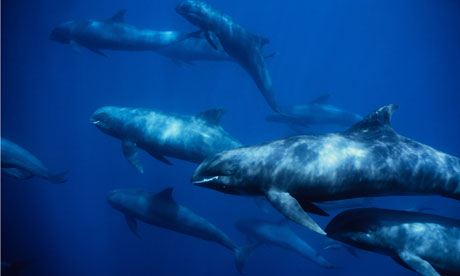
A melon-headed whale, which normally lives in tropical waters, was spotted in the English Channel.
A melon-headed whale, which normally lives in tropical waters and eats squid, was spotted in the English Channel. Photograph: Gerard Soury/Getty Images
The waters around the British Isles could soon be home to several new species of mammals as a rising number of foreign visitors are being reported around our coasts. Experts believe the rare sightings of cetaceans from tropical climes could mean sea creatures are scouting for new territories to settle as global warming takes effect on sea temperatures.
Animals from the tropics, including the dwarf sperm whale, the pygmy sperm whale, and the Fraser's dolphin have all made recent appearances here, and the Cuvier's beaked whale, another warm-water species, has been recorded increasingly regularly in the west of Britain. The melon-headed whale, a squid-loving relative of the killer whale, has been seen in the Channel, off the coast of Brittany. Before too long we may see giants such as the 16-metre gray whale nudging into deep water around Cornwall and into the Irish Sea.
"We are now seeing a number of species far from home, and they probably will continue to recur with increasing frequency," said Peter Evans, director of the Sea Watch Foundation. "Several are normally found off west Africa. For the moment they tend to be seen at times of year when our sea temperatures are at their warmest. Whales and dolphins can cope with a wide range of temperatures but their fish and squid prey tend to be more constrained, and their ranges are extending significantly northwards."
He said cetaceans would follow their favourite food, and many species rare in colder waters just a decade ago had moved into British seas. This autumn a dwarf sperm whale was spotted in Mounts Bay, Cornwall, while a pygmy sperm whale, its close relative, was found beached on Seil island, near Oban.
"They were both very big surprises: they are rarely seen even where the populations are known to exist," said Evans. "If the fish are extending their range, as we know many are, then the whales and dolphins will follow. Anchovies, for example, were really quite scarce in the North Sea 10-20 years ago. Now they are widespread and may be why the common dolphin is now a regular in the North Sea.
"The behaviour of different fish, if they shoal or don't shoal, for example, requires a fair bit of understanding, so once a species has learned a feeding strategy they will follow rather than learn a new technique for a new prey."
Evans believes we may soon see a visitor that disappeared from the Atlantic in the 17th century – the grey whale. "They migrate up the west coast of north America, from Mexico and California up to the Arctic and, of course, could go no further. But now the Northwest Passage is open it is very possible they may cross the North Atlantic.
"Gray whales were seen last year off the coast of Israel and off Barcelona this year. Such a remarkable appearance in such a strange location reinforces the pattern we are seeing."
Twenty-nine species of dolphin and whale have been recorded this century in British or Irish territorial waters. The common dolphin, striped dolphin, minke whale and humpback whale are among those species where numbers sighted have increased since 1980.
But it is not just the whales moving north into warmer seas; we are also seeing mammals coming down from colder climes. Bearded seals from the Arctic have been seen off the coast of Fife, east Scotland, said Callan Duck, a senior research scientist at the Scottish Oceans Institute at St Andrews University.
"The change in climate and the food chains is definitely having an impact in the species we are seeing, but I think you have to remember to factor in how much better we are at spotting and recording these mammals. Good digital cameras are really accessible now, and so everybody has the opportunity to identify what they have seen – so the whole process of reporting sightings is much more accurate and efficient."

Monday, December 5, 2011

Jonathan Amos, BBC: Antarctica's hidden world revealed -- BEDMAP: the topography of Antarctica beneath the ice

Antarctic's hidden world revealed

Labels:
Antartic map with labels

Related Stories

Ever wondered what Antarctica would look like without all that ice?
Scientists have produced the most detailed map yet of the White Continent's underbelly - its rock bed.
Called simply BEDMAP, this startling view of the landscape beneath the ice incorporates decades of survey data acquired by planes, satellites, ships and even people on dog-drawn sleds.
It is remarkable to think that less than 1% of this rock base projects above the continent's frozen veil.
In the map at the top of this page, the highest elevations are marked in red/black. The light blue colour shows the extent of the continental shelf.
The lowest elevations are dark blue. You will note the deep troughs within the interior of the continent that are far below today's sea level.
An animated view of Antarctica, revealing its great mountains and deepest depressions
The map is a fascinating perspective but it is more than just a pretty picture - it represents critical knowledge in the quest to understand how Antarctica might respond to a warming world.
Scientists are currently reporting significant changes at the margins of the continent, with increasing volumes of ice now being lost to the ocean, raising global sea levels. The type of information contained in BEDMAP will help researchers forecast the pace of future events.
"This is information that underpins the models we now use to work out how the ice flows across the continent," explained Hamish Pritchard from the British Antarctic Survey (BAS).
"The Antarctic ice sheet is constantly supplied by falling snow, and the ice flows down to the coast where great bergs calve into the ocean or it melts. It's a big, slow-speed hydrological cycle.
"To model that process requires knowledge of some complex ice physics but also of the bed topography over which the ice is flowing - and that's BEDMAP."
Dr Pritchard is presenting the new imagery on Monday to the 2011 American Geophysical Union (AGU) Fall Meeting, the world's largest annual gathering of Earth and planetary scientists.
This is actually the second generation of the digital BEDMAP. The first version, which was produced in 2001, incorporated 1.9 million measurement points. For BEDMAP2, the sampling has been raised to more than 27 million points on a grid spacing of 5km.
"It's like you've brought the whole thing now into sharp focus," Dr Pritchard told BBC News.
"In many areas, you can now see the troughs, valleys and mountains as if you were looking at a part of the Earth we're much more used to seeing, exposed to the air."
The source data comes from a range of international partners. Dr Pritchard and BAS colleagues Peter Fretwell and David Vaughan have merged it all into a single product.
Geophysical survey work (N.Frearson)Instrumented planes fly grids across the surface of the ice to survey what lies beneath
The project has benefited greatly from the large number of airborne radar surveys that have been flown in recent years.
Unlike rock, ice is transparent to radar. So by firing microwave pulses through the overlying sheet and recording the return echoes, scientists can plot both the depth of the rock bed and - by definition - the thickness of the ice covering.
Instrumented planes, guided by GPS, will now fly back and forth across the ice in campaigns that can last weeks at a time.
Perhaps the most publicised of these recent efforts was the multinational expedition in 2007/2008 to map the Gamburtsev mountains.
This range is the size of the European Alps with the tallest peaks reaching 3,000m above sea-level - and yet they are still hidden below more than a 1,000m of ice.
"It's fascinating to see the Gamburtsevs in the context of the other big mountains in Antarctica," said Dr Pritchard.
"They're similar in size to the likes of the Ellsworth and the Transantarctic mountains, but of course they're completely buried. It is just because the ice is so thick in the middle of the ice sheet that they're not exposed."
It is clear from BEDMAP2 that there are still two big areas of the continent that need improved coverage.
One of these lies between the Gamburtsevs and the coast; the other runs south of the Shackleton mountain range towards the South Pole.
Look closely at the map on this page and you can see that the yellow colouring in these areas appears quite smudged.
It is very likely that proposals will soon be put to national funding agencies to go and close these data gaps with airborne surveys.
Bedmap dataSome of the data that is of highest value to glaciologists covers the deep troughs under West Antarctica.
http://www.bbc.co.uk/news/science-environment-15735625

Sunday, December 4, 2011

Michael Mann, WSJ: Climate Contrarians Ignore Overwhelming Evidence

Climate Contrarians Ignore Overwhelming Evidence
by Michael Mann, December 5, 2011
Every snowflake is unique, but attacks on climate science all seem the same. I should know. I've been one of the climate contrarians' preferred targets for years.
A recent op-ed on this page by blogger and climate-change denier James Delingpole attacked the "hockey stick" graph my co-authors and I published more than a decade ago with well-worn, discredited arguments ("Climategate 2.0," Nov. 28).
Our original work showed that average temperatures today are higher than they have been for at least the past 1,000 years. Since then, dozens of analyses from other scientists based on different data and methods have all affirmed and extended our original findings.
Contrarians have nonetheless painted a misleading picture of climate science as a house of cards teetering on the edge of a hockey stick. In reality, my research is just one piece in a vast puzzle scientists have painstakingly assembled over the past 200 years establishing the reality of human-caused climate change.
Does that mean that everyone should have to drive an electric car and adopt a polar bear? Of course not. Policy decisions must balance matters of economics, international diplomacy and ethics in a way that is informed, rather than prescribed, by science.
In 2006, then-Rep. Sherwood Boehlert (R., N.Y.) asked the National Academy of Sciences to look into studies like the hockey stick. It affirmed our conclusions.
In recent years, attacks on climate science have become personal. After my colleagues and I had our emails stolen and posted online in November 2009, attacks from climate contrarians were subsequently shot down by investigations from two universities, the National Science Foundation, two federal agencies and several media outlets. Contrarians declared that those institutions were part of an imagined global-warming conspiracy.
In April 2010, Virginia Attorney General Ken Cuccinelli demanded emails I sent or received from other scientists while at the University of Virginia. A judge concluded Mr. Cuccinelli hadn't demonstrated any good reason to see that correspondence. Shortly after that, the American Tradition Institute, a group with ties to fossil-fuel interests, asked for the same emails under the state's open records laws. The university rightly asserted that much of my private correspondence is just that and not subject to release.
Many fossil-fuel interests and their allies are following the same attack-the-science strategy that tobacco companies adopted to delay smoking regulation. Climate scientists can also find kinship with Dr. Herbert Needleman, who identified a link between lead contamination and impaired childhood brain development in the 1970s. The lead industry accused him of misconduct. Later, the National Institutes of Health exonerated him.
Mr. Delingpole ends his piece by saying the anonymous hacker or hackers who stole emails from me and my colleagues deserve thanks. What they deserve is to be brought to justice. But British police have not determined who stole the emails. Recent reports of police expenditures suggest they may be devoting far fewer resources to it than other similar investigations.
Celebrating theft is silly. We should respect the role science and scientists play in society, especially when scientists identify new risks. Whether those risks stem from smoking, lead exposure or the increasing use of fossil fuels, scientists will always work to increase knowledge and reduce uncertainty. And we all benefit from that work.
Prof. Michael E. Mann
Meteorology Department
Penn State University
Director, Penn State Earth System Science Center
University Park, Pa.

Saturday, December 3, 2011

What Would Ben Franklin Do? Influences of America’s First Environmentalist

What Would Ben Franklin Do?

Influences of America’s First Environmentalist

This is the third installment in our series about the founding fathers’ relationships with science, and what they might have to say about the science policy issues of today. Parts one and two, about Thomas Jefferson and George Washington respectively, can be foundhere, and here.
In the late 18th century, Benjamin Franklin was something of an icon in Europe. The French hung portraits of Franklin on their walls much in the same way college students pay tribute to John Belushi or Jim Morrison in their dorms. Everywhere Franklin went, his feisty personality preceded him, and it was this reputation in Europe that played a key role in securing the foreign aid the revolutionaries needed to triumph over the British. Many consider the celebrated polymath to be the first “American” in numerous regards—in entrepreneurialism, in political discourse, and, of course, in partying. As it turns out, Franklin was also the first American environmentalist, and his inventions influenced the scientific community for decades.
Energy Efficiency
In the age of clean energy technologies racing to meet grid parity, we often forget that there was a push for cleaner energy in the time of the founders. Ben Franklin himself designed afour-sided street lamp to replace the commonly used globe lamps. A build-up of soot darkened the globe lamps, which required near-daily cleaning, and let off an excess of smoke. The Franklin lamp increased air circulation within the lamps, allowing for better fuel efficiency and less cleaning.
Similarly, Franklin sought to design a more fuel-efficient stove that consumed less wood and produced more heat. Incidentally, though Franklin managed to sell multiple sets, the stove did not work very well. It was later improved upon, however, and has come to be known as the “Franklin Stove.”
When Franklin was holed up in the suburbs of France due to a debilitating case of gout, his friends encouraged him to find ways to keep busy. And so, Franklin occupied himself in the only way he knew how: by devising ingenious and occasionally self-deprecating plots. In a1784 letter to the Journal de Paris, Franklin parodied his penchant for sleeping late, observing, after a loud noise awoke him at dawn, “Your readers, who with me have never seen any signs of sunshine before noon… will be as much astonished as I was, when they hear of [the sun] rising so early.”
As a more serious corollary, Franklin observed that, should he or any of his French compatriots rise with the sun, they would not have to burn candles for extra hours in the evening—a chore that Franklin, as a self-proclaimed cheapskate, found decidedly inefficient. It was from this observation and the desire to save a few bucks that Franklin outlined a rough idea for daylight saving time as a means for farmers to maximize production during light hours and cut down on fuel costs of illuminating the dark. The idea would not be adopted until after 1895, when George Vernon Hudson proposed the modern conception of daylight saving time.
It is no surprise that the first man to demonstrate that lightning was electrical would take a keen interest in electricity and energy. And take an interest, he did. Amid his busy schedule of promoting the American agenda, learning French in parlors, and drinking to excess, Franklin was the first to propose the theory of conservation of charge. Franklin also supported the controversial wave-theory of light. Among other contributions to physics, Franklin’s work with electricity precipitated his ascent to the first presidency of the American Philosophical Society, at the time a herald of scientific inquiry, which would later be headed by another famous scientist-statesman, Thomas Jefferson.
Environmentalism
Despite his humble birth, Ben Franklin rose to prominence via his publication of Poor Richard’s Almanack, a collection of aphorisms and amateur guide to meteorology. This interest in meteorology extended itself into other environmental realms, including those of forestry, oceanography, and clean air.
Franklin built his own paper mill in order to furnish himself with a cheaper, more efficient supply of newsprint that would save trees. In doing so, he undercut his competitors. In the 1740s, he encouraged his friends to do the same, and eventually found himself at the center of a wholesale paper mill industry that was also environmentally friendly.
It was in his study of postal routes that Franklin took an interest in oceans and currents. When sailors took Franklin’s advice on the Gulf Stream, they managed to cut their commute by two weeks. Franklin’s studies into oceans lent itself to a concern for clean water. In 1739, Franklin petitioned the Philadelphia government to prohibit local tanneries from dumping waste into the tributary of the Delaware River. Similarly, in the 1760s, Franklin led a commission to monitor water pollution and waste disposal in Pennsylvania. Franklin also urged people to decrease their chimney use so as not to pollute the air.
Public health
Franklin also concerned himself with promoting public health. His contemporaries assumed that wearing damp clothing caused the common cold; however, Franklin observed that sailors wore wet clothes frequently and remained healthy. Before germs were deemed the culprit of compromising the immune system, Franklin suggested that the common cold was transmitted from people living in close quarters—a trend that happened to coincide with winter.
In keeping with his commitment to public health, Franklin launched a campaign to open a public hospital. Franklin diverted funds to the nation’s first hospital, also known as thePennsylvania Hospital, in order to care for the poor and the mentally ill—two demographics long marginalized by colonial society.
In his will, Ben Franklin stipulated the construction of a water pipeline to provide fresh, clean water to the city of Philadelphia. This construction led to the Philadelphia Water Commission, which institutionalized Franklin’s belief that the public right to health should supersede private interests.
Given his commitment to environmental issues and sustainable business practices, it may be prudent to say that Franklin would have opposed some of the House cuts that stand to strip the public of food safety and farming innovation grants. He certainly would have taken no pleasure in the “Drill, Baby, Drill” chants, and not just because he would have found them lacking in wit.
Today’s political discourse supposes that the Founding Fathers were suspicious of the popular majority and favored limited government. Yet while our nation’s founders may not have intended the government itself to be run by direct democracy, they certainly believed that government had an obligation to protect the welfare of all its citizens. For Ben Franklin, a truly self-made man, that welfare included clean air, clean water, and general hygiene and sanitation. In retrospect, Ben Franklin did a couple things right. Maybe we should follow his lead in the arena of civic duty to protect our earth and our health.
Lauren Simenauer is finishing her bachelor’s degrees in biology and psychology at the University of Virginia.