Blog Archive

Monday, October 3, 2011

Bloomberg: Koch Brothers Flout Law With Secret Iran Sales

Koch Brothers Flout Law With Secret Iran Sales

bBloomberg Markets Magazine

Oct. 3 (Bloomberg) -- Danny Smalley speaks with Bloomberg's David Evans about his daughter, Danielle Smalley, and the foundation which promotes pipeline safety that bears her name. In 1996 a leak in a Koch Industries Inc. butane pipeline led to an explosion that killed 17 year-old Danielle. The November issue of Bloomberg Markets magazine examines the history of some illegal and improper practices of the global empire run by the billionaire brothers Charles and David Koch. (Source: Bloomberg)
The cover of the November 2011 issue of Bloomberg Markets magazine.
David H. Koch, executive vice president at Koch Industries Inc., left, poses for a photo with Julia Koch during the opening night at the Metropolitan Opera in New York on Sept. 26, 2011. Photographer: Amanda Gordon/Bloomberg 

Phil Dubose, photographed in Church Point, Louisiana, on Sept 12, 2011. Phil is a former Koch manager, says company stole oil. Photographer: Brent Humphreys/Bloomberg Markets via Bloomberg
Judge Janis Graham Jack, photographed at the federal courthouse in Corpus Christi, TX, on June 2, 2011. Photographer: David Evans 

Sally Barnes-Soliz, a former Koch employee, is seen leaving federal court in Corpus Christi, Texas, on Oct. 2000. She testified that the company filed a false report in Corpus Christi. Photographer: Corpus Christi Caller-Times via Bloomberg Markets 

Bill Koch at the America's Cup at San Diego Yacht Club in 1992. His young son is next to him. Photographer: Dale Frost/Port of San Diego via Bloomberg Markets 

Danny Smalley, photographed at the Smalley Foundation in Texas, Sept. 15, 2011. Smalley started a foundation for his daughter Danielle after she died in an explosion at a Koch Pipeline. Photographer: Brent Humphreys/Bloomberg Markets via Bloomberg 

In May 2008, a unit of Koch Industries Inc., one of the world’s largest privately held companies, sent Ludmila Egorova-Farines, its newly hired compliance officer and ethics manager, to investigate the management of a subsidiary in Arles in southern France. In less than a week, she discovered that the company had paid bribes to win contracts. 

“I uncovered the practices within a few days,” Egorova- Farines says. “They were not hidden at all.”
She immediately notified her supervisors in the U.S. A week later, Wichita, Kansas-based Koch Industries dispatched an investigative team to look into her findings, Bloomberg Markets magazine reports in its November issue.
By September of that year, the researchers had found evidence of improper payments to secure contracts in six countries dating back to 2002, authorized by the business director of the company’s Koch-Glitsch affiliate in France. 

“Those activities constitute violations of criminal law,” Koch Industries wrote in a Dec. 8, 2008, letter giving details of its findings. The letter was made public in a civil court ruling in France in September 2010; the document has never before been reported by the media. 

Egorova-Farines wasn’t rewarded for bringing the illicit payments to the company’s attention. Her superiors removed her from the inquiry in August 2008 and fired her in June 2009, calling her incompetent, even after Koch’s investigators substantiated her findings. She sued Koch-Glitsch in France for wrongful termination.

Obsessed with Secrecy

Koch-Glitsch is part of a global empire run by billionaire brothers Charles and David Koch, who have taken a small oil company they inherited from their father, Fred, after his death in 1967, and built it into a chemical, textile, trading and refining conglomerate spanning more than 50 countries. 

A very, very long article -- more here (well worth the read if you have time -- these guys don't give a damn about the law, and never did):  http://www.bloomberg.com/news/2011-10-02/koch-brothers-flout-law-getting-richer-with-secret-iran-sales.html

OccupyWallSt: On Our Way to Brooklyn

0 Comments

Brooklyn Bridge Occupied

Posted Oct. 1, 2011, 4:56 p.m. EST by
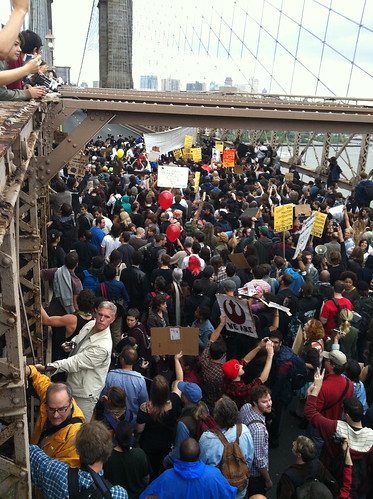
Police have kettled the march on the Brooklyn Bridge and have begun arresting protesters. At least 20 arrested so far.
Follow the action
UPDATE: 5:15PM - Brooklyn Bridge has been shut down by police
UPDATE: 5:55PM - At least 50 arrested.
UPDATE: 8:17PM - NYTimes reporting hundreds arrested - including a reporter - police appear to have deliberately misled protesters.
UPDATE: 8:40PM - Around 400 peaceful protesters arrested.
UPDATE 10/2 2:20AM - Over 700 protesters arrested.

http://occupywallst.org/

Sarah Jaffe: "They're Arresting Us One by One": 700 Thrown in Jail as Wall St. Protest Grows -- Labor Declares Support

"They're Arresting Us One by One": 700 Thrown in Jail as Wall St. Protest Grows -- Labor Declares Support

by Sarah Jaffe, Alternet, October 2, 2011
 
700 reported arrests and still Liberty Plaza remains occupied by protesters declaring, "We Are the 99%."
 
It's raining in Liberty Plaza Saturday afternoon as the shrunken crowds fall in around the Occupy Wall Street media center, which still isn't allowed a tent. They're keeping the laptops and livestream (which reports 13,000 viewers at one point, from around the world) under a large picnic umbrella and some tarps, and every now and then the call "mic check!" rings out and someone jumps atop a table to relay the latest from the protesters kettled on the Brooklyn Bridge, cuffed, and being loaded onto giant NYPD buses for dispersal to various locations.

The "People's Mic" is one of the most striking features of the "Occupy Wall Street" community that has sprung up down in the heart of New York's financial district. Because NYPD hasn't allowed amplification, speakers confine themselves to short half-sentences, that are repeated back by the crowd. It makes every statement communal -- in addition to wiggling your fingers downward if you disagree, or rolling your arms around if you want the person to hurry up and finish, you often simply stop repeating. There's an engagement, a type of consent that it creates, which is demonstrated when Congressman Charles Rangel shows up just before the march to show his support -- Rangel is greeted by the horde of reporters thrusting the microphones not allowed protesters in his face, but Rangel's words don't get repeated to the crowd -- instead, the most striking feature of his attempt to speak is the crowd's reaction to a heckler who got in Rangel's face. The crowd immediately took up the chant "Sit down!" and then "This is a peaceful march!" echoing across the plaza. 
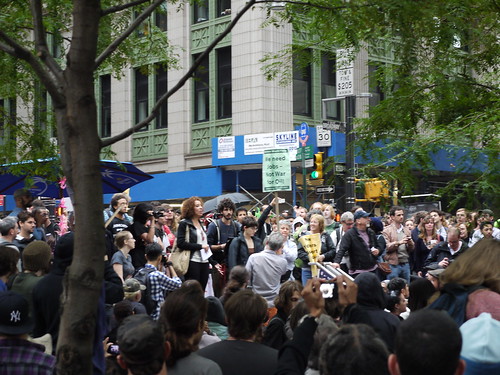
P1010034

There's only one round of shout-backs necessary in the small crowd during Saturday afternoon, but later that night, at about 7:30 PM, the reports from the legal team are echoed back in waves. It's almost soothing; combined with the professionalism from the legal team volunteer, who tells the crowd that they have names of 100 confirmed arrested and have dispatched lawyers to get them out, you almost forget that friends, colleagues are standing in the rain on the bridge. 

(Photo by Michael Whitney) 

AlterNet's Kristen Gwynne is one of those stuck in the bridge when the police closed off both ends and came in with the plastic cuffs. "They're arresting us one by one. I just asked a cop and they said they're going to arrest all of us. There are hundreds of people who don't have room to sit down. We're just crammed in," she reports by phone.

Later, she texts, "Now it's pouring and we're huddled five people to an umbrella. People just sang that [Rihanna] song 'you can get under my umbrella.'  Spirits are high and people are sharing what they have and coming together to protect each other."

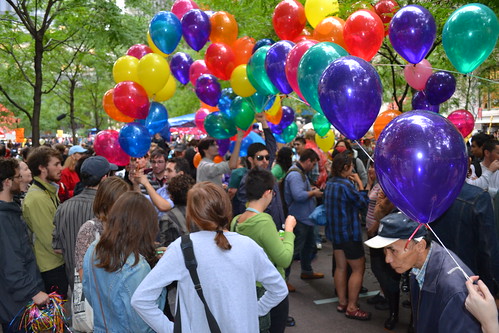
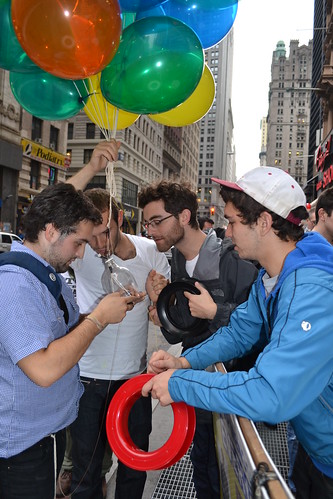
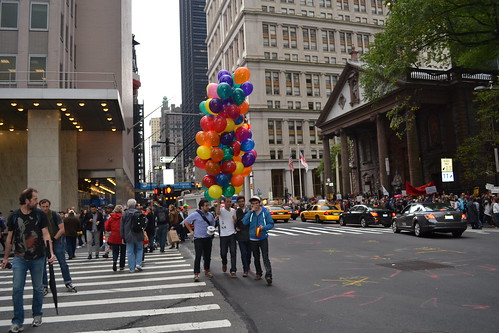
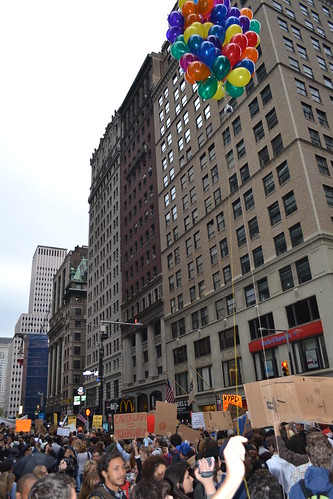
The relationship with the police stationed around the park has been remarkably good, but marches have been contested. The Saturday crowd proves that Friday's attendance wasn't just a fluke brought on by a rumor that Radiohead would play for the protesters, and thousands of people join the march -- as we pass, the boy clinging to a drainpipe and counting protesters shouts out "1,200 and counting!"  When visiting UK journalist Laurie Penny and I turn back, we squeeze past easily as many people as were ahead of us. A couple of marchers have a giant balloon cluster floating above with a camera dangling from it, getting a bird's-eye view of the crowds. 

When the texts and Twitter reports start to flood in that arrests are happening on the bridge, that even a New York Times reporter is being held, we rejoin the now-smaller crowd in Liberty Plaza to find out if there's any news. Reports are confused -- some say that you can get off the bridge on the Brooklyn side, and indeed I receive a report from a colleague that he's on the other side at Cadman Plaza. The jubilant tweets that the police were allowing marchers into the traffic lanes have turned to fear and anger at what many perceive as a trap. Surprisingly quickly, facilitators call "mic check!" and ask anyone who has a smartphone to go to the base of the bridge and record what they see -- including clear instructions on a specific app that can be downloaded to stream video instantly to the Web. 

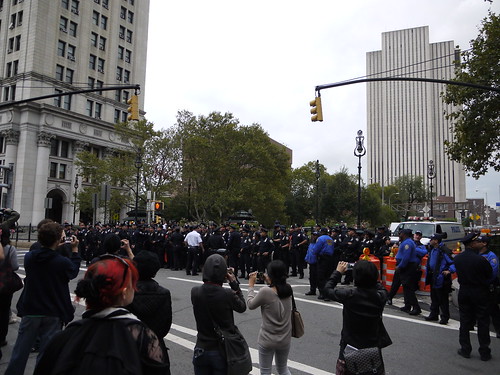
From the park, we briefly return to the base of the bridge to see a mass of police officers blocking the entrance to the traffic lanes. The crowd gathered there is mostly pointing cameras and smartphones at the police, but with no one moving on or off the bridge, the scene is tense. Protesters call "Join us!" and "Police are the 99 percent!" at the officers, who stand impassive, making no moves to arrest anyone or to allow anyone, on foot or on vehicles, from either direction, past. In the rain, we return to Liberty Plaza and the media tent, hoping for better news updates, and check updates on our phones. 

P1010053

Even as the NYPD was corralling and cuffing protesters on the bridge, new support was rolling in for the occupiers. Leo Gerard of the United Steelworkers union, North America's largest industrial union with 1.2 million active and retired members, made a resounding declaration of support: 
"The United Steelworkers (USW) stands in solidarity with and strongly supports Occupy Wall Street. The brave men and women, many of them young people without jobs, who have been demonstrating around-the-clock for nearly two weeks in New York City are speaking out for the many in our world. We are fed up with the corporate greed, corruption and arrogance that have inflicted pain on far too many for far too long." 
Working America, the AFL-CIO's community affiliate which organizes non-union workers, releases a statement as well, offering support and encouragement to the protesters. "It's obvious what has motivated these protests, and it's the same thing we hear at the doors we knock on every day," the statement reads. 

News also came in that the NYPD, which according to protesters has not allowed its officers to even accept donuts from protesters in the square, gratefully took $4.6 million from JP Morgan Chase, one of the Wall Street banks targeted by the protesters, in donation to its foundation. 

New Yorker and Naked Capitalism blogger Yves Smith writes of the gift, "The Foundation has been in existence for 40 years. If you assume that the $100 million it has received over that time is likely to mean “not much over $100 million” this contribution could easily be 3-4% of the total the Foundation have ever received."

The news coming in just as the reports were hitting that police had actually led protesters onto the car-traffic section of the bridge certainly sets the crowd humming (video below shows police marching ahead of the crowd onto the bridge): 

Michael Whitney, who was marching with the crowd onto the bridge, tells me, "No one knew we were going over the bridge." He says that the march stopped, then proceeded onto the traffic lane on the bridge, led by police. "We walked past dozens of police officers who said nothing to us--in the middle of the march, with 1200 people ahead of us. I thought out loud it felt like a trap and a bad idea." 

Whitney continues, "When it became clear police were blocking us from Brooklyn on the walkway and the roadway, we knew it was only a matter of time before arrests began. We started walking against the crowd back towards Manhattan. That's when we saw a sergeant and two officers walking up the pedestrian walkway, and multiple police vans driving on the roadway. They were getting everybody off the bridge, including the hot dog vendor and an old couple on a bench." 

Smith comments, "We simply don’t know whether the police would have behaved one iota differently in the absence of the JP Morgan donation. But it raises the troubling perspective that they might have." 

No one knows yet what the next few days will bring; Wednesday will see a march in solidarity with the occupiers which will include The United Federation of Teachers; 32BJ SEIU & 1199 SEIU; Workers United; Transport Workers Union Local 100, as well as the Working Families Party, Moveon.org, Make the Road New York, the Coalition for the Homeless, the Alliance for Quality Education, Community Voices Heard, United New York and Strong Economy For All. 

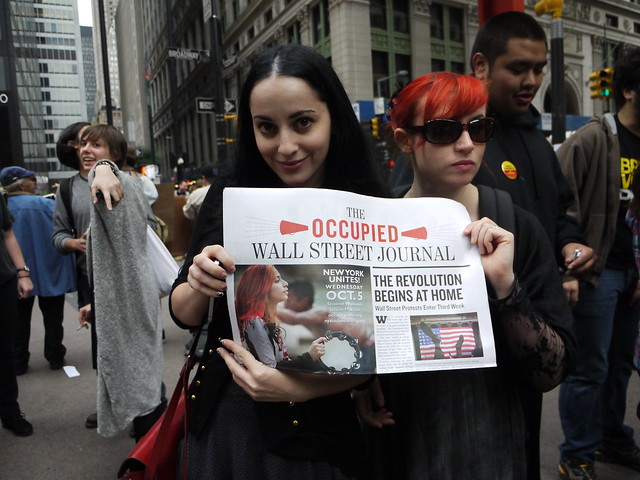
Occupations have sprung up around the country, and with the growing media coverage, the word is spreading fast. With union support comes money and an infrastructure used to planning rallies, strikes and protest actions, and with the community groups come people who aren't on social media but understand all too well the impact of bankers' greed. The first edition of the "Occupied Wall Street Journal," professionally printed as a broadsheet, was handed out along the parade route, and the occupiers issued their first official statement Saturday as well. 

P1010020

They have taken our houses through an illegal foreclosure process, despite not having the original mortgage.
They have taken bailouts from taxpayers with impunity, and continue to give Executives exorbitant bonuses.
They have perpetuated inequality and discrimination in the workplace based on age, the color of one’s skin, sex, gender identity and sexual orientation.
Hena Ashraf, who joined the protests this week, details in a blog post the process by which the official statement was composed and edited; her account highlights both the drawbacks and the strengths of the movement. She writes of calling the facilitators out for unacknowledged white privilege, the way the consensus-based decision-making process worked, and how the protesters learn from each other. "We walked away realizing what we had just done - spontaneously come together, demand change, and create it, in a movement that we are in solidarity with, but also feel a need for constructive criticism," she writes.

The crowd at the end of the night is unbowed, the mood still jubilant, in a "the flag was still there" sort of way. The square is full again, full of wiggling fingers of assent, echoes of news, dotted with Guy Fawkes masks turned backwards and 1199 SEIU ponchos, brought down from the union. Kristen is released from jail late at night; other protesters are also freed the same evening. Jeff Rae, one of those arrested, tweets pictures from inside his cell before his release, and says he is charged with "failure to obey order, prohibited use of roadway, and blocking traffic."  Their resolve is only hardened by their time singing songs of support on the bridge, the honks of support from passing cars, the growing protests around the country, and the cheers back in Liberty Plaza. 

*Photos, unless otherwise noted, are by Sarah Jaffe.

http://www.alternet.org/newsandviews/article/674826/hundreds_arrested%2C_including_alternet_reporter%2C_as_occupy_wall_street_keeps_growing

Sunday, October 2, 2011

Stunning conflict of interest: U.S. Department of State's public hearings on the Keystone XL pipeline being run by Cardno Entrix, the same firm that manages the Department's Keystone website and drafted the Department's environmental impact statement. Oh, and guess what? Cardno Entrix was contracted by TransCanada to do the work for the State Department. No arm's length whatsoever! TransCanada will be conducting the review of itself!!!

Austin Tar Sands Hearing a Farce

Hundreds of people turned out and many waited for hours yesterday in Austin, TX, to testify against the dangerous Keystone XL tar sands pipeline, which is proposed by a foreign company and threatens the health, climate and water of those living along the proposed pipeline route.

Photo by Karen Hadden of man arrested for expressing concerns about the flawed hearing process.

This pipeline would be carrying the dirtiest of oil from Canada through the heartland of American to be refined here in Texas.  The State Department sent contract facilitators who abruptly halted testimony, turning away several dozen speakers.  Federal Security and UTPD then forced people out of the room.  One man expressed concerns about the flawed process and was arrested for “criminal trespass.”

According to Karen Hadden, the Executive Director of the Sustainable and Economic Development (SEED) Coalition, “This was not a hearing, this was a farce.”  Ms. Hadden arrived and had been waiting for a couple of hours to give comments when they cut the hearing off.  Later, when she was attempting to find out what her options were for providing comments to the State Department given she was unable to do so at the hearing, she was told she must leave the premises or she would be arrested.

According to Brad Johnson of ThinkProgress:
In a stunning conflict of interest, public hearings on federal approval for a proposed tar sands pipeline are being run by a contractor for the pipeline company itself. The U.S. Department of State’s public hearings along the proposed route of the TransCanada Keystone XL tar sands pipeline this week are under the purview of Cardno Entrix, a “professional environmental consulting company” that specializes in “permitting and compliance.”
Cardno is not only running the State Department hearings, but also manages the department’s Keystone XL website and drafted the department’s environmental impact statement. Comments from the public about the pipeline go not to the government, but to a cardno.com email address.
Cardno Entrix was contracted by TransCanada Keystone XL LP (“Keystone”) to do the work for the Department of State, to assist DOS in preparing the EIS and to conduct the Section 106 consultation process.
Throughout the history of the DOS review of the Keystone pipeline, the work has been conducted not by civil servants but by representatives of the pipeline company. During the Bush administration, the Department of State appointed TransCanada “and its subcontractors to act as its designated non-federal representatives” to assess the potential impact of the Keystone pipeline on endangered species.
Cardno Entrix contractors are running the public hearings from Port Arthur, Texas, to Glendive, Montana. It is not clear from media reports whether the State Department “representatives” at the hearing were in fact Entrix employees. ThinkProgress Green is awaiting information from the State Department.
“All of this adds up to the old saying, the fox is guarding the hen house,” says Jane Kleeb, the Nebraska activist leading the fight to protect her state from the risks of the Keystone XL project.
We will also followup and let you know if there were, in fact, any actual employees of the State Department present at this hearing.

Link:  http://texasvox.org/2011/09/29/austin-tar-sands-hearing-a-farce/

Yves Smith: Is JP Morgan Getting a Good Return on $4.6 Million “Gift” to NYC Police? (Like Special Protection from OccupyWallStreet?)

Readers, in case you do not already know, Yves Smith is the foremost blogger on the world of finance on the Internet. She tells it exactly like it is. She's the Alan Grayson of finance. If something is rotten in Denmark she can smell it light years before anyone else can.  [She let's this guy who uses the pseudonym of George Washington post on climate science, and he is always wrong, but in finance, she is always right.  Hey, nobody's perfect.]

Is JP Morgan Getting a Good Return on $4.6 Million “Gift” to NYC Police? (Like Special Protection from OccupyWallStreet?)

by Yves Smith, Naked Capitalism, October 2, 2011
No matter how you look at this development, it does not smell right. From JP Morgan’s website, hat tip Lisa Epstein:
JPMorgan Chase recently donated an unprecedented $4.6 million to the New York City Police Foundation. The gift was the largest in the history of the foundation and will enable the New York City Police Department to strengthen security in the Big Apple. The money will pay for 1,000 new patrol car laptops, as well as security monitoring software in the NYPD’s main data center.
New York City Police Commissioner Raymond Kelly sent CEO and Chairman Jamie Dimon a note expressing “profound gratitude” for the company’s donation.
“These officers put their lives on the line every day to keep us safe,” Dimon said. “We’re incredibly proud to help them build this program and let them know how much we value their hard work.”
Perhaps I remember too much of the scruffy and not exactly safe New York City of the 1980s, where getting your wallet pinched was a pretty regular occurrence. My perception has been that police-related charities have relied overmuch on the never-stated notion that if you didn’t donate, you might not get the speediest response if you needed help. As a mere apartment-dweller, I can’t imagine that anyone could scan incoming 911 calls against a priority list. But the flip side is if I owned a retail store and thought the beat police would keep an extra eye on it if I gave to a police charity, it would seem like an awfully cheap form of insurance.
But what, pray tell, is this about? The JPM money is going directly from the foundation to the NYPD proper, not to, say, cops injured in the course of duty or police widows and orphans. But that is how the NYPD Police Foundation works. From its website:
The New York City Police Foundation, Inc. was established in 1971 by business and civic leaders as an independent, non-profit organization to promote excellence in the NYPD and improve public safety in New York City.
The Police Foundation supports programs designed to help the NYPD keep pace with rapidly evolving technology, strategies and training.
The New York City Police Foundation:
Provides resources that are not readily available through other means – to date over $100 million has been invested in 400+ innovative NYPD programs;
Serves as a vehicle for tax-exempt gifts and grants from individuals, businesses, and philanthropies;
Is the first municipal foundation of its kind in the country, and serves as a model for similar organizations in other cities;
Is the only organization authorized to raise funds on behalf of the NYPD and;
Does not solicit by telephone or use telemarketers.
The Police Foundation works closely with the Police Commissioner to develop a strategic program agenda. The Foundation encourages and supports NYPD programs in two main areas:
Projects, research studies, and equipment to improve the effectiveness of police activities; and
Education, training and skill development to strengthen the partnership between the police and the public.
Given when the NYC Police Foundation was formed, it looked to have been a desperate move during New York City’s fiscal crisis (remember the infamous headline: “Ford to City: Drop Dead”?) When I moved to the city in 1981, pretty much everyone I knew who lived in a non-doorman building had suffered a break-in. Guiliani’s reputation was built on cleaning up a perceived-to-be unsafe city (which he did by hiring William Bratton). Even in the later 1980s, when I lived in a townhouse on 69th between Park and Madison (translation: good neighborhood), I’d be the first out of the building in the AM. The inner door to the townhouse was locked, the outer one was closed but unlocked. I’d always have to navigate my way out carefully so as not to waken the homeless person sleeping in the vestibule.
So while this effort to supplement taxpayer funding has a certain logic, it raises the nasty specter of favoritism, that if private funding were to become a significant part of the Police Department’s total budget, it would understandably give priority to its patrons.
And look at the magnitude of the JP Morgan “gift.” The Foundation has been in existence for 40 years. If you assume that the $100 million it has received over that time is likely to mean “not much over $100 million” this contribution could easily be 3-4% of the total the Foundation have ever received.
Now readers can point out that this gift is bupkis relative to the budget of the police department, which is close to $4 billion. But looking at it on a mathematical basis likely misses the incentives at work. Dimon is one of the most powerful and connected corporate leaders in Gotham City. If he thinks the police donation was worthwhile, he might encourage other bank and big company CEOs to make large donations.
And what sort of benefits might JPM get? It is unlikely that there would be anything as crass as an explicit quid pro quo. But it certainly is useful to be confident that the police are on your side, say if an executive or worse an entire desk is caught in a sex or drugs scandal. Recall that Charles Ferguson in Inside Job alleged that the use of hookers is pervasive on Wall Street (duh) and is invoiced to the banks.
Or the police might be extra protective of your interests. Today, OccupyWallStreet decided to march across the Brooklyn Bridge (a proud New York tradition) to Chase Manhattan Plaza in Brooklyn. Reports in the media indicate that the police at first seemed to be encouraging the protestors not only to cross the bridge, but were walking in front of the crowd, seemingly escorting them across:
The wee problem is that the police are in the street, and part of the crowd is also on the street (others are on a pedestrian walkway that is above street level). That puts them in violation of NYC rules that against interfering with traffic. Note the protest were aware of the rules; they were careful to stay on the sidewalk on the way to the bridge.
Over 700 of the marchers were arrested, and the media has a rather amusing “he said, she said” account, with OccupyWallStreet claiming entrapment and the cops batting their baby blues and trying to look innocent. From the New York Times:
But many protesters said they believed the police had tricked them…
“The cops watched and did nothing, indeed, seemed to guide us onto the roadway,” said Jesse A. Myerson, a media coordinator for Occupy Wall Street who marched but was not arrested…all insisted that the police had made no mention that the roadway was off limits. Ms.[Annie] Day and several others said that police officers had walked beside the crowd until the group reached about midway, then without warning began to corral the protesters behind orange nets…
Where the entrance to the bridge narrowed their path, some marchers, including organizers, stuck to the generally agreed-upon route and headed up onto the wooden walkway that runs between and about 15 feet above the bridge’s traffic lanes.
But about 20 others headed for the Brooklyn-bound roadway, said Christopher T. Dunn of the New York Civil Liberties Union, who accompanied the march…They were met by a handful of high-level police supervisors, who blocked the way and announced repeatedly through bullhorns that the marchers were blocking the roadway and that if they continued to do so, they would be subject to arrest.
There were no physical barriers, though, and at one point, the marchers began walking up the roadway with the police commanders in front of them – seeming, from a distance, as if they were leading the way. The Chief of Department Joseph J. Esposito, and a horde of other white-shirted commanders, were among them…
A freelance reporter for The New York Times, Natasha Lennard, was among those arrested….
Mr. Dunn said he was concerned that those in the back of the column who might not have heard the warnings “would have had no idea that it was not O.K. to walk on the roadway of the bridge.” Mr. Browne [of the NYPD] said that people who were in the rear of the crowd that may not have heard the warnings were not arrested and were free to leave.
Earlier in the afternoon, as many as 10 Department of Correction buses, big enough to hold 20 prisoners apiece, had been dispatched from Rikers Island in what one law enforcement official said was “a planned move on the protesters.”
Etan Ben-Ami, 56, a psychotherapist from Brooklyn who was up on the walkway, said that the police seemed to make a conscious decision to allow the protesters to claim the road. “They weren’t pushed back,” he said. “It seemed that they moved at the same time.”...
He added: “We thought they were escorting us because they wanted us to be safe.”
The part I find more interesting, which has not been as well reported, is that some (many?) the protestors who used the walkway and got across the bridge were also corralled and not permitted to proceed to the Chase plaza. Greg Basta, deputy director of the New York Communities for Change, told me by phone, based on multiple reports from people who participated in the march, that as soon as protestors got to the Brooklyn side of the bridge, they were kettled. Greg was under the impression that there were construction barricades at the foot of the bridge which made it impossible for the marchers not to walk on the street.
Because the focus has been on the what happened on the bridge, the coverage of what happened to the rest of crowd is sparse.
Some confirmation in passing comes from MsExPat at Corrente (apparently some of the very first off the bridge were permitted to proceed):
My friends and I made it to the Brooklyn side okay–we ended up with about 350 other marchers in Cadman Plaza, a lovely 19th century park. What I didn’t find out until later is that several hundred people behind me also got kettled and barred from going all the way to Brooklyn. So I was among the lucky marchers in the middle.
But notice even then that the procession to Chase Manhattan Plaza was effectively barred.
We simply don’t know whether the police would have behaved one iota differently in the absence of the JP Morgan donation. But it raises the troubling perspective that they might have. Richard Kline pointed out that that local policing was important protection against control by the elites:
The oligarchy specifically and the Right in general are far less strong in American society apart from what their noise machines and bankroll flashing would make one think. The great bulk of the judiciary remains independent even if important higher appellate positions are tainted. Domestic policing is, by tradition and design, highly decentralized, with a good deal of local control, making overt police state actions difficult, visible, and highly unpopular (think TSA). While the military is a socially conservative society in itself, it is also an exceptionally depoliticized one, with civilian control an infrangible value. Popular voter commitment to the nominally more conservative political party has never been narrower or more fragile.
So far, the JP Morgan donation is an isolated example. But the high odds of continuing deep budget cuts at the state and local level open up the opportunity for corporate funding of preferred services, and with it, much greater private sector influence on the apparatus of government. This is a worrisome enough possibility to warrant a high degree of vigilance by all of us.
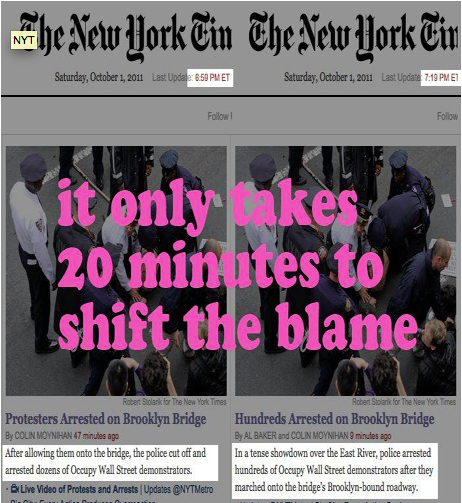
Update 5:00 AM: Debra C, via e-mail, points to FreakOut Nation, which has screen shots to show how the New York Times edited the OccupyWallStreet story after it went live to make it less protestor friendly:


Virtual March on Wall Street

Virtual March on Wall Street


Join the Virtual March on Wall Street this Wednesday, October 5, to show your support for the Occupy Wall Street movement!

First thing Wednesday morning, we'll send the instructions for participating online. 

http://www.civic.moveon.org/joinvirtualwallstreet/index_rtd.html

Official link for donations and UPS address where you can send supplies to Occupy Wall Street

Readers, please go to that actual page, I have only made this post FYI (also at the link below are comments and a twitter feed -- interesting comments):

http://nycga.cc/donate/

 Donate Money to #occupywallstreet

$
You will taken to nicanet.org and asked to confirm. All donations through here are tax deductible.
Don’t be alarmed when you end up on nicanet.org this is the method that our sponsor Alliance for Global Justice provided to the NYCGA.

Mail your check or money order to the Alliance for Global Justice.
Please indicate “Occupy wall street” in the memo line.
Alliance for Global Justice
1247 “E” Street, SE
Washington, DC 20003
Or CALL at 202-544-9355 to make a telephone donation.

The following donations are managed by some of our working groups:
Live Streaming team
bitcoin.org - 1Q7DQVTubbUqr5by2YoZJRKCEzj9D3LQ9w

Donate yourself

Come to Liberty Plaza, formally Zuccotti Park. How to get there.
Liberty st and Broadway, Financial District, Manhattan, NY (map)

Order Us Food

Panini & Co 115 Broadway: Please try to focus on vegan and vegetarian options with some meat options.
Order Panini
Lemongrass Grill: Please try to focus on vegan and vegetarian options with some meat options.
Order Lemongrass Grill
Tolache Taqueria: Please try to focus on vegan and vegetarian options with some meat options.
Order Tolache

Liberatos pizza – order online – order the “Occu-pie”
Please order vegan or non-meat pizzas :)
Other local business that deliver

Our physical address

UPS Store 118A
Fulton st #205
New York, NY, 10038
Non perishable, no checks (money orders okay) , any size package okay

Check here for posts about the needs of the 99%

Police State | #OccupyWallStreet 400 Protesters on Brooklyn Bridge Arrested – Was it a Setup?

Police State | #OccupyWallStreet 400 Protesters on Brooklyn Bridge Arrested – Was it a Setup?

Earlier in the afternoon, as many as 10 Department of Correction buses, big enough to hold 20 prisoners apiece, had been dispatched from Rikers Island in what one law enforcement official said was “a planned move on the protesters.”
~

Police Arrest About 400 Protesters on Brooklyn Bridge

In a tense showdown above the East River, the police arrested about 400 demonstrators from the Occupy Wall Street protests who took to the roadway as they tried to cross the Brooklyn Bridge on Saturday afternoon.

The police did not immediately release precise arrest figures, but said it was the choice of those marchers that led to the swift enforcement.

“Protesters who used the Brooklyn Bridge walkway were not arrested,” said the head police spokesman, Paul J. Browne. “Those who took over the Brooklyn-bound roadway, and impeded vehicle traffic, were arrested.”

But many protesters said that they thought the police had tricked and trapped them, allowing them onto the bridge and even escorting them across, only to surround them in orange netting after hundreds of them had entered.

“The cops watched and did nothing, indeed, seemed to guide us on to the roadway,” said Jesse A. Myerson, a media coordinator for Occupy Wall Street who was in the march but was not arrested.

Check out the rest here…

http://4closurefraud.org/2011/10/01/police-state-occupywallstreet-400-protesters-on-brooklyn-bridge-arrested-was-it-a-setup/

I was present last night. I am an organizer working with Occupy Boston’s legal team. The encampment is at Dewey Square which is directly across Atlantic Ave from both South Station and the Fed Reserve building

Jugo1502 says:
I was present last night. I am an organizer working with Occupy Boston’s legal team. The encampment is at Dewey Square which is directly across Atlantic Ave from both South Station and the Fed Reserve building (we’re talking just a few meters distance here). Plus, very clear line-of-site.

After the Bank of America protest earlier in the afternoon (a separate Move On.org event), Occupy Boston moved in on Dewey Sq. for encampment at 18:00 hours (apologies, I’m ex-Army, I prefer 24-hour clock).

At about 22:00 hours we moved (est. 500-600 bodies) out of our encampment and marched through Downtown Crossing, up through Beacon Hill, down through Government Center, through Quincy Market, back onto Atlantic Ave where we then proceeded down the Rose Kennedy Greenway back to the encampment at Dewey Square. Instead of bedding down for the night, we crossed Atlantic Ave at approx. 23:00 hours to demonstrate in front of the Fed Reserve Building (now, suddenly, a considerable police presence appears). Demonstrated for a couple of hours to the delight of the drunken crowds of bar goers headed home from South Boston. Line of police moved in after we initially touched the glass of the Fed’s lobby. Police formed a buffer between us and the Reserve building. Protest continued with no police action. Police continued to stay gentle (even the Staties!). No actions followed. Bedded down. Day one complete.

Loads of foot traffic in the area. Loads of onlookers. Truckers, cabbies, motorists, etc. all honked and cheered in support. Also, the vast majority of onlookers (sitting in restaurants, strolling about, etc.) clapped and raised fists in support as we marched past. Many looked bewildered. A couple of frat-boy, self-described “bankers” in very fine suits half-drunkenly approached the edge of Dewey Square to begin an argument with whomever they could. They approached a couple of “socialists” and commenced bullying. I (and my tall, muscular frame) joined in when I could bear the stupidity of the arguments being made no more. I asked the young “bankers” some questions about accounting policy, and some pretty heavy financial questions about their daily operations at their “bank” (as I am an accountant) and it quickly became clear that the two gentleman lack fundamental finance knowledge. They also wouldn’t identify which institution they work for. Angered by my calm statements and questions, which caused them to fumble and exhibit ignorance, they began using expletives and stormed away as they did so. 

In general, police were gentle, polite, and professional (not that I expect this to last into the long term). Did not make moves to suppress our action as we took to the streets in this unplanned, late night march. They blocked traffic and anticipated our route as we moved. They made no attempt to divert our path of movement or break up our phalanx. I do have to salute the action of Boston PD. Unexpectedly helpful.

‘Twas a positive first night. However, I expect “friction” if and when this starts to get serious.
I have loved, love, and shall continue to love Yves Smith, NC, and all the brilliant voices who contribute to this blog. A haven off sanity and reason.

Earthjustice is heading to court to challenge federal approval of Shell Oil’s plan to drill in the Alaskan Arctic’s Beaufort Sea.

Earthjustice - Because the Earth Needs a Good Lawyer

Dear Tenney,
arctic-shell-44.jpgThanks to you [just a tiny little bit], Earthjustice is heading to court to challenge federal approval of Shell Oil’s plan to drill in the Alaskan Arctic’s Beaufort Sea.

After the devastating Deepwater Horizon spill, President Obama wisely delayed plans by Shell Oil to drill in the Arctic Ocean. But this August, the administration reversed course and approved the first part of the most aggressive Arctic drilling proposal in the history of the country by approving Shell’s plan to start drilling in the Beaufort Sea as early as the summer of 2012. 
Yesterday, Earthjustice initiated litigation in the Ninth Circuit Court of Appeals on behalf of Alaska Native and conservation groups challenging the Bureau of Ocean Energy Management, Regulation, and Enforcement’s (BOEMRE) decision to allow this reckless drilling in the Arctic.
According to our Alaska-based attorney on the case, Holly Harris:
"BOEMRE is allowing Shell to drill even though the company has no credible plan to cleanup an oil spill in the Arctic’s icy waters, and instead just asserts it can clean up 95 percent of oil spilled.  Let’s look at the facts: in the Deepwater Horizon cleanup, with a massive response and no Arctic ice to hamper them, crews skimmed up only 3 percent of the oil. Now is not the time for a 'just trust us' approach to Arctic drilling.”

A spill in the Arctic Ocean would devastate polar bears, seals, bowhead whales and other marine mammals and would severely affect Native subsistence communities which have thrived in this region for generations.
U.S. Coast Guard officials have repeatedly explained that the resources to clean up an oil spill in the waters of the Arctic Ocean simply don’t exist. This summer, U.S. Coast Guard Commandant Admiral Robert Papp told Congress that the federal government has “zero” spill response capability in the Arctic. 
Further, as a recent report by the government’s leading scientists highlights, basic scientific information about nearly every aspect of the Arctic Ocean ecosystem is missing. This lack of data makes it impossible to adequately assess the risks and impacts of drilling to wildlife and people in the Arctic and, as a result, makes it impossible to make informed, science-based decisions. 
Thanks to you and others like you, Earthjustice has consistently held the line against dangerous offshore oil drilling in the Arctic.
We hope you continue to stand by our work now and in the fight to come.
Sincerely,
Trip Van Noppen Trip Van Noppen
Trip Van NoppenPresident, Earthjustice

Saturday, October 1, 2011

The plutocrats at JP Morgan Chase are running so scared they just donated $4.6 million to the NYPD: talk about a straight out in the open ... fill in the blank

Quelle Surprise! “J.P. Morgan Chase “donates” $4.6 Million to NYPD” #OccupyWallStreet

Quelle Surprise! “J.P. Morgan Chase “donates” $4.6 Million to NYPD” #OccupyWallStreet


JPMorgan Chase recently donated an unprecedented $4.6 million to the New York City Police Foundation. The gift was the largest in the history of the foundation and will enable the New York City Police Department to strengthen security in the Big Apple. The money will pay for 1,000 new patrol car laptops, as well as security monitoring software in the NYPD’s main data center.


New York City Police Commissioner Raymond Kelly sent CEO and Chairman Jamie Dimon a note expressing “profound gratitude” for the company’s donation.


“These officers put their lives on the line every day to keep us safe,” Dimon said. “We’re incredibly proud to help them build this program and let them know how much we value their hard work.”

Yes Men: The Alberta Tar Sands is ... Mordor?

Reveal date: Apr 15 2011 Status: Complete Partners: Greenpeace Canada Tagged: Canada, climate change, Tar Sands
A fuzzy cell phone video of an Elijah Woods sighting in Alberta, Canada. A fake Alberta Film website touting the advantages of filming at the Tars Sands. A fake production company website, a gossip video blog, an angry press release by the Tolkien family, a fake video blog by Peter Jackson himself, director of the Lord of the Rings Trilogy, and now The Hobbit, and of course a Facebook campaign against Jackson, calling on him to stop filming in the Tar Sands: because it was too flattering to Mordor.

The only thing missing was a sighting of evil Lord Sauron.

This complex social media campaign, which had the blogosphere abuzz speculating as to when, how and why Jackson was shooting the Mordor scenes from The Hobbit in the Alberta Tar Sands, created an opportunity to further highlight the devastation caused by the Tar Sands. The Tar Sands, which NASA scientist and climate expert James Hansen has called Canada's "carbon bomb," is the country's single largest source of climate change enhancing greenhouse gas emissions. And at a time of worsening climate crisis, Canada is expanding operations at the massive industrial site.

The campaign was developed by a troupe of Toronto activists calling themselves Black Flood, along with the Yes Lab. The stated goal of the Canadian activists—"to stir up some hot and bubbly controversy on the Alberta tar sands"—worked like a charm.
Selected press:

Current Extreme Weather & Climate Change: Overview (with Kevin Trenberth, Jerry Meehl, Jeff Masters & Richard Somerville)

Current Extreme Weather & Climate Change

Climate Communication hosted a press conference featuring our expert reviewers discussing the connections between extreme weather and climate change. The full audio recording of the conference can be downloaded here: 9/7/11 Climate Communication Press Conference.

Expert Reviewers:

Editorial Team for Climate Communication:

Record Highs Now Outpace Record Lows by 2:1


The ratio of record daily high temperatures to record daily lows observed at about 1,800 weather stations in the 48 contiguous United States from January 1950 through September 2009 (Meehl et al., 2009).
Recent weather events such as deadly heat waves and devastating floods have sparked popular interest in understanding the role of global warming in driving extreme weather. These events are part of a new pattern of more extreme weather across the globe, shaped in part by human-induced climate change.

As the climate has warmed, some types of extreme weather have become more frequent and severe in recent decades, with increases in extreme heat, intense precipitation, and drought. Heat waves are longer and hotter. Heavy rains and flooding are more frequent. In a wide swing between extremes, drought, too, is more intense and more widespread.

All weather events are now influenced by climate change because all weather now develops in a different environment than before. While natural variability continues to play a key role in extreme weather, climate change has shifted the odds and changed the natural limits, making certain types of extreme weather more frequent and more intense. The kinds of extreme weather events that would be expected to occur more often in a warming world are indeed increasing.

For example, 60 years ago in the continental United States, the number of new record high temperatures recorded around the country each year was roughly equal to the number of new record lows. Now, the number of new record highs recorded each year is twice the number of new record lows, a signature of a warming climate, and a clear example of its impact on extreme weather.1

The increase in record highs extends outside the U.S. as well. A similar two to one ratio of record highs to record lows recently has been observed in Australia.2 Over the past decade, 75 counties set all-time record highs but only 15 countries set all-time record lows. In 2010, 19 countries set new all-time record high temperatures, but not a single country set a new all-time record low (among those countries keeping these statistics). 3

European 2003 Summer Temperatures Were Far Outside Normal Range


2003 European Heat Wave: The Hottest Summer in 140 Years (1864-2003). Each vertical line represents the average summer temperature for a single year from the average of four locations in Switzerland over the period 1864 through 2003. This illustrates how far outside the normal range the summer of 2003 was (Schär et al., 2004).


One way in which climate change is connected to individual events such as heat waves and heavy rains is by increasing the odds they will occur. We witness that connection in the form of more frequent extreme events. Analyzing how global warming has changed the odds for a specific event has been done for standout moments such as the European heat wave of 2003 that killed tens of thousands. Based on temperature records from 1864 to 2002, the odds of such a heatwave occurring are about 1 in 10 million.4 An event like the 2003 heatwave becomes much more likely after factoring in the observed warming of 2 °F over Europe and increased weather variability.5 In addition, comparing computer models of climate with and without human contribution shows that human influence has roughly quadrupled the odds of a European summer as hot as or hotter than the summer of 2003.6

A Small Increase in Average Temperature Leads to Big Changes in Extreme Weather

Small changes in the averages of many key climate variables can correspond to large changes in weather.7 Substantial changes in the frequency and intensity of extreme events can result from a relatively small shift in the average of a distribution of temperatures, precipitation, or other climate variables.8

Climate Change Shifts the Odds for Extreme Weather Events


Solomon et al., 2007.

Weather variation on our planet can be described with a rough bell-shaped curve. So-called normal weather is very common while extreme weather is rare. While events close to normal occur frequently, in the broad center of the curve, there is a sharp fall-off in the frequency of events further away from normal, in the flatter ends of the curve. For instance, a small increase in temperature shifts the entire curve toward hotter high temperatures. The rarest and most extreme record heat events become even more severe and much more frequent. Precipitation does not follow quite the same pattern, but the same concept applies: fewer light and moderate rains are being replaced by more heavy rain events.

While our understanding of how climate change affects extreme weather is still developing, evidence suggests that extreme weather may be affected even more than anticipated. Changes in precipitation are quite complex,9 and current computer models of climate have only a limited ability to predict the heaviest precipitation. Recent observed changes in precipitation have been even greater than the changes projected by climate models.10 Even with their limitations, current models still capture the physical processes associated with the observed increases in intense precipitation. Warmer air holds more moisture. That additional moisture fuels increases in precipitation intensity. This has been been measured in real-world observations as well as simulated by climate models.11

Humans Contribute to Extreme Weather – and Suffer its Consequences

Rigorous analyses have shown that natural variability alone cannot explain the observed long-term trends of changing extremes in temperature and precipitation.12

In contrast, the observed trends fit well with our understanding of how climate change drives changes in weather. Computer models of the climate that include both natural forces as well as human influences are consistent with observed global trends in heat waves, warm days and nights, and frost days over the last four decades.13 Human influence has also been shown to have contributed to the increase of heavy precipitation over the Northern Hemisphere.14
Extreme weather events do not have a single cause but instead have various possible contributing factors – and human-induced climate change is now one of those factors.

Weather variability can be extremely costly. One estimate finds that the total U.S. economic output varies by up to $485 billion/year owing to weather variability.15 From 1980 to 2010 there were 99 weather disasters in the U.S. in which damages exceeded $1 billion. Altogether those disasters cost $725 billion.16 In 2011, the costs of all weather-disaster damages so far has climbed past $35 billion, according to NOAA estimates. As of August 30th, the U.S. has witnessed 10 weather disasters costing over $1 billion each. This breaks the previous record for the number of such U.S. weather disasters in an entire year.17

Changes in extreme weather threaten human health as well as prosperity. Many societies have taken measures to cope with historical weather extremes, but new, more intense extremes have the potential to overwhelm existing human systems and structures.18 More frequent and more severe extreme weather events are more likely to destabilize ecosystems and cripple essential components of human livelihood, such as food production, transportation infrastructure, and water management. Death, disease, displacement, and economic hardship may follow, as we have seen with recent hurricanes, floods, heat waves, and droughts.

YouTube video (interviews of the scientists):  http://www.youtube.com/watch?v=OmJfsjYfVNU


Link:  http://climatecommunication.org/new/articles/extreme-weather/overview/

Here Be Monsters -- download episode on Occupy Together and Occupy Wall Street and Elizabeth Warren