Blog Archive

Thursday, October 30, 2008

Alexey Karpechko: Human activity to blame for polar warming

Data pins polar warming blame on humans


by Matthew Knight, for CNN, October 30, 2008

LONDON, England (CNN) -- Scientists think they have uncovered conclusive proof that human activity is responsible for rising temperatures in both polar regions.

Changes in polar temperatures are not consistent with natural climate changes say scientists.

Changes in polar temperatures are not consistent with natural climate changes say scientists.

Research carried out at the Climatic Research Unit at the UK's University of East Anglia (UEA) demonstrates for the first time that anthropogenic climate change is responsible for warming at the Arctic and Antarctic.

Previous studies have observed rises in temperature at both poles, but none, until now, have formally attributed the cause to human activity.

Using up-to-date gridded data sets, scientists led by the UEA observed mean land surface temperatures in the Arctic over a 100 year period. For the Antarctic the observation period was shorter -- 50 years -- as there is no station data available before 1945.

They then applied an average simulated response using two models. The first examined natural forcings -- events like solar cycles and volcanic activity which can affect temperatures.

The second model simulated natural combined with anthropogenic forcings -- which included greenhouse gases, stratospheric ozone depletion and sulphate aerosol.

Scientists discovered that the observed changes in Arctic and Antarctic temperatures are not consistent with internal climate variability or natural climate drivers alone.

One of the report authors, Dr Alexey Karpechko told CNN: "In both cases the accelerations are not consistent with natural forcing, which means that natural forcing alone cannot produce such a warming. So in a sense, we can say conclusively that this [warming trend at the poles] is due to human influence."

The paper "Attribution of polar warming to human influence" is published in the science journal Nature Geoscience.

The Antarctic data is of particular interest given that the Intergovernmental Panel on Climate Change's Fourth Assessment Report in 2007 notes that anthropogenic climate change had been detected in every continent except Antarctica.

This new data appears to demonstrate that man-made warming is indeed happening on the continent as well.

The report may go some way towards silencing climate skeptics who point to evidence that most of Antarctica has been cooling for some time.

"There is strong warming in the Antarctic peninsula," Karpechko said. "But for several decades there has been a slight cooling of the rest of the continent. This slight cooling is due to circulation changes which are partly caused by ozone depletion.

"This is why there has been a bit of confusion as to what is happening in Antarctica. But we expect a recovery of the ozone layer in the future. We may also expect that the Antarctic warming trends will emerge more clearly."

Commenting on the study conducted by the UEA, Professor David Vaughan, a Glaciologist at the British Antarctic Survey told CNN: "This is exactly the sort of study we need. The poles are extremely important in the climate change debate and the rapid warming in the Arctic is one of the icons."

Professor Vaughan, who is studying the patches of warming happening in Antarctica, concedes that the cooling that's occurred in the past 30 to 50 years is "a little perplexing". But he agrees with Dr Karpechko over the effects of the ozone hole.

"The likelihood is that over the next century the ozone hole will be substantially reduced," Professor Vaughan said, "And it may mean that the Antarctic warming becomes much more apparent in that period."

Climate modeling might not convince everyone that warming is taking place, but as Professor Vaughan points out: "Simulations are built around physical principles and an understanding of the physical world".

Climate modeling is a relatively new area of expertise but Professor Vaughan said that the UEA is widely recognized as one of the world leaders in this field.

As previous IPCC reports have pointed out, the effects of warming at the poles are already being felt by indigenous polar species and communities. This new report is confirmation of the culpability of humans in contributing to these rising temperatures.

"I'm afraid that there will always be people that don't believe that we are making all these changes," Dr Karpechko said.

"Some people are waiting for the science to say that a particular heat wave is caused by humans. But attributing specific effects to human activities is much more difficult than attributing global changes. I don't know if we should wait for that because it will be too late.

"I see from the data that there is warming. This is really frightening."

Link to article: http://edition.cnn.com/2008/TECH/science/10/30/polar.warming/index.html

Tuesday, October 28, 2008

Bulletin of the Atomic Scientists: China's strategies to combat climate change

Blogger's note: I have a tendency to read such articles with a highly jaundiced eye.

China's strategies to combat climate change

Editor's note: The following article is drawn from findings published in the Climate Group's July report, "China's Clean Revolution." PDF

China is pursuing a green energy program for all the right reasons: It will offer the country a new source of domestically produced energy, provide an alternative to imported fuels, and help support Beijing's ongoing economic development. What's more, a renewable energy platform also lays the groundwork for developing new business sectors that could contribute to the economy through job creation and export potential. In short, China recognizes that energy efficiency addresses global warming, but also that the actions needed to tackle climate change also could contribute to economic development. In addition, by moving quickly to implement policies that address global warming, China is positioning itself to work more effectively with the international community to negotiate a successor agreement to the Kyoto Protocol.

That isn't to say any of this will be easy. China faces real challenges in balancing continued economic development against the need to safeguard the environment domestically and to play a responsible role in the international community as well.

Since Beijing launched its economic reforms in the early 1980s and opened the country to ever-increasing levels of foreign investment, China's economy has grown at a breakneck pace of 10-15 percent each year--with the exception of 1989 and 1990 when gross domestic product (GDP) growth cooled. Even as the global economy has vacillated since 2001, the Chinese economy has continued to grow at rates of 8-11 percent per year. An explosion in manufacturing has largely driven this rapid expansion. In the process, China has lifted hundreds of millions of people out of poverty and turned itself into an economic and industrial powerhouse.

Of course, the rapid growth and major shift to manufacturing has meant a corresponding rise in energy use. As a result, China has become the planet's largest emitter of greenhouse gases. China is also now the world's largest producer and consumer of coal at about 2.5 billion tons--or 40 percent of the global total. In fact, coal is the source of 80 percent of Chinese electricity, and is one of the few fuel resources China has in great abundance.

Yet, overall, energy intensity in China has improved steadily at a rate of around 3.9 percent per year from 1980 to 2005, resulting in impressive cumulative gains. For example, in 1980, China consumed 17 tons of coal for every $1,400 of GDP it produced, but that figure fell to 1.2 tons per $1,400 of GDP in 2006.

And despite the rapid rise in total energy use, per-capita energy consumption is still well below that of the West, as the average Chinese citizen consumes less than one-half the energy of the average person in the European Union (EU) and only one-fourth that of the average American. Again, the challenge becomes how China will deliver an improved standard of living for its populace while also protecting the environment and addressing global warming. It's an especially vexing proposition when Beijing's reliance on coal is considered.

More here: http://www.thebulletin.org/web-edition/features/chinas-strategies-to-combat-climate-change

World Wildlife Fund's 2008 Living Planet Report Warns: Humans using 1/3 more than the planet can sustain

Living Planet analysis shows looming ecological credit crunch

Living Planet Report 2008
© WWF
29 Oct 2008
Gland, Switzerland: The world is heading for an ecological credit crunch as human demands on the world's natural capital reach nearly a third more than earth can sustain.

That is the stark warning contained in the latest edition of WWF’s Living Planet Report, the leading statement of the planet’s health. In addition global natural wealth and diversity continues to decline, and more and more countries are slipping into a state of permanent or seasonal water stress.

“The world is currently struggling with the consequences of over-valuing its financial assets,” said WWF International Director-General James Leape, “but a more fundamental crisis looms ahead – an ecological credit crunch caused by under-valuing the environmental assets that are the basis of all life and prosperity.”

The report, produced with the Zoological Society of London (ZSL) and the Global Footprint Network (GFN), shows more than three quarters of the world’s people now living in nations that are ecological debtors, where national consumption has outstripped their country’s biological capacity.

“Most of us are propping up our current lifestyles, and our economic growth, by drawing – and increasingly overdrawing – on the ecological capital of other parts of the world,” Mr Leape said.

“If our demands on the planet continue to increase at the same rate, by the mid-2030s we would need the equivalent of two planets to maintain our lifestyles.”

The report, published every two years, has since 1998 become widely accepted as an statement of earth's ability to remain a “living planet.” In 2008, it adds for the first time new measures of global, national and individual water footprint to existing measures of the Ecological Footprint of human demand on natural resources and the Living Planet Index, a measure of the state of nature.

The Living Planet Index, compiled by ZSL, shows a nearly 30% decline since 1970 in nearly 5000 measured populations of 1,686 species. These dramatic losses in our natural wealth are being driven by deforestation and land conversion in the tropics (50% decline in Tropical LPI) and the impact of dams, diversions and climate change on freshwater species (35% decline). Pollution, over-fishing and destructive fishing in marine and coastal environments is also taking a considerable toll.

“We are acting ecologically in the same way as financial institutions have been behaving economically – seeking immediate gratification without due regard for the consequences,” said ZSL co-editor Jonathan Loh. “The consequences of a global ecological crisis are even graver than the current economic meltdown.”

Carbon emissions from fossil fuel use and land disturbance are the greatest component of humanity’s footprint, underlining the key threat of climate change. The ecological footprint analysis, produced by GFN, shows that while global biocapacity – the area available to produce our resources and capture our emissions – is 2.1 average or “global” hectares per person, the per person footprint is 2.7 global ha.

“Continued ecological deficit spending will have severe economic consequences,” said GFN Executive Director Dr Mathis Wackernagel. “Resource limitations and ecosystem collapses would trigger massive stagflation with the value of investments plummeting, while food and energy costs skyrocket.”

The USA and China have the largest national footprints, each in total about 21% of global biocapacity, but US citizens each require an average of 9.4 global ha (or nearly 4.5 Planet Earths if the global population had US consumption patterns) while Chinese citizens use on average 2.1 global ha per person (one Planet Earth).

Biocapacity is unevenly distributed, with eight nations – the United States, Brazil, Russia, China, India, Canada, Argentina and Australia – containing more than half the world total. Population and consumption patterns make three of these countries ecological debtors, with footprints greater than their national biocapacity – the United States (footprint 1.8 times national biocapacity), China (2.3 times) and India ( 2.2 times).

This can be contrasted with the Congo with the seventh highest per person biocapacity of 13.9 global ha per person and an average footprint of just 0.5 global ha per person – but facing a future of degrading biocapacity from deforestation and increased demands from a rising population and export pressures.

The new water footprint measures show up the significance of water traded in the form of commodities with, for example, a cotton T-shirt requiring 2,900 litres of water in its production. On average, each person consumes 1.24 million litres (about half an Olympic swimming pool) of water a year, but this varies from 2.48 million litres per person a year (USA) to 619,000 litres per capita annually (Yemen).

“Around 50 countries are currently facing moderate or severe water stress and the number of people suffering from year-round or seasonal water shortages is expected to increase as a result of climate change,” the report finds.

“These Living Planet measures serve as clear and robust signposts to what needs to be done,” said Mr Leape. “It is our hope that in years to come we will be reporting increases in the Living Planet Index, an ecological footprint coming down in shoe sizes and water becoming more rather than less available in more places.”

The report suggests some key “sustainability wedges” which if combined could stabilise and reverse the worsening slide into ecological debt and enduring damage to global support systems. For the single most important challenge – climate change – the report shows that a range of efficiency, renewable and low emissions “wedges” could meet projected energy demands to 2050 with reductions in carbon emissions of 60–80%.

“If humanity has the will, it has the ways to live within the means of the planet, but we must recognize that the ecological credit crunch will require even bolder action than that now being mustered for the financial crisis” Mr Leape said.

Link to article: http://www.panda.org/index.cfm?uNewsID=148922

New Scientist special report: How our economy is killing the Earth

Special report: How our economy is killing the Earth

  • 16 October 2008
  • From New Scientist Print Edition.

(Graph: Springer-Verlag, Berlin, Heidelberg, New York)

THE graphs climbing across these pages (see graph, above, or explore in more detail) are a stark reminder of the crisis facing our planet. Consumption of resources is rising rapidly, biodiversity is plummeting and just about every measure shows humans affecting Earth on a vast scale. Most of us accept the need for a more sustainable way to live, by reducing carbon emissions, developing renewable technology and increasing energy efficiency.

But are these efforts to save the planet doomed? A growing band of experts are looking at figures like these and arguing that personal carbon virtue and collective environmentalism are futile as long as our economic system is built on the assumption of growth. The science tells us that if we are serious about saving Earth, we must reshape our economy.

This, of course, is economic heresy. Growth to most economists is as essential as the air we breathe: it is, they claim, the only force capable of lifting the poor out of poverty, feeding the world's growing population, meeting the costs of rising public spending and stimulating technological development -- not to mention funding increasingly expensive lifestyles. They see no limits to that growth, ever.

Economists see no limits to growth -- ever

In recent weeks it has become clear just how terrified governments are of anything that threatens growth, as they pour billions of public money into a failing financial system. Amid the confusion, any challenge to the growth dogma needs to be looked at very carefully. This one is built on a long-standing question: how do we square Earth's finite resources with the fact that as the economy grows, the amount of natural resources needed to sustain that activity must grow too? It has taken all of human history for the economy to reach its current size. On current form it will take just two decades to double.

In this special issue, New Scientist brings together key thinkers from politics, economics and philosophy who profoundly disagree with the growth dogma but agree with the scientists monitoring our fragile biosphere. The father of ecological economics, Herman Daly, explains why our economy is blind to the environmental costs of growth ("The World Bank's blind spot"), while Tim Jackson, adviser to the UK government on sustainable development, crunches numbers to show that technological fixes won't compensate for the hair-raising speed at which the economy is expanding ("Why politicians dare not limit economic growth").

Gus Speth, one-time environment adviser to President Jimmy Carter, explains why after four decades working at the highest levels of US policy-making he believes green values have no chance against today's capitalism ("Champion for green growth"), followed by Susan George, a leading thinker of the political left, who argues that only a global government-led effort can shift the destructive course we are on ("We must think big to fight environmental disaster").

For Andrew Simms, policy director of the London-based New Economics Foundation, it is crucial to demolish one of the main justifications for unbridled growth: that it can pull the poor out of poverty ("The poverty myth"). And the broadcaster and activist David Suzuki explains how he inspires business leaders and politicians to change their thinking ("Interview with an environmental activist").

Just what a truly sustainable economy would look like is explored in "Life in a land without growth", when New Scientist uses Daly's blueprint to imagine life in a society that doesn't use up resources faster than the world can replace them. Expect tough decisions on wealth, tax, jobs and birth rates. But as Daly says, shifting from growth to development doesn't have to mean freezing in the dark under communist tyranny. Technological innovation would give us more and more from the resources we have, and as philosopher Kate Soper argues in "Nothing to fear from curbing growth", curbing our addiction to work and profits would in many ways improve our lives.

It is a vision John Stuart Mill, one of the founders of classical economics, would have approved of. In his Principles of Political Economy, published in 1848, he predicted that once the work of economic growth was done, a "stationary" economy would emerge in which we could focus on human improvement: "There would be as much scope as ever for all kinds of mental culture, and moral and social progress... for improving the art of living and much more likelihood of it being improved, when minds cease to be engrossed by the art of getting on."

Today's economists dismiss such ideas as naive and utopian, but with financial markets crashing, food prices spiralling, the world warming and peak oil approaching (or passed), they are becoming harder than ever to ignore.

Read more:

Why politicians dare not limit economic growth (FREE FEATURE)

Harvesting renewable energy will help us to avert climate change without big changes to our lifestyles, right? Not without cutting consumption, says Tim Jackson

Interview: The environmental activist

Why do we fail to live within the constraints that nature has set for us, and fool ourselves things have never been better, asks environmental activist David Suzuki

Economics blind spot is a disaster for the planet

If we can't find a way to switch to a sustainable economy, we're heading for the ultimate crash Herman Daly

Interview: Champion for green growth (FREE FEATURE)

Gus Speth has influenced US environmental policy from the Supreme Court to the White House. He tells Liz Else why green values stand no chance against market capitalism

The trickle-down myth: Does growth really help the poor?

The argument that economic growth helps fight poverty is disingenuous and misguided, says economist Andrew Simms

We must think big to fight environmental disaster

As the ecological and financial crises mount, Susan George says our only option is to scale up positive actions to transform our economies

What would life be like in a land without growth?

What would a sustainable society actually be like? How would we make a living? And what would happen to all those bankers? New Scientist imagines the progress of a "steady state" economy 10 years after its inception

Nothing to fear from curbing growth

Breaking our dependence on profits and growth would make our lives better, not worse, says philosopher Kate Soper

Plus:

Editorial: Time to banish the god of growth

Tips from scientists on how to save the planet

Twelve recommended books on overconsumption

The facts about overconsumption

Recommended organisations and websites: read more and take action

From issue 2678 of New Scientist magazine, 16 October 2008, pages 40-41

Link to article:
http://www.newscientist.com/channel/opinion/mg20026786.000-special-report-how-our-economy-is-killing-the-earth.html

Katharine Giles et al.: Arctic Sea ice thickness 'plummets'

Arctic ice thickness 'plummets'

By Mark Kinver
Science and environment reporter, BBC News, October 28, 2008

Arctic sea ice
The data prove that overall volume of sea ice is decreasing, say researchers

The thickness of Arctic sea ice "plummeted" last winter, thinning by as much as 49 centimetres (1.6 ft.) in some regions, satellite data has revealed.

A study by UK researchers showed that the ice thickness had been fairly constant for the previous five winters.

The team from University College London added that the results provided the first definitive proof that the overall volume of Arctic ice was decreasing.

The findings have been published in the journal Geophysical Research Letters.

"The ice thickness was fairly constant for the five winters before this, but it plummeted in the winter after the 2007 minimum," lead author Katharine Giles told BBC News.

I think this is the first time that we can definitively say that the bulk overall volume of ice has decreased
Dr Seymour Laxon
University College London

Sea ice in the Arctic shrank to its smallest size on record in September 2007, when it extended across an area of just 4.13 million sq. km (1.59 million sq. miles), beating the previous record low of 5.32 million sq. km, measured in 2005.

The team from the university's Centre for Polar Observation and Modelling -- part of the UK's National Centre for Earth Observation -- found that last winter the ice had thinned by an average of 26 cm (0.9 ft.) below the 2002-2008 winter average.

Dr Giles added that the data also showed the western Arctic experienced the greatest impact, where the ice thinned by up to 49 cm (1.6 ft.).

Melting point

The recent record losses of ice cover in the Arctic has led to suggestions that the region could have reached a "tipping point" but some uncertainty over the causes had remained, explained co-author Seymour Laxon.

"The extent can change because the ice can be redistributed, increasing the amount of open water," he told BBC News. "But this does not reduce the overall amount of ice."

Envisat (Image: Esa)

"To determine whether the reduction in sea ice extent is the result of ice being piled up against the coast or whether it is the result of melting, you need to measure the thickness."

"I think this is the first time that we can definitively say that the bulk overall volume of ice has decreased," observed Dr Laxon.

"So this means melting; it doesn't mean that the ice has just been pushed up against the coastline."

Dr Giles explained that the measurements gathered by satellite provided a continuous data-set and had a number of advantages over other methods.

"Drilling, submarines or aircraft; all of these techniques can be limited by time and space," she said.

"You can only sample relatively small areas, and you cannot have a continuous time series -- it's a very harsh environment, so field experiments in winter are logistically difficult."

"We have been using satellite data, which means we get coverage all across the Arctic Ocean (apart from the very centre) and we get it continuously, so we have great coverage both in terms of time and area."

The measurements were recorded via a radar altimeter onboard the European Space Agency's (ESA) ENVISAT satellite.

The altimeter fires pulses of electromagnetic waves down on to the ice, which reflects them back up to a receiver on the satellite.

The time taken for the waves to complete this journey is recorded, and it is a fairly straightforward calculation to work out the height of the ice above sea level.

As one-tenth of the ice sits above the water, it is then possible to work out the overall volume and thickness of ice in that location.

Dr Laxon said the project's findings are being used to help climate modellers refine their projections of what is going to happen in the future.

"The time when Arctic sea ice is going to disappear is open to a lot of debate," he said.

"About five years ago, the average projection for the sea ice disappearing was about 2080.

"But the ice minimums, and this evidence of melting, suggests that we should favour the models that suggest the sea ice will disappear by 2030-2040, but there is still a lot of uncertainty."

The researchers hope to keep the data series, funded by the EU and the Natural Environmental Research Council (NERC), running for as long as satellite-based measurements are available.

Link to article: http://news.bbc.co.uk/2/hi/science/nature/7692963.stm

Dead water effect caused by layers of water with different levels of salinity

Blogger's note: this article is about an interesting phenomenon that must be taken into consideration when discussing the Arctic Sea ice melt.

Mysterious 'dead water' effect caught on film

  • David Robson, NewScientist.com news service, October 21, 2008
A toy boat demonstrates how waves beneath the sea's surface can invisibly slow a ship's progress: Watch the full-size video

In 1893, Norwegian explorer Fridtjof Nansen and his ship Fram were victims of a strange phenomenon as he sailed past the Nordenskiöld Archipelago, north of Siberia.

Nansen wrote afterwards: "Fram appeared to be held back, as if by some mysterious force, and she did not always answer the helm … We made loops in our course, turned sometimes right around, tried all sorts of antics to get clear of it, but to very little purpose."

Nansen called the effect "dead water", reporting that it slowed Fram to a quarter of her normal speed.

Research has already shown that dead water occurs when an area of water consists of two or more layers of water with different salinity, and hence density – for example, when fresh water from a melting glacier forms a relatively thin layer on top of denser seawater. Waves that form in the hidden layer can slow the boat with no visible trace.

Now French scientists recreating that scenario in a lab tank have revealed new detail of the phenomenon and even captured the effect on video. The work will help scientists to better understand dead water and the behaviour of stratified sea patches.

Silent stalker

Physicist Thierry Dauxois and colleagues from the University of Lyon found that a hidden wave at the interface of the layers invisibly chases and slows a boat (see video, top right).

The toy boat is pulled across the 300-centimetre tank with a constant force by a cable. The water is separated into two layers of different saltiness and hence density, labelled with dye.

Just as described by people who have experienced dead water in the real world, the water's surface is smooth, but the boat suddenly slows as the concealed wave makes contact.

"It creates a depression below the boat that prevents it from moving," team member Matthieu Mercier told New Scientist.

Swimming hazard?

It is the boat itself that initiates the wave – water from the layers below is dragged upwards to fill in the gulf its wake. That sets up an oscillation in the boundary between the layers, which gradually grows as the boat moves forward.

The wave gains size and speed until it, and the trough in front of it, eventually catch up with the boat and sapping its energy before the wave breaks against its side, Mercier says.

Although previous work on dead water considered two layers of water, the real ocean naturally separates into many different layers of slightly varying salinity. When the researchers added a third layer of water to their experiments, hidden waves appeared at both boundaries, slowing the boat by about the same amount.

Studying the way these "interfacial waves" build and develop across the different layers could help scientists to understand real ocean dynamics – for example, how pollutants mix and percolate down to the depths of the ocean, says Dauxois.

Leo Mass, a physical oceanographer at Utrecht University, was the first to study dead water in detail. He says the same effect may also explain how strong swimmers can experience unexpected difficulties in the ocean.

A paper on the Lyon group's research is available on the arXiv preprint server

Link to article: http://www.newscientist.com/article/dn15003-mysterious-dead-water-effect-caught-on-film.html

Monday, October 27, 2008

The Public's Dangerous Misunderstanding of Climate Change

The Public's Dangerous Misunderstanding of Climate Change

As I report on climate change, I come across a lot of scary facts, like the possibility that thawing permafrost in Siberia could release gigatons of carbon dioxide into the atmosphere, or the risk that Greenland could pass a tipping point and begin to melt rapidly. But one of the most frightening studies I've read recently had nothing to do with icebergs or megadroughts. In a paper that came out Oct. 23 in Science, John Sterman -- a professor at Massachusetts Institute of Technology's (MIT) Sloan School of Management -- wrote about asking 212 MIT grad students to give a rough idea how much governments need to reduce global greenhouse gas emissions to eventually stop the increase in the concentration of carbon in the atmosphere. These students had training in science, technology, mathematics and economics at one of the best schools in the world -- they are probably a lot smarter than you or me. Yet 84% of Sterman's subjects got his problem wrong, greatly underestimating the degree to which greenhouse gas emissions need to fall. When the MIT kids can't figure out climate change, what are the odds that the broader public will?

The shocking study reflects the tremendous gap that exists on global warming. On the one hand are the scientists, who with few exceptions think that climate change is very serious and needs to be dealt with immediately and ambitiously. On the other side is the public, which increasingly believes that climate change is real and worries about it, but which rarely ranks it as a high priority. A 2007 survey by the UN Development Programme found that 54% of Americans advocate taking a "wait-and-see" approach to climate change action -- holding off on the deep and rapid cuts in global warming that would immediately impact their lives. (And it's not just SUV-driving Americans -- similar majorities were found in Russia, China and India.) As a result, we have our current dilemma -- a steady drumbeat of scientific evidence of global warming's severity, and comparatively little in the way of meaningful political action. "This gap exists," says Sterman. "The real question is why."

That's where Sterman's research comes in. "There is a profound and fundamental misconception about climate," he says. The problem is that most of us don't really understand how carbon accumulates in the atmosphere. Increasing global temperatures are driven by the increase in the concentration of carbon in the atmosphere. Before the industrial age, the concentration was about 280 parts per million (ppm) of carbon in the atmosphere. After a few centuries of burning coal, oil and other fossil fuels, we've raised that concentration to 387 ppm, and it's rising by about 2 ppm every year. Many scientists believe that we need to at least stabilize carbon concentrations at 450 ppm, to ensure that global temperatures don't increase more than about 2 C above the pre-industrial level. To do that, we need to reduce global carbon emissions (which hit about 10 billion tons last year) until they are equal to or less than the amount of carbon sequestered by the oceans and plant life (which removed about 4.8 billion tons of carbon last year). It's just like water in a bathtub -- unless more water is draining out than flowing in from the tap, eventually the bathtub will overflow.

That means that carbon emissions would need to be cut drastically from current levels. Yet almost all of the subjects in Sterman's study failed to realize that, assuming instead that you could stabilize carbon concentration simply by capping carbon emissions at their current level. That's not the case -- and in fact, pursuing such a plan for the future would virtually guarantee that global warming could spin out of control. It may seem to many like good common sense to wait until we see proof of the serious damage global warming is doing before we take action. But it's not -- we can't "wait and see" on global warming because the climate has a momentum all its own, and if we wait for decades to finally act to reduce carbon emissions, it could well be too late. Yet this simply isn't understood. Someone as smart as Bill Gates doesn't seem to get it. "Fortunately climate change, although it's a huge challenge, it's a challenge that happens over a long period of time," he said at a forum in Beijing last year. "You know, we have time to work on it." But the truth is we don't.

If elite scientists could simply solve climate change on their own, public misunderstanding wouldn't be such a problem. But it can't. Reducing carbon emissions sharply will require all 6.5 billion (and growing) of us to hugely change the way we use energy and travel. We'll also need to change the way we vote, to reward politicians willing to make the tough choices on climate. Instead of a new Manhattan Project -- the metaphor often used on global warming -- Sterman believes that what is needed is closer to a new civil rights movement, a large-scale campaign that dramatically changes the public's beliefs and behaviors. New groups like Al Gore's We Campaign are aiming for just such a social transformation, but "the reality is that this is even more difficult than civil rights," says Sterman. "Even that took a long time, and we don't have that kind of time with the climate."

The good news is that you don't need a PhD in climatology to understand what needs to be done. If you can grasp the bathtub analogy, you can understand how to stop global warming. The burden is on scientists to better explain in clear English the dynamics of the climate system, and how to affect it. (Sterman says that the Intergovernmental Panel on Climate Change's landmark report last year was "completely inadequate" on this score.) As for the rest of us, we should try to remember that sometimes common sense isn't a match for science.

Link to article: http://news.yahoo.com/s/time/20081027/hl_time/thepublicsdangerousmisunderstandingofclimatechange

Arctic is melting even in winter: The polar icecap is retreating and thinning at a record rate

The Sunday Times, October 26, 2008

Arctic is melting even in winter

The polar icecap is retreating and thinning at a record rate


A polar bear walks in the Arctic National Wildlife Refuge

The Arctic icecap is now shrinking at record rates in the winter as well as summer, adding to evidence of disastrous melting near the North Pole, according to research by British scientists.

They have found that the widely reported summer shrinkage, which this year resulted in the opening of the Northwest Passage, is continuing in the winter months with the thickness of sea ice decreasing by a record 19% last winter.

Usually the Arctic icecap recedes in summer and then grows back in winter. These findings suggest the period in which the ice renews itself has become much shorter.

Dr Katharine Giles, who led the study and is based at the Centre for Polar Observation and Modelling at University College London (UCL), said the thickness of Arctic sea ice had shown a slow downward trend during the previous five winters but then accelerated.

She said: “After the summer 2007 record melting, the thickness of the winter ice also nose-dived. What is concerning is that sea ice is not just receding but it is also thinning.”

The cause of the thinning is, however, potentially even more alarming. Giles found that the winter air temperatures in 2007 were cold enough that they could not have been the cause.

This suggests some other, longer-term change, such as a rise in water temperature or a change in ocean circulation that has brought warmer water under the ice.

If confirmed, this could mean that the Arctic is likely to melt much faster than had been thought. Some researchers say that the summer icecap could vanish within a decade.

The research, reported in Geophysical Research Letters, showed that last winter the average thickness of sea ice over the whole Arctic was 26 cm (10%) less than the average thickness of the previous five winters.

However, sea ice in the western Arctic lost about 49 cm of thickness. This region saw the Northwest Passage become ice-free and open to shipping for the first time in 30 years during the summer of 2007.

The UCL researchers used satellites to measure sea-ice thickness from 2002 to 2008. Winter sea ice in the Arctic is about 8 ft. thick on average.

The team is the first to measure ice thickness throughout the winter, from October to March, over more than half of the Arctic, using the European Space Agency’s Envisat satellite.

Giles’s findings confirm the more detailed work of Peter Wadhams, professor of ocean physics at Cambridge University, who has undertaken six voyages under the icecap in Royal Navy nuclear submarines since 1976 and has gathered data from six more voyages.

The vessels use an upward-looking echo-sounder to measure the thickness of sea ice above the vessel. The data gathered can then be compared with previous years to find changes in thickness.

Wadhams published his first paper in 1990, showing that the Arctic ice had grown 15% thinner between 1976 and 1987.

In March 2007 he went under the Arctic again in HMS Tireless and found that the winter ice had been thinning even more quickly; it was now 50% of the 1976 thickness.

“This enormous ice retreat in the last two summers is the culmination of a thinning process that has been going on for decades, and now the ice is just collapsing,” Wadhams said.

The scale of the ice loss has also been shown by other satellite-based observations that are used to measure the area of the Arctic icecap as it grows and shrinks with the seasons.

In winter it normally reaches about 5.8 million square miles before receding to about 2.7 million square miles in summer.

In 2007, however, the sun shone for many more days than normal, raising water temperatures to 4.3 C above the average. By September the Arctic icecap had lost an extra 1.1 million square miles, equivalent to more than 12 times the area of Britain.

That reduced the area of summer ice to 1.6 million square miles, 43% smaller than it was in 1979, when satellite observations began.

At the heart of the melting in the Arctic is a simple piece of science. Ice is white, so most of the sunlight hitting it is reflected back into space. When it melts, however, it leaves open ocean, which, being darker, absorbs light and so gets warmer. This helps to melt more ice. It also makes it harder for ice to form again in winter. The process accelerates until there is no more ice to melt.

Wadhams said: “This is one of the most serious problems the world has ever faced.”

Link to article: http://www.timesonline.co.uk/tol/news/environment/article5014744.ece

Australia's Stern review warns of runaway global warming : No chance of hitting targets says economist Ross Garnaut

[Blogger's note: it is my not-so-humble opinion that we need to get back down to 350 ppm -- this report is trying to say that 450 ppm is not possible.]

Australia's Stern review warns of runaway global warming

Carbon emissions are rising so fast that the world has no chance of hitting climate targets, says Australian economist

  • David Adam, The Guardian, October 27, 2008

Carbon pollution levels are rising so fast that the world has no realistic chance of hitting ambitious climate targets set by Britain and the G8, an influential report to the Australian government has warned.

The report, from economist Ross Garnaut, says existing carbon goals, such as those in Britain's climate change bill, are based on out-of-date emissions figures, and are so ambitious that they could wreck attempts to agree a new global deal on global warming.

Garnaut says that nations must accept a greater amount of warming is inevitable, or risk a failure to agree that "would haunt humanity until the end of time."

The report, billed as the Australian Stern review, uses recent estimates of booming carbon emissions that were not included in last year's report of the Intergovernmental Panel on Climate Change (IPCC), or the 2006 report from Sir Nicholas Stern on the economics of the problem.

Since 2000, the Garnaut report says, global carbon emissions from fossil fuel use have grown by 3% each year, as economies of developing countries including China have boomed. This compares to annual growth rates of 2% through the 1970s and 1980s, and just 1% in the 1990s.

The report, published today, predicts that carbon dioxide emissions will continue to rise by more than 3% each year until 2030.

The worst case considered by the IPCC was that world carbon dioxide emissions would rise by 2.5% each year — a scenario often criticised as too pessimistic. Most government projections and discussions are based on the milder IPCC "median" scenario, which sets an annual growth rate of just 2%.

Garnaut says the recent spike in emissions means reflects a "platinum age" for the world economy, with growth exceeding the "golden age" of the 1950s and 1960s. And he says the trend raises "serious questions" about suggested climate targets.

Britain and Europe are pushing for the world to agree to limit carbon dioxide levels in the atmosphere to 450 parts per million (ppm), which they say could avoid dangerous climate change. The level is currently more than 380 ppm, up from 280 ppm before the industrial revolution, and rising by more than 2ppm each year.

The framework for such an agreement was established at UN negotiations in Bali last year, and will be discussed in Poland this December. Analysts say a new treaty must be agreed at a meeting in Copenhagen, late next year, for it to enter into force in 2012, when the existing Kyoto protocol expires.

The Garnaut report says developed nations including Britain, the United States and Australia would have to slash carbon dioxide emissions by 5% each year over the next decade to hit the 450 ppm target. Britain's climate change bill, the most ambitious of its kind in the world, calls for reductions of about 3% each year to 2050.

Garnaut, a professorial fellow in economics at Melbourne University, said: "Achieving the objective of 450 ppm would require tighter constraints on emissions than now seem likely in the period to 2020 ... The only alternative would be to impose even tighter constraints on developing countries from 2013, and that does not appear to be realistic at this time."

The report adds: "The awful arithmetic means that exclusively focusing on a 450 ppm outcome, at this moment, could end up providing another reason for not reaching an international agreement to reduce emissions. In the meantime, the cost of excessive focus on an unlikely goal could consign to history any opportunity to lock in an agreement for stabilising at 550 ppm, a more modest, but still difficult, international outcome. An effective agreement around 550 ppm would be vastly superior to continuation of business as usual."

Experts say that a 450 ppm goal could limit temperature rise to 2 C, while 550 ppm would commit the world to 3 C warming, which the IPCC warned would inflict drought and famine on hundreds of millions of people and devastate wildlife.

Friends of the Earth said: "A target of 550 ppm of carbon dioxide is a recipe for disaster and even the lower target of 450ppm will mean we will face runaway climate change. The Arctic sea ice and Himalaya glaciers are already disappearing and the permafrost bomb is looming. We need much deeper cuts. Professor Garnaut has described strong targets as delusional, but he continues to feed a delusional policy debate that recognises the problem but doesn't want to implement the solution."

The report, which was released by the Australian government last month, comes after climate scientists criticised carbon targets as having no scientific basis and potentially leading to "dangerously misguided" policies.

Kevin Anderson and Alice Bows at the Tyndall centre for climate change research at Manchester University say global carbon emissions are rising so fast that they would need to peak by 2015 and then decrease by up to 6.5% each year for atmospheric CO2 levels to stabilise at 450 ppm, which might limit temperature rise to 2 C. Even a goal of 650 ppm — way above most government projections — would need world emissions to peak in 2020 and then reduce 3% each year.

Link to article: http://www.guardian.co.uk/environment/2008/oct/27/climate-change-australia

Climate change 'making seas more salty': increased salinity in oceans can be attributed to manmade climate change

Climate change 'making seas more salty'

Scientists report that increased salinity in oceans can be attributed to manmade climate change

  • David Adam, The Guardian, October 27, 2008
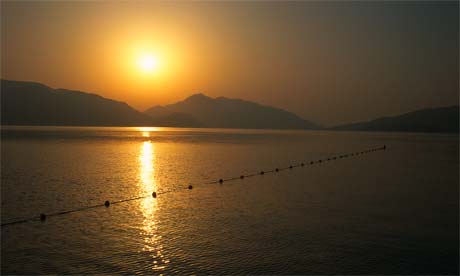
Sunset over the Mediterranean coast, Marmaris, Turkey

The Mediterranean area will become drier as a result of increased salinity in the water. Photograph: Corbis

Global warming is making the sea more salty, according to new research that demonstrates the massive shifts in natural systems triggered by climate change.

Experts at the UK Met Office and Reading University say warmer temperatures over the Atlantic Ocean have significantly increased evaporation and reduced rainfall across a giant stretch of water from Africa to the Carribean in recent years. The change concentrates salt in the water left behind, and is predicted to make southern Europe and the Mediterranean much drier in future.

Peter Stott of the Met Office, who led the study, said: "With global warming we're talking about very big changes in the overall water cycle. This moisture is being evaporated and transported to higher latitudes."

The team wanted to see whether manmade climate change could be blamed for changes in salinity measured in the Atlantic. In 2003, experts reported that the north Atlantic waters were freshening, with salt levels decreasing – a mild version of the scenario depicted in the Hollywood film The Day After Tomorrow where massive amounts of fresh water shut down warm ocean currents and cause temperatures to plunge.

Meanwhile, further south towards the tropics, Atlantic waters have been getting saltier – about 0.5% more since the 1960s.

Using state-of-the-art climate models, the scientists simulated events over both parts of the ocean with and without increased levels of greenhouse gases. They found that the freshening of the north Atlantic could be explained by natural variations, a conclusion supported by a recent recovery of the salt levels there.

But for the mid Atlantic, the models showed that only human-driven global warming could explain the increase in saltiness – the first time such an explicit link has been made between climate change and salinity. The results will appear in the journal Geophysical Research Letters.

Link to article: http://www.guardian.co.uk/environment/2008/oct/27/climate-change-water

David Adam: CO2 curbs may be too late for reefs, study warns

CO2 curbs may be too late for reefs, study warns
Plight of the coral reefs

Plight of the coral reefs. Photograph: Sterling Zumbrunn/CI

A new global deal on climate change will come too late to save most of the world's coral reefs, according to a US study that suggests major ecological damage to the oceans is now inevitable.

Emissions of carbon dioxide are making seawater so acidic that reefs including the Great Barrier Reef off Australia could begin to break up within a few decades, research by the Carnegie Institution at Stanford University in California suggests. Even ambitious targets to stabilise greenhouse gas levels in the atmosphere, as championed by Britain and Europe to stave off dangerous climate change, still place more than 90% of coral reefs in jeopardy.

Oceanographers Long Cao and Ken Caldeira looked at how carbon dioxide dissolves in the sea as human emissions increase. About a third of carbon pollution is soaked up in this way, where it reacts with seawater to form carbonic acid. Experts say human activity over the last two centuries has produced enough acid to lower the average pH of global ocean surface waters by about 0.1 units.

Such acidification spells problems for coral reefs, which rely on calcium minerals called aragonite to build and maintain their exoskeletons.

"We can't say for sure that [the reefs] will disappear but ... the likelihood they will be able to persist is pretty small," said Caldeira.

The new study was prompted by questions by a US congressional committee on how possible carbon stabilisation targets would affect coral loss.

Link to article: http://www.guardian.co.uk/environment/2008/oct/27/coral-reefs-co2-wildlife-conservation

Friday, October 24, 2008

news.com.au 's environmental meters

news.com.au maintains an environmental page with live, running meters for:

Global carbon emissions

Sea level rise

Species extinctions

Global temperature

Deforestation

Population

Link here: http://www.news.com.au/feature/0,,5009760,00.html

Thursday, October 23, 2008

League of Conservation Voters: "Dirty Dozen" List of Politicians

Link to pdf file with links to candidates (begins on page 3): http://www.columbia.edu/~jeh1/mailings/20081023_Obstruction.pdf

Congressman Tim Walberg Named Latest Member of the 2008 Dirty Dozen


WASHINGTON, DC, October 14, 2008 - The League of Conservation Voters (LCV), which works to turn environmental values into national priorities, today announced that U.S. Rep. Tim Walberg of Michigan's 7th District has been named to its 2008 "Dirty Dozen" list.

LCV's trademark Dirty Dozen program targets candidates for Congress — regardless of party affiliation — who consistently vote against clean energy and conservation and are running in races in which LCV has a serious chance to affect the outcome. Since the Dirty Dozen was launched in 1996, LCV has defeated more than half of the candidates named to the list. In 2006 alone, LCV ousted several supposedly "undefeatable" incumbents such as former House Resources Chairman Richard Pombo and former Senator Conrad Burns....more

Anne Northup Named to 2008 Dirty Dozen

WASHINGTON, DC, October 14, 2008 - The League of Conservation Voters, which works to turn environmental issues into national priorities, today added Anne Northup to its 2008 Dirty Dozen list.* Northup has a lifetime score of only 7% on LCV's National Environmental Scorecard and voted against every major piece of environmental legislation in the 109th Congress.

"With energy at the heart of the 2008 election, it is critical that we elect Representatives who will steer us away from Big Oil and toward a clean, renewable energy policy," said LCV Deputy Legislative Director Tim Greeff. "Anne Northup has a deplorable environmental record and promises to continue our reliance on oil and minimize investment in alternative energy sources." ...more

Don Young Joins the 2008 Dirty Dozen

WASHINGTON, DC, October 2, 2008 - WASHINGTON, DC –The League of Conservation Voters (LCV), which works to turn environmental values into national priorities, today added Alaska Congressman Don Young to its 2008 “Dirty Dozen” list.* Young’s abysmal record on energy issues makes him one of this year’s worst candidates for re-election to the US House of Representatives.

“Alaska is the frontline of global warming. As their homes and businesses slide into the sea, the people of Alaska deserve a Representative who will fight for real solutions, not oil company profits,” said LCV President Gene Karpinski. “Don Young has repeatedly blocked legislation that would raise fuel efficiency in our cars; repeal subsides for oil conglomerates, and invest in clean renewable energy, working instead to pad the pockets of Big Oil interests at home and in Washington.”...more

LCV Urges Voters to Turn Out the Lights on Senator Dole

WASHINGTON, DC, September 15, 2008 - The League of Conservation Voters (LCV), which works to turn environmental values into national priorities, today announced that Senator Elizabeth Dole (R-NC) has been named to its 2008 “Dirty Dozen” list. Dole has a lifetime score of only 4% on LCV’s National Environmental Scorecard.*

“Senator Dole’s record proves that she’s working in the best interests of Exxon/Mobil, not the people of Raliegh/Durham. For Chevron, not the people of Charlotte. For the lobbyists of big oil, not the people of small town North Carolina,” LCV Senior Vice President Tony Massaro said.

“Instead of protecting clean water and clean air for our health or developing clean energy for our children, she votes in favor of oil company profits every time.”...more

Dean Andal Takes Pombo’s Place in the 2008 Dirty Dozen

WASHINGTON, DC, August 14, 2008 - The League of Conservation Voters (LCV), which works to turn environmental values into national priorities, today added Dean Andal to its 2008 “Dirty Dozen” list.* Andal’s abysmal record on energy and environmental issues make him one of the worst candidates for federal office in the nation. “Californians are paying over $4.50 per gallon for gasoline, and deserve a representative who will work to end our nation’s dependence on oil, and fight for alternative energy sources,” LCV Senior Vice President Tony Massaro said.

“Andal has consistently voted against fuel efficiency programs and measures to slow global warming. His current proposals echo the failed policies of the Bush Administration that created the situation we’re in now. If elected, Andal will help the oil industry dismantle the laws that protect California’s coastline from oil spills from tankers and offshore drilling while doing nothing to reduce the price of gasoline.”...more

Congressman Sam Graves Earns Dubious Distinction as Member of 2008 Dirty Dozen

WASHINGTON, DC, August 12, 2008 - The League of Conservation Voters (LCV), which works to turn environmental values into national priorities, today added Congressman Sam Graves (MO-6) to its 2008 “Dirty Dozen” list.* Graves has earned an abysmal lifetime LCV score of only 4% on energy and environmental issues. He has accepted $63,983 from the oil & gas industry.
“While the people of Missouri are paying record prices at the pump, the oil companies are handing that money right back to Sam Graves,” LCV Senior Vice President Tony Massaro said.

“Is it any wonder that he keeps voting to give those same oil companies billions of our tax dollars? Thanks to Sam Graves, we’re paying Exxon twice for the same gas – once at the pump and again with the tax dollars that could be going to schools, to veterans, or to developing new sources of energy that would create thousands of jobs in Missouri.” ...more

LCV Adds Senator Ted Stevens (R-AK) to 2008 "Dirty Dozen"

WASHINGTON, DC, July 1, 2008 - The League of Conservation Voters (LCV), which works to turn environmental values into national priorities, today announced that Senator Ted Stevens (R-AK) has been named to its 2008 “Dirty Dozen” list. Stevens holds a lifetime score of only 14% on the LCV environmental scorecard.

“For forty years in the Senate, Ted Stevens has stood in the way of progress. Today, he literally lives in the house that oil built,” LCV President Gene Karpinski said. “With his scandalous ties to the oil industry finally exposed, Alaska has the chance to let Mr. Stevens retire to that nice house.”

Stevens has consistently voted for billions of dollars in tax breaks for oil companies since 1977. Oil and gas interests have given more than $460,000 in campaign contributions to Stevens’s campaigns. Last July, the FBI raided Stevens’s home in search of records documenting his connection to Bill Allen, an executive of the Veco oil services company, which reaped millions in federal contracts and who was convicted of bribery. Allen’s contracting business doubled the size of Stevens’s home. Stevens is under federal investigation. ...more

LCV Adds Senator Mary Landrieu to 2008 "Dirty Dozen"

WASHINGTON, DC, July 1, 2008 - The League of Conservation Voters (LCV), which works to turn environmental values into national priorities, today added Senator Mary Landrieu (D-LA) to its 2008 “Dirty Dozen” list.* Her lifetime LCV Score of 43% ranks her the worst Democrat in the Senate on environmental issues currently running for reelection. **

Last week, Dr. Thomas Fingar, the Chairman of the National Intelligence Council testified that global warming poses a significant risk to America’s national security, and that “some parts of the United States—particularly built-up coastal areas—will be at greater risk of extreme weather events.” In the wake of Hurricane Katrina, Louisiana’s representatives should be leading the charge in the fight against global warming.

“For a Senator from Louisiana, which faces severe consequences from global warming, to fail to protect Louisiana is disappointing,” LCV Senior Vice President for Political Affairs and Public Education Tony Massaro said. “Senator Landrieu joins the DD because she acts more to protect Big Oil than the future for the people of Louisiana.” ..more

LCV Adds Congressman Steve Pearce to 2008 "Dirty Dozen"

WASHINGTON, DC, July 1, 2008 - The League of Conservation Voters (LCV), which works to turn environmental values into national priorities, today added Congressman Stevan Pearce (R-NM) to its 2008 "Dirty Dozen" list.* Pearce’s record of extremism marks him as one of the twelve worst members of Congress currently up for election.

"During his five years in Congress, Steve Pearce has voted consistently against the environment," LCV Senior Vice-President for Political Affairs and Public Education Tony Massaro said. "Of the 80 conservation key votes since he has been elected, Pearce has voted against clean air, clean energy, protecting the nation's wildlife, and preserving our natural heritage in all but one vote."

Pearce's lifetime LCV score is an embarrassing 1%. He has earned three 0% scores in his tenure and his highest annual score was 5% in his first year.** His opponent, Tom Udall, has earned a 96% lifetime LCV score.

In addition to owning millions of dollars of stock in Key Energy, a Texas-based oil services company, Steve Pearce has accepted more from the oil and gas industry, $556,649, than from any other economic sector. He has voted to give more than $14 billion in tax breaks to the oil industry, opposed renewable electricity, and fought against fuel efficient cars that would save New Mexico families hundreds of dollars at the pump...more

LCV Adds Senate Minority Leader Mitch McConnell to 2008 "Dirty Dozen"

WASHINGTON, DC, April 10, 2008 - The members of the League of Conservation Voters (LCV), the independent political voice for the environment, today voted Senate Minority Leader Mitch McConnell (R-KY) to the 2008 "Dirty Dozen" list.

LCV members voted online to decide which 2008 candidate had committed the most egregious offenses against the environment. 25,000 concerned citizens voted for the next member of the "Dirty Dozen," and chose Sen. McConnell by an overwhelming margin.

"Our members know that Mitch McConnell has voted against our health and safety since he came to Washington. They know that he stands as an impassable roadblock in the way of a clean energy future for this country," said LCV President Gene Karpinski. "They know that it is time to tear down this roadblock. That's why McConnell, this 'Godfather of Green,' is the new 'Don' of the Dirty Dozen."..more

LCV Adds Former U.S. Rep. Bob Schaffer to 2008 "Dirty Dozen"

WASHINGTON, DC, Jan. 24, 2008 - The League of Conservation Voters (LCV), the independent political voice for the environment, today announced that former U.S. Rep. Bob Schaffer (R-CO) has been named to its 2008 "Dirty Dozen" list.

During his tenure in Congress, Bob Schaffer worked to get Big Oil $33 billion in tax breaks by supporting an energy bill written by Dick Cheney and the oil industry. After leaving the House, he went to work for Big Oil. Now he wants to return to Washington to work for them in the Senate," said LCV Senior Vice President and Colorado native Tony Massaro. "Coloradans deserve a senator who works for them, not Big Oil."..more

MOST IMPORTANT SENATE RACES:

COLORADO US SENATE: Mark Udall has been a leader on renewable energy since his time in the Colorado State House, and as Co-Chair of the House Renewable Energy and Energy Efficiency Caucus, he fights to expand America's commitment to renewable energy every day. His lifetime LCV score is 99%. RUNNING AGAINST REPUBLICAN STEVE PEARCE

NEW MEXICO US SENATE: Tom Udall has fought to defend America's wild spaces and led the first successful effort to pass meaningful renewable electricity standards in the House in 2007. His lifetime LCV score is 96%. RUNNING AGAINST SCHAEFFER

NEW HAMPSHIRE US SENATE: Former Governor Jeanne Shaheen of New Hampshire worked with members of both parties to reduce greenhouse gas emissions and other pollutants and has pledged to fight for clean energy as a US Senator. RUNNING AGAINST INCUMBENT JOHN E. SUNUNU
James Hansen: Obstruction of Justice

Following 2-pager (plus a long footnote re League of Conservation Voter recommendations) is on my web site at http://www.columbia.edu/~jeh1/mailings/20081023_Obstruction.pdf

Obstruction of Justice

“You’re Hannah, right?” Hannah Morgan, a 20-year old from Appalachia, Virginia, was one of 11 protesters in handcuffs early Monday morning September 15 at the construction site for a coal-fired power plant being built in Wise County Virginia by Dominion Power. The handcuffs were applied by the police, but the questioner, it turns out, was from Dominion Power.

“Mumble, mumble, mumble,” the discussion between police and the Dominion man was too far away to be heard by the young people. But it almost seemed that the police were working for Dominion. Maybe that’s the way it works in a company town. Or should we say company state? Virginia has got one of the most green-washed coal-blackened governors in the nation (http://www.columbia.edu/~jeh1/mailings/20080529_DearGovernorGreenwash.pdf ).

It seems Hannah had been pegged by Dominion as a “ringleader.” She had participated for two years in public meetings and demonstrations against the plan for mountaintop removal, strip mining and coal burning, and she had rejected their attempts to either intimidate or bargain.
“Bargain?” What bargain is possible when Dominion is guaranteed 14% return on their costs, whether the coal plant’s power is needed or not? Utility customers have to cough this up, and they aren’t given any choice. The meetings and demonstrations were peaceful. Forty-five thousand signatures against the plant were collected. But money seems to talk louder.

Dominion’s “mumble, mumble” must have been convincing. Hannah and Kate Rooth were charged with 10 more crimes than the other 10 defendants. Their charges included “encouraging or soliciting” others to participate in the action and were topped by “obstruction of justice.” Penalty if convicted: up to 14 years in prison. [Why does this remind me of Jim Jobe in “Grapes of Wrath”?]

“Obstruction of justice??” My first thought was that this case might help draw attention to the inter-generational injustice and inequity of continued building of coal-fired power plants. Is the Orwellian double-speak in the charge of “obstruction of justice” not apparent?

Executives in the coal and other fossil fuel industries are now aware of the damage that continued coal emissions causes for present and future life on the planet. Yet their response is to promote continued use of coal, and in some cases even encourage contrarians to muddy the issue in the public’s mind. Their actions raise issues of ethical responsibility to the young and the unborn, and a question of legal liability, it seems to me.

Mountaintop removal is not the only potential source of energy. The governor of neighboring West Virginia asserted that if there were an alternative energy source, they would not need to continue strip mining. A case has since been made that over time wind power on the mountaintops could provide more power than coal ( http://www.coalriverwind.org/), but if the mountaintops are removed for coal mining, the wind quality becomes less useful for power generation. The governor has not taken up the suggestion of wind instead of coal.

In Wise County the defense case is even stronger than at Kingsnorth in the United Kingdom (http://www.columbia.edu/~jeh1/mailings/20080910_Kingsnorth.pdf), because of demonstrable local effects of strip-mining. Twenty-five percent of Wise County is already devastated by mountaintop removal. Health problems of local residents associated with coal dust have been well documented (http://www.uvawise.edu/gmec/AnnualReport2007/annualreport2007.pdf). Given all this, the peaceful protest of the demonstrators is commendable. They are just asking business to invest in Appalachia, not destroy it (http://understory.ran.org/2008/09/16/wise-up-dominion/).

However, let me correct an error in a recent article by Andy Revkin in the New York Times. I have argued that it is time to “draw a line in the sand” and demand “no new coal plants,” but I have not advocated unlawful protest. My recommendation, as you can see in my presentation at Virginia Tech last week (http://www.columbia.edu/~jeh1/2008/VirginiaTech_20081011.pdf) (also pdf -> ppt) is that this is the time to exert maximum effort to use the democratic process.

I participated in a press conference of PowerVote, and the above talk was in cooperation with Virginia Powershift 2008. The upcoming election potentially could be a tipping point, but it requires a lot of changes. Young people are doing a great job of informing people and getting out the vote. The organizations do not generally endorse specific candidates, but I have a very astute young friend who identified the most important races, where the outcome could affect actions on the climate matter.

That friend’s opinions (recommendations of the League of Conservation Voters) are below. They include Democrats and Republicans. (BTW, I am an Independent, and I believe that the United States needs a third party, but that will be the subject of a different e-mail.)

Don’t expect the election to solve the climate problem. There are differences between Presidential candidates, but neither appears to “get it.” They both seem to think that “clean coal” exists. They both (and special interests) are likely to favor the hidden tax and market distortions of the inefficient “carbon cap and trade” game. For politicians and CEOs the shenanigan potential of “carbon cap and trade” is irresistible – it beats the pants off a simple, honest, effective “carbon tax and 100% dividend” that would put money in the hands of consumers and drive innovations and energy/carbon efficiency in the most economically effective way.

Back to Hannah Morgan et al. and the proposed coal plant. No happy ending here, at least not yet. The defense lawyer realized that a trial would be dangerous. An “unfavorable jury pool” made the possibility of prison time real. With 14 charges against Hannah and Kate, it was unlikely that a jury would find them innocent of all charges. Result: a “B-minus” plea bargain.

This, it seems to me, is the reality of the present situation in the United States. The fossil fuel industry has enormous power, with big influence on the public, as well as on politicians. Although practical steps to stabilize climate, with other benefits, can be defined, it will be difficult to overcome fossil fuel special interests, and we are running out of time. That is my rationale for interjecting comments/recommendations about the upcoming election into this note.

Don’t expect the young people to give up. But they shouldn’t be standing alone. They didn’t even create the mess. They are just inheriting it.

To top it off, because I was on travel, I couldn’t make it to the court proceedings. They had decided to accept the plea bargain, but asked me to write a statement on their behalf (which follows), but when I sent an e-mail in the wee hours that morning I failed to attach the attachment! It figures – they are pretty much on their own anyhow.

Statement of James E. Hansen*

If this case had gone to trial I would have requested permission to testify on behalf of these young people, who, for the sake of nature and humanity, had the courage to stand up against powerful “authority.” In fact, these young people speak with greater authority and understanding of the consequences of continued coal mining, not only for the local environment, but for the well-being of nature itself, of creation, of the planet inherited from prior generations.

The science of climate change has become clear in recent years: if coal emissions to the atmosphere are not halted, we will drive to extinction a large fraction of the species on the planet. Already almost half of summer sea ice in the Arctic has been lost, coral reefs are under great stress, mountain glaciers are melting world-wide with consequences for fresh water supplies of hundreds of millions of people within the next several decades, and climate extremes including greater floods, more intense heat waves and forest fires, and stronger storms have all been documented.

Our parents did not realize the long-term effects of fossil fuel use. We no longer have that excuse. Let us hope that the courage of these young people will help spark public education about the climate and environmental issues, and help us preserve nature for the sake of our children and grandchildren.

*For the sake of identification, I am director of the NASA Goddard Institute for Space Studies and Adjunct Professor at the Columbia University Earth Institute, but these are my personal opinions and do not represent any organization.

Jim Hansen

Nitrogen trifluoride 17,000 times more powerful greenhouse gas than CO2 is more prevalent in the atmosphere than previously thought

Potent Greenhouse Gas More Prevalent than Thought

A potent greenhouse gas is at least four times more prevalent in the atmosphere than was previously estimated, a new study reports.

Using new analytical techniques, a research team in California made the first atmospheric measurements of nitrogen trifluoride, which is thousands of times more effective at warming the atmosphere than an equal amount of carbon dioxide (though carbon dioxide is much more prevalent, and therefore still the key greenhouse gas of concern in terms of global warming).

In 2006, the amount of nitrogen trifluoride in the atmosphere, which could not be detected using previous techniques, was estimated at less than 1,322 short tons (1,200 metric tons).

The new research, funded by NASA and detailed in the Oct. 31 issue of the journal Geophysical Research Letters, found that the actual amount was 4,630 short tons (4,200 metric tons) in 2006. Currently, about 5,950 short tons (5,400 metric tons) is estimated to be in the atmosphere. The estimates indicate that the amount of gas in the atmosphere is increasing by about 11 percent per year.

Emissions of nitrogen trifluoride were thought to be so low that the gas was not considered a significant contributor to global warming. It was not covered in the Kyoto Protocol, the 1997 agreement signed by 182 countries to reduce greenhouse gases.

Nitrogen trifluoride is about 17,000 times more powerful at trapping heat than is carbon dioxide, though current emissions of the gas only contribute about 0.15 percent of the total global warming effect contributed by human-produced carbon dioxide emissions.

Nitrogen trifluoride is one of several gases used during the manufacture of liquid crystal flat-panel displays, thin-film photovoltaic cells and microcircuits. Many industries used it as a replacement for perfluorocarbons, another type of potent greenhouse gas, because it was thought that only about 2 percent of the nitrogen trifluoride used escaped into the atmosphere.

Scientists have recently recommended adding nitrogen trifluoride to the list of greenhouse gases regulated by Kyoto in response to its growing use and concerns that its emissions are not well known.

"From a climate perspective, there is a need to add nitrogen trifluoride to the suite of greenhouse gases whose production is inventoried and whose emissions are regulated under the Kyoto Protocol, thus providing meaningful incentives for its wise use," said study leader Ray Weiss of the Scripps Institution of Oceanography in La Jolla, Calif.

Link to article: http://news.yahoo.com/s/livescience/20081023/sc_livescience/potentgreenhousegasmoreprevalentthanthought

Hu Jia wins the European Parliament's most prestigious human rights' prize, the Sakharov Prize for Freedom of Thought, despite warnings from China

Chinese Activist Wins Rights Prize

by Jim Yardley, New York Times, October 23, 2008

BEIJING — Hu Jia, a soft-spoken, bespectacled advocate for democracy and human rights in China, was awarded Europe’s most prestigious human rights prize on Thursday. The award was a pointed rebuke of China’s ruling Communist Party that comes as European leaders are arriving in Beijing for a weekend summit.

Mr. Hu, 35, was chosen by the European Parliament as this year’s recipient of the Sakharov Prize for Freedom of Thought, despite warnings from Beijing that his selection would harm relations with the European Union.

Last year, Mr. Hu testified via video link before a hearing of the European Parliament about China’s human rights situation. Weeks later, Mr. Hu was jailed and later sentenced to three and a half years in prison on a conviction for subversion based on his critical writings about Communist Party rule.

Mr. Hu has been one of China’s leading figures on a range of human rights issues, while also speaking out on behalf of AIDS sufferers and for environmental protection. His selection for the prize comes after he had been considered a frontrunner for the Nobel Peace Prize, only to lose to the former president of Finland, Martti Ahtisaari.

“Hu Jia is one of the real defenders of human rights in the People’s Republic of China,” said European Parliament President Hans-Gert Poettering. “The European Parliament is sending out a signal of clear support to all those who support human rights in China.”

The timing may make for a frosty weekend in Beijing where European leaders are to meet with top Chinese officials at the Asia-Europe summit. Behind the scenes, China had lobbied against Mr. Hu’s candidacy for the Sakharov Prize. Song Zhe, the Chinese ambassador to the European Union, wrote a critical Oct. 16 letter to the president of the European Parliament.

“If the European Parliament should award this prize to Hu Jia, that would inevitably hurt the Chinese people once again and bring serious damage to China-E.U. relations,” Song wrote, according to The Associated Press.

China had also warned against awarding Mr. Hu the Nobel Peace Prize, and Foreign Ministry spokesman Qin Gang had described him in scathing terms as a convicted criminal.

“The Chinese government will be upset,” said Teng Biao, a legal expert who has co-authored essays with Mr. Hu. “But as a responsible nation that is trying to integrate into the international community, China has to understand that its conduct should follow international protocols. It should embrace the criticism as an opportunity to improve China’s human rights condition.”

Mr. Hu remains imprisoned in Beijing and could not be reached for comment. His wife, Zeng Jinyan, a prominent blogger and human rights activist, also could not be contacted. She has lived for months under house arrest with the couple’s infant daughter.

The award to Mr. Hu is an embarrassment for the Communist Party less than two months after China’s successful staging of the Olympic Games. During the Olympics, the Chinese government proved it could smoothly manage the world’s biggest sporting event, but the government also prevented demonstrations at designated protest zones, instituted broad censorship restrictions on the domestic media and placed numerous dissidents under house arrest or surveillance.

Mr. Hu’s conviction in April was part of a nationwide crackdown against dissidents in what many human rights advocates considered a pre-Olympic silencing campaign. A devout Buddhist, Mr. Hu has dedicated himself to a range of issues during the past 12 years, including environmental protection, helping AIDS sufferers, championing the legal rights of Chinese citizens and promoting greater democracy.

He also used a personal website and emails to become a one-man clearinghouse of information on human rights abuses and other controversies that officials preferred to keep silent.

“Whatever he does, he always stands in the forefront,” Mr. Teng said in an earlier interview. “Everything he wrote, everything he said, is straight from his heart. We have poor people and marginalized people in society whose voices are being muzzled. Hu Jia was trying to be the spokesman for the unheard voices.”

Mr. Hu graduated from Beijing’s Capital University of Economics and Trade in 1996 and almost immediately plunged into China’s nascent civil society. He traveled to Inner Mongolia to plant trees as a measure to slow the advance of the Gobi Desert.

By 2000, China was facing the rapid spread of AIDS, a problem the government had initially denied and remained reluctant to publicly confront. Mr. Hu formed a non-governmental organization, Loving Source, and focused on caring for people infected by a blood selling scandal in Henan Province.

Gao Yaojie, a prominent AIDS activist in China, recalled how Mr. Hu once rode a bicycle down a rutted dirt road to reach an isolated village decimated by AIDS. The road became narrower and potted with holes until Mr. Hu simply put the bike on his shoulder and walked to deliver help to a village where local officials where trying to cover-up the disease.

“We didn’t do anything wrong,” Dr. Gao said, in an interview earlier this month. “The only thing we did was to help HIV positive people. But we were always under great pressure from the government.”

Mr. Hu later began joining Internet petition campaigns calling for the release of political prisoners, while also calling on authorities to uphold the legal rights of citizens written in the Chinese Constitution.

His activism quickly made him a target. In 2006, he spent 168 days under house arrest. Rather than disappear from public view, Mr. Hu produced a documentary, “Prisoner in Freedom City,” in which he filmed state security agents harassing his wife as she tried to leave their apartment complex, which is known as Bo Bo Freedom City.

Indeed, as Mr. Hu faced constant surveillance and harassment — he once was taken away for 41 days — he continued to use the Internet to push for political reform and publicize human rights abuses. His testimony via video link before the European parliamentary committee came last November.

“It is ironic that one of the people in charge of organizing the Olympic Games is the head of the Bureau of Public Security, which is responsible for so many human rights violations,” he testified. “It is very serious that the official promises are not being kept before the Games.”

Huang Yuanxi contributed research

Link to article: http://www.nytimes.com/2008/10/24/world/24prize.html

Wednesday, October 22, 2008

Eric Rignot et al.: Mass balance of the Greenland ice sheet from 1958 to 2007

Geophysical Research Letters, Vol. 35, L20502; doi:10.1029/2008GL035417, 2008

Mass balance of the Greenland ice sheet from 1958 to 2007

E. Rignot (Department of Earth System Science, University of California, Irvine, CA, U.S.A.; Jet Propulsion Laboratory, California Institute of Technology, Pasadena, CA, U.S.A.), J. E. Box (Byrd Polar Research Center, Ohio State University, Columbus, OH, U.S.A.), E. Burgess (Department of Geography, University of Utah, Salt Lake City, UT, U.S.A.), and E. Hanna (Department of Geography, University of Sheffield, Sheffield, U.K.)

Abstract

We combine estimates of the surface mass balance (SMB) of the Greenland ice sheet for the years 1958 to 2007 with measurements of the temporal variability in ice discharge (D) to deduce the total ice sheet mass balance. During that time period, we find a robust correlation (R2 = 0.83) between anomalies in SMB and in D, which we use to reconstruct a continuous series of total ice sheet mass balance. We find that the ice sheet was losing 110 ± 70 Gt/yr in the 1960s, 30 ± 50 Gt/yr or near balance in the 1970s–1980s, and 97 ± 47 Gt/yr in 1996 increasing rapidly to 267 ± 38 Gt/yr in 2007. Multi-year variations in ice discharge, themselves related to variations in SMB, cause 60 ± 20% more variation in total mass balance than SMB and therefore dominate the ice sheet mass budget.

Received 21 July 2008; accepted 22 September 2008; published 22 October 2008.

Key words: glaciology, mass balance, sea level

Index Terms: 0720 Cryosphere: Glaciers; 0726 Cryosphere: Ice sheets; 0762 Cryosphere: Mass balance (1218, 1223); 1621 Global Change: Cryospheric change (0776); 1620 Global Change: Climate dynamics (0429, 3309).


Citation: Rignot, E., J. E. Box, E. Burgess, and E. Hanna (2008), Mass balance of the Greenland ice sheet from 1958 to 2007, Geophys. Res. Lett., 35, L20502, doi:10.1029/2008GL035417.

Global Dimming report by the BBC

Blog reader Leon has given me the link to the video report on "global dimming," and it is a must-see for all those seeking a better understanding of the problems we need to confront:

http://video.google.com/videoplay?docid=-2058273530743771382

Marc W. Cadotte, Bradley J. Cardinale, & Todd Oakley: Earth In Midst Of Sixth Mass Extinction — 50% Of All Species Disappearing

Earth In Midst Of Sixth Mass Extinction: 50% Of All Species Disappearing

ScienceDaily (Oct. 21, 2008) — The Earth is in the midst of the sixth mass extinction of both plants and animals, with nearly 50% of all species disappearing, scientists say.

Because of the current crisis, biologists at UC–Santa Barbara are working day and night to determine which species must be saved. Their international study of grassland ecosystems, with flowering plants, is published in the Proceedings of the National Academy of Sciences.

"The current extinction event is due to human activity, paving the planet, creating pollution, many of the things that we are doing today," said co-author Bradley J. Cardinale, assistant professor of ecology, evolution and marine biology (EEMB) at UC–Santa Barbara. "The Earth might well lose half of its species in our lifetime. We want to know which ones deserve the highest priority for conservation."

He explained that the last mass extinction near the current level was 65 million years ago, called the Cretaceous Tertiary extinction event, and was probably the result of a meteor hitting the Earth. It is best known for the extinction of non-avian dinosaurs, but massive amounts of plant species became extinct at that time as well.

According to the current study, the most genetically unique species are the ones that have the greatest importance in an ecosystem. These are the ones that the scientists recommend be listed as top priority for conservation.

"Given that we are losing species from ecosystems around the world, we need to know which species matter the most – and which we should pour our resources into protecting," said first author Marc W. Cadotte, postdoctoral fellow at UCSB's National Center for Ecological Analysis and Synthesis (NCEAS).

Cadotte, Cardinale, and co-author Todd Oakley, an EEMB associate professor, put together a "meta-analysis" of approximately 40 important studies of grassland ecosystems around the world. They reconstructed the evolutionary history among 177 flowering plants used in these studies by comparing the genetic makeup of the plants.

The scientists found that some species are more critical than others in preserving the functions of ecosystems and that these species tend to be those that are genetically unique. Therefore, they are looking to evolutionary history for guidance in conservation efforts and in understanding the potential impacts of species loss.

Recent studies show that ecological systems with fewer species generally produce less biomass than those with more species. Less plant biomass means that less carbon dioxide is absorbed from the atmosphere and less oxygen is produced. So, as the biomass of plants plummets around the globe, the composition of gasses in the atmosphere that support life could be profoundly affected. Additionally, there are fewer plants for herbivorous animals to eat. Entire food chains can be disrupted, which can impact the production of crops and fisheries.

The loss of species that are not closely related to other species in the ecosystem reduces productivity more than the loss of species with close relatives. And the more genetically distinct a species is, the more impact it has on the amount of biomass in an ecosystem.

"Losing a very unique species may be worse than losing one with a close relative in the community," said Oakley. "The more evolutionary history that is represented in a plant community, the more productive it is."

Cadotte explained that the buttercup is a very unique species, evolutionarily. Losing the buttercup, where it occurs in grasslands, would have a much bigger impact on the system than losing a daisy or a sunflower, for example. The latter species are closely related. Each could therefore help fill the niche of the other, if one were to be lost. The daisy and sunflower also have a more similar genetic make-up.

"These 40 studies are showing the same thing for all plants around the world," said Cardinale. "It is not a willy-nilly conclusion. This study is very robust. It includes studies of plants that are found throughout the U.S., Europe, and Asia. We can have a high degree of confidence in the results. And the results show that genetic diversity predicts whether or not species matter."


Thomas Friedman: The Urgent Need for Green Incentives in Spite of Lower Gas Prices

Bailout (and Buildup)

by Thomas L. Friedman, New York Times, October 21, 2008

The 2 is back. Last week, U.S. retail gasoline prices fell below $3 a gallon — to an average of $2.91 — the lowest level in almost a year. Why does this news leave me with mixed feelings?

Credit: Fred R. Conrad/The New York Times

Because in the middle of this wrenching economic crisis, with unemployment rising and 401(k)’s shrinking, it would be a real source of relief for many Americans to get a break at the pump. Today’s declining gasoline prices act like a tax cut for consumers and can save $15 to $20 a tank-full for an S.U.V.-driving family, compared with when gasoline was $4.11 a gallon in July.

Yet, it is impossible for me to ignore the fact that when gasoline hit $4.11 a gallon we changed — a lot. Americans drove less, polluted less, exercised more, rode more public transportation and, most importantly, overwhelmed Detroit with demands for smaller, more fuel-efficient, hybrid and electric cars. The clean energy and efficiency industries saw record growth — one of our few remaining engines of real quality job creation.

But with little credit available today for new energy start-ups, and lower oil prices making it harder for existing renewables like wind and solar to scale, and a weak economy making it nearly impossible for Congress to pass a carbon tax or gasoline tax that would make clean energy more competitive, what will become of our budding clean-tech revolution?

This moment feels to me like a bad B-movie rerun of the 1980s. And I know how this movie ends — with our re-addiction to oil and OPEC, as well as corrosive uncertainty for our economy, trade balance, security and environment.

“Is the economic crisis going to be the end of green?” asks David Rothkopf, energy consultant and author of “Superclass.” “Or, could green be the way to end the economic crisis?”

It has to be the latter. We can’t afford a financial bailout that also isn’t a green buildup — a buildup of a new clean energy industry that strengthens America and helps the planet.

But how do we do that without any policy to affect the price signal for gasoline and carbon?

Here are some ideas: First, Washington could impose a national renewable energy standard that would require every utility in the country to produce 20 percent of its power from clean, non-CO2-emitting, energy sources — wind, solar, hydro, nuclear, biomass — by 2025. About half the states already have these in place, but they are all different. It would create a huge domestic pull for renewable energy if we had a uniform national mandate.

Second, Washington could impose a national requirement that every state move its utilities to a system of “decoupling-plus.” This is the technical term for changing the way utilities make money — shifting them from getting paid for how much electricity or gas they get you to consume to getting paid for how much electricity or gas they get you to save. Several states have already moved down this path.

Third, an idea offered by Andy Karsner, former assistant secretary of energy, would be to modify the tax code so that any company that invests in new domestic manufacturing capacity for clean energy technology — or procures any clean energy system or energy savings device that is made by an American manufacturer — can write down the entire cost of the investment via a tax credit and/or accelerated depreciation in the first year.

“I’m talking about anything from energy efficient windows to water heaters to industrial boilers to solar panels, and the job creating, manufacturing facilities that produce them — anything that makes us more efficient, lean and economically competitive and comes from a domestic, American source,” said Karsner.

He also suggests using some of the money from any stimulus package to directly incentivize and support states’ efforts to implement and intelligently modernize their building codes to get already well-established national “best practices” quickly into their marketplaces.

Lastly, we need the next president to be an energy efficiency trendsetter, starting by reinventing the inaugural parade. Get rid of the black stretch limos and double-plated armored Chevy Tahoes inching down Pennsylvania Avenue. Instead, let the next president announce that he will use no vehicles on inauguration day that get less than 30 miles per gallon. He could invite all car companies to participate in the historic drive with their best available American-made, fuel-efficient, innovative vehicle.

Finally, if Congress passes another stimulus package, it can’t just be another round of $600 checks to go buy flat-screen TVs made in China. It has to also include bridges to somewhere — targeted investments in scientific research, mass transit, domestic clean-tech manufacturing and energy efficiency that will make us a more productive and innovative society, one with more skills, more competitiveness, more productivity and better infrastructure to lead the next great industrial revolution: E.T. — energy technology.

Link to article: http://www.nytimes.com/2008/10/22/opinion/22friedman.html

Sunday, October 19, 2008

FRONTLINE SPECIAL: HEAT -- A GLOBAL INVESTIGATION, October 21, 2008 -- 9 p.m. EST -- ON THE AIR AND ONLINE

FRONTLINE SPECIAL: HEAT -- A GLOBAL INVESTIGATION, October 21, 2008 -- 9 p.m. EST -- ON THE AIR AND ONLINE (http://www.pbs.org/wgbh/pages/frontline/view/)


For years, big business--from oil and coal companies to electric utilities to car manufacturers--has resisted change to environmental policy and stifled the debate over climate change in America and around the globe. Now, facing rising pressure from governments, green groups and investors alike, big business is reshaping its approach to the environment. With the election looming, FRONTLINE producer Martin Smith investigates what some businesses are doing to fend off new regulations and how others are repositioning themselves to prosper in a radically changed world.

press release

FRONTLINE GLOBAL INVESTIGATION REPORTS WHAT BIG BUSINESS IS DOING TO ADDRESS CLIMATE PROBLEM

FRONTLINE Presents
HEAT
Tuesday, October 21, 2008, from 9 to 11 P.M. ET on PBS

Melting glaciers, rising sea levels, fires, floods and droughts. On the eve of a historic election, award-winning producer and correspondent Martin Smith investigates how the world's largest corporations and governments are responding to Earth's looming environmental disaster. HEAT , part of "PBS Vote 2008" election coverage, confronts the defining story of our time in a two-hour FRONTLINE investigation airing Tuesday, Oct. 21, 2008, from 9 to 11 P.M. ET on PBS (check local listings).

"I have reported on the Cold War, the breakup of the Soviet Union, the rise of Al Qaeda, and the wars in Iraq and Afghanistan," says Smith. "But nothing matches climate change in scope and severity."

The world needs to dramatically cut the carbon emissions responsible for wreaking havoc on the planet's climate, according to Dr. Rajendra Pachauri, whose organization, the Intergovernmental Panel on Climate Change (IPCC), shared last year's Nobel Peace Prize. "If we don't take action immediately, we face a crisis," Pachauri tells Smith. "Climate change is caused by human actions, and we need to do something about it. The sooner we realize that, the better."

With that sense of urgency in mind, Smith traveled to 12 countries on four continents to investigate whether major corporations and governments are up to the challenge. HEAT features in-depth interviews with top policy-makers and with leading executives from many of the largest carbon emitters from around the world, including Chinese coal companies, Indian SUV makers and American oil giants. The report paints an ominous portrait. Despite increasing talk about "going green," across the planet, environmental concerns are still taking a back seat to shorter-term economic interests.

Smith's journey begins at the epicenter of new industrial development: China. In the midst of unprecedented growth, the Chinese are clearly moving in the wrong direction. He visits Shenhua Energy, one of the largest and fastest-growing power companies in the world--a coal conglomerate with a huge carbon footprint. But its CEO, Ling Wen, tells Smith that he answers not to the public but to his shareholders. "We must create money, not lose the money," Ling says. "It's my responsibility as a CEO of this company." And when pressed whether he should make climate change a higher priority, Ling says that he would if his shareholders asked him. But, he says, "I'm afraid maybe all the shareholders, they cannot accept that concept." In the meantime, China continues to build two new coal-fired power plants every week.

Smith finds a similar situation in India, where rapidly rising income levels have prompted an explosion in the demand for new cars. Automakers are thriving, pushing out new models, including the Nano, a small car aimed at helping even the poorest citizens get behind the wheel--no small thing, as India stands to overtake China as the world's most populous country by mid-century. With several hundred million new drivers taking to the streets, India's carbon emissions will soar.

And with new cars, of course, come new roads, linking crowded cities and fueling a construction boom across the developing world that drives emissions ever higher. The manufacture of cement is the third-largest industrial contributor of greenhouse gases in the world. Supplying more cement for buildings, roads and bridges makes big emission reductions impossible. This presents a core dilemma for all large emerging nations, from China to India, Indonesia, Russia, Mexico and Brazil: how to grow without inflicting more damage on the environment.

"I think the difficulty we have is that countries that have developed and have done the polluting part are now asking the countries that are developing, 'OK, you can't pollute,'" says Hameed Bhombal, of Aditya Birla Group, an Indian megaconglomerate. "It has to be done in a way that's fair."

According to Dr. Pachauri of the IPCC, the onus is on the developed world to lead the way. Now, with gas prices spiking, there is an additional incentive for American car companies to offer smaller, more efficient vehicles. But will they respond? Their record is discouraging. Smith asks Beth Lowery, head of environmental affairs at General Motors, why Toyota beat GM to the Prius. Lowery replies that GM looked at hybrids from a "business case" and asked, "Can this vehicle make money?" GM banked instead on trucks and SUVs and is now suffering its worst performance in 50 years. GM is now playing catch-up and investing billions in a new hybrid, the Chevy Volt, which is scheduled to be released sometime this year.

There is also the problem that while hybrid cars may emit less CO2 than their gas-guzzling cousins, they still require electricity to run. So, making cars like the Volt part of a campaign to seriously reduce emissions will mean finding a new, cleaner power source. Currently, more than half of American power comes from coal. Coal is cheap and reliable, but dirty.

The answer, the industry says, will be "clean coal"--a complex process by which the burnt-off carbon will be captured and buried in the earth's crust. But as Smith investigates, he finds there are serious doubts about whether "clean coal" will ever work. When pressed, utility CEO David Ratcliffe of Southern Company, one of the world's largest emitters of greenhouse gases, concedes that "we haven't even come close to defining what are the legal liabilities and what are the permitting requirements" for removing carbon from coal and burying it underground. Recently, several "clean coal" projects in the U.S. have stalled over these and other uncertainties. As Jeffrey Ball, environmental news editor at The Wall Street Journal, tells Smith, "There was huge, rosy optimism about it. What's wrong is that reality is intruding."

On the campaign trail, both Sen. John McCain and Sen. Barack Obama have announced their plans for a new energy policy that will cut carbon emissions. Optimistically, they suggest that the "greening" of American business heralds a new era of sleek technologies and opportunities for innovation. What they tend not to emphasize is cost and, on the part of every consumer, sacrifice.

In his interview with FRONTLINE, California's attorney general, Jerry Brown, reminds Smith that it won't be easy. "Our wealth, our society, our being is driven by oil and carbon. It's intellectually dishonest to somehow say we can get some light bulbs or get a Prius, and then we're all done. No, this is going to take massive technological innovation. It's going to take changes in the way we live and work. And it's going to take cooperation of unprecedented degrees among business and government and among countries. That's where we are, and that's why there's no other word except 'daunting.' I'm hopeful. I'm cautiously optimistic. But I would have to say one has to approach this with great humility."

Author and journalist Jeff Goodell adds, "We seem incapable of grasping what's at stake here, perhaps because so much is at stake. Addressing this really means reinventing the engine of our lives--which is fossil fuels."

HEAT is a FRONTLINE co-production with RAINMedia, Inc. The producer, writer and reporter is Martin Smith. The co-producer is Chris Durrance. Funding for FRONTLINE is provided through the support of PBS viewers. Major funding for FRONTLINE is provided by The John D. and Catherine T. MacArthur Foundation. Additional funding is provided by the Park Foundation. Major funding for HEAT is provided by the FRONTLINE Journalism Fund, with a grant from Hannelore and Jeremy Grantham and the Grantham Foundation for the Protection of the Environment, and additional support from Scott Nathan and Laura DeBonis. Additional funding for HEAT is provided by the Kendeda Fund, the Nathan Cummings Foundation and the Wallace Genetic Foundation, Inc. FRONTLINE is closed-captioned for deaf and hard-of-hearing viewers and described, for people who are blind or visually impaired, by the Media Access Group at WGBH. FRONTLINE is a registered trademark of WGBH Educational Foundation. The executive producer of FRONTLINE is David Fanning.

Link to PBS webpage: http://www.pbs.org/wgbh/pages/frontline/heat/

Friday, October 17, 2008

Bill Blakemore, Aspen Environment Forum: The Psychology of Climate Change 2008


Link to youtube video: http://www.youtube.com/watch?v=WM09qoR8oi0

Thursday, October 16, 2008

Jason Amundson et al.: Jakobshavn glacier -- Time-lapse footage reveals Greenland ice sheet in crisis

by Catherine Brahic, New Scientist, October 16, 2008

Dramatic images taken at least every six hours over an entire year reveal how the world's fastest-flowing glacier is draining Greenland's ice sheet and contributing to sea-level rise world-wide.

Jason Amundson of the University of Alaska Fairbanks and colleagues set up a complete "life monitoring" system around the end of the Jakobshavn glacier in Greenland, at the point where it dumps its ice into a narrow fjord and out to sea, during the summer of 2007. The system remained in place until May 2008.

The Jakobshavn glacier, known as Sermeq Kujalleq in Greenlandic, is the world's fastest flowing ice sheet (watch a NASA animation of the Jakobshavn Glacier) and a major contributor to the demise of Greenland's ice.

Each year, 7% of the ice lost from Greenland passes through the fjord. The incredible rate at which it sends ice crashing out to sea doubled to 12 kilometres per year between 1997 and 2003. This increased sea-level rise by 0.06 millimetres per year – roughly 4% of the 20th century rate of sea-level increase.

Three cameras took pictures every 10 minutes from 13 May to 8 June 2007, then every hour for the next month, every six hours over the winter and once more every 10 minutes from 7 to 14 May 2008.

Satellite pictures (see right) show that the ice sheet is not homogenous – two huge rivers of ice flow out into the fjord. Stitched together, Amundson's images reveal how this happens.

During the summer, huge chunks of ice broke off from the tip of the ice river about every 75 hours – a process known as calving.

Berg birth

In the winter, the ice river grew out over the water at the top of the fjord, creating an ice tongue several kilometres long. Amundson's pictures show that calving events stopped until the ice tongue disintegrated in four separate events between mid-April and mid-May 2008. In total, the team recorded 32 calvings.

At each calving event, the ice sheared through its entire 900-metre thickness and the new icebergs would flip over, drag up sediment from the bottom, and shove off into the fjord pushing floating ice ahead of it at a speedy one to two kilometres per hour. The ice river normally moves downstream 35 metres per day.

In addition to photographing the events, the team measured seismic waves generated by the break-ups and monitored the movement of the ice using GPS stations posted on the ice.

"It's been known for over 30 years that calving events release low-frequency seismic energy," says Amundson. The slow rumblings, known as glacial earthquakes, can be detected around the world and are happening more and more frequently.

Previously, seismologist Göran Ekström at Harvard University had proposed that when ice breaks off the tip of Greenland ice rivers, the rest of the glacier suddenly jolts forwards, triggering the low rumblings. But Amundson's life-monitoring stations show no such jolts.

"It is still possible that the glacial earthquakes are generated by a slow acceleration of the glacier," he says. "More likely, I think, is that they are caused by icebergs bouncing around in the fjord."

Journal reference: Geophysical Research Letters (DOI: 10.1029/2008GL035281, in press)

Link to article: http://environment.newscientist.com/article/dn14956-timelapse-footage-reveals-ice-sheet-in-crisis.html

From NOAA, the full 3rd Annual Arctic Report Card

Arctic Report Card
Home Atmosphere Sea Ice Ocean Land Greenland Biology
red square Atmosphere
red square Sea Ice
yellow square Biology
yellow square Ocean
red square Greenland
yellow square Land
Warming (red) and mixed (yellow) signals

Atmosphere Atmosphere
5° C temperature increases were recorded in autumn
Ocean Ocean
Observed increase in temperature of surface and deep ocean layers
Sea ice Sea Ice
Near-record minimum summer sea ice extent
Greenland Greenland
Records set in both the duration and extent of summer surface melt
Biology Biology
Fisheries and marine mammals impacted by loss of sea ice
Land Land
Permafrost temperatures tend to increase, while snow extent tends to decrease

About the Report Card


Link to above page: http://www.arctic.noaa.gov/reportcard/

Link to the pdf file of the 61-page report:

http://www.arctic.noaa.gov/reportcard/ArcticReportCard_full_report.pdf

NOAA: 3rd Annual Arctic Report Card shows evidence of dramatic Arctic melt and warming

'Dramatic evidence' of Arctic melt, experts warn

Federal report cites signals from Greenland ice sheet to reindeer herds


WASHINGTON -- Autumn temperatures in the Arctic are at record highs, the Arctic Ocean is getting warmer and less salty as sea ice melts, and reindeer herds appear to be declining, researchers reported Thursday.

"Obviously, the planet is interconnected, so what happens in the Arctic does matter" to the rest of the world, Jackie Richter-Menge of the Cold Regions Research and Engineering Laboratory in Hanover, N.H., said in releasing the third annual Arctic Report Card for the federal National Oceanic and Atmospheric Administration.

"There continues to be widespread and, in some cases, dramatic evidence of an overall warming of the Arctic system," the experts stated in their report.

Compiled by 46 scientists from 10 countries, the report looks at six areas in the Arctic: atmosphere, sea ice, Greenland, ocean, biology and land. It found a "warming" trend in the first three signals and "mixed" signals in the latter three.

The region has long been expected to be among the first areas to show impacts from global warming, which the U.N.-sponsored Intergovernmental Panel on Climate Change says is largely a result of human activities adding carbon dioxide and other gases to the atmosphere.

"Changes in the Arctic show a domino effect from multiple causes more clearly than in other regions," said James Overland, an oceanographer at NOAA's Pacific Marine Environmental Laboratory in Seattle. "It's a sensitive system and often reflects changes in relatively fast and dramatic ways."

Air temps 9 degrees above normal
For example, autumn air temperatures in the Arctic are at a record 9 degrees Fahrenheit above normal.

The report noted that 2007 was the warmest year on record the Arctic, leading to a record loss of sea ice. This year's sea ice melt was second only to 2007.

Rising temperatures help melt the ice, which in turn allows more solar heating of the ocean. That warming of the air and ocean affects land and marine life, and reduces the amount of winter sea ice that lasts into the following summer.

The study also noted a warming trend on Arctic land and increase in greenness as shrubs move north into areas that were formerly permafrost.

While the warming continues, the rate in this century is less than in the 1990s due to natural variability, the researchers said.

In addition to global warming there are natural cycles of warming and cooling, and a warm cycle in the 1990s added to the temperature rise. Now with a cooler cycles in some areas the rise in temperatures has slowed, but Overland said he expects that it will speed up again when the next natural warming cycle comes around.

Sun's impact downplayed
Asked if an increase in radiation from the sun was having an effect on the Earth's climate, Jason Box of the Byrd Polar Research Center in Columbus, Ohio, said while it's important, increased solar output only accounts for about 10 percent of global warming.

"You can't use solar to say that greenhouse gases are not a major factor," Overland added.

Other findings from the report include:

  • The Arctic Ocean continued to warm and freshen due to ice melt. This was accompanied by an "unprecedented" rate of sea level rise of nearly 0.1 inch per year.
  • Warming has continued around Greenland in 2007 resulting in a record amount of ice melt. The Greenland ice sheet lost 24 cubic miles of ice, making it the largest single contributor to global sea level rise.
  • Reindeer herds that had been increasing since the 1970s are now showing signs of leveling off or beginning to decline.
  • Goose populations are increasing as they expand their range within the Arctic.
  • Data on marine mammals is limited but they seem to have mixed trends. They are adapted to life in a region that is at least seasonally ice-covered. There is concern about the small numbers of polar bears in some regions, the status of many walrus groups is unknown, some whales are increasing and others declining.

"This is a very complicated system, and we are still working diligently to sort out its mysteries," said Richter-Menge.

In addition to Richter-Menge, Overland and Box, lead authors of the report included Michael Simpkin of NOAA, Silver Spring, Md., and Vladimir Romanovsky of the University of Alaska's Geophysical Institute in Fairbanks.

The full report is online at www.arctic.noaa.gov/reportcard.

Wednesday, October 15, 2008

ABC deems Gore climate change advert too 'controversial' for TV

ABC deems Gore climate change advert too 'controversial' for TV

The ABC network has refused to air an advert produced by Al Gore's environmental group, ruling that its charge of US government favouritism to the oil industry is too "controversial" for television.

The TV commercial, part of the WE campaign run by Gore's Alliance for Climate Protection, was submitted for airing after this week's presidential debate between Barack Obama and John McCain - both of whom have vowed to limit greenhouse gas emissions if elected.

But ABC concluded that the advert violated its internal policy against "controversial" content during network-sponsored programmes, network spokeswoman Julie Hoover told the Guardian.

"All of our advertising is reviewed on a case-by-case basis, and the context of this particular ad was determined not to be acceptable per our policy on controversial issue advertising," Hoover said.

The WE campaign has since attracted more than 170,000 supporters to an online petition drive asking ABC to reconsider its decision.

The script of the advert is similar in tone to political speeches made by Obama and McCain during the election season. An unseen narrator states that climate change can be combated through wind and solar power as well as "end[ing] our dependence on foreign oil".

Over an image of a young child playing with blocks, the narrator continues: "So why are we still stuck with dirty and expensive energy? Because big oil spends hundreds of millions of dollars to block clean energy. Lobbyists, ads, even scandals. All to increase their profits, while America suffers."

An ABC email published on the blog of Grist magazine stated that the advert was rejected due to its split-second shot of the US Capitol building.

"Per our guidelines, national buildings may be used in advertising provided the depictions are incidental to the advertiser's promotion of the product or service," the email stated. "Given the messages and themes of this commercial, the image of the Capital [sic] building is not incidental to this advertising."

Cathy Zoi, chief executive of the WE campaign, called ABC's decision "outrageous" in light of US networks' frequent airing of adverts from Chevron, Exxon Mobil and other oil companies.

"As our country faces deep economic problems, we need to be able to have an honest debate about the root causes of our problem," Zoi wrote in an email to supporters of Gore's group on Wednesday.

To build publicity for their products, American companies often produce TV adverts with content that pushes the limits of broadcast standards. A Snickers commercial featuring two men embarrassed after sharing a kiss was pulled from the US airwaves last year after complaints from gay-rights groups.

But rejection of an advert from a non-profit group is a far more rare occurrence. At the height of the US controversy over same-sex marriage in 2004, CBS and NBC turned down a commercial from the United Church of Christ that touted its acceptance of gay congregants.

Link to article: http://www.guardian.co.uk/world/2008/oct/10/algore-television

Tuesday, October 14, 2008

Anderson et al.: Response of Upper Gulf Coast Estuaries to Holocene Climate Change and Sea-Level Rise; Bays on U.S. Gulf Coast Vulnerable to Flooding

Bays On US Gulf Coast Vulnerable To Flooding

ScienceDaily (Oct. 14, 2008) — The most comprehensive geological review ever undertaken of the upper U.S. Gulf Coast suggests that a combination of rising seas and dammed rivers could flood large swaths of wetlands this century in one or more bays from Alabama to Texas.

The findings, which will be presented at next week's annual meeting of the Geological Society of America in Houston, stem from bayfloor sediment samples, radiocarbon tests and seismic surveys compiled over 30 years.

"In terms of sea-level increases and river sediments flowing into the bays, we're rapidly approaching a time when bays will face conditions they last saw in the Holocene, from about 9,600 until 7,000 years ago," said lead researcher John Anderson, the W. Maurice Ewing Professor in Oceanography and professor of Earth science at Rice University. "That period was marked by dramatic and rapid flooding events in each of these bays -- events that saw some bays increase their size by as much as one-third over a period of 100 or 200 years."

Anderson is presenting the findings at next week's annual meeting of the Geological Society of America (GSA) at Houston's George R. Brown Convention Center. Anderson said the magnitude of flooding seen in bays during the Holocene -- the geological epoch that began 10,000 years ago -- would be noticeable and apparent, even on a year-to-year timescale.

"If you lived at the head of Galveston Bay, near Anahuac (Texas), you could see the bayhead move northward by as much as the length of a football field each year," Anderson said.

Anderson and colleagues, including Antonio Rodriguez of the University of North Carolina at Chappell Hill, compiled their research in a new 146-page monograph published by the GSA, "Response of Upper Gulf Coast Estuaries to Holocene Climate Change and Sea-Level Rise."

Their findings stemmed from an analysis of 30 years of data from hundreds of bayfloor sediment samples, radiocarbon tests and seismic surveys from Galveston, Matagorda and Corpus Christi bays in Texas, Mobile Bay in Alabama, Calcasieu Bay in Louisiana and Sabine Lake on the Texas-Louisiana border.

"There is no question that sea levels are rising in this region at a rate today that approaches what we saw in the Holocene," Anderson said.

He said the Holocene was also marked by alternating wet and dry periods upstream, particularly in central and western Texas. There was significantly less sediment flowing into the bays during the dry periods, and the researchers found that the most dramatic flooding events occurred when less sediment was flowing into the bays at the same time that sea levels were rising faster than four millimeters per year.

Anderson said that's a particularly troubling finding because several recent studies have confirmed that the rate of sea-level rise along the Gulf Coast has doubled in the past century to a current rate of about three millimeters per year. At the same time, the installation of dams upstream has slashed the amount of sediment flowing into every southern U.S. bay.

"Our research paints a pretty clear picture of what happened in these bays the last time they encountered the circumstances that we expect to see during the coming century," Anderson said. "Our hope is that policymakers will take note of the potential danger and take steps to help alleviate it."

For example, Anderson said it doesn't make environmental sense to keep a navigation channel open between the lower Trinity River and upper Galveston Bay because the channel diverts the sediment that is flowing into the bay, preventing it from replenishing the upper bay wetlands near Anahuac.

"Now that we're aware of the dangers, there are clearly things we can do to try and avoid them," he said.


Adapted from materials provided by Rice University.

Link to article: http://www.sciencedaily.com/releases/2008/10/081002172434.htm

"2°C is Too Much": Climate Change to Devastate or Destroy Many Penguin Colonies

Climate Change To Devastate Or Destroy Many Penguin Colonies

ScienceDaily (Oct. 13, 2008) — Half to three-quarters of major Antarctic penguin colonies face decline or disappearance if global temperatures are allowed to climb by more than 2°C.

A new WWF report, –2°C is Too Much, shows that the colonies of 50% of the iconic Emperor penguins and 75% of the Adélie penguins are under threat.

Climate change models forecast that a 2°C temperature rise above pre-industrial level could be a reality in less than 40 years, producing a strong reduction in the sea ice cover of the Southern Ocean which is an essential nesting and feeding ground for Emperor and Adélie penguins.

A reduction in the sea ice is also likely to have a knock-on effect on the abundance of krill, which is a vital food source for penguins.

Juan Casavelos, WWF Antarctica Climate Change Coordinator said: “Penguins are very well adapted to living in the cold and extreme conditions of Antarctica, so the continued increase in global temperature and resulting loss of feeding areas and nesting zones for their chicks has already led to notable reductions in their populations.

“If temperatures increase by another two degrees these icons of the Antarctic will be seriously threatened.”

A rise in global average temperatures of 2°C is widely regarded as a threshold level for unacceptable risks of dangerous climate change. Many recent climate models forecast likely temperatures rises in excess of this.

2°C is Too Much was launched at the IUCN World Conservation Congress taking place this week in Barcelona, Spain.

The only way to significantly reduce the risks of climate change in Antarctica, as well as globally, is to substantially reduce greenhouse gas emissions.

WWF is calling for all nations to work together to agree on a new global deal that will succeed the Kyoto Protocol and tackle climate change beyond 2012.

This should include an obligation on developed countries to cut 25–40% of their emissions by 2020 and 80–90% by 2050, compared to 1990 levels.

WWF also proposes the establishment of a network of marine protected areas to reduce pressure on the species, and the implementation of precautionary management measures that ensure the future of the krill and finfish fisheries and all Southern Ocean species – including penguins – that are dependent on them.

Juan Casavelos said: “The predicted threat to Emperor and Adélie penguin populations is a clear incentive for the world to agree on a set of measures to reduce global emissions.

“It is imperative that the international community analyzes all possible ways to limit climate change and improve the resilience of the penguin population.”


Tom Henry: ON THIN ICE -- Climate change called certain and most predictions are bad: Even Ohio's namesake buckeye said to be at risk

ON THIN ICE
Climate change called certain and most predictions are bad
Even Ohio's namesake buckeye said to be at risk

Crops suffering from more frequent droughts, such as this corn in Clay Township in 2007, are likely to be common as global warming's effects grow stronger, many scientists say.
( THE BLADE )

Second of three parts

If the threat of more West Nile virus, smog, contaminated water, higher food prices, invasive species, toxic algae, lake level declines, and deaths from heat waves isn't enough to wake up people to problems associated with climate change, consider this: Ohio might lose its namesake nut to arch rival Michigan.

That's right. The buckeye.

Some fear the buckeye tree won't be able to handle the state's warming climate and will instead adapt to a more moderate climate in Michigan, a cruel fate of irony for Ohio's official tree.

But that may be the least of the region's concerns if other predictions about climate change come true -- forecasts that go well beyond reduced opportunities for skiing, snowmobiling, ice fishing, and other forms of winter recreation.

Ellen Mosley-Thompson and Lonnie Thompson of Ohio State University's Byrd Polar Research Center discuss the impact of global warming on the Great Lakes region

Agriculture could become more difficult, with crop yields harder to maintain because of drier soils and more insects -- and too much rain at the wrong times.

Soybeans, corn, and wheat might benefit from longer growing seasons some years, according to one University of Michigan study. But the frequency and duration of thunderstorms could make it more difficult to grow those and other crops, especially if soil bounces between extreme drought and flooding cycles.

RELATED CONTENT
VIEW: Greenland (Day 2) photos
VIEW: Greenland (Day 1) photos


VIDEO: Ellen Mosley - Thompson (Ohio State University's Byrd Polar Research Center) big picture global warming discussion

VIDEO: Lonnie Thompson and Ellen Mosley-Thompson of Ohio State University's Byrd Polar Research Center

VIDEO: Frozen Library, Byrd Polar Research Center

MULTIMEDIA: Land of Ice and Snow

READ: Global warming grips Greenland, leaves lasting mark
READ: Scientist defies danger, goes deep for answers on receding ice sheet
READ: Ohio State facility holds eons of atmospheric history
HENRY COLUMN: Happenings in Greenland offer lessons for everyone

The result could be higher food prices for the region's 42 million residents, according to George Kling, a University of Michigan biology professor involved with the study.

He also was the lead author of a 2003 report that predicted Ohio and Michigan would have extreme bouts of summertime heat by the end of the century, akin to what Arkansas experiences today, with as much as a 9-degree increase in Ohio's average summer temperature and as much as a 13-degree upward swing in Michigan's.

The frequency of thunderstorms could be doubled, yet soil is expected to be drier and more prone to drought because of the increased rate of evaporation. Ohio winters also are predicted to be 7 degrees warmer on average, with Michigan winters expected to be 10 degrees warmer on average, according to a report published by the Union of Concerned Scientists and the Ecological Society of America.

That, of course, is if no major changes occur soon to curb greenhouse gases.

The consequences nationally of doing nothing could include more Katrina-force hurricanes along the Gulf and Atlantic coastlines, more forest fires in California and other parts of the West, and more species going extinct, according to Stephen Schneider, a Stanford University biology professor who was on the report's steering committee.

"We are facing threats to the life support system of the Earth," said Mr. Schneider, one of America's top climatologists and a key figure in the Intergovernmental Panel of Climate Change's Nobel Prize-winning work in 2007.

Steep declines in hunting and fishing, cutting into the Great Lakes region's multibillion dollar recreation and tourism industries, are projected.

U.S. Rep. John Dingell (D., Mich.), the senior member of the U.S. House of Representatives, has met with sportsmen in his southeastern Michigan district to discuss the climate changes to come.

Warming could cause a 39% reduction in the region's duck population and a 42% decline in its trout and salmon habitat by the end of the century, Mr. Dingell's office said.

"I would prefer to legislate with more certainty from the scientists about the dangers we face in the future, but we do not have that luxury. Scientists are already observing effects now from climate change," said Mr. Dingell, chairman of the House Energy and Commerce Committee, at a June 26 hearing.

Failure to pass meaningful legislation to address climate change "could put the planet and our country at risk of even bigger and graver consequences," he said.

Falling lake levels

Equally important are the anticipated losses of fresh drinking water in the western Lake Erie watershed. The five Great Lakes -- Superior, Michigan, Huron, Erie, and Ontario -- hold 20% of Earth's fresh surface water.

Evaporation would more than offset the region's gains in precipitation, according to Frank Quinn, a retired hydrologist from the National Oceanic and Atmospheric Administration, who has studied Great Lakes water levels since the 1960s.

Lake Erie doesn't have the kind of ice fishing opportunities it had a generation ago, when ice was so thick that automobiles could drive safely over it by mid-winter.

Recent Januarys have produced more rain than snow, and Lake Erie froze over only sporadically in recent years, sometimes for only a month and sometimes not at all. Lakeside residents remember how the lake used to be frozen solid for three months at a time. Some recall the wintertime tradition of lining up discarded Christmas trees to mark safe routes for automobile traffic between the Lake Erie islands and the mainland.

In recent winters there was not enough ice to drive on the lake.

A 2007 report acknowledges that Great Lakes water levels have fluctuated over thousands of years but says lower lake levels "are consistent with many global climate change scenarios." The report was issued by the National Oceanic and Atmospheric Administration's Great Lakes office and Duke University.

Lake Erie is under the greatest stress when it doesn't freeze in winter. Evaporation is greatest in late fall and early winter because the difference between air temperature and water temperature is greatest then.

Ice seals off evaporation, but when it comes late or not at all, lake levels are much more susceptible to plunging because of the additional evaporation.

"The amount of ice on the lake can dramatically affect what happens to the lake the rest of the year," said Jay Austin, an assistant professor of physics at the University of Minnesota at Duluth.

Lake Erie continues to receive heat and solar radiation as long as there is open water, causing the lake to keep evaporating in winter, said Jia Wang, a Great Lakes ice climatologist at the National Oceanic and Atmospheric Administration.

'A warmer region'

"Unequivocally, we're already observing changes in the Great Lakes region," said Joel Scheraga, national program director for the U.S. Environmental Protection Agency's Global Change Research Program. "On average, it is becoming a warmer region. But I emphasize 'on average.' "
Some parts of the region, such as the Ohio River Valley, have actually cooled a bit. The same phenomenon has occurred in other parts of the country because of their unique climatic conditions. In other words, not all areas are necessarily getting warmer.

"There's a regional texture," Mr. Scheraga said. "We're seeing wetter conditions, more intense rainfall and precipitation. Some of the consequences are lower lake levels, earlier ice break-up, an early spring, and longer growing seasons. The key point here is we are already seeing changes in climate in the Great Lakes region."

The best hatches of walleye and yellow perch -- Lake Erie's most prized sportfish -- come after winters with good ice cover, said Jeff Tyson, a supervisor for the Lake Erie Fisheries Research Unit that the Ohio Department of Natural Resources operates in Sandusky.

Walleye and yellow perch are cool-water species. So are lake trout and brook trout. They thrive when competitors get displaced or killed off by the cold.

The lake likely will grow more algae as the climate warms, said Jeff Reutter, Ohio Sea Grant director and OSU's Stone Lab director.

Some algae is always in the water. Small blooms help block out sunlight for underwater plants that fish use as habitat, which can help spawning. But excessive amounts rob the lake of its oxygen, killing fish while causing noxious odors and driving down property values of lakefront homes.

Phosphorus runoffs from farms into the Maumee River, Lake Erie's largest tributary, have been on the rise since 1997, reversing a 25-year decline and bringing back the lake's algae problem.

Phosphorus is a common soil nutrient that helps algae grow. A warmer climate could lead to more rain and more phosphorus runoff in the wintertime, officials said.

Anomalies can be found in any point of the Earth's climate history. The focus needs to be kept on climate trends, Mr. Reutter said.

The region can expect more on-again, off-again winters with a mix of rain and snow, with perhaps the biggest change being warmer winter nights that keep Lake Erie from freezing as early as it has in the past.

During summer, daytime highs in Ohio have not changed all that much yet, but evening temperatures have.

Jeffrey Rogers, Ohio's state climatologist, wrote in a report earlier this year that summer nights in Ohio are on average 3 degrees warmer than they were in the 1960s, most likely because of climate change.

"In Ohio, we don't have a clear signal of global change like you have in the Arctic, where sea ice is melting, but these rising nighttime lows are the next closest thing," said Mr. Rogers, an Ohio State University geography professor.

A dire forecast

On July 17, the U.S. Environmental Protection Agency issued the most comprehensive report it has ever published about the anticipated effects of climate change on the United States.

It predicted more smog, more deadly heat waves, more drought, and more extreme rainfall with flooding in the Great Lakes region.

Mr. Scheraga, the lead spokesman for that report, is in charge of the U.S. EPA's Global Change Research Program. He's also that agency's representative on the U.S. Climate Change Science Program. The latter is a consortium of 13 federal agencies assessing the potential impacts of climate change, the highest empaneled by the U.S. government.

Mr. Scheraga said climate change "poses real risks to human health."

He said the United States and developing countries are often "cavalier about how we can adapt to a changing climate because we're wealthy and we're technologically advanced."

Each region of the country will experience unique effects.

"There's no one size fits all," he said.

Climate-related factors are at least partially responsible for quadrupling the rate of asthma in the United States over the past 20 years, according to Dr. Paul Epstein, associate director of the Center for Health and the Global Environment at Harvard medical school and one of the nation's preeminent experts on the public health effects of climate change.

Expect more sneezing from pollen and ragweed, plus a variety of other health issues from more mushroom spores, mold, and poison ivy, he said.

Portions of North America are now being affected by dust clouds emanating as far away as Africa's expanding deserts. Now that oceans have started to warm, the dust has been carried by stronger winds across the Atlantic Ocean, causing more respiratory irritants for Caribbean islanders, according to research Dr. Epstein had published in a new report issued by the National Academy of Sciences.

More plant pollen and soil fungi may be coming too. Ragweed growth under elevated levels of carbon dioxide also have been shown to grow 10% taller and produce 60% more pollen, his paper said.

Major storms are expected to become more frequent and devastating as the Earth's climate warms.

Hurricane Katrina, for example, gained a lot of speed and force after ripping across South Florida and coming in contact with warm air rising from the Gulf of Mexico before slamming into New Orleans.

Katrina was not the worst hurricane in history, but it was a wake-up call in that it showed Americans how unprepared some of its major cities were for handling disasters.

It served as a wake-up call in another sense too -- that more such disasters could be in the making as gulf water and ocean currents continue to warm.

Mr. Scheraga said more hurricanes and other climate-driven disasters "may impose the greatest challenge to public health" because of what they put into the air, as well as the mold they leave behind after floodwater recedes.

Floods are often followed by outbreaks of disease and sicknesses, as downpours force rodents out of their burrows, disperse mosquitoes, and promote the growth of fungus. Major coastal storms trigger harmful blooms of toxic algae, which can lead to "dead zones" in waterways because of a lack of oxygen, according to the National Academy of Sciences.

The Great Lakes are not immune from such effects. Just last month, remnants of Hurricane Ike left much of southern Ohio and other parts of the Midwest under water and without power for days.

Residents of Findlay and Ottawa, Ohio, are still cleaning up from record floods in 2007, with the Hancock County commissioners last month voting to raise the county's sales tax to pay for flood-control projects.

The Great Lakes region is woefully behind on sewage-treatment needs, largely the result of sprawling growth patterns that have pushed antiquated systems well beyond their capacities.

Cities that can't handle a rush of rainfall end up releasing tons of untreated waste into streams to keep homes from flooding.

Congress is now considering legislation to fund more than $10 billion in sewage treatment projects in the Great Lakes region.

But is that enough? Mr. Scheraga said Great Lakes communities may find such vast projects, even if they are ever funded, falling short of keeping pace with the impacts of climate change.
"In other words, they will not be getting the intended outcomes," he said.

Some people, though, question if the focus on hurricanes and tornadoes diverts too much attention from the more immediate and simple problem of prolonged heat exposure.

Heat waves typically kill more people than hurricanes and other climate-related events combined. Those at greatest risk are the poor, the sick, and the elderly -- people who often lack access to air conditioning.

That can be especially true in northern states where air conditioning is not considered as essential as in the Sun Belt.

A report produced by the federal EPA's office of research and development stated it is "very likely that heat-related illnesses and deaths will increase over the coming decades."

The agency said that is especially likely in the Northeast and the Midwest.

Though it did not project numbers for future heat-related deaths, it noted there were at least 4,780 deaths resulting from heat waves between 1979 and 2002.

That figure was likely underestimated because heat is seldom listed on a death certificate. And heat often exacerbates chronic health problems, such as heart, renal, and lung diseases, and diabetes, the report stated.

The Great Lakes region will likely see more heat waves like the one in 1995 that killed 700 people in the Chicago area, according to Don Wuebbles, a University of Illinois professor of atmospheric sciences.

He said he expects Illinois to warm so much by the end of the century that it feels like eastern Texas does today, and for Minnesota's frigid climate to someday have the extreme summer heat that is found these days in Kansas.

As temperatures rise, expect more mosquitoes carrying the West Nile virus into the Great Lakes region, Dr. Epstein said.

Ticks carrying Lyme disease and other diseases have been found to move north as winters become warmer, while mosquitoes - which carry many diseases other than West Nile -- reproduce in greater numbers and stay around longer. They have already been found moving to higher ground in mountainous regions as permafrost thaws and glaciers retreat.

There are numerous biological changes in store given the fact that the oceans have absorbed 22 times as much heat as the atmosphere since 1957. That has resulted in more water vapor and hot air rising, Dr. Epstein said.

How good are the projections?

Scientists give themselves mixed reviews.

"Scientists tend to be conservative. Most of the predictions you see are going to be underestimated," said Daniel Schrag, director of Harvard University's Center for the Environment. "[But] this whole assumption that we scientists know what the Earth's system is going to do is crazy."

Linda Mortsch, a Canadian who authored a chapter of the Nobel-winning Intergovernmental Panel on Climate Change report, agreed that predictions have been made by "extremely conservative" scientists who are leery of over-committing themselves.

But there are signs of problems emerging for the Great Lakes region as far west as Colorado, where the devastating mountain pine beetle is thriving.

Canada, the world's largest source of pine trees, is on guard for them. Because of a warmer climate, the beetle appears capable of crossing the Continental Divide and ruining Canada's pines. It is expected to come south from Canada into Minnesota, Wisconsin, and Michigan.

A warmer climate also makes latent problems such as algae worse, said Ms. Mortsch, former head of the Canadian Climate Centre's lakes climatology unit and now a senior researcher of the adaptation and impacts research group for the Meteorological Service of Canada.

"That's the one thing I can tell you for sure, that the climate's going to be changing in the future," she said.

Contact Tom Henry at: thenry@theblade.com

Link to article: http://toledoblade.com/apps/pbcs.dll/article?AID=/20081013/NEWS06/810130302

Tom Henry: Midwest has lots at stake in 'clean coal' -- Carbon sequestration could ease energy hunger

Midwest has lots at stake in 'clean coal'
Carbon sequestration could ease energy hunger

Ohio gets about 80 percent of its electricity from plants that burn coal from mines like this one near Salineville, Ohio, but carbon dioxide from coal burning is the major greenhouse gas. Several Midwestern states are eyeing the potential of wind-generated electricity to help reduce their dependence on coal. These wind turbines are in Bowling Green.
( COLUMBUS DISPATCH )

Coal is king when it comes to generating electricity in the United States, producing nearly half of the nation's power.
Industry-heavy Ohio gets about 80% of its electricity from coal-fired power plants. Michigan consumes slightly less energy than Ohio but is still among the nation's leaders for industry and is also heavily reliant on coal.

Because it is the largest emitter of greenhouse gases, coal's future has become one of the world's largest policy issues.
Can it be pulverized and burned in the traditional way without releasing so much heat-trapping carbon dioxide into the atmosphere? Is it worth the cost of replacing old coal-fired power plants with newer ones?

And will the most idealistic scenario, the "clean coal" technology in which carbon is captured and forever sequestered underground, ever be viable?

To date, it hasn't been, in part because carbon dioxide is a light gas that wants to rise, making it hard to keep trapped. Plus, there are questions about the necessary geology.

There's a lot at stake, especially for the Great Lakes region. And big money is being spent to find answers.

ALSO
VIEW: Greenland Day 2 photos
VIEW: Greenland Day 1 photos


VIDEO: Ellen Mosley - Thompson (Ohio State University's Byrd Polar Research Center) big picture global warming discussion

VIDEO: Lonnie Thompson and Ellen Mosley-Thompson of Ohio State University's Byrd Polar Research Center

VIDEO: Frozen Library, Byrd Polar Research Center

VIDEO: Frozen Library, Byrd Polar Research Center

MULTIMEDIA: Land of Ice and Snow


TODAY, OCTOBER 14, 2008
ALSO: Politics, money blur climate change picture
ALSO: Summit looks to update Kyoto treaty

MONDAY, OCTOBER 13, 2008
ALSO: Climate change called certain and most predictions are bad
ALSO: Warming likely to affect fishing, shipping industries

SUNDAY, OCTOBER 12, 2008
ALSO: Global warming grips Greenland, leaves lasting mark
ALSO: Scientist defies danger, goes deep for answers on receding ice sheet
ALSO: Ohio State facility holds eons of atmospheric history
HENRY COLUMN: Happenings in Greenland offer lessons for everyone

Earlier this year, the Midwest Regional Carbon Sequestration Partnership -- a group that includes scientists from Ohio, Michigan, Indiana, Kentucky, West Virginia, Maryland, Pennsylvania, and New York -- got another $61.1 million for carbon research being run out of Columbus by Battelle Memorial Institute.

It was the latest major grant issued by the U.S. Department of Energy to the group, one of seven doing similar research across the country.

Containing carbon emissions was to be the backbone of the much-ballyhooed FutureGen project, which was a $1 billion bonanza and a cornerstone of President Bush's energy policy when it was announced in 2003. The winner was to become the nation's center for clean-coal research as host of the first such plant deploying that technology.

Mr. Bush pulled the plug on it earlier this year, though, citing costs rising to $1.8 billion. Opponents claimed the decision was largely because Mr. Bush's home state, Texas, was beaten out by Illinois as the host state.

Ohio had been making a push for it, too.

In England, BP is leading a $25 million carbon sequestration research project involving eight countries. Results could conceivably help ensure the viability of BP's oil refineries, including one in eastern Lucas County.

Only three industrial-scale projects on carbon-capture and sequestration are under way worldwide. One is off the Norway shoreline, another in a western Canada oil field, and another in an Algerian gas field. Each handles a million tons of carbon dioxide.
Coal is the only fossil fuel that America has in abundance. The United States has more than any other nation except Russia, enough to generate electricity for hundreds of years, according to U.S. government estimates.

It is abundant in southern Ohio, although much of it has sulfur too high for it to be burned unless better pollution controls are developed.

This part of the country is the nation's biggest coal consumer.

After Texas, the next four states for coal consumption are Illinois, Indiana, Ohio, and Pennsylvania. A year ago, Ohio was second only to Texas, according to the Energy Information Administration, an agency within the Energy Department.

Ohio is one of 24 states, plus the District of Columbia, that have passed laws requiring utilities doing business with them to come up with a more diversified energy mix. Ohio has called for 20 percent of a utility's energy to come from wind, solar, and other forms of renewable energy by 2020.

The de-emphasis on coal has opened new doors for renewable energy producers, which collectively produced less than 1 percent of the nation's share of energy.

Wind, though, is now the nation's fastest-growing form of energy. Its advocates believe that wind can command 6 percent of the market share within two decades.

Governors in several manufacturing states, including Ohio, are eyeing the job-growth potential that program carries.

"Energy can be a catalyst for new jobs, bringing forth a new day, a new economy, a new Ohio," Gov. Ted Strickland said when announcing his Energy, Jobs, and Progress plan last year.

He cited a report that said "an expanded use of renewable energy would provide Ohio more than 20,000 new manufacturing jobs building the products necessary to harvest the energy of the wind, sun, water and other renewable resources."

Coal is expected to remain a staple of America's energy portfolio for decades, because -- like nuclear, hydro, and natural gas plants -- it provides what's known as "baseload" energy. That's electricity that can be relied upon 24 hours a day.

That dilemma has been played out in Bowling Green, a city that has touted itself as Ohio's leader for renewable energy. In addition to having the state's first four industrial-scale wind turbines at the Wood County landfill, six miles west of the city, Bowling Green State University has one of the few hockey arenas with ice made partially from the sun. The arena's roof is covered by solar panels.

As much as Bowling Green has embraced clean, renewable energy, it can't wean itself off coal.
A year ago, when the Bowling Green City Council wanted to lock the city into a long-term contract for electricity, it joined nearly 75 other Ohio cities and villages in financing the construction of the state's first new coal-fired power plant in years.

The AMP-Ohio project is in southeast Ohio, along the Ohio River in Meigs County's Letart Township. The target date for completion is 2013.

The United States had long been the world's biggest consumer of coal, but has been surpassed by China.

China is building coal-fired power plants so quickly in its quest to become modernized that key officials, such as U.S. Sen. George Voinovich (R., Ohio), have expressed misgivings about imposing climate regulations on the United States that aren't matched by it.

Some officials in developing countries, though, feel it's disingenuous of the United States to become a superpower with the help of coal and now try to discourage other countries from using it. U.S. officials, though, would like to see developing countries embrace technological advances that didn't exist years ago.

For Ohio and Michigan, there will be changes. But given their manufacturing legacy, the energy needs of those two states can't be denied.

"We are blessed to be among the nation's leading manufacturing states and to be home to one of America's largest concentrations of Fortune 500 companies," Mr. Strickland said when announcing his energy plan last year.

"But the consequence of all that is done here and all that is made here is the vast quantity of energy that is consumed here."

Contact Tom Henry at: thenry@theblade.com

Link to article: http://toledoblade.com/apps/pbcs.dll/article?AID=/20081014/NEWS06/810140305

Tom Henry: Politics, money blur climate change picture

ON THIN ICE
Politics, money blur climate change picture

Democrat Barack Obama and Republican John McCain vow to tighten emission standards for coal-fi red power plants.
( COSCOCTON TRIBUNE )

Achieving meaningful reductions in greenhouse gases that cause global warming could result in higher taxes and electric bills while also driving up costs for everything from food to electronics.

By how much?

That's one of the great unknowns, though many of the world's top climate scientists believe that failing to act is a foolhardy risk that could irreversibly harm the planet and cost more in the long run.

This year's presidential election is historic beyond Barack Obama becoming the first African-American presidential nominee for either major party and Sarah Palin becoming the first Alaskan and the first woman on the Republican ticket.

It is the first time both major parties are fielding a presidential candidate who vows to tighten rules on coal-fired power plants specifically to cut back on heat-trapping carbon dioxide and other emissions warming the Earth's climate.

Lonnie Thompson of Ohio State University's Byrd Polar Research Center discusses opportunities in the future for Ohio

John McCain co-authored such legislation with Democrat-turned-Independent U.S. Sen. Joe Lieberman in 2007, though — like other proposals — it never made it out of the Senate Environment and Public Works Committee. Mr. Obama and his former rival for the Democratic nomination, Sen. Hillary Clinton, were among that bill's co-sponsors.

Coal-fired power plants are the biggest source of man-made greenhouse gases that cause global warming, responsible for almost 40% of the carbon dioxide that humans generate.

Mr. Obama and Mr. McCain both favor a cap-and-trade program over a carbon tax, the latter which is a straight tax on emissions that utilities likely would pass along to consumers.

ALSO
VIEW: Greenland Day 2 photos
VIEW: Greenland Day 1 photos

VIDEO: Ellen Mosley - Thompson (Ohio State University's Byrd Polar Research Center) big picture global warming discussion

VIDEO: Lonnie Thompson and Ellen Mosley-Thompson of Ohio State University's Byrd Polar Research Center

VIDEO: Frozen Library, Byrd Polar Research Center

VIDEO: Frozen Library, Byrd Polar Research Center

MULTIMEDIA: Land of Ice and Snow


TODAY, OCTOBER 14, 2008
ALSO: Summit looks to update Kyoto treaty
ALSO: Midwest has lots at stake in 'clean coal'

MONDAY, OCTOBER 13, 2008
ALSO: Climate change called certain and most predictions are bad
ALSO: Warming likely to affect fishing, shipping industries

SUNDAY, OCTOBER 12, 2008
ALSO: Global warming grips Greenland, leaves lasting mark
ALSO: Scientist defies danger, goes deep for answers on receding ice sheet
ALSO: Ohio State facility holds eons of atmospheric history
HENRY COLUMN: Happenings in Greenland offer lessons for everyone

The Edison Electric Institute said it cannot quantify how much a carbon tax would drive up electric bills but said the cost would be 'substantial.' Under a cap-and-trade program, the government would place a limit on emissions and force utilities to barter for credits.

Many utility officials prefer the cap-and-trade concept because it is a market-based approach and rewards ingenuity.

Utilities that operate efficiently can sell leftover credits to utilities that don't.

Such a program has been used nationally since 1990 to cut back on emissions of sulfur dioxide that form acid rain in the atmosphere. Acidic precipitation damages forests, lakes, and streams.

While both candidates still are fine-tuning their programs, Mr. Obama said he envisions one aggressive enough to curb greenhouse gases 80% by 2050.

Mr. McCain said he is looking at one that achieves a 60% reduction by that same year.

Just last week, U.S. Reps. John Dingell (D., Mich.) and Rick Boucher (D., Va.) released a discussion draft of legislation that aims to reduce emissions by 80% by 2050 through a cap-and-trade program.

U.S. Sen. Barbara Boxer (D., Calif.), who chairs the Senate Committee on Environment and Public Works, called it 'a very good sign of the commitment in the House to tackle global warming legislation in the next Congress.'

Politics and money
If the science behind climate change is such a slam dunk, why aren't more people embracing it?

Two words: politics and money.

According to the Pew Research Center, only 27% of Republicans believe man has influenced the Earth's climate. Among Democrats, the figure is 58%. Independents are split 50-50.

'The science is bullet-proof right now. The uncertainty is in the predictions [of climate change],' said Jason Box, of Ohio State University's Byrd Polar Research Center.

Global warming was the sixth biggest story of 2007, according to an Associated Press poll of U.S. editors and news directors.

But from conservative talk-show hosts to oil lobbyists, enough doubts have been raised about it to make people uneasy about calls for costly regulations.

Some compare it to the disinformation campaign that tobacco lobbyists waged on the public for years. We don't call them skeptics, because any good scientist is a skeptic. We call them ‘confusionists.' They're trying to confuse the public like the tobacco lobby did,' said Don Wuebbles, a University of Illinois atmospheric sciences professor.

'The science debate is over,' he said. 'There is no debate.'

‘Fog of doubt'
Don't say that to the Chicago-based Heartland Institute, publishers of the tabloid-format Environment & Climate News, which claims on its banner to be 'The Monthly Newspaper for Common Sense Environmentalists.'

Each issue is chock full of stories about those who debunk climate change as a myth, as well as those who challenge the wisdom of wind, solar, and other forms of renewable energy.

The lead story in its December issue last year was one about the controversy over whether former Vice President Al Gore's movie, An Inconvenient Truth, was too partisan to be shown in England's secondary schools.

A British High Court ruled the film was a 'powerful, dramatically presented, and highly professionally produced film,' yet agreed with the father of a child who had challenged that it is a 'political film.' The court allowed schools to show the movie but agreed with the parent there should at least be a disclaimer for teachers to explain it in a greater context.

Don't say the debate is over to the Competitive Enterprise Institute, either.

That institute, which calls itself a free-market think tank, is believed to be the largest of several recipients of ExxonMobil money to downplay or deny the global warming issue.

ExxonMobil announced in 2006 that it had stopped funding such groups, but the
Washington Post reported last year that the giant oil company had funneled about $2 million over seven years to that institute alone for its campaign.

A cover story in Newsweek last year examined the history of global warming naysayers, claiming that one group funded by ExxonMobil had offered scientists $10,000 to write articles undercutting the Intergovernmental Panel on Climate Change's Nobel-winning report in 2007.

'Since the late 1980s, this well-coordinated, well-funded campaign by contrarian scientists, free-market think tanks, and industry has created a paralyzing fog of doubt around climate change,' the article stated.

Opposing views
Is this effort a disinformation campaign or an effort to bring balance to the debate?

Both sides have accused each other of trying to mislead the public with half-truths, exaggerations, and outright lies.

Both have their rising stars.

This month's edition of Esquire lists Al Gore and Bjorn Lomborg as two of the 21st Century's most influential people, the latest of several such accolades the
men have received from major publications.

Most people are aware Mr. Gore was a co-recipient of the Nobel Peace Prize in 2007 for warnings about climate change that began while he was still in Congress and culminated with his Oscar-winning documentary, An Inconvenient Truth.

The public at large is not as familiar with Mr. Lomborg. But the Danish political scientist and business professor has become a hero to legions of people who believe global warming has been blown out of proportion, if it exists at all.

He has been wildly popular among naysayers for books such as The Skeptical Environmentalist: Measuring the Real State of the World (originally published in Demark in 1998 and translated into English in 2001) and last year's Cool It: The Skeptical Environmentalist's Guide to Climate Change.

His first book, though — the one that brought him celebrity — was lambasted first in the scientific journal, Nature, and then in a 2002 Scientific American article by four experts who claimed it was fraught with errors, intentional oversights, and misleading statements. The controversy didn't stop there: The Danish Committees on Scientific Dishonesty condemned the book in January 2003. The committees' 27 allegations were dismissed by the Danish government that December.

Mr. Lomborg acknowledges that climate change exists but questions the causes of it. He suggests people take a more pragmatic view of what's happening to the Earth, rather than spending billions of dollars searching for a fix that might only have a marginal effect, at best.

His biggest fans include bestselling American fiction writer Michael Crichton, who described Mr. Lomborg on amazon.com as 'the best-informed and most humane advocate for environmental change in the world today.'

'In contrast to other figures that promote a single issue while ignoring others, Lomborg views the globe as a whole, studies all the problems we face, ranks them, and determines how best, and in what order, we should address them,' wrote Mr. Crichton, who created a buzz himself with his 2004 thriller, State of Fear, a novel that plays off the global warming debate.

Although the book is fiction, many people have cited footnotes in it as proof that global warming is a hoax.

Among them is University of Michigan football play-by-play announcer Frank Beckmann, who hosts a conservative talk show on WJR-AM (760) in Detroit and writes a political column for the Detroit News.

WJR is an 86-year-old AM radio station with a signal strong enough to be heard throughout much of the Great Lakes region and parts of Canada.

Mr. Beckmann has a page on WJR's Web site dedicated to his views about climate change.

'I always direct newcomers in the global warming arena to begin by reading Michael Crichton's book, State of Fear, not so much for the story but for all the research included in its pages,' Mr. Beckmann said in the opening line of that Web page.

Mr. Beckmann, a conservative, includes a 1948 quote in which Norman Thomas, a six-time Socialist Party of America candidate, claimed Americans will never knowingly adopt socialism but will inadvertently become a socialist nation under the guise of liberal programs.

Acknowledging the issue
Though many people continue to question how much human activity is affecting the climate or whether global warming exists at all, a number of public officials beyond Mr. Gore have recognized it as a legitimate issue.

'Global climate change is the most important environmental challenge facing not only our nation, but the entire world.'

Those were the words Mr. McCain used to begin his June 5 press release in support of the Lieberman-Warner Climate Security Act of 2008, a bill that resembled legislation he had proposed with Mr. Lieberman last year. The bill made it out of committee but could not pass the full Senate this summer.

That same day, two retired military officers, Gen. Gordon R. Sullivan and Adm. T. Joseph Lopez, called global warming a national security threat at a press conference in support of the Lieberman-Warner bill. In addition to Mr. Lieberman and Mr. Warner, the officers were joined by Senator Boxer and Sen. John Kerry (D., Mass.).

General Sullivan, admitting he was once a skeptic about global warming, cited reduced access to fresh water, impaired food production, land loss, and the displacement of major populations of people as the security issues magnified by climate change. He said the projected changes act 'as a threat multiplier for instability in some of the most volatile regions of the world.'

The military never has 100% certainty on a battleground — and policymakers shouldn't prolong the debate on climate change, given the risks, he said.

'National security involves much more than just military strength. National security is affected by political, military, cultural, and economic elements. And climate change has an impact on each of them,' Admiral Lopez said. 'The instabilities that exist will create a fertile ground for extremism — and these instabilities are likely to be exacerbated by global climate change.'

Both sides of the debate differ over the Bush Administration's treatment of NASA's James Hansen, who has been pushing Congress to address climate change since the 1980s.

Mr. Hansen, head of the NASA Goddard Institute for Space Studies in New York and an adjunct professor of Earth and Environmental Sciences at Columbia University, is the subject of a book released this year, Censoring Science: Inside the Political Attack on Dr. James Hansen and the Truth of Global Warming.

In it, author Mark Bowen details how The New York Times and others uncovered evidence of the administration selectively editing his work.

But even President Bush, scorned by environmentalists for failing to act on climate change, did something his father never did in the White House.

He agreed during his first year in office in 2001 that scientific evidence appeared to link man-made pollution to climate change.

Mr. Bush has said for the last seven years he believes governments need to take action but has said he did not want to take measures that would hurt the U.S. economy or fail to be matched by China and India. China last year surpassed the U.S. for total greenhouse gas emissions.

Things have come a long way since the 1992 presidential campaign, when Mr. Bush's father, George Herbert Walker Bush, mocked Al Gore on the campaign trail with these words:

'Ozone Man! Ozone! He's crazy, way out, far out, man.'

Even in Ohio, there has been a big change since Gov. Ted Strickland became the state's first Democratic governor in years.

Environmentalists accused former state Environmental Protection Agency directors Don Schregardus, Chris Jones, and Joe Koncelik of being soft on utilities. Current state EPA Director Chris Korleski said in Ottawa County last spring that uniform, federal rules need to be adopted for cracking down on greenhouse gases to address 'what is truly becoming the environmental issue of our time.'

High costs
The verdict is far from being unanimous among world leaders.

Vaclav Klaus, president of the Czech Republic, told the United Nations on Sept. 24, 2007, that it is premature to call climate change a crisis. He questioned if any government action to curb greenhouse gases is necessary, given the costs and the uncertainty of the payback.

On a DVD of his speech that has been widely circulated by the Heartland Institute, Mr. Klaus said developed countries such as the United States do not have the right to tell developing countries such as China and India they should not follow the same path toward modernization.

He said the consequences of acknowledging the symptoms of climate change 'as a real, big, imminent, and man-made threat would be so enormous that we are obliged to think twice before making decisions.'

'To prematurely declare the victory of one group over another would be a tragic mistake and I'm afraid we are making it,' Mr. Klaus said.

High stakes
Those frustrated by the public's mule-like response to the issue include Lonnie Thompson and his wife, Ellen Mosley-Thompson, who 32 years ago co-founded the internationally famous ice core paleoclimatology unit at Ohio State University's Byrd Polar Research Center.

Both have traveled the world pulling ice core samples from glaciers and ice sheets in search of clues that will help advance the world's understanding of climate change.

Mr. Thompson, featured in Mr. Gore's book and movie, agreed with the comparisons between naysayers and tobacco lobbyists.

'The thing about science is it's about what is, not what we hope for,' he said.

Ms. Mosley-Thompson said she is dumbfounded by what she sees as a movement to deceive the public.

'It's very frustrating. It's very demoralizing. It's amazing how many intelligent, very skilled people believe the rubbish, and I mean the rubbish that the Heartland Institute and Fox News put out,' she said.

The message is complicated by sound bites and short-range vision, according to Konrad 'Koni' Steffen, a University of Colorado researcher who has been doing research in the Arctic since 1975 and has been on the Greenland ice sheet annually since 1990.

Earth's climate would be different in 2100, even if mankind wasn't generating so much carbon dioxide.

'This is the difficult part to talk about with politicians: We're in for warming no matter what we do. But life doesn't stop at 2100,' he said.

Mr. Box wonders if climate change gets a cool reaction from a segment of the population because of a politically driven callousness that some people have about nature, naively and arrogantly thinking the human race is above it.

'There's obviously a strong political resistance to environmental destruction. I mean, it goes beyond climate warming. We're chopping down the forests, we're killing the oceans, we're killing the air. Raising the temperature of the climate is just one other way that humans are managing to destroy the environment,' he said. 'I think [to some people] it's just another ‘Save the Whales.' '

Except that the stakes are global if we're wrong.

'Humans have really gotta get their act together if they want to take this one on,' Mr. Box said.

Contact Tom Henry at: thenry@theblade.com

Link to article: http://toledoblade.com/apps/pbcs.dll/article?AID=/20081014/NEWS06/810140297/-1/NEWS

IUCN’s Species Programme: Climate Change Is Pushing Species to the Brink

Climate Change: Pushing Species To The Brink

ScienceDaily (Oct. 13, 2008) — Thirty-five percent of the world’s birds, 52% of amphibians and 71% of warm-water reef-building corals are likely to be particularly susceptible to climate change, the first results of an IUCN study have revealed.

The report identified more than 90 biological traits which are believed to make species most susceptible to climate change. It found that 3,438 of the world’s 9,856 bird species have at least one out of 11 traits that could make them susceptible to climate change.

Albatross, penguin, petrel and shearwater families are all likely to be susceptible to climate change, while heron and egret families, and osprey, kite, hawk and eagle families are among those least likely to be susceptible to climate change.

“This is the first time that a systematic assessments of species’ susceptibility to climate change has been attempted,” says Wendy Foden, of IUCN’s Species Programme. “Climate change is already happening, but conservation decision makers currently have very little guidance on which species are going to be the worst affected.”

The study found 3,217 of the 6,222 amphibians in the world are likely to be susceptible to climate change. Three salamander families are could be particularly susceptible, while 80-100% of Seychelles frogs and Indian Burrowing Frogs, Australian ground frogs, horned toads and glassfrog families were assessed as susceptible.

Specialized habitat requirements, such as species with water-dependent larvae, and those unable to disperse due to barriers such as large water bodies or human-transformed habitats are most at risk.

The report found that 566 of 799 warm-water reef-building coral species are likely to be susceptible to the impacts of climate change. The Acroporidae family, including staghorn corals, had particularly high numbers of susceptible species, while the Fungiidae family, including mushroom corals, and the Mussidae family, including some brain corals, possess relatively few.

Coral species qualified due to their sensitivity to increases in temperature, sedimentation and physical damage from storms and cyclones. Poor dispersal ability and colonization potential were used as a further important indicators.

According to the IUCN Red List of Threatened Species, 32% of amphibians are threatened with extinction. Of these, 75% are susceptible to climate change while 41% of non-threatened species are susceptible to climate change. For birds, the overall percentage of those threatened with extinction is lower – 12%. However, 80% of those are susceptible to climate change.

“There is a large overlap between threatened and climate change susceptible amphibian and bird species,” says Jean-Christophe Vié, Deputy Head of IUCN Species Programme. “Climate change may cause a sharp rise in the risk and rate of extinction of currently threatened species. But we also want to highlight species which are currently not threatened but are likely to become so as climate change impacts intensify. By doing this we hope to promote preemptive and more effective conservation action.”


Link to article: http://www.sciencedaily.com/releases/2008/10/081013142545.htm

Tom Henry: Konrad Steffen defies danger, goes deep for answers on Greenland's receding ice sheet

Scientist defies danger, goes deep for answers on receding ice sheet
Crevices known as 'moulins' offer clues on break-up of glaciers


Konrad Steffen descends into an icy crevice known as a 'moulin' on the Petermann glacier in northwestern Greenland.
VIEW: Greenland Day 1 photos

( UNIVERSITY OF COLORADO )

ILULISSAT, GREENLAND -- With his mountaineering gear, ropes, and a buddy system that keeps him anchored, Konrad Steffen rappels down cracks into the heart of Greenland's ice sheet.

One mistake and he's dead. The crevices he enters, called moulins, are like vertical caves, or deep wells. Or Arctic versions of black holes, some of them plunging to depths of 500 feet and consisting of ice more than 100,000 years old.
They are an unforgiving master of the laws of physics, ready to suck unprepared intruders down to wherever gravity will take them in one of the most slippery, remote, and harrowing places on Earth.

Mr. Steffen's motivation for entering moulins is to learn more about the physical properties of those ice shafts, especially how they drain melt water from the top of the Greenland ice sheet to its base and speed the calving of glaciers. The tools he uses include a rotating laser and sophisticated camera system provided by NASA's Jet Propulsion Laboratory.

A Swiss-born researcher, Mr. Steffen directs the University of Colorado's environmental science institute and is one of the world's top Greenland experts. He's been doing field work in the Arctic since 1975. He has camped on Greenland's ice sheet at least once every year since 1990, when he created a permanent outpost east of Ilulissat known as "Swiss Camp."

That camp became the base of an extensive climate-monitoring network that now consists of 22 stations spread across the ice sheet. Mr. Steffen maintains that network, transmitting hourly data via satellites so scientists can learn more about how the ice sheet is changing.

PHOTO GALLERY
VIEW: Greenland Day 1 photos

NASA, the World Meterological Organization, the National Academy of Sciences, and state departments in the United States and Greenland are among those funding that work.

He's proud of never having lost one of his crew members through the ice.

Mr. Steffen said he is well aware of the risks and is careful to take precautions, including his use of hand-held global-positioning system devices. "You have to do that. Otherwise, it's suicide," he said.

America is well-represented in Greenland and Antarctica by scientists working to unravel clues about our warming planet.

Jason Box of Ohio State University's Byrd Polar Research Center is a former student of Mr. Steffen's. In July, Mr. Box and a graduate student took a 21-hour boat ride down a rarely traveled fjord east of Uummannaq, a little heart-shaped fishing village in northwestern Greenland that's surrounded by water.

ALSO
ALSO: Global warming grips Greenland, leaves lasting mark
ALSO: Ohio State facility holds eons of atmospheric history
HENRY COLUMN: Happenings in Greenland offer lessons for everyone

They spent three days hiking across some of Greenland's hilliest and roughest terrain -- all for better time-lapse photography of a remote glacier after installing or replacing a combination of cameras.
The painstaking efforts they took to get those images are to help Mr. Box and his colleague, Ian Howat, an OSU glaciologist, take a more holistic look at the factors influencing Greenland's historic ice melt.

NASA satellite images, lasers, infrared technology, saltwater gauges, climate monitors, radar, sediment cores, ice samples, and readings from the Arctic Ocean are just a few of their tools.

"The big picture is the glaciers are changing. Certainly, it's warming up there," said Mark Fahnestock, a University of New Hampshire researcher whose field work in Greenland this summer marked the latest of several expeditions for him.

"If you go back 15 years, there wasn't anybody talking about large-scale changes to the glaciers just around the corner," he said.

Modern research includes field work from Alaska to Antarctica, from the forests of eastern Europe to the tropics of South America and the mountains of Asia.

And locally, Ohio State University's Stone Laboratory on Gibraltar Island, near Put-in-Bay, has been studying the effects of climate change on Lake Erie, as have biologists at the Ohio Department of Natural Resources' Lake Erie fisheries unit in Sandusky.

The University of Michigan's biological research station just south of the Mackinac Bridge, on a 10,000-acre tract near Pellston, Mich., also is one of the nation's most renowned for climate research.

Much of the climate work done by government scientists and those in academic institutions relies on computer modeling.

New research that Oregon State University published this month in the journal Science appears to strengthen that methodology, establishing a stronger correlation between carbon dioxide levels and abrupt changes to the Earth's climate. That helps explain why Greenland is melting now, given the rise in carbon dioxide levels globally.

"In every historic sequence we observed, the abrupt warming of Greenland occurred about when carbon dioxide was at maximum levels," Ed Brook, an Oregon State University associate professor of geosciences, said.

Contact Tom Henry at: thenry@theblade.com

Link to article: http://toledoblade.com/apps/pbcs.dll/article?AID=/20081012/NEWS06/810120304

Monday, October 13, 2008

Takeshi Ise et al.: High sensitivity of peat decomposition to climate change through water-table feedback

Letter abstract


Nature Geoscience, published online 12 October 2008 | doi:10.1038/ngeo331

High sensitivity of peat decomposition to climate change through water-table feedback

Takeshi Ise1, Allison L. Dunn2, Steven C. Wofsy3 & Paul R. Moorcroft4

Historically, northern peatlands have functioned as a carbon sink, sequestering large amounts of soil organic carbon, mainly due to low decomposition in cold, largely waterlogged soils1, 2. The water table, an essential determinant of soil-organic-carbon dynamics3, 4, 5, 6, 7, 8, 9, 10, interacts with soil organic carbon. Because of the high water-holding capacity of peat and its low hydraulic conductivity, accumulation of soil organic carbon raises the water table, which lowers decomposition rates of soil organic carbon in a positive feedback loop. This two-way interaction between hydrology and biogeochemistry has been noted3, 5, 6, 7, 8, but is not reproduced in process-based simulations9. Here we present simulations with a coupled physical–biogeochemical soil model with peat depths that are continuously updated from the dynamic balance of soil organic carbon. Our model reproduces dynamics of shallow and deep peatlands in northern Manitoba, Canada, on both short and longer timescales. We find that the feedback between the water table and peat depth increases the sensitivity of peat decomposition to temperature, and intensifies the loss of soil organic carbon in a changing climate. In our long-term simulation, an experimental warming of 4 °C causes a 40% loss of soil organic carbon from the shallow peat and 86% from the deep peat. We conclude that peatlands will quickly respond to the expected warming in this century by losing labile soil organic carbon during dry periods.


  1. Frontier Research Center for Global Change, Japan Agency for Marine-Earth Science and Technology, Yokohama 236-0001, Japan
  2. Department of Physical and Earth Sciences, Worcester State College, Worcester, MA 01602, USA
  3. Department of Earth and Planetary Sciences, Harvard University, Cambridge, MA 02138, USA
  4. Department of Organismic and Evolutionary Biology, Harvard University, Cambridge, MA 02138, USA

Correspondence to: Takeshi Ise1 e-mail: ise@jamstec.go.jp

Link to abstract: http://www.nature.com/ngeo/journal/vaop/ncurrent/abs/ngeo331.html

Rising Temperatures May Dry Up Peat Bogs, Causing Carbon Release

Rising Temperatures May Dry Up Peat Bogs, Causing Carbon Release

by Henry Fountain, New York Times, October 13, 2008

It’s increasingly clear that the effects of climate change will be felt — or are already being felt — in all corners of the globe, in all kinds of ecosystems.

Even, it appears, in peat bogs. A study in Nature Geoscience suggests that northern bogs may lose a significant portion of their peat as global temperatures rise. Organic matter in the peat will decompose, releasing carbon into the atmosphere.

Ordinarily peat bogs are a huge carbon sink. They consist of marsh grasses, trees and other organic matter that, because of the wet, oxygen-starved conditions, don’t decay much. What’s more, peat generally begets more peat: because it holds so much water and blocks drainage, as it accumulates the water table rises, reducing decay even further.

This water table-peat interaction is what scientists call a positive feedback loop. Takeshi Ise of the Japan Agency for Marine-Earth Science and Technology and colleagues looked at what would happen to this process when environmental conditions change.

Using data from bogs in northern Manitoba, the researchers simulated the effects of warming by 7 F. They found that higher temperatures would in effect reverse the feedback loop: the water table would drop, causing more peat to dry and decompose.

Over hundreds of years, their simulation suggests, 40% of organic carbon could be lost from bogs where the peat layer is shallow, while in deep bogs, the losses would be as much as 86%.

Link to article: http://www.nytimes.com/2008/10/14/science/14obpeat.html

Pablo Campra et al.: Surface temperature cooling trends and negative radiative forcing due to land use change toward greenhouse farming in SE Spain

Pablo Campra (Escuela Politécnica Superior, Universidad de Almeria, Almeria, Spain), Monica Garcia (Estación Experimental de Zonas Áridas (EEZA-CSIC), Almeria, Spain), Yolanda Canton (Departamento de Edafología y Química Agrícola, Universidad de Almeria, Almeria, Spain), and Alicia Palacios-Orueta (Escuela Técnica Superior de Ingenieros de Montes, Universidad Politecnica de Madrid, Madrid, Spain)

Received 4 February 2008; revised 15 May 2008; accepted 24 June 2008; published 23 September 2008.

Greenhouse horticulture has experienced in recent decades a dramatic spatial expansion in the semiarid province of Almeria, in southeastern (SE) Spain, reaching a continuous area of 26,000 ha in 2007, the widest greenhouse area in the world. A significant surface air temperature trend of –0.3 C/decade in this area during the period 1983–2006 is first time reported here. This local cooling trend shows no correlation with Spanish regional and global warming trends. Radiative forcing (RF) is widely used to assess and compare the climate change mechanisms. Surface shortwave RF (SWRF) caused through clearing of pasture land for greenhouse farming development in this area is estimated here. We present the first empirical evidences to support the working hypothesis of the development of a localized forcing created by surface albedo change to explain the differences in temperature trends among stations either inside or far from this agricultural land. SWRF was estimated from satellite-retrieved surface albedo data and calculated shortwave outgoing fluxes associated with either uses of land under typical incoming solar radiation. Outgoing fluxes were calculated from Moderate Resolution Imaging Spectroradiometer (MODIS) surface reflectance data. A difference in mean annual surface albedo of +0.09 was measured comparing greenhouses surface to a typical pasture land. Strong negative forcing associated with land use change was estimated all year round, ranging from –5.0 W/m to –34.8 W/m, with a mean annual value of –19.8 W/m. According to our data of SWRF and local temperatures trends, recent development of greenhouse horticulture in this area may have masked local warming signals associated to greenhouse gases increase.

Citation: Campra, P., M. Garcia, Y. Canton, and A. Palacios-Orueta (2008), Surface temperature cooling trends and negative radiative forcing due to land use change toward greenhouse farming in southeastern Spain, J. Geophys. Res., 113, D18109, doi:10.1029/2008JD009912.

Link to complete article: http://www.ual.es/~pcampra/index_archivos/mypaper.pdf

Gavin Schmidt, RealClimate: Tropical tropospheric temperature trends in agreement with models

Tropical tropospheric trends again (again)

Filed under: — gavin @ 6:45 PM

Many readers will remember our critique of a paper by Douglass et al on tropical tropospheric temperature trends late last year, and the discussion of the ongoing revisions to the observational datasets. Some will recall that the Douglass et al paper was trumpeted around the blogosphere as the definitive proof that models had it all wrong.

At the time, our criticism was itself criticised because our counterpoints had not been submitted to a peer-reviewed journal. However, this was a little unfair (and possibly a little disingenuous) because a group of us had in fact submitted a much better argued paper making the same principal points. Of course, the peer-review process takes much longer than writing a blog post and so it has taken until today to appear on the journal website.

The new 17-author paper (lead by Ben Santer), does a much better job of comparing the various trends in atmospheric datasets with the models and is very careful to take account of systematic uncertainties in all aspects of that comparison (unlike Douglass et al). The bottom line is that while there is remaining uncertainty in the tropical trends over the last 30 years, there is no clear discrepancy between what the models expect and the observations. There is a fact sheet available which explains the result in relatively simple terms.

Additionally, the paper explores the statistical properties of the test used by Douglass et al and finds some very odd results. Namely, that their test should nominally inadvertently reject a match 1 time out 20 (i.e. for a 5% significance), actually rejects valid comparisons 16 times out of 20! And curiously, the more data you have, the worse the test performs (figure 5 in the paper). The other aspect discussed in the paper is the importance of dealing with systematic errors in the data sets. These are essentially the same points that were made in our original blog post, but are now much more comprehensively shown. The data sources are now completely up-to-date and a much wider range of sources is addressed - not only the different satellite products, but also the different analyses of the radiosonde data.

The bottom line is best encapsulated by the summary figure 6 from the paper:

The grey band is the real 2-sigma spread of the models (while the yellow band is the spread allowed for in the flawed Douglass et al test). The other lines are the different estimates from the data. The uncertainties in both preclude any claim of some obvious discrepancy -- a result you can only get by cherry-picking what data to use and erroneously downplaying the expected spread in the simulations.

Taking a slightly larger view, I think this example shows quite effectively how blogs can play a constructive role in moving science forward (something that we discussed a while ago). Given the egregiousness of the error in this particular paper (which was obvious to many people at the time), having the initial blog posting up very quickly alerted the community to the problems even if it wasn't a comprehensive analysis. The time in-between the original paper coming out and this new analysis was almost 10 months. The resulting paper is of course much better than any blog post could have been and in fact moves significantly beyond a simple rebuttal. This clearly demonstrates that there is no conflict between the peer-review process and the blogosphere. A proper paper definitely takes more time and gives generally a better result than a blog post, but the latter can get the essential points out very quickly and can save other people from wasting their time.

Link to realclimate blog post and comments:

http://www.realclimate.org/index.php/archives/2008/10/tropical-tropopshere-iii/#more-607

Sunday, October 12, 2008

Tom Henry, Blade columnist, writes on Greenland and climate change: Happenings in Greenland offer lessons for everyone

by Tom Henry, columnist, The Blade, Sunday, October 12, 2008

I remember when Ron Royhab, The Blade's vice president-executive editor, summoned me to his office at the end of 2007.

Oh, gawd, I thought. What did I do now?

You have to realize this is The Blade newsroom equivalent of being called to the principal's office.
"Get a passport," he said. "We want to send you to Greenland."

RELATED CONTENT
ALSO: Global warming grips Greenland, leaves lasting mark
ALSO: Scientist defies danger, goes deep for answers on receding ice sheet
ALSO: Ohio State facility holds eons of atmospheric history

Thus began the early planning for my four-day series on climate change that began today.

The credit, though, goes to John Robinson Block's curiosity. The Blade's co-publisher and editor-in-chief explained to me last spring that he's had a longtime interest in the plight of the Vikings. And I'm not talking about the ones who play football in Minneapolis.

Legend has it one of the more sinister of those ancient Norsemen, Erik the Red, gave Greenland its name after getting kicked out of Iceland. By dumb luck or design, he wound up on a southwest part of Greenland that was, well, lush and green.

But that anecdote is just a hook into the fascinating big-picture theme Mr. Block had hit upon.

Adaptation.

Greenland is one of the most remote and mysterious places on Earth. The island, a territory of Denmark since 1721, claims to have had native Inuits as far back as 4,500 years ago - although it also notes extensive periods since then when it was devoid of human life because the climate was too wicked for anyone to survive there.

Even so, it begs the question: What made people tick? Why did some succeed and others fail?
The goal of my series is to help people in the Great Lakes region start making more connections.

Do I think we're doomed? Of course not.

But we're headed into uncharted territory. Changes occurring to Greenland should be a wake-up call for the rest of the world.

Or, to put it simply, it ain't about polar bears. It's about you and me and our ethics.

That's right. Our ethics.

If we have irrefutable evidence that the pollution we generate as a global society is ruining the plant for our children, grandchildren, and great-grandchildren, we have a moral obligation to act.

As one of the world's top Greenland researchers told me, it's hard enough for most people to look beyond their own noses. Try getting them to empathize with those living on the planet in 2100, 2200, or 2300.

I know this is a hard issue for a lot of people to face. I don't begrudge groups such as the Heartland Institute for waging a flat-out war against the notion of blind acceptance. Our country was built on checks and balances.

But the world's most prestigious group of climatologists, the United Nations' Intergovernmental Panel on Climate Change, last year said there is "unequivocal" evidence that man's activities are warming the Earth.

That doesn't mean we're doomed. But we've got to stop pretending the world's flat, too.

Tomorrow, you'll learn how climate change is already under way in the Great Lakes region, even if it's not obvious to the layman.

On Tuesday, you'll learn how both Barack Obama and John McCain agree the next Congress needs to take action. And how some military leaders now believe that addressing climate change has become a national security issue.

The series concludes Wednesday with some ideas of little things you can do to make a difference.

We can learn from Greenland. More than two-thirds of it lies above the Arctic Circle, where temperatures are rising twice as fast as they are near the equator.

The question is whether we are willing to listen.

Link to essay: http://toledoblade.com/apps/pbcs.dll/article?AID=/20081012/COLUMNIST42/810120309

Global warming grips Greenland, leaves lasting mark; Island residents adapt to new realities; comments by Konrad Steffen and Jason Box

BLADE SPECIAL REPORT,
A cruise ship passes by the foot of Greenland’s Eqi Glacier, one of the world’s most active for calving icebergs. Greenland and its ice sheets are immense. The island spans 1,660 miles from north to south.
VIEW: Greenland Day 1 photos

( THE BLADE/TOM HENRY )

First of four parts

ILULISSAT, GREENLAND — Beyond the howl of sled dogs echoing across this hilly coastal village is the thunderclap of ancient icebergs splitting apart, a deafening rumble you feel in your bones.

There's no mistaking its big, loud, and powerful boom, a sound that can work up to a crescendo like rolling thunder. Or be as sudden as a shotgun blast.

Lifelong Greenland resident Karen Jessen Tannajik said people who live in Ilulissat — an Inuit word for icebergs — notice more about what's been calved by the village's nearby Sermeq Kujalleq
glacier than sights and sounds.

'Right now, they're coming out so quick. There are not so many big ones, but many small ones,' she said with almost a spiritual reverence as she talked about the village's world-famous procession of icebergs.
'When I am tired, I can watch them and feel them and smell them,' she said, pausing for a big breath of air to help make her point. 'It seems like we get our power from them.'

Sermeq Kujalleq is the largest glacier in the northern hemisphere that flows out to sea. The icebergs it calves float along a fjord that was recognized as one of the wonders of the world when it was added to the 2004 World Heritage List by the United Nations, which cited its natural history, geology, and beauty.

Ellen Mosley - Thompson (Ohio State University's Byrd Polar Research Center) big picture global warming discussion

Lonnie Thompson and Ellen Mosley-Thompson of Ohio State University's Byrd Polar Research Center

Frozen Library, Byrd Polar Research Center

MULTIMEDIA: Land of Ice and Snow
Although millions of people across the world still aren't convinced global warming exists or that it's as big a problem as scientists claim, symptoms of the planet's warming pop up everywhere in Greenland.

The summer fishing season is longer. Crops are being grown in areas never thought possible. Tourism is booming.

Interest in oil exploration and mining has hit a feverish pitch, with several 'interesting' projects under way, including the possibility of aluminum smelters being built there to take advantage of the island's hydropower potential, according to the U.S. Central Intelligence Agency.

A recent editorial in the Copenhagen Post said Greenland is 'believed to be sitting on a mind boggling 10,000 billion kroner [nearly $2 trillion] worth of offshore oil reserves.'


Even the island's first-ever craft brewery, Greenland Beer, is a product of global warming. The company markets the water it uses as purer than what is found in other parts of the world because it comes from melted inland ice formed thousands of years before the Industrial Revolution.

But Greenland's long-term problems from global warming will likely overshadow such short-term gains.

A lack of sea ice has made winter passage between settlements more difficult, if not impossible. That's a huge problem because there are no roads between villages. Greenland is one of the only places on Earth that relies on sled dogs as a primary mode of transportation.

Fishing is Greenland's No. 1 industry. Mild winters, especially in Uummannaq on Greenland's west coast, have made it treacherous for residents to fish or hunt on what little ice there's been.

Greenland is the world's top producer of halibut and cold-water prawns, or shrimp. Halibut in particular have become more elusive, plunging to greater depths as the ocean temperature has warmed. Other species are moving in, but those gains are offset by the movement of whales toward the coast.

Whales have become so common near Ilulissat that two of the village's three tour operators began offering whale-watch excursions in 2007. Fishermen fear whales will act like vacuum cleaners, sucking down fish they want to catch.

Two leaders of the Ilulissat fishing community, Peter Olsen and Johanne Mathaussen, said the downward movement of halibut makes those fish more difficult and costly to catch. Full-sized halibut that used to be available at depths of about 1,000 feet now swim at depths of about 2,600 feet.

Another commercial fisherman, Gedion Lange, said long-line fishing he does with as many as 300 hooks at a time isn't as productive as it was in the 1990s.

Ove Rosbach, who has fished the Arctic for decades, blamed the decline on warmer ocean currents flowing to the north. He said a similar phenomenon occurred in the 1950s.

Halibut returned when the ocean current cooled in the 1970s, but Mr. Rosbach said things feel different now. '[Even] when the sun is not shining, it's still very warm,' he said. 'The sun is warmer than normal now.'

Niels Kristensen, an Ilulissat municipal official, said many fishermen can no longer catch what their quota allows. 'It's much more difficult because of the climate,' he said.

Warming, cooling cycles
Greenland and its ice sheets are immense. The island spans 1,660 miles from north to south, longer than the distance from Maine to Cuba. From west to east, Greenland is 652 miles, just shy of the distance between Chicago and New York.

It is a fickle place. A Danish territory of 56,000 people, it has gone through extreme warming and cooling periods before.

Literature produced for visitors claims various cultures of Inuits have lived on Greenland for more than 4,500 years, although it also notes extensive periods in which the island had no inhabitants — usually when climatic conditions were so extremely cold there was little, if any, wildlife to hunt.

Legend has it the island got its name from a murderous Viking called Erik the Red, after he was ousted from Iceland about 950 A.D.

He reportedly put together a group of men to sail with him, with the lure of an island of lush greenery. That was more than 1,000 years ago, during the Medieval Warming Period — a climatic era that preceded the Little Ice Age and the island's modern ice sheet.

That ice sheet today is a hotbed for research as scientists from across the world study how the island is melting, sometimes with lakes appearing out of nowhere and the melt water vanishing suddenly through deep crevices known as moulins.

Greenland may be a harbinger of things to come, although it is second to Antarctica terms of ice.

Seventy-seven percent of the planet's fresh water is locked up in the ice sheets that cover Greenland and Antarctica, with about 70 percent of that in Antarctica. Ninety-eight percent of Antarctica is still covered by ice compared to Greenland's 80%.

Antarctica, the coldest and windiest place on Earth, is seven times the size of Greenland. It is less prone to melt. Portions of that continent's ice sheet are actually thickening, a reminder of how much more rugged the South Pole is than the North Pole. Antarctica has 250 days a year that are 50 degrees below zero or colder.

Far-reaching effects
While politicians remain in a quandary over what to do about global warming, change is coming that will affect life everywhere from the Himalayan mountain range in Asia to the Great Lakes region of North America.

Peru's political instability is further threatened by changes in water flow as glaciers retreat in the central Andes mountains, resulting in less water for agriculture and hydroelectric power.

Southern Africa is expected to lose 30 percent of its staple food, corn, by 2030. As London-based journalist Gwynne Dyer noted in a column earlier this year: 'No part of the developing world can lose one-third of its main food crop without descending into desperate poverty and violence.'

And even if the most conservative estimate for sea level rise materializes — 1 meter, or about 3.3 feet of water by 2100 — low-lying regions of the South Pacific and South Asia will be flooded. The result could be a mass exodus of people from one of the poorest and most populated regions of the world.

America's Gulf Coast, the southern tip of Florida, and parts of the Atlantic seaboard would be submerged as well.

The prospect of mass flooding by the end of this century, though, has taken a back seat to more immediate changes in the Arctic Circle's northwest passage, especially with gasoline being sold in the United States between $3 and $4 a gallon.

Russia — second only to the Middle East in oil reserves — last year staked claim to the North Pole, where speculation about huge petroleum reserves runs rampant.

Once impassable to ships, the northwest passage has become a tug-of-war involving Russia, the United States, Canada, Norway, Sweden, Finland, Denmark, Greenland, and Iceland.

'The potential is there for an outbreak of tensions we have not seen since the Cold War days,' said Rob Huebert, associate director of the University of Calgary's Centre for Military and Strategic Studies.

The Arctic's warming climate has opened up the passageway to more than just oil tankers and cargo ships.

Oliver Pitras, 48, of Norway, said he has seen sailboat traffic on the rise. He sailed through the northwest passage in 1999 and is spending five months crossing it now at the helm of a yearlong sailing expedition he began taking around the world May 17 to raise global awareness of climate change. Details of his trip are at 69nord.com. 'We're talking about the opening of a common route,' he said. 'But it's still a delicate situation.'

Last year, several congressmen were stunned to learn that summer sea ice could be gone from the Arctic by 2015 — well ahead of the earlier projection of 2050, said Daniel Schrag, director of Harvard University's Center for the Environment.

Human activity
Changes to the Earth's climate are nothing new. Scientists believe natural climate variations occur every 100,000 years based on how the planet spins, tilts, and orbits around the sun.

The sun itself changes. NASA believes that volcanic eruptions on Earth, coupled with natural changes to the sun, explain warming and cooling from 1000 through 1850.

But the space agency also believes that Earth has been on a one-way warming trend triggered by human activity since the Industrial Revolution began about 1850.

Heat-trapping carbon dioxide, the chief greenhouse gas, is on a course to exceed 500 parts per million in the atmosphere later this century, something the human race has never experienced, Mr. Schrag said.

An abundance of greenhouse gases means higher temperatures on land and in the oceans. The gases rise in the atmosphere and trap the sun's energy, keeping heat from escaping back into space.

A climate variation of 3 to 5 degrees 'is a really big deal,' considering that much of the Earth was covered in ice 18,000 years ago when the planet was only an average of 5 degrees cooler, Mr. Schrag said.

'We are performing an experiment at a planetary scale that hasn't been done for millions of years. No one knows exactly what will happen,' he said.

‘Unequivocal' warming
The scientific consensus about climate change is based primarily around evidence of increasing air and ocean temperatures, accelerated melting of snow and ice at the polar ice caps, and rising ocean levels.

Records on global surface temperatures only go back to 1850. But the world's most prestigious body of climatologists — the United Nations' Intergovernmental Panel on Climate Change — noted in its landmark 2007 series of climate reports that the Earth's average temperatures for 11 of the 12 years from 1995 to 2006 were at or near record-high levels.

Those reports concluded there has been 'unequivocal' warming of the planet and claimed with a certainty of greater than 90 percent that human activity was largely responsible. The data those reports used came, in part, from satellite images showing an accelerated loss of northern polar sea ice since 1978 and a rise in average sea levels since 1961 — accelerating after 1993.

About 600 scientists from 40 U.N. countries and the World Meteorological Organization were involved in producing those reports. Scientists directly involved with the panel's work shared the 2007 Nobel Peace Prize with former Vice President Al Gore. Since losing the 2000 presidential race, Mr. Gore has given countless lectures across the country about global warming. He authored the book, An Inconvenient Truth, and won an Academy Award for the documentary based on it.

The greatest single source of human-generated carbon dioxide comes from coal-fired power
plants. Other major contributors include factories and automobiles.

The Intergovernmental Panel on Climate Change findings were preceded by a 2001 report by America's most prestigious group of government scientists — the National Academy of Sciences — which stated explicitly that human activity has affected the Earth's climate. Similar statements have been issued by a consortium of 13 federal agencies called the U.S. Climate Change Science Program.

‘A shared risk'
Ellen Mosley-Thompson of Ohio State University's Byrd Polar Research Center said public officials and lobbyists have wasted valuable time disputing the science behind climate change.

She wonders how many naysayers would get into their automobiles without making some adjustments if they learned there was greater than a 90 percent chance they'd get in a wreck. 'The difference is that [climate change] is a shared risk,' she said.

People identify with symbols, but are they doing so at their own peril by dismissing climate change as some distant problem that just affects polar bears? Why aren't connections being made?

The cost of dealing with climate change is one reason.

Presidential candidates Barack Obama and John McCain agree the United States must get more aggressive about controlling carbon dioxide emissions from coal-fired power plants but aren't sure whether a carbon tax or a cap-and-trade approach is best.

The Edison Electric Institute said it cannot quantify how much a carbon tax would drive up electric bills but said the cost would be 'substantial.' Under a cap-and-trade program, the government would place a limit on emissions and force utilities to barter for carbon credits with other utilities.

A matter of degree
Few Toledoans probably realize they live in the 41st Parallel North, meaning they are 41 degrees above the equator, or less than halfway to the North Pole. The effects of climate change are more acute near the relatively uninhabited poles, where average temperatures are rising twice as fast as they are near the equator.

Most Ilulissat residents know they're in the 69th Parallel North, which is 69 degrees above the equator and nearly two-thirds of the way to the North Pole. One of Ilulissat's soccer teams is named I-69, after the village's latitude.

Ilulissat is Greenland's third-largest village, with 4,500 people and just as many sled dogs. Each summer, it hosts dozens of researchers and hundreds of tourists. Many of the latter see Greenland's famous Eqi glacier breaking off into seawater from the comfort of luxury cruise ships.

Influential U.S. lawmakers, such as House Speaker Nancy Pelosi (D., Calif.), have recently stayed in the village's posh Hotel Arctic, as have celebrities such as pop singer Bjork and New York Times columnist Thomas Friedman. The hotel is in the midst of doubling in size.

Regardless where they stay, nearly everyone who visits Ilulissat seems to have a feeling of suspended reality when they open their hotel blinds each morning.

Almost without fail, the icebergs they saw the night before have been replaced by new ones.

How can such massive hunks of ice come and go so fast? After all, they were formed from thousands of years of compressed snow. And they look harder to budge than skyscrapers.

But it happens. The frequency that the Sermeq Kujalleq glacier calved icebergs over the past decade rose, throwing some of the world's top Greenland experts for a loop.

One of them is Swiss-born Konrad 'Koni' Steffen of the University of Colorado. He has done field work in the Arctic since 1975 and on Greenland's ice sheet at least once every year since 1990. His work is cited in major publications.

He is at the table of most major climate talks.

Conventional wisdom during the 1970s was that Greenland's ice sheet would take thousands of years to melt.

'Nobody would have predicted 10 to 15 years ago that Greenland would lose ice that fast,' Mr. Steffen said. 'That revises all of the textbooks.'

His take-home message: Forget the scientific modeling. Greenland is melting faster than anyone's best guess.

'How can you have an ice sheet so big and respond that quickly?' he asked. 'That is still part of the mystery, to be honest.'

Ohio State's Jason Box is perhaps the most famous of Mr. Steffen's former students, having done research in Greenland every summer except one since 1994.

Mr. Box has likewise gained attention from the national media for his work. He synthesizes data he and others generate into a 'holistic' view of Greenland's thaw, using a number of tools, including time-lapse photography.

A costly problem
Americans may fret about paying more for electricity if the next Congress enacts a carbon tax or strict regulations on utilities to combat global warming. But Mr. Box said that cost will be a fraction of what adapting to climate change will cost, especially if nothing's done to curb emissions now.

Billions of dollars will be needed to construct New Orleans-like levees along the nation's coastline to guard against flooding, he said.

'It's going to get too expensive for the U.S. to mitigate,' Mr. Box said. 'It's going to be kind of like taking on a global war against terrorism. It's going to be too expensive. It's going to sap the U.S. economy.'

Sea level rise is 'going to cost people whether their properties are flooded or not,' he said.

On average, Greenland's ice sheet loses 300 billion tons of ice a year. That hasn't been enough to raise global sea level a millimeter a year, though.

The Greenland ice sheet has been eroding almost annually for 50 years, except for a short period in the 1970s when temperatures were cool enough in summer to keep it 'in balance' by rejuvenating itself enough in winter.

But the greatest ice losses on record are recent — in 2003, 2005, and 2007, Mr. Box said.

Losing ground
In Alaska, coastal villages are eroding. Long stretches of highway are impassable for months at a time because they were built on permafrost that is melting.

One of the most impacted villages, Newtok (population 400), was told in June that it will get $3.3 million in state aid to help relocate displaced residents to higher ground.

Alaska is putting aside nearly $13 million to protect six remote villages in the coming year. That could only be the beginning of a massive tab for taxpayers. According to the Government Accountability Office, erosion and flooding affect 184 of Alaska's 213 native villages to some degree.

In Greenland, Ilulissat's soccer field is slumping because of permafrost melt. Tourists hiking marked trails to see the village's famous glacier feel the spongy soil.

During the Republican National Convention, TV crews aired sound bytes from delegates who said they'll leave the Earth's climate in God's hands.

'It's actually not a faith issue but whether or not you believe in the science. In its purest form [climate change] is objective science,' Mr. Box said. 'The ice in the Arctic is the canary in the coal mine. To put it bluntly, the canary is dead.'

Contact Tom Henry at: thenry@theblade.com

Link to article: http://toledoblade.com/apps/pbcs.dll/article?AID=/20081012/NEWS06/810109858

Saturday, October 11, 2008

Reorienting investments to a transition to a clean energy economy will be the engine of growth for the U.S. economy

NewScientist, October 10, 2008

If the U.S. focused on curbing climate change as soon as a new president took office – or sooner – it could help pull the world from the financial brink, according to environmental policy experts.

"Skyrocketing energy prices and the financial crisis have been a wake-up call that something's got to change," says Cathy Zoi, chief executive officer of the Alliance for Climate Protection, which is chaired by former U.S. Vice-President Al Gore.

"My very strong belief is that we need to reorient our investments toward this transition to a clean energy economy, and it will be the engine of growth for getting us out of the doldrums that we've gotten in right now," says Zoi.

The reorientation must include limits on emissions of climate-warming carbon in the U.S., she said: "Unless we take action at home, we're not going to be able to have much influence in the international arena about what gets done."

The Bush administration accepts that human-spurred climate change is a reality, but rejects mandatory across-the-board caps on carbon as a disadvantage when competing with fast-growing, big-emitting countries like China and India.

The U.S. is alone among the major developed countries in staying out of the carbon-capping Kyoto protocol, but is part of international discussions on new targets to fight climate change, due to be finalized in Copenhagen at the end of 2009.

Both major U.S. presidential candidates– Democrat Barack Obama and Republican John McCain – favour requiring reductions in greenhouse emissions, and environmental activists says whoever wins the White House in the 4 November elections will be an improvement over president George W. Bush.

"There is an urgent need for whichever party wins the U.S. election to give an early signal [of an intent to do more to combat global warming], or there cannot be a credible reason for 190 nations to come together in Copenhagen," says Achim Steiner, head of the UN Development Program.

Rajendra Pachauri, who shared the 2007 Nobel Peace Price with Gore and who chairs the UN Intergovernmental Panel on Climate Change, says an Obama presidency would probably be more favourable to the fight against climate change.

But he adds: "Even if McCain wins, he has been very committed."

There is little chance of passing a U.S. law to mandate a program to cap and trade carbon emissions before Bush leaves office in January.

However, the first draft of a cap-and-trade bill was released this week by U.S. Democratic representatives John Dingell of Michigan – home of the Big Three auto manufacturers – and Rick Boucher of Virginia – coal-mining country – that is likely to frame debate next year.

The draft legislation drew measured applause from environmental activists, who noted it contains options that could substantially weaken controls on greenhouse emissions from some sectors.

But the fact that these two law makers are crafting legislation aimed at curbing climate change indicates a possible change in tone in Washington.

Link to article: http://environment.newscientist.com/article/dn14910

Pablo Campra et al.: Roofs of hothouse farms in Almeria, Spain, reflect so much sunlight that they may be pushing down local temperatures

NewScientist, October 10, 2008

HERE is one greenhouse effect that is welcome: the roofs of hothouse farms in Spain reflect so much sunlight that they may be pushing down local temperatures.

Since the 1970s, semi-arid pasture land in Almeria, south-eastern Spain, has been replaced by greenhouse horticulture. Today, Almeria has the largest expanse of greenhouses in the world - around 26,000 hectares.

Pablo Campra of the University of Almeria and colleagues studied temperature trends from weather stations inside the region, and from other areas of Spain. With the help of satellite data they compared semi-arid pasture land and greenhouses, looking for differences in surface radiation and albedo -- the ability to reflect sunlight.

In the greenhouse region, air temperature has cooled by an average of 0.3 °C per decade since 1983. In the rest of Spain it has risen by around 0.5 °C. The satellite data revealed that the white greenhouses were much more reflective than farmland. (Journal of Geophysical Research, DOI: 10.1029/2008JD009912).

The team thinks that the white roofs are key to the cooling, demonstrating the potential for placing reflective surfaces in semi-arid regions of the world to offset climate change.

Link to article: http://environment.newscientist.com/article/mg20026775.000

Robert K. Colwell et al., Global Warming, Elevational Range Shifts, and Lowland Biotic Attrition in the Wet Tropics

Science, 10 October 2008, Vol. 322, No. 5899, pp. 258-261
DOI: 10.1126/science.1162547

Reports

Global Warming, Elevational Range Shifts, and Lowland Biotic Attrition in the Wet Tropics

Robert K. Colwell,1* Gunnar Brehm,2{dagger} Catherine L. Cardelús,3{dagger} Alex C. Gilman,4{dagger} John T. Longino5{dagger}

Many studies suggest that global warming is driving species ranges poleward and toward higher elevations at temperate latitudes, but evidence for range shifts is scarce for the tropics, where the shallow latitudinal temperature gradient makes upslope shifts more likely than poleward shifts. Based on new data for plants and insects on an elevational transect in Costa Rica, we assess the potential for lowland biotic attrition, range-shift gaps, and mountaintop extinctions under projected warming. We conclude that tropical lowland biotas may face a level of net lowland biotic attrition without parallel at higher latitudes (where range shifts may be compensated for by species from lower latitudes) and that a high proportion of tropical species soon faces gaps between current and projected elevational ranges.

1 Department of Ecology and Evolutionary Biology, University of Connecticut, Storrs, CT 06269, USA.
2 Institut für Spezielle Zoologie und Evolutionsbiologie mit Phyletischem Museum, Friedrich-Schiller-Universität Jena, Erbertstraße 1, 07743 Jena, Germany.
3 Department of Biology, Colgate University, Hamilton, NY 13346, USA.
4 Department of Ecology and Evolutionary Biology, University of California, Los Angeles, CA 90950, USA.
5 Evergreen State College, Olympia, WA 98505, USA.

{dagger} These authors are listed alphabetically.

* To whom correspondence should be addressed. e-mail: colwell@uconn.edu

Rising Temps May Be Too Hot for Tropical Species -- tropical plants and insects may struggle with global warming

Sultry to Scorching: Rising Temps May Be Too Hot for Tropical Species

Despite living amongst the steamiest conditions, tropical plants and insects may struggle with global warming

by David Biello, Scientific American, October 9, 2008

Climate change is warming the tropics, too. Average temperatures have increased by 1.4 degrees Fahrenheit (0.78 degree Celsius) in the last 30 years, making them as warm as at any point in the past 2 million years. That increased warmth, however, is not good news for tropical plants and insects, according to a new study in Science.

Ecologist Robert Colwell of the University of Connecticut and his colleagues surveyed more than 1,900 species of plants and insects from sea level to nearly 10,000 feet (3,050 meters) above, along the forested slopes of a volcano near the La Selva Biological Station in northern Costa Rica. The goal was to determine the ranges of currently extant species.

Based on these ranges—and potential further warming of as much as 5.4 degrees F (3 degrees C)—more than half of these plants and insects would need to relocate 2,000 feet (610 meters) farther up the mountainside to maintain the temperatures they enjoy in their present range. And for those species—ranging from trees and epiphytes (rootless plants) to predatory ants and leaf-chewing moths currently thriving in the lowland—such a migration could leave a vacuum in its wake.

"Because lowland tropical forests are already the warmest forests on Earth, there are no replacement species waiting in the wings to replace these lowland species, as there are for many places at higher latitudes," Colwell explains.

In the absence of mountainsides to serve as a cool refuge, those plants and insects that cannot face higher temperatures may disappear as it would require migrations of hundreds or even thousands of miles to find a suitable cooler climate—crossing habitats utterly changed by human impacts. "For lowland tropical species whose geographical range lies far from mountains, for example in the middle of the Amazon," Colwell says, "the prospect for extinction cannot be dismissed."

But other scientists argue that it is possible—and even probable—that such plants might retain the ability to survive in warmer climes. "In the past 45 million years, temperatures have fluctuated often, yet we see no signs of large extinctions in the lowland tropics like those that happened in the temperate regions during glaciation," says ecologist Richard Condit of the Smithsonian Tropical Research Unit in Balboa, Panama. "There is evidence from other places that species or genera or families retain climatic tolerance for very long times." Nor is there evidence about the highest temperatures tropical species can tolerate, given that these are the warmest conditions on Earth, he adds, and it may be that shifts in rainfall patterns will play the deciding role.

"There is a lingering notion that because species live in hot climates, they can withstand even hotter climates," counters study member and plant ecologist Catherine Cardelús of Colgate University. "This, however, is not necessarily true." Only time or experiments, such as taking plants from several elevations and growing them at the same altitude or measuring how plants and insects respond to higher temperatures in the laboratory, will tell.

In the meantime, if these plants and insects must move to escape warmer conditions, then mountains like the volcano near La Selva may provide the nearest and only refuge. "The most likely exit will be tropical mountains where cooler conditions can be found within short distances," argues team member and entomologist Gunnar Brehm of Friedrich Schiller University of Jena in Germany. "That is why we think it is extremely important to protect mountainsides. They already harbor a striking diversity [of life], but can play the Noah's Ark in the future."

Link to article: http://www.sciam.com/article.cfm?id=rising-temperatures-too-hot-for-tropical-plants-and-insects

Friday, October 10, 2008

Benjamin Santer et al.: Observed warming in tropical troposphere now shown to have no fundamental disagreement with climate model simulations

Claim That Simulated Temperature Trends For Tropics Inconsistent With Observations Is Flawed, Experts Argue

CLICK TO ENLARGE (Credit: Image courtesy of DOE/Lawrence Livermore National Laboratory)

ScienceDaily (Oct. 10, 2008) — A team led by Livermore scientists has helped reconcile the differences between simulated and observed temperature trends in the tropics.

Using state-of-the-art observational datasets and results from computer model simulations archived at Lawrence Livermore National Laboratory, LLNL researchers and colleagues from 11 other scientific institutions have refuted a recent claim that simulated temperature trends in the tropics are fundamentally inconsistent with observations. This claim was based on the application of a flawed statistical test and the use of older observational datasets.

Climate model experiments invariably predict that human-caused greenhouse gas increases should lead to more warming in the tropical troposphere (the lowest layer of the atmosphere) than at the tropical land and ocean surface. This predicted “amplification” behavior is in accord with basic theoretical expectations.

Until several years ago, however, most satellite and weather balloon records suggested that the tropical troposphere had warmed substantially less than the surface.

For nearly a decade, this apparent discrepancy between simulations and reality was a major conundrum for climate scientists. The discrepancy was at odds with the overwhelming body of other scientific evidence pointing toward a “discernible human influence” on global climate.

A paper published online last year in the International Journal of Climatology claimed to show definitively that “models and observations disagree to a statistically significant extent” in terms of their tropical temperature trends. This claim formed the starting point for an investigation by a large team of climate modelers and observational data specialists, which was led by LLNL’s Benjamin Santer.

In marked contrast to the earlier claim, Santer’s international team found that there is no fundamental discrepancy between modeled and observed trends in tropical temperatures.

“We’ve gone a long way toward reconciling modeled and observed temperature trends in the problem area of the tropics,” said Santer, the lead author of a paper now appearing online in the International Journal of Climatology.

There are two reasons for this reconciliation.

First, the analysis that reported disagreement between models and observations had applied an inappropriate statistical test, which did not account for the statistical uncertainty in observed warming trends. This uncertainty arises because the human-caused component of recent temperature changes is not perfectly known in any individual observed time series – it must be estimated from data that are influenced by both human effects and the “noise” of natural climate variability. Examples of such “noise” include large El Niño and La Niña events, which have pronounced effects on the year-to-year variability of tropical temperatures.

The Livermore-led consortium applied this inappropriate test to randomly generated data. The test revealed a strong bias in the method toward “detecting” differences that were not real.

The consortium modified the test to correctly account for uncertainty in estimating temperature trends from noisy observational data. With this modified test, there were no longer pervasive, statistically significant differences between simulated and observed tropical temperature trends.

The second reason for the reconciliation of models and observations was the availability of new and improved observational datasets, both for surface and tropospheric temperatures. The developers of these datasets used different procedures to identify and adjust for biases (such as those caused by changes over time in the instruments and platforms used to measure temperature).

Access to multiple, independently produced datasets provided the LLNL-led consortium with a valuable perspective on the inherent uncertainty in observations. Many of the recently developed observational datasets showed larger warming aloft than at the surface, and were more consistent with climate model results.

Even with improved datasets, there are still important uncertainties in observational estimates of recent tropospheric temperature trends that may never be fully resolved, and are partly a consequence of historical observing strategies, which were geared toward weather forecasting rather than climate monitoring.

“We should apply what we learned in this study toward improving existing climate monitoring systems, so that future model evaluation studies are less sensitive to observational ambiguity,” Santer said.

Other researchers in this international consortium were Karl Taylor, Peter Gleckler and Stephen Klein (all at Livermore); Peter Thorne at the United Kingdom Meteorological Office Hadley Centre; Leo Haimberger at the University of Vienna; Tom Wigley and Doug Nychka at the National Center for Atmospheric Research; John Lanzante at the National Oceanic and Atmospheric Administration (NOAA)/Geophysical Fluid Dynamics Laboratory; Susan Solomon at the NOAA/Earth System Research Laboratory; Melissa Free at the NOAA/Air Resources Laboratory; Phil Jones at the University of East Anglia; Tom Karl at the NOAA/National Climatic Data Center; Carl Mears and Frank Wentz at Remote Sensing Systems; Gavin Schmidt at the NASA/Goddard Institute for Space Studies; and Steve Sherwood at Yale University.

LLNL researchers were supported by the Office of Biological and Environmental Research in the U.S. Department of Energy's Office of Science.


David Holland et al.: Thinning of Greenland Glacier Attributed to Ocean Warming Preceded by Atmospheric Changes

Thinning Of Greenland Glacier Attributed To Ocean Warming Preceded By Atmospheric Changes

ScienceDaily (Oct. 10, 2008) — The sudden thinning in 1997 of Jakobshavn Isbræ, one of Greenland's largest glaciers, was caused by subsurface ocean warming, according to research published in the journal Nature Geoscience. The research team traces these oceanic shifts back to changes in the atmospheric circulation in the North Atlantic region.

The study, whose lead author was David Holland, director of the Center for Atmosphere Ocean Science, part of New York University's Courant Institute of Mathematical Sciences, suggests that ocean temperatures may be more important for glacier flow than previously thought.

The project also included scientists from the Wallops Flight Facility, Canada's Memorial University, the Danish Meteorological Institute, and the Greenland Institute of Natural Resources.

Jakobshavn Isbræ, a large outlet glacier feeding a deep-ocean fjord on Greenland's west coast, went from slow thickening to rapid thinning beginning in 1997. Several explanations have been put forward to explain this development. The scientists in the Nature Geoscience study sought to address the matter comprehensively by tracing changes in ocean temperatures and the factors driving these changes.

In doing this, they relied on previous results published by others that used NASA's Airborne Topographic Mapper, which has made airborne surveys along a 120-km stretch in the Jakobshavn ice-drainage basin nearly every year since 1991. While many other glaciers were thinning around Greenland, these surveys revealed that Jakobshavn Isbræ thickened substantially from 1991 to 1997. But, after 1997, Jakobshavn Isbræ began thinning rapidly. Between 1997 and 2001, Airborne Topographic Mapper surveys showed an approximately 35-m reduction in surface elevations on the glacier's 15-km floating ice tongue. This is far higher than thinning rates of grounded ice immediately upstream.

The researchers reported that these changes coincided with jumps in subsurface ocean temperatures. These temperatures were recorded by the Greenland Institute of Natural Resources from 1991 to 2006 over nearly the entire western Greenland continental shelf. These data indicate a striking, substantial jump in bottom temperature in all parts in the survey area during the second half of the 1990s. In particular, they show that a warm water pulse arrived suddenly on the continental shelf on Disko Bay, which is in close proximity Jakobshavn Isbræ, in 1997. The arrival coincided precisely with the rapid thinning and subsequent retreat of Jakobshavn Isbræ. The warm water mass remains today, and Jakobshavn Isbræ is still in a state of rapid retreat.

The remaining question, then, is what caused the rise in water temperatures during this period.

The researchers traced these oceanic changes back to changes in the atmospheric circulation in the North Atlantic region. The warm, subsurface waters off the west Greenland coast are fed from the east by the subpolar gyre—or swirling water—of the North Atlantic, by way of the Irminger current. The current flows westward along the south coast of Iceland. Since the mid-1990s, observations show a warming of the subpolar gyre and the northern Irminger Basin, which lies south of Greenland. The researchers attributed this warming to changes in the North Atlantic Oscillation (NAO), which is a large-scale fluctuation in the atmospheric pressure system situated in the region. The surface pressure drives surface winds and wintertime storms from west to east across the North Atlantic affecting climate from New England to western Europe.

Specifically, they noted a major change in the behavior of the NAO during the winter of 1995, which weakened the subpolar gyre, allowing warm subpolar waters to spread westward, beneath colder surface polar waters, and consequently on and over the west Greenland continental shelf.

"The melting of the ice sheets is the wild card of future sea level," Holland explained, "and our results hint that modest changes in atmospheric circulation, possibly driven by anthropogenic influences, could also cause future rapid retreat of the Antarctic Ice Sheet, which holds a far greater potential for sea level rise."

The research was supported by a grant from the National Science Foundation's Office of Polar Programs.


Adapted from materials provided by New York University, via EurekAlert!, a service of AAAS.
Link to article: http://www.sciencedaily.com/releases/2008/09/080929093754.htm

Thursday, October 9, 2008

Moustafa Chahine et al.: NASA mapping of CO2 distribution in the troposphere

Alan Buis 818-354-0474
Jet Propulsion Laboratory, Pasadena, Calif.
Alan.buis@jpl.nasa.gov

NEWS RELEASE: 2008-189 Oct. 9, 2008

NASA Maps Shed Light on Carbon Dioxide's Global Nature

PASADENA, Calif. --A NASA/university team has published the first global satellite maps of the key greenhouse gas carbon dioxide in Earth's mid-troposphere, an area about 8 kilometers, or 5 miles, above Earth. The team's study reveals new information on how carbon dioxide, which directly contributes to climate change, is distributed in Earth's atmosphere and moves around our world.

A research team led by Moustafa Chahine of NASA's Jet Propulsion Laboratory, Pasadena, Calif., found the distribution of carbon dioxide in the mid-troposphere is strongly influenced by major surface sources of carbon dioxide and by large-scale atmospheric circulation patterns, such as the jet streams and weather systems in Earth's mid-latitudes. Patterns of carbon dioxide distribution were also found to differ significantly between the northern hemisphere, with its many land masses, and the southern hemisphere, which is largely covered by ocean.

The findings are based on data collected from the Atmospheric Infrared Sounder (AIRS) instrument on NASA's Aqua spacecraft between September 2002 and July 2008. Chahine, the instrument's science team leader, said the research products will be used by scientists to refine models of the processes that transport carbon dioxide within Earth's atmosphere.

"These data capture global variations in the distribution of carbon dioxide over time," Chahine said. "These variations are not represented in the four chemistry-transport models used to determine where carbon dioxide is created and stored."

Chahine said the AIRS data will complement existing and planned ground and aircraft measurements of carbon dioxide, as well as upcoming satellite missions to study Earth's carbon cycle and climate. Included in the new satellite missions is NASA's Orbiting Carbon Observatory, planned for launch in January 2009. The combination of carbon dioxide data from AIRS and the Orbiting Carbon Observatory will allow scientists to determine the distribution of carbon dioxide in the lower atmosphere, above Earth's surface.

"Carbon dioxide is difficult to measure and track," he said. "No place on Earth is immune from its influence. It will take many independent measurements, including AIRS, to coax this culprit out of hiding and track its progress from creation to storage."

The new maps reveal enhanced concentrations of carbon dioxide south of the northern hemisphere jet stream, in a band between 30 and 40 degrees north latitude. These enhanced concentrations correspond to a well-documented belt of pollution in the northern hemisphere mid-latitudes.

The team attributed the increased levels of carbon dioxide detected over the western North Atlantic to emissions transported from the Southeast U.S. on warm atmospheric "conveyor belts." These belts lift carbon dioxide from Earth's surface into the middle and upper troposphere. The AIRS maps also showed enhanced carbon dioxide over the Mediterranean, resulting from North American and European sources. Carbon dioxide from South Asia ended up over the Middle East, while carbon dioxide from East Asia flowed out over the Pacific Ocean.

In the southern hemisphere, a belt of mid-tropospheric air containing enhanced concentrations of carbon dioxide emerged between 30 and 40 degrees south latitude. This belt had not previously been seen in the four chemistry-transport models used in this study. The researchers say the flow of air in this belt over South America's high Andes Mountains lifts carbon dioxide from major sources on Earth's surface, such as the respiration of plants, as well as forest fires and facilities used for synthetic fuel production and power generation. A portion of this lifted carbon dioxide is then carried into the mid-troposphere, where it becomes trapped in the mid-latitude jet stream and transported rapidly around the world. "The troposphere is like international waters," Chahine said. "What's produced in one place will travel elsewhere."

Study results were published recently in Geophysical Research Letters. Other participants included the California Institute of Technology, Pasadena, Calif.; and the University of California, Irvine.

More information on AIRS is online at http://airs.jpl.nasa.gov/ .

JPL is managed for NASA by Caltech.

Sirpa Hakkinen: Rising frequency and intensity of Arctic storms contributes to warming waters and accelerated drift of Arctic Sea ice

Rising Arctic Storm Activity Sways Sea Ice, Climate


[CLICK TO ENLARGE IMAGE] Data from Arctic buoys reporting surface air temperatures and sea level pressure were used to create sparse storm tracks from 1950 to 1972. Buoys also captured the data used to create the more abundant storm tracks from 2000 to 2006. (Credit: NASA)

ScienceDaily (Oct. 6, 2008) — A new NASA study shows that the rising frequency and intensity of arctic storms over the last half century, attributed to progressively warmer waters, directly provoked acceleration of the rate of arctic sea ice drift, long considered by scientists as a bellwether of climate change.

NASA researcher Sirpa Hakkinen of Goddard Space Flight Center in Greenbelt, Md., and colleagues from Woods Hole Oceanographic Institution, Woods Hole, Mass., and the Arctic and Antarctic Research Institute, St. Petersburg, Russia, set out to confirm a long-standing theory derived from model results that a warming climate would cause an increase in storminess.

Their observational approach enabled them to not only link climate to storminess, but to also connect increasing trends in arctic storminess and the movement of arctic ice -- the frozen ocean water that floats on the Arctic's surface. Results from their study as well as what they could mean for future climate change appeared this month in the American Geophysical Union's Geophysical Research Letters.

"Gradually warming waters have driven storm tracks -- the ocean paths in the Atlantic and Pacific along which most cyclones travel -- northward. We speculate that sea ice serves as the 'middleman' in a scenario where increased storm activity yields increased stirring winds that will speed up the Arctic's transition into a body of turbulently mixing warm and cool layers with greater potential for deep convection that will alter climate further," said Hakkinen. "What I find truly intriguing about confirming the link between the rise in storminess and increased sea ice drift is the possibility that new sinks for carbon dioxide may emerge from this relationship that could function as negative feedback for global warming."

Hakkinen and colleagues analyzed 56 years of storm track data from earlier studies and annual data on atmospheric wind stress, an established indicator of storm activity, that is generated by the National Center for Atmospheric Research in Boulder, Colo. The data confirmed an accelerating trend in storm activity in the Arctic from 1950 to 2006. Acknowledging ice as a harbinger of climate change, they next analyzed ice drift data collected during the same 56-year period from drifting stations and after 1979 from drifting buoys positioned around the Arctic that measured surface air temperature and sea level pressure.

The team found that the pace of sea ice movement along the Arctic Ocean's Transpolar Drift Stream from Siberia to the Atlantic Ocean accelerated in both summer and winter during the 55-year period. The accelerating pace of sea ice drift coincided with an increase in wind stress. Because the surface wind is known to be the "driving force" behind the movement of sea ice, they concluded that the increase in arctic storminess and the sea ice drift speeds are linked. The finding could reinforce the critical role changes in the Arctic Ocean play in global ocean circulation and climate change.

"Ice is a very simple medium. It really is highly responsive to atmospheric forcing, a great test bed for studies like ours. Sea ice is a bellwether of climate change," said Hakkinen. "Several analyses of sea level pressures suggest increased storm activity, but some of these reports are contradictory. We used a different approach to get to the bottom of this by looking at changes in wind stress and sea ice drift rather than sea level pressure as others had done. We identified a new trend -- an increase in the magnitude of surface wind stresses over the 56-year period that tells us that storm activity and sea ice movement are connected through a cause-and-effect relationship. We didn't have solid proof until now. This relationship holds major importance for the stability of the Arctic Ocean, and the mixing of warmer and cooler layers of its water."

Progressively stronger storms over the Transpolar Drift Stream forced sea ice to drift increasingly faster in a matter of hours after the onset of storms. After analyzing past data from ground-based stations based in northern Alaska, on the mobile Fletcher's Ice Island, and in North Pole area's formerly claimed by then-Soviet Union, and others scattered across the Arctic by the International Arctic Buoy Program, Hakkinen and colleagues reported an increase over 56 years in maximum summer sea ice speeds from about 20 cm/s to more than 60 cm/s, and wintertime speeds from about 15 cm/s to about 50 cm/s.

The moving sea ice forces the ocean to move which sets off significantly more mixing of the upper layers of the ocean than would occur without the "push" from the ice. The increased mixing of the ocean layer forces a greater degree of ocean convection, and instability that offers negative feedback to climate warming. Globally, oceans absorb about 30% of the carbon dioxide carried by the atmosphere. According to the new findings by Hakkinen and her colleagues, the Arctic's capacity to absorb carbon dioxide could climb.

Hakkinen believes the study's approach also holds relevance for testing scientific computer models. "Twentieth century model simulations of storm activity and carbon dioxide scenario simulations from the last half century will be a test for climate change prediction models to see if they produce results in line with ours," she said.

"Although it remains to be seen how this may ultimately play out in the future, the likelihood this increasing trend and link between storminess and ice drift could expand the Arctic's role as a sink for extracting fossil fuel-generated carbon dioxide from the air is simply fascinating," said Hakkinen. "If it unfolds in the way we suppose, this scenario could, of course, affect the whole climate system and its evolution."


China calls Nobel contender Hu Jia an undeserving criminal

China calls Nobel contender an undeserving criminal


Posted 2008/10/09 at 5:50 am EDT

BEIJING, Oct. 9, 2008 (Reuters) — A Chinese government spokesmen said jailed dissident Hu Jia was a criminal undeserving of a Nobel Peace Prize, amplifying Beijing's unhappiness at the possibility Hu could win the honor this year.


Chinese Foreign Ministry spokesman Qin Gang said countless other compatriots deserved consideration for the prize, but not Hu Jia, a political activist and Buddhist who has campaigned for AIDS patients, political democracy, Tibetan self-determination and a clutch of other touchy subjects.

A Beijing court sentenced Hu to over three years' jail in April. Hu, in his mid-30s, had already spent many months under house arrest with his wife and child.

Hu's jailing drew condemnation from Washington, across Europe and from human rights advocates, and his energetic campaigning may yet win him the Nobel honor, worth $1.4 million. He has climbed to the top spot with some online bookmakers.

Qin made it plain Beijing would be outraged if Hu is named in Oslo on Friday.

"Everyone knows what sort of person Hu Jia is. He is a criminal who because he committed the crime of inciting subversion of state power, he was sentenced to a prison term by Chinese judicial authorities according to the law," Qin told a regular news conference.

"If the so-called prize is given to this kind of person, that would crude meddling in China's domestic affairs, in its judicial independence and sovereignty," he added.

(Reporting by Chris Buckley; Editing by David Fox)

Link to article: http://www.newsdaily.com/stories/tre4982fv-us-china-nobel/

Chien-Lu Ping et al.: Arctic Soil May Contain Nearly Twice Greenhouse-Gas Producing Material Than Previously Estimated

Arctic Soil May Contain Nearly Twice Greenhouse-Gas Producing Material Than Previously Estimated

ScienceDaily (Oct. 8, 2008) — Frozen arctic soil contains nearly twice the greenhouse-gas-producing organic material as was previously estimated, according to recently published research by University of Alaska Fairbanks scientists.

School of Natural Resources & Agricultural Sciences professor Chien-Lu Ping published his latest findings in Nature Geoscience. Wielding jackhammers, Ping and a team of scientists dug down more than one meter into the permafrost to take soil samples from more than 100 sites throughout Alaska. Previous research had sampled to about 40 centimeters deep.

After analyzing the samples, the research team discovered a previously undocumented layer of organic matter on top of and in the upper part of permafrost, ranging from 60 to 120 cm deep. This deep layer of organic matter first accumulates on the tundra surface and is buried during the churning freeze and thaw cycles that characterize the turbulent arctic landscape.

The resulting patterned ground plays a key role in the dynamics of carbon storage and release, Ping found. When temperatures warm and the arctic soil churns, less carbon from the surface gets to the deeper part of the soil. The carbon already stored in the deeper part of the soil is released into the atmosphere as carbon dioxide, methane and other gases.

Ping predicted that a two- to three-degree rise in air temperatures could cause the arctic tundra to switch from a carbon sink--an area that absorbs more carbon dioxide than it produces--to a carbon source--an area that produces more carbon dioxide than it absorbs. The more organic material stored in the tundra, the greater the potential effect of future releases, Ping stated.

“The distribution of the Arctic carbon pool with regard to the surface, active layer and permafrost has not been evaluated before, but is very relevant in assessing changes that will occur across the Arctic system,” Ping wrote in his study. “Where soil organic carbon is located in the soil profile is especially relevant and useful to climate warming assessments that need to evaluate effects on separate soil processes that vary with temperature and depth throughout the whole annual cycle of seasons.”

Colleagues on the project were Gary Michaelson, UAF Agricultural and Forestry Experiment Station; Mark Jorgenson, Alaska Biological Research; John Kimble, professional soil scientist; Howard Epstein, University of Virginia Department of Environmental Sciences; Vladimir Romanovsky, UAF Geophysical Institute; Donald Walker, UAF Institute of Arctic Biology. Ping’s study also included data from similarly conducted Canadian research.


Wednesday, October 8, 2008

Marco Tedesco: 2008 satellite data reveal extreme summer snowmelt in northern Greenland

Satellite data reveals extreme summer snowmelt in northern Greenland, CCNY professor says

October 8, 2008, in Earth & Climate

The northern part of the Greenland ice sheet experienced extreme snowmelt during the summer of 2008, with large portions of the area subject to record melting days, according to Dr. Marco Tedesco, Assistant Professor of Earth & Atmospheric Sciences at The City College of New York (CCNY), and colleagues. Their conclusion is based on an analysis of microwave brightness temperature recorded by the Special Sensor Microwave Imager (SSM/I) onboard the F13 satellite. "Having such extreme melting so far north, where it is usually colder than the southern regions is extremely interesting," Professor Tedesco said. "In 2007, the record occurred in southern Greenland, mostly at high elevation areas where in 2008 extreme snowmelt occurred along the northern coast."

Melting in northern Greenland lasted up to 18 days longer than previous maximum values. The melting index (i.e., the number of melting days times the area subject to melting) was three times greater than the 1979–2007 average, with 1.545•106 sq. km x days. The findings were reported in the October 6 edition of "EOS," a weekly newspaper published by the American Geophysical Union.

"The results obtained from SSM/I are consistent with the outputs of the MAR (Modèl Atmosphérique Régional) regional climate model, which indicated runoff 88% higher than the 1979–2007 mean and close to the 2007 value," Professor Tedesco noted. In addition, analysis of ground measurements from World Meteorological Organization automatic weather stations located close to where the record snowmelt was observed indicate surface/air maximum temperatures up to 3° C above average.

The snowmelt and temperature anomalies occurred near Ellesmere Island, where several ice shelf break-ups were observed this summer. The region where the record melting days were recorded includes the Petermann glacier, which lost 29 sq. km in July.

Professor Tedesco and his colleagues are currently analyzing possible causes for the high snowmelt in northern Greenland. High surface temperatures are, so far, the most evident factor. However other factors, such as solar radiation, could play a role, as well, he noted.

"The consistency of satellite, model and ground-based results provides a basis for a more robust analysis and synthesis tool," Professor Tedesco added. Next June, he and his colleagues plan to conduct field work in northern Greenland.

Link to article: http://esciencenews.com/articles/2008/10/08/satellite.data.reveals.extreme.summer.snowmelt.northern.greenland.ccny.professor.says

David M. Holland et al.: Acceleration of Jakobshavn Isbræ triggered by warm subsurface ocean waters

DAVID M. HOLLAND* (New York University, New York, NY 10012, U.S.A.), ROBERT H. THOMAS (EG&G Services, Wallops Flight Facility, Virginia 23337, U.S.A.), BRAD DE YOUNG (Memorial University, St. John’s A1B 3X7, Canada), MADS H. RIBERGAARD (Danish Meteorological Institute, Copenhagen DK-2100, Denmark), and BJARNE LYBERTH (Greenland Institute of Natural Resources, Nuuk 3900, Greenland)

*e-mail: holland@cims.nyu.edu

Observations over the past decades show a rapid acceleration of several outlet glaciers in Greenland and Antarctica[1]. One of the largest changes is a sudden switch of Jakobshavn Isbræ, a large outlet glacier feeding a deep-ocean fjord on Greenland’s west coast, from slow thickening to rapid thinning[2] in 1997, associated with a doubling in glacier velocity[3]. Suggested explanations for the speed-up of Jakobshavn Isbræ include increased lubrication of the ice–bedrock interface as more meltwater has drained to the glacier bed during recent warmer summers[4] and weakening and break-up of the floating ice tongue that buttressed the glacier[5]. Here we present hydrographic data that show a sudden increase in subsurface ocean temperature in 1997 along the entire west coast of Greenland, suggesting that the changes in Jakobshavn Isbræ were instead triggered by the arrival of relatively warm water originating from the Irminger Sea near Iceland. We trace these oceanic changes back to changes in the atmospheric circulation in the North Atlantic region. We conclude that the prediction of future rapid dynamic responses of other outlet glaciers to climate change will require an improved understanding of the effect of changes in regional ocean and atmosphere circulation on the delivery of warm subsurface waters to the periphery of the ice sheets.

The Greenland ice sheet is drained by....

Link to paper: