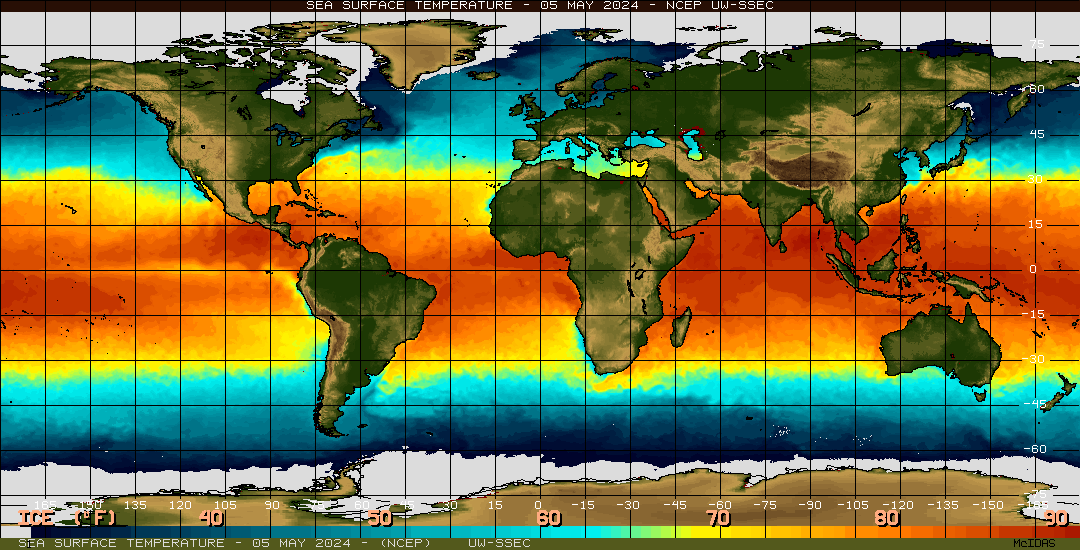
When we see records being broken and unprecedented events such as this, the onus is on those who deny any connection to climate change to prove their case. Global warming has fundamentally altered the background conditions that give rise to all weather. In the strictest sense, all weather is now connected to climate change. Kevin Trenberth
HIT THE PAGE DOWN KEY TO SEE THE POSTS
Now at 8,800+ articles. HIT THE PAGE DOWN KEY TO SEE THE POSTS
Andrea Thompson Senior Writer, Live Science, October 22, 2008
A potent greenhouse gas is at least four times more prevalent in the atmosphere than was previously estimated, a new study reports.
Using new analytical techniques, a research team in California made the first atmospheric measurements of nitrogen trifluoride, which is thousands of times more effective at warming the atmosphere than an equal amount of carbon dioxide (though carbon dioxide is much more prevalent, and therefore still the key greenhouse gas of concern in terms of global warming).
In 2006, the amount of nitrogen trifluoride in the atmosphere, which could not be detected using previous techniques, was estimated at less than 1,322 short tons (1,200 metric tons).
The new research, funded by NASA and detailed in the Oct. 31 issue of the journal Geophysical Research Letters, found that the actual amount was 4,630 short tons (4,200 metric tons) in 2006. Currently, about 5,950 short tons (5,400 metric tons) is estimated to be in the atmosphere. The estimates indicate that the amount of gas in the atmosphere is increasing by about 11 percent per year.
Emissions of nitrogen trifluoride were thought to be so low that the gas was not considered a significant contributor to global warming. It was not covered in the Kyoto Protocol, the 1997 agreement signed by 182 countries to reduce greenhouse gases.
Nitrogen trifluoride is about 17,000 times more powerful at trapping heat than is carbon dioxide, though current emissions of the gas only contribute about 0.15 percent of the total global warming effect contributed by human-produced carbon dioxide emissions.
Nitrogen trifluoride is one of several gases used during the manufacture of liquid crystal flat-panel displays, thin-film photovoltaic cells and microcircuits. Many industries used it as a replacement for perfluorocarbons, another type of potent greenhouse gas, because it was thought that only about 2 percent of the nitrogen trifluoride used escaped into the atmosphere.
Scientists have recently recommended adding nitrogen trifluoride to the list of greenhouse gases regulated by Kyoto in response to its growing use and concerns that its emissions are not well known.
"From a climate perspective, there is a need to add nitrogen trifluoride to the suite of greenhouse gases whose production is inventoried and whose emissions are regulated under the Kyoto Protocol, thus providing meaningful incentives for its wise use," said study leader Ray Weiss of the Scripps Institution of Oceanography in La Jolla, Calif.
BEIJING — Hu Jia, a soft-spoken, bespectacled advocate for democracy and human rights in China, was awarded Europe’s most prestigious human rights prize on Thursday. The award was a pointed rebuke of China’s ruling Communist Party that comes as European leaders are arriving in Beijing for a weekend summit.
Mr. Hu, 35, was chosen by the European Parliament as this year’s recipient of the Sakharov Prize for Freedom of Thought, despite warnings from Beijing that his selection would harm relations with the European Union.
Last year, Mr. Hu testified via video link before a hearing of the European Parliament about China’s human rights situation. Weeks later, Mr. Hu was jailed and later sentenced to three and a half years in prison on a conviction for subversion based on his critical writings about Communist Party rule.
Mr. Hu has been one of China’s leading figures on a range of human rights issues, while also speaking out on behalf of AIDS sufferers and for environmental protection. His selection for the prize comes after he had been considered a frontrunner for the Nobel Peace Prize, only to lose to the former president of Finland, Martti Ahtisaari.
“Hu Jia is one of the real defenders of human rights in the People’s Republic of China,” said European Parliament President Hans-Gert Poettering. “The European Parliament is sending out a signal of clear support to all those who support human rights in China.”
The timing may make for a frosty weekend in Beijing where European leaders are to meet with top Chinese officials at the Asia-Europe summit. Behind the scenes, China had lobbied against Mr. Hu’s candidacy for the Sakharov Prize. Song Zhe, the Chinese ambassador to the European Union, wrote a critical Oct. 16 letter to the president of the European Parliament.
“If the European Parliament should award this prize to Hu Jia, that would inevitably hurt the Chinese people once again and bring serious damage to China-E.U. relations,” Song wrote, according to The Associated Press.
China had also warned against awarding Mr. Hu the Nobel Peace Prize, and Foreign Ministry spokesman Qin Gang had described him in scathing terms as a convicted criminal.
“The Chinese government will be upset,” said Teng Biao, a legal expert who has co-authored essays with Mr. Hu. “But as a responsible nation that is trying to integrate into the international community, China has to understand that its conduct should follow international protocols. It should embrace the criticism as an opportunity to improve China’s human rights condition.”
Mr. Hu remains imprisoned in Beijing and could not be reached for comment. His wife, Zeng Jinyan, a prominent blogger and human rights activist, also could not be contacted. She has lived for months under house arrest with the couple’s infant daughter.
The award to Mr. Hu is an embarrassment for the Communist Party less than two months after China’s successful staging of the Olympic Games. During the Olympics, the Chinese government proved it could smoothly manage the world’s biggest sporting event, but the government also prevented demonstrations at designated protest zones, instituted broad censorship restrictions on the domestic media and placed numerous dissidents under house arrest or surveillance.
Mr. Hu’s conviction in April was part of a nationwide crackdown against dissidents in what many human rights advocates considered a pre-Olympic silencing campaign. A devout Buddhist, Mr. Hu has dedicated himself to a range of issues during the past 12 years, including environmental protection, helping AIDS sufferers, championing the legal rights of Chinese citizens and promoting greater democracy.
He also used a personal website and emails to become a one-man clearinghouse of information on human rights abuses and other controversies that officials preferred to keep silent.
“Whatever he does, he always stands in the forefront,” Mr. Teng said in an earlier interview. “Everything he wrote, everything he said, is straight from his heart. We have poor people and marginalized people in society whose voices are being muzzled. Hu Jia was trying to be the spokesman for the unheard voices.”
Mr. Hu graduated from Beijing’s Capital University of Economics and Trade in 1996 and almost immediately plunged into China’s nascent civil society. He traveled to Inner Mongolia to plant trees as a measure to slow the advance of the Gobi Desert.
By 2000, China was facing the rapid spread of AIDS, a problem the government had initially denied and remained reluctant to publicly confront. Mr. Hu formed a non-governmental organization, Loving Source, and focused on caring for people infected by a blood selling scandal in Henan Province.
Gao Yaojie, a prominent AIDS activist in China, recalled how Mr. Hu once rode a bicycle down a rutted dirt road to reach an isolated village decimated by AIDS. The road became narrower and potted with holes until Mr. Hu simply put the bike on his shoulder and walked to deliver help to a village where local officials where trying to cover-up the disease.
“We didn’t do anything wrong,” Dr. Gao said, in an interview earlier this month. “The only thing we did was to help HIV positive people. But we were always under great pressure from the government.”
Mr. Hu later began joining Internet petition campaigns calling for the release of political prisoners, while also calling on authorities to uphold the legal rights of citizens written in the Chinese Constitution.
His activism quickly made him a target. In 2006, he spent 168 days under house arrest. Rather than disappear from public view, Mr. Hu produced a documentary, “Prisoner in Freedom City,” in which he filmed state security agents harassing his wife as she tried to leave their apartment complex, which is known as Bo Bo Freedom City.
Indeed, as Mr. Hu faced constant surveillance and harassment — he once was taken away for 41 days — he continued to use the Internet to push for political reform and publicize human rights abuses. His testimony via video link before the European parliamentary committee came last November.
“It is ironic that one of the people in charge of organizing the Olympic Games is the head of the Bureau of Public Security, which is responsible for so many human rights violations,” he testified. “It is very serious that the official promises are not being kept before the Games.”
Geophysical Research Letters, Vol. 35, L20502; doi:10.1029/2008GL035417, 2008
Mass balance of the Greenland ice sheet from 1958 to 2007
E. Rignot (Department of Earth System Science, University of California, Irvine, CA, U.S.A.;Jet Propulsion Laboratory, California Institute of Technology, Pasadena, CA, U.S.A.), J. E. Box (Byrd Polar Research Center, Ohio State University, Columbus, OH, U.S.A.), E. Burgess (Department of Geography, University of Utah, Salt Lake City, UT, U.S.A.), and E. Hanna (Department of Geography, University of Sheffield, Sheffield, U.K.)
Abstract
We combine estimates of the surface mass balance (SMB) of the Greenland ice sheet for the years 1958 to 2007 with measurements of the temporal variability in ice discharge (D) to deduce the total ice sheet mass balance. During that time period, we find a robust correlation (R2 = 0.83) between anomalies in SMB and in D, which we use to reconstruct a continuous series of total ice sheet mass balance. We find that the ice sheet was losing 110 ± 70 Gt/yr in the 1960s, 30 ± 50 Gt/yr or near balance in the 1970s–1980s, and 97 ± 47 Gt/yr in 1996 increasing rapidly to 267 ± 38 Gt/yr in 2007. Multi-year variations in ice discharge, themselves related to variations in SMB, cause 60 ± 20% more variation in total mass balance than SMB and therefore dominate the ice sheet mass budget.
Received 21 July 2008; accepted 22 September 2008; published 22 October 2008.
Key words: glaciology, mass balance, sea level
Index Terms: 0720 Cryosphere: Glaciers; 0726 Cryosphere: Ice sheets; 0762 Cryosphere: Mass balance (1218, 1223); 1621 Global Change: Cryospheric change (0776); 1620 Global Change: Climate dynamics (0429, 3309).
Citation: Rignot, E., J. E. Box, E. Burgess, and E. Hanna (2008), Mass balance of the Greenland ice sheet from 1958 to 2007, Geophys. Res. Lett., 35, L20502, doi:10.1029/2008GL035417.
Blog reader Leon has given me the link to the video report on "global dimming," and it is a must-see for all those seeking a better understanding of the problems we need to confront:
Earth In Midst Of Sixth Mass Extinction: 50% Of All Species Disappearing
ScienceDaily (Oct. 21, 2008) — The Earth is in the midst of the sixth mass extinction of both plants and animals, with nearly 50% of all species disappearing, scientists say.
Because of the current crisis, biologists at UC–Santa Barbara are working day and night to determine which species must be saved. Their international study of grassland ecosystems, with flowering plants, is published in the Proceedings of the National Academy of Sciences.
"The current extinction event is due to human activity, paving the planet, creating pollution, many of the things that we are doing today," said co-author Bradley J. Cardinale, assistant professor of ecology, evolution and marine biology (EEMB) at UC–Santa Barbara. "The Earth might well lose half of its species in our lifetime. We want to know which ones deserve the highest priority for conservation."
He explained that the last mass extinction near the current level was 65 million years ago, called the Cretaceous Tertiary extinction event, and was probably the result of a meteor hitting the Earth. It is best known for the extinction of non-avian dinosaurs, but massive amounts of plant species became extinct at that time as well.
According to the current study, the most genetically unique species are the ones that have the greatest importance in an ecosystem. These are the ones that the scientists recommend be listed as top priority for conservation.
"Given that we are losing species from ecosystems around the world, we need to know which species matter the most – and which we should pour our resources into protecting," said first author Marc W. Cadotte, postdoctoral fellow at UCSB's National Center for Ecological Analysis and Synthesis (NCEAS).
Cadotte, Cardinale, and co-author Todd Oakley, an EEMB associate professor, put together a "meta-analysis" of approximately 40 important studies of grassland ecosystems around the world. They reconstructed the evolutionary history among 177 flowering plants used in these studies by comparing the genetic makeup of the plants.
The scientists found that some species are more critical than others in preserving the functions of ecosystems and that these species tend to be those that are genetically unique. Therefore, they are looking to evolutionary history for guidance in conservation efforts and in understanding the potential impacts of species loss.
Recent studies show that ecological systems with fewer species generally produce less biomass than those with more species. Less plant biomass means that less carbon dioxide is absorbed from the atmosphere and less oxygen is produced. So, as the biomass of plants plummets around the globe, the composition of gasses in the atmosphere that support life could be profoundly affected. Additionally, there are fewer plants for herbivorous animals to eat. Entire food chains can be disrupted, which can impact the production of crops and fisheries.
The loss of species that are not closely related to other species in the ecosystem reduces productivity more than the loss of species with close relatives. And the more genetically distinct a species is, the more impact it has on the amount of biomass in an ecosystem.
"Losing a very unique species may be worse than losing one with a close relative in the community," said Oakley. "The more evolutionary history that is represented in a plant community, the more productive it is."
Cadotte explained that the buttercup is a very unique species, evolutionarily. Losing the buttercup, where it occurs in grasslands, would have a much bigger impact on the system than losing a daisy or a sunflower, for example. The latter species are closely related. Each could therefore help fill the niche of the other, if one were to be lost. The daisy and sunflower also have a more similar genetic make-up.
"These 40 studies are showing the same thing for all plants around the world," said Cardinale. "It is not a willy-nilly conclusion. This study is very robust. It includes studies of plants that are found throughout the U.S., Europe, and Asia. We can have a high degree of confidence in the results. And the results show that genetic diversity predicts whether or not species matter."
by Thomas L. Friedman, New York Times, October 21, 2008
The 2 is back. Last week, U.S. retail gasoline prices fell below $3 a gallon — to an average of $2.91 — the lowest level in almost a year. Why does this news leave me with mixed feelings?
Credit: Fred R. Conrad/The New York Times
Because in the middle of this wrenching economic crisis, with unemployment rising and 401(k)’s shrinking, it would be a real source of relief for many Americans to get a break at the pump. Today’s declining gasoline prices act like a tax cut for consumers and can save $15 to $20 a tank-full for an S.U.V.-driving family, compared with when gasoline was $4.11 a gallon in July.
Yet, it is impossible for me to ignore the fact that when gasoline hit $4.11 a gallon we changed — a lot. Americans drove less, polluted less, exercised more, rode more public transportation and, most importantly, overwhelmed Detroit with demands for smaller, more fuel-efficient, hybrid and electric cars. The clean energy and efficiency industries saw record growth — one of our few remaining engines of real quality job creation.
But with little credit available today for new energy start-ups, and lower oil prices making it harder for existing renewables like wind and solar to scale, and a weak economy making it nearly impossible for Congress to pass a carbon tax or gasoline tax that would make clean energy more competitive, what will become of our budding clean-tech revolution?
This moment feels to me like a bad B-movie rerun of the 1980s. And I know how this movie ends — with our re-addiction to oil and OPEC, as well as corrosive uncertainty for our economy, trade balance, security and environment.
“Is the economic crisis going to be the end of green?” asks David Rothkopf, energy consultant and author of “Superclass.” “Or, could green be the way to end the economic crisis?”
It has to be the latter. We can’t afford a financial bailout that also isn’t a green buildup — a buildup of a new clean energy industry that strengthens America and helps the planet.
But how do we do that without any policy to affect the price signal for gasoline and carbon?
Here are some ideas: First, Washington could impose a national renewable energy standard that would require every utility in the country to produce 20 percent of its power from clean, non-CO2-emitting, energy sources — wind, solar, hydro, nuclear, biomass — by 2025. About half the states already have these in place, but they are all different. It would create a huge domestic pull for renewable energy if we had a uniform national mandate.
Second, Washington could impose a national requirement that every state move its utilities to a system of “decoupling-plus.” This is the technical term for changing the way utilities make money — shifting them from getting paid for how much electricity or gas they get you to consume to getting paid for how much electricity or gas they get you to save. Several states have already moved down this path.
Third, an idea offered by Andy Karsner, former assistant secretary of energy, would be to modify the tax code so that any company that invests in new domestic manufacturing capacity for clean energy technology — or procures any clean energy system or energy savings device that is made by an American manufacturer — can write down the entire cost of the investment via a tax credit and/or accelerated depreciation in the first year.
“I’m talking about anything from energy efficient windows to water heaters to industrial boilers to solar panels, and the job creating, manufacturing facilities that produce them — anything that makes us more efficient, lean and economically competitive and comes from a domestic, American source,” said Karsner.
He also suggests using some of the money from any stimulus package to directly incentivize and support states’ efforts to implement and intelligently modernize their building codes to get already well-established national “best practices” quickly into their marketplaces.
Lastly, we need the next president to be an energy efficiency trendsetter, starting by reinventing the inaugural parade. Get rid of the black stretch limos and double-plated armored Chevy Tahoes inching down Pennsylvania Avenue. Instead, let the next president announce that he will use no vehicles on inauguration day that get less than 30 miles per gallon. He could invite all car companies to participate in the historic drive with their best available American-made, fuel-efficient, innovative vehicle.
Finally, if Congress passes another stimulus package, it can’t just be another round of $600 checks to go buy flat-screen TVs made in China. It has to also include bridges to somewhere — targeted investments in scientific research, mass transit, domestic clean-tech manufacturing and energy efficiency that will make us a more productive and innovative society, one with more skills, more competitiveness, more productivity and better infrastructure to lead the next great industrial revolution: E.T. — energy technology.
For years, big business--from oil and coal companies to electric utilities to car manufacturers--has resisted change to environmental policy and stifled the debate over climate change in America and around the globe. Now, facing rising pressure from governments, green groups and investors alike, big business is reshaping its approach to the environment. With the election looming, FRONTLINE producer Martin Smith investigates what some businesses are doing to fend off new regulations and how others are repositioning themselves to prosper in a radically changed world.
FRONTLINE GLOBAL INVESTIGATION REPORTS WHAT BIG BUSINESS IS DOING TO ADDRESS CLIMATE PROBLEM
FRONTLINE Presents HEAT Tuesday, October 21, 2008, from 9 to 11 P.M. ET on PBS
Melting glaciers, rising sea levels, fires, floods and droughts. On the eve of a historic election, award-winning producer and correspondent Martin Smith investigates how the world's largest corporations and governments are responding to Earth's looming environmental disaster. HEAT , part of "PBS Vote 2008" election coverage, confronts the defining story of our time in a two-hour FRONTLINE investigation airing Tuesday, Oct. 21, 2008, from 9 to 11 P.M. ET on PBS (check local listings).
"I have reported on the Cold War, the breakup of the Soviet Union, the rise of Al Qaeda, and the wars in Iraq and Afghanistan," says Smith. "But nothing matches climate change in scope and severity."
The world needs to dramatically cut the carbon emissions responsible for wreaking havoc on the planet's climate, according to Dr. Rajendra Pachauri, whose organization, the Intergovernmental Panel on Climate Change (IPCC), shared last year's Nobel Peace Prize. "If we don't take action immediately, we face a crisis," Pachauri tells Smith. "Climate change is caused by human actions, and we need to do something about it. The sooner we realize that, the better."
With that sense of urgency in mind, Smith traveled to 12 countries on four continents to investigate whether major corporations and governments are up to the challenge. HEAT features in-depth interviews with top policy-makers and with leading executives from many of the largest carbon emitters from around the world, including Chinese coal companies, Indian SUV makers and American oil giants. The report paints an ominous portrait. Despite increasing talk about "going green," across the planet, environmental concerns are still taking a back seat to shorter-term economic interests.
Smith's journey begins at the epicenter of new industrial development: China. In the midst of unprecedented growth, the Chinese are clearly moving in the wrong direction. He visits Shenhua Energy, one of the largest and fastest-growing power companies in the world--a coal conglomerate with a huge carbon footprint. But its CEO, Ling Wen, tells Smith that he answers not to the public but to his shareholders. "We must create money, not lose the money," Ling says. "It's my responsibility as a CEO of this company." And when pressed whether he should make climate change a higher priority, Ling says that he would if his shareholders asked him. But, he says, "I'm afraid maybe all the shareholders, they cannot accept that concept." In the meantime, China continues to build two new coal-fired power plants every week.
Smith finds a similar situation in India, where rapidly rising income levels have prompted an explosion in the demand for new cars. Automakers are thriving, pushing out new models, including the Nano, a small car aimed at helping even the poorest citizens get behind the wheel--no small thing, as India stands to overtake China as the world's most populous country by mid-century. With several hundred million new drivers taking to the streets, India's carbon emissions will soar.
And with new cars, of course, come new roads, linking crowded cities and fueling a construction boom across the developing world that drives emissions ever higher. The manufacture of cement is the third-largest industrial contributor of greenhouse gases in the world. Supplying more cement for buildings, roads and bridges makes big emission reductions impossible. This presents a core dilemma for all large emerging nations, from China to India, Indonesia, Russia, Mexico and Brazil: how to grow without inflicting more damage on the environment.
"I think the difficulty we have is that countries that have developed and have done the polluting part are now asking the countries that are developing, 'OK, you can't pollute,'" says Hameed Bhombal, of Aditya Birla Group, an Indian megaconglomerate. "It has to be done in a way that's fair."
According to Dr. Pachauri of the IPCC, the onus is on the developed world to lead the way. Now, with gas prices spiking, there is an additional incentive for American car companies to offer smaller, more efficient vehicles. But will they respond? Their record is discouraging. Smith asks Beth Lowery, head of environmental affairs at General Motors, why Toyota beat GM to the Prius. Lowery replies that GM looked at hybrids from a "business case" and asked, "Can this vehicle make money?" GM banked instead on trucks and SUVs and is now suffering its worst performance in 50 years. GM is now playing catch-up and investing billions in a new hybrid, the Chevy Volt, which is scheduled to be released sometime this year.
There is also the problem that while hybrid cars may emit less CO2 than their gas-guzzling cousins, they still require electricity to run. So, making cars like the Volt part of a campaign to seriously reduce emissions will mean finding a new, cleaner power source. Currently, more than half of American power comes from coal. Coal is cheap and reliable, but dirty.
The answer, the industry says, will be "clean coal"--a complex process by which the burnt-off carbon will be captured and buried in the earth's crust. But as Smith investigates, he finds there are serious doubts about whether "clean coal" will ever work. When pressed, utility CEO David Ratcliffe of Southern Company, one of the world's largest emitters of greenhouse gases, concedes that "we haven't even come close to defining what are the legal liabilities and what are the permitting requirements" for removing carbon from coal and burying it underground. Recently, several "clean coal" projects in the U.S. have stalled over these and other uncertainties. As Jeffrey Ball, environmental news editor at The Wall Street Journal, tells Smith, "There was huge, rosy optimism about it. What's wrong is that reality is intruding."
On the campaign trail, both Sen. John McCain and Sen. Barack Obama have announced their plans for a new energy policy that will cut carbon emissions. Optimistically, they suggest that the "greening" of American business heralds a new era of sleek technologies and opportunities for innovation. What they tend not to emphasize is cost and, on the part of every consumer, sacrifice.
In his interview with FRONTLINE, California's attorney general, Jerry Brown, reminds Smith that it won't be easy. "Our wealth, our society, our being is driven by oil and carbon. It's intellectually dishonest to somehow say we can get some light bulbs or get a Prius, and then we're all done. No, this is going to take massive technological innovation. It's going to take changes in the way we live and work. And it's going to take cooperation of unprecedented degrees among business and government and among countries. That's where we are, and that's why there's no other word except 'daunting.' I'm hopeful. I'm cautiously optimistic. But I would have to say one has to approach this with great humility."
Author and journalist Jeff Goodell adds, "We seem incapable of grasping what's at stake here, perhaps because so much is at stake. Addressing this really means reinventing the engine of our lives--which is fossil fuels."
HEAT is a FRONTLINE co-production with RAINMedia, Inc. The producer, writer and reporter is Martin Smith. The co-producer is Chris Durrance. Funding for FRONTLINE is provided through the support of PBS viewers. Major funding for FRONTLINE is provided by The John D. and Catherine T. MacArthur Foundation. Additional funding is provided by the Park Foundation. Major funding for HEAT is provided by the FRONTLINE Journalism Fund, with a grant from Hannelore and Jeremy Grantham and the Grantham Foundation for the Protection of the Environment, and additional support from Scott Nathan and Laura DeBonis. Additional funding for HEAT is provided by the Kendeda Fund, the Nathan Cummings Foundation and the Wallace Genetic Foundation, Inc. FRONTLINE is closed-captioned for deaf and hard-of-hearing viewers and described, for people who are blind or visually impaired, by the Media Access Group at WGBH. FRONTLINE is a registered trademark of WGBH Educational Foundation. The executive producer of FRONTLINE is David Fanning.
by Catherine Brahic, New Scientist, October 16, 2008
Dramatic images taken at least every six hours over an entire year reveal how the world's fastest-flowing glacier is draining Greenland's ice sheet and contributing to sea-level rise world-wide.
Jason Amundson of the University of Alaska Fairbanks and colleagues set up a complete "life monitoring" system around the end of the Jakobshavn glacier in Greenland, at the point where it dumps its ice into a narrow fjord and out to sea, during the summer of 2007. The system remained in place until May 2008.
Each year, 7% of the ice lost from Greenland passes through the fjord. The incredible rate at which it sends ice crashing out to sea doubled to 12 kilometres per year between 1997 and 2003. This increased sea-level rise by 0.06 millimetres per year – roughly 4% of the 20th century rate of sea-level increase.
Three cameras took pictures every 10 minutes from 13 May to 8 June 2007, then every hour for the next month, every six hours over the winter and once more every 10 minutes from 7 to 14 May 2008.
Satellite pictures (see right) show that the ice sheet is not homogenous – two huge rivers of ice flow out into the fjord. Stitched together, Amundson's images reveal how this happens.
During the summer, huge chunks of ice broke off from the tip of the ice river about every 75 hours – a process known as calving.
Berg birth
In the winter, the ice river grew out over the water at the top of the fjord, creating an ice tongue several kilometres long. Amundson's pictures show that calving events stopped until the ice tongue disintegrated in four separate events between mid-April and mid-May 2008. In total, the team recorded 32 calvings.
At each calving event, the ice sheared through its entire 900-metre thickness and the new icebergs would flip over, drag up sediment from the bottom, and shove off into the fjord pushing floating ice ahead of it at a speedy one to two kilometres per hour. The ice river normally moves downstream 35 metres per day.
In addition to photographing the events, the team measured seismic waves generated by the break-ups and monitored the movement of the ice using GPS stations posted on the ice.
Previously, seismologist Göran Ekström at Harvard University had proposed that when ice breaks off the tip of Greenland ice rivers, the rest of the glacier suddenly jolts forwards, triggering the low rumblings. But Amundson's life-monitoring stations show no such jolts.
"It is still possible that the glacial earthquakes are generated by a slow acceleration of the glacier," he says. "More likely, I think, is that they are caused by icebergs bouncing around in the fjord."
Federal report cites signals from Greenland ice sheet to reindeer herds
WASHINGTON -- Autumn temperatures in the Arctic are at record highs, the Arctic Ocean is getting warmer and less salty as sea ice melts, and reindeer herds appear to be declining, researchers reported Thursday.
"Obviously, the planet is interconnected, so what happens in the Arctic does matter" to the rest of the world, Jackie Richter-Menge of the Cold Regions Research and Engineering Laboratory in Hanover, N.H., said in releasing the third annual Arctic Report Card for the federal National Oceanic and Atmospheric Administration.
"There continues to be widespread and, in some cases, dramatic evidence of an overall warming of the Arctic system," the experts stated in their report.
Compiled by 46 scientists from 10 countries, the report looks at six areas in the Arctic: atmosphere, sea ice, Greenland, ocean, biology and land. It found a "warming" trend in the first three signals and "mixed" signals in the latter three.
The region has long been expected to be among the first areas to show impacts from global warming, which the U.N.-sponsored Intergovernmental Panel on Climate Change says is largely a result of human activities adding carbon dioxide and other gases to the atmosphere.
"Changes in the Arctic show a domino effect from multiple causes more clearly than in other regions," said James Overland, an oceanographer at NOAA's Pacific Marine Environmental Laboratory in Seattle. "It's a sensitive system and often reflects changes in relatively fast and dramatic ways."
Air temps 9 degrees above normal For example, autumn air temperatures in the Arctic are at a record 9 degrees Fahrenheit above normal.
The report noted that 2007 was the warmest year on record the Arctic, leading to a record loss of sea ice. This year's sea ice melt was second only to 2007.
Rising temperatures help melt the ice, which in turn allows more solar heating of the ocean. That warming of the air and ocean affects land and marine life, and reduces the amount of winter sea ice that lasts into the following summer.
The study also noted a warming trend on Arctic land and increase in greenness as shrubs move north into areas that were formerly permafrost.
While the warming continues, the rate in this century is less than in the 1990s due to natural variability, the researchers said.
In addition to global warming there are natural cycles of warming and cooling, and a warm cycle in the 1990s added to the temperature rise. Now with a cooler cycles in some areas the rise in temperatures has slowed, but Overland said he expects that it will speed up again when the next natural warming cycle comes around.
Sun's impact downplayed Asked if an increase in radiation from the sun was having an effect on the Earth's climate, Jason Box of the Byrd Polar Research Center in Columbus, Ohio, said while it's important, increased solar output only accounts for about 10 percent of global warming.
"You can't use solar to say that greenhouse gases are not a major factor," Overland added.
Other findings from the report include:
The Arctic Ocean continued to warm and freshen due to ice melt. This was accompanied by an "unprecedented" rate of sea level rise of nearly 0.1 inch per year.
Warming has continued around Greenland in 2007 resulting in a record amount of ice melt. The Greenland ice sheet lost 24 cubic miles of ice, making it the largest single contributor to global sea level rise.
Reindeer herds that had been increasing since the 1970s are now showing signs of leveling off or beginning to decline.
Goose populations are increasing as they expand their range within the Arctic.
Data on marine mammals is limited but they seem to have mixed trends. They are adapted to life in a region that is at least seasonally ice-covered. There is concern about the small numbers of polar bears in some regions, the status of many walrus groups is unknown, some whales are increasing and others declining.
"This is a very complicated system, and we are still working diligently to sort out its mysteries," said Richter-Menge.
In addition to Richter-Menge, Overland and Box, lead authors of the report included Michael Simpkin of NOAA, Silver Spring, Md., and Vladimir Romanovsky of the University of Alaska's Geophysical Institute in Fairbanks.
The ABC network has refused to air an advert produced by Al Gore's environmental group, ruling that its charge of US government favouritism to the oil industry is too "controversial" for television.
The TV commercial, part of the WE campaign run by Gore's Alliance for Climate Protection, was submitted for airing after this week's presidential debate between Barack Obama and John McCain - both of whom have vowed to limit greenhouse gas emissions if elected.
But ABC concluded that the advert violated its internal policy against "controversial" content during network-sponsored programmes, network spokeswoman Julie Hoover told the Guardian.
"All of our advertising is reviewed on a case-by-case basis, and the context of this particular ad was determined not to be acceptable per our policy on controversial issue advertising," Hoover said.
The WE campaign has since attracted more than 170,000 supporters to an online petition drive asking ABC to reconsider its decision.
The script of the advert is similar in tone to political speeches made by Obama and McCain during the election season. An unseen narrator states that climate change can be combated through wind and solar power as well as "end[ing] our dependence on foreign oil".
Over an image of a young child playing with blocks, the narrator continues: "So why are we still stuck with dirty and expensive energy? Because big oil spends hundreds of millions of dollars to block clean energy. Lobbyists, ads, even scandals. All to increase their profits, while America suffers."
An ABC email published on the blog of Grist magazine stated that the advert was rejected due to its split-second shot of the US Capitol building.
"Per our guidelines, national buildings may be used in advertising provided the depictions are incidental to the advertiser's promotion of the product or service," the email stated. "Given the messages and themes of this commercial, the image of the Capital [sic] building is not incidental to this advertising."
Cathy Zoi, chief executive of the WE campaign, called ABC's decision "outrageous" in light of US networks' frequent airing of adverts from Chevron, Exxon Mobil and other oil companies.
"As our country faces deep economic problems, we need to be able to have an honest debate about the root causes of our problem," Zoi wrote in an email to supporters of Gore's group on Wednesday.
To build publicity for their products, American companies often produce TV adverts with content that pushes the limits of broadcast standards. A Snickers commercial featuring two men embarrassed after sharing a kiss was pulled from the US airwaves last year after complaints from gay-rights groups.
But rejection of an advert from a non-profit group is a far more rare occurrence. At the height of the US controversy over same-sex marriage in 2004, CBS and NBC turned down a commercial from the United Church of Christ that touted its acceptance of gay congregants.
ScienceDaily (Oct. 14, 2008) — The most comprehensive geological review ever undertaken of the upper U.S. Gulf Coast suggests that a combination of rising seas and dammed rivers could flood large swaths of wetlands this century in one or more bays from Alabama to Texas.
The findings, which will be presented at next week's annual meeting of the Geological Society of America in Houston, stem from bayfloor sediment samples, radiocarbon tests and seismic surveys compiled over 30 years.
"In terms of sea-level increases and river sediments flowing into the bays, we're rapidly approaching a time when bays will face conditions they last saw in the Holocene, from about 9,600 until 7,000 years ago," said lead researcher John Anderson, the W. Maurice Ewing Professor in Oceanography and professor of Earth science at Rice University. "That period was marked by dramatic and rapid flooding events in each of these bays -- events that saw some bays increase their size by as much as one-third over a period of 100 or 200 years."
Anderson is presenting the findings at next week's annual meeting of the Geological Society of America (GSA) at Houston's George R. Brown Convention Center. Anderson said the magnitude of flooding seen in bays during the Holocene -- the geological epoch that began 10,000 years ago -- would be noticeable and apparent, even on a year-to-year timescale.
"If you lived at the head of Galveston Bay, near Anahuac (Texas), you could see the bayhead move northward by as much as the length of a football field each year," Anderson said.
Anderson and colleagues, including Antonio Rodriguez of the University of North Carolina at Chappell Hill, compiled their research in a new 146-page monograph published by the GSA, "Response of Upper Gulf Coast Estuaries to Holocene Climate Change and Sea-Level Rise."
Their findings stemmed from an analysis of 30 years of data from hundreds of bayfloor sediment samples, radiocarbon tests and seismic surveys from Galveston, Matagorda and Corpus Christi bays in Texas, Mobile Bay in Alabama, Calcasieu Bay in Louisiana and Sabine Lake on the Texas-Louisiana border.
"There is no question that sea levels are rising in this region at a rate today that approaches what we saw in the Holocene," Anderson said.
He said the Holocene was also marked by alternating wet and dry periods upstream, particularly in central and western Texas. There was significantly less sediment flowing into the bays during the dry periods, and the researchers found that the most dramatic flooding events occurred when less sediment was flowing into the bays at the same time that sea levels were rising faster than four millimeters per year.
Anderson said that's a particularly troubling finding because several recent studies have confirmed that the rate of sea-level rise along the Gulf Coast has doubled in the past century to a current rate of about three millimeters per year. At the same time, the installation of dams upstream has slashed the amount of sediment flowing into every southern U.S. bay.
"Our research paints a pretty clear picture of what happened in these bays the last time they encountered the circumstances that we expect to see during the coming century," Anderson said. "Our hope is that policymakers will take note of the potential danger and take steps to help alleviate it."
For example, Anderson said it doesn't make environmental sense to keep a navigation channel open between the lower Trinity River and upper Galveston Bay because the channel diverts the sediment that is flowing into the bay, preventing it from replenishing the upper bay wetlands near Anahuac.
"Now that we're aware of the dangers, there are clearly things we can do to try and avoid them," he said.
Climate Change To Devastate Or Destroy Many Penguin Colonies
ScienceDaily (Oct. 13, 2008) — Half to three-quarters of major Antarctic penguin colonies face decline or disappearance if global temperatures are allowed to climb by more than 2°C.
A new WWF report, –2°C is Too Much, shows that the colonies of 50% of the iconic Emperor penguins and 75% of the Adélie penguins are under threat.
Climate change models forecast that a 2°C temperature rise above pre-industrial level could be a reality in less than 40 years, producing a strong reduction in the sea ice cover of the Southern Ocean which is an essential nesting and feeding ground for Emperor and Adélie penguins.
A reduction in the sea ice is also likely to have a knock-on effect on the abundance of krill, which is a vital food source for penguins.
Juan Casavelos, WWF Antarctica Climate Change Coordinator said: “Penguins are very well adapted to living in the cold and extreme conditions of Antarctica, so the continued increase in global temperature and resulting loss of feeding areas and nesting zones for their chicks has already led to notable reductions in their populations.
“If temperatures increase by another two degrees these icons of the Antarctic will be seriously threatened.”
A rise in global average temperatures of 2°C is widely regarded as a threshold level for unacceptable risks of dangerous climate change. Many recent climate models forecast likely temperatures rises in excess of this.
2°C is Too Much was launched at the IUCN World Conservation Congress taking place this week in Barcelona, Spain.
The only way to significantly reduce the risks of climate change in Antarctica, as well as globally, is to substantially reduce greenhouse gas emissions.
WWF is calling for all nations to work together to agree on a new global deal that will succeed the Kyoto Protocol and tackle climate change beyond 2012.
This should include an obligation on developed countries to cut 25–40% of their emissions by 2020 and 80–90% by 2050, compared to 1990 levels.
WWF also proposes the establishment of a network of marine protected areas to reduce pressure on the species, and the implementation of precautionary management measures that ensure the future of the krill and finfish fisheries and all Southern Ocean species – including penguins – that are dependent on them.
Juan Casavelos said: “The predicted threat to Emperor and Adélie penguin populations is a clear incentive for the world to agree on a set of measures to reduce global emissions.
“It is imperative that the international community analyzes all possible ways to limit climate change and improve the resilience of the penguin population.”
ON THIN ICE Climate change called certain and most predictions are bad Even Ohio's namesake buckeye said to be at risk
Crops suffering from more frequent droughts, such as this corn in Clay Township in 2007, are likely to be common as global warming's effects grow stronger, many scientists say. ( THE BLADE )
by Tom Henry, Blade Staff Writer, October 13, 2008
Second of three parts
If the threat of more West Nile virus, smog, contaminated water, higher food prices, invasive species, toxic algae, lake level declines, and deaths from heat waves isn't enough to wake up people to problems associated with climate change, consider this: Ohio might lose its namesake nut to arch rival Michigan.
That's right. The buckeye.
Some fear the buckeye tree won't be able to handle the state's warming climate and will instead adapt to a more moderate climate in Michigan, a cruel fate of irony for Ohio's official tree.
But that may be the least of the region's concerns if other predictions about climate change come true -- forecasts that go well beyond reduced opportunities for skiing, snowmobiling, ice fishing, and other forms of winter recreation.
Ellen Mosley-Thompson and Lonnie Thompson of Ohio State University's Byrd Polar Research Center discuss the impact of global warming on the Great Lakes region
Agriculture could become more difficult, with crop yields harder to maintain because of drier soils and more insects -- and too much rain at the wrong times.
Soybeans, corn, and wheat might benefit from longer growing seasons some years, according to one University of Michigan study. But the frequency and duration of thunderstorms could make it more difficult to grow those and other crops, especially if soil bounces between extreme drought and flooding cycles.
The result could be higher food prices for the region's 42 million residents, according to George Kling, a University of Michigan biology professor involved with the study.
He also was the lead author of a 2003 report that predicted Ohio and Michigan would have extreme bouts of summertime heat by the end of the century, akin to what Arkansas experiences today, with as much as a 9-degree increase in Ohio's average summer temperature and as much as a 13-degree upward swing in Michigan's.
The frequency of thunderstorms could be doubled, yet soil is expected to be drier and more prone to drought because of the increased rate of evaporation. Ohio winters also are predicted to be 7 degrees warmer on average, with Michigan winters expected to be 10 degrees warmer on average, according to a report published by the Union of Concerned Scientists and the Ecological Society of America.
That, of course, is if no major changes occur soon to curb greenhouse gases.
The consequences nationally of doing nothing could include more Katrina-force hurricanes along the Gulf and Atlantic coastlines, more forest fires in California and other parts of the West, and more species going extinct, according to Stephen Schneider, a Stanford University biology professor who was on the report's steering committee.
"We are facing threats to the life support system of the Earth," said Mr. Schneider, one of America's top climatologists and a key figure in the Intergovernmental Panel of Climate Change's Nobel Prize-winning work in 2007.
Steep declines in hunting and fishing, cutting into the Great Lakes region's multibillion dollar recreation and tourism industries, are projected.
U.S. Rep. John Dingell (D., Mich.), the senior member of the U.S. House of Representatives, has met with sportsmen in his southeastern Michigan district to discuss the climate changes to come.
Warming could cause a 39% reduction in the region's duck population and a 42% decline in its trout and salmon habitat by the end of the century, Mr. Dingell's office said.
"I would prefer to legislate with more certainty from the scientists about the dangers we face in the future, but we do not have that luxury. Scientists are already observing effects now from climate change," said Mr. Dingell, chairman of the House Energy and Commerce Committee, at a June 26 hearing.
Failure to pass meaningful legislation to address climate change "could put the planet and our country at risk of even bigger and graver consequences," he said.
Falling lake levels
Equally important are the anticipated losses of fresh drinking water in the western Lake Erie watershed. The five Great Lakes -- Superior, Michigan, Huron, Erie, and Ontario -- hold 20% of Earth's fresh surface water.
Evaporation would more than offset the region's gains in precipitation, according to Frank Quinn, a retired hydrologist from the National Oceanic and Atmospheric Administration, who has studied Great Lakes water levels since the 1960s.
Lake Erie doesn't have the kind of ice fishing opportunities it had a generation ago, when ice was so thick that automobiles could drive safely over it by mid-winter.
Recent Januarys have produced more rain than snow, and Lake Erie froze over only sporadically in recent years, sometimes for only a month and sometimes not at all. Lakeside residents remember how the lake used to be frozen solid for three months at a time. Some recall the wintertime tradition of lining up discarded Christmas trees to mark safe routes for automobile traffic between the Lake Erie islands and the mainland.
In recent winters there was not enough ice to drive on the lake.
A 2007 report acknowledges that Great Lakes water levels have fluctuated over thousands of years but says lower lake levels "are consistent with many global climate change scenarios." The report was issued by the National Oceanic and Atmospheric Administration's Great Lakes office and Duke University.
Lake Erie is under the greatest stress when it doesn't freeze in winter. Evaporation is greatest in late fall and early winter because the difference between air temperature and water temperature is greatest then.
Ice seals off evaporation, but when it comes late or not at all, lake levels are much more susceptible to plunging because of the additional evaporation.
"The amount of ice on the lake can dramatically affect what happens to the lake the rest of the year," said Jay Austin, an assistant professor of physics at the University of Minnesota at Duluth.
Lake Erie continues to receive heat and solar radiation as long as there is open water, causing the lake to keep evaporating in winter, said Jia Wang, a Great Lakes ice climatologist at the National Oceanic and Atmospheric Administration.
'A warmer region'
"Unequivocally, we're already observing changes in the Great Lakes region," said Joel Scheraga, national program director for the U.S. Environmental Protection Agency's Global Change Research Program. "On average, it is becoming a warmer region. But I emphasize 'on average.' "
Some parts of the region, such as the Ohio River Valley, have actually cooled a bit. The same phenomenon has occurred in other parts of the country because of their unique climatic conditions. In other words, not all areas are necessarily getting warmer.
"There's a regional texture," Mr. Scheraga said. "We're seeing wetter conditions, more intense rainfall and precipitation. Some of the consequences are lower lake levels, earlier ice break-up, an early spring, and longer growing seasons. The key point here is we are already seeing changes in climate in the Great Lakes region."
The best hatches of walleye and yellow perch -- Lake Erie's most prized sportfish -- come after winters with good ice cover, said Jeff Tyson, a supervisor for the Lake Erie Fisheries Research Unit that the Ohio Department of Natural Resources operates in Sandusky.
Walleye and yellow perch are cool-water species. So are lake trout and brook trout. They thrive when competitors get displaced or killed off by the cold.
The lake likely will grow more algae as the climate warms, said Jeff Reutter, Ohio Sea Grant director and OSU's Stone Lab director.
Some algae is always in the water. Small blooms help block out sunlight for underwater plants that fish use as habitat, which can help spawning. But excessive amounts rob the lake of its oxygen, killing fish while causing noxious odors and driving down property values of lakefront homes.
Phosphorus runoffs from farms into the Maumee River, Lake Erie's largest tributary, have been on the rise since 1997, reversing a 25-year decline and bringing back the lake's algae problem.
Phosphorus is a common soil nutrient that helps algae grow. A warmer climate could lead to more rain and more phosphorus runoff in the wintertime, officials said.
Anomalies can be found in any point of the Earth's climate history. The focus needs to be kept on climate trends, Mr. Reutter said.
The region can expect more on-again, off-again winters with a mix of rain and snow, with perhaps the biggest change being warmer winter nights that keep Lake Erie from freezing as early as it has in the past.
During summer, daytime highs in Ohio have not changed all that much yet, but evening temperatures have.
Jeffrey Rogers, Ohio's state climatologist, wrote in a report earlier this year that summer nights in Ohio are on average 3 degrees warmer than they were in the 1960s, most likely because of climate change.
"In Ohio, we don't have a clear signal of global change like you have in the Arctic, where sea ice is melting, but these rising nighttime lows are the next closest thing," said Mr. Rogers, an Ohio State University geography professor.
A dire forecast
On July 17, the U.S. Environmental Protection Agency issued the most comprehensive report it has ever published about the anticipated effects of climate change on the United States.
It predicted more smog, more deadly heat waves, more drought, and more extreme rainfall with flooding in the Great Lakes region.
Mr. Scheraga, the lead spokesman for that report, is in charge of the U.S. EPA's Global Change Research Program. He's also that agency's representative on the U.S. Climate Change Science Program. The latter is a consortium of 13 federal agencies assessing the potential impacts of climate change, the highest empaneled by the U.S. government.
Mr. Scheraga said climate change "poses real risks to human health."
He said the United States and developing countries are often "cavalier about how we can adapt to a changing climate because we're wealthy and we're technologically advanced."
Each region of the country will experience unique effects.
"There's no one size fits all," he said.
Climate-related factors are at least partially responsible for quadrupling the rate of asthma in the United States over the past 20 years, according to Dr. Paul Epstein, associate director of the Center for Health and the Global Environment at Harvard medical school and one of the nation's preeminent experts on the public health effects of climate change.
Expect more sneezing from pollen and ragweed, plus a variety of other health issues from more mushroom spores, mold, and poison ivy, he said.
Portions of North America are now being affected by dust clouds emanating as far away as Africa's expanding deserts. Now that oceans have started to warm, the dust has been carried by stronger winds across the Atlantic Ocean, causing more respiratory irritants for Caribbean islanders, according to research Dr. Epstein had published in a new report issued by the National Academy of Sciences.
More plant pollen and soil fungi may be coming too. Ragweed growth under elevated levels of carbon dioxide also have been shown to grow 10% taller and produce 60% more pollen, his paper said.
Major storms are expected to become more frequent and devastating as the Earth's climate warms.
Hurricane Katrina, for example, gained a lot of speed and force after ripping across South Florida and coming in contact with warm air rising from the Gulf of Mexico before slamming into New Orleans.
Katrina was not the worst hurricane in history, but it was a wake-up call in that it showed Americans how unprepared some of its major cities were for handling disasters.
It served as a wake-up call in another sense too -- that more such disasters could be in the making as gulf water and ocean currents continue to warm.
Mr. Scheraga said more hurricanes and other climate-driven disasters "may impose the greatest challenge to public health" because of what they put into the air, as well as the mold they leave behind after floodwater recedes.
Floods are often followed by outbreaks of disease and sicknesses, as downpours force rodents out of their burrows, disperse mosquitoes, and promote the growth of fungus. Major coastal storms trigger harmful blooms of toxic algae, which can lead to "dead zones" in waterways because of a lack of oxygen, according to the National Academy of Sciences.
The Great Lakes are not immune from such effects. Just last month, remnants of Hurricane Ike left much of southern Ohio and other parts of the Midwest under water and without power for days.
Residents of Findlay and Ottawa, Ohio, are still cleaning up from record floods in 2007, with the Hancock County commissioners last month voting to raise the county's sales tax to pay for flood-control projects.
The Great Lakes region is woefully behind on sewage-treatment needs, largely the result of sprawling growth patterns that have pushed antiquated systems well beyond their capacities.
Cities that can't handle a rush of rainfall end up releasing tons of untreated waste into streams to keep homes from flooding.
Congress is now considering legislation to fund more than $10 billion in sewage treatment projects in the Great Lakes region.
But is that enough? Mr. Scheraga said Great Lakes communities may find such vast projects, even if they are ever funded, falling short of keeping pace with the impacts of climate change.
"In other words, they will not be getting the intended outcomes," he said.
Some people, though, question if the focus on hurricanes and tornadoes diverts too much attention from the more immediate and simple problem of prolonged heat exposure.
Heat waves typically kill more people than hurricanes and other climate-related events combined. Those at greatest risk are the poor, the sick, and the elderly -- people who often lack access to air conditioning.
That can be especially true in northern states where air conditioning is not considered as essential as in the Sun Belt.
A report produced by the federal EPA's office of research and development stated it is "very likely that heat-related illnesses and deaths will increase over the coming decades."
The agency said that is especially likely in the Northeast and the Midwest.
Though it did not project numbers for future heat-related deaths, it noted there were at least 4,780 deaths resulting from heat waves between 1979 and 2002.
That figure was likely underestimated because heat is seldom listed on a death certificate. And heat often exacerbates chronic health problems, such as heart, renal, and lung diseases, and diabetes, the report stated.
The Great Lakes region will likely see more heat waves like the one in 1995 that killed 700 people in the Chicago area, according to Don Wuebbles, a University of Illinois professor of atmospheric sciences.
He said he expects Illinois to warm so much by the end of the century that it feels like eastern Texas does today, and for Minnesota's frigid climate to someday have the extreme summer heat that is found these days in Kansas.
As temperatures rise, expect more mosquitoes carrying the West Nile virus into the Great Lakes region, Dr. Epstein said.
Ticks carrying Lyme disease and other diseases have been found to move north as winters become warmer, while mosquitoes - which carry many diseases other than West Nile -- reproduce in greater numbers and stay around longer. They have already been found moving to higher ground in mountainous regions as permafrost thaws and glaciers retreat.
There are numerous biological changes in store given the fact that the oceans have absorbed 22 times as much heat as the atmosphere since 1957. That has resulted in more water vapor and hot air rising, Dr. Epstein said.
How good are the projections?
Scientists give themselves mixed reviews.
"Scientists tend to be conservative. Most of the predictions you see are going to be underestimated," said Daniel Schrag, director of Harvard University's Center for the Environment. "[But] this whole assumption that we scientists know what the Earth's system is going to do is crazy."
Linda Mortsch, a Canadian who authored a chapter of the Nobel-winning Intergovernmental Panel on Climate Change report, agreed that predictions have been made by "extremely conservative" scientists who are leery of over-committing themselves.
But there are signs of problems emerging for the Great Lakes region as far west as Colorado, where the devastating mountain pine beetle is thriving.
Canada, the world's largest source of pine trees, is on guard for them. Because of a warmer climate, the beetle appears capable of crossing the Continental Divide and ruining Canada's pines. It is expected to come south from Canada into Minnesota, Wisconsin, and Michigan.
A warmer climate also makes latent problems such as algae worse, said Ms. Mortsch, former head of the Canadian Climate Centre's lakes climatology unit and now a senior researcher of the adaptation and impacts research group for the Meteorological Service of Canada.
"That's the one thing I can tell you for sure, that the climate's going to be changing in the future," she said.


 Atmosphere
 Biology


 Posts
Posts