Blog Archive

Showing posts with label PETM. Show all posts

Wednesday, October 9, 2013

PETM Shocker: When CO2 levels doubled 55 million years ago, Earth may have warmed 9 °F in 13 years

by Joe Romm, Climate Progress, October 8, 2013
The Paleoeocene's 40-foot Titanoboa
The Paleoeocene’s 40-foot Titanoboa
The Paleocene–Eocene thermal maximum (PETM) and associated carbon pulse “are often touted as the best geologic analog for the current” manmade rise in CO2 levels, as a new study notes.
The Proceedings of the National Academy of Sciences paper, “Evidence for a rapid release of carbon at the Paleocene–Eocene thermal maximum,” concludes that sediment data indicates the carbon was released in the geologic blink of an eye. As the news release explains, Rutgers geologists Morgan Schaller and James Wright argue that:
… following a doubling in carbon dioxide levels, the surface of the ocean turned acidic over a period of weeks or months and global temperatures rose by 5 degrees centigrade — all in the space of about 13 years. Scientists previously thought this process happened over 10,000 years.
“We’ve shown unequivocally what happens when CO2 increases dramatically — as it is now, and as it did 55 million years ago,” Wright said. “The oceans become acidic and the world warms up dramatically.
Note that if we stay anywhere near our current emissions path, we are headed for a tripling or quadrupling of CO2 concentrations from preindustrial levels.
The nature of the PETM carbon burst has been a puzzle to scientists for a long time, but “Wright and Schaller’s contention that it happened so rapidly is radically different from conventional thinking, and bound to be a source of controversy, Schaller believes.”
Still, any study offering new answers on the PETM merits attention, given the prospect that we might be doing something similar today.
The PETM’s climate would be quite inhospitable to human civilization (see “The Garden of Eden had a 40-foot, 1-ton snake plus 90 °F average temperatures”). A 2009 Nature article concluded:
If our Palaeocene estimates are correct, tropical temperatures at the slightly younger (55.8 Myr ago) Palaeocene–Eocene thermal maximum (PETM) could have reached 38–40 °C, resulting in widespread equatorial heat-death as recent models and other proxy data have predicted.
A 2006 Nature analysis of deep marine sediments beneath the Arctic found Arctic temperatures during the PETM almost beyond imagination — above 23 °C (74 °F) — temperatures more than 18 °F warmer than current climate models had predicted (see “A methane feedback from the past strikes again”). The three dozen authors of the 2006 paper concluded that existing climate models are missing crucial feedbacks that can significantly amplify polar warming.
Significantly, the editor of this new study is none other than the “dean of climate scientists,” Wallace Broecker who popularized the term “global warming.”
Two decades ago, Broecker said, “The climate system is an angry beast, and we are poking at it with sticks.” He stood by that warning in a 2012 interview:
“We’re in for big trouble,” he says matter-of-factly. “There’s been a “true disruption of the basic climate of the planet.”
“My point [with the 'angry beast' metaphor] was that by adding large amounts of CO2 to the atmosphere, we were poking our climate system without being sure how it would respond,” he says.
At the rate we are spewing carbon pollution into the atmosphere, one might even say we are punching the climate beast in the nose. Paleoclimate studies, including this new one, suggests that is a very, very bad move.

Thursday, October 3, 2013

"Evidence for a rapid release of carbon at the Paleocene-Eocene thermal maximum," by James D. Wright & Morgan F. Schaller, PNAS 110 (October 2013); doi: 10.1073/pnas.1309188110

Proceedings of the National Academy of Sciences, 110(40) (October 2013) 15908-15913; doi:

Evidence for a rapid release of carbon at the Paleocene-Eocene thermal maximum

James D. Wright and Morgan F. Schaller

Abstract

The Paleocene/Eocene thermal maximum (PETM) and associated carbon isotope excursion (CIE) are often touted as the best geologic analog for the current anthropogenic rise in pCO2. However, a causal mechanism for the PETM CIE remains unidentified because of large uncertainties in the duration of the CIE’s onset. Here, we report on a sequence of rhythmic sedimentary couplets comprising the Paleocene/Eocene Marlboro Clay (Salisbury Embayment). These couplets have corresponding δ18O cycles that imply a climatic origin. Seasonal insolation is the only regular climate cycle that can plausibly account for δ18O amplitudes and layer counts. High-resolution stable isotope records show 3.5‰ δ13C decrease over 13 couplets defining the CIE onset, which requires a large, instantaneous release of 13C-depleted carbon. During the CIE, a clear δ13C gradient developed on the shelf with the largest excursions in shallowest waters, indicating atmospheric δ13C decreased by ∼20‰. Our observations and revised release rate are consistent with an atmospheric perturbation of 3,000-gigatons of carbon (GtC). 

http://www.pnas.org/content/110/40/15908.abstract.html

Wednesday, April 11, 2012

Triggering permafrost meltdown is closer than we think by Climate Code Red

Triggering permafrost meltdown is closer than we think


by Climate Code Red, April 10, 2012
  • Current levels of atmospheric carbon dioxide are probably sufficient to trigger large-scale permafrost carbon feedbacks and global warming that human effort would be unable to contain.
  • The time to slash emissions was a long time ago but now is still much, much better than later, which may, as new studies suggests, simply become too late.
Thawing permafrost
Two future climate impacts above all others will overwhelm human efforts to mitigate global warming should temperatures and carbon dioxide levels reach critical levels, which in the latter case we are already close to achieving.
       The last time carbon dioxide levels were apparently as high as they are today — and were sustained at those levels — global temperatures were 3 to 6 degrees Celsius higher than they are today, the sea level was approximately 25 to 40 metres higher than today, there was no permanent sea ice cap in the Arctic and very little ice on Antarctica and Greenland.
     One impact is ocean acidification (increasing atmospheric carbon dioxide is well-mixed with the ocean, to form carbonic acid and thus increasing water acidity) and rising ocean temperatures.  Given that carbon dioxide emissions over the next two decades are being determined (more than we would wish!) by existing energy infrastructure, we are not far from disaster: 
The second overwhelming impact would be the large-scale release of permafrost carbon. It is estimated that the amount of carbon stored in the polar north as soil permafrost or on the ocean bed as methane clathrates is around 1,670 billion tonnes, three times greater than the current quantity of atmospheric carbon.  Losing even a third of the Arctic carbon stores would double atmospheric carbon dioxide levels and usher in warming of 4 degrees Celsius or more.
     So the big question is how far we are from triggering large-scale permafrost release.
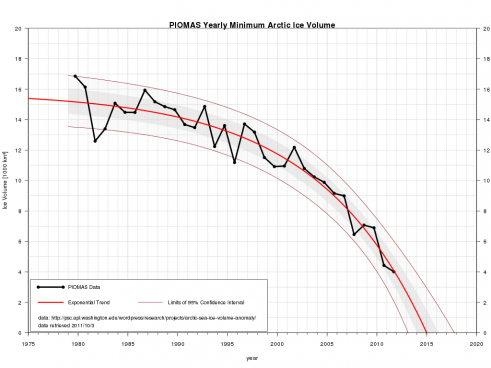
PIOMAS yearly minimum Arctic ice volume
(click to enlarge)
  • The first point to note is that the Arctic has already proved to be more sensitive to global warming that expected. It is now acknowledged that the Arctic has passed the tipping point for sea-ice-free summers. The lack of summer sea-ice will increase Arctic warming (already double the global average) as heat-reflecting ice is replaced by dark, heat-absorbing open seas. There may well be a summer sea-ice-free Arctic by around 2015 (see chart).
  • Those circumstances will increase the rate of melting of the Greenland ice sheet, which is already accelerating. And now the tipping point for Greenland's ice sheet (eventual sea level rise of 7 metres) has been revised down from around 3 ºC to just 1.6 ºC (uncertainty range of 0.8-3.2 ºC). At the current temperature rise of 0.8 ºC we may have already reached Greenland's tipping point, and with temperature rises in the pipeline (global emissions still rising, no reasonable agreement to reduce them), we are very likely to hit 1.6 ºC in two to three decades. 
  • Global average temperatures have warmed just less than 1 ºC since the Industrial Revolution, but average temperatures in Siberia, Alaska and western Canada are now 3-4 ºC warmer than 50 years ago. In parts of northern Canada, Greenland and the surrounding ocean during the 2010-2011 northern winter, temperatures were more than 6 ºC warmer than the baseline temperature average for the period of 1951-1980, and 7 to 9 ºC above average over the Chukchi Sea. So by mid-century the regional increase increase could easily be 4-6 ºC.
  • Predictions in 2011 suggested that as soon as 2020 carbon emissions from melting permafrost could be close to a billion tonnes a year. Researchers said that this positive permafrost carbon feedback will “will change the Arctic from a carbon sink to a source after the mid-2020s and is strong enough to cancel 42–88% of the total global land sink.”
  • Work by Celia Bitz, Philippe Ciais and others suggests that the tipping point for the large-scale loss of permafrost carbon is around 8–10 ºC regional temperature increase. As temperatures rise, it is projected that Arctic amplification (the multiple by with the Arctic warms compared to the global average) would be approximately times three, so around a 3 ºC increase in global temperature is probably more than enough to detonate the permafrost timebomb. This feedback in the carbon cycle would drive temperatures significantly higher. Caias told the March 2009 Copenhagen science conference that: “A global average increase in air temperatures of 2 ºC and a few unusually hot years could see permafrost soil temperatures reach the 8 ºC threshold for releasing billions of tonnes of carbon dioxide and methane.”
And now former UN climate chief Yves de Boer thinks that limiting warming to "two degrees is out of reach," which makes Caias's statement more than ominous.  Of course, permafrost tipping points is not the only reason to view 2 degrees Celsius as a crazy outcome and to be avoided at all costs. NASA climate chief James Hansen concludes that at the current temperature, no “cushion” is left to avoid dangerous climate change, and that the Australian government target goals  “… of limiting human-made warming to 2 degrees Celsius and CO2 to 450 ppm are prescriptions for disaster.”
RELATED POSTS
 On 19 March this year, a study published in Geology found that temperatures were 2 degrees warmer climate in late Pliocene (3–4 million years ago) and this meant 12–32 meters higher sea levels. Yet at that time CO2 levels were around 365–410 parts per million, similar to today's level of 390 parts per million, and Arctic temperatures were 11–16 °C warmer. Other studies over this period estimated global temperature to be 3–4 °C warmer than pre-industrial temperatures.  
     The take-home message is that current levels of atmospheric carbon dioxide are probably sufficient to trigger large-scale permafrost carbon feedbacks and global warming that human effort would be unable to contain.
In the Pliocene 3 million years ago conditions were 11–16 degrees Celsius warmer, at atmospheric carbon dioxide levels similar to today.
And now comes a new study which shows a sudden and extreme global warming events 55 million years ago known as the Palaeocene–Eocene Thermal Maximum (PETM) is characterized by a massive input of Antarctic permafrost carbon, ocean acidification and an increase in global temperature of about 2 degrees Celsius within a few thousand years.  The study's author, Rob DeConto, says the implications of the study appear dire for the long-term future as polar permafrost carbon deposits have begun to thaw due to burning fossil-fuels: 
Similar dynamics are at play today. Global warming is degrading permafrost in the north polar regions, thawing frozen organic matter, which will decay to release CO2 and methane into the atmosphere. This will only exacerbate future warming in a positive feedback loop.
Here's more on the new study from Joe Romm's Climate Progress:

Nature Bombshell: ‘Past Extreme Warming Events Linked To Massive Carbon Release From Thawing Permafrost’

So begins an article in the journal Nature that offers an unsettling explanation for one of the great climate mysteries: What caused the PETM?     The article’s title gives away the answer: “Past extreme warming events linked to massive carbon release from thawing permafrost” (subs. req’d).
     The lead author, climate scientist Rob DeConto, explains in a news release:
The standard hypothesis has been that the source of carbon was in the ocean, in the form of frozen methane gas in ocean-floor sediments,” DeConto says. “We are instead ascribing the carbon source to the continents, in polar latitudes where permafrost can store massive amounts of carbon that can be released as CO2 when the permafrost thaws."
     The new view is supported by calculations estimating interactions of variables such as greenhouse gas levels, changes in the Earth’s tilt and orbit, ancient distributions of vegetation, and carbon stored in rocks and in frozen soil.
     While the amounts of carbon involved in the ancient soil-thaw scenarios was likely much greater than today, implications of the study appear dire for the long-term future as polar permafrost carbon deposits have begun to thaw due to burning fossil-fuels, DeConto adds. “Similar dynamics are at play today. Global warming is degrading permafrost in the north polar regions, thawing frozen organic matter, which will decay to release CO2 and methane into the atmosphere. This will only exacerbate future warming in a positive feedback loop.”
Indeed, the recent scientific literature suggests that the permafrost is poised to be a major amplifying feedback if we are self-destructive enough to ignore yet another dire warning and stay anywhere near our current path of unrestricted carbon pollution:A 2010 study found our oceans are acidifying 10 times faster today than 55 million years ago when a mass extinction of marine species occurred.
     In short, whatever we do, we don’t want to duplicate the conditions of the PETM.  But, tragically, we are. Indeed, a 2011 study that found humans are releasing carbon to the atmosphere 10 times faster now than during the PETM.  “Rather than the 20,000 years of the PETM which is long enough for ecological systems to adapt, carbon is now being released into the atmosphere at a rate 10 times faster,” one of the authors of that study explained. “It is possible that this is faster than ecosystems can adapt.”

     Here’s more on this important new study:
[DeConto] and colleagues at Yale, the University of Colorado, Penn State, the University of Urbino, Italy, and the University of Sheffield, U.K., designed an accurate model―elusive up to now―to satisfactorily account for the source, magnitude and timing of carbon release at the PETM and subsequent very warm periods, which now appear to have been triggered by changes in the Earth’s orbit. 
Earth’s atmospheric temperature is a result of energy input from the sun minus what escapes back to space. Carbon dioxide in the atmosphere absorbs and traps heat that would otherwise return to space. The PETM was accompanied by a massive carbon input to the atmosphere, with ocean acidification, and was characterized by a global temperature rise of about 5 degrees C in a few thousand years, the researchers point out. 
Until now, it has been difficult to account for the massive amounts of carbon required to cause such dramatic global warming events. 
To build the new model, DeConto’s team used a new, high-precision geologic record from rocks in central Italy to show that the PETM and other hyperthermals occurred during periods when Earth’s orbit around the sun was both highly eccentric (non-circular) and oblique (tilted). Orbit affects the amount, location and seasonality of solar radiation received on Earth, which in turn affects the seasons, particularly in polar latitudes, where permafrost and stored carbon can accumulate. 
They then simulated climate-ecosystem-soil interactions, accounting for gradually rising greenhouse gases and polar temperatures plus the combined effects of changes in Earth orbit. Their results show that the magnitude and timing of the PETM and subsequent hyperthermals can be explained by the orbitally triggered decomposition of soil organic carbon in the circum-Arctic and Antarctica. 
This massive carbon reservoir at the poles “had the potential to repeatedly release thousands of petagrams of carbon to the atmosphere-ocean system once a long-term warming threshold was reached just prior to the PETM,” DeConto and colleagues say. Until now, Antarctica, which today is covered by kilometers of ice, has not been appreciated as an important player in such global carbon dynamics. 
In the past, “Antarctica and high elevations of the circum-Arctic were suitable locations for massive carbon storage,” they add. 
“During long-term warming, these environments eventually reached a climatic threshold,” with permafrost thaw and the sudden release of stored soil carbon triggered during the Earth’s highly eccentric orbits coupled with high tilt… 
Overall, they conclude, “an orbital-permafrost soil carbon mechanism provides a unifying model accounting for the salient features of the hyperthermals that other previously proposed mechanisms fail to explain.” Further, if the analysis is correct and past extreme warm events can be attributed to permafrost loss, it implies that thawing of permafrost in similar environments observed today “will provide a substantial positive feedback to future warming.”
The time to slash emissions was a long time ago but now is still much, much better than later, which may, as this study suggests, simply become too late.

http://www.climatecodered.org/2012/04/triggering-permafrost-meltdown-is.html

Friday, April 6, 2012

Past extreme warming events linked to massive carbon release from thawing permafrost, Nature 484, Robert M. DeConto et al.


Nature 484, 87–91 (05 April 2012); doi:10.1038/nature10929


Received 24 April 2011, accepted 2 February 2012, published online 4 April 2012.


Past extreme warming events linked to massive carbon release from thawing permafrost


Robert M. DeConto, Simone Galeotti, Mark Pagani, David Tracy, Kevin Schaefer, Tingjun Zhang, David Pollard and David J. Beerling


Abstract


Between about 55.5 and 52 million years ago, Earth experienced a series of sudden and extreme global warming events (hyperthermals) superimposed on a long-term warming trend1. The first and largest of these events, the Palaeocene–Eocene Thermal Maximum (PETM), is characterized by a massive input of carbon, ocean acidification2 and an increase in global temperature of about 5 °C within a few thousand years3. Although various explanations for the PETM have been proposed4, 5, 6, a satisfactory model that accounts for the source, magnitude and timing of carbon release at the PETM and successive hyperthermals remains elusive. Here we use a new astronomically calibrated cyclostratigraphic record from central Italy7 to show that the Early Eocene hyperthermals occurred during orbits with a combination of high eccentricity and high obliquity. Corresponding climate–ecosystem–soil simulations accounting for rising concentrations of background greenhouse gases8 and orbital forcing show that the magnitude and timing of the PETM and subsequent hyperthermals can be explained by the orbitally triggered decomposition of soil organic carbon in circum-Arctic and Antarctic terrestrial permafrost. This massive carbon reservoir had the potential to repeatedly release thousands of petagrams (1015 grams) of carbon to the atmosphere–ocean system, once a long-term warming threshold had been reached just before the PETM. Replenishment of permafrost soil carbon stocks following peak warming probably contributed to the rapid recovery from each event9, while providing a sensitive carbon reservoir for the next hyperthermal10. As background temperatures continued to rise following the PETM, the areal extent of permafrost steadily declined, resulting in an incrementally smaller available carbon pool and smaller hyperthermals at each successive orbital forcing maximum. A mechanism linking Earth’s orbital properties with release of soil carbon from permafrost provides a unifying model accounting for the salient features of the hyperthermals.


http://www.nature.com/nature/journal/v484/n7392/full/nature10929.html

Saturday, March 3, 2012

Oceans' acidic shift may be fastest in 300 million years

Oceans' acidic shift may be fastest in 300 million years


(Reuters) - The world's oceans are turning acidic at what could be the fastest pace of any time in the past 300 million years, even more rapidly than during a monster emission of planet-warming carbon 56 million years ago, scientists said on Thursday.

Looking back at that bygone warm period in Earth's history could offer help in forecasting the impact of human-spurred climate change, researchers said of a review of hundreds of studies of ancient climate records published in the journal Science.

Quickly acidifying seawater eats away at coral reefs, which provide habitat for other animals and plants, and makes it harder for mussels and oysters to form protective shells. It can also interfere with small organisms that feed commercial fish like salmon.

The phenomenon has been a top concern of Jane Lubchenco, the head of the U.S. National Oceanic and Atmospheric Administration, who has conducted demonstrations about acidification during hearings in the U.S. Congress.

Oceans get more acidic when more carbon gets into the atmosphere. In pre-industrial times, that occurred periodically in natural pulses of carbon that also pushed up global temperatures, the scientists wrote.

Human activities, including the burning of fossil fuels, have increased the level of atmospheric carbon to 392 parts per million from about 280 parts per million at the start of the industrial revolution. Carbon dioxide is one of several heat-trapping gases that contribute to global warming.

To figure out what ocean acidification might have done in the prehistoric past, 21 researchers from the United States, the United Kingdom, the Netherlands, Germany and Spain reviewed studies of the geological record going back 300 million years, looking for signs of climate disruption.

Those indications of climate change included mass extinction events, where substantial percentages of living things on Earth died off, such as the giant asteroid strike thought to have killed the dinosaurs some 65 million years ago.

The events that seemed similar to what is happening now included mass extinctions about 252 million and 201 million years ago, as well as the warming period 56 million years in the past.

The researchers reckoned the 5,000-year hot spell 56 million years ago, likely due to factors like massive volcanism, was the closest parallel to current conditions at any time in the 300 million years.

To detect that, they looked at a layer of brown mud buried under the Southern Ocean off Antarctica. Sandwiched between layers of white plankton fossils, the brown mud indicated an ocean so acidic that the plankton fossils from that particular 5,000-year period dissolved into muck.

During that span, the amount of carbon in the atmosphere doubled and average temperatures rose by 10.8 F (6 C), the researchers said. The oceans became more acidic by about 0.4 unit on the 14-point pH scale over that 5,000-year period, the researchers said.

That is a fast warm-up and a quick acidification, but it is small compared with what has happened on Earth since the start of the industrial revolution some 150 years ago, study author Baerbel Hoenisch of Columbia University's Lamont-Doherty Earth Observatory said by telephone.

EXTINCTIONS ON THE SEAFLOOR

During the warming period 56 million years ago, known as the Paleocene-Eocene Thermal Maximum, or PETM, and occurring about 9 million years after the extinction of the dinosaurs, acidification for each century was about .008 unit on the pH scale, Hoenisch said.

Back then, many corals went extinct, as did many types of single-celled organisms that lived on the sea floor, which suggests other plants and animals higher on the food chain died out too, researchers said.

By contrast, in the 20th century, oceans acidified by .1 unit of pH, and are projected to get more acidic at the rate of .2 or .3 pH by the year 2100, according to the study.

The U.N. Intergovernmental Panel on Climate Change projects world temperatures could rise by 3.2 to 7 degrees F (1.8 to 4 degrees C) this century.

"Given that the rate of change was an order of magnitude smaller (in the PETM) compared to what we're doing today, and still there were these big ecosystem changes, that gives us concern for what is going to happen in the future," Hoenisch said.

Those skeptical of human-caused climate change often point to past warming periods caused by natural events as evidence that the current warming trend is not a result of human activities. Hoenisch noted that natural causes such as massive volcanism were probably responsible for the PETM.

She said, however, that the rate of warming and acidification was much more gradual then, over the course of five millennia compared with one century.

Richard Feely, an oceanographer at the U.S. National Oceanic and Atmospheric Administration who was not involved in the study, said looking at that distant past was a good way to foresee the future.

"These studies give you a sense of the timing involved in past ocean acidification events - they did not happen quickly," Feely said in a statement. "The decisions we make over the next few decades could have significant implications on a geologic timescale."

(Editing by Peter Cooney)

Saturday, July 2, 2011

Doug Craig: The last time the Earth got hot [on Lee Kump's book "The Earth System" and Scientific American article "The Last Great Global Warming"]

The last time the Earth got hot


Many deniers of human-caused climate change substantiate their denial with the fact that global warming happened before. Long before humans walked the Earth, 56 million years ago. We didn't cause it then, so how could we cause it now?
Lee Kump can answer that. In a world of 7 billion people, he is one of the few of us who really knows and understands.
Dr. Kump is a "Professor in the Department of Geosciences, and an associate of the Earth System Science Center and Astrobiology Research Center at the Pennsylvania State University."
He is also one of the authors of The Earth System, "The first book of its kind to address the issues of global change from a true Earth systems perspective."
And if you pick up a copy of the current Scientific American, you can read Dr. Kump's article, "The Last Great Global Warming."
Surprising new evidence suggests the pace of the earth's most abrupt prehistoric warm-up paled in comparison to what we face today. The episode has lessons for our future."
Visiting "Spitsbergen, the largest island in Norway's Svalbard archipelago," Kump imagines "a time when palm trees, ferns and alligators probably inhabited this area." And it is there Kump looks for and finds clues to Earth's past...and her future.
Research had indicated that in the course of a few thousand years -- a mere instant in geologic time -- global temperatures rose five degrees Celsius, marking a planetary fever known to scientists as the Paleocene-Eocene Thermal Maximum, or PETM. Climate zones shifted toward the poles, on land and at sea, forcing plants and animals to migrate, adapt or die. Some of the deepest realms of the ocean became acidified and oxygen-starved, killing off many of the organisms living there. It took nearly 200,000 years for the earth's natural buffers to bring the fever down."
Like now the cause of this ancient warming was "a massive injection of heat-trapping greenhouse gases into the atmosphere and oceans comparable in volume to what our persistent burning of fossil fuels could deliver in coming centuries."
Back then, the Earth consisted of one immense supercontinent we now call Pangea. As it entered the final stages of its dissolution, it released a cataclysmic explosion of carbon dioxide and methane gases, consisting of hundreds of billions of tons of carbon "enough to raise global temperature a couple of degrees."
But that was just the beginning. "A second, more intense warming phase began when the volcano-induced heat set other types of gas release into motion." As the atmosphere warmed, the oceans heated up as well, thawing out frozen methane hydrate deposits buried deep in the seabed.
"As the hydrates thawed, methane gas bubbled up to the surface, adding more carbon to the atmosphere." Adding approximately 1.7 billion tons of carbon each year over 20,000 years, it caused a warming of 0.025 °C per century, reaching an overall temperature rise of 5 °C.
Now while the rate of warming 56 million years ago was 0.025 °C per century, current trends suggest a minimum rise of 1-4 °C just this century. And while it took 20,000 years for the Earth to heat up by 5 °C back then, current trends will see a rise of 2-10 °C over the next 200-300 years.
Kump tells us that when you compare the present warming with the last one, "the climate shift currently under way is happening at breakneck speed."
In a matter of decades, deforestation and the cars and coal-fired power plants of the industrial revolution have increased CO2 by more than 30%, and we are now pumping nine petagrams (one petagram equals one billion tons) of carbon into the atmosphere each year."
That rate is expected to reach 25 billion tons a year until all fossil-fuel reserves are exhausted.
Current global warming is on a path to vastly exceed the PETM, but it may not be too late to avoid the calamity that awaits us. To do so requires immediate action by all the nations of the world to reduce the buildup of atmospheric carbon dioxide and to ensure that the Paleocene-Eocene Thermal Maximum remains the last great global warming."
Scientists always end with these positive, hopeful messages, telling us it's not too late if only we wake up and alter our course. Why do we have such trouble admitting the truth? Of course I hope we respond in time, but at the moment we should be completely honest that we are doing absolutely nothing about this and we have no plans to do anything. That is our greatest shame. That we know what is coming and we refuse to act and we carry on as if it isn't really happening.