Blog Archive

Showing posts with label Jeff Biggers. Show all posts

Wednesday, August 27, 2014

Saline County Illinois residents beg Gov. Quinn and AG Lisa Madigan to stop Peabody Coal's Rocky Branch strip mine's toxic blasting and water contamination

by Jeff Biggers, EcoWatch, August 25, 2014


Update: Rocky Branch residents are reporting that decorated Vietnam War-veteran Glen Kellen, a Rocky Branch resident, has been arrested this morning, as he attempted to move his cross and protest sign closer to the public road.
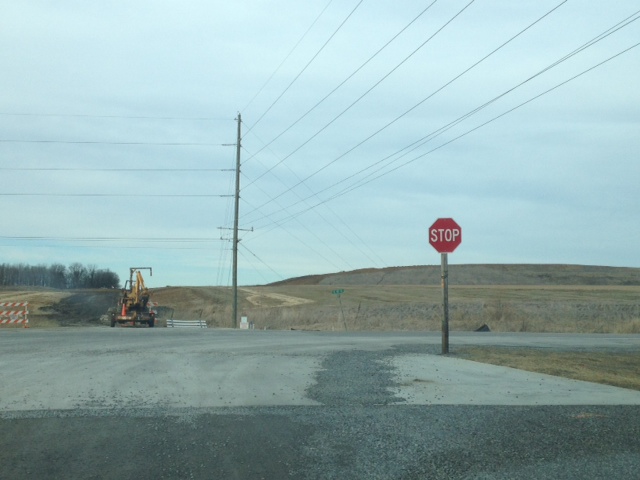
jbiggersDespite an appeal over the controversial Rocky Branch strip mine permit still pending with an Illinois Department of Natural Resources administrative judge, Peabody Energy defiantly closed down public roads and moved massive mining equipment in Saline County yesterday, in preparation to carry out its already violation-ridden and state-subsidized mine operation.

biggers3
Rocky Branch, Illinois. Photo credit: Jeff Lucas / Gutting the Heartland

Calling out clear violations of the state’s mine permitting process, civil rights and environmental justice policies, besieged farm residents facing toxic mine blasting and water contamination within yards of their homes and wells have appealed to Gov. Pat Quinn and Attorney General Lisa Madigan to halt the state’s flawed mine permit process.
“I feel the Attorney General has abandoned us by dragging her feet and letting Peabody destroy a community,” Rocky Branch resident Jennifer Dumbris said. 
“She has the power to stop what is going on until investigations are through but seems to rather look the other way, while Peabody is conducting business as usual.”
Last spring, thousands of Illinois residents appealed to Madigan to investigate the numerous inconsistencies and permit violations in the Rocky Branch mine process. Where does the AG stand now?
On behalf of civil rights and environmental justice in Rocky Branch?
Or with Peabody Energy CEO Greg Boyce, who declared in Australia last week that “coal always wins.”
In truth, Peabody was named as a party subject to discovery in a recent law suit over the Prairie State coal-fired plant, “a scheme by Peabody,” according to Illinois state residents, “to create a market for its high-sulfur, high-ash coal reserves in Southern Illinois.” A UK judge also ruled this week that Peabody’s “clean coal” ad campaign is misleading.

Peabody coal equipment on Rt. 13, Saline County, IL.  Photo credit: Shawnee Hills and Hollers
Peabody Coal equipment on Rt. 13, Saline County, IL. Photo credit: Shawnee Hills and Hollers

If Gov. Quinn and Attorney General Madigan can step in and halt the proposed Banner strip mine, why can’t they step in and halt the violation-ridden permits of the proposed Rocky Branch strip mine?
If Gov. Quinn and Attorney General Madigan can step in and halt petcoke coal dust, a “serious public health threat facing the residents,” why can’t they step in and halt the admitted unprotected health threat of toxic coal dust in Rocky Branch?
According to the IDNR permit for Rocky Branch, released earlier this spring, toxic coal dust from blasting, which will occur only a few hundred feet from resident homes, farms and wells, is not even considered:
bigger1
If Quinn and Madigan can campaign to reduce carbon emissions from coal-fired plants, why can’t they stop the unnecessary and CO2-exploding Peabody mine in Saline County from being loaded onto barges and shipped for dirty coal-fired plants overseas?
“Why is it that electric cigarettes are more important to make a decision on than the health and well being of a community of 70- and 80-year-olds that are law-abiding, tax-paying citizens,” Dumbris added. “It is nothing but profit over people.”
Yesterday, as equipment trundled across the state highway and down public roads in Saline County, Rocky Branch residents protested and held signs, “God Save Rocky Branch.”

bigger4
Rocky Branch, Illinois. Photo credit: Shawnee Hills and Hollers

That is—until Gov. Quinn, Attorney General Madigan and the courts uphold regulatory laws and fair mining practices, as well as civil rights and environmental justice.
You Might Also Like
http://ecowatch.com/2014/08/26/peabody-coal-overruns-rocky-branch-despite-appeal-pending/

Thursday, February 27, 2014

Jeff Biggers: FrackGate Comes to Illinois? Media Blackout on Fracking Vote in Johnson County

by Jeff Biggers, EcoWatch, February 26, 2014

jbiggersAs the national media puts the spotlight on the “FrackGate” public relations scandal in Ohio, where state officials worked to “marginalize opponents of fracking by teaming up with corporations—including Halliburton—business groups and media outlets,” Illinois residents behind a ballot initiative to ban fracking in rural Johnson County are facing a similar campaign of misinformation and local news blackout.

It’s bad enough that Illinois’ flawed state fracking regulations have spiraled into a widely denounced phase of disarray and confusion.

Until last Friday, the Vienna Times/Goreville Gazette newspaper company, the only local newspapers in Johnson County’s treasured Shawnee National Forest heartland, had provided fairly balanced coverage of the fracking debate, including the county commissioners’ decision last May to support a one-year moratorium on the controversial fracking process, as out-of-state corporations like Kansas-based Woolsey Energy swept up land leases.

Two of the three Johnson County commissioners, in fact, had encouraged residents last fall to draw up their own “simple” ballot initiative to gauge the “will of the people.”

Sounds reasonable and democratic, no?

But now, with the same local citizens group’s non-binding ballot initiative gaining widespread support across the county from residents especially concerned about the threat of involuntary “forced pooling” from neighboring leases, the Vienna Times/Goreville Gazette has suddenly announced—according to local residents—a new policy to refuse all anti-fracking ads, letters to the editor or news releases, even as it accepts ads and press releases from an Orwellian campaign set up to dismiss the community rights-driven campaign against absentee fracking corporations as a “radical agenda of out-of-state interests.”

Since when are local farmers called “out-of-state” and absentee fracking corporations considered homeboys?

And since when has this ad become too dangerous for the Vienna Times?

frackingjohnson

Instead, featuring Shawnee Professional Services president Mitch Garrett and Johnson County Commissioner Ernie Henshaw—who had originally voted for the one-year moratorium and asked for public input—the Vienna Times/Goreville Gazette celebrated the kick-off of an opposition group to the county citizens initiative on its front page this week, and included an ad with a direct link to opposition’s Facebook page:

viennatimes

Two years agoVienna Times publisher Lonnie Hinton and Shawnee Professional
Service owner Mitch Garrett worked together on another hot issue: Ridding the town of stray cats.

And now, what about what the fracking cats about about to drag in? As in debunked and clearly exaggerated job promises, and the onslaught of the well-documented fracking reality of industrial traffic, workplace accidents and injuries, massive amounts of pollution and toxic discharges risking public health and potential earthquakes?

“I’ve never quite grasped how much power the oil and gas industry has until now. What they are doing to manipulate the vote makes me angry and sad. And, what industry has not begun to understand is that there are plenty of us, and more all the time who will never, never give up,” said Annette McMichaels, communications director for the Southern Illinoisans Against Fracturing Our Environment citizens groups, and a resident and landowner in Johnson County.

“The best way to have discussion is in open dialogue, solved in an equal and democratic fashion,” said Johnson County vegetable farmer Kris Pirmann, who is active in the community rights ballot initiative. “Open discourse is the only legitimate and democratic way, and shutting down one side is not open discourse.”

Not so, says the local media. The Vienna Times/Goreville Gazette failed to answer multiple queries about its new policies. But local residents noted a new sign at the newspaper office, with a warning signed by Vienna Times publisher Hinton: “We reserve the right to accept or reject material submitted for publication, including letters to the editor, news releases and advertising.”

Here’s the ballot initiative, drawn up by local Johnson County residents and southern Illinois native and resident Natalie Long, a community organizer with the Community Environmental Legal Defense Fund: 

“Shall the people’s right to local self-government be asserted by Johnson County to ban corporate fracking as a violation of their rights to health, safety, and a clean environment?”
 
“This ballot initiative is led by a local group of people of common concerns, Johnson County resident, many who are third or fourth generation farmers,” said Pirmann, the Johnson County vegetable farmer, who noted that more than 1,000 county residents signed a petition for the ballot. “The argument that this initiative is hijacked from the outside doesn’t hold any water.”

Long adds: “A Community Bill of Rights is a community-tailored document. It’s made up of two main parts: (1) a section that asserts the rights of the community, including the right to local self-governance, the right to clean air, and the right to clean water; and (2) an enumeration of activities that violate those rights, and therefore are prohibited in the community. Because a Community Bill of Rights is drafted with each particular community, that means that no two documents are the same. Instead, they reflect the priorities of the community. In this case, Johnson County citizens are hard at working crafting language that focuses specifically on prohibiting hydraulic fracturing—nothing else. Any claim otherwise is both misguided and false.”

Only days away from the March 18th ballot vote, Johnson County residents are not giving up on the local news media black out, or the political games from out-of-state industry sycophants. Redoubling their efforts, Johnson County residents are stepping up grassroots efforts and seeking funds to place the ads in regional newspapers.

“It appears we don’t have avenue to voice our concerns,” Pirmann said. “They just want us to be quiet and go away. But we’re Johnson County residents and we’re going to talk to Johnson County residents face-to-face, in a democratic fashion, and voice our opinions to protect our land and farms.”

vote_yes_march18

Visit EcoWatch’s FRACKING page for more related news.

http://ecowatch.com/2014/02/26/frackgate-illinois-media-blackout-fracking-vote/

Friday, February 21, 2014

Jeff Biggers: Illinois Residents Stand Up to Peabody Coal at Historic EPA Hearing: Will AG Madigan Bring Justice to Rocky Branch?

by Jeff Biggers, Huffington Post, February 20, 2014

Outnumbering Peabody Energy supporters more than four to one among those willing to make public comments, outraged residents, farmers and former miners expertly broke down the inconsistencies and errors in the Illinois Environmental Protection Agency's tentative determination to issue a water quality permit at a packed strip mine hearing on Tuesday in the heart of Illinois' coal country.
It was a historic evening in Harrisburg, Illinois -- only a few miles from where Peabody Coal sank its first coal mine in 1895--and for the first time in decades,southern Illinois residents brought the spotlight to issues of civil rights and the state's spiraling crisis from a poorly regulated coal mining rush.
After tolerating the reckless fallout of nearby blastingtoxic coal dust and threatened waterways of the adjoining Cottage Grove strip mine -- which has left only a cemetery in the ruins of a once thriving rural community -- residents and their supporters have drawn the line in the sand for Peabody's request to expand its strip mine and effectively wipe out the close-knit farm community of Rocky Branch.
"They are ringing the bell for the death of Rocky Branch," said Rita Karns, whose family has farmed and lived in the famed Shawnee Forest area for generations, "and we've got to stop it."
"We the people of Rocky Branch," declared resident Jennifer Dumberis, "we will decide what happens to us and our civil rights -- not Peabody."
Among the long line of residents speaking out against the strip mine expansion, compared to a handful of Peabody employees, Karns held up a jar of discolored tap water already affected by mine discharges, which would effectively expand into area drinking water sources and tributaries leading to the Saline River under the present permit plan.

2014-02-20-karns.jpg
Karns holds jar of contaminated tap water. Photo courtesy of Jeff Biggers.

Ranging over 1,000 acres, the mine would destroy over 35,000 feet of natural streams, and discharge waste into area waterways.
But on the heels of a disappointing Department of Natural Resources hearing in December, where residents say Illinois agency officials refused to accept documentation and photographs of blasting and pollution violations, Tuesday's hearing revealed unanswered questions and troubling errors in the EPA permitting process, including incorrectly labeled streams. Only one of the the five-member IEPA panel admitted to having visited the nearby strip mine location.
And IEPA official Dean Studer repeated an earlier comment on the record that his agency had never rejected such a permit for a coal company in recent memory.
Last month, due to the Department of Natural Resources inaction, federal officials were called in to make sure state officials halted illegal logging by Peabody in the proposed mining area.
At the IDNR hearing in December, residents also questioned whether Peabody had already built a haulage road exit onto Rocky Branch, without proper Illinois Department of Transportation permits.

2014-02-20-rockybranchroad.jpg


Legal or illegal haulage road exit to Rocky Branch? Photo by Jeff Biggers

"These hearings seem to be a farce," said Judy Keller, who sits on the Cottage Grove town council. "When there are this many questions, without any answers, it makes you wonder what's going on behind closed doors. We call on Governor Quinn and Attorney General Madigan to come to Saline County for themselves, to see the price we are paying for this mine."
Given the mounting administrative inconsistencies, residents now wonder if the time has come for Illinois Attorney General Lisa Madigan and her investigators to intervene in the Saline County strip mine, just as she did three years ago for the failed Banner strip mine proposal in Fulton County.
"The facts indicate that a strip mine at this location will be harmful to the local environment and the people that live nearby," Madigan said in a statement in 200 9on the Banner mine proposal. "I am asking the court to hear the many voices from the Banner area who have expressed their concern and to reevaluate the facts regarding this permit."
Will Madigan bring a similar justice to Rocky Branch?
Besieged residents reminded Peabody officials that their "good neighbor" policy was lacking, and challenged the company's claims of reclamation yields on their land, water quality plans, as well as the mine's economic impact. A study released last year actually found that the state's antiquated tax policies, subsidies and maintenance racked up a $20 million annual deficit to support the coal industry.
Peabody, in fact, laid off 400 coal miners at the nearby Willow Lake mine in the fall of 2012, after the death of a coal miner and an MSHA ruling on safety problems. Last year, retired coal miners descended on Peabody headquarters in St. Louis to protest the loss of health benefits from a bankruptcy scheme.
That same sense of outrage dominated the hearing in Harrisburg on Tuesday.

2014-02-20-porter.jpg
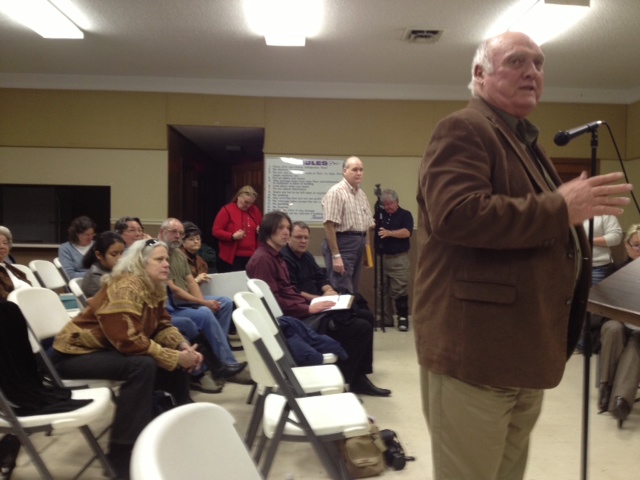
Rocky Branch residents speak against strip mine proposal. Photo courtesy of Jeff Biggers.

Rocky Branch resident Rhonda Dillard distributed photos of 2011 flooding in the area designated for mining, and questioned feasible emergency road arrangements.
"The IEPA no longer has the luxury of pleading ignorance," third-generation miner and Shawnee Forest resident Sam Stearns said.
Recalling past damages by strip mining, Steve Karns challenged the discharge allowances, and asked -- without any answer -- if the state or Peabody had prepared any emergency contingency in "case of acts similar to what happened in West Virginia."
In an area historically rich in indigenous artifacts, dating back to nearby prehistoric mounds and settlements, Shawnee Vinyard Indian Settlement spokesperson Barney Bush questioned why the state was allowing mining in probable Native village sites. It was unclear if Peabody had properly carried out an archaeological survey.
"Before we totally destroy the whole thing," said Rocky Branch farmer Allan Porter, calling on the state and federal officials to recognizing the community's civil rights, "if we don't consider the human side of this, we're going to miss the whole thing. The greatest environment we need to protect is human life. Let's consider there's more to it than water down a stream."