Blog Archive

Showing posts with label Methane. Show all posts

Wednesday, January 22, 2020

Evidence that an ice-free Arctic Ocean allowed ancient CO2 and methane emissions


Speleothems like these form fastest when the permafrost has thawed. Image: By James St John, via Wikimedia Commons
As the world warms, more greenhouse gas will enter the atmosphere. Researchers now think an ice-free Arctic Ocean explains how and why.

by Tim Radford, Climate News Network, January 10, 2020

LONDON – Deep in a cave in Siberia, Israeli, Russian and British scientists have identified evidence of periodic losses of carbon from the permafrost. And the unexpected link is not simply with peak periods of bygone global warming, but with an ice-free Arctic Ocean. The escape into the atmosphere of prodigious volumes of methane and carbon dioxide from the thawing soils is in step not with average planetary temperature rise, but with long periods when the Arctic Ocean is free of ice every summer.

Fact one: about one quarter of land in the northern hemisphere is now, and has been for much of the last half million years, permanently frozen, and with it about twice as much atmospheric carbon – in the form of peat and preserved vegetation – as there exists freely in the planetary atmosphere.

Fact two: in the most recent decades, sea ice has been both thinning and dwindling rapidly, and the polar ocean could by 2050 become almost entirely ice-free in the summer months. “This discovery about the behaviour of the permafrost suggests that the expected loss of Arctic sea ice will accelerate melting of the permafrost presently found across much of Siberia” And this twist in the tale of a rapidly-warming Arctic is preserved in stalagmite formations in a cave deep beneath the rim of the Arctic Circle in Siberia.

The chronology of stalagmite and stalactite development can be established precisely by the pattern of uranium and lead isotope deposits in formations, built up imperceptibly by the steady drip of water from, and through, the soils far above. That is, the speleothems – a geologist’s catch-all word for both stalactite and stalagmite – form fastest when the permafrost has thawed. And unexpectedly, the periods of thaw did not match the peaks of interglacial warming during the last 1.35 million years. They did however coincide with periods when the Arctic was ice-free in the summer.

“This discovery about the behaviour of the permafrost suggests that the expected loss of Arctic sea ice in the future will accelerate melting of the permafrost presently found across much of Siberia,” said Gideon Henderson of the University of Oxford, and one of the authors of a new study in the journal Nature.

The argument goes like this: if there is no sea ice then more heat and moisture is delivered from the ocean to the atmosphere, with warmer air flowing over Siberia, and therefore more autumn snowfall. A blanket of snow insulates the soil beneath from the extreme winter cold, so ground temperatures go up, to unsettle the permafrost and start a thaw that leads to accelerated plant decay and ever-increasing escape of carbon dioxide and methane that would otherwise have been frozen into the permafrost. So the stalagmites endure as evidence of these warmer soils and survive as a direct link to periods of ice-free ocean.

“If these processes continue during modern climate change, future loss of summer Arctic sea ice will accelerate the thawing of Siberian permafrost,” the scientists say. 

https://climatenewsnetwork.net/ice-free-arctic-ocean-allowed-ancient-carbon-leaks/

Sunday, April 21, 2019

Greenhouse Gas Emissions from thawing Arctic permafrost may be 12 times higher than thought, scientists say

'This needs to be taken more seriously than it is right now,’ says author of new study

Melting permafrost in Alaska caused by rising global temperatures.
Melting permafrost in Alaska caused by rising global temperatures. (Andrew Burton/Getty Images )

by Chiara Giordano, The Independent, April 20, 2019

READERS: here is the Barrow, Alaska, measuring site for CO2:

https://www.esrl.noaa.gov/gmd/dv/iadv/graph.php?code=BRW&program=ccgg&type=fi

Emissions from thawing Arctic permafrost may be 12 times higher than previously thought, scientists have discovered.
Permafrost is a mix of soil, rock or sediment that has been frozen for at least two years which is mostly found in the uppermost areas where temperatures are rising more quickly than the rest of the world.
When it thaws because of global warming, it releases large quantities of carbon dioxide and methane into the atmosphere, causing temperatures to rise and creating a perpetual cycle where more permafrost melts.
Nitrous oxide, a third greenhouse gas nearly 300 times more potent than carbon dioxide, stays in the atmosphere for an average of 114 years, according to the Environmental Protection Agency (EPA).
It has “conventionally been assumed to have minimal emissions in permafrost regions,” according to a fresh study published in the Atmospheric Chemistry and Physics journal.
However the research team behind the study, led by Harvard University scientists, has found that nitrous oxide emissions are 12 times higher than previously thought and therefore more of a threat.
The group used a small plane with a probe on its nose to measure greenhouse gases over 120 square miles of thawing permafrost in the North Slope of Alaska.
They found that nitrous oxide emissions reached what was previously thought to be the expected yearly limit within just one month in August 2013.
Nitrous oxide also poses a second threat because “up in the stratosphere, sunlight and oxygen team up to convert the gas into nitrogen oxides, which eat at the ozone,” Harvard University said in a statement.
Jordan Wilkerson, one of the authors of the study, said: “Much smaller increases in nitrous oxide would entail the same kind of climate change that a large plume of CO2 would cause.”
“This is widespread, pretty high emissions.”
He called for further research on the greenhouse gases, especially nitrous oxide, adding: “This needs to be taken more seriously than it is right now.”
https://www.independent.co.uk/environment/global-warming-greenhouse-gases-emissions-arctic-alaska-a8874456.html

Wednesday, April 26, 2017

'It scares me': Permafrost thaw in Canadian Arctic sign of global trend

Buildings in Inuvik being demolished because of shaky foundations

by David Michael Lamb, CBC News,April 17, 2017

Jim McDonald, the mayor of Inuvik, stands in front of a warehouse that’s slated for demolition due to melting permafrost, which has shifted the building's foundation.
Jim McDonald, the mayor of Inuvik, stands in front of a warehouse that’s slated for demolition due to melting permafrost, which has shifted the building's foundation. (David Michael Lamb/CBC)
Canada is melting.
Like a popsicle taken out of the freezer and left on the counter, the permanently frozen ground in the northern reaches of this country is thawing at an ever faster rate.
Half of Canada is blanketed in some form of permafrost, including patches in the northern reaches of Ontario and the Prairie provinces.
But in many places, including around Inuvik, NWT, as much as 90 per cent of this "ground" is actually frozen water. (The rest is dirt, rocks and decomposed organic material that was once trees, shrubs, even animals.)
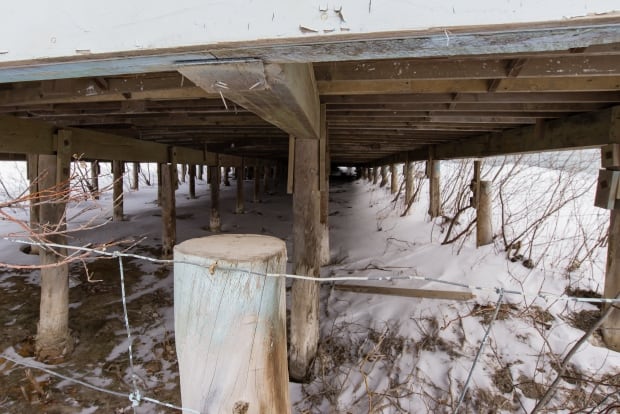
For years now, buildings in Inuvik have been gradually sinking into the ground as it softens. Others are so unstable, they are literally sliding off their foundations.
Unstable building
This building is now set to be torn down. Some of the stilts that support it have sunk and others have heaved up, leaving the building dangerously unstable. (David Michael Lamb/CBC)
"You can really see the effect of the permafrost," said Inuvik mayor Jim McDonald, standing in front of two warehouses built in the 1980s that are now unsafe to enter and are slated for demolition.
"The seasonal thaw is getting deeper now, and that wreaks havoc."
This is where a local problem becomes a global concern.
Scientists in the Northwest Territories, Alaska and Siberia are now realizing that as the ground under them melts, it will not only make life harder for the people living in the Arctic, but will in fact speed up climate change around the globe.

Temperature swings

The World Meteorological Organisation says the globe is now in uncharted territory, with temperatures in 2016 the hottest ever recorded.
Effects of climate change can be difficult to spot for most Canadians, but not in Inuvik.
Mackenzie Delta landscape
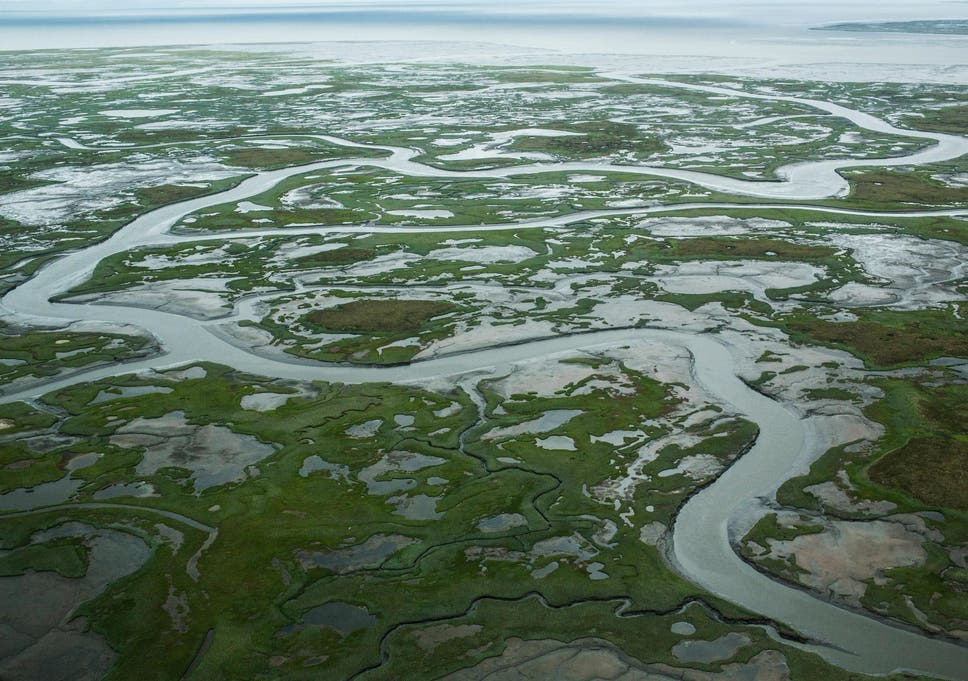
The landscape of the Mackenzie Delta is a maze of small lakes and rivers. This waterlogged environment has always been one of constant change, but the melting permafrost is now transforming it in ways no one has ever seen. (David Michael Lamb/CBC)
Jim McDonald has lived here his whole life — his father helped build the town when it was created from scratch in the 1950s.
He said that in the Mackenzie River Delta, the cold used to set in by October and stay that way into May. Temperatures would regularly dip to -40 and remain there for weeks at a time.
But McDonald said that in recent years, winters are much warmer and much shorter. It's also more unpredictable. Wild temperature swings are common.
The thaw is destroying buildings, forcing construction crews to change their methods. Buildings used to be hoisted on stilts sunk five or six metres into the ground. Nowadays, said McDonald, "they're finding that they have to go down in the 15- or 20-metre range to get a stable enough foundation."
In melting the permafrost, the changing climate is not only unsettling buildings but making transportation in the region more difficult.
For decades, the community of Tuktoyaktuk, on the shore of the Arctic Ocean, has relied on an ice road from Inuvik in winter. But because of warmer temperatures, the road's season is shorter and faces periodic closures as the ice shifts and becomes unstable.
This spring it will close for good, to be replaced by a permanent gravel road that will be known as the Inuvik-Tuktoyaktuk Highway.

'It scares me'

Above the Arctic Circle, the permafrost hasn't melted since at least the last Ice Age, more than 10,000 years ago. 
Kumari Karunaratne
Kumari Karunaratne, a permafrost expert who works with the NWT Geological Survey, says the effects of climate change in the north are 'scary.” (David Michael Lamb/CBC)
No one knows exactly what it will unleash when it melts. But no one thinks it will be good.
At the very least, it's changing the landscape. The Mackenzie Delta is a maze of small lakes and broad hillsides. People who live in Inuvik say they don't have to travel far from town in the summer to see craters that formed when the surface layer of land simply collapsed. 
They also see entire hillsides that have slid away, and have found entire lakes that have drained — as well as others that have been newly formed.
When permafrost thaws, all the organic material previously trapped in it releases methane into the atmosphere.
Permafrost slump
When permafrost melts, it can cause the land to collapse in dramatic fashion. In this scene from last summer, a drone captured the effects, which included the partial draining of a lake. (NWT Geological Survey)
"It scares me," said Kumari Karunaratne, a permafrost expert who works for the Northwest Territories Geological Survey. "This methane that's being released is being released over huge areas across the north. And it's continually seeping out."
Methane is a greenhouse gas that is 25 times more potent than carbon dioxide. So, as climate change speeds up the permafrost melt, the permafrost melt will exacerbate climate change.
By exactly how much, it's impossible to say. Karunaratne won't even try to guess, because measuring it is difficult and imprecise. The area where it's happening is vast and much of it remains uninhabited and unexplored.
But there are dramatic examples that show just how much methane is bubbling up from underground. Some lakes in the Arctic are so full of it, if you punch a hole in the ice you can light the escaping gas on fire.
YouTube has videos of researchers and others doing it in Alaska and Siberia. But the same thing is happening in the Northwest Territories.

Unleashing other problems

There are other problems, too.
Last summer in Siberia, the unusually intense summer heat melted the permafrost, exposing a reindeer carcass that had been embedded in it. 
That carcass was infected with anthrax, a deadly bacteria that had been locked in the ice. A 12-year-old boy died after being infected and at least eight others were sickened.
It opens up the possibility that other dangers could be unleashed.
Siberian researchers say a gravesite in one town contains bodies of people who died of smallpox in the 1890s. They were buried in the soil just above the permafrost, which is now melting. That's raising fears that smallpox, which was eradicated globally in 1977, could make a comeback.
RUSSIA-YAMAL/NENETS
A woman stands with reindeer in the Yamal-Nenets region of Siberia, Russia, where a 12-year-old boy died and 20 people were infected in 2016 after an anthrax outbreak. An unusually intense summer had melted the permafrost, exposing a reindeer carcass containing anthrax. (Denis Sinyakov/Reuters)
Sergey Netesov, chief of the virology laboratory at Novosibirsk State University, told the Siberian Times newspaper that there are thousands of graves in the region — some human, some cattle. 
The recent anthrax outbreak, he said, is "reason enough to finance research into the diagnostics and prevention of exceptionally dangerous infections."
Whether that happens or not, people in the Northwest Territories know they have no power to stop climate change. 
Global temperatures are already at record levels and the polar regions are feeling the effects more dramatically than anywhere else.
"There are really remarkable changes that are happening in a short amount of time," said Karunaratne.
And there's likely more to come.

Friday, March 25, 2016

Bill McKibben:  Global Warming’s Terrifying New Chemistry --  Our leaders thought fracking would save our climate. They were wrong. Very wrong.

fracking_texas_ap_img

A fracking well in the Eagle Ford Shale region, near Karnes City, Texas. (AP Photo / Aaron M. Sprecher) 

by Bill McKibben, The Nation, March 23, 2016


Global warming is, in the end, not about the noisy political battles here on the planet’s surface. It actually happens in constant, silent interactions in the atmosphere, where the molecular structure of certain gases traps heat that would otherwise radiate back out to space. If you get the chemistry wrong, it doesn’t matter how many landmark climate agreements you sign or how many speeches you give. And it appears the United States may have gotten the chemistry wrong. Really wrong.
There’s one greenhouse gas everyone knows about: carbon dioxide, which is what you get when you burn fossil fuels. We talk about a “price on carbon” or argue about a carbon tax; our leaders boast about modest “carbon reductions.” But in the last few weeks, CO2’s nasty little brother has gotten some serious press. Meet methane, otherwise known as CH4.
In February, Harvard researchers published an explosive paper in Geophysical Research Letters. Using satellite data and ground observations, they concluded that the nation as a whole is leaking methane in massive quantities. Between 2002 and 2014, the data showed that US methane emissions increased by more than 30%, accounting for 30-60% of an enormous spike in methane in the entire planet’s atmosphere.
To the extent our leaders have cared about climate change, they’ve fixed on CO2. Partly as a result, coal-fired power plants have begun to close across the country. They’ve been replaced mostly with ones that burn natural gas, which is primarily composed of methane. Because burning natural gas releases significantly less carbon dioxide than burning coal, CO2 emissions have begun to trend slowly downward, allowing politicians to take a bow. But this new Harvard data, which comes on the heels of other aerial surveys showing big methane leakage, suggests that our new natural-gas infrastructure has been bleeding methane into the atmosphere in record quantities. And molecule for molecule, this unburned methane is much, much more efficient at trapping heat than carbon dioxide.
The EPA insisted this wasn’t happening, that methane was on the decline just like CO2. But it turns out, as some scientists have been insisting for years, the EPA was wrong. Really wrong. This error is the rough equivalent of the New York Stock Exchange announcing tomorrow that the Dow Jones isn’t really at 17,000: Its computer program has been making a mistake, and your index fund actually stands at 11,000.
These leaks are big enough to wipe out a large share of the gains from the Obama administration’s work on climate change—all those closed coal mines and fuel-efficient cars. In fact, it’s even possible that America’s contribution to global warming increased during the Obama years. The methane story is utterly at odds with what we’ve been telling ourselves, not to mention what we’ve been telling the rest of the planet. It undercuts the promises we made at the climate talks in Paris. It’s a disaster—and one that seems set to spread.
The Obama administration, to its credit, seems to be waking up to the problem. Over the winter, the EPA began to revise its methane calculations, and in early March, the United States reached an agreement with Canada to begin the arduous task of stanching some of the leaks from all that new gas infrastructure. But none of this gets to the core problem, which is the rapid spread of fracking. Carbon dioxide is driving the great warming of the planet, but CO2 isn’t doing it alone. It’s time to take methane seriously.

To understand how we got here, it’s necessary to remember what a savior fracked natural gas looked like to many people, environmentalists included. As George W. Bush took hold of power in Washington, coal was ascendant, here and around the globe. Cheap and plentiful, it was most visibly underwriting the stunning growth of the economy in China, where, by some estimates, a new coal-fired power plant was opening every week. The coal boom didn’t just mean smoggy skies over Beijing; it meant the planet’s invisible cloud of carbon dioxide was growing faster than ever, and with it the certainty of dramatic global warming.
So lots of people thought it was great news when natural-gas wildcatters began rapidly expanding fracking in the last decade. Fracking involves exploding the sub-surface geology so that gas can leak out through newly opened pores; its refinement brought online new shale deposits across the continent—most notably the Marcellus Shale, stretching from West Virginia up into Pennsylvania and New York. The quantities of gas that geologists said might be available were so vast that they were measured in trillions of cubic feet and in centuries of supply.
The apparently happy fact was that when you burn natural gas, it releases half as much carbon dioxide as coal. A power plant that burned natural gas would therefore, or so the reasoning went, be half as bad for global warming as a power plant that burned coal. Natural gas was also cheap—so, from a politician’s point of view, fracking was a win-win situation. You could appease the environmentalists with their incessant yammering about climate change without having to run up the cost of electricity. It would be painless environmentalism, the equivalent of losing weight by cutting your hair.
And it appeared even better than that. If you were President Obama and had inherited a dead-in-the-water economy, the fracking boom offered one of the few economic bright spots. Not only did it employ lots of people, but cheap natural gas had also begun to alter the country’s economic equation: Manufacturing jobs were actually returning from overseas, attracted by newly abundant energy. In his 2012 State of the Union address, Obama declared that new natural-gas supplies would not only last the nation a century, but would create 600,000 new jobs by decade’s end. In his 2014 address, he announced that “businesses plan to invest almost $100 billion in factories that use natural gas,” and pledged to “cut red tape” to get it all done. In fact, the natural-gas revolution has been a constant theme of his energy policy, the tool that made his restrictions on coal palatable. And Obama was never shy about taking credit for at least part of the boom. Public research dollars, he said in 2012, “helped develop the technologies to extract all this natural gas out of shale rock—reminding us that government support is critical in helping businesses get new energy ideas off the ground.”
Obama had plenty of help selling natural gas—from the fossil-fuel industry, but also from environmentalists, at least for a while. Robert Kennedy, Jr., who had enormous credibility as the founder of the Waterkeeper Alliance and a staff attorney at the Natural Resources Defense Council, wrote a paean in 2009 to the “revolution…over the past two years [that] has left America awash in natural gas and has made it possible to eliminate most of our dependence on deadly, destructive coal practically overnight.” Meanwhile, the longtime executive director of the Sierra Club, Carl Pope, had not only taken $25 million from one of the nation’s biggest frackers, Chesapeake Energy, to fund his organization, but was also making appearances with the company’s CEO to tout the advantages of gas, “an excellent example of a fuel that can be produced in quite a clean way, and shouldn’t be wasted.” (That CEO, Aubrey McClendon, apparently killed himself earlier this month, crashing his car into a bridge embankment days after being indicted for bid-rigging.) Exxon was in apparent agreement as well: It purchased XTO Energy, becoming the biggest fracker in the world overnight and allowing the company to make the claim that it was helping to drive emissions down.
For a brief shining moment, you couldn’t have asked for more. As Obama told a joint session of Congress, “The development of natural gas will create jobs and power trucks and factories that are cleaner and cheaper, proving that we don’t have to choose between our environment and our economy.”
* * *
Unless, of course, you happened to live in the fracking zone, where nightmares were starting to unfold. In recent decades, most American oil and gas exploration had been concentrated in the western United States, often far from population centers. When there were problems, politicians and media in these states paid little attention.
The Marcellus Shale, though, underlies densely populated eastern states. It wasn’t long before stories about the pollution of farm fields and contamination of drinking water from fracking chemicals began to make their way into the national media. In the Delaware Valley, after a fracking company tried to lease his family’s farm, a young filmmaker named Josh Fox produced one of the classic environmental documentaries of all time, Gasland, which became instantly famous for its shot of a man lighting on fire the methane flowing from his water faucet.
This reporting helped galvanize a movement—at first town by town, then state by state, and soon across whole regions. The activism was most feverish in New York, where residents could look across the Pennsylvania line and see the ecological havoc that fracking caused. Scores of groups kept up unrelenting pressure that eventually convinced Governor Andrew Cuomo to ban it. Long before that happened, the big environmental groups recanted much of their own support for fracking: The Sierra Club’s new executive director, Michael Brune, not only turned down $30 million in potential donations from fracking companies but came out swinging against the practice. “The club needs to…advocate more fiercely to use as little gas as possible,” he said. “We’re not going to mute our voice on this.” As for Robert Kennnedy Jr., by 2013 he was calling natural gas a “catastrophe.”
In the end, one of the most important outcomes of the antifracking movement may have been that it attracted the attention of a couple of Cornell scientists. Living on the northern edge of the Marcellus Shale, Robert Howarth and Anthony Ingraffea got interested in the outcry. While everyone else was focused on essentially local issues—would fracking chemicals get in the water supply?—they decided to look more closely at a question that had never gotten much attention: How much methane was invisibly being leaked by these fracking operations?
B
Because here’s the unhappy fact about methane: Though it produces only half as much carbon as coal when you burn it, if you don’t—if it escapes into the air before it can be captured in a pipeline, or anywhere else along its route to a power plant or your stove—then it traps heat in the atmosphere much more efficiently than CO2. Howarth and Ingraffea began producing a series of papers claiming that if even a small percentage of the methane leaked—maybe as little as 3%—then fracked gas would do more climate damage than coal. And their preliminary data showed that leak rates could be at least that high: that somewhere between 3.6 and 7.9% of methane gas from shale-drilling operations actually escapes into the atmosphere.
To say that no one in power wanted to hear this would be an understatement. The two scientists were roundly attacked by the industry; one trade group called their study the “Ivory Tower’s latest fact-free assault on shale gas exploration.” Most of the energy establishment joined in. An MIT team, for instance, had just finished an industry-funded report that found “the environmental impacts of shale development are challenging but manageable”; one of its lead authors, the ur-establishment energy expert Henry Jacoby, described the Cornell research as “very weak.” One of its other authors, Ernest Moniz, would soon become the US Secretary of Energy; in his nomination hearings in 2013, he lauded the “stunning increase” in natural gas as a “revolution” and pledged to increase its use domestically.
The trouble for the fracking establishment was that new research kept backing up Howarth and Ingraffea. In January 2013, for instance, aerial overflights of fracking basins in Utah found leak rates as high as 9%. “We were expecting to see high methane levels, but I don’t think anybody really comprehended the true magnitude of what we would see,” said the study’s director. But such work was always piecemeal, one area at a time, while other studies—often conducted with industry-supplied data—came up with lower numbers.
* * *
That’s why last month’s Harvard study came as such a shock. It used satellite data from across the country over a span of more than a decade to demonstrate that US methane emissions had spiked 30% since 2002. The EPA had been insisting throughout that period that methane emissions were actually falling, but it was clearly wrong—on a massive scale. In fact, emissions “are substantially higher than we’ve understood,” EPA Administrator Gina McCarthy admitted in early March. The Harvard study wasn’t designed to show why US methane emissions were growing—in other parts of the world, as new research makes clear, cattle and wetlands seem to be causing emissions to accelerate. But the spike that the satellites recorded coincided almost perfectly with the era when fracking went big-time.
To make matters worse, during the same decade, experts had become steadily more worried about the effects of methane in any quantity on the atmosphere. Everyone agrees that, molecule for molecule, methane traps far more heat than CO2—but exactly how much wasn’t clear. One reason the EPA estimates of America’s greenhouse-gas emissions showed such improvement was because the agency, following standard procedures, was assigning a low value to methane and measuring its impact over a 100-year period. But a methane molecule lasts only a couple of decades in the air, compared with centuries for CO2. That’s good news, in that methane’s effects are transient—and very bad news because that transient but intense effect happens right now, when we’re breaking the back of the planet’s climate. The EPA’s old chemistry and 100-year time frame assigned methane a heating value of 28 to 36 times that of carbon dioxide; a more accurate figure, says Howarth, is between 86 and 105 times the potency of CO2 over the next decade or two.
If you combine Howarth’s estimates of leakage rates and the new standard values for the heat-trapping potential of methane, then the picture of America’s total greenhouse-gas emissions over the last 15 years looks very different: Instead of peaking in 2007 and then trending downward, as the EPA has maintained, our combined emissions of methane and carbon dioxide have gone steadily and sharply up during the Obama years, Howarth says. We closed coal plants and opened methane leaks, and the result is that things have gotten worse.
Since Howarth is an outspoken opponent of fracking, I ran the Harvard data past an impeccably moderate referee, the venerable climate-policy wonk Dan Lashof. A UC Berkeley PhD who has been in the inner circles of climate policy almost since it began, Lashof has helped write reports from the Intergovernmental Panel on Climate Change and craft the Obama administration’s plan to cut coal-plant pollution. The longtime head of the Clean Air Program at the Natural Resources Defense Council, he is now the chief operations officer of billionaire Tom Steyer’s NextGen Climate America.
“The Harvard paper is important,” Lashof said. “It’s the most convincing new data I have seen showing that the EPA’s estimates of the methane-leak rate are much too low. I think this paper shows that US greenhouse-gas emissions may have gone up over the last decade if you focus on the combined short-term-warming impact.”
Under the worst-case scenario—one that assumes that methane is extremely potent and extremely fast-acting—the United States has actually slightly increased its greenhouse-gas emissions from 2005 to 2015. That’s the chart below: the blue line shows what we’ve been telling ourselves and the world about our emissions—that they are falling. The red line, the worst-case calculation from the new numbers, shows just the opposite.
Lashof argues for a more moderate reading of the numbers (calculating methane’s impact over 50 years, for instance). But even this estimate—one that attributes less of the methane release to fracking—wipes out as much as three-fifths of the greenhouse-gas reductions that the United States has been claiming. This more modest reassessment is the yellow line in the chart below; it shows the country reducing its greenhouse-gas emissions, but by nowhere near as much as we had thought.
The lines are doubtless not as smooth as the charts imply, and other studies will provide more detail and perhaps shift the calculations. But any reading of the new data offers a very different version of our recent history. Among other things, either case undercuts the statistics that America used to negotiate the Paris climate accord. It’s more upsetting than the discovery last year that China had underestimated its coal use, because China now appears to be cutting back aggressively on coal. If the Harvard data hold up and we keep on fracking, it will be nearly impossible for the United States to meet its promised goal of a 26-28% reduction in greenhouse gases from 2005 levels by 2025.

One obvious conclusion from the new data is that we need to move very aggressively to plug as many methane leaks as possible. “The biggest unfinished business for the Obama administration is to establish tight rules on methane emissions from existing [wells and drill sites],” Lashof says. That’s the work that Obama and Canadian Prime Minister Justin Trudeau promised to tackle at their conclave in March—although given the time it takes for the EPA to draft new rules, it will likely be long after Obama’s departure before anything happens, and the fossil-fuel industry has vowed to fight new regulations.
Also, containing the leaks is easier said than done: After all, methane is a gas, meaning that it’s hard to prevent it from escaping. Since methane is invisible and odorless (utilities inject a separate chemical to add a distinctive smell), you need special sensors to even measure leaks. Catastrophic blowouts like the recent one at Porter Ranch in California pour a lot of methane into the air, but even these accidents are small compared to the total seeping out from the millions of pipes, welds, joints, and valves across the country—especially the ones connected with fracking operations, which involve exploding rock to make large, leaky pores. A Canadian government team examined the whole process a couple of years ago and came up with despairing conclusions. Consider the cement seals around drill pipes, says Harvard’s Naomi Oreskes, who was a member of the team: “It sounds like it ought to be simple to make a cement seal, but the phrase we finally fixed on is ‘an unresolved engineering challenge.’ The technical problem is that when you pour cement into a well and it solidifies, it shrinks. You can get gaps in the cement. All wells leak.”
With that in mind, the other conclusion from the new data is even more obvious: We need to stop the fracking industry in its tracks, here and abroad. Even with optimistic numbers for all the plausible leaks fixed, Howarth says, methane emissions will keep rising if we keep fracking.
And if we didn’t frack, what would we do instead? Ten years ago, the realistic choice was between natural gas and coal. But that choice is no longer germane: Over the same 10 years, the price of a solar panel has dropped at least 80%. New inventions have come online, such as air-source heat pumps, which use the latent heat in the air to warm and cool houses, and electric storage batteries. We’ve reached the point where Denmark can generate 42% of its power from the wind, and where Bangladesh is planning to solarize every village in the country within the next 5 years. We’ve reached the point, that is, where the idea of natural gas as a “bridge fuel” to a renewable future is a marketing slogan, not a realistic claim (even if that’s precisely the phrase that Hillary Clinton used to defend fracking in a debate earlier this month).
One of the nastiest side effects of the fracking boom, in fact, is that the expansion of natural gas has undercut the market for renewables, keeping us from putting up windmills and solar panels at the necessary pace. Joe Romm, a climate analyst at the Center for American Progress, has been tracking the various economic studies more closely than anyone else. Even if you could cut the methane-leakage rates to zero, Romm says, fracked gas (which, remember, still produces 50% of the CO2 level emitted by coal when you burn it) would do little to cut the world’s greenhouse-gas emissions because it would displace so much truly clean power. A Stanford forum in 2014 assembled more than a dozen expert teams, and their models showed what a drag on a sustainable future cheap, abundant gas would be. “Cutting greenhouse-gas emissions by burning natural gas is like dieting by eating reduced-fat cookies,” the principal investigator of the Stanford forum explained. “If you really want to lose weight, you probably need to avoid cookies altogether.”
Of course, if you’re a cookie company, that’s not what you want to hear. And the Exxons have a little more political juice than the Keeblers. To give just one tiny example, during his first term, Obama’s then–deputy assistant for energy and climate change, Heather Zichal, headed up an interagency working group to promote the development of domestic natural gas. The working group had been formed after pressure from the American Petroleum Institute, the chief fossil-fuel lobbying group, and Zichal, in a talk to an API gathering, said: “It’s hard to overstate how natural gas—and our ability to access more of it than ever—has become a game changer, and that’s why it’s been a fixture of the President’s ‘All of the Above’ energy strategy.” Zichal left her White House job in 2013; one year later, she took a new post on the board of Cheniere Energy, a leading exporter of fracked gas. In the $180,000-a-year job, she joined former CIA head John Deutch, who once led an Energy Department review of fracking safety during the Obama years, and Vicky Bailey, a commissioner of the Federal Energy Regulatory Commission under Bill Clinton. That’s how it works.
* * *
There was one oddly reassuring number in the Harvard satellite data: The massive new surge of methane from the United States constituted somewhere between 30 and 60% of the global growth in methane emissions this past decade. In other words, the relatively small percentage of the planet’s surface known as the United States accounts for much (if not most) of the spike in atmospheric methane around the world. Another way of saying this is: We were the first to figure out how to frack. In this new century, we’re leading the world into the natural-gas age, just as we poured far more carbon into the 20th-century atmosphere than any other nation. So, thank God, now that we know there’s a problem, we could warn the rest of the planet before it goes down the same path.
Except we’ve been doing exactly the opposite. We’ve become the planet’s salesman for natural gas—and a key player in this scheme could become the next president of the United States. When Hillary Clinton took over the State Department, she set up a special arm, the Bureau of Energy Resources, after close consultation with oil and gas executives. This bureau, with 63 employees, was soon helping sponsor conferences around the world. And much more: Diplomatic cables released by WikiLeaks show that the Secretary of State was essentially acting as a broker for the shale-gas industry, twisting the arms of world leaders to make sure US firms got to frack at will.
To take just one example, an article in Mother Jones based on the WikiLeaks cables reveals what happened when fracking came to Bulgaria. In 2011, the country signed a $68 million deal with Chevron, granting the company millions of acres in shale-gas concessions. The Bulgarian public wasn’t happy: Tens of thousands were in the streets of Sofia with banners reading Stop Fracking With Our Water. But when Clinton came for a state visit in 2012, she sided with Chevron (one of whose executives had bundled large sums for her presidential campaign in 2008). In fact, the leaked cables show that the main topic of her meetings with Bulgaria’s leaders was fracking. Clinton offered to fly in the “best specialists on these new technologies to present the benefits to the Bulgarian people,” and she dispatched her Eurasian energy envoy, Richard Morningstar, to lobby hard against a fracking ban in neighboring Romania. Eventually, they won those battles—and today, the State Department provides “assistance” with fracking to dozens of countries around the world, from Cambodia to Papua New Guinea.
So if the United States has had a terrible time tracking down and fixing its methane leaks, ask yourself how it’s going to go in Bulgaria. If Canada finds that sealing leaks is an “unresolved engineering challenge,” ask yourself how Cambodia’s going to make out. If the State Department has its way, then in a few years Harvard’s satellites will be measuring gushers of methane from every direction.
* * *
Of course, we can—and perhaps we should— forgive all that past. The information about methane is relatively new; when Obama and Clinton and Zichal started backing fracking, they didn’t really know. They could have turned around much earlier, like Kennedy or the Sierra Club. But what they do now will be decisive.
There are a few promising signs. Clinton has at least tempered her enthusiasm for fracking some in recent debates, listing a series of preconditions she’d insist on before new projects were approved; Bernie Sanders, by contrast, has called for a moratorium on new fracking. But Clinton continues to conflate and confuse the chemistry. Natural gas, she said in a recent position paper, has helped US carbon emissions “reach their lowest level in 20 years.” It appears that many in power would like to carry on the fracking revolution, albeit a tad more carefully.
Indeed, just last month, Cheniere Energy shipped the first load of American gas overseas from its new export terminal at Sabine Pass in Louisiana. As the ship sailed, Cheniere’s vice president of marketing, Meg Gentle, told industry and government officials that natural gas should be rebranded as renewable energy. “I’d challenge everyone here to reframe the debate and make sure natural gas is part of the category of clean energy, not a fossil-fuel category, which is viewed as dirty and not part of the solution,” she said. A few days later, Exxon’s PR chief, writing in The Los Angeles Times, boasted that the company had been “instrumental in America’s shale gas revolution,” and that as a result, “America’s greenhouse gas emissions have declined to levels not seen since the 1990s.”
The new data prove them entirely wrong. The global-warming fight can’t just be about carbon dioxide any longer. Those local environmentalists, from New York State to Tasmania, who have managed to enforce fracking bans are doing as much for the climate as they are for their own clean water. That’s because fossil fuels are the problem in global warming—and fossil fuels don’t come in good and bad flavors. Coal and oil and natural gas have to be left in the ground. All of them.