When we see records being broken and unprecedented events such as this, the onus is on those who deny any connection to climate change to prove their case. Global warming has fundamentally altered the background conditions that give rise to all weather. In the strictest sense, all weather is now connected to climate change. Kevin Trenberth
HIT THE PAGE DOWN KEY TO SEE THE POSTS
Now at 8,800+ articles. HIT THE PAGE DOWN KEY TO SEE THE POSTS
The Union of Concerned Scientists released a report with a treasure trove of primary documents from fossil fuel companies and their lobbying efforts and front groups. Here's a glimpse of what we're dealing with: industry front group astroturf campaigns, forged letters to Congress, and bought off scientists.
While those fluent in denial tactics won't be surprised by most of the revelations, there are still new outrages to get your heart rate going. The coverage has largely focused on Exxon's knowledge of the climate-carbon relationship as early as 1981 and subsequent neglect, but The Climate Deception Dossiers reveal even more sinister tactics employed by fossil fuel companies, as well as their front groups and PR hires. The primary documents reveal how companies secretly funded Willie Soon for his climate denial science, how fossil fuel lobby groups planned their campaigns of climate deceit climate deceit after internal memos acknowledged in 1995 that the link between climate change and carbon emissions "cannot be denied," and perhaps most shockingly, how a PR firm sent out forged letters to Congress before crucial votes.
The firm sent the letters—assuming the identity and misrepresenting the stance of civil rights organizations like NAACP—while Congress debated the Waxman-Markey bill (which proposed a federal emissions reduction plan). Congress members were unaware that in fact it was the PR firm, Bonner and Associates—working for the coal industry front group American Coalition for Clean Coal Electricity—that sent the oppositional letters. ACCCE and Bonner didn't bother telling the lawmakers about the forgeries until after the votes were recorded.
To make matters even worse, Bonner and Associates not only coopted a defunct chapter of the NAACP for their forgery, they even signed it as a staffer who had long since passed away.
Because just when you thought the bar couldn't get lower, deniers found a way to dig six feet under it.
by Donald Prothero, Insight, Skeptic.com, March 6, 2015
In the past few weeks, there has been a tremendous furor over the disclosure of the ethics of a noted climate denier, Wei-Hock “Willie” Soon. He has been one of the “stars” of the climate denial lobby, spending most of his time speaking to right-wing media and denialist groups, and being promoted by prominent denialist politicians like Sen. James Inhofe (R-OK). Even though the problems with his research, and with his funding, were public knowledge for many years, it made news because of recent discoveries revealed by the New York Times of just how much money he was paid for his work. His situation is even more problematic because he failed to report this funding in his publications and signed “conflict of interest” statements that he then violated. Naturally, the denialist institutes and right-wing media have fought back and defended their man, and Soon himself made a statement (brilliantly dissected by Greg Laden) to the press in his own defense. But the facts of the case seems incontrovertible, no matter what you might think of the climate change debate, and it appears that serious consequences will be forthcoming.
First, some background. Soon is often hyped as a “noted climate change scientist.” He is nothing of the sort. His doctorate was in aerospace engineering, with a thesis on plasma physics, so he has no research experience or specialized training in the fields of climate science on which he so often writes, such as ice cores, tree rings, atmospheric chemistry, and even polar bears. As I have written many times, beware of people working outside their own field of training! A Ph.D. does not make you a universal expert, and if your doctorate is not in the appropriate field and you have no peer-reviewed publications in the relevant fields, your are no more qualified to write about climate science or evolutionary biology or any other specialized field than you are qualified to write a symphony or fix a car. Climate science, in particular, is plagued by the intrusion of people from other unrelated fields of science (especially unrelated areas of physics). They seem to think that they can do this research and know what it’s about when they’ve never studied an ice core, spent hours looking down the microscope at planktonic microfossils (as I have), run isotopes on a mass spectrometer (as I have), analyzed atmospheric gases or satellite images. These are the specialized research skills you must have to know enough about the primary data and its limitations to do this sort of work competently. If you don’t have this first-hand research experience, you’re just an outsider, an amateur dabbling in a field you don’t really understand. Yet Soon has written attacks on climate science in these very fields (but these papers are never published in respected peer-reviewed journals), even though his only relevant training is understanding the physics of the solar wind and solar radiation.
This is not the place to list all of Soon’s discredited science, but a few examples are illustrative. In 2003, he and Sallie Baliunas published a review paper (an invited paper to give an overview on a topic, which are normally not carefully reviewed nor rejected) in the journal Climate Research, where he falsely claimed that the twentieth century was not the warmest of the past millennium (based on data from tree rings, ice cores, and other data he is not trained to understand). The problems with the paper and its conclusions were many. Soon and Baliunas used data from changes in moisture, rather than temperature; they did not distinguish between regional and hemispheric mean temperature anomalies; and they reconstructed past temperatures from proxy evidence that does not have the resolution to distinguish decadal trends. This paper was torn to pieces by the scientific community for its slipshod methodology, misuse of statistics, and cherry-picking and deliberate misrepresentations, and 40% of the editorial board of the journal resigned from the board over the journal’s failure to conduct proper peer review.
In 2007, Soon published an unreviewed editorial letter in the journal Ecological Complexity, claiming that there was no decline in polar bear populations, a claim that is patently false. Most readers will not see the “Viewpoints” heading and realize that this claim is just an editorial, not a reviewed scientific paper, so it gets cited again and again by climate deniers despite the overwhelming evidence of the damage to the Arctic ecosystem.
In 2003, in anticipation of the 2004 IPCC report on climate change, Soon and his denialist buddies plotted an attack paper on a report that wasn’t even finished! Infiles released from Soon’s work, he wrote:
“Clearly they [the AR4 chapters] may be too much for any one of us to tackle them all … But, as A-team, we may for once give it our best shot to try to anticipate and counter some of the chapters, especially WG1—judging from our true expertise in the basic climate sciences … Even if we can tackle ONE single chapter down the road but forcefully and effectively … we will really accomplish A LOT! In all cases, I hope we can start discussing among ourselves to see what we can do to weaken the fourth assessment report or to re-direct attention back to science …”
This is not the writing of an objective scientist, waiting for results to be properly reviewed and published before critiquing them, but a “merchant of doubt” playing a PR game to create controversy and confusion about a scientific topic for ideological and political, not scientific reasons.
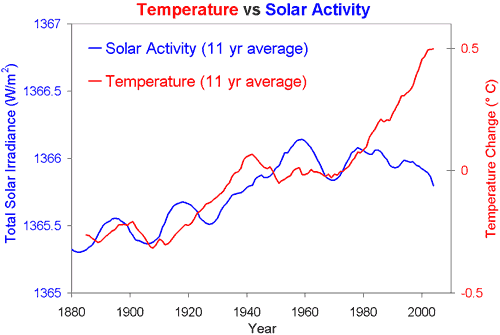
Despite Soon’s claim that global warming is due to increased solar radiation, the actual data show that the radiation has been decreasing as the planet has warmed. (From http://skepticalscience.com/solar-activity-sunspots-global-warming.htm)
Soon’s main claim to fame, however, is his interpretation of the historical data of solar radiation on the earth, and his argument that increased solar input explains global warming. This research has been thoroughly debunked many times, mostly because Soon has misinterpreted the data source, misused statistics, and cherry-picks the results that support his predetermined conclusions. More importantly, even if it were true that the solar input were increasing (when it has actually been decreasing for the past 45 years), the difference in the amount of solar radiation is minuscule. It would not make nearly enough difference in the global temperature compared to the effect of greenhouse gases on global warming. Yet Soon has testified many times that the warming of the earth is due to the sun, not man-made causes, and makes his living now claiming that anthropogenic climate change is not real.
All of these examples of incompetent and politicized science should have led to Soon’s dismissal long ago, but somehow the SAO is either very tolerant of his freedom of speech and freedom to do bad science, or else reluctant to deal with him for fear of the controversy over “censorship.”
He has accepted more than $1.2 million in money from the fossil-fuel industry over the last decade while failing to disclose that conflict of interest in most of his scientific papers. At least 11 papers he has published since 2008 omitted such a disclosure, and in at least eight of those cases, he appears to have violated ethical guidelines of the journals that published his work. The documents show that Dr. Soon, in correspondence with his corporate funders, described many of his scientific papers as “deliverables” that he completed in exchange for their money. He used the same term to describe testimony he prepared for Congress.
This is very serious. Nearly every scientific journal requires that you clearly disclose any sources of funding, and most also require that you sign a statement about “conflict of interest” to prove that you have not biased your results to please the funder. This is not a simple slip-up by Soon, but a deliberate effort to not reveal the obscene amounts of money he was getting paid, and where it came from. Such an ethics violation, if proven, would typically lead to a strong action (such as dismissal) by any university or research institute in the country, no matter how famous you were, and how good your previous reputation might have been. In particular his description of his work as “deliverables,” something bought and paid for by his funders, clearly shows his intent to act as a “hired gun” and give his funding sources what they paid for—not following the data wherever they may lead, and interpreting them honestly and in an unbiased fashion, as a real scientist must do.
I’m not saying that taking money from energy companies automatically taints your research or disqualifies you from being relevant to climate change science. A great counter-example is UC Berkeley physicist Richard Muller, who was initially a climate doubter. As I blogged about previously, he accepted funding from ExxonMobil, the Koch brothers, and other denialist sources to re-examine the global temperature data compiled by NOAA, the Goddard Institute of Space Science, and the Hadley Climate Research Unit at the University of East Anglia. He did so, and then in March 2011 shocked the GOP members of the House Science and Technology Committee, who called him as a sympathetic expert witness to debunk the temperature data. Instead, Muller behaved like a real scientist: he realized that the data from the other three institutes were indeed valid, and told the hearing so. It says a lot about Muller that he kept his scientific integrity and followed the data wherever they might lead, rather than bias his results to please those who paid him.
The Soon affair has actually blown up in the climate denialists’ faces. Sen. Edward Markey (D-MA) has just announced a congressional investigation of science funding by the denialist lobby:
“For years, fossil fuel interests and front groups have attacked climate scientists and legislation to cut carbon pollution using junk science and debunked arguments,” Markey said in a statement. “The American public deserve an honest debate that isn’t polluted by the best junk science fossil fuel interests can buy. That’s why I will be launching this investigation to see how widespread this denial-for-hire scheme stretches within the anti-climate action cabal.”
So what will happen to Willie Soon? Now that the Soon affair has exploded in controversy over his ethics violations, expect the bosses at the SAO to terminate his connection to them. According to the New York Times:
Charles R. Alcock, director of the Harvard-Smithsonian Center, acknowledged on Friday that Dr. Soon had violated the disclosure standards of some journals. “I think that’s inappropriate behavior,” Dr. Alcock said. “This frankly becomes a personnel matter, which we have to handle with Dr. Soon internally.” “I am aware of the situation with Willie Soon, and I’m very concerned about it,” W. John Kress, interim under secretary for science at the Smithsonian in Washington, said on Friday. “We are checking into this ourselves.”
The Smithsonian just released the following statement:
The Smithsonian is greatly concerned about the allegations surrounding Dr. Willie Soon’s failure to disclose funding sources for his climate change research.
The Smithsonian is taking immediate action to address the issue: Acting Secretary Albert Horvath has asked the Smithsonian Inspector General to review the matter. Horvath will also lead a full review of Smithsonian ethics and disclosure policies governing the conduct of sponsored research to ensure they meet the highest standards. Wei-Hock (Willie) Soon is a part-time researcher at the Smithsonian Astrophysical Observatory in Cambridge, Mass. He was hired to conduct research on long-term stellar and solar variability. The Smithsonian does not fund Dr. Soon; he pursues external grants to fund his research.
The Smithsonian does not support Dr. Soon’s conclusions on climate change. The Smithsonian’s official statement on climate change, based upon many decades of scientific research, points to human activities as a cause of global warming.
Bye, bye, Willie. We in the scientific community are not sorry to see you go.
Swift support from the denial community for Willie Soon reflects a disregard for self-policing.
by Peter Dykstra, Environmental Health News, The Daily Climate, March 5, 2015
The most remarkable aspect of Willie Soon’s soiled science scandal is that in the light of damning evidence of a serious ethical lapse, the climate denial camp shows no interest in self-policing.
When documents acquired through the Freedom of Information Act showed Soon was promising “deliverables” for climate research funded by fossil fuel affiliates, the judgment outside the climate denial sphere was swift, largely because the evidence was from Soon’s own hand.
But many who embrace climate denial not only saw nothing wrong with this, they circled the wagons around their embattled Man of Science.
Many who embrace climate denial not only saw nothing wrong with this, they circled the wagons around their embattled Man of Science. Soon crossed what most scientists believe are several inviolable ethical lines. While academia doesn’t generally disdain funding from parties who may have an economic or ideological stake in the outcome, transparency is key. Soon, via his unpaid climate-related research with the Harvard Smithsonian Center for Astrophysics, failed to reveal on multiple papers that his climate change-related publications were largely bankrolled by Exxon Mobil, Southern Company, and the Charles Koch Foundation.
He also gushed about how the results would please prospective funders. "I have a big super-duper paper soon to be accepted on how the sun affects the climate system,” he wrote to a Southern Company sponsor. Southern is the biggest electric utility in the Southeast U.S., is heavily coal-dependent, and clearly would have something to gain should a scientific paper throw the sun under the bus for what the vast majority of scientists believe to be fossil fuel-driven climate change.
The Heartland Institute's Joe Bast called climate scientists and advocates "mental midgets."
The Climate Investigations Center and Greenpeace* obtained and released the documents. Some climate activists crowed. Editorial pages scowled. The Smithsonian promised a swift investigation.
Soon's defenders, meanwhile, pulled out what is now a reliable playbook for conservatives confronted with accusations of errors, omissions and downright lies: They doubled down and went on the attack.
The Heartland Institute, which has listed Soon as an in-house expert, took the reins as his communications clearinghouse, releasing Soon’s official statement on its website along with a volley of counterattack. Heartland chief Joe Bast called climate scientists and advocates “mental midgets.” To be fair, that may signal a softening of Heartland’s hard line, since three years ago they were likening their foes to mass murderer Ted Kaczynski.
The Breitbart.com site was particularly unhinged in its response. The release of Soon’s own documents was a “crucifixion,” and reporting on the documents by The New York Times was a “hit piece” and a “smear.” Congressman Joe Sestak (D-Penn.) was singled out for the offense of re-tweeting the Times story. (Heartland’s Bast co-authored the “crucifixion” piece.)
Fox News took a more passive stance, deploying crickets. While Fox’s website lists multiple stories about sexual harassment allegations against R.K. Pachauri, the recently resigned head of the Intergovernmental Panel on Climate Change, Soon’s soiled science appears to have received only one brief mention on a Sunday talk show. The only other reference to climate change on Fox in recent weeks have centered on attempts to prove that a cold, snowy month in much of the U.S. is Exhibit A against climate change.
Fox’s high-profile prime time host Bill O’Reilly (left) didn’t mention the scandal, either. O’Reilly once embraced climate science, telling "60 Minutes": “Global warming is here… all these idiots that run around and say it isn’t here, that’s ridiculous.” But as climate denial has embedded itself in conservative doctrine and in Fox’s Fair-and-Balanced reporting, O’Reilly no longer believes climate scientists.
O’Reilly might be excused for skipping the Soon story. Like Soon’s supporters, he’s busy doubling down to defend against his own accusers’ allegations that he embellished his own war-correspondent stories.
And in that is an illustrative lesson in how climate denial and American conservatism became inseparable: Doubling down against critics is the standard defense, no matter how demonstrable the evidence is against you. It’s what Dick Cheney did on his whirlwind media tour last December, in which he defended both the Iraq war and the use of torture by American intelligence officials. It’s what Pat Michaels, another widely-cited skeptical scientist, did when soliciting coal producers’ money back in 2006. And it’s what Oliver North, the Grandpappy of modern-day doubling down, did in the late 1980’s when he was caught at the center of the Iran-Contra arms-for-hostages scandal. He became a hero to millions of Americans.
To this day, Ollie North still hosts a weekend show on Fox News. So in the event that Willie Soon has to face the music because ethics outweighs doubling down, there may be an opening for a Fox News science show host. It would be Super-Duper.
*I used to work for Greenpeace in the 1980s. That’s full disclosure, Willie.
EHN welcomes republication of our stories, but we require that publications include the author's name and Environmental Health News at the top of the piece, along with a link back to EHN's version.
With its roots in the tobacco industry, climate science denial talking points can be seen as manufactured doubt
The manufacturing of doubt on climate change science, backed by the fossil fuel industry, has its roots with the tobacco industry’s assault on climate science in the 1960s. Photograph: Richard Hamilton Smith/Richard Hamilton Smith/Corbis by Graham Readfearn, "Planet Oz," The Guardian, March 4, 2015
It’s a product that you can find in newspaper columns and TV talk shows and in conversations over drinks, at barbecues, in taxi rides and in political speeches.
This product is doubt – doubt about the causes and impacts of climate change, the impartiality of climate scientists, the world’s temperature records, the height of the oceans and basic atmospheric physics.
There’s doubt too about the “agenda” of policy makers and government environment agencies and a continued attempt to politicise climate science as “leftist.”
There’s also doubt over the role renewable energy might play now and in the future.
Yet where it matters most, in the leading scientific journals in the world, any doubt that burning fossil fuels is causing the planet to heat up is almost nowhere to be seen.
In the last couple of weeks, we’ve been given yet another glimpse into the global climate science denial industry and the machinery that produces all of this doubt.
For those playing catch-up, the story revolves around Dr Willie Soon, who is a long-serving climate science denialist and worker bee for numerous conservative think tanks over the past 15 years.
As The Chronicle of Higher Education has explained, The Smithsonian doesn’t actually pay Soon a wage and he has no association with the world-renowned Harvard University, despite the name of his institution suggesting there might be one.
Soon chases money himself and in the last decade practically all of it has come either from the fossil fuel industry or conservative groups. The Smithsonian is now carrying out a review, after it also emerged that it had agreed to a clause preventing the institution from revealing the identity of at least one donor.
Now three US Senators have asked 100 fossil fuel groups, conservative “free market” think tanks and conservative aligned funding groups for information about climate change research and scientists they might have been involved with.
Scientists have long criticised Soon’s work as flawed. Dr Gavin Schmidt, the head of NASA’s Goddard Institute for Space Studies, has described Soon’s work as “singularly poor” and “almost pointless.”
The Denial Machine
For more than 15 years Soon has been a key part of the globe-spanning industry producing doubt about the science of climate change.
There are four main cogs that make up the machinery as I see it – conservative “free market” think tanks, public relations groups, fossil fuel organisations and ideologically aligned media.
Occasionally over the years, the hood on the climate denial machine has been lifted to reveal its hidden workings.
As I wrote for The Guardian last week, in 1998 a leaked American Petroleum Institute memo detailed how a dozen fossil fuel lobbyists, think tank associates and PR professionals had come together for a mass scale misinformation project on climate science.
The memo claimed that “victory” would be achieved when “uncertainties” (read: doubt) became part of the conventional wisdom among the public.
As detailed in my piece, many of the same individuals continue to work in the climate science doubt production industry while defending fossil fuels.
But this wasn’t the first or the last time that internal documents have shown how the fossil fuel industry and ideologues work together to produce doubt on climate science.
In 1991, for example, a group of coal utilities devised an advertising and public relations campaign that would also recruit scientists to “reposition global warming as theory (not fact).”
In 2000, influential US Republican pollster Frank Luntz produced a memo for the energy industry and anyone else challenging the science of climate change. Luntz wrote:
Should the public come to believe that the scientific issues are settled, their views about global warming will change accordingly. Therefore, you need to continue to make the lack of scientific certainty a primary issue in the debate.
Luntz also proposed that Republicans should stop using the phrase “global warming” and replace it with “climate change” because this was “less frightening.”
In 2006, the Intermountain Rural Electric Association – a group that distributes coal-generated electricity – produced a "fact" sheetfor their members to pass around to employees who should then pass them on to their friends and family.
The materials claimed climate change was mainly caused by changes in the output of the sun, changes in the earth’s orbit and by plate tectonics.
Despite every major science academy in the world disagreeing with them, the pamphlet claimed the role of carbon dioxide was minor. The "fact" sheet said:
Trendy global warming theory suffers the great conceit that human activity has a significant impact on climate change.
Another infamous effort was the Oregon petition – a supposed survey of US science graduates claiming 17,000 “scientists” (later building to 33,000) who claimed there was “no convincing evidence” that carbon dioxide was a problem for the world’s climate (most of the signatories had graduated in completely unrelated disciplines).
As I wrote last year, despite the petition being one of the feeblest factoids in the climate science denial songbook, it didn’t stop Dick Warburton, a government-appointed reviewer of Australian renewables policy, from citing it as supposed evidence of a split among scientists over the causes of climate change.
The 1998 petition came with an attached manuscript, co-authored by Willie Soon, which claimed that “predictions of harmful climatic effects” from increasing carbon dioxide levels were “in error.”
The manuscript was produced in a format almost identical to that used by the prestigious Proceedings of the National Academy of Sciences, leading the National Academy of Sciences to issue a statement saying it had nothing to do with the petition, and that the manuscript “was not published in the Proceedings of the National Academy of Sciences or in any other peer-reviewed journal.”
The actual tobacco playbook
The campaign to sow doubt and discredit science to maintain industry profits was one honed by the tobacco industry during its fight against the science linking its products with cancer.
In the book Merchants of Doubt (released as a film this week) authors Naomi Oreskes (an actual Harvard professor) and Erik Conway explain that some of the same individuals and think tanks who had worked with the tobacco industry had moved on to climate science denial.
A preview of the film Merchants of Doubt produced by Yale Climate Forum.
Documents obtained by US lawsuits against the tobacco industry in the 1990s and 2000s are now housed in the Legacy Tobacco Documents Library.
Among the many thousands of documents, is Bad Science: A Resource Book– described in Merchants of Doubt as a “how-to handbook for fact fighters.”
Produced by the tobacco industry to help any industry fight any legislation that responded to scientific findings, this was a representation of big tobacco’s playbook in written form.
The book provided sound bites and ready-made talking points to arm any industry fighting regulation. Among the talking points the book suggested should be pushed home were:
Too often, science is manipulated to fulfill a political agenda.
Government agencies, too often, betray the public trust by violating principles of good science in a desire to achieve a political goal.
Public policy decisions that are based on bad science impose enormous economic costs on all aspects of society.
Among the newspaper cuttings provided as back up were newspaper columns, several of which took climate science denialists viewpoints, with self-explanatory titles.
There was “Warming Theories need a Warning Label,” “Earth Summit Will Shackle the Planet, Not Save It,” and “Great Hoax On Asbestos Finally Ends.”
Think tanks?
At the time of the Oregon petition, Willie Soon was affiliated to the George C. Marshall Institute, one of the earliest US free market think tanks to take up climate science denial with the help of fossil fuel funding.
This week, another free market think tank, the Heartland Institute, issued a statement on behalf of Soon, who claimed his funding had never influenced his work and that he had always disclosed his financial backers when asked.
Of course, Heartland continues to defend the tobacco industry in its online “Smoker’s Lounge” and claims the public health community’s “campaign to demonize smokers” is based on “junk science.”
There is a network of these think tanks across the world, and they play a key role in producing doubt as part of what should be seen as a public relations effort that serves the vested interests of the fossil fuel industry
For example, the US has the Competitive Enterprise Institute, The George C. Marshall Institute, the Heartland Institute, and the Campaign for A Constructive Tomorrow.
The UK has the Global Warming Policy Foundation, a group that declines to disclose its funders but has been backed by wealthy conservatives.
Australia has its own cogs in the climate science denial machine.
As well as the sympathetic Rupert Murdoch-owned press and the fossil fuel industry, there is the influential free market “think tank” the Institute of Public Affairs.
The IPA is another group to push climate science denial while also defending the tobacco industry (the Sydney Morning Herald reported in 2012 that British American Tobacco was a financial supporter of the institute).
Last year, the IPA encouraged supporters to take advantage of a tax concession to help fund a climate book with chapters written by a familiar line-up of climate science denialists – one of which was Dr Soon.
In February, the IPA ran a short speaking tour promoting its book Climate Change: The Facts (it was suggested to me that moving the semicolon in the book’s title one word to the left would better describe the contents).
Doubt is our product since it is the best means of competing with the “body of fact” that exists in the mind of the general public. It is also the means of establishing a controversy. Within the business we recognize that a controversy exists. However, with the general public the consensus is that cigarettes are in some way harmful to the health. If we are successful in establishing a controversy at the public level, then there is an opportunity to put across the real facts about smoking and health. Doubt is also the limit of our “product.”
What’s clear – and has been clear for well over a decade – is that the climate science denial industry is largely an extension of a program developed in the 1960s by big tobacco.
Much of its product, liberally spread, is a public relations exercise. The fact that this is not regularly acknowledged is possibly also a result of the production of doubt.
You’ll probably be able to sample some of that product in the comment section of this post. Enjoy.
by Stephen Mulkey, EnvironmentalCentury.net, March 4, 2015
Update: Inside Climate News has profiled my experience with Soon here.
I attended a conference billed as a forum for scientists in Boise in 2010, in which the panelists – and one in particular – delivered angry, polemic, nonscientific arguments against climate change. It was nauseating to watch one notable scientist cherry-pick data from short time frames and small geographic areas to try and debunk centuries of global data showing a rise in global temperatures.
At one point, the scientist, Dr. Wei Hock “Willie” Soon, claimed rising acidification of ocean water would lead to larger shells and bulkier weights for lobster and crab populations.
Not many in the crowd would have known that lobsters and crabs have chitinous exoskeletons, not calcium carbonate shells. The carbonate chemistry of the ocean has been massively altered by CO2-induced acidification, as demonstrated by numerous experiments and observation of imperiled shellfish populations. His conclusion about lobster and crabs was not only irrelevant; it was false. Nevertheless, the audience nodded their approval. I sat there stunned.
Quoted in a National Public Radio story on Soon, University of Rochester professor Adam Frank gave a similar reaction to the flimsy nature of one of his talks. “If Soon had been giving a Ph.D. defense,” Frank reported, “he would have been skewered.”
For many citizens, when a “Harvard climate scientist” says global warming doesn’t exist and thus presents no threat to civilization, the argument stops there.
But what if such a conclusion didn’t come from Harvard, wasn’t done by a climate scientist, and was funded by corporations vested in the outcome?
The motivations of scientifically corrupt climate change deniers were laid bare last week with reports in The New York Times, Washington Post and The Guardian that Soon – a scientist at the Harvard Smithsonian Center for Astrophysics – accepted more than $1.2 million from the petroleum industry over the last decade to write papers – “deliverables,” he called them – attempting to debunk the scientific fact of rapidly increasing global temperatures.
Worse, he failed to disclose those payments. The New York Times reported at least 11 papers he published since 2008 omitted such a disclosure. “In at least eight of those cases, he appears to have violated ethical guidelines of the journals that published his work,” the Times reported.
As is common among Harvard-Smithsonian scientists, Soon — who claims variations in the sun’s energy explain global warming – is expected to bring in external funds to support the Center. He relies on outside grant money, which the Center for Astrophysics doesn’t require its scientists to disclose.
Soon is often described as a “Harvard astrophysicist,” but he is neither. A Harvard spokesperson told the Times that Soon has never been employed by the university … even though he carries a Harvard ID and uses a Harvard email address. And he is not an astrophysicist; he is a part-time employee of the Smithsonian Institution with a doctoral degree in aerospace engineering. There’s a difference, but one that is easily lost on many audiences.
There should be no confusion. The vast majority of experts – real climatologists with no vested interest except scientific truth – have concluded climate change is real, and that human-caused emissions pose long-term risks to civilization.
This controversy reveals an inherent tension between academic freedom and the role of the scientific establishment in verifying the integrity of its participants. Should we look the other way when science is compromised by outside interests simply to respect the freedom of scholarship?
For the world of higher education, the problem is less with the industry-funded research that attempts to debunk scientifically undeniable underpinnings of global warming than with the cloak of academic legitimacy beneath which such efforts are hidden.
For years, politicians wanting to block legislation on climate change have bolstered their arguments with industry-funded people like Soon. Soon testified before Congress and infected the debate in state capitals, damaging our ability to shield civilization from further harm.
But Dr. Naomi Oreskes, a historian of science at Harvard, said academic institutions and scientific journals have been too lax in vetting dubious research created to serve a corporate agenda, and she called on the journals that published Soon’s work to disclose the corporate funding behind it. I concur but, sadly, much irreparable damage has been done when the world of higher education is associated with junk science like Soon’s.
Just as the fight against global climate change is an ethical call to do the right thing by our planet and for the generations of our children and grandchildren who hope to inherit it; the academic community needs to look deeply at itself and start implementing ethical reforms that protect the integrity of academia. That means full disclosure of funding sources and a new look at whether public funding of scientific research is sufficient, and whether privately funded research is sufficiently tracked.
Meanwhile, for the sake of the preservation of critical thinking and the restoration of higher education to its place at the pinnacle of our civilization, we join the call of Dr. Oreskes – and scores of other legitimate, peer-reviewed scientists – that Soon’s papers be consigned to the trash heap, and that any legislation or policy debates arising from his work be revisited and rescinded — and soon.
Dr. Stephen Mulkey, president of Unity College, holds a Ph.D. in biology and ecology from The University of Pennsylvania and served as director of the environmental science program at the University of Idaho and science adviser to the Century Commission for a Sustainable Florida.
About Stephen Mulkey
Stephen Mulkey has recently served as Director of Research and Outreach/Extension for the School of Natural Resources and Environment at the University of Florida, and as science advisor to the Century Commission for a Sustainable Florida. During this period, he was tenured faculty in the Department of Botany, and a research associate with the School of Forest Resources and Conservation at the University of Florida. He received a PhD in ecology from the University of Pennsylvania in 1986. Prior to coming to the University of Florida in 1996, Mulkey co-founded and later directed the International Center for Tropical Ecology, a nationally ranked graduate training and conservation program at the University of Missouri in St. Louis. Mulkey's research was focused on tropical forest form and function, and he was affiliated for over 20 years as a research associate with the Smithsonian Institution, Tropical Research Institute. He is a scholar of the interdisciplinary literature in climate change and sustainability. Mulkey is active as a public interpreter of climate change science. His recent research focuses on the role of landscape carbon stocks in climate mitigation. Beginning in August 2008, he joined the faculty at the University of Idaho as director of the program in Environmental Science. He has been the lead in obtaining National Science Foundation funding for the creation of the new Professional Science Master’s degree at the University of Idaho. Supported by major funding from NASA, he is presently directing a project focused on climate change education. Stephen Mulkey is the current president of Unity College in Unity, Maine. Efforts led by Mulkey have resulted in Unity College being the first college in the US to divest its endowment from the top 200 fossil fuel companies, and the first college in the US to adopt sustainability science as the framework for all academic programming.





 Posts
Posts