Blog Archive

Friday, November 4, 2011

NSIDC Arctic Sea Ice News and Analysis: November 2, 2011

A rapid freeze-up

NSIDC, November 2, 2011
Arctic sea ice extent increased rapidly through October, as is typical this time of year. Large areas of open water were still present in the Beaufort and Chukchi seas at the end of the month. The open water contributed to unusually warm conditions along the coast of Siberia and in the Beaufort and Chukchi seas.
map from space showing sea ice extent, continents 
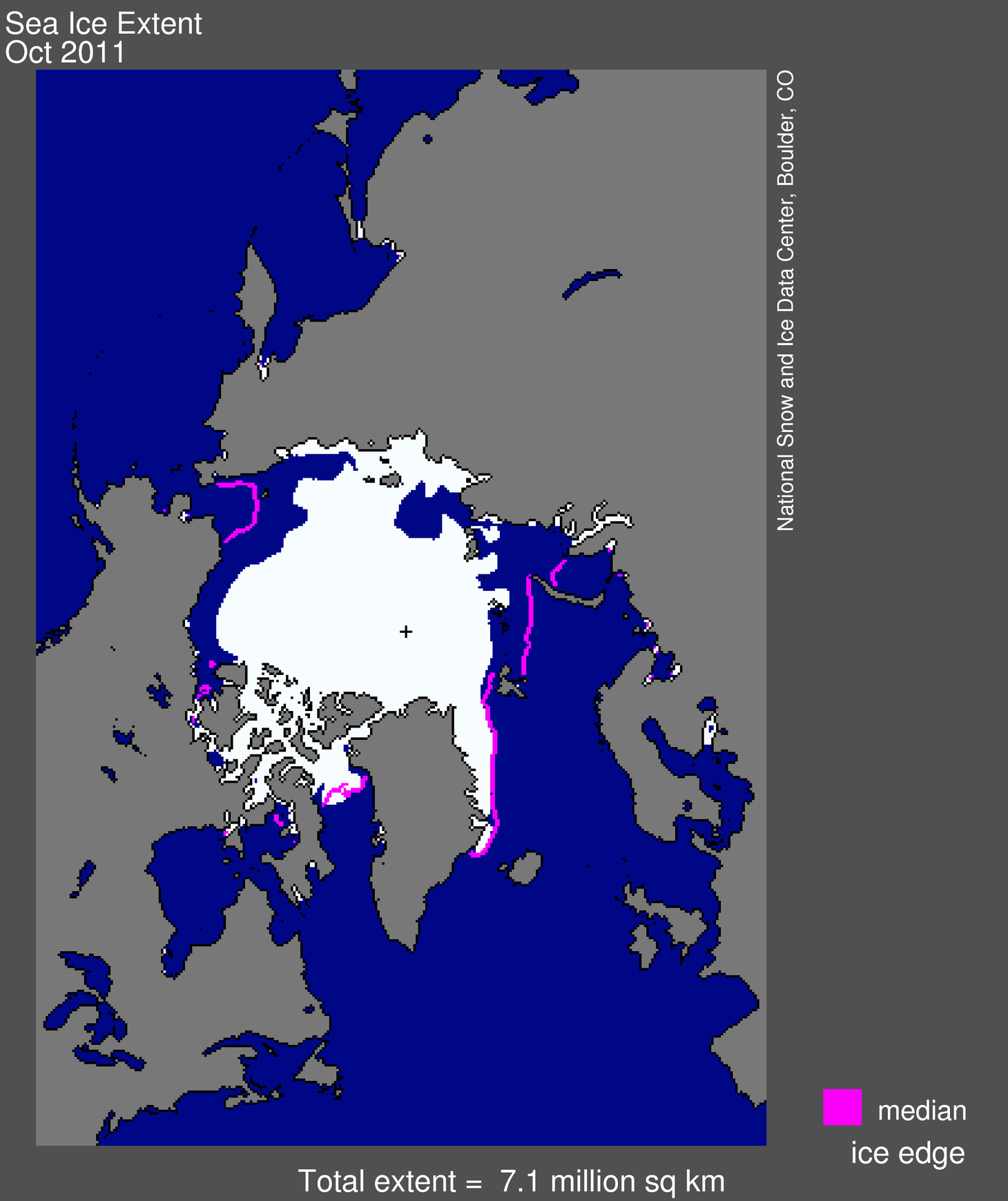
Figure 1. Arctic sea ice extent for October 2011 was 7.10 million square kilometers (2.74 million square miles). The magenta line shows the 1979 to 2000 median extent for that month. The black cross indicates the geographic North Pole. Sea Ice Index data.  —Credit: National Snow and Ice Data Center. High-resolution image

Overview of conditions

Average ice extent for October 2011 was 7.10 million square kilometers (2.74 million square miles), 2.19 million square kilometers (846,000 square miles) below the 1979 to 2000 average. This was 330,000 square kilometers (127,000 square miles) above the average for October 2007, the lowest extent in the satellite record for that month. By the end of October, ice extent remained below the 1979 to 2000 average in the Beaufort and Chukchi seas and in the Barents and Kara seas. Extent was near average in the East Greenland Sea. New ice growth has closed both the Northwest Passage and the Northern Sea Route.
graph with months on x axis and extent on y axis  
 
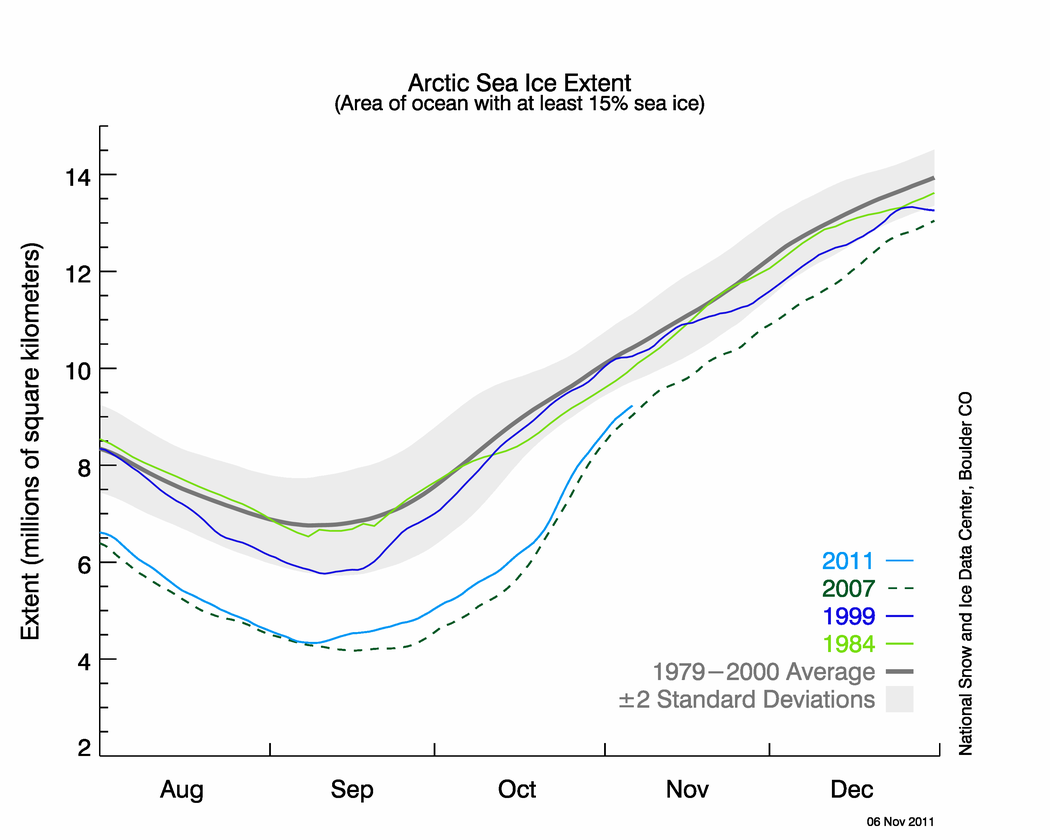
Figure 2. The graph above shows daily Arctic sea ice extent as of October 31, 2011, along with the lowest ice extents in the preceding decades, 1984 and 1999.  2011 is shown in light blue. 2007, the year with the record low minimum, is dashed green. Purple indicates 1999 and light green shows 1984. The gray area around the average line shows the two standard deviation range of the data. Sea Ice Index data. —Credit: National Snow and Ice Data Center . High-resolution image
 
Conditions in context
Arctic sea ice extent increased rapidly through October. Ice extent during October 2011 increased at an average rate of 114,900 square kilometers (44,360 square miles) per day, about 40% faster than the average growth rate for October 1979 to 2000. On October 30, Arctic sea ice extent was 8.41 million square kilometers (3.25 million square miles), 226,000 square kilometers (87,300 square miles) more than the ice extent on October 30, 2007, the lowest extent on that date in the satellite record.

During the month of October, the freeze-up that begins in September kicks into high gear. The rate of freeze-up depends on several factors including the atmospheric conditions and the amount of heat in the ocean that was accumulated during the summer. However, each decade, the October extent has started from a lower and lower point, with the record low extent during the 1980s (1984) substantially higher than the record low extent during the 1990s (1999), which in turn is substantially higher than the record low extent during the 2000s (2007).
graph with months on x axis and extent on y axis  
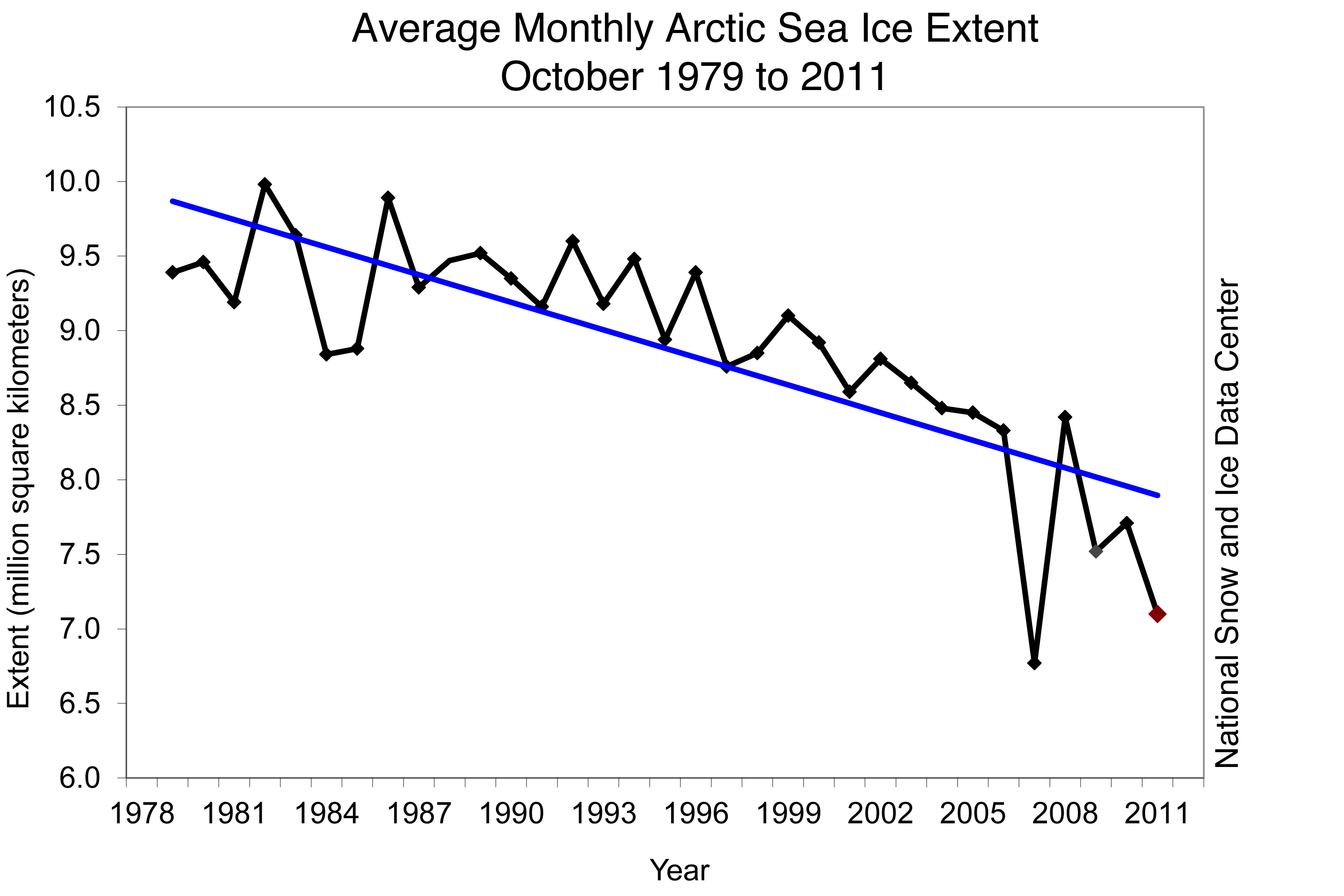
Figure 3. Monthly October ice extent for 1979 to 2011 shows a decline of 6.6% per decade. —Credit: National Snow and Ice Data Center . High-resolution image
 
October 2011 compared to past years
Ice extent for October 2011 was the second lowest in the satellite record for the month, behind 2007. The linear rate of decline for October over the satellite record is now -61,700 square kilometers (-23,800 square miles) per year, or -6.6% per decade relative to the 1979 to 2000 average.
graph with months on x axis and extent on y axis 
 
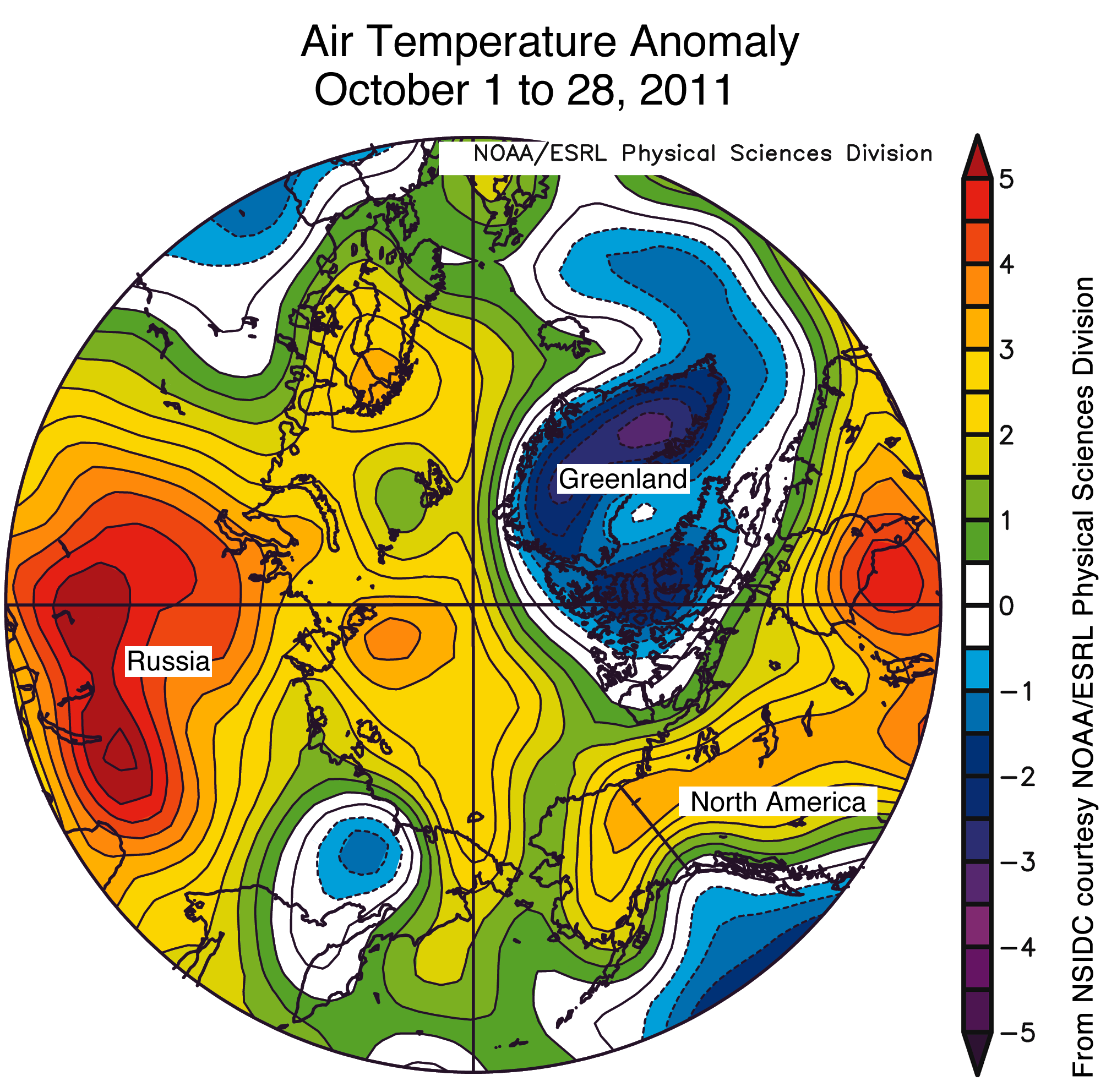
Figure 4. This map of air temperature anomalies at the 925 hPa level (approximately 3,000 feet) for October 2011 shows unusually high temperatures over most of the Arctic Ocean (yellow shading) and unusually low temperatures over the eastern Canadian Arctic Archipelago and Greenland (blue shading). —Credit: National Snow and Ice Data Center . High-resolution image
 
Atmospheric conditions
In recent years, low sea ice extent in the summer has been linked to unusually warm temperatures at the surface of the Arctic Ocean in the fall. This pattern appeared yet again this fall.

Air temperatures over most of the Arctic Ocean for October 2011 ranged from 1 to 4 degrees Celsius (1.8 to 7.2 degrees Fahrenheit) above average, measured at the 925 millibar level, about 1,000 meters or 3,000 feet above the surface. However, over the eastern Canadian Arctic and Greenland, temperatures were as much as 3 degrees Celsius (5.4 degrees Fahrenheit) below average.

These temperature anomalies in part reflect a pattern of above-average sea level pressure centered over the northern Beaufort Sea, and lower than average sea level pressure extending across northern Eurasia. This pattern is linked to persistence of the positive phase of the Arctic Oscillation through most of the month. These pressure and temperature anomalies tend to bring in heat from the south, warming the Eurasian coast, but they also lead to cold northerly winds over the eastern Canadian Arctic Archipelago. However, along the Siberian coast and in the Beaufort and Chukchi seas, warmer temperatures came primarily from the remaining areas of open water in the region, as heat escaped from the water. These effects are more strongly apparent in the surface air temperatures: average October temperatures in the region were 5 to 8 degrees Celsius (9.0 to 14.4 degrees Fahrenheit) above average.
graph with months on x axis and extent on y axis  
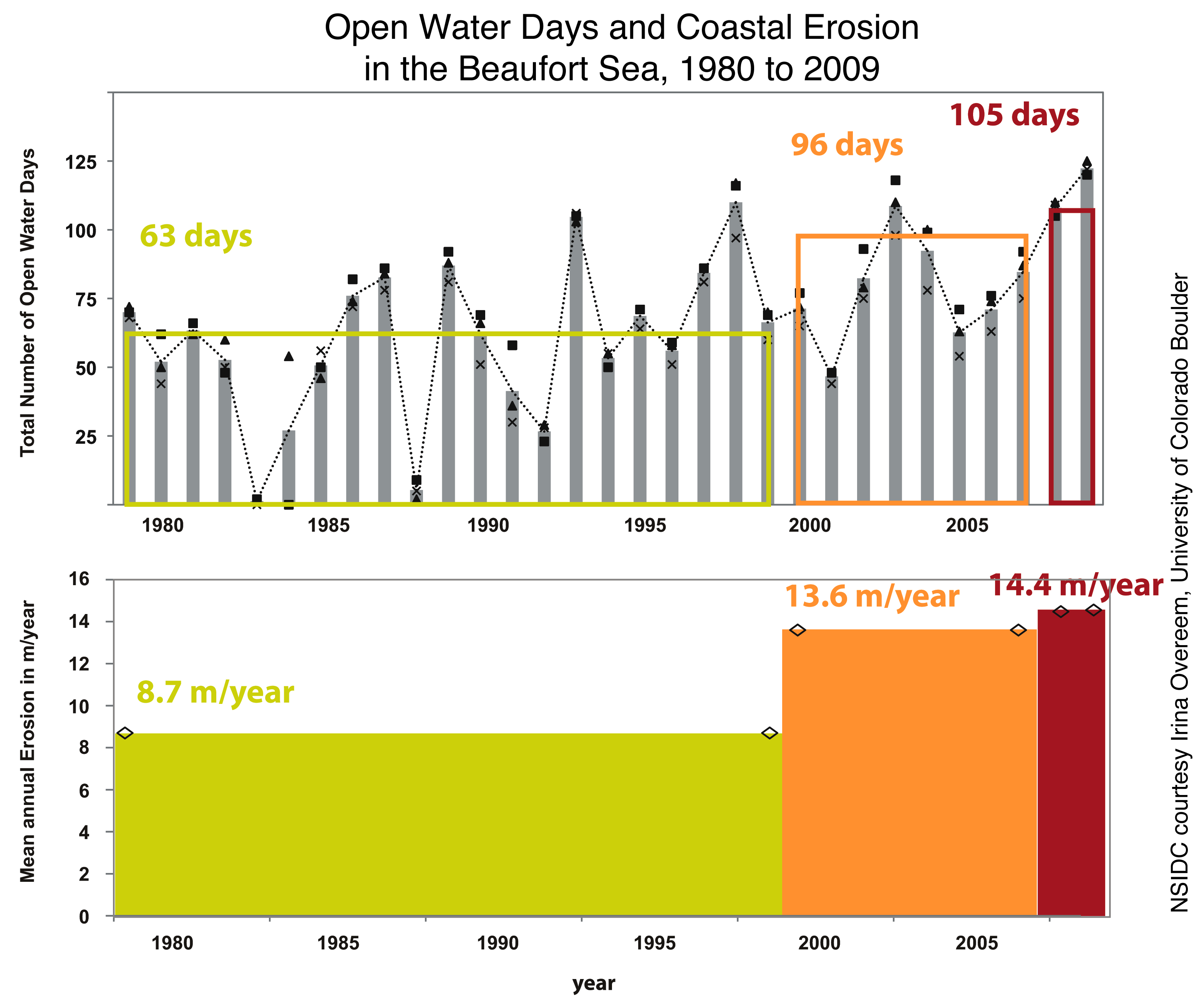
Figure 5. The top panel of this figure shows the number of open water days for the approximate 75 kilometer (46.6 mi) coastal zone along the Beaufort Sea (data for each year and linear trend). The bottom panel shows the average annual coastal erosion rate for three periods, 1979-1999, 2000-2007 and 2008-2009. —Credit: NSIDC courtesy Irina Overeem, CU Boulder. High-resolution image
 
Sea ice loss and coastal erosion
Declining sea ice in the Arctic has led to increasing erosion rates along the coast of the Beaufort Sea over the past fifty years, according to a new study led by Irina Overeem of the University of Colorado Institute for Arctic and Alpine Research (INSTAAR). Their study used a wave model driven by sea ice position and wind data.

As the period of open water on the coast of the Beaufort Sea has increased, so has the mean annual erosion rate, the study showed. From 1979 to 1999, the average erosion rate was 8.5 meters (27.9 feet) per year. The average rate over the period 2000 to 2007 was 13.6 meters (44.6 feet) per year, while the rate for the last two years of the record, 2008 to 2009, was 14.4 meters (47.2 feet) per year.

With a longer open water season, ocean water warms more and waves eat away at the coastline. The sediments comprising the coastal bluffs are locked together by permafrost—hard frozen ground with a concrete-like consistency. As the waves lap at the permafrost, they also help to thaw it, making the ground much more vulnerable to erosion.

Further Reading
Overeem, I., R.S. Anderson, C.W. Wobus, G.D. Clow, F.E. Urban, and N. Matell. 2011: Sea ice loss enhances wave action at the Arctic coast. Geophysical Research Letters, 38, L17503, doi:10.1029/2011GL048681.
Serreze, M.C., and R.G. Barry. 2011: Processes and impacts of Arctic Amplification: A research synthesis. Global and Planetary Change, 77,85-96. 

http://nsidc.org/arcticseaicenews/

Brad Johnson: Fact Check: Keystone XL Tar Sands Pipeline Isn’t A Job Creator

Fact Check: Keystone XL Tar Sands Pipeline Isn’t A Job Creator

by Brad Johnson, Think Progress Green, November 4, 2011

Proponents of the dangerous Keystone XL project claim that construction of the 1700-mile tar sands pipeline from Canada to Texas will create tens of thousands, if not hundreds of thousands, of much-needed jobs across the country. “Jobs for the 99%!” proclaims a website funded by the American Petroleum Institute (API). The Wall Street Journal promises “13,000 union jobs.” On the House floor today, Rep. Alan Nunnelee (R-MS) claimed the pipeline will create “20,000 high-wage construction jobs.” Rep. John Shimkus (R-IL) says the pipeline will “create 14,600 jobs in Illinois.” The U.S. Chamber of Commerce claims the project will create “more than 250,000 permanent jobs.”  “U.S. jobs supported by Canadian oil sands development could grow from 21,000 jobs today to 465,000 jobs by 2035,” said API Executive Vice President Marty Durbin.

Accepting these figures, reporters like CNN’s Steve Hargreaves, NPR’s Ari Shapiro, and the New York Times’ Kirk Johnson have portrayed the battle over the tar sands pipeline as one of economic benefits versus environmental fears.

However, these tremendous-seeming jobs claims are based entirely on a report by the Perryman Group, commissioned by the pipeline’s owner, TransCanada, whose results have been described as “dead wrong” and “meaningless” by Council on Foreign Relations fellow, Michael Levi, and environmental economist, Andrew Leach, neither of whom opposes the construction of the pipeline.

The only independent analysis conducted of the American job-creation potential of the Keystone XL pipeline finds that between 500 and 1,400 temporary construction jobs will be created, with a negative long-term economic impact as gas prices rise in the Midwest and environmental costs are borne:
Why this tremendous discrepancy? Examining TransCanada’s business operations, the Cornell Global Labor Institute report finds that TransCanada has already purchased most of the steel it intends to use for the pipeline from India; that most of the work will be conducted by people already employed by TransCanada; and that the Perryman Group included already-completed pipeline projects in its job-creation estimates.

“The operating costs for KXL are very minimal,” the Cornell Global Labor Institute report explains, “and based on the figures provided by TransCanada for the Canadian section of the pipeline, the new permanent US pipeline jobs in the US number as few as 50.”

Unlike the Perryman Group’s “opaque” methodology,” the Cornell report explains its calculations with full transparency.

http://thinkprogress.org/green/2011/11/04/362056/fact-check-keystone-xl-tar-sands-pipeline-isnt-a-job-creator/

Occupy the Koch Brothers and Stop the American Nightmare

Occupy the Koch Brothers and Stop the American Nightmare

by Nation of  Change, November 3, 2011

The very name of a Washington conservative conference this weekend is the height of subterfuge. It's called the "Defending the American Dream" conference, which is not about defending the actual American dreams of most Americans (the focus of our own "Take Back the American Dream" conference), sponsored by Americans for Prosperity, which is not an organization that promotes what is needed for broad American prosperity.
Article image
B
This actually is the latest effort by the billionaire Koch brothers, founders and key funders of Americans for Prosperity, and their corporate and political allies to hijack our democracy and pillage our economy. It's their attempt to perpetuate an American nightmare of continued income inequality and a government held hostage to the whims of elites. It is thus a perfect target for the latest Occupy-style protest.

The Other 98% and Health Care for America Now are sponsoring a "Koch Brothers Guerrilla Drive-In" Friday evening at the Washington Convention Center, where the conference is being held. The plan is to have an outdoor showing of a documentary on how the Kochs are using their fortune to pursue their grotesque mangling of American democracy.

The conference itself brings together many of the players in and elements of their grand scheme. For example, there is James O'Keefe, the person who dressed up as a pimp in a scheme to get damaging video footage for his scurrilous slander of the group ACORN, doing a lecture on "investigative journalism." There's Grover Norquist on a panel on "pro-growth tax reform." (He's lately been championing Texas Gov. Rick Perry's "flat tax" plan, which would allow the wealthy to slash their tax payments and would explode the federal deficit, forcing Norquist's longtime shrink-government-and-drown-it-in-the-bathtub objective.) There's Kansas Republican Rep. Mike Pompeo, a member of the House Energy and Commerce Committee, on a panel on the Environmental Protection Agency's "job-crushing regulatory assault"; he will be speaking on behalf of the Koch brothers, his leading campaign contributor, and the oil and gas industry, his biggest source of campaign cash. At least two Republican presidential candidates, Mitt Romney and Herman Cain, are also scheduled to appear.

No conservative conference is complete without the deification of Ronald Reagan, and there will be plenty of that going on at the Friday night "Tribute to Ronald Reagan" dinner, which will be followed by a screening of "Atlas Shrugged." (No, I am not making this up.)

What makes this conference significant is not the tired repetition of right-wing bumper-sticker slogans, the over-the-top characterizations of Obama administration policy or the pathetic preening of presidential candidates to show off how extreme they can be. It is the very real damage that the Koch brothers and the forces that this conference is assembling are doing to our economy and to the 99% of us for whom the American dream of economic security is becoming increasingly out of reach.

Consider what the Koch brothers have actually been "defending":
  • Their $45 million effort to buy control of Congress. That's the amount of money Forbes magazine says Americans for Prosperity spent in the 2010 elections. That money helped Republicans control the House with the most extreme group of conservatives elected in modern history. With this group firmly in control, every effort by the Obama administration to move legislation to revive the economy has been thwarted and previous successes in health care and financial reform have come under unrelenting attack. The stream of anti-regulation, anti-labor legislation passed by the Tea Party-besotted House is pretty much lifted straight from the Koch brothers legislative agenda.
  • The destructive efforts of the American Legislative Exchange Council to co-opt state and local governments. Rather than promoting state and local governments as entities that are particularly equipped to respond to the public interest because of their proximity to the people, ALEC mounts campaigns that leave state and local governments facilitating private greed rather than serving the public good. In August The Nation's Lisa Graves explained that "of all the Kochs’ investments in right-wing organizations, ALEC provides some of the best returns: it gives the Kochs a way to make their brand of free-market fundamentalism legally binding." Examples include legislation that allows energy companies to avoid fines for polluting, that push privatization of public education, and that prevent states and localities from regulating the rogue behavior of financial institutions.
  • ALEC's efforts to suppress voter turnout. The Koch brothers' fingerprints are all over the efforts by various Republican governors and legislatures to pass voter ID laws that use trumped-up allegations of voter fraud to deliberately disenfranchise voters most likely to oppose their agenda. "It was ALEC’s draft legislation that inspired a spate of recently passed voter ID laws that, if allowed to stand, are expected to marginalize the impact of students and people of color at the polls in Texas, South Carolina, Wisconsin, Tennessee and Kansas," Adele Stan reported for the AFL-CIO blog. Patrick Caldwell at the American Prospect wrote that "the rules are often configured specifically to favor the Republican base at the expense of excluding likely Democrats."
  • Their assault on public workers. Scott Walker won the governorship of Wisconsin and the ability to execute his attack on public workers there with the help of $43,000 in direct contributions from the Koch Industries political action committee and indirectly through the $1 million that Koch's PAC gave to the Republican Governors Association. The Kochs are also major supporters of Ohio Gov. John Kasich, who earlier this year credited "the strong support" of Americans for Prosperity for his now faltering attempt to strip Ohio state workers of their bargaining rights.
  • The dominance of extremist candidates in the 2012 presidential race. Koch bothers money can be found in the pockets of at least three of the most extreme Republican presidential candidates: Minnesota congresswoman Michele Bachmann, Texas Gov. Rick Perry and, especially, Herman Cain. Rachel Maddow reported that the Cain connections include a campaign manager from the Wisconsin chapter of Americans for Prosperity, a now ex-spokesperson from another Americans for Prosperity affiliate, and the economic advisor who came up with Cain's infamous "9-9-9" tax plan, who was a member of Americans for Prosperity's advisory board. This is no surprise, because, as the Associated Press has reported, Cain has historically been a shill for the Americans for Prosperity legislative agenda. The Kochs have said they will pour at least $200,000 into the 2012 presidential campaign. "At least" is the operative phrase; expect the Kochs to funnel millions of dollars into the 2012 campaign through a variety of channels, most of which—thanks in part to the Supreme Court's Citizens United ruling—will be unrestricted and largely untraceable.
  • Their ability to violate the law with impunity, and to punish those who hold them accountable. A Bloomberg Markets magazine investigation published in October calls it "the Koch method," in which employees of the brothers' oil and gas companies "were shown by their managers how to steal and cheat." The stealing and cheating, according to Bloomberg, ranged from not paying royalties for oil extracted from federal land to bribing foreign officials to win contracts—and firing the company compliance officer who discovered the bribes and called them to the attention of top corporate officials. "For six decades around the world, Koch Industries has blazed a path to riches -- in part, by making illicit payments to win contracts, trading with a terrorist state, fixing prices, neglecting safety and ignoring environmental regulations. At the same time, Charles and David Koch have promoted a form of government that interferes less with company actions," the magazine wrote.
Unregulated, unaccountable corporations. Extremist elected officials who disdain the concept of a government serving the common good. Workers stripped of the ability to negotiate collectively for fair pay, working conditions and benefits. Hundreds of millions of corporate dollars drowning out the voices of working-class and middle-class people. Voters forced to jump over ever-higher obstacles to vote for candidates who represent them, assuming those candidates can even get on ballots. This is the Koch brothers' dystopia. What they are defending is indefensible.

For at least a few hours on Friday evening, the Washington Convention Center should be the focus of Occupy movement and its allies, for the Koch brothers embody just about everything the Occupy movement is against—members of the 1 percent who act as if our economy and our democracy should be their personal servant, and that the 99 percent should feel satisfied with the crumbs off their table.

It is time for us to declare that we are the real Americans for prosperity, those of us who believe that workers should receive a fair wage for a fair day's work and be treated with dignity; that companies should be accountable for the harm that they do to people and the environment; that health care is a basic right for every person; that the education of our children shouldn't be turned into yet another corporate profit center; that government can and should work for all of the people, not the privileged few; that our democracy is the property of the people and cannot be owned by those with the most money.

We cannot allow the Koch brothers' so-called "American dream" to continue to be our national nightmare.

Attorney Christopher Horner with group [American Tradition Institute] targeting climate scientists' emails featured at Koch-funded conference, "Defending the American Dream Summit" sponsored by the Americans for Prosperity Foundation, the nonprofit sister group of Americans for Prosperity, founded by the Koch brothers

Attorney with group targeting climate scientists' emails featured at Koch-funded conference

The American Tradition Institute -- a global-warming denier group that's using the Freedom of Information Act in controversial ways to discredit climate scientists -- suffered a legal loss this week when a judge allowed one of the scientists to intervene in a lawsuit against the University of Virginia.

But ATI's director of litigation is not letting that setback slow his crusade against environmental regulation.

Christopher Horner is one of the featured speakers at this weekend's Defending the American Dream Summit sponsored by the Americans for Prosperity Foundation, the nonprofit sister group of Americans for Prosperity, a corporate-interest advocacy group. AFP was founded and is heavily funded by the Koch brothers, the billionaire owners of the Koch Industries oil and chemical conglomerate.

Horner is also a fellow at the Competitive Enterprise Institute, a free-market advocacy group that has been one of the main organizers in the effort to block regulation of greenhouse gas emissions. CEI has received generous funding from ExxonMobil, Texaco and the Koch Family Foundations.

Horner is scheduled to speak at 3:15 p.m. today on a panel titled "Extreme Power Abuse: The EPA's Job-Crushing Regulatory Assault." He will be joined on the panel by U.S. Rep. Mike Pompeo (R-Kan.), who has close ties to Koch Industries, which is located in his district. Pompeo's chief of staff is a former lawyer for the company, and Pompeo has proposed legislation that would benefit many of Koch's business interests, according to the Washington Post. A political science professor at the University of Kansas has characterized Pompeo as "the congressman from Koch."

Also speaking on today's panel with Horner are Kathleen Hartnett White of the Texas Public Policy Foundation, a conservative think tank that is funded by the Koch Family Foundations, and Ann McElhinney, maker of the film "Not Evil, Just Wrong: The True Cost of Global Warming Hysteria."

Another featured speaker at the conference is Virginia Attorney General Ken Cuccinelli (R), who's also involved in an ongoing legal action against U.Va. seeking the emails of former professor Michael Mann, one of the scientists targeted by ATI who this week was allowed to intervene in the group's FOIA suit against the school. However, Cuccinelli is not speaking about that action or his effort to challenge the Environmental Protection Agency's finding that greenhouse gas pollution endangers human health. Instead, he is speaking about his effort to challenge President Obama's health care reform law on a panel titled "Critical Care: Your Health Care After the Takeover."

The summit kicked off last evening with screenings of the documentary films "The Cartel," which attacks teachers' unions and supports vouchers, and "Free or Equal," an update of the 1980 film "Free to Choose" that featured free-market economist Milton Friedman. The gathering continues tomorrow with a "Cut Spending Now" rally and sessions on tax policy, grassroots mobilization, promoting school choice, killing collective bargaining, and how to "pimp" (their word) one's website.

http://www.southernstudies.org/2011/11/attorney-with-group-targeting-climate-scientists-emails-featured-at-koch-funded-conference.h

Wednesday, November 2, 2011

Climate change scientist Michael Mann fends off sceptic group's raid on emails: Judge revokes permission of scektic think tank American Tradition Institute to look at private University of Virginia emails

Climate change scientist Michael Mann fends off sceptic group's raid on emails:

Judge revokes permission of scektic think tank American Tradition Institute to look at private University of Virginia emails


American climatologist Michael Mann
American climatologist Michael Mann. He is one of the originators of a graph of temperature trends dubbed the 'hockey stick'. Illustration: Jon Golden/Pennstate
The climate scientist Michael Mann has successfully fought off an attempt by a pro-industry thinktank to gain access to thousands of private emails.
After a day-long court hearing on Tuesday, a judge in Manassas, Virginia, granted Mann's petition to join a lawsuit against the American Tradition Institute, an industry-funded thinktank that promotes scepticism about man-made climate change.
In an email, Mann called the decision a "good day" for academic freedom: "I don't think there is any way to view this as anything other than a win for us, and for science more generally."
Judge Gaylord Finch also granted a petition from the University of Virginia, Mann's former employer, to revisit its earlier decision to let lawyers for the ATI have access to the emails before they were made public.
Scientists had seen the demands for documents and private correspondence as an attempt to intimidate Mann and other climate scientists. Virginia's attorney general, Ken Cuccinelli, has also pursued the emails.
ATI is pursuing similar legal action against the NASA scientist James Hansen, according to an investigation of the industry group.
The university has already released thousands of Mann's emails but said some correspondence was exempt from ATI's freedom of information requests.
Its initial decision to allow ATI's lawyers to review the emails while it determined which would be withheld had been criticised by scientists.
Mann, who is now at Pennsylvania State University, has been regularly targeted by climate science doubters because of his work on the "hockey stick graph."
His research, demonstrating a recent sharp rise in warming, is one of the most easily understood representations of climate change – and has infuriated those opposing action on global warming.
Mann has been repeatedly cleared of any scientific misconduct. But Cuccinelli, and more recently the ATI, launched their own investigations, alleging Mann may have manipulated data to help get government research grants. Cuccinelli lost his case, but it is under appeal.
The University of Virginia initially agreed to allow lawyers for ATI to review the emails. But on Tuesday its lawyers said they no longer trusted ATI to keep the contents confidential before their release.
With Tuesday's ruling, Mann for the first time has a say in the university's decisions about which emails should be released.
Rick Piltz, the director of Climate Science Watch, said Mann's lawyers could also be expected to fight more strenuously for his privacy than his former employer.
Mann's legal battles do not end with Tuesday's decision. The judge ordered the scientist and the university to come to an agreement with ATI on email access by 20 December 2011 or else he would impose one.
"I have no illusions that ATI and their industry-funded ilk are going to give up in their efforts to harass me and other climate scientists," Mann wrote. "But this is a very good day for me, for my fellow scientists across the country who might fear that they could be subject to similar intimidation tactics if their work too were perceived as a threat to powerful vested interests, and it's a good day for the publicm, which, after all, depend on the unfettered progress of science for the betterment of modern life."

American climate refugees: A Town in Texas: This is How it Ends [for Robert Lee, TX]

A Town in Texas: This is How it Ends


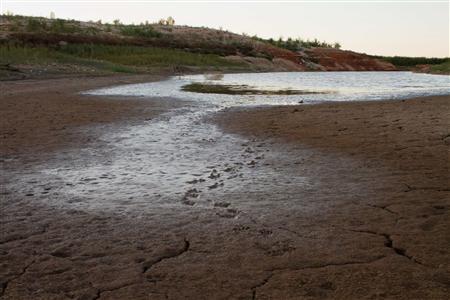
Once a thriving recreational lake and source of water for the town of Robert Lee, Texas, the E.V. Spence Reservoir is now a brackish puddle.
The Daily Impact, November 1, 2011
They are starting to think seriously about abandoning the west Texas town of Robert Lee because it is about to run completely out of water. Too strong? Okay, some of Robert Lee’s 1,049 people are thinking about leaving before the water runs out. Will that create a trend that gives us our first American town to be abandoned because of climate change? (I’m still betting on Las Vegas as the first city.) Will America’s first recognized climate refugees be Rick Perry’s Texans? We’ll report. You decide.
A half-century ago, Robert Lee did what most municipalities in the West did to make sure they would have a permanent water supply: they dammed the Colorado River and made a private lake. (That’s what Vegas did, with a dam called Hoover.) Robert Lee’s lake was the E.V. Spence Reservoir, which gave the town not only water but a tourist industry: marinas and boatyards and lake houses and all the ancillary businesses and revenue flows that derive from people playing on water. In a desert.
Too strong? Robert Lee’s annual rainfall average is 12 inches, which is 2 inches a year above the commonly used standard of 10 inches for a true desert. Twelve inches puts it in the loose category (10-30 inches per year) of semi-arid steppe. In the past year it has received 6 inches of rain. It’s a desert now.
And the E.V. Spence Reservoir, that once covered 22 square miles, more than 20 times the area of the town it nourished, is now more than 99% gone. It’s a fetid pond, now being overrun, in a cinematic post-apocalyptic touch, by herds of feral hogs. The town’s public water is a brown, smelly brine. The marina’s docks loom over bone-dry, crusted ground and the luxurious lake houses overlook, well, desert. And here’s another post-apocalyptic scene: the last green grass in town — which has for two years prohibited lawn-watering — is on the golf course, which uses reclaimed waste water to maintain the emerald green.
But wait! The town has a plan! To build an emergency water pipeline to…wait for it…another town 12 miles way, that has some wells. Two questions:
  1. Why would that town, which is also located in a desert, in a state suffering its worst drought in recorded history, with no end in sight, pipe a bunch of its last water to Robert Lee? And
  2. Why on earth would Rick Perry’s Texas, home of the mythical Texas Miracle where people create jobs without government help of any kind and never pay taxes, and where there is no such thing as climate change, cough up the $9 million that Robert Lee needs for its pipeline? (And that the Obama campaign may need as an example of how things really work in Texas.)
Remember the famous question in Jared Diamond’s Collapse: What was on the mind of the man who cut down the last tree on Easter Island (completing the reduction of a one-lush landscape to basically a bare rock)? Well, we can be pretty sure that the two questions above will be on the minds of the person who turns out the last light and leaves Robert Lee, Texas.
Not, one hopes, to go live in Las Vegas.

Chris Mooney: Score Another Victory for Scientists, Michael Mann, and the Freedom of Inquiry

Score Another Victory for Scientists, Michael Mann, and the Freedom of Inquiry


by Chris Mooney, DeSmogBlog, November 2, 2011
Yesterday in a Virginia courtroom, Michael Mann—who is quickly becoming the Galileo of climate science—triumphed over the conservative American Tradition Institute, and ongoing attempts at scientist-harassment.
More specifically, Prince William County Circuit Court Judge Gaylord Finch both allowed Mann to join the case that ATI is pursuing against the University of Virginia to get Mann’s emails, and allowed UVA to back out of an agreement with ATI to let it review some of Mann’s emails that the university is nevertheless claiming are exempt from disclosure.
This is a bit technical, as is often the case in ongoing court proceedings, but let’s remember why it matters.
The ATI lawsuit is a follow-on to Virginia attorney general Ken Cuccinelli’s outrageous harassment of Mann. And protecting Mann’s emails from disclosure is critical for ensuring that ideological fishing expeditions that attack and harass scientists aren’t permitted. The contrary result, as many scientific groups have asserted, could have a chilling effect on academic research and freedom of inquiry in controversial areas.
Mann has been greatly supported by the Union of Concerned Scientists, the American Geophysical Union, and other organizations, and by grassroots fundraising efforts to support his legal expenses. To contribute see here.
Let us also add that there is no reason to think Mann has done anything wrong, scientifically or otherwise, or that his emails will reveal some malfeasance. To the contrary, Mann and other scientists involved in the pseudo-scandal of “ClimateGate” have been repeatedly vindicated by independent investigations.
Meanwhile, the connections between ATI and various other conservative and industry groups and funders have now been extensively documented.
I called Mann the “Galileo of climate science,” and increasingly, I think this is not mere hyperbole.
I’ve been following climate science, and political attacks on it, for nearly a decade. Throughout that period, conservatives have been relentlessly attacking Mann because of the hockey stick graph. And starting in 2005, there have been attempts—first in Congress, then using the legal process—to wrest information from Mann, information whose disclosure would simply allow conservative motivated reasoners to come up with new reasons to criticize and attack him.
This is a beast that, at all costs, must not be fed.
At the same time, all of this has surely exacted a serious toll on Mann himself in the form of personal stresses and, perhaps, legal expenses.
Mann has risen to the occasion, however, and fought back admirably and courageously. 
In the process, he has become a hero and a role model for standing up against the forces of ideology and unreason.
And in turn, as this long and completely unnecessary legal process continues, we must continue to give him our full and absolutely unwavering support.
[Readers, please help by contributing to the Climate Science legal defense fund -- it is amazing what tiny amounts of money can do against the 100s of millions spent by the fossil fuel companies, just amazing!!! Click on the logo on upper left column.  Soon, Scott Mandia will have it all set up so that tax-free donations can be made, but seriously, small amounts all add up and will help.  Many people are working for free, of course, but sometimes money is needed for court costs and the like.]

Scott Mandia: Mike Mann’s Thank You Letter to Supporters

Mike Mann’s Thank You Letter to Supporters

by Scott Mandia, "Global Warming -- Man or Myth?" blog, November 2, 2011
Some very good news regarding Mike Mann’s legal case:
Mike Mann spoke with John Abraham yesterday and stated:
“ATI could not convince the court that he (Mike Mann) did not have legal standing. The court has allowed him legal standing so he can be a party in the settlement.
Second, the court allowed that there was reason for UVA to reopen the protective order before the court. The original protective order would have allowed ATI to review the emails themselves. That court order is now invalid. ATI will not see the exempt emails.
The only matter to be resolved is the process by which ATI can challenge the exempt emails. Now, a neutral party will be able to see the emails, not ATI. The neutral party must be agreed upon by all parties in the good.
The broader message is that this is a major victory and a huge setback for ATI. ATI might appeal this to the Supreme Court…“
Mike could not have achieved this victory without the generous support of those that have contributed to his legal defense.  Mike sent me the letter below thanking his supporters.
There is still a long road ahead so please keep the contributions coming.  Click the Climate Science Legal Defense Fund Logo on the upper-right of this blog to contribute. [Or click on the upper left of this blog -- I did!]
The Climate Science Legal Defense Fund is nearing the point where tax-deductible funds will be accepted through a unique web site (hopefully before the end of the year).  In the short-term there is an immediate need to help Mike with his case so please continue to use the Pay Pal button posted here or personal checks sent via postal mail.
My previous posts regarding this case:
Others reporting on this case:

Tuesday, November 1, 2011

Climate scientist Michael Mann wins his day in court:Prince William County Circuit Court Judge Gaylord Finch had granted his petition to join his former employer, the University of Virginia, in fighting a lawsuit seeking access to thousands of emails Mann sent as a professor there between 1999 and 2005

Nature, newsblog, November 1, 2011

Climate scientist wins his day in court

by Jeff Tollefson on November 1, 2011

mann.manassas.JPGPennsylvania State University climatologist Michael Mann stepped out of a courthouse in Manassas, Virginia, on Tuesday with a smile on his face. After a surprisingly contentious hearing that lasted most of the day, Prince William County Circuit Court Judge Gaylord Finch had granted his petition to join his former employer, the University of Virginia, in fighting a lawsuit seeking access to thousands of emails Mann sent as a professor there between 1999 and 2005.
"This is great news," Mann said. "I have no complaints about the way things turned out today."
The conservative American Tradition Institute filed the lawsuit in May, seeking to follow up on a similar investigation launched last year by Republican Attorney General Ken Cuccinelli. The latter case is currently pending before the Virginia Supreme Court. Both initiatives have their roots in the scandal over emails leaked from the University of East Anglia in 2009, which fueled skepticism about global warming despite various reviews that have cleared Mann and other scientists of misconduct allegations.
At Tuesday's hearing, attorneys representing Mann and UVA went on the offensive. Mann's attorney, Peter Fontaine of the firm Cozen O'Connor, called ATI an extreme right-wing group bent on attacking climate scientists and preventing any kind of action on global warming. After documenting links to various conservative organizations, Fontaine said ATI is part of a "shadowy political network that is largely funded by petroleum companies."
Attorney David Schnare, director of ATI's Environmental Law Center, called the accusations baseless. "It doesn't matter who we represent," he said, "because we are citizens of Virginia."
The question before the court is which emails are subject to the state's freedom-of-information law. UVA has already released many of the more innocuous emails, but the university says most of the correspondence falls under an exemption for academic research. ATI disagrees. 
---
Back in May UVA signed an agreement that would allow ATI to review even the exempt correspondence as the court prepares to take up the matter. Various scientific groups objected, however, and on Tuesday UVA attorneys requested that the court nullify that agreement and start over.
In explaining why the university was seeking to back out of its agreement, UVA attorney Richard Kast said he no longer trusts ATI to keep the emails confidential as would be required if Schnare and fellow attorney Chris Horner were allowed to review them prior to public disclosure. Kast alleged that Schnare mislead university officials about his position representing ATI, about his former employment with the US Environmental Protection Agency and about whether he had permission from the EPA to work as an attorney on such a case.
Schnare again dismissed the accusations and said he never transgressed EPA rules, even if the detailed paperwork might not have been in order. He went on to argue that as it stands only UVA officials and Mann have seen the emails, which puts ATI at an inherent disadvantage in the case. "We're the ones who are at risk to be rolled here," Schnare said.
Judge Finch listened to all of this and then granted UVA's request to revisit the earlier agreement, citing obvious distrust among the parties. He gave the parties until 20 December 2011 to reach a new accord on how to go about reviewing the emails; if they fail to do so, Finch said, the court may take over. And this is just the first step in what is likely to be a long legal battle. Regardless of how the judge rules, both sides said an appeal is likely.
Initially worried when UVA granted ATI access to his emails, Mann says he is pleased that he and the university are now on the same legal page. But he nonetheless wants to maintain his own representation going forward -- along with some funding from a new organization called the Climate Science Legal Defense Fund. "Universities are often quite limited in what they can do when academics are under attack," Mann says. "These skeptic groups are trying to exploit that."