Blog Archive

Tuesday, November 1, 2011

"Climate Scientist [Michael Mann] Wins a Round for America" by Shawn Lawrence Otto, Huffington Post. Virginia judge rules in favor of Michael Mann and against the "American Traditions Institute" known fossil-fuel funded faux think tank

Climate Scientist Wins a Round for America


by Shawn Lawrence Otto, Huffington Post, November 1, 2011


A hearing today has implications for academic freedom across the country. A Virginia judge granted climate scientist Michael Mann the right to intervene on his own behalf in a lawsuit filed by a climate change denial group seeking to get his private papers and emails from the University of Virginia. While this is an important victory for American-style freedom and privacy, its background is a story of just the opposite - attempts at authoritarian repression of science for political purposes.
In 2010 newly-elected Virginia Attorney General Ken Cuccinelli, a climate-change denier, sued the University of Virginia to get Mann's private papers. Cuccinelli wanted to sift through them in the wake of "climategate" to see if he could find anything he could spin into a case under the state's Fraud Against Taxpayers Act, arguing that while an employee of UVA, Mann's work on climate change may have used public money to perpetrate a fraud.
Mann has become a political taget because he helped create the "hockey stick" graph, which shows global temperatures stable for a thousands of year and spiking since about 1950. It has the iconic power of e=mc2, and discrediting him has become the holy grail of climate-change deniers.
hockey stick graph
This is why Mann was at the center of the climategate attacks in late in 2009. Climate deniers illegally hacked into scientists' emails and claimed they showed scientists, including Mann, manipulating data. Their charges were investigated by four separate bodies, each one reaffirming the soundness of the science, and exonerating the scientists. In other words, climategate was over -- nothing, it turned out. Instead of data, it was the press that had been manipulated.
Rightly, the University of Virginia, which was founded by scientist Thomas Jefferson, rejected Cuccinelli's McCarthyite attack. Cuccinelli sued and lost. The case in under appeal.
But it didn't end there. Next, a little-known group named Western Tradition Partnership (WTP) got into the act. WTP is a political advocacy group backed primarily by the energy industry. It was first registered as a Colorado nonprofit in 2008 by Scott Shires, a Republican operative who pleaded guilty that same year to fraudulently obtaining federal grants to develop alternative fuels.
In 2010, WTP changed its name to American Tradition Partnership (ATP) and announced that it had launched the American Tradition Institute, a think tank that would be "battling radical environmentalist junk science head on."  The "junk science" ATP seems most concerned with is what the US National Academy of Sciences says should now be regarded as "settled facts" -- that the Earth is warming and humans are the likely cause.
Last year WTP/ATP fought for a Colorado referendum allowing voters to opt out of the state's renewable energy standard. The standard requires 30% of electricity produced by investor-owned utilities to come from renewables by 2030. The referendum's backers missed the filing deadline, but ATI sued Colorado over the standard, and is now targeting similar standards inDelawareMinnesotaMontanaNew Mexico and Ohio.

WTP/ATP also fights laws that restrict corporate money in elections or require disclosure of contributions. In 2009, the group sued Longmont, CO, over their Fair Campaign Practices Act. The city settled and agreed to drop disclosure requirements. In 2010, after the U.S. Supreme Court's Citizens United decision, WTP/ATP successfully challenged the constitutionality of the Montana Corrupt Practices Act of 1912, which prohibited independent political expenditures by corporations.

During the 2010 elections, the Montana Commission of Political Practices found that the organization broke state campaign laws by failing to register as a political committee or report its donors and spending. The state suggested WTP/ATP was involved in corruption and money laundering. They found that it solicited unlimited contributions to support candidates and then passed them through a "sham organization," the Bozeman-based political action committee The Coalition for Energy and the Environment that ran attack ads against Democrats. WTP told corporations that it aimed to combat "radical environmentalists" and "beat them at their own game" and that their contributions would remain secret.
These actions reflect an all-too-common authoritarian goal, a goal that vested interests have pursued since the days of Galileo: forcibly silencing freedom of speech, thought, inquiry and expression that runs counter to the vested interests. In Galileo's 1633 indictment, it was the Catholic Church, then the seat of world political power. Today the vested interests that are being threatened by the measured facts of science are the current seat of world political power, the US energy industry. But quashing science is anti-freedom and unAmerican, so they try to do it anonymously, through groups like ATI.
ATI's executive director is Paul Chesser, who WTP/ATP describes as a "noted climate scholar." But Chesser is not a scientist. According to his bio, Chesser edited two weekly conservative North Carolina Christian newspapers, Raleigh World and Triad World. His writing has appeared in many fundamentalist and anti-science websites including The Good Steward.com, Evangelical Press, the Christian Examiner, The Home School Legal Defense Association, and antiscience evolution denier Answers in Genesis.
Sue Sturgis of the Institute of Southern Studies (ISS) reported that Chesser then moved to edit the Carolina Journal, the monthly newsletter of the John Locke Foundation (JLF), a "free market" think tank in Raleigh, NC, that has been a leading voice of climate denial in that state. This is ironic, since Locke is considered the father of empiricism, and defined how scientific knowledge is different from and superior to "but faith, or opinion," something the JLF seems to have missed. The JLF ignores empiricism in favor of publishing rhetorical arguments for a predetermined conclusion -- the opposite of empiricism. An example is their Citizens Guide to Global Warming (pdf), which is an antiscience publication that attacks what the group calls "global warming alarmism" and promotes the views of climate deniers.

The Locke Foundation was founded -- and is still funded in part -- by Art Pope. Pope is a national director of the Koch brothers-founded Tea Party astroturfer Americans for Prosperity. The Kochs fund several climate-denial groups. Their foundations contributed at least $70,000 to the Locke Foundation, according to the Institute of Southern Studies (ISS).

Sturgis says that Chesser also worked with Climate Strategies Watch, a joint project of the JLF and the Heartland Institute, that sought to discredit the Center for Climate Strategies, a nonprofit group that helps states figure out ways to reduce greenhouse gas pollution.

Sturgis's research shows that Chesser also served as a special correspondent to the Heartland Institute, which has received at least $676,000 from ExxonMobil since 1998. Between 1997 and 2008, it also received $30,000 from foundations connected to the Kochs and another $50,000 from Pope's family foundation. Walter Buchholtz, an ExxonMobil executive, served as Heartland's Government Relations Advisor, according to Heartland's 2005 IRS Form 990, pg. 15

Chesser then became an associate fellow for the National Legal and Policy Center, a conservative think tank and propaganda dispenser funded by the Scaife Foundations, which are controlled by the family that owns Gulf Oil. He blogged at the climate denialist Cooler Heads Coalition, an industry astroturfer closely tied to the think tank and astroturfer Competitive Enterprise Institute (CEI). CEI opposes greenhouse gas regulations and has taken over $2 million from ExxonMobil. It also has funding from the American Petroleum Institute, Texaco, and the Amoco, Koch, Scaife and Pope foundations. ATI's director of litigation, Christopher Horner, is a CEI fellow.

At ATI, Sturgis says that Chesser's antiscience propaganda efforts are largely bankrolled by fossil fuel interests. According to its most recent filing with the IRS, ATI last year received $40,000 from its sister group ATP, which in turn is supported by oil, gas and coal interests. It received another $5,000 from the Atlas Economic Research Foundation, a Virginia-based think tank that since 1998 has received over $1 million in funding from Exxon Mobil; between 1997 and 2008, Atlas also received $122,300 from the Koch foundations and $735,000 from the Pope foundation.
ATI's biggest funder is Montana businessman Doug Lair and the Lair Family Foundation; together they contributed over 75% of its total income. Lair's fortune comes from Lair Petroleum, a family business that was sold in 1989 to William Koch, brother of Charles and David Koch. Lair still works for Lair Petroleum according to 2010 state campaign finance reports.
Today's hearing considered Mann's motion to intervene in ATI's case against UVA in order to protect his own papers under the ideals of privacy and freedom that Americans have always held dear. Without this right, Mann would have had no say in what papers the UVA might ultimately release to ATI.
The American Association for the Advancement of Science (AAAS) said lawsuits like ATI's "have created a hostile environment that inhibits the free exchange of scientific findings and ideas." Francesca Grifo, director of the Scientific Integrity Program at the Union of Concerned Scientists, said "Scientists should be able to challenge other scientists' ideas and discuss their preliminary thinking before their analyses are complete and published." Grifo said that "scientists shouldn't have to worry if political opponents of science will be sifting through emails" for bits and phrases to spin. "It has a chilling effect" on research, she said, and that's not going to take America where we need to go. The American Association of University Professors sent a letter to the UVA president arguing that the Virginia public documents statute exempts scholarly data of a proprietary nature that has not yet been publicly released, published, copyrighted or patented -- in other words, Mann's emails. And US copyright law suggests that the documents may be covered under common copyright.
What is at stake in Mann's case is something much larger and more precious than papers and emails, or partisan politics -- what is at stake is Americans' freedom to investigate, debate and express ideas that run counter to those of corporations. Attacks on this basic freedom are a step away from democracy and toward tyranny.
Get Shawn Lawrence Otto's important new book: Fool Me Twice: Fighting the Assault on Science in America, "a gripping analysis of America's anti-science crisis." --Starred Kirkus Review. An "incredible book" -- Starred Publishers Weekly review. Like him on Facebook. Listen to him on Science Friday. Join ScienceDebate.org to get the presidential candidates to debate science.


http://www.huffingtonpost.com/shawn-lawrence-otto/climate-scientist-wins-a-_b_1070426.html

"Obama - Not Hillary Clinton - Will Decide Keystone XL Pipeline Fate" by Brendan DeMelle, desmogblog

Obama - Not Hillary Clinton - Will Decide Keystone XL Pipeline Fate

by Brendan DeMelle, desmogblog.com, November 1, 2011
In a clear sign that President Obama recognizes that Hillary Clinton is too compromised by conflict of interest given the web of crony tar sands lobbyists around her to make the decision on whether to approve the Keystone XL pipeline, Obama announced today that he will make the call personally.  And some of his comments in an interview this afternoon indicate that he has serious reservations about the KeystoneXL and the thought of the U.S. making a long-term commitment to Canada's filthy tar sands oil. 

Obama made the announcement about taking personal responsibility for the Keystone XL decision during an interview with Nebraska's KETV NewsWatch 7.  Interviewer Rob McCartney asked, "How do you weigh any potential negative impact with the jobs that it may bring in?" 
PoliticoPro has the transcript of the President's remarks, excerpted here (and corrected in a few spots):

"The State Department's in charge of analyzing this, because there's a pipeline coming in from Canada,” Obama told KETV’s Rob McCartney in the White House. “They'll be giving me a report over the next several months, and, you know, my general attitude is, what is best for the American people? What’s best for our economy both short term and long term? But also, what's best for the health of the American people? Because we don’t want, for example, aquifers that are adversely affected, folks in Nebraska obviously would be directly impacted, and so we want to make sure that we’re taking the long view on these issues.
“We need to encourage domestic natural gas and oil production. We need to make sure that we have energy security and aren’t just relying on Middle East sources. But there’s a way of doing that and still making sure that the health and safety of the American people and folks in Nebraska are protected, and that’s how I’ll be measuring these recommendations when they come to me.”
Obama gave more hints that he's not buying the idea that the industry's "jobs" argument is worth the trade-off of polluted water and public health impacts.

More from the must-watch KETV interview with President Obama:
“I think folks in Nebraska like all across the country aren’t going to say to themselves, ‘We’ll take a few thousand jobs if it means that our kids are potentially drinking water that would damage their health or if rich land that’s so important to agriculture in Nebraska ends up being adversely affected,’” Obama said, adding, “because those create jobs, and you know, when somebody gets sick that’s a cost that the society has to bear as well. So these are all things that you have to take a look at when you make these decisions.”

UpdateFriends of the Earth President Erich Pica had the following response to President Obama’s remarks:

“This appears to be major and welcome news. The State Department’s pipeline review has been hopelessly corrupted. President Obama taking the reins would mean we once again have a shot at a fair process. If the scope and severity of the threats posed by the pipeline are accurately understood, it will be obvious to President Obama that the costs far outweigh the benefits and that he must reject it.”

Stay tuned, there will surely be more developments on this news, especially in the lead up to Tar Sands Action returning to the White House on November 6th, 2011.

In the meantime, here are a couple of my favorite Barack Obama quotes, one from the campaign and one from last year. Let's hope the President lives up to these words and rejects the Keystone XL pipeline:

"Because after one president in the pocket of the oil companies – we can’t afford another. For the sake of our economy, our security, and the future of our planet, we must end the age of oil in our time." - Barack Obama, Youngstown, Ohio, August 5, 2008
"The next generation will not be held hostage to energy sources from the last century.  We are not going to move backwards.  We are going to move forward."
- President Barack Obama, June 2, 2010 

Weird Donna Bethell, SEPP, and Sandia National Laboratories

Weird Anti-Science - Donna Bethell, SEPP, and Sandia National Laboratories


by John Mashey, DeSmogBlog, November 1, 2011
Donna Bethell recently complained to The Washington Post about an article that mentioned human causation of global warming:
It also cited two well-known skeptics of this claim. Were those skeptics allowed to explain why they are skeptics? No, they were only allowed to say that climate change is a political issue. Well, duh.”
The “skeptics” in the article were Rush Limbaugh and Marc Morano.  Lawyer Bethell's husband is political writer Thomas Bethell, whose book, The Politically Incorrect Guide(TM) to Science (2005) promoted intelligent design and AIDS denialism, but scoffed at any dangers from global warming, radiation, dioxins, DDT, loss of biodiversity, etc.  It lauded Fred Singer and fictioneer Michael Crichton.  Donna rated it highly and urged people to buy it:
(5 stars)This guide shows you other people are lost, November 21, 2005 … Most of us are a little afraid of scienceWe never quite got it in high school and it could be pretty icky, too…But what if the experts are wrong? And how is the non-expert to know? Never fear, Tom Bethell is here to help us separate the wheat from the chaff. …
All this makes perfect sense, given that she told The Post that she "serves on the board of the Science & Environmental Policy Project (SEPP)," Fred Singer 's little thinktank.
The 32-page attachment gives the details, with instructive quotes, including Tom's long arguments against relativity with senior physicists.  His book is a cornucopia of ideological non-science.  The 17-page global warming chapter alone offers 24 of the wrong arguments from Skeptical Science.  Page 4 shows the web of anti-science advocacy in which the Bethells are unsurprisingly enmeshed.
Why would anyone care? Anti-science is all too common around Washington, DC.
But imagine one found an astrologer in a position of influence over NASA or a tobacco executive over the National Institutes of Health.  Would that worry a taxpayer?
Somehow, Donna Bethell has been, for at least 7 years, a member of the Board of Sandia National Laboratories,  a major US national science/engineering resource. 
Who recommended her and kept her there?  Does she get paid for this?  If so, in Meatloaf's words, "… I Want My Money Back."  Put coffee down before reading the attached report PDF.
Image Credit: Sandra Cunningham / Shutterstock.
AttachmentSize
weird.anti-science.pdf1.96 MB

http://www.desmogblog.com/weird-anti-science-donna-bethell-sepp-and-sandia-national-laboratories

John Mashey: Weird Anti-Science - Donna Bethell, SEPP and Sandia National Laboratories

Weird Anti-Science - Donna Bethell, SEPP and Sandia National Laboratories


by John Mashey, desmogblog, October 31, 2011


A recent Washington Post article elicited this fascinating letter:
  • ―The Aug. 20 front-page article on the political ramifications of the arguments over climate change quoted several people who said human activity is causing global warming and recounted data on global temperature statistics (as if that proves anything about human causation). It also cited two well-known skeptics of this claim. Were those skeptics allowed to explain why they are skeptics? No, they were only allowed to say that climate change is a political issue. Well, duh.
  • When will The Post present the real arguments and let its readers decide whether there is a consensus?
Donna Fitzpatrick Bethell, Washington 

The writer was the undersecretary in the Energy Department from 1988 to 1989 and serves on the board of the Science & Environmental Policy ProjectSEPP is mostly S. Fred Singer, who has a well-documented, multi-decadal history of driving anti-science campaigns. The skeptics were Rush Limbaugh and Marc Morano, past PR aide to James Inhofe (R-OK).  


Lawyer Donna Bethell shares strong pseudoscience and anti-science views with her husband Tom Bethell, a political journalist who has long campaigned against relativity, albeit without relevant math. His 2005 book "The Politically Incorrect Guide to Science" promoted intelligent design and AIDS denialism, but scoffed at any dangers from global warming, radiation, dioxins, DDT, loss of biodiversity, etc. It lauded Fred Singer and fiction writer Michael Crichton, but denigrated many scientists. She gave it a glowing 5-star review on Amazon. Anti-science seems to have become all too common in US politics, but is distressing to find on the Sandia National Laboratories Board of Directors, where she has been a member since 2003 or earlier.

Sandia is a wholly owned subsidiary of Lockheed Martin Corporation (LMC), which manages it for the Department of Energy, spending $2-$2.5B/year. Its missions have expanded from nuclear-related work into national security, climate, environment and biology. I think Sandia’s ~8,500 employees include many fine scientists, engineers and computing people. They deserve good governance, as do American taxpayers.

She and Board member James Schlesinger (Chairman of MITRE, past Director of Peabody Energy (coal) and Seven Seas Petroleum) have written climate anti-science pieces for think tanks famous for such. Schlesinger has long cooperated closely with the George Marshall Institute (GMI) Chaired by Will Happer, a long-serving MITRE Board member.  Tom Bethell has long associated with Singer, whose SEPP has always been tightly linked with GMI.  Most are connected with Arthur Robinson of the Oregon Institute of Science and Medicine.


In this tightly coupled network, strong ideology has long employed antiscience advocacy to bypass real science.

This is not just science illiteracy but well-organized anti-literacy. 

People might be upset to find astrologers in positions of influence over NASA or tobacco executives in power over NIH, but for Sandia to have Board members who reject basic physics is no better.

I hope LMC can satisfactorily explain all this to the DOE, Congress and the American people. It raises serious questions of governance of a major physics-based national asset, when board members reject science they dislike.

[Readers, please go to the pdf file to see the quotes and connections -- extremely interesting and a bit shocking: http://www.desmogblog.com/sites/beta.desmogblog.com/files/weird.anti-science.pdf ]


My summarized opinions may seem harsh, but readers can study the carefully cited quotes, check contexts and form their own opinions.


The  Bethells exhibit science illiteracy and fondness of pseudoscience, but go far beyond that into continual anti-science advocacy.12

Tom Bethell uses high-school math to argue against relativity with senior physicists. The Bethells’ views may be evaluated in light of the friends on whom they rely for “science:” Beckmann, Singer, Hayden, Robinson.

Happer is a distinguished atomic physicist, but strong ideology seems to have totally nullified critical scientific thought on this particular topic.


Singer‘s decades of ideological anti-science have been well documented.13


All are of course free to write what they like.14


I am delighted to find such things on the record.  I hope they write more.  They add evidence for my studies of the machinery of climate anti-science and its penetration into politics and governance of the US.  Given what they say publicly, I’d guess their emails would be really enlightening.15

As a taxpayer and old Bell Labs manager who thought Sandia was a national asset, I think it is utterly appalling, even frightening, to find a dedicated anti-science advocate on the Sandia Board.16 

Baked Curry: The BEST Way to Hide the Incline [see excellent graphs in gif files]

Baked Curry: The BEST Way to Hide the Incline

by dana1981, Skeptical Science, November 1, 2011
Sadly, the so-called climate "skeptics" continue to find new ways to spin the Berkeley Earth Surface Temperature (BEST) results.  First they came up with bogus excuses why the BEST results are not valid.  Then they tried to change the subject, doubling-down on other climate myths.  Now Judith Curry - a member of the BEST team no less (though her involvement in the project has been relatively minimal) - has claimed that the BEST team has tried to "hide the decline" in recent temperatures.
"This is “hide the decline” stuff. Our data show the pause, just as the other sets of data do. Muller is hiding the decline."
Curry's comments were in response to a BBC radio interview with the leader of the BEST team, Richard Muller, who said:
"We see no evidence of it [global warming] having slowed down"
So is Muller right that BEST shows no evidence of global warming slowing down, or is Curry correct in accusing her colleagues of hiding the decline in temperatures?

Misguided Curry

Firstly, it's worth noting that the BEST team addressed the myth that global warming stopped in recent years in their FAQ:
"decadal fluctuations are too large to allow us to make decisive conclusions about long term trends based on close examination of periods as short as 13 to 15 years."
In short, Curry's comments are contradicted by actual statistical analysis done by other members of the BEST team.  As SkS has discussed at length with Dr. Pielke, Sr., over short timeframes on the order of a decade, there is too much noise in the data to draw any definitive conclusions about changes in the long-term trend. 
On his blog, tamino does the statistical analysis of the BEST data and finds that because the timeframe in question is so short, the uncertainty is too large to say for certain that the short-term trend in question is any different than the long-term trend.  Right off the bat, it's clear that Dr. Muller was correct to say there is no definitive evidence that global warming has slowed down.

Hiding the Incline

The Daily Mail article containing the Curry interview includes a graph of BEST data originating from serial misinformation source GWPF, with a cherrypicked starting point of January 2001, through the final BEST data point in May 2010 (a period shy of a decade).  Figure 1 highlights the magnitude of the cherrypick by comparing the full BEST record to the fraction of the record included in the article.
BEST cherrypick
Figure 1. Entire BEST record vs. the data examined in the Judith Curry Daily Mail article.
Eagle-eyed readers may notice a problem towards the end of the record, as tamino did: the April 2010 BEST anomaly is -1.04 °C, which represents a sharp cooling of 1.9 °C from the previous month, and is followed by a 2.1 °C warming the following month (Figure 2).
BEST with outliers
Figure 2. BEST record since January 2001, with the April 2010 anomaly highlighted in red.
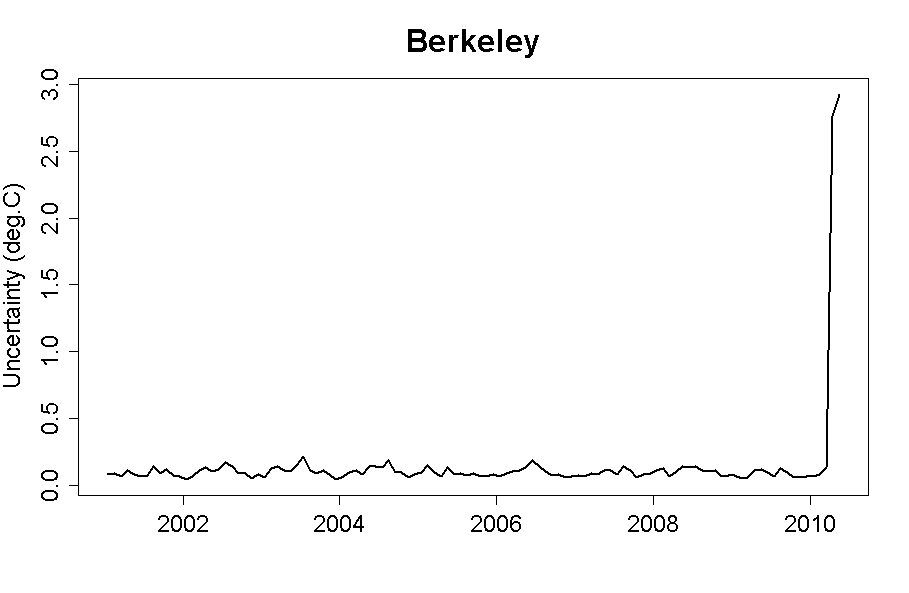
Was there really such a large temperature drop and rise between March and May 2010? It doesn't show up in any other surface temperature record.  When we examine the BEST data, the problem is immediately apparent. The uncertainty levels in April and May 2010 are 2.8 °C and 2.9 °C, respectively.  Going back to January 2001, the next-largest uncertainty level is 0.21 °C, and the average uncertainty is less than 0.1 °C. Tamino plots the monthly data hockey stick-like uncertainties (Figure 3).
BEST uncertainty
Figure 3. BEST monthly uncertainties since 2001, with a huge spike in April and May 2010.
So what happened with the April and May 2010 data?  While the March 2010 anomaly was based on 14,488 stations, April and May were based on only 47 stations, all in the Antarctic (h/t Nick Stokes). In other words, April and May 2010 should be excluded from BEST data analysis because they are incomplete, their uncertainties are just too large, and April 2010 is quite obviously an anomalous outlier. Frankly they should not have been published in their current state.
Figure 4 shows how the short-term trend changes when we exclude those two unreliable data points.
hiding the incline
Figure 4. BEST data and linear trend since January 2001 including and excluding April and May 2010.
The BEST linear trend increases from 0.03 °C per decade when including the faulty data points, to 0.14 °C per decade when they are excluded. It's also important to remember that according to NOAA, which is the dataset most similar to BEST, 2010 was the second-hottest year on record over land (behind 2007), and the hottest globally (effectively tied with 2005).  Ironically, the analysis the "skeptics" are using to argue that global warming has stopped ends in a record hot year for global surface temperatures.
In short, the problem is not that Muller is hiding the decline, the problem is that Curry is hiding the incline.

Enough Cherrypicking Already

As we have recently discussed, although we can't say for certain statistically, it's likely that the global surface temperature warming trend has slowed over the past decade, because virtually all short-term temperature impacts have been in the cooling direction over that timeframe. Climate "skeptics" desperately want us to believe that the trend has slowed because global warming has magically disappeared, but that's simply not the case. In fact, as Santer et al. (2011) showed:
"Because of the pronounced effect of interannual noise on decadal trends, a multi-model ensemble of anthropogenically-forced simulations displays many 10-year periods with little warming. A single decade of observational TLT data is therefore inadequate for identifying a slowly evolving anthropogenic warming signal. Our results show that temperature records of at least 17 years in length are required for identifying human effects on global-mean tropospheric temperature."
Although the Santer et al. analysis applied to the temperature of the lower atmosphere, the same argument applies to surface temperatures. Figure 5 shows the BEST trend from March 1993 to March 2010 (the most recent 17-year period available in the data, excluding the two final unreliable points).
BEST 17 year
Figure 5. BEST most recent 17 years of data with linear trend.
Over the most recent 17-year period, the BEST trend is 0.36 °C per decade*, clearly showing the anthropogenic warming trend over that period. 
Examining the causes of decadal variability is both interesting as useful, but exploiting decadal variability to try and incorrectly argue that global warming has magically stopped is neither. And of course those who argue that global warming has magically stopped conveniently ignore the continued increase in ocean heat content (Figure 6).
warming
Figure 6. Total Global Heat Content from Church et al. (2011).
"my statement to Rose was about the plot with the 10-year running mean ending in 2006 being misleading. It is misleading."
As it so happens, most of the BEST graphs include 12-month running means (i.e., see their research papers). Moreover, how plotting a 10-year running mean is automatically "misleading" is a mystery (unexplained by Curry), and Curry's accusations of deception remain unsupported, unwarranted, and unwise.
Accusing other scientists (especially one's colleagues) of deceit for doing proper statistical analysis is simply unconscionable, and why Curry would accuse others of "hiding the decline" while herself hiding the incline is a mystery. On  her blog, Curry complains that the article misrepresented her to some degree (while standing behind some of her worst comments, and acknowledging that the quotes attributed to her in the article are correct), but frankly when dealing with fake skeptics like those at The Daily Mail, most of us know that misrepresentation is the norm. 
We conclude by offering Dr. Curry the same advice we recently offered Dr. Pielke: DNFTD (Do Not Feed The Delayers). In short, if an interviewer tries to "tease out" from you a quote about "hiding the decline," or some other denialist myth, don't let them.
===================
*There is probably a small contribution to this trend from the 1991 Mount Pinatubo eruption. The 15-year trend is 0.30 °C per decade, 16-year is 0.28 °C per decade, and 18-year is 0.41 °C per decade.

Pablo Campra et al., Surface temperature cooling trends and negative radiative forcing due to land use change toward greenhouse farming in southeastern Spain, J. Geophys. Res., 113 (2008)

Journal Geophysical Research, 113 (2008) D18109; doi:10.1029/2008JD009912

Surface temperature cooling trends and negative radiative forcing due to land use change toward greenhouse farming in southeastern Spain


Pablo Campra (Escuela Politécnica Superior, Universidad de Almeria, Almeria, Spain), Monica Garcia (Estación Experimental de Zonas Áridas (EEZA-CSIC), Almeria, Spain), Yolanda Canton (Departamento de Edafología y Química Agrícola, Universidad de Almeria, Almeria, Spain), and Alicia Palacios-Orueta (Escuela Técnica Superior de Ingenieros de Montes, Universidad Politecnica de Madrid, Madrid, Spain)

Received 4 February 2008; revised 15 May 2008; accepted 24 June 2008; published 23 September 2008.

Abstract

Greenhouse horticulture has experienced in recent decades a dramatic spatial expansion in the semiarid province of Almeria, in southeastern (SE) Spain, reaching a continuous area of 26,000 ha in 2007, the widest greenhouse area in the world. A significant surface air temperature trend of –0.3 C/decade in this area during the period 1983–2006 is first time reported here. This local cooling trend shows no correlation with Spanish regional and global warming trends. Radiative forcing (RF) is widely used to assess and compare the climate change mechanisms. Surface shortwave RF (SWRF) caused through clearing of pasture land for greenhouse farming development in this area is estimated here. We present the first empirical evidences to support the working hypothesis of the development of a localized forcing created by surface albedo change to explain the differences in temperature trends among stations either inside or far from this agricultural land. SWRF was estimated from satellite-retrieved surface albedo data and calculated shortwave outgoing fluxes associated with either uses of land under typical incoming solar radiation. Outgoing fluxes were calculated from Moderate Resolution Imaging Spectroradiometer (MODIS) surface reflectance data. A difference in mean annual surface albedo of +0.09 was measured comparing greenhouses surface to a typical pasture land. Strong negative forcing associated with land use change was estimated all year round, ranging from –5.0 W/m to –34.8 W/m, with a mean annual value of –19.8 W/m. According to our data of SWRF and local temperatures trends, recent development of greenhouse horticulture in this area may have masked local warming signals associated to greenhouse gases increase.

Citation: Campra, P., M. Garcia, Y. Canton, and A. Palacios-Orueta. (2008). Surface temperature cooling trends and negative radiative forcing due to land use change toward greenhouse farming in southeastern Spain, J. Geophys. Res., 113, D18109, doi: 10.1029/2008JD009912.

Link to complete article: http://www.ual.es/~pcampra/index_archivos/mypaper.pdf

Seth Borenstein, AP: UN IPCC Panel says wild weather worsening

APNewsbreak: Panel says wild weather worsens


WASHINGTON (AP) — Freakish weather disasters — from the sudden October snowstorm in the Northeast U.S. to the record floods in Thailand — are striking more often. And global warming is likely to spawn more similar weather extremes at a huge cost, says a draft summary of an international climate report obtained by The Associated Press.

The final draft of the report from a panel of the world's top climate scientists paints a wild future for a world already weary of weather catastrophes costing billions of dollars. The report says costs will rise and perhaps some locations will become "increasingly marginal as places to live."

The report from the Nobel Prize-winning Intergovernmental Panel on Climate Change will be issued in a few weeks, after a meeting in Uganda. It says there is at least a 2-in-3 probability that climate extremes have already worsened because of man-made greenhouse gases.

This marks a change in climate science from focusing on subtle changes in daily average temperatures to concentrating on the harder-to-analyze freak events that grab headlines, cause economic damage and kill people. The most recent bizarre weather extreme, the pre-Halloween snowstorm, is typical of the damage climate scientists warn will occur — but it's not typical of the events they tie to global warming.
Photo 1 of 4
FILE - In this Oct. 31, 2011, file photo, Thai residents carry their belongings along floods as they move to higher ground at Bangkok's Don Muang district, Thailand. Freakish weather, from this weekend's October snowstorm to the long-lasting drought in the US Southwest, is striking more often. And global warming should make future weather even weirder, a special international report says. (AP Photo/Aaron Favila, File)

"The extremes are a really noticeable aspect of climate change," said Jerry Meehl, senior scientist at the National Center for Atmospheric Research. "I think people realize that the extremes are where we are going to see a lot of the impacts of climate change."

The snow-bearing Nor'easter cannot be blamed on climate change and probably isn't the type of storm that will increase with global warming, four meteorologists and climate scientists said. They agree more study is needed. But experts on extreme storms have focused more closely on the increasing numbers of super-heavy rainstorms, not snow, NASA climate scientist Gavin Schmidt said.

The opposite kind of disaster — the drought in Texas and the Southwest U.S. — is also the type of event scientists are saying will happen more often as the world warms, said Schmidt and Meehl, who reviewed part of the climate panel report. No studies have specifically tied global warming to the drought, but it is consistent with computer models that indicate current climate trends will worsen existing droughts, Meehl said.

Studies also have predicted more intense monsoons with climate change. Warmer air can hold more water and puts more energy into weather systems, changing the dynamics of storms and where and how they hit.

Thailand is now coping with massive flooding from monsoonal rains that illustrate how climate is also interconnected with other manmade issues such as population and urban development, river management and sinking lands, Schmidt said. In fact, the report says that "for some climate extremes in many regions, the main driver for future increases in losses will be socioeconomic in nature" rather than greenhouse gases.

There's an 80% chance that the killer Russian heat wave of 2010 wouldn't have happened without the added push of global warming, according to a study published last week in the Proceedings of the National Academy of Sciences.

So while in the past the climate change panel, formed by the United Nations and World Meteorological Organization, has discussed extreme events in snippets in its report, this time the scientists are putting them all together. The report, which needs approval by diplomats at the mid-November meeting, tries to measure the confidence scientists have in their assessment of climate extremes both future and past.

Chris Field, one of the leaders of the climate change panel, said he and other authors won't comment because the report still is subject to change. The summary chapter of the report didn't detail which regions of the world might suffer extremes so severe as to leave them marginally habitable.

The report does say scientists are "virtually certain" — 99% — that the world will have more extreme spells of heat and fewer of cold. Heat waves could peak as much as 5 degrees hotter by mid-century and even 9 degrees hotter by the end of the century.

Weather Underground meteorology director Jeff Masters, who wasn't involved in the study, said in the United States from June to August this year, blistering heat set 2,703 daily high temperature records, compared with only 300 cold records during that period, making it the hottest summer in the U.S. since the Dust Bowl of 1936.

By the end of the century, the intense, single-day, heavy rainstorms that now typically happen only once every 20 years are likely to happen about twice a decade, the report says.
The report said hurricanes and other tropical cyclones — like 2005's Katrina — are likely to get stronger in wind speed, but won't increase in number and may actually decrease. 
Massachusetts Institute of Technology meteorology professor Kerry Emanuel, who studies climate's effects on hurricanes, disagrees and believes more of these intense storms will occur.

And global warming isn't the sole villain in future climate disasters, the climate report says. An even bigger problem will be the number of people — especially the poor — who live in harm's way.

University of Victoria climate scientist Andrew Weaver, who wasn't among the authors, said the report was written to be "so bland" that it may not matter to world leaders.

But Masters said the basics of the report seem to be proven true by what's happening every day. "In the U.S., this has been the weirdest weather year we've had for my 30 years, hands down. Certainly this October snowstorm fits in with it."


http://www.google.com/hostednews/ap/article/ALeqM5g_vRxk1x0gV6lh77pCUYvzfgPQMw?docId=13969a79a76544b5ba4cdaad78e0d14a